Imperialism
When Europeans first came to North America, they created new settlements called colonies. A colony is a territory of land that is controlled by another country. Up until the mid-1900s, many countries in Europe, Asia, and the Middle East claimed colonies around the globe. The earliest colonists in Canada came from France. They are the ancestors of most Francophone Canadians today.
Empiresare networks of colonies controlled by a single country, sometimes called the home country. Colonies had no independence, meaning that the people living in a colony did not have control of their political or economic affairs. Decisions about their future were usually made by the home country. This system of countries extending their control over other nations is called imperialism. For centuries, much of the world was ruled by imperial powers. It was within this framework that Canada became a country.
North America
Key
CONCEPT
▲
What kind of society did the French colonists create in their
North American colonies?
Chapter
INQUIRY
The French were not the only imperialists during this era. The British, the
Maps allow us to see and show many
different types of information about a particular place. The Skill Check feature on the next page will
take you through the steps to Analyze
Thematic Maps. Wherever you see
in this chapter, it is an opportunity to practise your new skill.
Honing
Your Skills
Think about what you already know about early French explorers, colonists, and the way of life in New France. Record your information in a chart like the one below. In the “Know” column, record everything you know, or think you know, about this topic. Then, in the “Wonder” column, record those things you would like to know. When you have finished this chapter, return to your chart. Check off the questions in the “Wonder” column that have been answered. Then summarize what you have learned in the “Learn” column.
Think
AHEAD
▲
New France
Know Wonder Learn
New France
In this chapter, we will investigate why France was interested in building a colony in North America. We’ll look at the journeys of some French explorers as they set out to claim new lands for France. In Chapter 1, you learned about the societies and economies of three different First Nations. In this chapter, you’ll look at these same aspects of New France.
T
hematic maps show specific types of detailed information (or themes) about a place. For example, a climate map might show precipitation patterns across a province. A historic map might use different colours or patterns to show the empires around the world in the past. Here are some guidelines for analyzing and interpreting thematic maps.Examine the Basics
Most maps contain a title, a directional symbol such as a compass rose, and a scale. The most important feature on a thematic map is the legend. Maps, especially thematic maps, contain different patterns, colours, and symbols. These are explained in the legend.
Interpret the Information
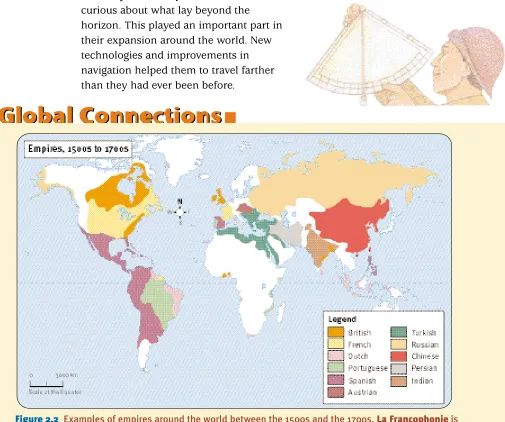
Use the legend to identify patterns on the map. Then ask yourself what the patterns mean. For example, the theme of the map in Figure 2.2 (page 35) is “empires around the world between the 1500s and the 1700s.” By studying the colour-coded legend and applying it to the map, we can see the following:
• Britain and Spain were in control of most of North America.
• France, Spain, Portugal, and the Netherlands controlled South America. • The Middle East and Northern Africa were mainly under the control of
the Turkish empire, while China and Russia were dominant in Asia. • The Dutch seemed to be mainly interested in coastal colonies in the
Southern Hemisphere.
• Russia controlled the largest area of land, while Spain had the largest number of colonies spread around the globe.
Communicate Your
Understanding
Use the information you have gathered to try to draw conclusions. Then think about the significance this information might have on the topic you are studying.
S
KILL
C
HECK
:
Analyze
Thematic Maps
Using GIS software or another online mapping program, create a thematic map of Canada. What are the two most important things a foreigner should know about Canada, in your opinion? Add two theme layers to your
map to show this information as well as a legend to explain the
colours or symbols used. You can see several
historical maps of New France, including two by Samuel de Champlain. Just open Chapter 2 on your
Voices and Visions
CD-ROM.
E
uropeans began arriving in the land we call Canada 1000 years ago. They were the Norse, who sailed fromScandinavia. In the 1400s, long after the Norse had left North America, sailors from Spain, Portugal, and possibly England crossed the Atlantic to catch fish off the shores of present-day Newfoundland and Labrador. These fishermen were followed by many other Europeans, who came across the ocean as explorers and colonists.
In this section, you’ll examine the different reasons why the imperial countries of Europe decided to cross the ocean to North America. You’ll see why they wanted to claim colonies here.
Looking for a New
Silk Road
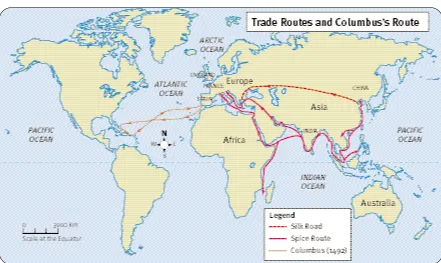
For centuries, the countries of Europe and Asia traded with one another. France, England, Spain, Portugal, and the
Netherlands looked to India, China, Japan, and Indonesia to obtain spices, tea, silk, porcelain, and precious gems.
To bring these goods home, the Europeans travelled a route known as the Silk Road. This long overland route crossed through Asia and Eastern Europe. The route was dangerous because ambush parties would often attack the traders. They would either steal the traders’ cargo or charge them a large payment, or “tax,” to pass through the territory. By the 1400s, the Europeans were eager to find another route to Asia, preferably a water route.
Why did explorers and colonists from Europe come to North America?
Focus
European Imperialism
Figure 2.1 European explorers were looking for a water route to Asia. Do you see a possible route? What disadvantages and challenges might this route pose?
Portugal led the search for a water route to the Far East, sending ships south around the tip of Africa as far as India. Soon after, Spain began looking for a route. In 1492, Queen Isabella sent Christopher Columbus west across the Atlantic.
More explorers followed in the wake of Columbus. Their voyages increased
European knowledge of and interest in the land across the ocean.
Expanding Across
the Ocean
Why did the imperial countries of Europe want to expand their empires?
• Economics.Europeans set up colonies so they could claim the resources of the land for themselves. In the country we now call Canada, the resource the Europeans valued most was fur. In Europe, there was a fashion craze for beaver hats and fur coats. Since the beaver had been hunted to extinction in Europe, the Europeans looked to North America for more. • Competition.The countries of Europe
were often at war with one another as they competed for land and resources. The more colonies a country controlled, the more power and prestige it had. Colonies supplied their home countries with resources such as timber and iron ore. These were used to build up European armies and navies.
Global Connections
1. You are a French explorer in the 1500s. Write a diary entry in which you explain why you feel it is a good idea to sail to North America and set up a colony there. Point out the ways in which the colony will benefit the home country as well as the colonists who move there.
2. Think about what you learned in Chapter 1. In a chart, outline the arguments the First Nations might have made for and against the Europeans coming to North America.
Think It
Through
▲
Figure 2.2 Examples of empires around the world between the 1500s and the 1700s. La Francophonieis an organization of all the countries around the world today where French is the people’s first language or is the official (or main) language. Do some research in an atlas or on the Internet to find all the current member countries. Then, on a tracing of this map, mark these countries with a symbol. How do the two maps compare?
Many imperial countries used to claim colonies around the world. Once a land was claimed, its resources and original inhabitants were
controlled by the home country. How do you
think the people who lived in the lands that were colonized felt about being told what to do by a foreign power? How would you feel if this happened in Canada today?
Global Connections
• Curiosity.The Europeans were alsoF
rance entered the race to find an ocean passage to Asia in the mid-1500s. The king, François I, was determined that his people should find a route before the othercountries of Europe. The French decided to start their search by exploring North America.
This section looks at some of the reasons the French continued to come back to North America and eventually built colonies here.
Cartier Crosses the
Atlantic
The king of France sent a French sea captain named Jacques Cartier to find a passage through North America to Asia. In 1534, Cartier set out across the Atlantic with two ships. After 20 days at sea, he arrived off the coast of Newfoundland. Sailing around the north end of the island,
Cartier entered a broad inland sea—the Gulf of St. Lawrence.
One day, Cartier and his men were exploring along the shore. They came across a group of Mi’kmaq [MIG-mah] paddling in their canoes. Can you imagine how the Mi’kmaq reacted upon
encountering Cartier and his crew? The boat would have been larger than any they had seen before. The style of clothing and the language of the men on board would have been unfamiliar to them as well. In his journal, Cartier wrote about what happened next from his point of view:
This is the first known written account of trade between the Europeans and First Nations peoples. What things in this account suggest that the Mi’kmaq had traded before? With whom do you think they might have traded?
France Takes an Interest in North America
Why did the French decide to
explore North America and build colonies here?
Focus
Figure 2.3 Mi’kmaq rock drawing showing sailors on board a European ship. The Mi’kmaq had a rich oral culture to pass along information. They also made drawings on rocks, called
petroglyphs, to record events and information. Why do you think these old petroglyphs are considered so important today?
A large number of people … set up a great
clamour and made frequent signs to us to
come on shore, holding up to us some skins
on sticks….
We likewise made signs to them
that we wished them no harm, and sent
two men ashore to offer them some knives
and other iron goods and a red hat to give
to their chief….
They bartered all they had, to
such an extent that all went back naked
… and they made signs to us that they
would return on the morrow with more
skins.
Source: Ramsay Cook, ed., The Voyages of Jacques Cartier
The Challenges of
Settlement
In July 1534, Cartier landed at a place he called Gaspé. There, he met a First Nations
people called the Haudenosaunee [hah-duh-nuh-SAH-nee] and their leader, a man named Donnacona. They had travelled from their home farther up the St. Lawrence River to fish in the region we know as the Gaspé Peninsula.
After this meeting, Cartier took two of Donnacona’s sons, Taignoagny and Domagaya, on board his ship. He sailed with them back to France to prove to the king what he had found. In 1535, Cartier
returned to North America with three ships and 110 men. He brought Donnacona’s sons
back with him. They guided the French up the St. Lawrence River, deeper into the continent. They went as far as Stadacona, where Donnacona and his people lived.
Cartier and his crew decided to stay the winter. They built a small log fort near Stadacona. However, they did not have enough fresh fruit and vegetables. Many of the crew became ill and died from scurvy, a disease brought on by a lack of vitamin C. But the Haudenosaunee had a cure for scurvy. They
taught the French how to make the tea cure by boiling pieces of white cedar.
Without their help, Cartier and the rest of his men may not have survived the winter.
The Haudenosaunee had lived in the Great Lakes– St. Lawrence Lowlands since time immemorial. They controlled travel along the river and governed the surrounding lands. However, when Cartier arrived at Gaspé, he and his men raised a large wooden cross. He wrote across the top, Vive le Roi de France!— Long Live the King of France!
In his journal, Cartier described how Donnacona reacted to the cross:
When we had returned to our ships, the captain [Donnacona], dressed in an old black bear skin, arrived in a canoe with three of his sons and his brother. … Pointing to the cross, he made us a long harangue, making the sign of the cross with his two fingers; and then he pointed to the land all around, as if to say that all this region belonged to him, and that we ought not to have set up this cross without his permission.
Source: H.P. Biggar, ed., The Voyages of Jacques Cartier
(Ottawa: Public Archives of Canada, 1924), p. 65.
Figure 2.4 A painting of Cartier raising the cross for France at Gaspé, by Charles Walter Simpson, 1927. In those days, it was typical for European explorers to claim lands they visited on their travels. Judging by this encounter, what issue do you predict may develop between the First Nations peoples and the Europeans who will eventually come to live in North America?
“
“
V
OICES
V
OICES
Look in Chapter 2 on the Voices and VisionsCD-ROM to compare two different paintings showing the meeting of Cartier and the Haudenosaunee.
Tech Link
Look under the Videos section of Chapter 2 on the
Voices and Visions
CD-ROM to see a First Nations person making cedar tea.
Land of Riches
The Haudenosaunee told Cartier about a land northeast of their village where there were fruit trees, metals, and gems. In the spring of 1536, Cartier forcibly took
Donnacona and nine other villagers back to Europe. He did this so that they could tell the king about the riches in North America. Cartier hoped this information would convince the king to pay for another cross-Atlantic trip.
Cartier Visits Again
Cartier returned to North America in 1542. He planned to set up a colony
along the St. Lawrence River. By this time, all but one of the
Haudenosaunee Cartier had taken across the ocean had died in Europe. Cartier told the Haudenosaunee that the people he took were well and living in Europe. However, written historical accounts say they didn’t believe him. As a result, the Haudenosaunee were hostile toward the French.
After another terrible winter, the French colonists decided to return to Europe. Cartier took samples of what he believed were gold and diamonds with him. But it turned out they were worthless pyrite (fool’s gold) and quartz. Although he was not able to establish a permanent colony in North America, Cartier did succeed in gathering a great deal of important information about the land across the ocean.
1. Think about why Cartier’s explorations in North America were important for France. What did he accomplish? Create a web diagram to illustrate your answer. 2. With a partner, role-play the encounter
between Cartier and Donnacona as Cartier
raised the cross at Gaspé. Try to express why Cartier felt justified in raising the cross and why Donnacona felt justified in objecting. (You may want to refer to Skill Check: Research and Perform a Role Play on page 268 before beginning.)
Think It
Through
▲
Figure 2.6 The routes followed by Jacques Cartier on three of his trips to the St. Lawrence. How do historians know Cartier travelled these particular routes? Where might they have found supporting historical evidence?
J
acques Cartier’s settlement on the St. Lawrence River had failed, but the French did not forget about North America completely. Fishing fleets still came to theNorth Atlantic each year. Fur traders still came to trade with First Nations trappers. In this section, you’ll learn how France began to build North American colonies at Acadia and Québec. You’ll see why the explorer
Champlain and some First Nations forged alliances, and you’ll investigate the impact these alliances had on the colonies.
The French Return
By the early 1600s, the demand for furs in Europe was growing. The French king, Louis XIII, decided that France should build a colony in North America. Then they would have access to the abundant supply of furs.
Another reason the French returned to North America was that Louis XIII wanted to
be the most powerful ruler in Europe. To reach his goal, he needed to expand France’s colonial empire. Resources from the colonies would give France a military advantage over its imperial rivals.
The king knew that a colony so far from home would be expensive for him to build and support. So he decided to let someone else pay for it. The king granted a trade monopolyto a group of merchants. This meant that only the merchants within the group would be allowed to trade for furs in the colony. In return, the merchants agreed to build settlements in North America and find French citizens to live in them.
The French in Acadia
In 1604, a French noble named Pierre de Monts received a monopoly. He sailed to North America to set up a colony. He took a map-maker and explorer named Samuel de Champlain with him. In the spring of 1605, de Monts established a settlement at Port Royal on the Bay of Fundy. The French called the area Acadia. It was from the Greek word Arcadia, meaning “an earthly paradise.”
At first, the Mi’kmaq who lived there did not object to the newcomers. The French did not interfere with their fishing and hunting activities, and the Mi’kmaq welcomed the chance to trade their furs for metal goods and blankets. The Mi’kmaq were willing to share the land as long as they had access to it.
In time, more and more French people came to Acadia. Although life was hard, it was no harder than it had been back in France. Acadia offered poor farmers from France an opportunity to make a new start.
France Expands Its Empire
How were the first permanent French colonies established in North America?
Focus
The colonists spread out along the shores of the Bay of Fundy. They survived through farming, fishing, and hunting. These French pioneers formed a unique community and culture. They were the first Acadians.
The Founding of Québec
Port Royal was a long way from the centre of the fur trade, so de Monts and Champlain decided to move to the St. Lawrence River. They chose a site near Stadacona, where Jacques Cartier had built a fort many years earlier.
The French colonists called their settlement Québec. The name came from an Algonquin [al-GONG-kwin] word meaning “the place where the river narrows.” It was an ideal place to trade furs, as
Figure 2.8 shows. However, living conditions were far from ideal for the colonists. During their first winter, 20 of the 28 newcomers died due to the weather and lack of food.
The Voices and VisionsCD-ROM contains an image
of the original plan for Québec. Look at the image,
and explain how security issues influenced the plan.
Tech Link
Figure 2.9 Annual temperatures and precipitation in Paris, France, and Québec. The lines show temperature while the bars show precipitation. Compare these two graphs. How do they explain one of the reasons why Champlain and his men had such a difficult time surviving in New France? Figure 2.8 Locations of French settlements and exploration routes. From the east, ships from France could bring supplies to Québec. From the west, canoes could travel from the interior, bringing furs. As a result of the fur trade, strong partnerships developed between the First Nations and the French. Why was water transportation so important in those days? You can see a
video re-enactment of the hard work of the wood artisans who helped build New France. Just open Chapter 2 on your Voices and VisionsCD-ROM.
Samuel de Champlain (1567–1635)
Samuel de Champlain worked to build the colony at Québec and to develop the fur trade. He lived in Québec for 27 years. During that time, he returned to France eight times to
persuade the king to send more French colonists and to provide greater support for the settlement.
At the same time, Champlain built alliances with the Montagnais [MON-tun-yay] and
Algonquin First Nations. He travelled the rivers into the interior. When he reached the Great Lakes, he established a friendship with the Wendat [WAH-n-dot] (also known as Huron) who lived in what is now Central Ontario.
Champlain wanted to trade with the Wendat. He agreed to fight with them against their enemies, the Haudenosaunee. The French and the Haudenosaunee had been enemies since Jacques Cartier’s encounter with them years before. The two First Nations raided one another to obtain furs and to take revenge for relatives who had died in earlier conflicts. By siding with
the Wendat, Champlain fuelled a conflict that would last for another 100 years. It would make life insecure and unstable for all sides.
Champlain died at Québec on Christmas Day in 1635. At that time, Québec was still a struggling settlement with just a few dozen people. In time, though, the colony began to flourish. Champlain came to be known as the founder of New France.
Biography
Biography
Figure 2.10 A self-portrait by Champlain. This is the only picture of Champlain that dates from his lifetime. It shows him firing his gun at a group of
Haudenosaunee during a battle. Is this a primary source image or a secondary source image? Give reasons for your choice.
Think It
Through
▲
1. Examine the painting at the beginning of this chapter (pages 30–31). It shows early Acadians. Describe the details of the scene to get a better idea of the Acadian way of life. Consider clothing, tools, farming techniques, roles of men/women, and so on. 2. a) Working in a small group, brainstorm a
list of challenges the French faced as they tried to build the colonies. Prepare a list of arguments to justify France spending more money on the colony. Then prepare a list of arguments to justify France not spending more money.
b) Write one of the following letters: • Imagine you are Samuel de
Champlain. Write a letter to the king of France asking him to send more colonists to Québec.
• Imagine you are the king. Write a letter to Champlain explaining why you cannot fulfill his request. 3. Create a chart like the one below in which
you outline both the positive and negative economic aspects of the colonies from the perspective of each of the people listed.
Positive Negative The king
A French colonist
A
side from the official explorers, the first people to leave the settlements of New France and begin roaming the countryside were the coureurs de bois(in English, “runners of the woods”).In this section, you’ll investigate how these adventurers and the First Nations built the fur trade. You’ll see why they pushed farther west and south into the continent. As you read about their explorations, you’ll analyze how European ideas of land ownership caused conflict between them and the First Nations peoples.
The Coureurs de Bois
The coureurs de bois were a unique group of adventurers. They lived for long periods among the First Nations. In fact, many coureurs de bois married First Nations women, and these couples became parents to the first Métis [may-TEE]. The coureurs de bois learned to speak the First Nations’ languages and how to build birchbark canoes. They also learned many of the other skills they needed to survive in the woods.
Many of the young French men who became coureurs de bois were lured into the fur trade by the promise of adventure,
freedom, and money. Their main interest was fur trapping, but they also acted as guides and interpreters for the French traders. In this way, they were responsible for much of the early European exploration of the continent.
Cultural Exchange ...
Even Then
A young French colonist named Étienne Brûlé was one of the first coureurs de bois. In 1610, the French and the Wendat agreed to a
cultural exchange. Brûlé went to live with the Wendat. A young Wendat man named
Savignon went to live in France. Brûlé wanted to learn as much as possible about the Wendat. During his years living with them, he gained an appreciation for the Wendat way of life. He learned to speak their language. He practised their customs. Brûlé travelled with the Wendat hunters and came to know their territory. He was the first European to travel up the Ottawa River and into Georgian Bay.
Things did not go as well for Savignon in France. He learned to speak French, but he was eager to return to North America. When he did, Savignon described France as a place where children were treated badly. He described beggars living in the streets, arguing loudly with one another.
Exploring Deeper into the Continent
What did the early French explorers in New France achieve?
Focus
Expanding West
Two of the most adventurous coureurs de bois were Pierre Radisson and his brother-in-law, the Sieur des Groseilliers. Radisson came
to New France in 1650 as a boy. When he was a teenager, a group of Mohawk took him to their home and adopted him into their family. For two years, Radisson lived among the Mohawk before deciding to return to Québec.
During the time he lived with the Mohawk, Radisson learned to speak their language and survive in the woods. It seemed only natural that he would become a coureur de bois. In 1659, he joined des Groseilliers on a trading trip. It took them deep inland to the far end of Lake Superior. No Europeans had ever been there before. Everywhere they went, the First Nations people welcomed them. Their knowledge of the fur country grew. As they travelled, they gave French names to some of the settlements, lakes, rivers, mountains, and other landforms they encountered. In this way, they claimed these lands for France.
In 1670, Radisson and des Groseilliers travelled to Hudson Bay because First Nations people had told them the land was rich in fur-bearing animals. Later the same year, a fur-trading business called the Hudson’s Bay Company was founded as a result of the accomplishments of these two explorers.
Figure 2.12 A painting of Radisson and des Groseilliers (Radisson is standing), by Frederick Remington, 1905. Because the coureurs de bois lived with First Nations peoples, each side learned about the other’s culture. How can this type of cultural exchange affect the relationship between peoples?
Visuals, such as photos, diagrams, and maps, often help us better understand the text we are reading. For the section of text on the next page titled “Expanding South,” use the map in Figure 2.13 to see the route the explorers took and the land they claimed.
Expanding South []
For many years, the French heard the First Nations talk about a mighty river beyond the Great Lakes that flowed into the south. In the Cree (Nehiyawak [nay-HI-uh-wuk]) language, the river was called the Mississippi—the “big river.” In 1672, the king of France sent two explorers, Louis Jolliet and Jacques Marquette, to find out where this mysterious river
flowed. Would it take them south to the Gulf of Mexico or west to the Pacific Ocean?
After several weeks of canoeing, they learned that there was a Spanish colony only a few days’ journey away. Worried that the Spanish might take them hostage, Jolliet and Marquette turned back. They had travelled a long way and learned that the river emptied into the Gulf of Mexico. But they still had not reached the mouth of the mighty Mississippi.
In 1682, a French fur trader named René Robert Cavelier de la Salle finally reached the mouth of the Mississippi River at the Gulf of Mexico. Due to his expedition, France claimed ownership of all of the Mississippi country. They called it Louisiana, after the French king Louis XIV.
Different Perspectives
about Land ]
Like people from the other imperial countries of Europe, the French claimed “ownership” of the territories they explored. They did not discuss land ownership with the First Nations or Inuit. They did not understand that the First Nations had a different idea about land. Although a First Nation granted certain bands or families the right to hunt and fish in a territory, no one owned land privately. First Nations believed land was to be shared by everyone.
While France claimed a vast territory, most colonists remained clustered along the St. Lawrence River. First Nations people lived in other parts of the colony. To gain control of the territory, France needed more colonists. It wasn’t easy to persuade people to come to New France, though. The climate was much colder than it was in France. Also, it was hard to start a farm in the wilderness. As a result, the population in the colony grew slowly.
1. a) Make a colourful poster to show the accomplishments of a French explorer. Your poster should include
• images of the explorer
• a map(s) and/or photos showing the areas explored
• an explanation of the challenges faced and the person’s contributions to the growth of the colony
• any other biographical information you can find at the library or online b) In your opinion, how important was this
person’s exploration to the future development of Canada?
2. The French claimed a great deal of land in North America, but there were not enough
people to occupy it.
a) Come up with at least two possible solutions to this problem. Create a table to show the advantages and disadvantages of each solution.
b) Choose the solution you feel is the best one. Explain your choice.
3. Outline in writing, orally, or using a visual illustration the differing perspectives that the First Nations and the Europeans had on the idea of land ownership.
4. Why do you think the First Nations helped the French survive in the wilderness? Write a scenario predicting what might have happened if the First Nations had not helped the French.
Think It
Through
I
n this section, you’ll investigate how the king of France increased thepopulation of the colony. You’ll analyze the tensions between the French and some First Nations. You’ll examine the role of religion and the Catholic Church in
building the colony. Finally, you’ll investigate the way of life that was evolving in New France.
The Royal Takeover []
As a colony, New France depended on France for its survival. It relied on the home country for colonists, supplies, and military protection. In return, New France supplied resources such as furs and fish. The colony
made France richer and more powerful, which were the aims of imperialism.
In the early days of New France, however, this system was not working well. To the merchants who ran it, New France was simply a place to trade for furs. They had little interest in building settlements. As a result, few people wanted to move there, and the colony failed to prosper.
In 1663, King Louis XIV took control of the colony from the merchants. He set up a Sovereign Council to govern the colony. This council was made up of appointed councillors and three key officials.
• Governor.The most powerful member of the Sovereign Council was the governor. The governor, who was the King’s personal representative, was usually an army officer and a noble. He took charge of the defence of the colony and of its relations with allies and enemies. • Intendant.The second-most important
official was the intendant. The intendant was in charge of the day-to-day affairs of the colony. For example, he supervised the courts, saw that roads were built and that settlers were looked after, and managed the economy.
How did the king of France and the Catholic Church influence the development of New France?
Focus
Figure 2.14 King Louis XIV of France. Louis was known as the Sun King because he was all-powerful. Louis was so forceful in acquiring colonies that the other countries of Europe united against him. Why would it have been important to the king for New France to thrive?
Year Population
1608 28 1641 240 1653 2 000 1667 3 918 1680 9 677 1685 10 725 1692 12 431 1698 15 355
Economy and Government in New France
Figure 2.16 A weekly session of the Sovereign Council, by Charles Huot, 1929. The governor is seated in the tall chair. The bishop is to the left. The intendant is to the right. Other members of the Council were appointed from among the most important merchants and nobles in the colony. Was this seventeenth-century government democratic? Explain.
The first intendant in New France was Jean Talon. On the king’s orders, Talon brought newcomers from France to live in the colony. He talked with colonists to find out what they needed to improve their lives. He started shipbuilding and fishing industries, and built factories and roads. • Bishop.The head of the church in the
colony was the bishop. As a member of the Sovereign Council, he played a leading role in politics as well. The first bishop, François de Laval, opened a seminary in Québec to train priests; it later became Laval University.
The royal government paid the colony’s expenses, so taxes were lower than they were in France. The government of New France was all-powerful, and the colonists had to follow the rules and laws established by the Sovereign Council. However, the courts heard complaints filed by the colonists. Overall, the people enjoyed greater freedom in New France than they had back in France.
A distinctive Francophone society developed. The colonists were expected to be responsible, contributing members. In this way, they became the citizens of New France.
CASE
STUDY
Interactions with the First Nations
What impact did the First Nations have on the French newcomers? The
habitants[a-bee-TAH(N)], who were the farmers of New France, admired many
things in the First Nations’ cultures. They adopted some of their skills and technologies. For example, they learned to line their winter coats and mittens with fur and to make boots out of moose hides to keep warm during the long, cold winters.
However, not all interaction between the First Nations and the habitants was peaceful. From the early days of the fur trade, the French and the Wendat
were allies. Farther south, the British and the Haudenosaunee were allies. France and England were often at war in Europe. Sometimes, these conflicts spilled over into North America. For decades, the people of New France lived under the threat of attack by the British or the Haudenosaunee.
In the 1600s, the people of New France and the Haudenosaunee lived in the same territory in the St. Lawrence River Valley. Often, the habitants were afraid to venture beyond their villages. Their lives were at risk when they were simply working in the fields or hunting in the forests. For their safety, the habitants would often arm
themselves when doing chores like gathering firewood. The hostilities between the people of New France and the
Haudenosaunee convinced many people in France not to move to the colony. The habitants needed help. Intendant Jean Talon wrote to the king asking for military protection. The king sent 1500 soldiers to New France. The soldiers burned down Haudenosaunee homes and villages. The Haudenosaunee seemed to be overpowered and agreed to sign a peace treaty with the French.
Why do you think the French decided to use military force against the Haudenosaunee? Would such a solution be acceptable in Canada today? Explain.
Respond
The Catholic Church
in New France
Religion had an important place in the lives of the Europeans. In France, most people were Catholic. Therefore, almost all the colonists in New France were Catholic, too.
Priests, nuns, and missionaries who went to New France helped build the colony. They held religious services, taught school, ran hospitals, and cared for the poor. The colonists supported the Church and its activities by donating a portion of their income, called a tithe.
The most important goal of the Church was to spread the Catholic faith. The
missionaries came to North America to convert First Nations peoples to their religion. The village of Ville-Marie was founded as a place where missionaries could do this. Today, we know this place as Montréal.
Many of the missionaries were
centuries and are an important source of historical information about that time. For example, a series of journals called the
Jesuit Relationswere written by a special order of missionaries. The Jesuits, who started arriving in New France in 1625, wrote mainly about their work and travels. They sent their journals back to France, where they were published. The following is an excerpt from the Jesuit Relations. In it, a Jesuit missionary described the conversion of some Wendat children and their parents to the Catholic faith.
Populating the Colony
Aside from nuns, few French women were interested in living in New France. It was far from home, and life there was very harsh. But the colony needed women to marry the male colonists and raise families. Without them, New France would fail to grow and prosper.
The king had a solution. Between 1665 and 1673, he sent about 900 single young women and girls to New France to become wives. Some of the women were orphans. Others were poor. If they married, the king gave each couple an ox, a cow, two pigs, two chickens, some salt beef, and a purse of money. The women were known as the
filles du roi—the “king’s daughters.”
Within 14 years, the population of New France grew from 3200 to 10 000. After 1680, there were few newcomers from France. These 10 000 colonists are therefore the ancestors of most Canadians of French descent—the original Canadiens.
Women in New France []
The family was the centre of daily life in New France. Women worked very hard alongside their husbands in the fields. They also cared for their homes and children and helped manage the family finances.
Girls in New France received a better education than they did in France. The daughters of wealthier families went to boarding schools in the towns. Other families sent their daughters to schools
In our Processions we had the little children march before
the Cross, and perform some service, such as carrying the
lights, or other things. Both they and their fathers take
pleasure in this …. Thank God this much has already
been accomplished, that they do not wish to die without
baptism, believing that they will be forever miserable, if
they pass away without it, or at least a strong desire for
it, and without sorrow for their sins.
Figure 2.17 A statue of Marguerite Bourgeoys, by sculptor Jules LaSalle, 1988. When she arrived in Ville-Marie in 1653, there were only 200 inhabitants. There was no school, so Bourgeoys took over a stone stable and began to teach girls such things as cooking, sewing, reading, and writing. Why do you think this was important?
in the countryside. The nuns operated the schools and taught the children how to read
and write as well as how to do domestic chores. Since there were more schools for girls than for boys in the colony, girls often received a better education.
Many children had a greater opportunity to attend school than children in France did. In France, many children were sent to the cities at a young age to learn a trade. Therefore, they never attended school. In New France, though, most children stayed with their families so they could help on the farm. This gave them the chance to go to school when planting and harvesting were finished.
The Economy of New France
There was more to the economy of New France than the fur trade. Most of the French colonists were farmers.
The social structure of New France was based on the seigneurial system. In
this system, the king gave large tracts of land along the St. Lawrence River to the nobles, called seigneurs. In return, each seigneur had to find colonists to settle the land. These colonists, known as habitants, rented strips of land from the seigneur and set up farms. The river was used for travel and irrigation. Both seigneurs and habitants had duties to each other that were protected by law. For example, each habitant had to give the seigneur a portion of each year’s crop and pay other fees. The seigneur had to build a mill and a church on his land.
Figure 2.18 The filles du roi arriving in New France, as painted by C.W. Jefferys about 1940. Girls were usually quite young when they married, anywhere from 12 to 16 years old. Imagine you were a young French person who was shipped across the ocean without any family. What would be your greatest fear about coming to New France? What would be your greatest hope?
Pierre Boucher came to live in New France in 1635. For many years, he lived among the Wendat. Later, he settled on a farm near the village of Trois-Rivières. Boucher published a book about life in New France in 1664. In it, he described the kind of people who made the most successful settlers in the colony.
The people best fitted for this country are those who can work with their own hands in making clearings, putting up buildings and otherwise. …
Poor people would be much better off here than they are in France, provided they are not lazy; they could not fail to get employment and could not say, as they do in France, that they are obliged to beg for their living because they cannot find anyone to give them work; in one word, no people are wanted, either men or women, who cannot turn their hands to some work, unless they are very rich.
Source: Pierre Boucher, True and Genuine Description of New France, 1664; reprinted in English in 1883 as Canada in the Seventeenth Century
(Montréal: GE Desbarats, 1883).
“
”
V
OICES
V
OICES
Look on the Voices and VisionsCD-ROM to see a map of the extent of the
seigneuries in New France.
Farming is still important in Québec today. About 7 per cent of the province’s total land area is farmland. Most of this land is located along the St. Lawrence River where the first French colonists settled.
Figure 2.19 The seigneurial system was officially abolished in 1854, and tenants were able to start purchasing the farmland rather than rent it. This is a modern photo of the St. Lawrence River. Even though the system no longer exists, can you see its lasting impact on the landscape?
The king knew the seigneurial system would encourage settlement in New France. If a seigneur did not find tenants to farm his land, he would not make any money. The seigneurial system became the model for settlement throughout New France.
The French: Forging the
Foundations of Canada
The citizens of New France had a much different life than they would have had if
they had stayed in France. They had more food and better houses than people in the home country did. As well as being pioneers in the fur trade, they were explorers of the interior as far west as the plains and as far south as the Gulf of Mexico. The French colonists became a self-reliant people with a unique way of life that was distinct from that of France. Through hard work and perseverance, the citizens of New France laid the foundations of Canada.
1. Create a chart to show all the ways in which life in New France was different from life in France. How do you think these differences influenced the colonists’ views of their relationship to France?
2. Create a web diagram to show how each of the following contributed to the building of New France:
• Louis XIV • the Jesuits • Jean Talon • the nuns • the First Nations • the filles du roi • the Catholic Church • the habitants
3. Return to the K-W-L chart you started at the beginning of this chapter.
a) Check off the questions in the “Wonder” column that have been answered.
b) Summarize what you have learned in the “Learn” column.
4. The French were the first permanent colonists here. As a class, discuss the impact of this fact on the development of the Canadian society we know today.
Think It
Through
D
ramas can help us to understand and appreciate a historical event and the motives of the people involved. A tableau is a type of drama that can both entertain and inform us.Tableauis a French word meaning a painting. It is a scene created when actors dramatize an event without moving or speaking. Imagine watching a DVD movie and pressing the pause button during a scene. The image that is frozen on the screen is a tableau.
Tableaux can be performed in a series to show a sequence of events. To signal a new tableau, the stage lighting is dimmed to allow the actors to rearrange themselves for the next scene.
Selecting Scenes
In a small group, select an event from this chapter that would make good tableaux. Think about why this event is important and why it would make a good drama. For example, the first meeting of French explorers and First Nations peoples would make effective tableaux.
Once your group has decided what scene to present, think about how the event can be presented from different points of view. For example, how would the French have viewed the event? How would the First Nations have viewed it? Women? The king? Create a tableau for each point of view.
Designing the Tableaux
Once you have the characters for the tableaux, write a description of the scene from each character’s point of view. Identify the props that will be needed. Keep these simple. For example, a paddle or a paper hat may be sufficient to
identify certain characters. Avoid stereotypes, and be respectful of the groups and cultures you represent. Include a rough sketch of each scene.
Rehearsing the Tableaux
• Decide who will play each character. Select one person to be the technician who controls the lights during your presentation.
• Practise each scene. Actors should have a frozen body position and facial expression. • Take turns looking at the others in their frozen
positions. Suggest changes that might improve the drama or express emotions more clearly. • Practise changing from one tableau to the next
until you are able to make these changes quickly and easily. Hold a final practice, turning out the lights to provide the transition from scene to scene.
The Audience’s Role
While you are watching other groups’ tableaux, write down the historic events you think they are presenting. Remember to be a polite and attentive audience. Don’t interrupt the presentations, and applaud when a presentation is over.
As you watch the tableaux, think of any questions you have about the scene. Then raise your questions following the presentation.
Metacognition: Reflecting
Recall your original ideas and points of view on contact, imperialism, and colonization. Once all groups have presented their tableaux, discuss how the dramatization has affected your views. Have you changed your thinking on any of the topics presented? Explain.