ISSN 2324-805X E-ISSN 2324-8068 Published by Redfame Publishing URL: http://jets.redfame.com
The Examination of Competencies in Master‘s Degree Programs in the
Context of Lifelong Learning Key Competencies
İbrahim Tuncel
Correspondence: İbrahim Tuncel, Pamukkale University, Faculty of Education, Department of Educational Sciences, Denizli-Turkey.
Received: January 6, 2019 Accepted: February 11, 2019 Online Published: February 15, 2019 doi:10.11114/jets.v7i3.3942 URL: https://doi.org/10.11114/jets.v7i3.3942
Abstract
The importance and support of higher education in implementing the lifelong learning has been emphasized in Bologna Process, which is really effective in devising higher education programs. In the present study, it is aimed to find out the competencies of the higher education programs which support lifelong learning by examining the program competencies of the master‘s degree programs under the Graduate School of Educational Sciences within the framework of the key competencies of lifelong learning. In the study, a multiple case holistic design has been used as one of the case study designs. The unit of analysis consists of the key competencies of lifelong learning. The master‘s degree programs examined in 12 different fields constitute multiple cases. Document analysis has been used as the method in the study. Content analysis has been conducted on the documents by taking the lifelong learning key competencies into account. The data has been encoded by two different encoders having researches in the field of lifelong learning, and the consistency between the encoders has been examined. As a result of the analysis of the data, it has been concluded that the content of the program competencies in the graduate fields examined within the scope of the study is insufficient to include all the knowledge, skills and attitudes that are covered by the key competencies of lifelong learning and the results of the study indicate that in particular, social competency and cultural awareness and expression competency have not been included in the content of the program competencies examined.
Keywords: lifelong learning, lifelong learning key competencies, master‘s degree program competencies 1. Introduction
The importance of educational institutions and programs at every level aiming to create a culture of lifelong learning and awareness in individuals, and having the qualifications to realize this goal is increasing day by day. The fact that learning in limited times and spaces will not be enough in today's technology and information age is well-known. 1996 was a turning point in Europe in terms of lifelong learning. With the decision of the European Parliament and Council of the European Union, 1996 was proclaimed as the "European Year of Lifelong Learning". This event has initiated the joint decision-making process on this topic in the Commission of the European Communities (2000) which defines lifelong learning as ―learning activities in addition to knowledge and skills that are carried out in every moment of life, which will help to survive in personal, social and economic life.‖ Lifelong learning as a post-modern learning model can be defined as self-directed learning through the use of potential of the new media and information technologies. On the one hand, it is the factor of increasing labor productivity in macroeconomic terms, economic growth and economic competitiveness; on the other hand, it is an individual strategy against unqualification, and the human capital approach and competitiveness, which includes the renewal of professional qualifications through continuous learning (Wiesner & Wolter, 2005).
1.1 Lifelong Learning Key Competencies
The European Communities (2007) has identified 8 areas of competency for lifelong learning. These are competency in mother tongue communication, foreign language competency, mathematical competency, competencies on basic science and technology, digital competency, competencies related to learning to learn: competencies on social responsibility, cultural competencies and entrepreneurship competencies.
management, both individually and in groups. This competency includes the awareness of one's learning process and needs, identifying existing opportunities and overcoming obstacles in order to learn successfully. (European Commission, 2002; European Communities, 2007). Learning to learn is considered as the basic idea of lifelong learning. The realization of lifelong learning in today's societies can only be possible when individuals gain the ability of learning to learn. The ability of learning to learn requires accessing information from various sources via the use of information and communication technologies (Turan, 2005). It is also inevitable that the individuals taking an active part in life gain their own self-directed learning skills. Skills such as identifying the problem, decision making, monitoring, evaluation and solving this problem are of vital importance for the survival of the individual (Senemoğlu, 2013). Another key competency of lifelong learning is the competency of ―cultural awareness and expression.‖ An individual is expected to recognize his / her own culture, at the same time to know the characteristics and values of different cultures, to respect different cultures as much as his/her own culture and to have the level of knowledge and consciousness that he/she can compare the culture of the society he/she belongs to with others (European Communities, 2007). Entrepreneurship, which needs to be gained especially in university education, is one of the key competencies of lifelong learning. With the entrepreneurial and innovative university index, it is aimed to promote innovative activities in universities. (Demircioğlu, Yavuz-Konokman & Akay, 2016). Lifelong learners' benefitting from technology is not related to how often or how much they use technology but how they use technology for learning purpose. Information and Communication Technology (ICT) is used as a learning environment where individuals, who learn through experience, come together, a means for researching a subject or problem, and a support environment for sharing material or experience with individuals who learn through experience (European Commission, 2002). According to Wilson (2001), information literacy constitutes a basis for lifelong learning, which is a common concept for all disciplines, educational environments and education levels. One of the competencies of lifelong learning is ―Mathematical competency and basic competencies in science and technology.‖ This competency includes the ability to use and reorganize evidence-based scientific data in order to achieve a goal or to reach a decision or conclusion. Individuals should also be able to recognize the important features of scientific research and have the ability to share the causes and results that direct themselves to the research (European Communities, 2007). The master‘s degree education has a significant impact in gaining this competency.
1.2 Lifelong Learning and Higher Education
Soran, Akkoyunlu and Kavak (2006) has stated that universities have an important role in gaining lifelong learning skills by indicating that social services function has been added to the teaching and research functions of universities since the 1950s. The Bologna Declaration (1999), the turning point for universities, has made a significant contribution to higher education to implement lifelong learning. Member States of the Bologna Process have developed ―a national competency framework in higher education‖. The competency in the field of higher education is the qualifications that consist of the combination of knowledge, skills and attitudes of a person who successfully completes any degree of higher education. In the declaration that was published after the meeting in Prague by the European Universities Association (EUA) (2001), which was formed in this direction, and signed by the education ministers of 32 countries; lifelong learning, student participation in higher education and making European higher education more attractive was emphasized. In 2003 in the ―Berlin Summit‖, a decision was taken to support the opportunities of lifelong learning. In the literature, it is stated that lifelong learning is an integral part of higher education with an emphasis on the importance of the higher education institutions in raising individuals with the knowledge and skills necessary for lifelong learning (Diker-Coşkun & Demirel, 2012; Göksan, Uzundurukan & Keskin, 2009; Kazu & Demiralp, 2016; Selvi, 2011; Yavuz-Konokman & Yanpar-Yelken, 2014). According to Jarvis (2007), diversification of individual expectations and needs in parallel with technological advancements and expansion of the access to information require that lifelong learning programs should be included in the curricula of universities.
In literature, there are studies that associate lifelong learning competencies to undergraduate, graduate and doctorate programs in higher education (Griffin, 1982; Pepper, 2011; Pitman & Broomhall, 2009; Reeves, 2011). In the study called ―The influence of curriculum on master‘s students‘ perceived abilities in four domains of graduateness‖ conducted by Steur, Jansen and Hofman (2016), it was found that there is no difference between the students who are enrolled in the programs that do not emphasize lifelong learning and those enrolled in the programs that emphasize lifelong learning. However, researchers suggest that program contents and practices should be examined more closely in terms of having lifelong learning competencies.
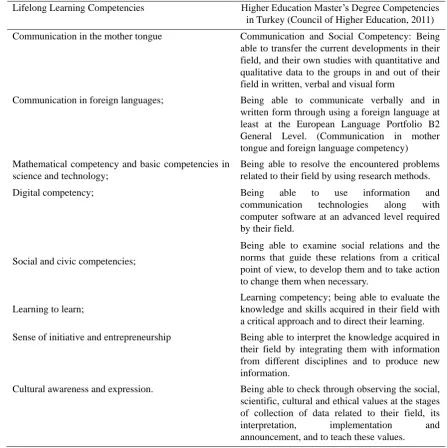
In the research conducted by Kazu and Demiralp (2016) for the purpose of examining the programs in the context of lifelong learning; it has also been concluded that teacher training programs are not suitable for gaining lifelong learning competency, that they are inadequate in developing teacher candidates‘ personal development, and that lifelong learning competency is ignored in the programs implemented in the faculties of education. In the study named ―a content analysis of the thesis and articles on lifelong learning: 2000-2015‖ conducted by Yüksel, Gündoğdu, Akyol and Akar-Vural (2016); attention has been drawn to the lack or absence of studies on postgraduate students in the field of lifelong learning. The main purpose of graduate education are to raise manpower having the quality to research, criticize, learn to learn, produce and use the information, and able to solve problem. (Alhas, 2006; İnce & Korkusuz, 2006; Karaman & Bakırcı, 2010). When the competencies of lifelong learning are examined, it can be said that these competencies should also be among the competencies of a graduate education program (Table 1).
Table 1. Comparison of the Lifelong Learning Competencies and Master‘s Degree Competencies
Lifelong Learning Competencies Higher Education Master‘s Degree Competencies in Turkey (Council of Higher Education, 2011) Communication in the mother tongue Communication and Social Competency: Being
able to transfer the current developments in their field, and their own studies with quantitative and qualitative data to the groups in and out of their field in written, verbal and visual form
Communication in foreign languages; Being able to communicate verbally and in written form through using a foreign language at least at the European Language Portfolio B2 General Level. (Communication in mother tongue and foreign language competency) Mathematical competency and basic competencies in
science and technology;
Being able to resolve the encountered problems related to their field by using research methods.
Digital competency; Being able to use information and
communication technologies along with computer software at an advanced level required by their field.
Social and civic competencies;
Learning to learn;
Being able to examine social relations and the norms that guide these relations from a critical point of view, to develop them and to take action to change them when necessary.
Learning competency; being able to evaluate the knowledge and skills acquired in their field with a critical approach and to direct their learning. Sense of initiative and entrepreneurship Being able to interpret the knowledge acquired in
their field by integrating them with information from different disciplines and to produce new information.
Cultural awareness and expression. Being able to check through observing the social, scientific, cultural and ethical values at the stages of collection of data related to their field, its interpretation, implementation and announcement, and to teach these values.
In this study, it is aimed to examine the competencies of master‘s degree programs of 12 fields under the Institute of Educational Sciences in the context of key competencies of lifelong learning, and to reveal which key competencies of lifelong learning are supported by the examined master‘s degree programs. For this purpose, an answer has been sought to the question of ―Which key competencies of lifelong learning are included in the program competencies of master‘s degree programs?
2. Method
2.1 Design of the Study
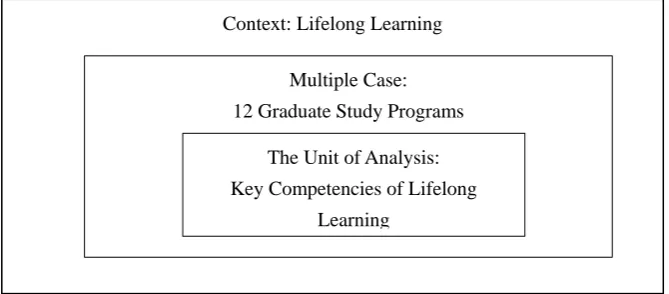
In the study, a multiple case holistic design has been used from the case study designs (Figure 1). In this design, there is more than one case that can be perceived as holistic in it-self (Yıldırım & Şimşek, 2018). Key competencies of lifelong learning constitute the unit of analysis. The master‘s degree programs examined in 12 different fields constitute a multiple case. Document analysis has been used as a data collection method.
The following steps have been followed in the document analysis:
Access to documents: Accessed through the website of Pamukkale University https://ebs.pau.edu.tr
Checking the authenticity: For this purpose, they were confirmed with the heads of department and the faculty members of the master‘s degree program.
Understanding documents: Information was obtained from the people in the team, who wrote the program competencies, when the researcher needed it in terms of understanding the competencies correctly.
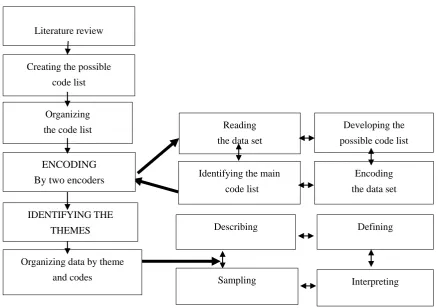
Data analysis: Content analysis technique was used in data analysis. The stage of data analysis is visualized in Figure 2.
The use of data: At the stage of reporting, firstly, data are presented by comparing the data under the key competency of each lifelong learning.
While sharing quotations; following abbreviations are used for the name of examined master‘s degree programs; Education Administration: EY, Mathematics Education: M, Music Education: MZ, Science Education: F, Classroom Education: S, Preschool Education: O, Curriculum and Instruction: EP, Psychological Counselling and Guidance: PD, and Program Competency: PY.
Figure 1. Design of the study 2.2 Data Source
In the 2016-2017 academic year, the ―program competencies‖, which are accessed as a written document regarding the master‘s degree programs in 12 (twelve) different fields carried out under the Institute of Educational Sciences of Pamukkale University, constitute the data source of the research. Data source have beenaccessed through the education information system of Pamukkale University (web site: https://ebs.pau.edu.tr). Information on the data source is given in Table 2.
Context: Lifelong Learning
Multiple Case: 12 Graduate Study Programs
The Unit of Analysis: Key Competencies of Lifelong
Table 2. The Document that Create the Data Source
Institute of Educational Sciences Master‘s Degree Programs Total Program Competencies
Education Administration 19
Science Education 12
English Language Education 12
Mathematics Education 12
Music Education 8
Preschool Education 12
Curriculum and Instruction 13
Psychological Counselling and Guidance 17
Art Education 9
Classroom Education 15
Social Studies 11
Turkish Language Education 12
TOTAL 152 program competencies
2.3 Analysis of Data
In the context of the key competencies of lifelong learning, content analysis has been conducted on the master‘s degree program competencies of 12 different fields. It is aimed to define the data and to reveal the facts, which are hidden within the data by gathering data similar to each other within the framework of certain concepts and themes through content analysis (Yıldırım & Şimşek, 2018). First, a draft list of possible codes and themes has been prepared as a result of the literature review conducted within the framework of lifelong key competencies. The data set consisting of master‘s degree program competencies of 12 fields (total 152 program competencies) has been coded by two different encoders who have researches in the field of lifelong learning, and themes have been reached. The data analysis process is given in Figure 2.
Figure 2. The path followed in content analysis 2.4 Validity and Reliability
The actuality of the master‘s degree programs examined was confirmed by the heads of the department and the faculty members. Tavşancıl and Aslan (2001) stated that one of the ways to ensure reliability in the studies using content analysis is to encode the data by two different researchers and to look for consistency between the encodings. The data
Literature review
Creating the possible code list
Organizing the code list
ENCODING By two encoders
IDENTIFYING THE THEMES
Organizing data by theme and codes
Reading the data set
Developing the possible code list
Identifying the main code list
Encoding the data set
Interpreting Defining
were encoded by two different encoders who had researches in the field of lifelong learning, and consistency between the encoders was examined. The compatibility percentage between the two encoders was calculated as 83%.
In order to ensure the external validity of the study, the findings were identified with direct quotations, and the collected data were reported in detail. In order to ensure the internal validity, the raw data and its analyses were examined by experts, and feedback was received. In order to ensure external reliability in the study, the methods and processes followed were defined in detail, and the conclusion reached and comments were checked by experts. The researcher worked in the program development department of the university in Bologna process. Therefore, he has experience in the process of determining and writing program competencies within the framework of higher education competencies. 3. Results
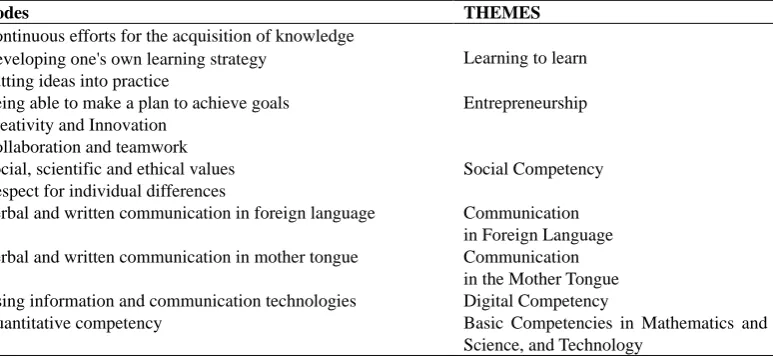
Within the scope of the study a total of 152 program competencies of 12 master‘s degree programs have been examined in the context of key competencies of lifelong learning. Among the master‘s degree program competencies examined, the competencies that directly mention the phrase ―lifelong learning‖ has been encountered. It is noteworthy that these competencies are only included in the master‘s degree programs opened under the Department of Educational Sciences. The competencies of the master‘s degree program in Education Administration include the competency “to adopt the principles of professional development and lifelong learning with the awareness of the necessity of lifelong learning in personal development” (EY-PY10). The competency in the master‘s degree program of Curriculum and Instruction is in the form of “He/she shows determination for his/her professional development as a lifelong learning individual” (EP-PY3). The master‘s degree program of Psychological Counselling and Guidance includes the competency ―he / she follows the developments related to his / her field and aim at the principle of lifelong learning (PD-PY3). However, some program competencies have been identified which do not directly mention lifelong learning but support key competencies of lifelong learning as a result of content analysis.
Table 3. Code-Theme Relation in Regard to Key Competencies of Lifelong Learning Revealed as a Result of the Content Analysis of Program Competencies
Codes THEMES
Continuous efforts for the acquisition of knowledge
Learning to learn Developing one's own learning strategy
Putting ideas into practice
Entrepreneurship Being able to make a plan to achieve goals
Creativity and Innovation Collaboration and teamwork
Social Competency Social, scientific and ethical values
Respect for individual differences
Verbal and written communication in foreign language Communication in Foreign Language Verbal and written communication in mother tongue Communication
in the Mother Tongue Using information and communication technologies Digital Competency
Quantitative competency Basic Competencies in Mathematics and Science, and Technology
3.1 Learning to Learn
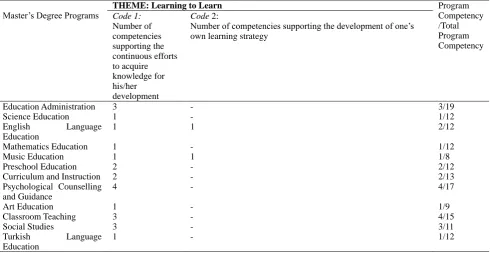
Table 4. Program Competencies Supporting the Competency of ‗Learning To Learn‘
Master‘s Degree Programs THEME: Learning to Learn Program Competency
/Total Program Competency Code 1:
Number of competencies supporting the continuous efforts to acquire knowledge for his/her development
Code 2:
Number of competencies supporting the development of one‘s own learning strategy
Education Administration 3 - 3/19
Science Education 1 - 1/12
English Language Education
1 1 2/12
Mathematics Education 1 - 1/12
Music Education 1 1 1/8
Preschool Education 2 - 2/12
Curriculum and Instruction 2 - 2/13
Psychological Counselling and Guidance
4 - 4/17
Art Education 1 - 1/9
Classroom Teaching 3 - 4/15
Social Studies 3 - 3/11
Turkish Language Education
1 - 1/12
As it is shown in Table 4, as a result of the content analysis of the master‘s degree program competencies in all the fields examined, ―the continuous efforts to acquire knowledge for his/her development‖, the codes of ―developing one's own learning strategy‖, and the theme of ―learning to learn‖ have been attained. One or more program competencies, which support ―the continuous efforts to acquire knowledge for its development‖, are included in the master‘s degree program competencies in all the fields examined within the scope of this study. For example; the competency, which is among the master‘s degree competencies in Mathematics Education, ―he / she shows commitment to follow the current developments for its professional development in mathematics education‖ (M-PY7), “he / she is determined to use and follow modern methods to create effective learning-teaching environments” (M-PY3) is supportive of the student‘s continuous effort to acquire knowledge. The phrase “follows” in the competency “he / she follows the new developments in his / her field, and interprets them according to national values and realities of the country” (O-PY10, S-PY12, which is among the master‘s degree competencies of Preschool Education and Classroom Education, also emphasizes the continuity in terms of learning. It was determined that the phrase “he / she uses theoretical and practical knowledge at the level of expertise that he / she has acquired in his / her field, he / she enhances and deepens this knowledge” (O-PY2, M-PY1, S-PY2, SO-PY6) are among the competencies of several master‘s degree programs. When it is considered that master‘s degree programs aim to provide the student with the research skills, it is inevitable for the student to be in a continuous effort to acquire knowledge by researching during his / her education. While this supports the competency of ―learning to learn‖ from the lifelong learning competencies, it can also be said that this is not enough.
3.2 Entrepreneurship
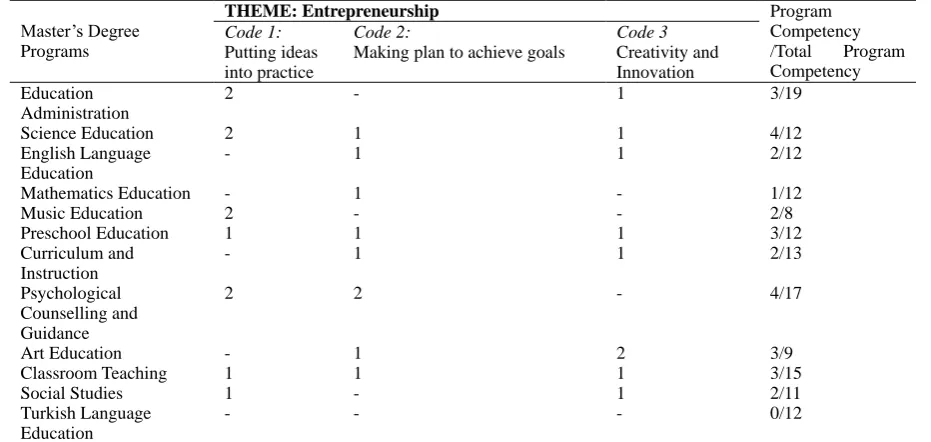
Table 5. Program Competencies Supporting ―Entrepreneurship‖
Master‘s Degree Programs
THEME: Entrepreneurship Program
Competency /Total Program Competency Code 1:
Putting ideas into practice
Code 2:
Making plan to achieve goals
Code 3 Creativity and Innovation Education
Administration
2 - 1 3/19
Science Education 2 1 1 4/12
English Language Education
- 1 1 2/12
Mathematics Education - 1 - 1/12
Music Education 2 - - 2/8
Preschool Education 1 1 1 3/12
Curriculum and Instruction
- 1 1 2/13
Psychological Counselling and Guidance
2 2 - 4/17
Art Education - 1 2 3/9
Classroom Teaching 1 1 1 3/15
Social Studies 1 - 1 2/11
Turkish Language Education
- - - 0/12
As seen in Table 5, as a result of the content analysis of the master‘s degree program competencies in the 12 fields examined, the codes of ‗putting ideas into practice‘, ‗making plan to achieve goals‘ and, ‗creativity and innovation‘ as well as the theme of ‗entrepreneurship‘ have been attained. It has been determined that the program competency of ‗putting ideas into practice‘ which can be considered as an indicator of entrepreneurship competency is among the competencies of the seven master‘s degree programs examined. For example; the competencies which support ‗putting ideas into practice‘ as “he / she independently builds a problem in his / her field, develops a solution method, solves and evaluates the results, and implement when necessary” (F-PY3), “he / she can apply strategies and processes designed for change management in schools in the context of school-environment relations” (EY-19) have been found. It is understood that the competency of ‗making plan to achieve goals‘ are among the competencies of eight graduate programs. For example, „he / she develops strategy, policy and application plans on the issues related to his / her field and evaluates the results attained within the framework of quality processes‟ (O-PY6). It is understood that as another indicator of entrepreneurship competency, the emphasis of ―creativity and innovation‖ has been made within the content of the competency of the eight graduate programs. For example; the competencies, which support ‗creativity and innovation‘, have been identified as “he / she develops solution models based on theories and approaches to the problems related to his / her field” (EY-PY7), “he / she develops knowledge through scientific methods using limited or incomplete data in his / her field” (F-PY2), “‟he / she develops new strategic approaches, and produces solutions by taking responsibility in unforeseen complex situations to encounter” (F-PY5), “he / she puts forward a problem in his / her field, and proposes a research method related to the problem” (M-PY5).
3.3 Digital Competency
Table 6. Program Competencies Supporting Digital Competency
Master‘s Degree Programs THEME: Digital Competency Program Competency /Total Program Competency Using information and
communication technologies
Education Administration 1 1/19
Science Education 1 1/12
English Language Education - 0/12
Mathematics Education 1 1/12
Music Education 1 1/8
Preschool Education 1 1/12
Curriculum and Instruction 1 1/13
Psychological Counselling and Guidance - 0/17
Art Education - 0/9
Classroom Teaching 1 1/15
Social Studies 1 1/11
Turkish Language Education - 0/12
eight fields. For example; the competencies which support ‗using information and communication technologies‘ have been identified as “he / she uses information and communication technologies effectively in mathematics teaching and researches” (M-PY4), “he / she recognizes and uses new educational technologies related to the field of music” (MZ-PY8), “he / she develops knowledge and skills for using information and communication technologies in educational applications (O-PY7, S-PY8). In addition, it has been identified that there is no content of competency related to ‗using information and communication technologies‘ in four master‘s degree programs (Psychological Counselling and Guidance, English Language Education, Art Education, and Turkish Language Education).
3.4 Social Competency
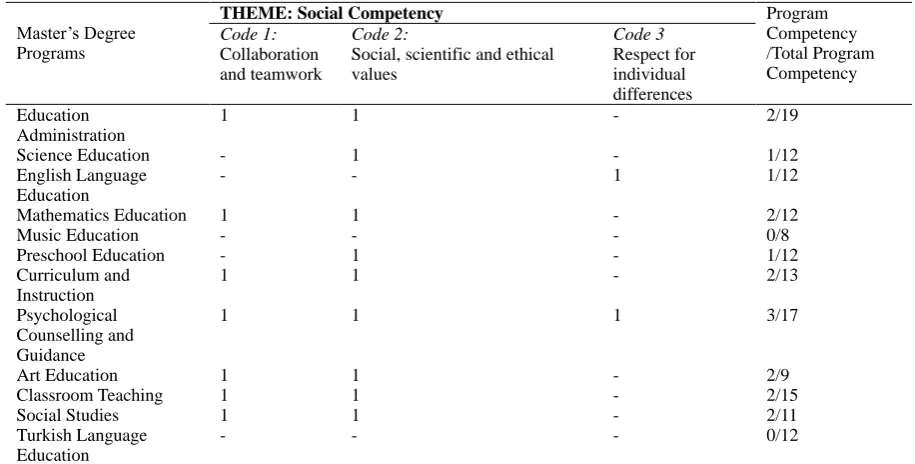
Table 7. Program Competencies Supporting Social Competency
Master‘s Degree Programs
THEME: Social Competency Program
Competency /Total Program Competency Code 1:
Collaboration and teamwork
Code 2:
Social, scientific and ethical values
Code 3 Respect for individual differences Education
Administration
1 1 - 2/19
Science Education - 1 - 1/12
English Language Education
- - 1 1/12
Mathematics Education 1 1 - 2/12
Music Education - - - 0/8
Preschool Education - 1 - 1/12
Curriculum and Instruction
1 1 - 2/13
Psychological Counselling and Guidance
1 1 1 3/17
Art Education 1 1 - 2/9
Classroom Teaching 1 1 - 2/15
Social Studies 1 1 - 2/11
Turkish Language Education
- - - 0/12
As seen in Table 7, ‗collaboration and team work‘ are included among the program competencies of seven fields. For example; there are competencies such as he / she develops independent and collaborative working skills in his / her field” (S-PY15), “he / she takes responsibility in the practices related to his / her field and works in collaboration” (PD-PY16). However, it is also a noteworthy finding that collaboration is not emphasized in the program competencies of the six fields of the study that are examined. ―Having social, scientific and ethical values‖ which is an indicator of social competency, is included in the program competency of nine fields. For example; ―he / she conducts his / her studies in his / her field by considering social, scientific and ethical values” (O-PY9, S-PY10), ―he / she acquires social, scientific and ethical values” (M-PY11). However, there is no program competency related to social, scientific and ethical values in the program competencies of the three fields (English Language Education, Music Education, and Turkish Language Education).
3.5 Communication in Foreign Language Competency
Table 8. Program Competencies Supporting Communication in Foreign Language
Master‘s Degree Programs THEME: Communication in Foreign Language
Program Competency /Total Program Competency Verbal and written
communication in foreign language
Education Administration 1 1/19
Science Education - 0/12
English Language Education 1 1/12
Mathematics Education 1 1/12
Music Education - 0/8
Preschool Education - 0/12
Curriculum and Instruction 1 1/13
Psychological Counselling and Guidance - 0/17
Art Education - 0/9
Classroom Teaching - 0/15
Social Studies 1 1/11
Turkish Language Education - 0/12
It is identified that the program competency related to the ability to communicate in at least one foreign language verbally and in written form is included in only five fields, and no program competency related to communication in foreign languages is included in program competencies of other fields.
3.6 Mathematical Competencies, Basic Competencies in Science and Technology
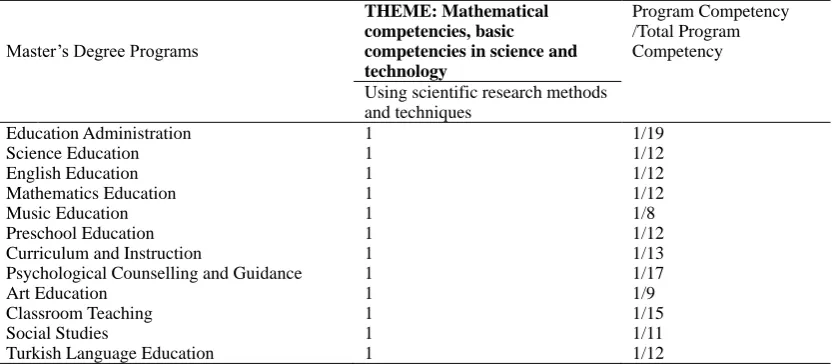
Table 9. Program Competencies Supporting Mathematical Competencies, Basic Competencies in Science and Technology
Master‘s Degree Programs
THEME: Mathematical competencies, basic competencies in science and technology
Program Competency /Total Program Competency
Using scientific research methods and techniques
Education Administration 1 1/19
Science Education 1 1/12
English Education 1 1/12
Mathematics Education 1 1/12
Music Education 1 1/8
Preschool Education 1 1/12
Curriculum and Instruction 1 1/13
Psychological Counselling and Guidance 1 1/17
Art Education 1 1/9
Classroom Teaching 1 1/15
Social Studies 1 1/11
Turkish Language Education 1 1/12
3.7 Communication in Mother Tongue
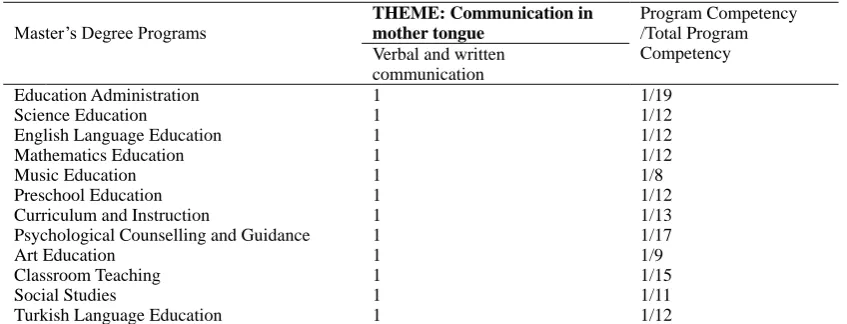
Table 10. Program Competencies Supporting Communication in Mother Tongue
Master‘s Degree Programs THEME: Communication in mother tongue
Program Competency /Total Program Competency Verbal and written
communication
Education Administration 1 1/19
Science Education 1 1/12
English Language Education 1 1/12
Mathematics Education 1 1/12
Music Education 1 1/8
Preschool Education 1 1/12
Curriculum and Instruction 1 1/13
Psychological Counselling and Guidance 1 1/17
Art Education 1 1/9
Classroom Teaching 1 1/15
Social Studies 1 1/11
Turkish Language Education 1 1/12
As seen in Table 10, there is program competency related to ‗verbal and written communication in mother tongue‘ in all fields of master‘s degree program examined in this study. For example; there are competencies such as “he / she systematically transfers current developments in his / her field and his / her own scientific studies to people, institutions and organizations in and out of the field in a written, verbal and visual form” (EY-PY11, F-PY4), “they can communicate the results of the researches attained related to the field of music education, and the information and discussions that support them to those who are experts or not in a clear and unambiguous way” (MZ-PY3).
4. Discussion and Conclusion
The competency directly related to lifelong learning has been identified among the competencies of only three fields from the competencies of the master‘s degree program in the 12 fields, which have been examined. Under the learning competency, which is among the competencies of master‘s degree program in Teacher Training and Education Sciences, there are competencies of ―he / she critically evaluates the information about his / her field and directs learning‖ and ―he / she conducts studies in its field within the framework of lifelong learning competencies‖ (Council of Higher Education, 2011). In this context, although ―lifelong learning‖ is included among the competencies of master‘s degree specified by the Council of Higher Education, the fact that the program competency has been identified in few areas related to lifelong learning can be seen as an open aspect for the improvement of the programs.
Under the theme of entrepreneurship competency from key competencies of lifelong learning; it has been determined that ―putting ideas into practice‖ is included in the program competency of seven fields, ―being able to make a plan to achieve goals‖ and ―creativity and innovation‖ were included in the program competency of eight fields. There is no program competency supporting the competency of entrepreneurship among competencies of the master‘s degree programs in Turkish language education. Based on these findings, it was concluded that knowledge, skills and attitudes related to entrepreneurship competency from lifelong learning competencies were included in the content of the competencies of master‘s degree programs in the fields examined (excluding Turkish Language Education) and, there are indicators supporting entrepreneurship more than other fields in the program competencies of master‘s degree in Science Education, Preschool Education and Classroom Education.
It has been determined that ‗using information and communication technologies‘ is included in program competencies of eight fields examined, but there is no content of competency related to ‗using information and communication technologies‘ in four fields of master's degree program (Psychological Counseling, English Language Education, Art Education, Turkish Language Education). Based on this finding, it has been concluded that it is necessary to add content related to digital competency to the competency of the master‘s degree programs of four fields. It can be said that ‗using information and communication technologies‘ is an important need for research which has an important place in master‘s degree education.
Under the theme of social competency among the key competencies of lifelong learning, ―cooperation and teamwork‖ are included in the program competency of the seven fields, ―social, scientific and ethical values‖ in the program competency of nine fields and, ―respect for individual differences‖ in the program competency of only one field. Based on these findings, considering that cooperation and teamwork are important in gaining social competency, and it should be in all fields of master‘s degree program, it has been concluded that it would be appropriate to add ‗cooperation and team work‘ to the content of the competencies of master‘s degree programs in Science Education, English Language Education, Music Education, Preschool Education and Turkish Language Education. Social competency includes personal, interpersonal and intercultural competency, and covers all forms of behavior that encourage individuals to participate effectively and constructively in social and working life, especially in more diverse societies and, if necessary, to resolve conflict (European Communities, 2007). According to the findings, it can be said that social competency is limited to ‗social, scientific and ethical values‘ in the master‘s degree program competencies. It is noteworthy that the content of the master‘s degree program competencies in all the fields examined does not include knowledge, skill and attitudes about intercultural competency. However, it has been identified that knowledge, skills and attitudes related to ―Cultural Awareness and Expression Competency‖ among lifelong learning key competencies are not included in the program competencies. Therefore, it has been concluded that master‘s degree program competencies including intercultural competency, cultural awareness and expression competency need to be reviewed again. It has been determined that ―competency of communication in foreign language‖, which is required in order to improve the quality of the master's degree program as well as for lifelong learning, is not included in the program competency of master‘s degree in seven fields examined. It has been concluded that the competency of communication in foreign language needs to be included in the master‘s degree program competencies of Science Education, Music Education, Preschool Education, Psychological Counseling and Guidance, Art Education, Classroom Education and Turkish Language Education. It has been determined that the master‘s degree program competencies in the fields of Education Administration, Classroom Teaching, Social Studies and Psychological Counseling include more lifelong learning key competencies than the other fields examined.
To sum up, it has been concluded that the content of the program competencies in the fields of master‘s degree examined within the scope of this study is insufficient to include all the knowledge, skills and attitudes that are covered by the key competencies of lifelong learning, and in particular, social competency, and cultural awareness and expression competency are not included in the content of the program competencies examined. There is no study conducted in Turkey on the examination of master‘s degree programs in the context of lifelong learning competencies. However, in the research conducted by Kazu and Demiralp (2016), it can be said that teacher-training programs are consistent with the results of the study that they are not suitable for gaining lifelong learning competency. As a result of the research conducted by Yaman and Yazar (2015), trends of lifelong learning among teachers who have a master‘s degree are higher than those with undergraduate degree. As a result of the study made by Adabaş (2016) using the scale of lifelong learning key competencies, it has been attained that lifelong learning competencies of master‘s degree students are at a high level with the exception of the competency of foreign language communication. The high level of lifelong learning competencies among master‘s degree students can be interpreted with the existence of other factors apart from the program that affects the lifelong learning competencies of the students.
competency of learning to learn, social competency, cultural awareness, and expression competency, competency of communication in foreign language. Program evaluation studies can be carried out to determine whether the competencies of the master‘s degree program supporting the key competencies of lifelong learning are gained by the students. In addition, researches can be also conducted to evaluate the achievements and content of the master‘s degree courses in the context of the key competencies of lifelong learning.
This research is limited to the method of document analysis, and the content analysis of the master's degree program competency of the 12 fields examined, which are carried out under the Pamukkale University Institute of Educational Sciences. This limitation can be eliminated by applying a survey of whether the learning outcomes analyzed in this study have been reached or whether these outcomes are included in the learning-teaching process.
Acknowledgements
This study was presented as an oral presentation at 2017 III. International Conference on Lifelong Learning and Leadership for All. Polytechnic University, Porto, Portugal.
References
Adabaş, A. (2016). Lifelong learning key competences levels of postgraduate students at Bartın University (Unpublished master‘s thesis). Bartın University, Institute of Educational Science, Bartın, Turkey.
Alhas, A. (2006). The interpretation on post-graduate education of the state employed teachers studying (Unpublished master‘s thesis). Gazi University, Institute of Educational Science, Ankara, Turkey.
Commission of the European Communities (2000). A Memorandum on lifelong learning. Retrieved from http://arhiv.acs.si/dokumenti/Memorandum_on_Lifelong_Learning.pdf
Council of Higher Education (2011). National qualifications framework for higher education in Turkey: general competencies. Retrieved from http://tyyc.yok.gov.tr/?pid=48
Demircioğlu, T., Yavuz-Konokman, G., & Akay, C. (2016). The effect of proactivity of academicians‘ at education faculty on their attitudes towards European Union lifelong learning projects. Electronic Journal of Social Science, 15(59), 1120-1137. https://doi.org/10.17755/esosder.263219
Dietrich, S. (1999). Self-directed learning - a new learning culture for institutional adult education? In S. Dietrich & E. Fuchs-Brüninghoff (Eds.), Self-directed learning on the way to a new learning culture (pp. 14-23). Retrieved from http://www.die-bonn.de/esprid/dokumente/doc-1999/dietrich99_01.pdf
Diker-Coşkun, Y., & Demirel, M. (2012). Lifelong learning tendencies of university students. Hacettepe University, Journal of Education, 42, 108-120.
European Commission (2002). European report on quality indicators of lifelong learning. Retrieved from http://www.aic.lv/ace/ace_disk/Bologna/contrib/EU/report_qual%20LLL.pdf
European Communities (2007). Key competences for lifelong learning – European reference framework Retrieved from https://www.britishcouncil.org/sites/default/files/youth-in-action-keycomp-en.pdf
European University Association (2001). Communiqué of the meeting of European Ministers in charge of Higher Education in Prague. Retrieved from http://glotta.ntua.gr/posdep/BOLOGNA/decla-praga-eng.html
Göksan, T. S., Uzundurukan, S., & Keskin, S. N. (2009, November). Lifelong learning and lifelong learning programs of the European Union. I. Civil Engineering Education Symposium, Antalya, Turkey. Retrieved from http://www.imo.org.tr/resimler/ekutuphane/pdf/16677_46_05.pdf
Griffin, C. (1982). Curriculum analysis of adult and lifelong education, International Journal of Lifelong Education, 1(2), 109-121. https://doi.org/10.1080/0260137820010203
İnce, M. L., & Korkusuz, F. (2006). Student-instructor interaction in developing graduate education objectives: Project report of the status of a university in different universities and different disciplines in a university. TÜBİTAK Social and Humanities Research Group, Project, (104K093).
Jarvis, P. (2007). Globalisation, lifelong learning and the learning Society: Sociological Perspectives. Retrieved from https://moodle.fct.unl.pt/pluginfile.php/32501/mod_glossary/attachment/10561/ CapitulosLLL
Karaman, S., & Bakırcı, F. (2010). Postgraduate study in Turkey: problems and proposed solutions. Social Sciences Research Journal, II, 94-114.
Pepper, D. (2011). Assessing key competences across the curriculum — and Europe. European Journal of Education, 46(3), 335-353. https://doi.org/10.1111/j.1465-3435.2011.01484.x
Pitman, T., & Broomhall, S. (2009). Australian universities, generic skills and lifelong learning. International Journal of Lifelong Education, 28(4), 439-458. https://doi.org/10.1080/02601370903031280
Reeves, J. (2011). Investigating knowledge exchange and creation on a practice-based Master‘s programme. Studies in Higher Education, 36(8), 953-967. https://doi.org/10.1080/03075079.2010.487558
Selvi, K. (2011). Teachers‘ lifelong learning competencies. International Journal of Curriculum and Instructional Studies, 1(1), 61-69.
Senemoğlu, N. (2013). Development, learning and teaching: from theory to practice. Ankara: Yargı Yayınevi
Sin, C. (2012). The Bologna master degree in search of an identity. European Journal of Higher Education, 2(2-3), 174-186. https://doi.org/10.1080/21568235.2012.702437
Soares, D., & Dias, D. (2018) Perspectives of lifelong education in Portuguese higher education: a critical analysis of learning outcomes. International Journal of Lifelong Education, 37(6), 1-9. https://doi.org/10.1080/02601370.2018.1559890
Soran, H., Akkoyunlu, B., & Kavak, Y. (2006). Lifelong learning skills and training faculty members: A Project at Hacettepe University. Hacettepe University, Journal of Education, 30, 201-210.
Steur, J., Jansen, E., & Hofman, A. (2016). The influence of curriculum on master‘s students‘ perceived abilities in four domains of graduateness. Research in Post-Compulsory Education, 21(3), 214-228. https://doi.org/10.1080/13596748.2016.1195170
Tavşancıl, E., & Aslan, A. E. (2001). Content analysis and application examples. İstanbul: Epsilon Yayınevi.
The Bologna Declaration (1999). Joint declaration of the European Ministers of Education Retrieved from http://www.ehea.info/media.ehea.info/file/Ministerial_conferences/02/8/1999_Bologna_Declaration_English_5530 28.pdf
Turan, S. (2005). Lifelong learning in European Union education policies towards learning society. Ankara Review of European Studies, 5(1), 87-98.
Wiesner, G., & Wolter, A. (2005). Introduction. In G. Wiesner & A. Wolter (Eds.), The learning society. Learning cultures and competence development in the knowledge society (pp. 7–44). Weinheim: Juventa Verlag
Wilson, L. A. (2001). Information literacy: Fluency across and beyond the university. In B. I. Dewey (Ed.), Library user education: Powerful learning, powerful partnerships (pp. 1-17). Lanham, MD: Scarecrow Press
Yaman, F., & Yazar, T. (2015). Investigating of life long learning tendency of teachers (The example of Diyarbakır). Kastamonu Education Journal, 23(4), 1553-1566.
Yavuz-Konokman, G., & Yanpar-Yelken, T. (2014). The perceptions of academicians in education faculties on their lifelong learning competencies. Hacettepe University Journal of Education, 29(2), 267-281.
Yıldırım, A., & Şimşek, H. (2018). Qualitative research methods in the social sciences. Ankara: Seçkin Yayıncılık. Yüksel, S., Gündoğdu, K., Akyol, B., & Akar-Vural, R. (2016). Content analysis of thesis and articles related to lifelong
learning: 2000-2015. Erzincan University Journal of Education Faculty, 18(2), 1491-1513. https://doi.org/10.17556/jef.88957
Copyrights
Copyright for this article is retained by the author(s), with first publication rights granted to the journal.