Flexibility in Online Teaching and Learning Spaces
Simeon J. Simoff
Faculty of Information Technology, University of Technology, Sydney, PO Box 123, Broadway NSW 2007, Australia
Abstract
This paper discusses the loose integration approach in building flexible virtual environments as a collection of several underlying technologies. The framework allows for the development of an open integrated environment which supports consistent human computer interaction, uniting existing supporting technologies at both the conceptual and interface level. The proposed approach provides flexibility in constructing online teaching and learning environments with respect to the requirements of the subject. It is suitable for developing flexible learning environments for subjects, which include in their curriculum a variety of computer mediated technologies and different modes of delivery.
Content- versus community-oriented online learning environments
Collaborative virtual environments have steadily stepped out of the universities' research laboratories, getting an increasing popularity in the area of online learning, industrial training, research and development activities. There are numerous approaches and techniques for arranging such environments, which can be roughly separated into content-oriented and
community-oriented, with respect to the information design and organisation of the environment information space. The design of the content-oriented environments is oriented towards the content delivery. Communication and other community support are incorporated as a customisable collection of tools. The content can be structured and organised in a variety of hierarchical structures. Earlier environments of this type (e.g. the popular CAI/CAL (Computer
Aided Instruction / Computer Aided Learning) programs in the late 80s - early 90s) followed the concept of an interactive multimedia book, which can be personalised to a certain extent with respect to differences in cognitive styles, e.g. analytical versus visual reasoning. The shift in the delivery mechanisms towards networked computer media extended the multimedia book
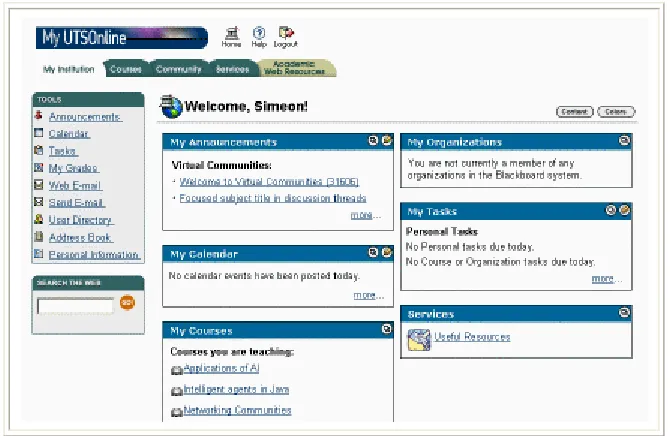
Figure 1a. The 'Web-based communities' style interface of an online learning environment
Figure 1b. The 'Web information system' style of access to functionality, including communication components
Figure 1. An example of 'out of the box' design of online learning environment
The limitations of the approach are connected with the commitment to the model offered by the development system. Different subjects and different type of students may require different delivery, teaching and learning scenarios, hence different metaphors, structuring and presentation of the information space. For example, the delivery of a studio style subject on computing may require the integration of portions of several environments, rather than customisation of a single one. An electrical engineering subject may require in addition to the lectures a hands-on
changes in the interface and, consequently, additional cognitive overhead for students and educators (unless the new environment follows similar developmental philosophy and interface agreements).
Instead of focussing on creating learning materials, the design of the community-oriented environments puts the emphasis on supporting community activities and providing resources, which the course participants then organise, modify, add to and share, according to their individual needs. Examples of different implementations of this approach include the so-called campus-style environments like TAPPEDIN (http://www.tappedin.edu/), Virtual Learning Environments (http://www.vu.vlei.com/), TheU (http://www.ccon.org/theu/) and the Virtual Campus (http://www.arch.usyd.edu.au:7778/). These environments followed a common approach - the environment is viewed as a place where the learning activities happened and it should be organised following the metaphor of a place for studying and research - in this case - a university. TAPPEDIN and the Virtual Campus (Maher 1999) followed the metaphor of a
University campus. Further, this approach is discussed based on the research and development of the Virtual Campus (Maher 1999). The development of customisable virtual places as
educational environments is expected to provide consistent and open environments for online education, with means for conducting research in the phenomenon of online teaching and learning (Simoff 1999; Simoff and Maher 2000). The basic premises aimed at significant decrease of the cognitive overhead in dealing with such environments and seamless integration and transition to new configurations and new environments. The premises behind this approach include:
The use of familiar metaphors (paradigms) in organising the information space of the integrated environment will decrease the cognitive overhead - the integrated environment will be 'augmented' and perceived as a natural extension of the traditional university environment;
The consistent representation of the metaphors that are part of the university campus metaphor - buildings, lecture theatres, laboratories, offices, including also various virtual 'things', which can be used in a similar manner as their physical counterparts, for
example, whiteboards, recorders, individual notebooks, slide projectors; Personal spaces in a campus style environment should allow broad range of
customization and adaptation according to the individual preferences, when the common spaces should be restricted in changes, so that they remain familiar to the majority of the students and other visitors;
Different subjects require different styles of delivery. For example, some subjects in design and engineering require laboratory works, simulations and modeling. Such activities may require additional 3D simulation environments, virtual laboratories,
equipped with virtual instrumentation and facilities for remote access to physical devices, project management and documenting facilities. Similar to a physical campus, a virtual campus should be capable of accommodating growth and changes, with seamless integration of new areas, new metaphors and interfaces.
(1999). This article is focussed on the further development of this ontology, which led to the concept of 'loose integration'.
The 'loose integration' concept
The spatial organisation of a virtual place supports our cognitive models and experiences in the physical world. Spatial organisation provides the cues for navigation, behaviour and reactions in the environment. A common sense approach in collaborative virtual environments (including Virtual Campus) is to organise the spatial layout of the environment around the notion of a room as a spatial unit. The room is viewed both as a topological (reference) element and as an
information container (Coyne 1995; Greenberg and Roseman 2001). Rooms are in particular relations with each other within the environment and they keep a variety of 'things' like recorders, carousels for slide projectors, message pads, slide projector, whiteboard and other useful collaboration tools. In the spatial ontology, supported within the loose integration
approach, the notion of the room is generalised to the notion of space that provides information privacy and can be uniquely identified by its coordinates in a virtual environment.
The functional and semantic organisation of a virtual place shapes the grouping of the spatial units. Functional and semantic organisation of the space is derived from the functional requirements and semantic relations in the learning environment (Maher 1999). Semantic relations usually reflect underlying subject logic. For example, functionally the main area of the Virtual Campus is organised around the notion of various (familiar) buildings, where each building serves a specific function. These buildings provide office space, seminar space, and library or resource space. Within a network of virtual campuses, 'campus' can be the high level notion for the functional organisation of the space.
Semantic organisation of the space deals with the meaningful arrangements of the rooms. For example, in the Virtual Campus, the information space in the course building is organised according to the subjects taught. In the Office building, the staff and students have personal offices that are either provided for them according to a style consistent with the rest of the campus, or the individual can design and implement her/his own office.
The concept of 'loose integration' approach addresses these principles on the implementation and interface levels. In the context of the spatial organisation, it ensures seamless transition from one spatial area to the other regardless of the underlying technology that supports different spaces. The integration is based on coupling the ontologies of the underlying environments. Such coupling is relatively straight forward, when both technologies operate with similar organisation of their spaces, though they may differ in the way they represent them and in the interfaces to these spaces. For example, virtual spaces, built on MOO-based virtual worlds and TeamWave (http://www.teamwave.com/) groupware technology, are based on the notion of room, hence the integration of such spaces does not require translation between ontologies. The integration of spaces, supported by MOO-based virtual world technology, with spaces supported by
on ontological (conceptual) level:
unique and consistent (preserving the name, character features, and other personal attributes) representation (embodiment) of a human or software agent in each of the underlying environments that constitute the place;
common metaphor for spatial organisation of the environment space, including common principles of structuring and organisation of the environment, providing intuitive cues for orientation and action;
set of feasible activities in the integrated environment, which is defined by the purpose of the environment,
on a design level:
mapping between the components of personal descriptions in different environments;
mapping between the components of the representations of the spatial metaphors of the underlying collaborative environment technologies;
common style HCI interfaces for moving from one area to another, regardless of whether it involves transition to a section of the environment supported by another underlying technology,
on implementation level:
transition interfaces for passing personal descriptions and space locations from one technology to another;
consistent support of the set of feasible activities defined at the ontological level.
The next section presents an example of the application of the 'loose integration' approach towards the rapid design and implementation of specialised virtual spaces.
Constructing flexible teaching and learning spaces
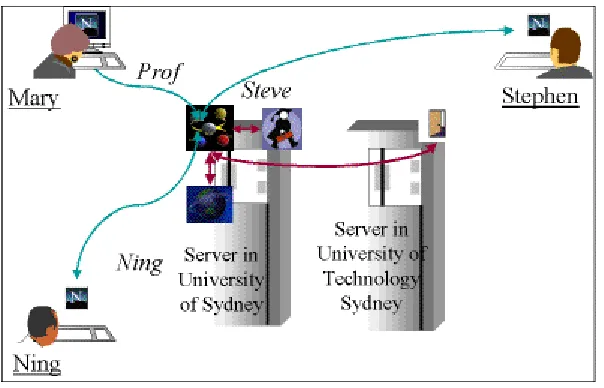
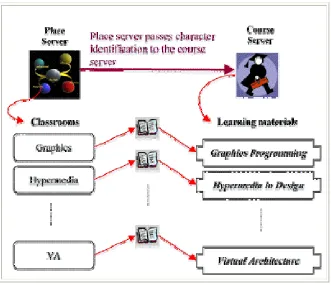
of a UTS subject, this part uses a link to UTS Online), and, if necessary, area(s) in the 3D studio server and room(s) on the project management server. To a person enrolled in such a subject, the subject environment will appear as a single virtual space. The only exception is the access to the content delivery server, which is part of the functionality of a room in the place server (the mechanism is illustrated in Figure 2b).
An open learning environment, based on the 'loose integration' principle provides a means for collecting consistent data for the analysis of communication that occurs during the educational activities. Although there are some differences in the activities and communication scripts from different environments, they can be transformed without loss of information to fit a common model. The framework for analysing communication in a virtual place learning environment is presented in Simoff (1999) and Simoff and Maher (2000).
Figure 2b. Elements of the loose integration concept at implementation level
Figure 2. An example of the application of the loose integration approach to a cross-university virtual campus
Icon Server and technology Icon Server and technology
Backbone Place Server [LambdaMoo
Technology]
Structured Content Delivery Server [WebCT Technology]
3D Virtual Design Studio Server
[ActiveWorlds Technology]
Project Management Server
[TeamWave Technology]
Table 1. The components of the environment, shown in Figure 2A
The loose integration approach offers a way of integrating (conceptually and technically) collaborative virtual environments based on different underlying technology into an open environment. This environment offers means for dynamic construction of virtual spaces on demand. The benefit of this approach is the relatively low cost in accommodating further growth - extending the functionality means plugging in another environment. By gradually incorporating the new portion of the virtual space this approach offers incremental changes, contrasting the 'step function' style of changes in HCI, that occurs with the shift to a completely new
environment (which is the usual practice). Except for the backbone place server, there is no commitment to a particular technology. For example, the content delivery service can be expanded with other content delivery servers. Such strategy in online learning can decrease the overheads for the content developers, allowing existing subjects to keep running online and providing the setup for a smooth transition (if necessary) to another content delivery
environment or running such environments in parallel, under the campus interface paradigm. Consequently, the loose integration approach supports continuity in the development of learning materials (i.e. minimises redundant developments that may occur as a result of the migration from one single system to another). On the other hand, in IT disciplines like virtual communities and e-commerce, dealing with a range of technologies, it allows one to present such technologies in a coherent way, rather than as a collection of isolated islands with their own models and user interface design. Future work in loose integration is seen to be in incorporating virtual laboratory equipment (like virtual instruments) that can bring real data for analysis and simulation within the virtual environment. Extending such types of collaborative virtual environments to
incorporate virtual reality equipment brings elements from the virtual environment into realistic renderings within the physical reality. The extension of the integrated environment is seen through the inclusion of new environments and adapting their ontology so that it translates correctly to the ontology of the main components. A possible technology that can be used for expansion of the virtual campus is LiveNet (http://livenet.it.uts.edu.au/), developed at the University of Technology, Sydney (Hawryszkiewycz 1999). LiveNet uses the notion of
workspace, which needs to be translated into the notion of room, adopted in the virtual campus.
References
1. Coyne, R. (1995) Designing Information Technology in the Postmodern Age. Cambridge, MA: MIT Press.
2. Greenberg, S. and Roseman, M. (2001) Using a Room Metaphor to Ease Transitions in Groupware, in M. Ackerman, V. Pipek and V. Wulf (eds) Beyond Knowledge
Management: Sharing Expertise, Cambridge, MA: MIT Press.
3. Hawryszkiewycz, I. T. (1999) Workspace networks for knowledge sharing, in R.
Debrency and A. Ellis (eds), Proceedings of AusWeb99, The Fifth Australian World Wide Web Conference, Ballina, Australia, 18-20 Apr. 1999, 219-227,
http://ausweb.scu.edu.au/aw99/papers/hawryszkiewycz/paper.html.
4. Maher, M. L. (1999) Design and Representation of the Virtual Campus as a Place, in C. M. Hoadley and J. Roschelle (eds), Proceedings of the Computer Support for
Collaborative Learning (CSCL) 1999 Conference. Palo Alto, CA: Stanford University, http://kn.cilt.org/cscl99/A47/A47.HTM
6. Simoff, S. J. (1999) Monitoring and evaluation in collaborative learning environments, in C. M. Hoadley and J. Roschelle (eds), Proceedings of the Computer Support for
Collaborative Learning (CSCL) 1999 Conference. Palo Alto, CA: Stanford University, http://kn.cilt.org/cscl99/A83/A83.html
7. Simoff, S. J. and Maher, M. L. (2000) Analysing participation in collaborative design environments, Design Studies, 21, 119-144.
Simeon J. Simoff
Faculty of Information Technology University of Technology, Sydney PO Box 123
Broadway NSW 2007 Australia