Volume 4, Issue 4 (2015) pp. 270-276
276 | Page Original Article
The Effect of Assets' Liquidation Regarding the
Limitations of Financing on Cash Flow Sensitivity of Cash
Marziyeh Zeydabadinezhad
1, Mehdi Alinezhad Sarokolaei
2*, Abbas
Shoul
31Student, Department of Accounting, Sirjan science and research Branch, Islamic Azad University, Sirjan, Iran
2Department of Accounting, Tabriz Branch, Islamic Azad University, Tabriz, Iran 3Department of Industrial Management, Valiasr University, Rafsanjan, Iran
*Corresponding Author E-mail: [email protected]
Received: 24 August 2015, Revised: 30 September 2015, Accepted: 20 October 2015
ABSTRACT
In the present research we have studied about the effect of asset's liquidation regarding the limitations of financing on cash flow sensitivity of cash. To carry out the research we have chosen 60 firms accepted in Tehran Stock Exchange during the time period between 2006 and 2011 using a systematic deletion method. To test the research hypotheses we have used a multiple variable regression method. Then the results were analyzed using atast software. The research results showed that the liquidation of physical assets does not affect cash flow sensitivity.
Keywords: Liquidation of Physical Assets, Limitations of Financing, Sensitivity of Cash Flows.
Introduction
Basically liquidation is a complicated concept with several dimensions and it is considered as one of the functions of Stock Exchanges. Liquidation means the ability to exchange an asset with a low cost and without a considerable effect on the price of that asset. It means that the price of asset should not have changed a lot during the time period between ordering to purchase (Khalifeh Soltani & Bahrami, 2012). The liquidation power of an asset is its ability to change an asset into cash. An asset having a high capability of liquidation can be exchanged in the market easily and it can be changed into cash with
277 | Page To determine the financial limitations of
companies we use indexes such as size, age, the ratio of dividends, and financial leverage of the firms (Arsalan et al., 2006). Regarding what was presented above the main question of the present research is that: "Does asset's liquidation affect cash flow sensitivity of cashes considering the limitations of financing?"
Theoretical foundations
Asset's liquidation: the role of liquidation factor is important in valuating assets because investors pay attention to the fact that is there any appropriate tools if they want to sell their assets? An asset which can be exchanged in a short time without any losses is an asset with liquidity (Yahyazadehfar et al., 2010). The liquidation of assets of a company is determined through its physical assets in the market. The physical assets are assets such as equipments, properties and ... which are physical and their value lies in the asset itself and does not depend on their material features.
Cash flow sensitivity of cashes: cash flow sensitivity of cashes refers to the percentage of the changes in cash holding levels against the changes in cash flows. Fazari et al reasoned that companies with tough financial limitations (companies having low and costly access to external cash resources) emphasize more on investing on cash flows in their decision makings. In other words by increasing the difference between internal and external financing cost the investing sensitivity to internal cashes should increase (Alianz et al., 2004). The effect of financing limitations on the financing approaches of the companies can be revealed by showing the tendency of companies to store the main part of the cash flows. Thus, companies with financial limitations should have a high amount of cash flow
sensitivity and cash holdings in those companies should not be related to the amount and changes in their cash flows systematically (Almedia et al., 2003).
Financing limitations: investing in companies for more profitability is one of the important goals of financing. Managers in companies seek to administer profitable investments in order to maximize the value of the company. Doing profitable projects requires financing to administer the projects. Different methods for financing include internal and external financing or a mixture of these two methods. We should consider that the supply of financial resources by the companies is not unlimited and the companies encounter limitations in supplying the financial resources (Karimi Sadeghi, 2009). Those companies are called limited financially which have low and costly access to external resources of financing (Azkan & Azkan, 2004). To determine the financial limitations of companies we use indexes such as size, age, the ratio of dividends, and financial leverage of companies (Arsalan et al., 2006).
Rocheteau Wright (2013) analyzed those economies in which cash assets have a main role in exchange processes in a research paper entitled: "Liquidation and the dynamic nature of asset market". The results of their research showed that the price of assets, participation in the market, production, and welfare are positively connected with each other. On the other
hand sometimes the sufficient
presentation of cash assets is efficient to saturate the demand while in some cases it is not such.
278 | Page in a research entitled: "The relationship
between financial leverage and assets' liquidation". To identify the relationship between the factors 24 companies were selected from among the statistical society and the data needed for them were accessible for the time period between 2004 and 2010. The results of testing showed that the variables of return rate of assets, net properties, machinery, and equipments of companies and assets' liquidation do not affect financial leverage meaningfully.
Foroughi et al. (2011) studied the relationship between profit quality and the amount of cash holding in firms accepted in Tehran Stock Exchange during the time period between 2000 and 2009 by using a regression method and based on integrated data. Also the controlling variables such as investing in fixed assets on net fixed assets of start of the period, the percentage of dividends, firm leverage, firm size, and debt maturity date structure, the cost of investing opportunities, growth opportunities, and membership in a business group were utilized. The research results showed that there is a negative and meaningful relationship between cash holding amount in Tehran Stock Exchange and the profit quality.
Research hypothesis:
Liquidation of physical assets affects cash flow sensitivity regarding the limitations of financing.
Research variables
Independent variable: it is the liquidation of physical assets of the company which can be calculated based on the ratio of cashes of the company to total physical assets of the company (Gopalan et al, 2008).
Dependent Variable: In this research we have used the model posed by Almeida et
al (2003) in order to study the sensitivity of cash flows of cash as follows:
CASH = α + β1CFLOW + β2Q + ε
Where Cash is the level of cash holding and equals with the ratio of current cashes to total assets, CFLOW shows cash flow and equals the net ratio of cash flows resulting from operational activities on net fixed assets of start of the period and Q shows the growth opportunities (Q Tobin) and equals with the ratio of book value of total liabilities plus market value of owners' equity to book value of total assets. Finally,
β1 of the variable coefficient of CFLOW
shows the sensitivity of cash flows of cashes.
In this research we have used the regression to calculate sensitivity effect of cash flow on the model. And to achieve the variable coefficient of CFLOW, we have used F Limer test for tableau data and Husman's test for studying fixed effects which will be discussed in details in data analysis section.
Controlling variable: financing limitations are control variables which include: firm size, firm age, the ratio of dividends, business group, and financial leverage.
Firm size: firm size can represent the ability of management and the quality of accounting plans. To measure firm size we have used the natural logarithm of book value of total assets (George et al, 2008).
Firm age: to measure firm age we have used the number of the years passed from the establishment year of the company (Arsalan et al, 2006).
The ratio of dividends: to measure the ratio of dividends we have used the dividends paid during the fiscal year on book value of total assets of the start of the period (Arsalan et al, 2006
279 | Page dividing total liabilities of the company
into total assets of it (George et al, 2008).
Materials and Methods
The present research is applied regarding its goal and it is quasi-experimental regarding administration method and it is
post-incidental regarding positive
accounting researches and it is based on real information. To collect the items about literature review we have used library method and computer websites. To collect the needed data to calculate research variables we have used Rahaward-e-Novin 3 database and the formal website of Tehran Stock Exchange.
Statistical population of the research
The location range of the present research entails firms accepted in Tehran Stock Exchange during the time period between 2006 and 2011. The statistical population of the present research includes all firms accepted in Tehran Stock Exchange which have been accepted in bourse before March 2006 and their trademarks did not stop until the end of the year 2011. Based on the studies carried out the number of the sample in this research included 60 companies observed with the following characteristics:
To observe their comparability the fiscal
year for the companies ended 21st March
(end of Esfand).
The companies didn't have stopped their activities during the period under investigation and they have not changes their fiscal year.
The data needed about the companies during the study period should have been accessible.
The companies shouldn't be among banks, insurance companies or investing and leasing companies.
Data analysis method
In the present research we have used the regression method to analyze the data and approve or reject the hypotheses. The data analysis was carried out by using Stata software and generalized moment method (GMM). In integrated data model when the dependent variable appears in right side other estimators of OLS are not compatible (Hishao, Arlano and Band and Baltaci, 1995) and we should utilize two step estimation methods (2SLS) of Anderson and Hishao or generalized moment method (GMM) of Arlano and Band (1991). As Matias and Suster pointed out (2SLS) estimation may result in great variances for the coefficients due to the problems in choosing the tools and the estimations would not be meaningful statistically. Thus, generalized moment method (GMM) of Arlano and Band was proposed to solve this problem. This estimator increases estimation consistency through the reduction of sample. Also we have used first order self-correlation tests and Wald's and Sargan's tests.
Results
Descriptive statistics
The descriptive statistics of the research are shown in table 1.
Table 1. The descriptive statistics related to independent and dependent variables of the research
Variable Mean Average Criterion
deviation Min. Max.
Firm size 5.87 5.96 0.64 3.67 8.007
Firm's age 11 13.22 9.47 1 44
280 | Page Ratio of dividends 0.005 0.003 0.035 1.00e-08 0.49
liquidation of
physical assets 0.09 0.27 1.22 0.0015 30.74
Cash 17109.49 156873.9 594880.0978 102.9973 7152513
Cash flow 0.4 1.22 44.33 -528.69 649.54
Growth opportunities
446708.11 2849132 1.04e07 4017.04 8.89e07
Measurement method of the sensitivity of cash flow
In the present research we have used Almeida et al (2003) method to measure the sensitivity of cash flow as follows. The
results of adjusting the model above are shown in the table below.
Basic model: CASH = α + β1CFLOW +
β2Q + ε1
Table 2. Results of estimating the basic model
Variable Coefficients Criterion
deviation
T statistics P-Value
Cash flows -0.0024 0.0008 -2.96 0.003
Growth
opportunities 5.09e8 8.06e9 5.92 0.000
Latitude from the base
12.26 0.15 78.94 0.000
Number of
observations 360
R2 0.29
F Limer 44.79 0.000
Husman 3.92 0.14
Testing the hypotheses:
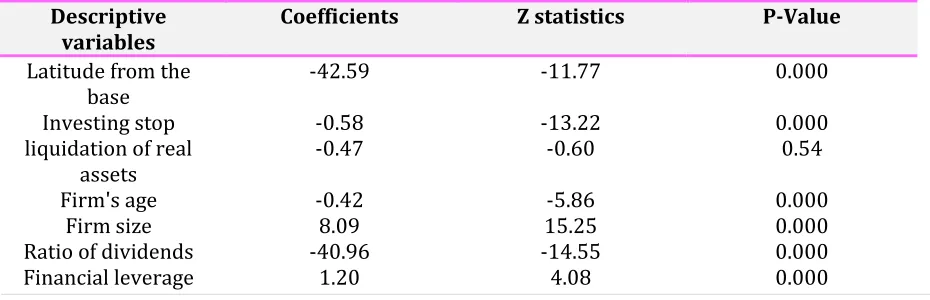
Testing the first hypothesis: According to the first hypothesis: 'liquidation of physical assets affects cash flow sensitivity regarding the limitations of financing'. The hypothesis above was tested in tableau
data level by using the research model and the results are shown in table 3.
FS = α + β1RAL + β2FL + β3AGE + β4SIZE +
β5 DR + ε
Table 3. The results of estimating the second equation
Descriptive variables
Coefficients Z statistics P-Value
Latitude from the base
-42.59 -11.77 0.000
Investing stop -0.58 -13.22 0.000
liquidation of real assets
-0.47 -0.60 0.54
Firm's age -0.42 -5.86 0.000
Firm size 8.09 15.25 0.000
Ratio of dividends -40.96 -14.55 0.000
281 | Page Model testing statistics
First order self-correlation test
AR(1)
-1.41 0.15
Second order self-correlation test
AR(2)
1.29 0.19
Wald test statistics 1.10e07 0.0000
Sargan test statistics 12.34 0.13
The results of estimated coefficients showed that cash flow coefficient equals -0.58 with a pause. This means that there is a negative relationship between the dependent variable and this descriptive variable. On the other hand, t statistics related to the variable showed that this relationship is meaningful in probability level of 0.05.
According to the results of model estimation the liquidation of physical assets is not meaningful. Thus, the
research hypothesis, liquidation of
physical assets affects cash flow sensitivity regarding the limitations of financing, is rejected. Also the variables such as financial leverage, firm size, the ratio of dividends, and firm age are not meaningful and do not affect cash flow sensitivity of cashes.
Conclusion
In the present research it was presupposed that liquidation of physical assets affects cash flow sensitivity regarding the limitations of financing. To measure the sensitivity of cash flows we utilized Almedia et al. (2003) model. Also four criteria of firm size, firm age, financial leverage, and the ratio of dividends were used to measure the effect of financing limitations. The research results showed that liquidation of physical assets does not affect cash flow sensitivity meaningfully and this shows that by increasing or decreasing the liquidation of physical
assets there would be no effects on cash flow sensitivity of cashes.
References
Arsenal, Q., Florackis, C., Ozkan, A. (2006). The role of cash holdings in reducing investment cash flow sensitivity. Emerging markets review, 7(4):320-338.
Alipour, H., Alimoradi, Sh. (2011). Studying financial leverage and assets' liquidation in Tehran Stock Exchange", Quarterly Journal of Financial Researches, 25: 91-108.
Allayannis, G., Mozumdar, A. (2004). The impact of negative cash flow and influential observations on investment cash flow sensitivity estimates. Journal of banking & finance¸ 28(90), 1-930.
Almeida. H., Camilla, M. (2003). Financial
constraints, asset tangibility, and
corporate investment. AfA 2005,
Philadelphia meetings.
Baum. C., Schafer, D., Talavera, O. (2011). The impact of financial system structure on firm financial constraints. Journal of international money and finance 30, 678-691.
Foroughi, D., Rasaeeyan, A., Zare, S., Saeedi, A. (2011). The effect of profit quality on the amount of cash holding in Tehran Stock Exchange", Quarterly Science and Research Journal, 2(16), 57-81.
282 | Page corporate investment. Brookings paper on
economic activity, 1, 141-195.
Gopalan, R., Kadan, O., Pevzner, M. (2008). Managerial decisions, asset liquidity, and stock liquidity. Available at ssrn.com.
George, R., kabir, R., Qian, I. (2008). Investment cash flow sensitivity and financial constraints: an analysis of indidan business group firms. Ssrn working paper.
Khaliheh-Soltani, A., Bahrami M. (2012). The relationship between capital structure changes and stock liquidation changes", Journal of Experimental Researches in Accounting, First year, No. 4, 35-53.
Karimi, F., Sadeghi, M. (2009). Internal and external financial limitations and their relationship with investing capital assets
in firms accepted in Tehran Stock
Exchange", Quarterly Science and
Research Journal of Financial Accounting, First year, No. 4.
Ozkan, A., Ozkan, N. (2004). Corporate cash holding? An empirical investigating of UK companies. Journal of banking &
finance28 (9), 2103-2134.
Riis flor, C.H., Hirth, S. (2013). Asset liquidity, corporate investment, and endogenous financing costs. Journal of
banking & finance37, 474-489.
Rocheteau, G., Wright R. (2013). Liquidity and asset market dynamics. Journal of monetary economics 60, 275-294.
Tehrani, R. (2012). Financial
Management", Negah-e-Danesh
Publications.
How to cite this article:Marziyeh Zeydabadinezhad, Mehdi Alinezhad Sarokolaei, Abbas Shoul, The Effect of Assets' Liquidation Regarding the Limitations of Financing
on Cash Flow Sensitivity of Cash. International Journal of Advanced Studies in
Humanities and Social Science, 2015, 4(4), 276-282.