Turkish Journal of Fisheries and Aquatic Sciences 12: 435-443 (2012)
www.trjfas.org ISSN 1303-2712 DOI: 10.4194/1303-2712-v12_2_34
© Published by Central Fisheries Research Institute (CFRI) Trabzon, Turkey
Method of Detecting the Long-Wave Structure of Sea Currents, Measured
Only in One Point
Introduction
It is known that the most reliable source of the information on sea currents generally accepted the mooring buoys observations data. Despite considerable enough volume of this data received for a shelf, they, generally speaking, owing to space-temporal discontinuity, are obviously unsuitable for research of the long-wave structure of the currents caused in basic at the development of its waveguide (resonant) properties (Hamon, 1962; Hamon, 1966; Gill and Schumann,1974;LeBlond and Mysak, 1978, 1981; Mysak, 1980; Hsieh, 1982; Blatov et al., 1984; Blatov and Ivanov, 1992; Brink, 1991; Ivanov and Jankovsky, 1992; Ivanov, 1996). Therefore presently
thereanimation of these data got, in fact, in one point
(on a separate horizon), from this point of view becomes especially actually in the geophysical hydrodynamics (Horolich et al., 2008; Horolich and Horolich, 2011a, 2011b).
The basic lack of the spectral theory of sea currents existing for today is absence both the universally accepted spectral method, and the spectral
hydrodynamic model necessary for interpretation of results of their spectral analysis in terms of geophysical hydrodynamics. Creation of such theory will allow to investigate harmonious (or wave) and turbulent character of sea currents from the point of view of an establishment of a variety of their scales, polyrecurrence, and also features of development both known, and unknown factors generating them (Belishev et al., 1983; Horolich et al., 2008).
The purpose of this study is to show that: 1) on a shelf, in principle, it is possible to prove the long-wave structure of currents by means of the semi-spectral linear theory according to only to point measurements (i.e. one horizon), taking into account the influence of many factors among which can be and unknown factors; 2) the vector algebraic method widely applied in physical oceanography for the spectral analysis of time series of a currents velocity in the tensor form allows to receive its results, as a matter of fact, in terms of the rotary-component method; 3) the offered approach already, in principle, can be today to use for mass data processing of point measurements of currents, first of all on a shelf, for
Nikolay Grigorjevich Horolich1,*, Vladimir Nikolaevich Horolich2
1
Marine Branch of Ukrainian Hydrometeorological Institute, 61, Sovetskaya St, 99011, Sevastopol, Ukraine. 2
Sevastopol State Technical University, Striletska Balka, 99053, Sevastopol, Ukraine.
* Corresponding Author: Tel.: +380.505 567730; Fax: ; E-mail: [email protected]
Received 15 March 2012 Accepted 04 July 2012
Abstract
It is shown within the framework of the semi-spectral linear model of wind-driven currents, that if temporal changes of the level inclination are mainly of a reverse character, that takes place in case of long-wave structure of gradient currents, then the similarity of their spectral tensors (the spectral tensor similarity criterion) does not depend on the level and bottom inclinations and is determined only in depth, by a vertical coordinate, viscosity, the angular frequency and the Coriolis parameter. This criterion will allow to investigate the harmonic (or wave) and the turbulent nature of sea currents, taking into account the diversity of their scales, polycyclicity, as well as other features of the development of both known and unknown factors generating them with the observations made only at one point. It can be used primarily for the reanimation of measurements of shelf currents in terms of detection, such as the development of its waveguide properties, since, in spite of a fairly significant amount of them, because of spatial-temporal discontinuity, is not enough for the use of traditional approaches. The hydrodynamic model and a brief comparative analysis of vector-algebraic method and the method of rotational components used in the spectral analysis of vector time series are shown. The analysis of long-wave velocity structure of the sea currents on the Kerch shelf of the Black Sea obtained by the proposed approach are presented as an example.
436
the purpose of revealing of their long-wave gradient generation.
Because the shelf currents of a homogeneous sea, if we abstract from the purely drift currents, which are important only in the upper layer of friction (Ekman, 1905; Felzenbaum, 1966), are, in fact, the gradient currents and presumably have a long-wave structure due, for example, to the waveguide properties of the shelf, it is interesting to study the characteristics of only gradient mechanism of their generation.
It is shown within the framework of the semi-spectral linear model of wind-driven currents, that if temporal changes of the level inclination normal to the coast are mainly of a reverse character, that takes place in case of the long-wave structure of gradient currents, then similarity of their spectral tensors does not depend on the level and bottom inclinations and is determined only in depth, by a vertical coordinate, viscosity, a angular frequency, and the Coriolis parameter.
If, for some maximum of spectral energy of the currents velocity coincidence of corresponding to its empiric and theoretical spectral tensor similarity criterion is set, then it can testify, in general speaking, about mainly reversible behavior of separate constituents of the level inclination and their possible accordance to the separate waves being on the long-wave range of changeability of level and stipulating this maximum of spectral energy of velocity of currents. In this case, the empirical spectral tensor of velocity of currents is completely determined by the superposition of long-wavelength level fluctuations.
Knowing the orientation of large axis of spectral tensor of velocity of currents, corresponding to this maximum, it is possible in theory to set direction in relation to that the resulting change of foregoing the level inclinations comes true and, consequently, position of the resulting wave vector. The sign of this vector depends on the type of the observed long-wavelength level fluctuations. However, the question on definition of length of a wave corresponding to it for real conditions, remains, generally speaking, opened as these parameters, strictly speaking, can be defined only theoretically.
In given paper as an example results of the analysis of the long-wave structure of the currents velocity on Kerch shelf of the Black Sea (Altman, 1991), received by means of the offered approach are resulted.
Semi-Spectral Theory and Methods
Within the framework before created temporal and spatial-temporal spectral models of sea wind currents (Horolich, 1984a,b; Horolich, 1987a,b; Horolich, 1991; Horolich et al., 2008; Horolich and Horolich, 2011b), based on the classic linear theory (Ekman, 1905; Felzenbaum, 1966), the fundamental
features of the gradient currents velocity are investigated in the homogeneous sea of arbitrary depth at the change of the level inclination only one-way, i.e. in the case when it has a reversible character.
A decision of this task most simply is for an endless shelf with a rectilinear coast and depth changing only normally to it. Forces of horizontal and vertical friction, the friction at bottom, the Coriolis parameter, and also the level inclinations on normal to a coast, caused by influence of the coast and bottom relief are thus considered. It is assumed that the level inclinations are known. The beginning of the Cartesian coordinates is located on an equilibrium surface of a sea. The horizontal Ox- and Oy-axes are pointed accordingly along with a coast (on the north) and toward a sea (on the east). The vertical Oz-axis is pointed downward.
Because the behavior of the gradient velocity of wind currents is investigated from the point of view of influence on it only the change of the level inclination specified above character for the decision of the given problem it is enough to receive a formal relationship between this velocity and the level inclination. Then for the viscous homogeneous liquid, the boundary conditions on a sea surface and at bottom in linear approach it is possible to write down the system of linear equations in following kind:
gG W if R z
W A t
W
2 ( )
2
, (1)
, 0 0
z
z W
A Wz=H = 0, (2)
where W = u + iv,
y i G
. (3)In these equations and boundary conditions W,
u, v are the currents velocity and its components accordingly along the valid (Ox) and imaginary (Oy) axes; t is time; A is the vertical turbulent exchange kinematical coefficient (the constant); R is the horizontal friction coefficient (the constant) (Mikhajlova, 1968); i = 1 ; f is the Coriolis parameter; g is the gravity acceleration; is the level (a deviation of the sea surface from an equilibrium surface z = 0); H = H(y) is the depth.
As arbitrary continuous processes of the task are examined with zero mean values, the expression for the velocity W (and also for the level inclination of G) it is possible to present as rows of Fourier on the temporal co-ordinate of t:
)
exp(
i
t
W
W
nn
n
, n 0, (4)437
the function W = W(y, z), and n is the angular
frequency (further in place of index n will be used only its sign).
The decision of the equation (1) for W is known (Horolich, 1987b):
W = ( iq)G, (5) where
,
2
y
i
y
G
b a
(6)
B= f1 f3 + rf2 f4, = f1 f4 rf2 f3, q = sign(f
+), 1
1
(
cos
cos
),
b a b
a
ch
ch
r
f
(7)),
sin
sin
2
b a b
a
sh
sh
f
5 2 2
3
(
a
b
)
f
f
, f4 = 2abf5,
/
(
)
,
2 2 2 5
g
A
a
b
f
r = 1/(ch2aH + cos2bH), a R f6,
, 6 f R
b 2 ( )2/2 ,
6 R f A
f
), / 1 ( z H H
a
a
bbH(1z/H),), / 1 ( z H H
a
a
b b H(1z/H).
G is the complex Fourier coefficient for the level inclination, a, b are the co and
sine-Fourier coefficients for the level on the temporal co-ordinate of t.
As a result of comparative analysis the rotary-component method (Fofonoff, 1969; Gonella, 1972; Mooers, 1973) and the vector-algebraic method (Belishev et al., 1983), in particular, it is well-proven that spectral descriptions of a vector velocity of currents, presented in terms of first from them, enable, in principle, comparatively easily to get basic invariants proper it spectral tensor (Horolich et al., 2008; Horolich and Horolich, 2011a,b). Thus the orientation and sign of polarization of the rotation ellipse of its resulting vector coincide accordingly with the orientation of the basic axis of symmetric part of this tensor and sign of one of its basic invariants (so-called the rotation indicator).
However, if to abstract from physics of behavior of an investigated vector (its rotation) it is possible to express the equation of the given ellipse in the tensor form by means of elements of a symmetric part of spectral tensor-function of the given vector corresponding to it. Let's in passing notices that elements of an asymmetric part of the given tensor-function formally depend on axes of the given ellipse as are defined by means of its elements. Nevertheless, we will follow here to work Belishev et al. (1983).
As follows from the joint analysis of expression (5) and (6), the rotary-components of the gradient velocity of currents W are determined identical on
the module and oriented symmetric in relation to a normal to the coast proper them by the rotary-components of the level inclination W = G. Therefore, expression for determination of the orientation angle of the major axis of the rotation ellipse of the gradient currents velocity will have a next kind:
= (q)/2, (8)
where is the angle between the rotary-components of the currents gradient velocity W and proper it the analogical component of the level inclination G (in accordance with (5) >0).
As follows from the analysis of the expression (5) for the currents gradient velocity regardless of size of inclination of level the proper by it ellipses of rotation will be similar, as for them compression coefficients
K = AB/(A+B), K [0; 1], (9)
(where A=+iq+, B=iq), the signs of
the polarization of rotation and the angles of orientation coincide.
Thus, if temporal changes of the level inclination have a reversible character, similarity of rotation ellipses of the proper gradient velocity of currents takes place, which does not depend on the level and bottom inclinations of, as determined only the gradient drift coefficient (iq).
For the purpose of simplification of the further analysis we will enter the similarity criterion as superposition the scalar K and vector E = cos +
isin fields:
KE KE(K, E), (10)
where = sign(AB).
Results of modeling the main characteristics of the study currents velocity obtained, in fact, in the semi-spectral form by the rotary-components method (Fofonoff, 1969; Gonella, 1972; Mooers, 1973) will present in spectral form, using the vector-algebraic method (Belishev et al., 1983), and thus obtain the tensor analogue KT KE of the above-mentioned
criterion of similarity KE.
Such comparison of these characteristics, got the way of both methods, rightfully, because their mathematical basis is combinations of identical spectral characteristics of the currents velocity projections on the Cartesian axis of co-ordinates.
438 , 0 , 1 1 , 0 5 , 0 , 0 0 , λ 0 , 1 1 , 0 , , , ) ( 2 1 D S λ iQ S , C C S S S S S uv vv uv uv uu vv vu uv uu (11)
where Suv = CuviQuv, Svu = Cuv + iQuv; Suu, Svv
are auto spectra, Cuv, Quv are co-spectrum and
quadrature-spectrum of the orthogonal components of the currents velocity u, v, 1 = 1, 2=2 are the
eigenvalues (1, 2 are the major and small axes) of the symmetric part of the spectral tensor S(), and D() is the function with a sense of the rotation indicator:
D() = SuvSvu = 2iQuv, (12)
From the analysis of kinematics of the currents velocity vector follows that
SuuA2B22ABcos2
, Svv 2 cos 2 2 2 B AB
A , QuvA2B2. (13)
Using (13), we can find expressions for spectra of the right Pand left P rotations:
S= I1 + D
,
2
A
S = I1 D,
2
B
(14)where I1 = Suu + Svv = 1 + 2 is the linear
invariant, and D = 2Quv.
Eigenvalues 1 and 2 also can put squares of the major and small semi-axes of the rotation ellipse of the investigated currents velocity in conformity:
1 (A+B)2, 2 (AB)2. (15)
Then for the compression coefficient K of the rotation ellipse of the gradient currents velocity there will be fairly following simple parity:
.
/
12
K
(16)The expression for the rotation indicator D() in terms of the rotary-component method according to (12) and (13) will become:
D() 2i(
A
2
B
2). (17)Then as a result of the analysis of expressions (15) – (17) it is possible to receive following relations for the rotation indicator D():
D() = 2iK1 = 2i
λ
1λ
2.
(18)Taking into account the expressions (16) and (18), the right part of the tensor (11) for the further analysis it is possible to write down in following kind:
. 0 , 1 1 , 0 1 ) 1 ( , 0 0 , ) 1 ( 2 1 2 2 1 2 K Ki K K K T
K (19)
Thus, from the above-mentioned analysis ensues, finally, that the spectral tensor KT of the
currents velocity of is the tensor analogue of the similarity criterion KE, before offered for its rotation
ellipse (see (10)), as contains, in fact, same ellipse descriptions, what KE.
Consequently, if the currents velocity is set in a kind (4), finding proper it the spectral tensor S() taken, in fact, to finding of the proper descriptions of its rotation ellipse. If similarity of these ellipses takes place here, for example, as in the task decided here, in this sense it is possible to talk and about similarity of spectral tensors, as relations by their basic invariants and their orientation of its major axis do not remain unchanging.
Discussion
As it is known, at research of generation of sea currents the problem of a concrete definition of values of influencing factors is for today almost unsoluble problem, already at least because among them, except known factors, can be and unknown factors. Besides even known factors can have along with known mechanisms of their developing and unknown mechanisms. At last, the most difficult is the problem of the account of unknown factors. As unique consolation thus can serve that their influence can be considered indirectly if to assume, for example, that among them there are the factors having known mechanisms of their developing.
Therefore, generally speaking, owing to specificity of measurement of sea currents, and also the increased requirements made now to quality of data on influencing factors, unfortunately, it is necessary to recognize that a unique source of the information on currents are, perhaps, only their time series in separate points (i.e. on separate horizons).
Especially it concerns a historical observations database of sea currents velocity. As thus data on concrete values of known influencing factors, as a rule, are strongly limited, and for unknown factors in general are absent, at the first analysis stage of the sea currents velocity (by results both observations, and hydrodynamic models) it is necessary to abstract from a concrete definition of values even known influencing factors. Hence, as a unique source of data on prospective mechanisms of their developing not so much concrete values of the spectral tensor characteristics of the currents velocity can serve in this situation, how many corresponding to it the similarity criterion KT (or its analog KE).
439
generation of currents. It is necessary to notice especially that each of influencing factors separately generates fluctuations of the currents velocity for which spatial-time scales, generally speaking, are unknown. It is quite obvious that the given problem basically can be solved within the limits of the semi-spectral linear theory of sea currents for a class of the currents which features would be defined by not so much influencing factors, and general mechanisms corresponding to them that would allow to find the fundamental decision for the spectral tensor similarity criterion KT in terms of geophysical hydrodynamics.
The most general model of sea currents is their representation in a form stationary non-homogenous vector stochastic function with the values in Euclidean space. Applied in physical oceanography for the analysis of the currents velocity the vector algebraic method allows to formalize its features in the form of the correlation and spectral tensors containing about it fullest information (Belishev et al., 1983).
The rotary-components method (Fofonoff, 1969; Gonella, 1972; Mooers, 1973; Godin et al., 1981; Godin, 1983) and the vector algebraic method (Belishev et al., 1983) of the spectral analysis of time series of a currents velocity considered above have, in our opinion, a number of the essential lacks caused, mainly, by inconsistency of their authors by consideration of such interconnected problems, as real structure of currents velocity, its formalization (mathematical model) and properties of the traditional Fourier transformation. From comparison of these problems follows that the dominant role thus belongs to last problem as only it defines formalization of physics of behavior of an investigated vector.
Some not absolutely physically well-founded positions of the vector algebraic method, and also too the general and consequently result of its application difficultly interpreted from the physical point of view were, in our opinion, the reason of that it hasn't received till now wide application in physical oceanography.
It is necessary to notice also that, criticizing bases of the rotary components method, authors of the vector algebraic method have given the main attention to finding-out of distinctions between these methods whereas the problem essence consisted in finding-out of that them unites.
At first sight the researcher can have an opinion that the rotary components method and the vector algebraic method are based on representation of the currents velocity in the form of complex number (Fofonoff, 1969;Gonella, 1972; Mooers, 1973) and in the Euclidean space (Belishev et al., 1983) accordingly. Really, at formalization of the given vector authors of the first method have applied the integrated traditional Fourier transformation to a complex kind directly whereas authors of other method have applied thus corresponding
combinations of elements of the correlation tensor, understanding that the spectral tensor has only formally same mathematical basis, as the rotary components method. In other words, last authors as it has appeared wrongly, believed that thus they managed to abstract from the aprioristic task of mathematical model of the given vector in terms of the method of rotary components and to overcome, in their opinion, limitation of its representation in the form of Fourier integral.
So, within the limits of the vector algebraic method as it is paradoxical, it is almost impossible to prove even purely oscillatory character of behavior of the currents velocity as received by means of its spectral characteristics describe kinematics of the given vector, under the statement of authors of this method, regardless to its physical nature. As they believed, universality of their method consists in it.
As a result given problem, in our opinion, has appeared not finished as the characteristics of a spectral tensor of the currents velocity received by means of the vector algebraic method should be expressed formally also through parameters of its purely oscillatory behavior in frequency area.
Analyzed methods, unfortunately, only after elimination in them of some discrepancies, the moments of subjectivity and the erroneous assumptions admitted both authors, and their critics and followers (Calman, 1978), allow to formalize, basically, in the invariant form the basic features of physics of behavior of the currents velocity in a kind both a spectral tensor (Belishev et al., 1983), and corresponding to this tensor polarized (in a horizontal plane owing to two-regularity of currents) an ellipse of rotation of the given vector (Fofonoff, 1969; Gonella, 1972; Mooers, 1973) which contain the fullest information on its oscillatory properties (Horolich and et al., 2009).
This polarized ellipse of rotation of the currents velocity as (without a sign on its polarization) can put to a curve of the second order in conformity the similar tensor curve of the symmetric part of a spectral tensor, and to a measure of its polarization the indicator of rotation of this tensor, i.e. an invariant of its asymmetric part if to abstract from that fact that last is imaginary size.
From here very important conclusion follows: it appears that spectral tensors of the currents velocity will be similar in case of similarity corresponding to them tensor curves, i.e. coincidence of their compression coefficients K, signs on polarization and orientation angles of the major axes that allows to enter for them criteria of similarity KT and Ke
accordingly thus should take place.
440
only formally. As to physics of behavior of the given vector it should be proved only within the limits of the hydrodynamic theory.
Example
In the present work the currents velocity on the Kerch strait shelf of the Black Sea, measured 16-24 May 1979 on 3 mooring buoys stations (A27, A331, and A343) on horizon
5 m were investigated. These data were borrowed from the database of the Marine Branch of Ukrainian Hydrometeorological Institute (Sevastopol, Ukraine). These measurements of currents are of great value, as are received at winds of different directions and intensity, including the north and north-east winds most typical for investigated area. Correlation and spectral characteristics of time series of the currents velocity were calculated by means of the above described the vector algebraic method (Belishev et al., 1983).
Preliminary processing of analyzed time series of the currents velocity (the observations quantity N = 744 and the observatins time interval 15 min) consisted in high-frequency filtration of currents velocity module and direction (using a weight 5-pointed filter weight with factors +2 = 2 = 0.05, +1
= 1 = 0.23, 0 = 0.44) and the low-frequency
filtration of currents velocity components (using cosine-filter with the period 24 h).
In an analyzed example the value of the inertial period found for the time shift max=25.25 h thus actually has coincided with its theoretical values for analyzed data stations (Table 1).
As appears from Figure 1, correlograms L1,2()
for stations А-27 and A-339 for all values of a shift practically do not differ as on decrement of attenuation, and recurrence of fluctuations. However their value there are less than values for А-341 (almost on an order on an initial part of the shift . Character of recurrence of these functions for three analyzed stations testifies to influence of inertial fluctuations on currents (Table 1, Figures 2 and 3). In it specifies, in particular, that the angles of orientation of the mayor axes for correlation and spectral tensors of the currents velocity for each of stations A-339 (66.6 and 66.2) and
А-341 (173.4 and 161.7) actually coincide (Table 1). Attracts attention that fact that on a considerable part of shift coherence the angle of the orientation k() for the major axis L1() with its
module L1() (also with L2()) for these stations differ
a little.
Table 1. Basic descriptions of the correlation (10 sм2/s2, = 0) and spectral (104 sм2/(rads), Ti = 16.83 h) tensors of a currents velocity on the Kerch shelf of the Black Sea 16-24 may 1979, horizon 5 m.
buoy
station Ik() L1() L2()
k(),
degree I1(in) D(in) 1(in) 2(in)
s(in),
degree Ti, h
A27 33.0 17.1 15.9 78.9 9.87 9.06 4.99 4.88 146.7 16.89
A341 430.2 261.7 168.5 173.4 167.5 134.9 95.6 71.9 161.7 16.92
A339 170.1 92.9 77.2 66.6 88.1 85.6 48.3 39.8 66.2 16.96
*I
k() linear invariant, *Dk() = 0 rotation indicator, *L1,2() eigenvalues, *k() azimuth of the major axis L1() of the correlation tensor, *in = 1,0368104 rad/s assumed inertial frequency,*Ti = 16.83 h assumed inertial period, *Ti mooring buoy station inertial period.
0 10 20
L, km
a c
0 2 4 6 8 10 12 14 16 18 20 22 24 0
10 20
0 2 4 6 8 10 12 14 16 18 20 22 , h
b d
Figure 1. Correlation tensor characteristics of the currents velocity on the Kerch shelf of the Black Sea on mooring buoys stations A339 (L=0 km), A341 (L=15 km), and А27 (L=24 km), 16-24 may 1979, horizon 5 m: (a) linear invariant Ik(), (b) rotation indicator Dk(), eigenvalues (c) L1() and (d) L2() (10 сm2/s2), and (c) azimuth (vector) of the major axis L1(). *
441
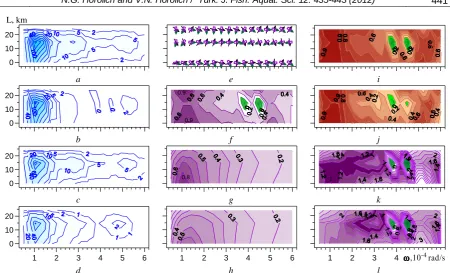
In actual practice, i.e. in case of irregular character of a coastal line and the bottom relief on a shelf, definition of the orientation of the hypothetical (theoretical) coast (Figures 2 and 3), orientation of a rotation ellipse of necessary for definition modeling
of the gradient currents velocity, i.e. the orientation of major axis 1 corresponding to it the symmetric part
of its spectral tensor (see (8)) is a little problematic. The decision of the given problem considerably becomes simpler if to take into consideration that
0 10 20
L, km
a e i
0 10 20
0.9 0.9
b f j
0 10 20
0.8 1
c g k
1 2 3 4 5 6
0 10 20
1 2 3 4 5 6 1 2 3 4 ,10-4rad/s
d h l
Figure 2. Spectral tensor characteristics of the currents velocity on the Kerch shelf of the Black Sea on mooring buoys stations A339 (L=0 km), A341 (L=15 km) and А27 (L=24 km), 16-24 may 1979, horizon 5 m: (a) linear invariant I1, (b) rotation
indicator D, (c) eigenvalues [(c)] 1 and (d) 2 (104 sм2/(rads)) of the empiric spectral tensor, (e) orientation (azimuth) of the
major axis 1 of the empiric spectral tensor of a currents velocity (black vector) and of the supposed mean coastline for the
polarized ellipse of the model gradient currents velocity (lilac vector for R = 0 and green vector for R = 510−5 s−1), (f)
Kc=sign(D)(K +Kd)/2, Kε=(2/1)1/2, Kd=D/21, (g) K0=K (R=0), (h) KR=K (R=510−5 s−1), (i) Kw =Kc /K, (j) Kv=Kd/Kc,
(k) E0=Kc /K0, (l) ER=Kc/KR; А=100 sm2/s.
*The axis L is the distance at which the currents velocity is measured. *See also Figure 3.
36.2 36.3 36.4 36.5 36.6 36.7 44.8
44.9 45.0 45.1
N, degree
E, degree t h e B l a c k S e a
Kerch Strait
A27
A341
A339 the Crim ea Peninsula
Figure 3. Map of the Kerch street shelf of the Black Sea, showing the plot of mooring buoys stations (A27, A331, A343) and orientations (azimuths) of the major axis 1 of the empiric spectral tensor of currents velocity and the supposed mean coastline
for the polarized ellipse of the model gradient currents velocity, 16-24 May 1979, horizon 5 m.
*
442
circumstance that orientation s of the major axis
1() of the symmetric part of the empirical spectral
tensor of the currents velocity should coincide with orientation of the similar axis of the theoretical spectral tensor corresponding to it for the gradient currents velocity at conformity of their similarity criteria. Hence, for definition of orientation of conditional coast to specified orientation s it is
necessary to add the acute angle defined by means of the formula (8).
From the analysis of Figures 2 and 3 follows that inertial fluctuations of the currents velocity in investigated area were generated basically by the long-wave indignations, which spatial scale, apparently, some first hundreds kilometers. Thus reversive fluctuations of an inclination of the level corresponding to given indignations of the currents velocity were carried out on a normal to a general direction of isobaths in investigated area.
Thus, it is established that features of currents on Kerch shelf of the Black sea under certain conditions, basically, can be defined basically at the expense of the given mechanism. Especially impress the results received for inertial fluctuations of currents.
Conclusions
1) Using the proposed semi-spectral linear model of wind currents, the fundamental features of the gradient velocity of currents are investigated at a periodic wind for an infinite shelf with a rectilinear coast and depth changing only normally to it. It is shown that if temporal changes of the level inclination normal to the coast are mainly of a reverse character, the relations between the basic invariants of the spectral tensor of the gradient velocity of currents and the orientation of its large axis (so-called spectral tensor criterion of similarity) do not depend on the level and bottom inclinations and are determined only by depth, vertical coordinate, viscosity, the angle frequency and the Coriolis parameter.
2) By virtue of importance of this criterion, it is suggested to attribute it to important hydrodynamic parameters applied in geophysical hydrodynamics.
3) In the case, if spectral tensor criterion of similarity of the velocity of currents, measured on a separate point (i.e. on separate horizon), corresponds its theoretical value, it is possible to assert that it has a long-wave structure of gradient origin, because it is determined, generally speaking, by superposition of the endless amount of long-wave oscillations of the level inclinations, which have reversible character mainly. It is important to note that here is not required some information about influencing factors.
4) This research will allow, in our view, to carry out already today noticeable advancement in the study of genesis of sea currents, foremost, on a shelf, for example, at creation of atlas of their long-wave structure, optimization of observations, including
organization of their monitoring on stationary platforms, and also perfection of hydrodynamic models.
References
Altman, E.N. 1991. Dynamics of waters of the Kerch Strait. In: F.S. Terziev (Executive ed.), Hydrometeorology and hydrochemistry of the seas of the USSR. Hydrometeorological conditions, Black Sea, Gidrometeoizdat, St Petersburg: 291-323.
Belishev, A.P., Klevantsov, J.P. and Rogkov, V.A. 1983. The Probability Analysis of Sea Currents. Gidrometeoizdat, Leningrad, 263 pp.
Blatov, A.C., Bulgakov, N.P., Ivanov, V.A., Kosarev, A.N. and Tugilkin, V.S. 1984. Variability of Hydrophysical Fields of the Black Sea. Gidrometeoizdat, Leningrad, 231 pp.
Blatov, A.C. and Ivanov, V.A. 1992. Hydrology and Hydrodynamics of a Shelf Zone of the Black Sea. Naukova Dumka, Kiev, 234 pp.
Brink, K.H. 1991. Coastal-Trapped Waves and Wind-Driven Currents over the Continental Shelf. Annu. Rev. Fluid Mech., 223: 380-412.
Calman, J. 1978. On the interpretation of ocean current spectra. J. Phys. Oceanogr., 8: 627-652.
Ekman, V.W. 1905. On the influence of the Earth's rotation on ocean currents. Arkiv Mat., Astron., Phys, 2: 11-53.
Felzenbaum, A.I. 1966. To the theory of periodic currents. Problems of the theory of oceanic currents, Naukova Dumka, Kiev: 5-23.
Fofonoff, N.P. 1969. Spectral characteristics of internal waves in the ocean. Deep-Sea Res., 16: 59-71. Gill, A.E. and Schumann, E.H. 1974. The generation of
long shelf waves by the wind. J. Phys. Oceanogr., 24: 83-90.
Godin, G., Candela, J. and Delapaz-Vela, R. 1981. An analysis and interpretation of current data collected in the Strait of Juan de Fuca in 1973. Mar. Geod., 5: 273-302.
Godin, G. 1983. The Spectra of Point Measurements of Currents: Their Features and Their Interpretation. Atmos-Ocean, 21: 263-284.
Gonella, J.A. 1972. A rotary-component method for analyzing meteorological and oceanographic vector time series. Deep-Sea Res., 19: 833-846.
Hamon, B.V. 1962. The spectrums of mean sea level at Sydney, Coff’s Harboor, and Lord Howe Islands. J. Geophys. Res., 67: 5147-5155 (Correction, 1963, J. Geophys. Res., 71: 4635).
Hamon, B.V. 1966. Continental Shelf Waves and the Effects of Atmospheric Pressure and Wind Stress on Sea Level. J. Geophys. Res., 71: 2883-2893.
Horolich, N.G. 1984. Theoretical model for calculation of time spectra of currents velocity in the homogeneous sea of finite depth. SO GOIN, Sevastopol, 38 pp. Horolich, N.G. 1984. Spatial-temporal spectral model for
calculation of mesoscale currents on a shelf with one-dimensional topography of a bottom. SO GOIN, Sevastopol, 45 pp.
443
Horolich, N.G. 1987. About calculation of spatial-temporal spectra of currents velocity of wind currents on a shelf taking into account a friction. SO GOIN, Sevastopol, 31 pp.
Horolich, N.G. 1991. Modeling of temporary spectra of currents velocity. In: F.S. Terziev (Executive ed.), Hydrometeorology and hydrochemistry of the seas of the USSR. Hydrometeorological conditions, Black Sea, Gidrometeoizdat, St Petersburg: 262-266. Horolich, N.G., Fomin, V.V. and Horolich, V.N. 2008.
About similarity of gradient velocity spectral tensors of wind currents on a shelf. Morskoj Gidrofizicheskij Jurnal, NAN Ukraine, 5: 67-80.
Horolich, N.G., Lomakin, P.D. and Horolich, V.N. 2009. Bispectra of the basic invariants of the spectral tensor of the currents velocity near the Caucasian Black Sea coast. In: V.N. Eremeev (Ed.), Environment control systems: means, models, monitoring, Morskoj Gidrofizicheskij Institut, NAN Ukraini, Sevastopol: 256-265.
Horolich, N.G. and Horolich, V.N. 2011. Method of Detecting the Long-Wavelength Structure of Shelf Currents according to Observations on a Separate Horizon. Thesis, 3rd Bi-annual BS Scientific Conference and UP-GRADE BS-SCENE Project Joint Conference, 1-4 November, Odessa, Ukraine: 86-87. Horolich, N.G. and Horolich, V.N. 2011. Method of
detecting the long-wavelength structure of shelf currents according to observations on a separate
horizon. http: // 81.8.63.74/Downloads/ 3BSCConf/ Posters/HorolichNG.pdf.
Hsieh, W.W. 1982. On the Detection of Continental Shelf Waves. J. Phys. Oceanogr., 5: 414-427.
Ivanov, V.A. and Jankovsky, A.E. 1992. Long-wave movements in the Black Sea. Naukova Dumka, Kiev, 106 pp.
Ivanov, V.A. 1996. Mesoscale fluid dynamics in the southern seas: contemporary views. Morskoj Gidrofizicheskij Institut, NAN Ukraine, Sevastopol, 312 pp.
LeBlond, P.H. and Mysak, L.A. 1978. Waves in the Ocean. Elsevier, New York, 602 pp.
LeBlond, P.H. and Mysak, L.A. 1981. Waves in the Ocean, Mir, Moscow, 480 pp.
Mikhajlova, E.N. 1968. About one way of the accounting of a horizontal exchange of quantity of movement in the theory of the established currents. In: A.G. Kolesnikov (Ed.), Problems of the theory of wind and
thermohaline currents, MGI, AN UkrSSR,
Sevastopol: 137-144.
Mooers, C.N.K. 1973. A technique for the cross spectrum analysis of pairs of complex-valued time series, with emphasis on properties of polarized components and rotational invariants. Deep-Sea Res., 20: 1129-1141. Mysak, L.A. 1980. Recent Advances in Shelf Wave