235
Information Technology and Control 2017/2/46
Anonymous and Authentication
Protocol for Multi-Server
ITC 2/46
Journal of Information Technology and Control
Vol. 46 / No. 2 / 2017 pp. 235-245
DOI 10.5755/j01.itc.46.2.13781 © Kaunas University of Technology
Anonymous and Authentication Protocol for Multi-Server
Received 2015/12/05 Accepted after revision 2017/05/03
http://dx.doi.org/10.5755/j01.itc.46.2.13781
Corresponding author: [email protected]
Wen-Chung Kuo, Po-Wei Shih
Department of Computer Science and Information Engineering, National Yunlin University of Science and Technology, e-mail: [email protected]
Yu-Chih Huang
Department of Information Management, Tainan University of Technology, Taiwan, R.O.C.
Lih-Chyau Wuu
Department of Computer Science and Information Engineering, National Yunlin University of Science and Technology
In a multi-server environment, when a user wants to login to a different server to access services, he/she needs to register another user identity and password. Recently, the single sign-on authentication method has been pro-posed. The major characteristic of this method is that a user only needs to remember one identity and password which can login to different servers. This reduces user inconvenience and server resource usage. On the other hand, anonymity is an important issue. If a user’s identity is disclosed, an attacker can trace or masquerade as the user to login servers. Preventing disclosure of the user’s identity is very important. In this paper, we will pro-pose an anonymous and single sign-on authentication scheme based on Lagrange interpolating polynomial for a multi-server environment. According to our security analysis, this proposed scheme maintains anonymity, pro-vides mutual authentication and also resists many attacks such as lost smart card, insider attack and replay attack.
KEYWORDS: Anonymous, mutual authentication, memory consumes, Lagrange interpolating polynomial, re-play attack.
Introduction
In recent years, people have used modern
technol-ogies such as e-mail, Twitter, Facebook, etc. to com- municate to each other over the Internet. However, users should use different identities and passwords for different services. Naturally, it is difficult to re-member many different identities and passwords. In
Information Technology and Control 2017/2/46 236
order to alleviate this problem, many authentica-tion schemes based on different methodologies such as password [3, 4], smart card [2, 8, 9], or one-way hash function [7] have been proposed. In 2003, Lee
et al. [3] proposed password authentication scheme
(LKH- scheme). The major contribution of this scheme is that two points are used to generate one linear equation and then the characteristics of equa-tion are used to authenticate the user.
The use of linear equations to replace traditional en-cryption can reduce com- puting cost and transmis-sion quantity for authentication. Therefore, in 2010, Liaw et al. [4] proposed an efficient password au-thentication scheme based on a geometric approach for multi-server environments. Different from the above, their proposed authentication scheme uses a 2-dimensional plane and 3-dimensional space coor-di- nates to achieve authentication. Although these schemes [3, 4] can achieve mutual authentication between user and server, they cannot provide user anonymity on a public network.
In order to achieve user anonymity, we propose an anonymous and single sign-on authentication scheme based on Lagrange interpolating polynomial for multi-server environments in this paper. In other words, a user only needs to remember one identity and password to be able to login to different servers. Each server does not save the user’s login informa-tion during authenticainforma-tion phase. This can reduce the usage of server resources. According to the secu-rity analysis, user anonymity is an important issue. If a user identity is disclosed, an attacker can trace or masquerade as the user to gain access to servers. Thus, we use linear equations to hide user identity and use the Lagrange interpolating polynomial to authenticate the user and server identities. Addi-tionally, our scheme can address lost smart cards, resist replay attack and provide mutual authentica-tion.
The rest of the paper is organized as follows: in Section 2, we review the Lagrange interpolating polynomial and Lee et al.’s scheme. Next, we pro-pose an anonymous and single sign-on protocol for multi-server environments and then discuss securi-ty analysis in Sections 3 and 4, respectively. Finally, we draw some conclusions in Section 5.
Related work review
The Lagrange interpolating polynomial
The Lagrange interpolating polynomial [10] is the polynomial P(x) of degree ≠ (n–1) that passes through
n points, and is given by Eq.(1),
��(�) � ��∏� ���������
������� (1)
where is the Lagrange polynomial, and xj and yj are
the x-value and y-value of point (xj, yj), respectively. In
our scheme, we use the Lagrange interpolating poly-nomial on modulus system.
The password authentication scheme
In 2003, a password authentication scheme based on a geometric approach was proposed by Lee et al. [3]. The major contribution of the LKH-scheme is not having to remember different identities and pass-words for various servers. There are four phases in the LKH-scheme: (1) the registration phase, (2) the login phase, (3) the authentication phase and (4) password key update. The notations and symbols used in the LKH-scheme are shown in Table 1.
Table 1
Notations and symbols
Notation Definition
Ui The ith user
Γ={S1, S2, . . . , Sm} A set of servers that Uiwould like to login to
IDi Unique identity of Ui PWi Password of Ui
(xj, yj) The secret points of server Sj
T Timestamp
L Linear equation
⊕ XOR operation
h(·) One-way hash function
The registration phase
Step LKH-R1. Ui→Trusted Manager: IDi, PWi
In this step, Ui sends his IDi and PWi to the trusted
manager.
237
Information Technology and Control 2017/2/46
After receiving the message from Ui, the trusted
man-ager calculates (Xij, Yij ) and (Cij, Dij) where Xij = h(IDi ⊕ xj), Yij = h(IDi⊕yj), Cij = Xij⊕PWi and Dij = Yij⊕ PWi. Then, the trusted manager stores the message
{IDi, (Cij, Dij)} in a smart card and gives it to Ui. The login phase
Step LKH-L1.Ui→Reader: PWi
In this step, Uiinserts the smart card into a reader and
enters PWito obtain (Xij, Yij ) by computing Xij= Cij⊕ PWiand Yij= Dij ⊕ PWi.
Step LKH-L2. Reader → Ui: {Aij, Bij, Ri, Ti}
Smart card generates two random numbers αiand βi. Uiutilizes (αi, βi) and (Xij, Yij) to generate Lij : y = fij(x) = aijx + bij mod p and calculates Aij= aij ⊕Xij, Bij = bij⊕Yij
and Ri= h(IDi||aij ||bij||Ti)), where Tiis the timestamp
of the Ui.
Step LKH-L3.Ui → Sj: {IDi, Aij, Bij, Ri, Ti} Ui forwards {IDi, Aij, Bij, Ri, Ti} to Sj. The authentication phase
Step LKH-A1. Ui→ Sj: {IDi, Aij, Bij, Ri, Ti}
After receiving the message from Ui, Sjchecks IDiand
verifies whether |T – Ti| ≠ ∆T, where T is the current
time on Sj and ∆T is the expected time interval for
transmission delay and clock offset error. If the time is within the expected range, Sjuses secret points (xj, yj)and IDito obtain (Xij, Yij). Then (aij, bij) is recovered
by using aij = Aij⊕Xij and bij = Bij⊕Yij. Then, Sj
calcu-lates Ri= h(IDi||aij||bij||Ti)) and checks whether R'i is equal to Ri. If R'i= Ri, then Lij = fij(x) = aijx + bijmodpcan
be reconstructed. This allows Sjto check whether (Xij, Yij) is located on line Lij .
Step LKH-A2.Sj→ Ui: {SIDj, Rj, Tj }
If Uiis authenticated, then Sjcalculates Rj = h(SIDj, h(aij), h(bij), Tj) and forwards {SIDj, Rj, Tj } to Ui. Step LKH-A3. When Uireceives the message from Sj, Uiuses SIDjand Tj to calculate R'j = h(SIDj, h(aij), h(bij, Tj). Then Uichecks whether R'j is equal to Rj. If
so, then Uiand Sjcan achieve mutual authentication. The password update phase
If Ui wants to change his/her password, he/she
can enter PWiinto the smart card to obtain (Xij, Yij).
Then, Uienters a new password PWnewto calculate C'ij = Xij ⊕ PWnewand Dij = Yij ⊕ PWnew . Finally, the new
secret information {IDi, (C'ij, D'ij)} is saved into the
smart card. Afterwards, Uican access the system
us-ing his/her new password PWnew.
Lee et al.[3] uses a geometric approach to propose an-other encryption method to reduce computing cost and memory use. However, their method cannot pro-vide user anonymity. We extend their contribution by incorporating anonymity in our scheme and propose an anonymous authentication protocol in the next section.
The Proposed Scheme
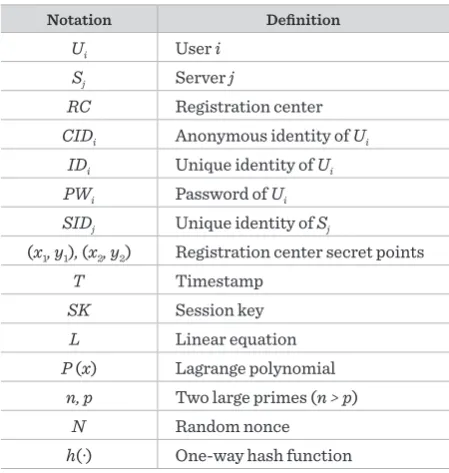
This section proposes an anonymous authentica-tion scheme for a multi-server environment. We assume that there are three entities in this scheme: registration center (RC), user (U), and server (S) in this scheme. The scheme includes the following four phases: (1) the registration phase; (2) the login phase; (3) the authentication phase and (4) the session key update phase. It is assumed that time is synchronous and information from smart card cannot be obtained through forced attacks. The notations and symbols used in the proposed scheme are shown in Table 2.
Table 2
Notations and symbols in our proposed scheme
Notation Definition
Ui User i
Sj Server j
RC Registration center CIDi Anonymous identity of Ui
IDi Unique identity of Ui PWi Password of Ui SIDj Unique identity of Sj
(x1, y1), (x2, y2) Registration center secret points
T Timestamp
SK Session key
L Linear equation
P (x) Lagrange polynomial n, p Two large primes (n > p)
N Random nonce
Information Technology and Control 2017/2/46 238
The registration phase
Preceding the registration phase, RC randomly choo-ses a 2D point (x1, y1) and a Lagrange polynomial P (x):
y = ix2 + jx + k mod n and then determines a point (x 2, y2) so that y2 = ix2 + jx
2 + k mod n.
The user registration subphase
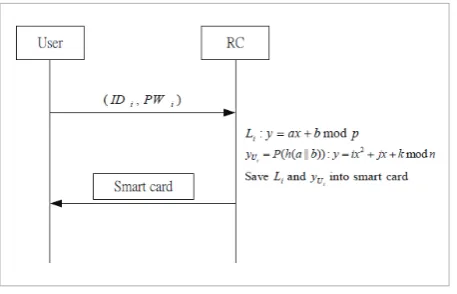
The user registration interaction sequence is depict-ed in Fig.1. An explanation of various messages and steps in this subphase is given below.
Step RU1. Ui→ RC : IDi, PWi
To register, Ui selects a password PWi and then sends IDiand PWito RC through a secure channel.
Step RU2. RC → Ui: Li: y = ax + b mod p and yUi.
After receiving a registration request from Ui, RC
uses (x1, y1) and (IDi, PWi) to generate linear equation Li : y = ax + b mod p and calculates hash value h(a||b).
Then, the hash value h(a||b) is substituted into the Lagrange polynomial P (x) : y = ix2 + jx + k mod n to generate the corresponding value yUi. Next, RC saves
h(a||b) and yUiin its database. Finally, linear equation
Liand value yUiare embedded into the smart card and
sent to Uithrough a secure channel.
Figure 1
Interaction sequence of the user registration subphase
The server registration subphase
The server registration interaction sequence is de-picted in Fig.2. An explanation of various messages and steps in this subphase is provided below.
Step RS1.Sj → RC : SIDj, Nj
Sjselects a random nonce Njand then sends SIDjand Njto RC through a secure channel.
Step RS2. RC → Sj : Lj : y = cx + d mod p and ySj.
After receiving the registration request from Sj, RC
uses (x1, y1) and (SIDj, Nj) to generate linear
equa-tion Lj: y = cx + d mod p and calculates a hash value h(c||d). Then, RC substitutes h(c||d) into the Lagrange polynomial P (x) : y = ix2 + jx + k mod n to generate corresponding value ySj, i.e. ySj = P (h(c||d)). Finally,
RC saves (SIDj, Nj, h(c||d)) and ySjin its database and
sends Ljand ySjto Sjthrough a secure channel.
Figure 2
Interaction sequence of the server registration subphase
The login phase
When Ui wants to login to Sj, he inserts his smart card
and enters his identity IDiand password PWi.
Step L1. The smart card checks (IDi, PWi) if the linear
equation function Li: y = ax + b mod p, i.e. PWi= a ∗ IDi + b mod p. If it is correct, then it generates a
ran-dom point (xi, yi) that is on the linear equation Liand
a random nonce Ni to calculate CIDi= h(a||b||Ni||Ti)
and M1 = a ⊕ b ⊕ Ni. Otherwise, the smart card rejects
the request.
Step L2.Uiforwards {CIDi, (xi, yi), M1, Ti} to Sj, where Tiis the timestamp of the Ui.
The authentication phase
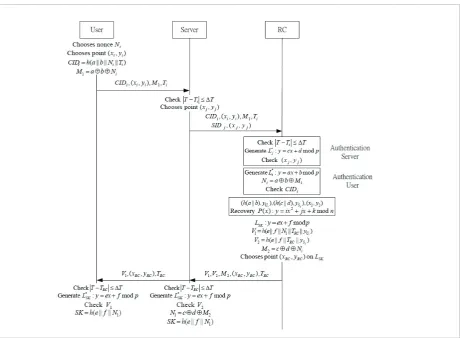
The authentication phase interaction sequence is de-picted in Fig.3. Following is an explanation of various messages and steps in this phase. When Sj receives the messages {CIDi, (xi, yi), M1, Ti} from Ui, the
follow-ing steps are executed.
Step A1.Sj → RC : {CIDi, (xi, yi), M1, Ti, SIDj, (xj, yj)}
To prevent a replay attack, Sj ensures |T − Ti|is not
greater than ∆T , where T is the current time on Sj
ter-239
Information Technology and Control 2017/2/46
minates the session. Otherwise, Sjproduces a random
point (xj, yj) on the linear equation Lj : y = cx+d mod p,
i.e., yj = cxj+d mod p and forwards {CIDi, (xi, yi), M1, Ti, SIDj, (xj, yj)}to RC.
Step A2.RC → Sj: {V1, V2, M2, (xRC, yRC), TRC}
When RC receives message {CIDi, (xi, yi), M1, Ti, SIDj,
(xj, yj)}from Sj, RC performs the following steps. 1 RC checks whether |T − Ti| ≠ ∆T. If it is true, RC
then uses SIDjto find the corresponding random
nonce Njfrom the database.
2 RC utilizes the point (x1, y1) and (SIDj, Nj) to
gener-ate L*j : y=cx + dmodp.
3 RC checks if (xj, yj) exists in Lj. If it does not
ex-ist, then RC terminates the session. Otherwise,
RC utilizes points (xj, yj ) and (x1, y1) to recover
L*i : y = ax + bmodp and calculate Ni = a ⊕ b ⊕ M1 and CID*i = h(a||b||Ni||Ti).
4 RC checks if CID*i is equal to CIDi. If the values are
equal, then RC uses Liand Ljto calculate hash
val-ues h(a||b) and h(c||d) to recover the corresponding
yUi and ySj values.
5 RC uses the three points (h(a||b), yUi), (h(c||d), ySj)
and (x2, y2) to recover the Lagrange polynomial P (x) : y = ix2 + jx + k mod n. If it cannot be recovered, then the request is rejected. Otherwise, RC utilizes (h(a||b), yUi) and (h(c||d), ySj) to generate the linear equation LSK: y = ex + f mod p and then selects a
ran-dom point (xRC, yRC) on LSK.
6 RC computes M2 = c⊕d⊕Ni, V1 = h(e||f ||Ni||TRC|| yUi) and V2 = h(e||f ||Ni||TRC|| ySj). Finally, RC sends
{V1, V2, M2, (xRC, yRC), TRC}to Sj. Step A3.Sj → Ui: {V1, (xRC, yRC), TRC}
After receiving the message {V1, V2, M2, (xRC, yRC), TRC}
from RC, Sjexecutes the following steps.
Figure 3
Information Technology and Control 2017/2/46 240
Sj uses (h(c||d), ySj) and (xRC, yRC) to generate L*SK : y = ex + f mod p when |T − TRC| ≠ ∆T.
Sjchecks whether V*2 is equal to V2. If so, then Sj
calcu-lates Ni= c⊕d⊕M2. Sjcalculates the session key SK = h(e||f ||Ni) and forwards {V1, (xRC, yRC), TRC}to Ui. Step A4. When Uireceives {V1, (xRC, yRC), TRC } from Sj , Uichecks whether |T − Ti| ≠ ∆T. If they are not
equal, Uiuses (h(a||b), yUi) and (xRC, yRC) to recover L*SK : y = ex + f mod p and check whether V*1 is equal to
V1. If they are equal, then Uicalculates the session key SK = h(e||f ||Ni).
The session key update phase
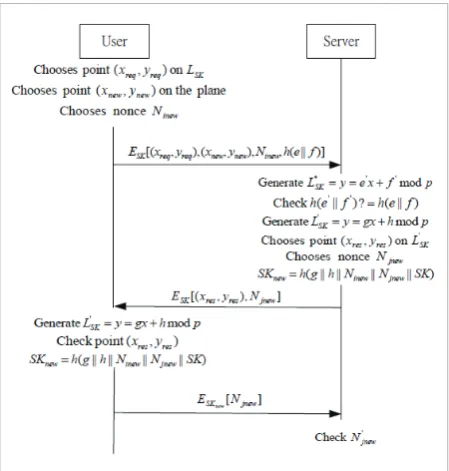
When the user wants to update the session key with the server, he/she can get a new session SKnewby using
the below listed steps. The session key update inter-action sequence is depicted in Fig.4.
Step U1.Ui → Sj: ESK[(xreq, yreq), (xnew, ynew), Ninew, h(e||f)] Uiselects two points (xreq, yreq) and (xnew, ynew) on a
plane where (xreq, yreq) lies on the linear equation Lsk: y = ex + f mod p. Then, Uicalculates h(e||f) and selects
a random nonce Ninew. Finally, Uiutilizes session key SK to encrypt the message {(xreq, yreq), (xnew, ynew), Ninew, h(e||f)}and sends it to Sj.
Step U2.Sj→ Ui: ESK[(xres, yres), Njnew]
When Sjreceives messages ESK[(xreq, yreq), (xnew, ynew), Ninew, h(e||f)] from Ui, Sjexecutes the following steps. 1 Sjdecrypts message ESK[(xreq, yreq), (xnew, ynew), Ninew,
h(e||f )].
2 Sjuses (h(c||d), ySj) and (xreq, yreq) to recover L*SK: y = e'x + f'mod p .
3 Sj calculates temp = h(e||f ) and checks whether temp is equal to h(e||f ). If equal, Sjutilizes (xreq, yreq)
and (xnew, ynew) to generate new linear equation L'SK : y = gx +h mod p and new random nonce Njnew. 4 Sjsends message ESK[(xres, yres), Njnew] to Ui, where
the point (xres, yres) is on the linear equation L'SK.
Finally, Sj computes the new session key SKnew = h(g||h||Ninew||Njnew||SK).
Step U3.Ui → Sj: ESKnew[Njnew]
Similarly, Uiwill perform the following steps when Ui
receives the message ESK[(xres, yres), Njnew] from Sj. 1 Ui decrypts the message and verifies if
yres = g ∗ xres + h mod p for (xres, yres).
2 If true, Ui generates a new session key SKnew= h(g||h||Ninew ||Njnew||SK) and uses SKnewto encrypt Njnew to send it to Sj . Otherwise, the request is
dropped.
Step U4. After Sjreceives the message ESKnew[Njnew], Sj uses the new session key SKnewto recover N'jnew and
checks if it is equal to the original Njnew. If it holds, the
server updates to the new session key.
Security analysis
In this section, we discuss the security of our scheme against various attacks and use the Burrows-Aba-di-Needham Logic (a.k.a BAN Logic) [1] mechanism to prove that the session key can be correctly updated between the user and server in the session key update process.
The authentication phase proof
We use the BAN-logic to show that our scheme cor-rectly updates between the user and the server. Let
X and Y represent the range over statements. For the BAN-logic, the logical notations of the logic are given in Table 3.
Figure 4
241
Information Technology and Control 2017/2/46
Furthermore, we also define some logical postulates that we will use in the proofs as follows:
Table 3
The logical notation
Items Explanation
j iS KS
U Ui and Sj share a session key. X
Ui |≡ Ui believes a statement X. )
(
# X X is fresh.
X
Ui ⇒ Ui controls X. X
Ui Ui receives X.
X
Ui |~ Ui sends X.
K
Y X, ]
[ X and Y are encrypted with the key K.
1. The Message-meaning rule
X Q P Q P P X P K |~ | SK | , ] [ (2) ) , ( # | ) ( # | Y X P X P
(3)
X Q P X P X Q P | | ) ( # | , |~
| (4)
X P X Q P X Q P | | , | | (5) ) , ( ), , ( | :
G1 RC xi yi xj yj (6)
) , ( | :
G2 Sj xRC yRC (7)
) , ( | :
G3 Ui xRC yRC (8)
(2)
If principal P believes that key K is shared with prin-cipal Q and P receives message X that is encrypted un-der K, then principal P believes that principal Q sent the statement X.
2. The Fresh concatenation rule X Q P Q P P X P K |~ | SK | , ] [ (2) ) , ( # | ) ( # | Y X P X P
(3)
X Q P X P X Q P | | ) ( # | , |~
| (4)
X P X Q P X Q P | | , |
| (5)
) , ( ), , ( | :
G1 RC xi yi xj yj (6)
) , ( | :
G2 Sj xRC yRC (7)
) , ( | :
G3 Ui xRC yRC (8)
(3)
If principal P believes the freshness of statement X, then principal P believes the freshness of (X, Y).
3. The Nonce-verification rule X Q P Q P P X P K |~ | SK | , ] [ (2) ) , ( # | ) ( # | Y X P X P
(3)
X Q P X P X Q P | | ) ( # | , |~
| (4)
X P X Q P X Q P | | , | | (5) ) , ( ), , ( | :
G1 RC xi yi xj yj (6) )
, ( | :
G2 Sj xRC yRC (7)
) , ( | :
G3 Ui xRC yRC (8)
(4)
If principal P believes that statement X was not stated before and principal Q sent the statement X, then prin-cipal P believes that principal Q believes statement X.
4. The Jurisdiction rule X Q P Q P P X P K |~ | SK | , ] [ (2) ) , ( # | ) ( # | Y X P X P
(3)
X Q P X P X Q P | | ) ( # | , |~
| (4)
X P X Q P X Q P | | , |
| (5)
) , ( ), , ( | :
G1 RC xi yi xj yj (6)
) , ( | :
G2 Sj xRC yRC (7)
) , ( | :
G3 Ui xRC yRC (8)
(5)
If principal P believes that statement X is under prin-cipal Q’s jurisdiction, then principal P believes princi-pal Q on the validity of statement X.
Next, we show that our scheme should satisfy the fol-lowing requirements: X Q P Q P P X P K |~ | SK | , ] [ (2) ) , ( # | ) ( # | Y X P X P
(3)
X Q P X P X Q P | | ) ( # | , |~
| (4)
X P X Q P X Q P | | , |
| (5)
) , ( ), , ( | :
G1 RC xi yi xj yj (6) )
, ( | :
G2 Sj xRC yRC (7) )
, ( | :
G3 Ui xRC yRC (8) (6) X Q P Q P P X P K |~ | SK | , ] [ (2) ) , ( # | ) ( # | Y X P X P
(3)
X Q
P X P X
Q P | | , | #( ) |~
| (4)
X P X Q P X Q P | | , |
| (5)
) , ( ), , ( | :
G1 RC xi yi xj yj (6)
) , ( | :
G2 Sj xRC yRC (7)
) , ( | :
G3 Ui xRC yRC (8)
(7) X Q P Q P P X P K |~ | SK | , ] [ (2) ) , ( # | ) ( # | Y X P X P
(3)
X Q
P X P X
Q P | | ) ( # | , |~
| (4)
X P X Q P X Q P | | , | | (5) ) , ( ), , ( | :
G1 RC xi yi xj yj (6) )
, ( | :
G2 Sj xRC yRC (7) )
, ( | :
G3 Ui xRC yRC (8)(8)
Before we analyze the proposed protocol, we trans-form to the idealized trans-form and identify the initial state of our scheme. The initial state is assumed to be the following:
RC |
:
A1 Ui UiyUi (9)
) ( # | :
A2 Ui TRC (10)
RC) (
| :
A3 Ui RC UiyUi (11)
RC |
:
A4 Sj Sj ySj (12)
) ( # | :
A5 Sj TRC (13)
RC) (
| :
A6 Sj RC Sj ySj (14)
RC |
:
A7 RC SjLj (15)
RC |
:
A8 RCUiLi (16)
RC) (
| :
A9 RC Sj SjLj (17)
RC) (
| :
A10 RCUi UiLi (18)
) T ( # | :
A11 RC i (19)
i i j j i
j (x,y ),(x ,y )T S
RC| |~ , (20)
(x,y ),(x ,y )
RC|# i i j j (21)
(x,y ),(x ,y )
S
RC| j| i i j j (22)
) , ( ), , ( | :
G1 RC xi yi xj yj
RC RC RC
j RC x y T
S | |~( , ), (23)
) y , (x RC
Sj| | RC RC (24)
) , ( | :
G2 Sj xRC yRC
(9)
RC |
:
A1 Ui Ui yUi (9)
) ( # | :
A2 Ui TRC (10)
RC) (
| :
A3 Ui RC Ui yUi (11)
RC |
:
A4 Sj SjySj (12)
) ( # | :
A5 Sj TRC (13)
RC) (
| :
A6 Sj RC SjySj (14)
RC |
:
A7 RC SjLj (15)
RC |
:
A8 RCUiLi (16)
RC) (
| :
A9 RC Sj SjLj (17)
RC) (
| :
A10 RCUi UiLi (18)
) T ( # | :
A11 RC i (19)
i i j j i
j (x,y ),(x ,y )T S
RC| |~ , (20)
(x,y ),(x ,y )
RC|# i i j j (21)
(x,y ),(x ,y )
S
RC| j| i i j j (22)
) , ( ), , ( | :
G1 RC xi yi xj yj
RC RC RC
j RC x y T
S | |~( , ), (23)
) y , (x RC
Sj| | RC RC (24)
) , ( | :
G2 Sj xRC yRC
(10) RC)
( |
:
A3 Ui RC UiyUi (11)
RC |
:
A4 Sj SjySj (12)
) ( # | :
A5 Sj TRC (13)
RC) (
| :
A6 Sj RC SjySj (14)
RC |
:
A7 RC SjLj (15)
RC |
:
A8 RCUiLi (16)
RC) (
| :
A9 RC Sj SjLj (17)
RC) (
| :
A10 RCUiUiLi (18)
) T ( # | :
A11 RC i (19)
i i j j i
j (x,y ),(x ,y )T S
RC| |~ , (20)
(x,y ),(x ,y )
RC|# i i j j (21)
(x ,y ),(x ,y )
SRC| j| i i j j (22)
) , ( ), , ( | :
G1 RC xi yi xj yj
RC RC RC
j RC x y T
S | |~( , ), (23)
) y , (x RC
Sj| | RC RC (24)
) , ( | :
G2 Sj xRC yRC
(11) RC
| :
A4 Sj Sj ySj (12)
) ( # | :
A5 Sj TRC (13)
RC) (
| :
A6 Sj RC Sj ySj (14)
RC |
:
A7 RC SjLj (15)
RC |
:
A8 RCUiLi (16)
RC) (
| :
A9 RC Sj SjLj (17)
RC) (
| :
A10 RCUi UiLi (18)
) T ( # | :
A11 RC i (19)
i i j j i
j (x,y ),(x ,y )T S
RC| |~ , (20)
(x,y ),(x ,y )
RC|# i i j j (21)
(x,y ),(x ,y )
SRC| j| i i j j (22)
) , ( ), , ( | :
G1 RC xi yi xj yj
RC RC RC
j RC x y T
S | |~( , ), (23)
) y , (x RC
Sj| | RC RC (24)
) , ( | :
G2 Sj xRC yRC
(12)
RC |
:
A4 Sj Sj ySj (12)
) ( # | :
A5 Sj TRC (13)
RC) (
| :
A6 Sj RC Sj ySj (14)
RC |
:
A7 RC SjLj (15)
RC |
:
A8 RCUiLi (16)
RC) (
| :
A9 RC Sj SjLj (17)
RC) (
| :
A10 RCUi UiLi (18)
) T ( # | :
A11 RC i (19)
i i j j i
j (x,y ),(x ,y )T S
RC| |~ , (20)
(x,y ),(x ,y )
RC|# i i j j (21)
(x,y ),(x ,y )
SRC| j| i i j j (22)
) , ( ), , ( | :
G1 RC xi yi xj yj
RC RC RC
j RC x y T
S | |~( , ), (23)
) y , (x RC
Sj| | RC RC (24)
) , ( | :
G2 Sj xRC yRC
(13) RC
| :
A4 Sj SjySj (12)
) ( # | :
A5 Sj TRC (13)
RC) (
| :
A6 Sj RC SjySj (14)
RC |
:
A7 RC SjLj (15)
RC |
:
A8 RCUiLi (16)
RC) (
| :
A9 RC Sj SjLj (17)
RC) (
| :
A10 RCUi UiLi (18)
) T ( # | :
A11 RC i (19)
i i j j i
j (x,y ),(x ,y )T S
RC| |~ , (20)
(x,y ),(x ,y )
RC|# i i j j (21)
(x,y ),(x ,y )
S
RC| j| i i j j (22)
) , ( ), , ( | :
G1 RC xi yi xj yj
RC RC RC
j RC x y T
S | |~( , ), (23)
) y , (x RC
Sj| | RC RC (24)
) , ( | :
G2 Sj xRC yRC
(14)
RC |
:
A4 Sj SjySj (12)
) ( # | :
A5 Sj TRC (13)
RC) (
| :
A6 Sj RC SjySj (14)
RC |
:
A7 RC SjLj (15)
RC |
:
A8 RCUiLi (16)
RC) (
| :
A9 RC Sj SjLj (17)
RC) (
| :
A10 RCUi UiLi (18)
) T ( # | :
A11 RC i (19)
i i j j i
j (x,y ),(x ,y )T S
RC| |~ , (20)
(x,y ),(x ,y )
RC|# i i j j (21)
(x,y ),(x ,y )
SRC| j| i i j j (22)
) , ( ), , ( | :
G1 RC xi yi xj yj
RC RC RC
j RC x y T
S | |~( , ), (23)
) y , (x RC
Sj| | RC RC (24)
) , ( | :
G2 Sj xRC yRC
(15) RC
| :
A4 Sj SjySj (12)
) ( # | :
A5 Sj TRC (13) RC)
( |
:
A6 Sj RC Sj ySj (14)
RC |
:
A7 RC SjLj (15)
RC |
:
A8 RCUiLi (16) RC)
( | :
A9 RC Sj SjLj (17)
RC) (
| :
A10 RCUi UiLi (18) ) T ( # | :
A11 RC i (19)
i i j j i
j (x,y ),(x ,y )T S
RC| |~ , (20)
(x,y ),(x ,y )
RC|# i i j j (21)
(x,y ),(x ,y )
SRC| j| i i j j (22)
) , ( ), , ( | :
G1 RC xi yi xj yj
RC RC RC
j RC x y T
S | |~( , ), (23)
) y , (x RC
Sj| | RC RC (24)
) , ( | :
G2 Sj xRC yRC
(16)
RC |
:
A4 Sj SjySj (12)
) ( # | :
A5 Sj TRC (13)
RC) (
| :
A6 Sj RC SjySj (14)
RC |
:
A7 RC SjLj (15)
RC |
:
A8 RCUiLi (16)
RC) (
| :
A9 RC Sj SjLj (17)
RC) (
| :
A10 RCUi UiLi (18)
) T ( # | :
A11 RC i (19)
i i j j i
j (x,y ),(x ,y )T S
RC| |~ , (20)
(x,y ),(x ,y )
RC|# i i j j (21)
(x,y ),(x ,y )
SRC| j| i i j j (22)
) , ( ), , ( | :
G1 RC xi yi xj yj
RC RC RC
j RC x y T
S | |~( , ), (23)
) y , (x RC
Sj| | RC RC (24)
) , ( | :
G2 Sj xRC yRC
(17) RC
| :
A4 Sj Sj ySj (12)
) ( # | :
A5 Sj TRC (13)
RC) (
| :
A6 Sj RC Sj ySj (14)
RC |
:
A7 RC SjLj (15)
RC |
:
A8 RCUiLi (16)
RC) (
| :
A9 RC Sj SjLj (17)
RC) (
| :
A10 RCUi UiLi (18)
) T ( # | :
A11 RC i (19)
i i j j i
j (x,y ),(x ,y )T SRC| |~ , (20)
(x,y ),(x ,y )
RC|# i i j j (21)
(x,y ),(x ,y )
SRC| j| i i j j (22)
) , ( ), , ( | :
G1 RC xi yi xj yj
RC RC RC
j RC x y T
S | |~( , ), (23)
) y , (x RC
Sj| | RC RC (24)
) , ( | :
G2 Sj xRC yRC
(18) RC
| :
A4 Sj Sj ySj (12)
) ( # | :
A5 Sj TRC (13)
RC) (
| :
A6 Sj RC SjySj (14)
RC |
:
A7 RC SjLj (15)
RC |
:
A8 RCUiLi (16)
RC) (
| :
A9 RC Sj SjLj (17)
RC) (
| :
A10 RCUi UiLi (18)
) T ( # | :
A11 RC i (19)
i i j j i
j (x,y ),(x ,y )T S
RC| |~ , (20)
(x,y ),(x ,y )
RC|# i i j j (21)
(x,y ),(x ,y )
SRC| j| i i j j (22)
) , ( ), , ( | :
G1 RC xi yi xj yj
RC RC RC
j RC x y T
S | |~( , ), (23)
) y , (x RC
Sj| | RC RC (24)
) , ( | :
G2 Sj xRC yRC
(19)
Now, we use the initial assumptions and the rules of the BAN-logic to analyze the idealized form of our scheme. The proofs are described as follows:
1 By A7, A8 and �� ⊲ ((��, ��), (��, �� ), ��), we apply
the message-meaning rule to derive RC
| :
A4 Sj SjySj (12)
) ( # | :
A5 Sj TRC (13)
RC) (
| :
A6 Sj RC SjySj (14)
RC |
:
A7 RC SjLj (15)
RC |
:
A8 RCUiLi (16)
RC) (
| :
A9 RC Sj SjLj (17)
RC) (
| :
A10 RCUi UiLi (18)
) T ( # | :
A11 RC i (19)
i i j j i
j (x,y ),(x ,y )T S
RC| |~ , (20)
(x,y ),(x ,y )
RC|# i i j j (21)
(x,y ),(x ,y )
SRC| j| i i j j (22)
) , ( ), , ( | :
G1 RC xi yi xj yj
RC RC RC
j RC x y T
S | |~( , ), (23)
) y , (x RC
Sj| | RC RC (24)
) , ( | :
G2 Sj xRC yRC
(20)
Information Technology and Control 2017/2/46 242
RC |
:
A4 Sj Sj ySj (12)
) ( # | :
A5 Sj TRC (13)
RC) (
| :
A6 Sj RC Sj ySj (14)
RC |
:
A7 RC SjLj (15)
RC |
:
A8 RCUiLi (16)
RC) (
| :
A9 RC Sj SjLj (17)
RC) (
| :
A10 RCUi UiLi (18)
) T ( # | :
A11 RC i (19)
i i j j i
j (x,y ),(x ,y )T S
RC| |~ , (20)
(x,y ),(x ,y )
RC|# i i j j (21)
(x,y ),(x ,y )
SRC| j| i i j j (22)
) , ( ), , ( | :
G1 RC xi yi xj yj
RC RC RC
j RC x y T
S | |~( , ), (23)
) y , (x RC
Sj| | RC RC (24)
) , ( | :
G2 Sj xRC yRC
(21)
3 By Eq.(20) and (21), we apply the nonce-verification rule to derive
RC |
:
A4 Sj SjySj (12)
) ( # | :
A5 Sj TRC (13)
RC) (
| :
A6 Sj RC SjySj (14)
RC |
:
A7 RC SjLj (15)
RC |
:
A8 RCUiLi (16)
RC) (
| :
A9 RC Sj SjLj (17)
RC) (
| :
A10 RCUi UiLi (18) ) T ( # | :
A11 RC i (19)
i i j j i
j (x,y ),(x ,y )T S
RC| |~ , (20)
(x,y ),(x ,y )
RC|# i i j j (21)
(x,y ),(x ,y )
S
RC| j| i i j j (22)
) , ( ), , ( | :
G1 RC xi yi xj yj
RC RC RC
j RC x y T
S | |~( , ), (23)
) y , (x RC
Sj| | RC RC (24)
) , ( | :
G2 Sj xRC yRC
(22)
4 By A9, A10 and Eq.(22), we apply the jurisdiction rule to derive Eq.(6): ) , ( ), , ( | :
G1 RC xi yi xj yj
RC RC RC
j RC x y T
S | |~( , ), (23)
) y , (x RC
Sj| | RC RC (24)
) , ( | :
G2 Sj xRC yRC
5 By A4 and �� ⊲ �(���, ���), ����, we apply the
mes-sage-meaning rule to derive ) , ( ), , ( | :
G1 RC xi yi xj yj
RC RC RC
j RC x y T
S | |~( , ), (23)
) y , (x RC
Sj| | RC RC (24)
) , ( | :
G2 Sj xRC yRC
(23)
6 By A5 and Eq.(23), we apply the fresh concatenation rule and nonce-verification rule to derive
) , ( ), , ( | :
G1 RC xi yi xj yj
RC RC RC
j RC x y T
S | |~( , ), (23)
) y , (x RC
Sj| | RC RC (24)
) , ( | :
G2 Sj xRC yRC
(24)
7 By A6 and Eq.(24), we apply the jurisdiction rule to de-rive Eq.(7): ) , ( ), , ( | :
G1 RC xi yi xj yj
RC RC RC
j RC x y T
S | |~( , ), (23)
) y , (x RC
Sj| | RC RC (24)
) , ( | :
G2 Sj xRC yRC
8 By A1 and �� ⊲ �(���, ���), ����, we apply the
mes-sage-meaning rule to derive
RC RC RC
i RC x y T
U | |~( , ), (25)
) y , (x RC
Ui| | RC RC (26)
) , ( | :
G3 Ui xRC yRC (27)
(25)
9 By A2 and Eq.(25), we apply the fresh concatenation rule and nonce-verification rule to derive
RC RC RC
i RC x y T
U | |~( , ), (25)
) y , (x RC
Ui| | RC RC (26)
) , ( | :
G3 Ui xRC yRC (27)
(26)
10 By A3 and Eq.(26), we apply the jurisdiction rule to de-rive Eq.(8).
RC RC RC
i RC x y T
U | |~( , ), (25)
) y , (x RC
Ui| | RC RC (26)
) , ( | :
G3 Ui xRC yRC (27) (27)
The security analysis
In this subsection, we discuss the resiliency of our pro-posed scheme against some common attacks such as replay attack, lost or stolen smart card attack, and im-personation attack, while providing mutual authenti-cation and user anonymity.
Resistance to replay attack
Since the transmitted messages CIDi, V1 and V2 in-clude timestamps, the server and user can detect a replay attack directly. If an attacker re-submits the intercepted message, the attacker must choose a suit-able time interval ∆T and modify these three messag-es. However, the attacker cannot modify them because he/she does not know Liand LSK. Note that the replay
attack is avoided while the system clock synchroniza-tion and transmission delay are accounted for.
Smart card stolen attack
This assumes that the smart card is lost or stolen. If the attacker wants to use this stolen smart card to login, the attacker must know the correct ID and PW
to complete the login phase. Furthermore, the ID and
PW cannot be recovered from the stolen smart card. Therefore, the lost smart card attack is prevented in our proposed scheme.
Resistance impersonation attack
In the authentication phase, an attacker may intercept message {CIDi, (xi, yi), M1, Ti}and try to impersonate
a legal user to pass authentication. However, the at-tacker cannot calculate Li: y = ax + b mod p, because
point (xi, yi) is a secret held by the registration center.
Therefore, the attacker cannot impersonate the legal user to pass authentication. On the other hand, if the attacker wants to masquerade as a server to spoof the user and intercept message {V1, V2, M2, (xRC, yRC), TRC},
the attacker must modify V1, but cannot do so since the attacker does not have yUi. Additionally, the at-tacker cannot calculate L*SK : y = ex + f mod p and
gen-erate the session key SK. Thus, the attacker cannot masquerade as a server to spoof users.
Mutual authentication
In our scheme, RC has the important role to authenti-cate user Uiand server Sj. If the verification operation
fails, this means that the credentials are incorrect and possibly the user Uior server Sjis not legitimate.
There-fore, mutual authentication will end. When the reg-istration center sends message {V1, V2, M2, (xRC, yRC), TRC} to server Sjand the server verifies V2 as correct, the server can trust that user Uiis legitimate since the
user passed the registration center authentication. Conversely, server Sjsends message {V1, (xRC, yRC), TRC}
243
Information Technology and Control 2017/2/46
trust that the server is legitimate since the authenti-cation message cannot be forged.
User anonymity
In our scheme, the user uses CIDiinstead of IDiso
the attacker cannot get the user’s real identity. In ad-dition, we use a random nonce Nito calculate CIDi.
This makes CIDiunique every time. Thus, the
attack-er cannot trace the usattack-er’s identity. In the authentica-tion phase, the registraauthentica-tion center does not use IDito
search for the corresponding Lagrange polynomial value instead, it uses the hash value h(a||b) to search. Therefore, the user does not send his/her identity over the public network. Hence, the attacker cannot trace the user’s real identity by intercepting a mes-sage transmitted between Uiand RC.
The security properties of our scheme are compared with other authentication schemes [3, 4, 11]. The re-sults are shown in Table 4. As can be seen from the Table 4, our scheme achieves user anonymity, mutu-al authentication and the session key security; it mutu-also prevents the lost smart card, replay and imperson-ation attacks.
The performance evaluation
Computational Load
In Table 5, the computational load of our scheme is examined and compared with other authentication
schemes [3, 4, 11]. The computation cost of a one-way function is denoted as TH; TM is the computation cost
of modular exponentiation; TR is the computation
cost of a random nonce, select point and timestamp generation.
Note that we ignore the cost of XOR and ||, because these operations require very little computation over-head. To be fair, we will not compare the session key update phase, because other schemes do not have this phase. As can be seen from the Table 5, our scheme has computation cost of 14 hashes, 7 instances of ran-dom nonce computing and 10 instances of modular exponentiation in the three phases of registration, login and authentication.
Communication Load
The communication load of our scheme was exam-ined and compared with [11] and the results are shown in Table 6. The hash value length is assumed to be 128-bits, timestamp length is assumed to be 24-128-bits, the length of the each point value is assumed to be 16-bits, and each of the other elements are assumed to be 128-bits. The bits used for each interaction are added to-gether and then divided by eight to obtain the number of bytes transferred for each interaction.
For example, from the authentication phase, there are four instances of message transmission which are:
Ui→ Sj, Sj→ RC, RC → Sjand Sj→ Ui. The results
show the total communication load of our scheme is less than Xue’s scheme.
Properties LKH-scheme[3] LYCH-scheme[4] XHM-scheme[11] Our scheme
User anonymous No No Yes Yes
Mutual authentication Yes Yes Yes Yes
Resist the smart card stolen Yes No Yes Yes
Security of the session key No No Yes Yes
Prevent the replay attack Yes Yes Yes Yes
Prevent the impersonation attack Yes Yes Yes Yes
Table 4
Information Technology and Control 2017/2/46 244
Table 5
Computational load
Protocols Computation cost
Registration Login Authentication
LKH-scheme[3]
Registration center
User 2TH0 TH 0+ TR TH0
Server 0 0 5TH + TR
Total 2TH TH + TR 6TH + TR
Registration center 4TH 0 0
LYCH-scheme[4]
User 0 3TH + TR 0
Server 0 0 4TH + TR
Total 4TH 3TH + TR 4TH + TR
XHM-scheme[11]
Registration center User Server
4TH 3TH + TR
TR
0 2TH
0
15TH + 2TR + 4TM 7TH + 2TR
6TH + TR
Total 7TH + 2TR + 4TM 2TH 28TH + 4TR
Proposed protocol
Registration center User Server
4TM + 2TH 0 TR
0 TH + 3TR
0
5TH + 2TR + 4TM 3TH + TM 3TH + TR + TM Total 2TH + TR + 4TM TH + 3TR 11TH + 3TR + 6TM
Table 6
Communication load for the authentication phase
Protocols Message length (byte)
Ui → Sj Sj → RC RC → Sj Sj → Ui
Our protocol 37 55 53 21
XHM-scheme[11] 83 163 64 32
Conclusion
The proposed authentication scheme can achieve user anonymity and provide mu- tual authentication between server and users. In addition, this approach can resist various kinds of attacks. For a multi-serv-er environment, our proposed scheme also provides
single sign-on capabilities for users. Therefore, a user does not need to register on many different servers or remember he/she unique identity and pass- word to login to participating servers. Furthermore, we use hash function and modular computing to replace the traditional encryption method which reduces com-puting cost.
References
1. Burrows, M., Abadi, M., Needham, R. A logic of authen-tication. ACM Transactions on Computer Systems, 1990, 8(1), 18-36. https://doi.org/10.1145/77648.77649
245
Information Technology and Control 2017/2/46
Systems with Applications, 2014, 41, 1411-1418. https:// doi.org/10.1016/j.eswa.2013.08.040
3. Lee, Y. C. Kuo, W. C., Hou, J. M. Password Authentica-tion Scheme with Multi- Servers. NCS, 2003.
4. Liaw, H. T., Yen, C. T., Chiu, M. Y., Hsiao, L. L. Efficient password authentication schemes based on a geometric approach for a multi-server environment. Journal of Zhe- jiang Uniersity Science, 2010, 11(12), 989-997. 5. Mun H. Han, K., Lee, Y. S., Yeun, C. Y., Choi, H. H.
En-hanced secure anonymous authentication scheme for roaming service in global mobility networks. Mathe-matical and Computer Modelling, 2012, 55, 214-222. https://doi.org/10.1016/j.mcm.2011.04.036
6. Shih, P. W., Kuo, W. C., Wuu, L. C., Huang, Y. C. Anon-ymous and efficient authenti- cation protocol based on Lagrange approach for multi-server environment. International Conference of Business and Information (BAI 2014), 2014.
7. Tsai, J. L. Efficient multi-server authentication scheme based on one-way hash function without verification table. Computers and Security, 2008, 27(3), 115-121. https://doi.org/10.1016/j.cose.2008.04.001
8. Tsai, J. L., Lo, N. W., Wu, T. C. Novel Anonymous Au-thentication Scheme Using Smart Card. IEEE Transac-tion on Industrial Informatics, 2013, 9(4), 2004-2013. https://doi.org/10.1109/TII.2012.2230639
9. Tsai, J. L., Lo, N. W. A chaotic map-based anonymous multi-server authenticated key agreement protocol using smart card. International Journal of Communi-cation Systems, 2015, 28(13), 1955-1963. https://doi. org/10.1002/dac.2829
10. Wuu, L. C., Hung, C. H., Chang C. M. Quorum-based Key Management Scheme in Wireless Sensor Net-works. KSII Transactions on Internet and Infor-mation Systems, 2012, 6(9), 2442-2454. https://doi. org/10.1145/2184751.2184770
11. Xue, K., Hong, P., Ma, C. A lightweight dynamic pseudonym identity based authentication and key agreement protocol without verification tables for multi-server architecture. Journal of Computer and System Sciences, 2014, 80(1), 195-206. https://doi.org/10.1016/j.jcss.2013.07.004 12. Yeh, K. H. An anonymous and lightweight
authenti-cation scheme for mobile devices. Information Tech-nology and Control, 2015, 44(2), 206-214.https://doi. org/10.5755/j01.itc.44.2.8335
Summary / Santrauka
In a multi-server environment, when a user wants to login to a different server to access services, he/she needs to register another user identity and password. Recently, the single sign-on authentication method has been pro-posed. The major characteristic of this method is that a user only needs to remember one identity and password which can login to different servers. This reduces user inconvenience and server resource usage. On the other hand, anonymity is an important issue. If a user’s identity is disclosed, an attacker can trace or masquerade as the user to login servers. Preventing disclosure of the user’s identity is very important. In this paper, we will pro-pose an anonymous and single sign-on authentication scheme based on Lagrange interpolating polynomial for a multi-server environment. According to our security analysis, this proposed scheme maintains anonymity, pro-vides mutual authentication and also resists many attacks such as lost smart card, insider attack and replay attack.