An Improved Biometric
Multi-Server Authentication
Scheme for Chang et al.’s
Protocol
ITC 2/48
Journal of Information Technology and Control
Vol. 48 / No. 2 / 2019 pp. 211-224
DOI 10.5755/j01.itc.48.2.17417
An Improved Biometric Multi-Server Authentication Scheme for Chang et al.’s Protocol
Received 2017/01/15 Accepted after revision 2019/05/06
http://dx.doi.org/10.5755/j01.itc.48.2.17417
Corresponding author: [email protected]
Azeem Irshad
Department of Computer Science & Software Engineering, International Islamic University, Islamabad, e-mail: [email protected]
Shehzad Ashraf Chaudhry
Department of Computer Science & Software Engineering, International Islamic University, Islamabad Faculty of Computing & Information Technology, University of Sialkot, Pakistan,
e-mail: [email protected]
Muhammad Shafiq
Department of Information and Communication Engineering, Yeungnam University, Gyeongsan, South Korea, e-mail: [email protected]
Muhammad Usman
Department of Computer Science, Faculty of Natural Science, Quaid-I-Azam University, Islamabad, Pakistan, e-mail: [email protected]
Muhammad Asif
Department of Computer Science, National Textile University, Faisalabad, Pakistan, e-mail: [email protected]
Sajid Ali
Department of information sciences, University of Education, Lahore, Pakistan, e-mail: [email protected]
Saru Kumari
The remote authentication has been advancing with the growth of online services being offered on remote ba-sis. This calls for an optimal authentication framework other than single-server authentication. In this connec-tion, the multi-server authentication architecture has been introduced in the literature that enables the users to avail variety of services of various service providers, using a single pair of identity and password. Lately, we have witnessed a few multi-server authentication protocols in the literature that had several limitations. One of those multi-server authentication protocols has been put forward by Chang et al. recently. Our analysis shows that the Chang et al.’s scheme is susceptible to impersonation threat, stolen smart card threat. In this study, we have reviewed the protocol thoroughly, and proposed an improved model, that is resistant to all known and identified threats. The formal security analysis along with discussion of informal analysis for contributed mod-el is also presented in this study, besides performance and its evaluation analysis.
KEYWORDS: Multiserver authentication, cryptanalysis, biometrics, remote authentication, attacks.
1. Introduction
The growth of internet has facilitated the day-to-day introduction of new services on remote basis. In this regard, an efficient Multi-Server Authentica-tion (MSA) serves as an integral component of this growth, which lets the users avail remote services from different servers, by utilizing a single pair of identity and password for all servers [10, 21, 29, 33]. MSA not only relieves the user of the hassle of mem-orizing so many passwords, but also relaxes the serv-ers of individualized registration procedures with each user, prior to the authentication phase [17]. In the last five years, many multi-server authentication schemes were presented. Nevertheless, there is still a need of more secure and efficient techniques [35]. In MSA literature, for neural networks, Li et al. [23], Lin et al. [30], Juang [18], Chang and Lee [3] contributed few techniques that were based on symmetric cryp-tography and discrete logarithms. However, these schemes did not protect the identity of user, and were also computationally inefficient for their operations cost. Afterwards, Liao and Wang [28] presented a dy-namic identity- based MSA protocol. However, the scheme was found vulnerable by Hsiang and Shih [9], for lacking mutual authentication, and improved scheme was presented by Hsiang and Shih. Then, Yeh et al. [36] found that the previous scheme is exposed to session key disclosure, replay threat, and forgery threat. Thereafter, Lee et al. [22] indicated that Yeh et al.’s scheme is prone to masquerading attack and also lacks mutual authentication. At the same time, Sood et al. [34] specifies that the same Yeh et al. pro-tocol suffers stolen smart card, impersonation threat, and a flawed password changing procedure. Sood et al. and Lee et al. also demonstrated their enhanced
2. Preliminaries
The properties of hash digest and bio-hashing func-tion are illustrated in preliminaries secfunc-tion.
2.1. Hash Function
To act as a secure authentication protocol, one of the constituent lightweight crypto-operations, i.e. a one-way hash function h: {0, 1}*→Z*
q, must hold the
under-stated features.
1 The function h generates a fixed length hash digest after taking a variable sized input.
2 In case h(μ)=δ, it is hard in polynomial time for
computing h-1(δ)= μ;
3 If μ is given, it is improbable to compute μ' in
poly-nomial time, such that μ'≠μ holds as well as h(μ') = h(μ);
4 In addition, it is hard to get a pair (μ, μ') given that μ'≠μ and h(μ')=h(μ) holds at the same time.
2.2. Bio-hashing
The bio-hashing function [19] is employed for captur-ing the inherent biometric features of a person, such as fingerprint to be used for authentication purpose, while these features remains permanent over a period of time. Jin et al. [16], in 2004 came up with a two-fac-tor authenticatwo-fac-tor protocol which bears iterated inner products, as kept between tokenized pseudorandom number and user-oriented finger impression-based features. This procedure computes a particular com-pact code which provides the basis for the current bio-hashing concept. Thereafter, this bio-hashing function was improved further by Lumini and Loris [32]. The bio-hashing function produces a unique random vector as a function of specific user’s bio-metric features, which is named as a Biocode. This, in addition, helps in discretizing the projection-coef-ficients and is computed as secure hashed password in general.
3. A Review of the Chang et al.’s
Scheme
The protocol’s working of Chang et al. [4] is described as under.
3.1. Revisiting Chang et al.’s Model
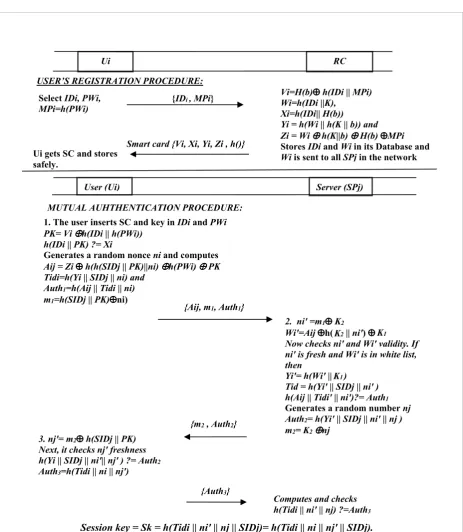
The Chang et al.’s model [4] is comprised of three pro-cedures, such as the registration procedure, mutual authentication procedure which is also shown in Fig-ure 1. We present a few notations that may be helpful to readers to comprehend the scheme as given in Table 1.
Table 1 Symbols guide
Notations Meaning
Ui: ith Subscriber or User
IDi, PWi Subscriber’s identity and password H(): Private hash function
HB(): Bio-hashing function SPj: The jth service provider RC: Registration centre
h(.): a secure hash digest function Bi: Biometric impression
K, b: RC’s master secret, RC’s random secret
ni, nj: Nonce
SC: Smart Card
||, ⊕ Concatenation and XOR functions
3.1.1. Server Registration Procedure
The Chang et al.’s model comprises a reliable regis-tration centre (RC) along with n number of servers (SPj), while the range of j implies 1 ≤ j ≤ n. The SPj completes its registration procedure with RC before the user’s registration. The SPj is registered from RC
with the sharing of two secrets K1 and K2 between SPj and RC over a confidential channel. Earlier, RC selects a master secret key k and a random integer b. Afterwards, SPj submits the identity SIDj towards registration centre. Then, RC calculates K1 = h(k || b)
and K2 = h(SIDj || H(b)). Here, H(.) is a private hash
SC: Smart Card ||, Concatenation and XOR functions
Figure 1. Chang et al.’s registration and mutual authentication procedure
3.1.1 Server Registration Procedure
The Chang et al.’s model comprises a reliable registration centre (RC) along with n number of servers (SPj), while the range of j implies 1≤ j ≤n.
The SPj completes its registration procedure with RC before the user’s registration. The SPj is registered from RC with the sharing of two secrets K1 and K2 between SPj and RC over a confidential channel. Earlier, RC selects a master secret key k
Smart card {Vi, Xi, Yi, Zi , h()}
{IDi , MPi} Vi=H(b)Wi=h(IDi ||K), h(IDi || MPi)
Xi=h(IDi|| H(b))
Yi = h(Wi || h(K || b)) and
Zi = Wi h(K||b) H(b) MPi
Stores IDi and Wi in itsDatabase and
Wi is sent to all SPj in the network
1. The user inserts SC and key in IDi and PWi
PK= Vi h(IDi || h(PWi))
h(IDi || PK) ?= Xi
Generates a random nonce ni and computes
Aij =Zi h(h(SIDj || PK)||ni) h(PWi) PK
Tidi=h(Yi || SIDj || ni) and
Auth1=h(Aij || Tidi || ni)
m1=h(SIDj || PK)ni)
USER’S REGISTRATION PROCEDURE:
Ui gets SC and stores safely.
User (Ui) Server (SPj)
Ui RC
MUTUAL AUHTHENTICATION PROCEDURE:
Select IDi, PWi,
MPi=h(PWi)
{Aij, m1, Auth1}
2. ni' =m1K2
Wi'=Aij h( 2 || ni')
Now checks ni' and Wi' validity. If ni' is fresh and Wi' is in white list, then
Yi'= h(Wi' ||
1
) Tid = h(Yi' || SIDj || ni' )
h(Aij || Tidi' || ni')?= Auth1
Generates a random number nj
Auth2= h(Yi' || SIDj || ni' || nj )
m2= K2nj
{m2 , Auth2}
{Auth3}
3. nj'= m2 h(SIDj || PK)
Next, it checks nj' freshness
h(Yi || SIDj || ni'|| nj' ) ?= Auth2
Auth3=h(Tidi || ni || nj')
Session key = Sk = h(Tidi || ni' || nj || SIDj)= h(Tidi || ni || nj' || SIDj). Computes and checks
h(Tidi || ni' || nj) ?=Auth3
K K
1 K
Figure 1
Figure 2 Proposed model
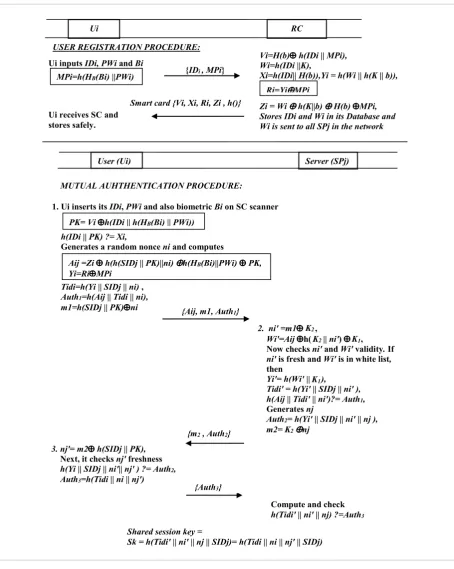
Figure. 2. Proposed model
Smart card {Vi, Xi, Ri, Zi , h()} {IDi , MPi}
Vi=H(b)⊕ h(IDi || MPi),
Wi=h(IDi ||K),
Xi=h(IDi|| H(b)),Yi = h(Wi || h(K || b)),
Zi = Wi ⊕ h(K||b) ⊕ H(b) ⊕MPi,
Stores IDi and Wi in its Database and Wi is sent to all SPj in the network
1. Ui inserts its IDi, PWi and also biometric Bi on SC scanner
h(IDi || PK) ?= Xi,
Generates a random nonce ni and computes
Tidi=h(Yi || SIDj || ni) , Auth1=h(Aij || Tidi || ni),
m1=h(SIDj || PK)⊕ni
USER REGISTRATION PROCEDURE:
Ui receives SC and stores safely.
User (Ui) Server (SPj)
Ui RC
MUTUAL AUHTHENTICATION PROCEDURE: Ui inputs IDi, PWi and Bi
{Aij, m1, Auth1}
2. ni' =m1⊕ ,
Wi'=Aij ⊕h( || ni') ⊕ ,
Now checks ni' and Wi' validity. If ni' isfreshand Wi' is in white list, then
Yi'= h(Wi' || ),
Tidi' = h(Yi' || SIDj || ni' ), h(Aij || Tidi' || ni')?= Auth1, Generates nj
Auth2= h(Yi' || SIDj || ni' || nj ),
m2= K2⊕nj
{m2 , Auth2}
{Auth3}
3. nj'= m2⊕ h(SIDj || PK),
Next, it checks nj' freshness h(Yi || SIDj || ni'|| nj' ) ?= Auth2, Auth3=h(Tidi || ni || nj')
Shared session key =
Sk = h(Tidi' || ni' || nj || SIDj)= h(Tidi || ni || nj' || SIDj) Compute and check h(Tidi' || ni' || nj) ?=Auth3
MPi=h(HB(Bi) ||PWi)
Ri=Yi⊕MPi
Aij =Zi ⊕ h(h(SIDj || PK)||ni) ⊕h(HB(Bi)||PWi) ⊕ PK,
Yi=Ri⊕MPi
PK= Vi ⊕h(IDi || h(HB(Bi) || PWi))
K2
K2 K1
3.1.2. User Registration Procedure
In the registration procedure, Ui performs few regis-tration steps with the RC. Afterwards Ui may access all service providers SPj. The RC performs the under-mentioned steps with the user to implement the reg-istration procedure.
1 Primarily, Ui chooses its identity (IDi)anda pass-word (PWi). Then, it computes MPi by calculat-ing MPi=h(PWi) andit sends{IDi, MPi} to SPj as
shown in Figure 1.
2 SPj, then, calculates Vi=H(b) ⊕ h(IDi || MPi), Wi=h(IDi || k), Xi=h(IDi || H(b)), Yi = h(Wi || h(k
|| b)) and Zi = Wi ⊕ h(k||b) ⊕ H(b) ⊕MPi. After-wards, SPj stores IDi and Wi in its database, while
Wi is sent to allservers inthenetwork. RC now issuessmartcardto Ui with these parameters {Vi, Xi, Yi, Zi and h()}.
3.1.3. Mutual Authentication Procedure
1 In this procedure, Ui employs its smart card to
avail the SPj’sservices. For this reason, the user inserts SC and gives IDi andPWias input. Next, it computes PK= Vi ⊕ h(IDi || h(PWi)) and checks the equality h(IDi || PK) ?= Xi. On successful check, it produces a random nonceniand calculate
Aij =Zi ⊕ h(h(SIDj || PK)||ni) ⊕ h(PWi) ⊕ PK, Tidi=h(Yi || SIDj || ni), Auth1=h(Aij || Tidi || ni)
and m2=h(SIDj || PK)⊕ ni). Next, it submits the
message{Aij, m2, Auth1} to SPj for verification. 2 The SPj receives {Aij, m2, Auth1} andcomputes
ni’ =m2 ⊕K2andWi’=Aij ⊕ h(K2 || ni’) ⊕K1. SPj
nowchecks validity and freshness of ni’ and Wi’. If
ni’ is freshand Wi’ is in its white list, it computes
Yi’= h(Wi’ || K1) and Tidi = h(Yi’ || SIDj || ni’ ). Next,
it checks the equality h(Aij || Tidi’ || ni’)?= Auth1. If
true, it engenders a random integer nj and further calculates Auth2= h(Yi’ || SIDj || ni’ || nj ), m2= K2⊕ nj. Next, itsends {m2, Auth2} to Ui.
3 After receiving {m2, Auth2}, Ui, calculates nj’= m2 ⊕ h(SIDj || PK). He/She checks the validity or freshness for nj’ and computes h(Yi || SIDj || ni’||
nj’ ) for checking the validity h(Yi || SIDj || ni’|| nj’) ?= Auth2. If true, then calculates Auth3= h(Tidi || ni || nj’), and sends the message {Auth3} to SPj as acknowledgement.
4 SPj receives Auth3messageandcomputes h(Tidi
|| ni’ || nj) forchecking h(Tidi || ni’ || nj) ?=Auth3.
Ifit proves to be valid, a session key is computed between the participants, as Sk=h(Tidi||ni’||
nj||SIDj)=h(Tidi||ni|| nj’||SIDj).
3.2. Cryptanalysis of Chang et al.’s Protocol The Chang et al.’s protocol is a multi-server authen-tication-based scheme relying on simple hash and XOR operations. Before presenting the limitations in Chang et al.’s model, we assume that adversary is pro-ficient in the following capabilities.
_ The adversary may intercept, modify or manipulate the message contents communicated on insecure public channel.
_ The adversary may access the smart card and its
parameters by stealth.
_ The adversary might not get any of the contents
communicated on secure channel, for instance, in registration phase.
The Chang et al.’s protocol is susceptible to the fol-lowing attacks.
3.2.1. Impersonation Attack
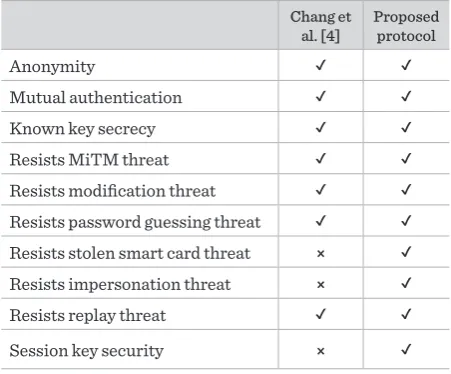
The Chang et al.’s protocol is prone to impersonation attack if the user’s smart card contents are revealed to adversary. Suppose, Eve, a valid but malicious user happens to steal the user’s smart card contents in some manner. In this context, Eve seize all SC param-eters {Vi, Xi, Yi, Zi} and intercepts public messag-es {Aij, m2, Auth1, m2, Auth2, Auth3}.Next, Eve may
adopt the following steps to launch an impersonation attack.
1 Initially, Eve computes PK such as PK = Vi ⊕ h(IDEve||MPi), where PK and H(b) represent the
same parameters.
2 Then, Eve computes ni=h(SIDj || PK) ⊕ m2. 3 Next, the PWi, being a low entropy password, can
easily be guessed by applying and testing various combinations PWi* in the equation Aij ?= Zi ⊕ h(h(SIDj || PK)||ni) ⊕ h(PWi*) ⊕ PK. Wherever the match is found, the valid PWi becomes known. 4 After the seizure of SC contents and guessing the
Tidi=h(Yi || SIDj || ni), Auth1=h(Aij || Tidi || ni),
and m2=h(SIDj || PK) ⊕ ni) towards server. On
server’s end, while impersonating as a server, Eve sends the message {m2, Auth2} towards user by
generating fresh nonce nj and computing Auth2= h(Yi || SIDj || ni’ || nj) and m2= h(SIDj || PK) ⊕nj.
3.2.2. No Session Key Security
In Chang et al.’s protocol, the attacker could deduce the session key comfortably, once the smart card is accessed by it. Since the session key is composed as Sk = h(Tidi || ni || nj || SIDj),Eve may try to reproduce Sk on the basis of computed elements.For this purpose, Eve, having the knowledge of {Vi, Xi, Yi, Zi, m2} parameters,
computesPK = Vi⊕ h(IDEve|| MPi), ni=h(SIDj || PK) ⊕ m2, nj = h(SIDj || PK) ⊕ m2, and Tidi=h(Yi || SIDj
|| ni). Finally, Eve can generate the session key by concatenating as Sk = h(Tidi || ni || nj || SIDj).In this manner, Eve may generate all previous session keys by approaching the publicly available messages as communicated between the legal participants.
4. Proposed Scheme
Our proposed model is based on countering the lim-itations in Chang et al.’s model. The contributed mod-el comprises service provider (server’s) registration procedure, user’s registration procedure, mutual au-thentication procedure, and password upgrading pro-cedure.
4.1. Server Registration Procedure
The proposed model comprises a trustworthy RC and n number of servers (SPj), while the range of j implies
1 ≤ j ≤ n. The SPj performs the registration with RC prior to user’s registration procedure, using a secret channel. During initialization process, RC selects a master secret key k, and also chooses a random secret b. Then, SPj forwards its identity SIDj towards reg-istration centre. Next, RC computes the two keys as
K1=h(k || b) and K2= h(SIDj || H(b)), and sends both
keys (K1 and K2) to SPj employing a confidential
chan-nel. In this manner, the SPj gets registered through RC. 4.2. User Registration Procedure
In registration phase, Ui registers with registration centre (RC) and follows the under-mentioned steps:
1 The user initially selects its identity as IDi,
pass-word as PWi, and the biometric as Bi [17]. Subse-quently, Ui calculates MPi=h(HB(Bi) || PWi) and
submits{IDi , MPi} to SPj.
2 Next, SPj calculates Vi=H(b) ⊕ h(IDi || MPi), Wi=h(IDi | |k), Xi=h(IDi || H(b)), Yi = h(Wi || h(k ||
b)) Ri=Yi ⊕MPi , and Zi = Wi ⊕ h(k||b) ⊕ H(b) ⊕ MPi,and stores IDi and Wi in its database, while
Wi is sent to all SPj inthenetwork.Next, RC issues smartcardto Ui with these parameters {Vi, Xi, Ri, Zi and h()}.
4.3. Mutual Authentication Procedure
In this stage, the user is mutually authenticated with server SPj and uses smart card to avail services. The related procedure is shown in Figure 2.
1 Initially, Ui inserts its smart card in scanner and
also inputs its ID and PWi. Then, it captures the biometric imprint Bi. Afterwards, Ui calculates
PK= Vi ⊕ h(IDi || h(HB(Bi) || PWi)) and verifies
the equalityfor h(IDi || PK) ?= Xi.If true, then Ui engenders a random integer ni and further calcu-lates Aij =Zi ⊕ h(h(SIDj || PK)||ni) ⊕h(HB(Bi) || PWi) ⊕ PK, Yi = Ri ⊕MPi , Tidi=h(Yi || SIDj || ni), Auth1=h(Aij || Tidi || ni) and m2=h(SIDj || PK)⊕ ni). Then, Ui sends the message{Aij, m2, Auth1} to SPj for verification.
2 Next, the SPj receives the message {Aij, m2, Auth1}
andcomputes ni’ =m2 ⊕K2andWi’=Aij ⊕h(K2 || ni’) ⊕K1. The SPjconfirms thevalidity and
fresh-ness of ni’ and Wi’.If ni’ is freshand Wi’ is in the white list, then it further computes Yi’= h(Wi’ || K1)
and Tidi = h(Yi’ || SIDj || ni’).Now, it verifies the equation h(Aij || Tidi’ || ni’)?= Auth1.If this proves
to be true, it engenders a random numbernj, and computes Auth2= h(Yi’ || SIDj || ni’ || nj ) and m2= K2⊕ nj. Then, itsends {m2, Auth2} to Ui for further
verifications.
3 Upon receiving {m2, Auth2} from SPj, Ui calculates nj’= m2 ⊕ h(SIDj || PK). Ui checks the validity for nj’ and computes h(Yi || SIDj || ni’|| nj’ ) for verify-ing the validity for h(Yi || SIDj || ni’|| nj’) ?= Auth2.
If this equation is found to be valid, it calculates
Auth3=h(Tidi || ni || nj’),and sends the message {Auth3} to SPj as an acknowledgement finally. 4 Upon having the message Auth3, the SPj calculates
?=Auth3.Iftrue, then develops the ultimate session
key as Sk = h(Tidi || ni’ || nj || SIDj)= h(Tidi || ni ||
nj’ || SIDj).
4.4. Password Updating Procedure
Ui modifies his/her old password (PWi) with a fresh password (PWi fr) without involving RC, by adopting
the under-mentioned steps:
1 To modify the password, the user would input his/
her identity as IDi, old password as PWi into the smart card. Next, the user imprints biometric iden-tity Bi into a device scanner.
2 Subsequently, SC computes PK= Vi ⊕ h(IDi ||
h(HB(Bi) || PWi)) and validates the equality h(IDi
|| PK) ?= Xi.If it does not match, the smart card aborts the session, otherwise allows the user to proceed on the next step.
3 After that, the user would insert a new password as PWi fr in SC, which calculates Vinew = PK⊕h(IDi || h(HB(Bi) || PWi fr)), Rinew = Ri ⊕h(HB(Bi) || PWi) ⊕ h(HB(Bi) || PWi fr), and Zinew = Zi ⊕ h(HB(Bi)||PWi) ⊕ h(HB(Bi) || PWi fr).Then, the user replaces the Vi, Ri and Zi parameters in smart card with the new values Vinew, Rinewand Zinew.
5. Security Discussion
This segment illustrates the informal security discus-sion for contributed model in comparison with Chang et al.’s model.
5.1. Replay Attacks
These attacks may be attempted by an attacker after replaying the seized message contents at opportune time to deceive any legal entity of the protocol. An attacker Ⱥ could seize the communication contents after examining a public channel as {Aij, m2, Auth1, m2, Auth2, Auth3} and attempt to replay at some
opportune time in future towards a valid participant. Nonetheless, Ⱥ cannot construct the parameter
Auth1, as it also comprises Aij which includes Ei and h(HB(Bi) ||PWi) in its construction,such as Aij =Zi ⊕ h(h(SIDj || PK)||ni) ⊕h(HB(Bi) || PWi) ⊕ PK. An
attackerȺneither knows the password nor biometric
Bi, which prevents the attacker for launching the replay attack. If Ⱥ replays the message {Aij, m2, Auth1}
to SPj, it may not be able to construct the upgraded challenge Auth3,which requires the computation of Tidi,which further needs Yi to be constructed that is inaccessible toȺeven if theSCgets stolen. At the same time, ifȺreplays the message {m2 , Auth2} towards Ui,
the latter may easily detect the attack, since Ui knows that Auth2cannot be constructed by the adversary due
to the non-availability of Yi parameter. Hence, our proposed protocol may counter any replay threat. 5.2. Man-In-The-Middle-Attack
In this threat, the attacker intrudes between the le-gal participants by acting as an intermediary through replaying or modifying the message contents. A suc-cessful attack may let the legitimate members com-municate with the adversary perceiving it as a right participant [6].
An adversary cannot construct the message {Auth2, m2} in request of {Aij, m2, Auth1}, since the
construc-tion of Auth2requires Yi, which is inaccessible to Ⱥ
from either intercepted messages or SC contents. Then, Ⱥ constructs a valid Auth3 against SPj’s
chal-lenge {Auth2, m2}, as Tidi is inaccessible toȺdue to
unknown Yi. Therefore, the contributed scheme is protected from MiTM threat.
5.3. Modification Threats
Such threats could be initiated by an attacker if it transforms the communication message illegally for submitting it to any valid participant [19].
An adversary may attempt to construct the message
{Aij, m2, Auth1}, however it may not be able to do so,
since it needs the parameter Aij, that further requires the knowledge of PWi and Bi as Aij =Zi ⊕ h(h(SIDj || PK) || ni) ⊕ h(HB(Bi)|| PWi) ⊕ PK. Likewise, it
requires Tidi to construct Auth1, which requires the
knowledge of Yi, which is also inaccessible toȺ due to the unreachable MPi. Similarly, an adversary is not able to construct the message {Auth2, m2} in request
of {Aij, m2, Auth1}, given that the production of Auth2
requires the information of Yi, which is not accessible to Ⱥ either from intercepted messages or stolen SC contents.
to be familiar with biometric information Bi of the user. If Bi is not available, then the password PWi may not be inferred or guessed from Vi , Zi and Ri parameters. 5.5. Session Key Disclosure Using Stolen Card
An attacker Ⱥ might steal smart card contents and try to generate a session key (Sk) from its contents. Nonetheless, Ⱥ cannot calculate the session key Sk = h(Tidi || ni || nj || SIDj) due to the inaccessible Tidi
parameter in Sk. While, the Tidi is constructed as
Tidi=h(Yi || SIDj || ni) and the attacker cannot guess
Yi either from stolen card contents or intercepted messages.
5.6. Impersonation Attack Using Smart Card Contents
An attacker Ⱥ might steal smart card and try to impersonate the legitimate users or service provider by constructing the identical message {Aij, m2, Auth1}.
Nonetheless, it may not be able to do so [24], since it needs the parameter Aij. Which further requires PWi
and Bi to be guessed, as Aij =Zi ⊕ h(h(SIDj || PK) || ni) ⊕ h(HB(Bi) || PWi)⊕PK. Besides, it needs Tidi to
build Auth1, which requires the value Yi, which is also
inaccessible toȺ due to the unknown MPi. Similarly, an adversary cannot construct the message {Auth2, m2} in response to a valid user request {Aij, m2, Auth1}, since, the construction of Auth2requires the
information of Yi, which is not accessible to Ⱥ either from intercepted messages or stolen SC contents. 5.7. Session Key Security
This trait makes certain that the established session key is merely known to lawful members of a session, i.e. client and service provider.
In proposed model, the agreed session key, i.e.
Sk = h(Tidi || ni || nj || SIDj) is secure, since, the Tidi
calculation requires the access of Yi, i.e., Tidi=h(Yi ||
SIDj || ni), while Yi requires the value MPi for guess-ing it, as Yi=Ri ⊕MPi. Hence, the session key Sk has been safe, in case the SC contents are accessed or Ⱥ
intercepts the public parameters. 5.8. Known Key Security
This attribute makes certain the protection of private keys of participants in case the current session key is exposed.
In contributed protocol, even if the adversary accesses the values Sk, Ri, an attacker cannot recover user password PWi, since the PWi recovery from Sk = h(Tidi
|| ni || nj || SIDj) requires calculation of Yi=Ri ⊕MPi
and Tidi=h(Yi || SIDj || ni). This is not possible due to the inaccessibility of Bi in MPi=h(HB(Bi) || PWi). At
the same time, the server secret K is also secure as it is existent in a function i.e h(K || b) and is hard be guessed in polynomial amount of time. Therefore, the proposed protocol keeps the feature of known key security. 5.9. Mutual Authentication
This attribute assures that the concerned members authenticate one another in the protocol session and construct a mutual session key ultimately [7].
In our scheme, both of the participants authenticate each other mutually on account of Tidi and Yi’ pa-rameters. The server authenticates the user only if
Tidi is valid in Auth3,and this Tidi cannot be
con-structed by an attacker. Similarly, Ui authenticates
SPj on account Yi’ parameter used by server in the construction of Auth2= h(Yi’ || SIDj || ni’ || nj ). The Yi parameter cannot be accessed by an attacker even through Ri if the card gets stolen. Therefore, our pro-tocol assures mutual authentication feature to the le-gitimate participants.
5.10. Anonymous Protocol
In an anonymous protocol [11, 12, 15], a legal user interacts with service provider without exposing its identity and an adversary may not recover the user’s identity or secret credentials from intercepted con-tents on public channel.
In proposed scheme, the adversary cannot extract Ui’s identity or other secret credentials out of intercept-ed contents on public channel or stolen smart card contents. This is because of the fact that the identity
IDi is protected in a secret function Wi =h(IDi ||K),
which is not possible to guess until the server secret
K is exposed. Therefore, the contributed scheme con-fers anonymity to the user.