Journal of Today’s Ideas – Tomorrow’s Technologies, Vol. 4, No. 1, June 2016 pp. 1–13 DOI: 10.15415/jotitt.2016.41001
Application of Artificial Neural Network to Analyze
Hexagonal Plate with Hole Considering Different
Geometrical and Loading Parameters
SAket RuSiA1, k. k. PAtHAk2
1Department of Civil and Environmental Engineering, National Institute of Technical Teachers’ Training and Research, Bhopal, MP, India
2Department of Civil Engineering, Indian Institute of Technology, Varanasi (BHU), UP, India
email: [email protected], [email protected]
Received: January 7, 2016 | Revised: March 11, 2016 | Accepted: May 17, 2016 Published Online: June 07, 2016
The Author(s) 2016. This article is published with open access at www.chitkara.edu.in/publications
Abstract In the competitive nature of structural engineering, industry and its heuristic problem-solving needs, among other reasons, have contributed to the development of some advanced decision making tools. A step ahead from soft computing techniques, now artificial intelligence has proved itself as an efficient tool for solving the problem in construction industry over old tedious analytical methods. In this study, Artificial Neural Network is compared with finite element techniques in order to find the stress, strain and deflection in plates with holes. For approaching the complexity of the problem, hexagonal plates with holes and different geometrical and loading parameters have been taken as specimens. Finite element analysis for 81 cases are carried out using the software based on finite element method (FEM), ANSYS Workbench 15.0 software. Using these data of FEM analysis an Artificial Neural Network has been trained. The successfully trained network is further used for analysis of four new cases which are also validated by using FEM based software. It was found that most of the results were quite close to the FEM results. Such a technique can be used to reduce the computation time and labour.
keywords Artificial Neural Networks; Finite Element Analysis; Hexagonal Plate; ANSYS
1. iNtRoDuCtioN
Rusia, S
Pathak, KK software allow us to find out the numerical solution of various problems, including the problems of structural analysis. The need of approximate
methods which would provide solutions in the form of simple analytic expressions is there. One of the method is artificial neural network also known as ANN. These are a functional abstraction of the biologic neural structures of the central nervous system.
ANNs are powerful pattern recognizers and classifiers. Garrett [1] has given an interesting engineering definition of the ANN as: “a computational mechanism able to acquire, represent, and compute mapping from one multivariate space of information to another, given a set of data representing that mapping.” Their computing abilities have been proven in the fields of prediction and estimation, pattern recognition, and optimization. Neural networks have been used for various structural analysis like fully stressed design of trusses, buckling behaviour of plates, stress concentration factor analysis for membranes etc.
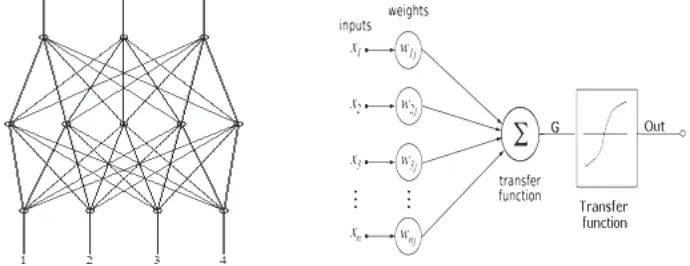
In Figure 1, artificial neural network consisting of an input layer with four nodes, one hidden layers with five nodes, and an output layer with three nodes is shown. State function is summation function. Among transfer functions like sigmoid, modified sigmoid, hyperbolic tangent, Gaussian and modified Gaussian, hyperbolic tan-gent function has been used. Then, a training algorithm is needed that is back- propagation algorithm over here. Neurons are the processing elements of network. Neuron consists of a set of weighted input connections, a bias input, a state function, a nonlinear transfer function, an output. Figure 2 shows the structure of a neuron.
Further, Initialization method of threshold and initialization method of weight factor are to be chosen between zero or random, in our research, we have chose random.
Application of Artificial Neural Network to Analyze Hexagonal Plate with Hole Considering Different Geometrical and Loading Parameters
P. Emmanuel Nicholas et al. [2] proposed a novel approach to study neural network based buckling strength prediction of laminated composite plate with central cut-out, The laminated composite plates with holes analyzed using finite element analysis by optimizing the parameters like thickness, orientation, material and the stacking sequence to obtain the desired characteristics for these structures. They showed that using finite element analysis makes the process more tedious job and thus proposed to construct the artificial neural network to predict the buckling behaviour of the composite plate. Hojjat Adeli [3] presented the first journal article on neural network application in civil/ structural engineering in 1989.
In many previous research papers, membrane with holes or cutouts analysed using finite element software like ANSYS [4], ABAQUS etc., also the stress field around circular holes in plates with arbitrary thickness has been studied but most of the researches only plane loading is considered. However, it seems difficult to locate a work that quantifies the use of ANNs for analysis of equivalent stress, strain and directional deformation in a hexagonal plate subjected to vertical surface pressure without performing finite element analysis. The artificial neural network is used as an alternative analysis tool to analysis plates with hole since it can handle uncertainty through the probability method.
While comparing the artificial neural networking method with finite element method we have taken hexagonal plate with hole, it is to make problem much complex and to increase the number of variables. Different shaped plates with different shaped holes are used in industry to match the needs. Thus, it becomes necessary to use the method which excels in dealing with arbitrary shapes in less time and computational cost.
Rusia, S
Pathak, KK for rectangular plates with circular cut-out. Optimum design of holes and notches by considering fatigue life were presented by Hwai Chung Wu et al. [9]. V.G. Ukadgaonker et al. [10] gave a general solution for bending of symmetric laminates with holes considering any shape of hole in symmetric laminates subjected to remotely apply bending or twisting moments. Moments around circular, elliptical, Triangular, square, rectangular and several irregular shaped holes in cross-ply and angle ply symmetric laminates are obtained.
In this study, artificial neural network has been employed for analysis of maximum equivalent von Mises stress, strain and directional deformation in equilateral Hexagonal plate with different geometrical and loading patterns. Plates, having different size concentric holes are analyzed. Finite element analysis for 81 cases are carried out using ANSYS Workbench 15.0 software. Using these data of FEM analysis an artificial neural network has been trained. The successfully trained network is further used for analysis of five new cases which are also validated using ANSYS Workbench 15.0 software.
2. StRuCtuRAL MoDeLiNG AND ANALySiS
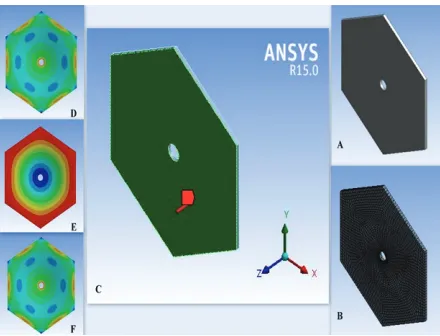
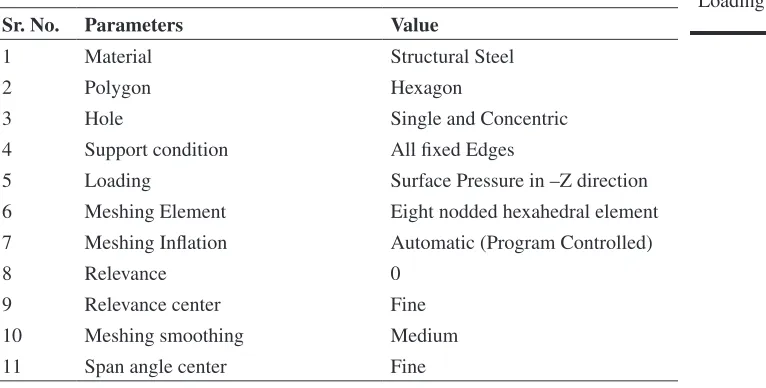
Modeling, meshing and analysis contours of plate are shown in Figure 3. Plate is a of five sided polygon having concentric hole. Size of edges of plate, thickness, size of hole diameter and loading pressure are varying parameters. In Table 1, isotropic elastic constants values are shown, these have been used as elemental properties. Other, in-use entities for finite element modeling is provided in Table 2. A total 81 cases are generated, and these are stated in Table 3.
Application of Artificial Neural Network to Analyze Hexagonal Plate with Hole Considering Different Geometrical and Loading Parameters
table 1: Isotropic Elastic Constants.
young’s Modulus
(MPa) Poisson’s Ratio Bulk Modulus (Pa) Shear Modulus (MPa)
2E+5 0.3 1.6667E+5 7.692E+4
table 2: Entities for Finite Element Modeling
Sr. No. Parameters Value
1 Material Structural Steel
2 Polygon Hexagon
3 Hole Single and Concentric
4 Support condition All fixed Edges
5 Loading Surface Pressure in –Z direction
6 Meshing Element Eight nodded hexahedral element 7 Meshing Inflation Automatic (Program Controlled)
8 Relevance 0
9 Relevance center Fine
10 Meshing smoothing Medium
11 Span angle center Fine
Sr. No.
input for ANSyS
Sr. No.
input for ANSyS edge Dimension (mm) Hole Dia. (mm) thickness of Plate (mm) Pressure Applied (MPa) edge Dimension (mm) Hole Dia. (mm) thickness of Plate (mm) Pressure Applied (MPa)
1 500 50 10 0.3 42 750 75 20 0.7
2 500 50 10 0.5 43 750 75 30 0.3
3 500 50 10 0.7 44 750 75 30 0.5
4 500 50 20 0.3 45 750 75 30 0.7
5 500 50 20 0.5 46 750 100 10 0.3
6 500 50 20 0.7 47 750 100 10 0.5
7 500 50 30 0.3 48 750 100 10 0.7
8 500 50 30 0.5 49 750 100 20 0.3
Rusia, S
Pathak, KK Sr.
No.
input for ANSyS
Sr. No.
input for ANSyS edge
Dimension (mm)
Hole Dia. (mm)
thickness of Plate (mm)
Pressure Applied (MPa)
edge Dimension (mm)
Hole Dia. (mm)
thickness of Plate (mm)
Pressure Applied (MPa)
9 500 50 30 0.7 50 750 100 20 0.5
10 500 75 10 0.3 51 750 100 20 0.7
11 500 75 10 0.5 52 750 100 30 0.3
12 500 75 10 0.7 53 750 100 30 0.5
13 500 75 20 0.3 54 750 100 30 0.7
14 500 75 20 0.5 55 1000 50 10 0.3
15 500 75 20 0.7 56 1000 50 10 0.5
16 500 75 30 0.3 57 1000 50 10 0.7
17 500 75 30 0.5 58 1000 50 20 0.3
18 500 75 30 0.7 59 1000 50 20 0.5
19 500 100 10 0.3 60 1000 50 20 0.7
20 500 100 10 0.5 61 1000 50 30 0.3
21 500 100 10 0.7 62 1000 50 30 0.5
22 500 100 20 0.3 63 1000 50 30 0.7
23 500 100 20 0.5 64 1000 75 10 0.3
24 500 100 20 0.7 65 1000 75 10 0.5
25 500 100 30 0.3 66 1000 75 10 0.7
26 500 100 30 0.5 67 1000 75 20 0.3
27 500 100 30 0.7 68 1000 75 20 0.5
28 750 50 10 0.3 69 1000 75 20 0.7
29 750 50 10 0.5 70 1000 75 30 0.3
30 750 50 10 0.7 71 1000 75 30 0.5
31 750 50 20 0.3 72 1000 75 30 0.7
32 750 50 20 0.5 73 1000 100 10 0.3
33 750 50 20 0.7 74 1000 100 10 0.5
34 750 50 30 0.3 75 1000 100 10 0.7
35 750 50 30 0.5 76 1000 100 20 0.3
36 750 50 30 0.7 77 1000 100 20 0.5
37 750 75 10 0.3 78 1000 100 20 0.7
38 750 75 10 0.5 79 1000 100 30 0.3
39 750 75 10 0.7 80 1000 100 30 0.5
40 750 75 20 0.3 81 1000 100 30 0.7
Application of Artificial Neural Network to Analyze Hexagonal Plate with Hole Considering Different Geometrical and Loading Parameters
Geometry of the plates are created in workbench itself and linear elastic analysis is performed. Automatic inflation is selected during meshing. In these models, fixed edge support condition is provided. Varying loading pressure is acting in negative Z direction where plates are lying in X-Y plane.
In Figure 3, A is showing the model view, B is the meshed structure, in C, Loading has been shown and in D, E, F, contour of variation in maximum equivalent von Mises stress, strain and directional deformation are shown respectively.
3. FiNite eLeMeNt ANALySiS
Finite element analysis has been performed using ANSYS Workbench 15.0 and results for following parameters are recorded,
1) Maximum Equivalent von Mises Stress 2) Maximum Equivalent von Mises Strain 3) Directional Deformation in Z – Direction
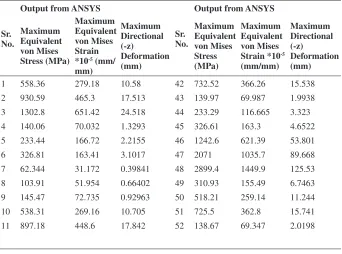
Output results are tabulated in Table 4. These values have been used as training data for artificial neural network, in the next section.
Sr. No.
output from ANSyS
Sr. No.
output from ANSyS
Maximum equivalent von Mises Stress (MPa) Maximum equivalent von Mises Strain *10-5 (mm/
mm) Maximum Directional (-z) Deformation (mm) Maximum equivalent von Mises Stress (MPa) Maximum equivalent von Mises Strain *10-5
(mm/mm) Maximum Directional (-z) Deformation (mm)
1 558.36 279.18 10.58 42 732.52 366.26 15.538 2 930.59 465.3 17.513 43 139.97 69.987 1.9938 3 1302.8 651.42 24.518 44 233.29 116.665 3.323 4 140.06 70.032 1.3293 45 326.61 163.3 4.6522 5 233.44 166.72 2.2155 46 1242.6 621.39 53.801 6 326.81 163.41 3.1017 47 2071 1035.7 89.668 7 62.344 31.172 0.39841 48 2899.4 1449.9 125.53 8 103.91 51.954 0.66402 49 310.93 155.49 6.7463 9 145.47 72.735 0.92963 50 518.21 259.14 11.244 10 538.31 269.16 10.705 51 725.5 362.8 15.741 11 897.18 448.6 17.842 52 138.67 69.347 2.0198
Rusia, S Pathak, KK
Sr. No.
output from ANSyS
Sr. No.
output from ANSyS
Maximum equivalent von Mises Stress (MPa) Maximum equivalent von Mises Strain *10-5 (mm/
mm) Maximum Directional (-z) Deformation (mm) Maximum equivalent von Mises Stress (MPa) Maximum equivalent von Mises Strain *10-5
(mm/mm) Maximum Directional (-z) Deformation (mm)
Application of Artificial Neural Network to Analyze Hexagonal Plate with Hole Considering Different Geometrical and Loading Parameters
4. APPLiCAtioN oF NeuRAL NetwoRk
The input, output data given in Table 3 and Table 4 are used for training of the neural network. A 4-5-3 size back propagation neural network has been trained. The input parameters are edge dimension, hole diameter, thickness of plate and pressure applied and output parameters are maximum equivalent von Mises stress, maximum equivalent von Mises strain and directional deformation in negative Z direction. For ANN, an in-house developed software has been used. The error tolerance is kept 0.03. It took 86830 epochs to converge to this tolerance. Thus trained network is used for complete analysis of four new cases of model plates, given in Table 5.
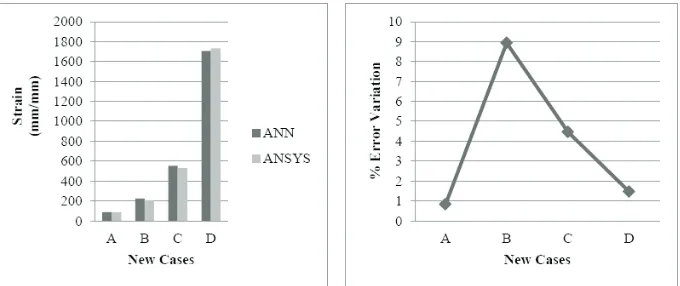
Validation of results has been presented in Table 6. Percentage (%) variation is carried out between the analyzed parameters artificial neural network and ANSYS Workbench. Graphical representation of analyzed parameters for new cases model plates are shown in Figure 4, Figure 5, Figure 6 and these figures also include percentage (%) variation between ANN and ANSYS results. It can be observed that averages of absolute positive percentage (%) errors are 3.605, 3.921, and 7.705 for maximum equivalent von Mises stress, maximum
Sr. No.
New Cases edge Dimension
(mm) Hole Dia. (mm)
thickness of Plate (mm)
Pressure Applied (MPa)
A 600 60 25 0.4
B 700 70 20 0.45
C 800 80 15 0.5
D 900 90 10 0.55
table 5: New Model Cases for Validation.
table 6: Validation of Results.
Sr. No. Model
Maximum equivalent vonMises Stress (MPa)
Maximum equivalent vonMises Strain *10-5 (mm/
mm)
Directional Deformation in (-Z) Direction (mm)
ANN ANSyS % ANN ANSyS % ANN ANSyS %
1 A 172.0455 172.17 0.07226 86.7942 86.084 0.825005 1.910345 1.883 1.452220
Rusia, S Pathak, KK
Figure 4: Model Case 1 - Max. Equivalent von Mises Stress and its % Variation for ANN and ANSYS.
Figure 5: Model Case 2 - Max. Equivalent von Mises Strain and its % Variation for ANN and ANSYS.
equivalent von Mises strain and directional deformation in negative Z direction respectively which are small values. Thus it has been proved that the use of artificial neural network can avoid the lengthy and tedious complex modeling and analysis using costly FEM software.
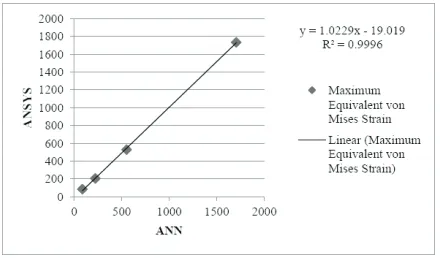
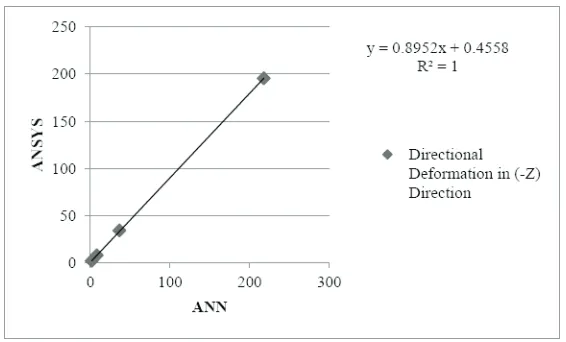
Furthermore, correlation analysis of ANSYS and ANN results have been also carried out and shown in Figure 7, Figure 8 and Figure 9.
Application of Artificial Neural Network to Analyze Hexagonal Plate with Hole Considering Different Geometrical and Loading Parameters
Figure 6: Model Case 3 - Directional Deformation and its % Variation for ANN and ANSYS.
Figure 7: Regression Analyses for Max. Equivalent von Mises Stress between ANN and ANSYS for New Models.
Rusia, S Pathak, KK
of squared residuals (R2) for all three output parameters are very close to 1 that
accounts for 100 % of the variance. Hence it can be proved that neural network predictions are close to FEM results.
5. CoNCLuSioN
In this study, linear elastic analysis of steel plates is performed, and results have been predicted using artificial neural network. The differences calculated between the maximum equivalent von Mises stress, strain and directional deformation by ANN and ANSYS are quite low. The average variation for all type of outcomes is about 5%. This could be further reduced if hidden layers used in higher numbers in neural network but that would in-crease the computation time a little so here, in this study a balance is made between the accuracy and time of computation. We have found that Artificial Neural Network (ANN) is a very powerful tool for linear elastic analysis of steel plates even with concentric cut-outs. Artificial neural network approach is easier and faster than approach adopted by software based on finite element method. It takes lesser time to compute the results. Using ANN, dependency upon costly analysis and design packages can be avoided.
ReFeReNCeS
[1] Adeli, H. Neural Networks in Civil Engineering. 1989–2000 Comput. Civ. Infrastruct. Eng. 16, 126-142. http://dx.doi.org/10.1111/0885-9507.00219
[2] ANSYS. Workbench User’ s Guide. ANSYS Work. 15.0 15317, 724–746 (2013).
Application of Artificial Neural Network to Analyze Hexagonal Plate with Hole Considering Different Geometrical and Loading Parameters
[3] Baba, B. O. Buckling Behavior of Laminated Composite Plates. J. Reinf. Plast. Compos. 26, 1637–1655 (2007). http://dx.doi.org/10.1177/0731684407079515
[4] Garrett, J. H. Where and why artificial neural networks are applicable in civil engineering. J. Comput. Civ. Eng. ASCE 8, 129–130 (1994).
http://dx.doi.org/10.1061/(ASCE)0887-3801(1994)8:2(129)
[5] Nicholas, P. Emmanuel Padmanaban, K. P., Vasudevan, D. & Selvaraj, I. J. Neural network based buckling strength prediction of laminated composite plate with central cutout. Appl. Mech. Mater. 560 (2014).
[6] Paik, Jeom Kee, Ultimate strength of perforated steel plates under combined biaxial compression and edge shear loads. Thin-Walled Struct. 46, 207–213 (2008).
http://dx.doi.org/10.1016/j.tws.2007.07.010
[7] Pan, Z., Cheng, Y. & Liu, J. Stress analysis of a finite plate with a rectangular hole subjected to uniaxial tension using modified stress functions. Int. J. Mech. Sci. 75, 265–277 (2013).
http://dx.doi.org/10.1016/j.ijmecsci.2013.06.014
[8] Rusia, S. & Pathak, K. K. “Application of artificial neural network for analysis of triangular plate with hole considering different geometrical and loading parameters,” Open J. Civ. Eng., 06, 01, 31–41(2016). http://dx.doi.org/10.4236/ojce.2016.61004
[9] Singh, A. . & Paul, U. . Finite displacement static analysis of thin plate with an opening––a variational approach. Int. J. Solids Struct. 40, 4135–4151 (2003).
http://dx.doi.org/10.1016/S0020-7683(03)00204-X
[10] Ukadgaonker, V. G. & Rao, D. K. N. A general solution for moments around holes in symmetric laminates. Compos. Struct. 49, 41–54 (2000).
http://dx.doi.org/10.1016/S0263-8223(99)00123-3
[11] Wu, H. C. & Mu, B. On stress concentrations for isotropic/orthotropic plates and cylinders with a circular hole. Compos. Part B Eng. 34, 127–134 (2003).