ISSN: 2333-6412 (Print), 2333-6420 (Online) Copyright © The Author(s). All Rights Reserved. Published by American Research Institute for Policy Development DOI: 10.15640/rcbr.v4n2a8 URL: http://dx.doi.org/10.15640/rcbr.v4n2a8
Imapct of Efficacious Internal Controls on Audit Process: Auditors' Perspective
Bagher Shanszadeh
1& Narges Zolfaghari
2Abstract
This paper aims to identify and determine the impact of effective internal controls on audit process. The research was conducted through a survey of Iranian Audit Organization’s Auditors. The designed questionnaire was sent to respondents after analyzing the reliability and validity. 104 questionnaires were received. Collected questionnaires and formulated hypotheses were analyzed and examined by SPSS and LISREL statistical software. The results obtained from the analysis showed that though the internal controls do not reduce the audit time and cost, but they can reduce incidental auditing during the period. The results also indicate that the effectiveness of internal controls can enhance the quality of audit, and increase the detection of significant errors and distortions. It can also increase the credibility of financial statements. Keywords: Effective Internal Controls, Auditors' Perspective, Audit Process, Incidental Auditing
1.Introduction
Internal controls are a set of measures which are performed by the managers in order to ensure relatively confidence about proper implementation of affairs and compatibility to the imposed regulations and policies so that operation’s efficiency and usefulness is increased and predetermined goals are achieved (Mohammadi, 2008). In other words, internal controls include organization’s plan and coordination of all procedures listed in an organization which are prescribed to protect the assets, deal with accuracy and reliability of accounting data, promote and encourage efficient operations management to comply with the managerial procedures (Ghorbani, 2007).
Since most management decisions are adopted based on financial information of accounting system, presence of strong internal control system guarantees reliability of accounting information, which is basis for making such decisions. Also, strong internal controls influence the way of auditing by the auditors. The more powerful are the internal controls, significant distortion risks are reduced and thus auditing risk is also decreased. Current study aims at investigating that if internal controls can be effective on audit process including time, cost, quality, significant error detection, and validation of audit reports. Significance of this study is in this way that internal controls system is associated with audit and it is expected that effective internal controls can justify audit motivation and highlight significance of internal controls and its direct relationship with audit process.
1. Statement of Problem
One of the necessities of auditing case is presence of effective internal controls. Internal control is considered as effective if the board of directors and management are ensured logically concerning following cases:
- Awareness about achievement to operational goals of the economic unit
- Preparing reliable financial statements
- Complying with respective regulations
Managers of the institutes and organizations pay considerable attention to internal control systems, because managers are aware that in case of lack of effective internal control system, realization of the company’s major mission, profitability preservation and minimizing unexpected events would be highly difficult. Internal control is very important in the perspective of independent auditors, because limits, type and implementation of internal controls is crucial in determining audit methods and volume of auditor’s auditing, and independent auditors can adopt decisions regarding financial reports following investigation of internal control (Arbab Soleymani, 2008). Thus, the problem is that if effective internal controls lead to reduction of time, costs, and incidental auditing in audit process, and if effective internal controls influence increasing audit quality, detection of significant errors and distortions, and validating financial statements.
2. Theoretical Framework
In the past, concept of internal control was confined to internal inspection. In 1949, the American Institute of Certified Public Accountants (AICPA) defined internal control as the organization’s plan and all accepted coordinated measures and methods within the business to protect the assets, deal with accuracy and reliability of accounting data, promote efficient operations and comply with the managerial procedures (Ghanbarian, 2011).
Internal Controls – Integrated Framework (COSO)
COSO stands for The Committee of Sponsoring Organizations of the Treadway Commission (COSO). It is a private organization which was voluntarily developed for improvement of financial reporting quality using business ethics, effective internal controls and corporate governance. COSO was originally established in 1985 for supporting “National Commission on Fraudulent Financial Reporting” (NCFFR), which is often referred to as Treadway Commission. COSO defines internal control as a process which is influenced by the board of directors of the business unit, management, and other staffs, and it is formulated for assuring achievement of operational effectiveness and efficiency goals, reliability of financial reporting, and compliance with administrative regulations (Rahmani, 2007).
COSO working group in 2004 formulated and provide its second journal in relation with internal controls entitled as “integrated framework for organizational risk management”. According to definition of COSO, “institution’s risk management is the process which is streamed by the board of directors, management, and staffs of the economic unit and it is utilized in strategy setting within the company” (Akhoondzadeh, 2011).
Internal Controls in 2002 - Sarbense-Oxely Act (SOX)
Congress of America enacted Sarbense-Oxely Act (SOX) in 2002 in reaction to accounting scandals of Enron Company and Arthur Andersen Audit Institute. Section 404 in this act about internal control necessitates that internal controls report should be prepared annually by the management and it should include management assessment of effectiveness of internal control structure and financial reporting procedures (Hochberg et al., 2009).
Internal Control Elements
- Control Environment: Control environment expresses climate of the organization. This fundamental element provides order and structure for all other internal control elements. Control environment principles include integrity and ethical values, management philosophy and operating style, organizational structure, commitment to financial reporting competencies, authority and responsibility and human resources.
- Risk Assessment: Risk assessment is to identify and analyze the risks affecting achievement of goals and establish the basis for determining how to achieve effective risk management.
- Control Activities: Control activities are policies and procedures which help management assurance about performing guidelines. Control activities include a various range of activities such as approval, authorization, verification, reconciliation, performance monitoring, asset protection and separation of duties.
- Information and Communications Every business needs proper financial and non-financial information in connection with internal and external events which should be available to those who need it in the form and time frame.
3. Review of Literature
Clay and Haskin (1981) raised this question: can internal auditors reduce cost of independent audit? Results of studies suggest that most companies demand high quality for internal audit, and tolerate high costs for achievement of this goal. Also, most of financial managers of the audit companies felt that internal audit is an independent task toward the organization, thus, utilization of internal audit findings by other independent auditors should be developed so that independent audit costs can be reduced.
Findings by Hung and Han (1995) showed that with increase in skill of internal auditors, independent auditors can rely more on them. In fact, due to presence of these features, volume and time of independent audit work is reduced and hence audit cost is reduced. Donald LMini (1996) in his work entitled “Internal Control and Auditing Program Modification” investigated internal control quality in prevention of offenses - with the exception of conspiracy resulting offences – and its relationship with auditing program modification. Research findings showed internal controls assessment during audit in the companies leads to auditing program modification. Cohen, Krishnamoorthy, and Wright (2002) in their work studied corporate governance impacts on audit process. They stated that in order to have effective governance factors on auditing programs, firstly corporate governance strength should be properly identified and assessed. Then, these documents and evidences are used for developing auditing program. If the governance structure is strong, auditor can reduce case size and tests of costly content.
Ioan-Ovidiu Spatacean (2012) in his research entitled “Addressing Fraud Risk by Testing the Effectiveness of Internal Control over Financial Reporting Case of Romanian Financial Investment Companies” showed that internal controls have considerable impact on reliability of prepared financial statements and significantly influence investment decisions. Hence, auditors should properly evaluate fraud risk factors. His research findings showed that increased effectiveness of internal controls reduces fraud risk in financial assets. Sadeghi (1997) in his work entitled “Impact of Management Letter of Independent Auditors on Internal Control System Companies Investigated by Audit Organization” found that in case of negligence of independent auditors to weak points in internal controls of the companies, audit report would not be reliable. Thus, weak points in the system should be identified and management of the business unit should be informed in order to eliminate them.
Vadiee and Koochaki (2008) studied effectiveness of internal controls system. Their research question was as follows: is internal controls system in companies applied for preventing from occurrence of errors, distortions and offenses in an effective and efficient manner? In other words, they investigated if internal control system is effective in the view of independent auditor or not. In addition, if assessment of auditor about internal control system influences audit process? Results of this research showed that internal controls in the companies are not effective and assessment of independent auditors about effectiveness of controls is not basis for audit operation.
Taghi Nataj and Bahramian (2011) in their work entitled “Evaluation of Internal Controls Effectiveness in Investment Company” investigated test application regarding internal controls effectiveness in Investment Company in order to evaluate optimal use of economic, human and social resources. Investment Company of the study was selected as a practical model for determining internal controls system effectiveness based on COSO approach. Research findings showed evaluation of internal controls’ effectiveness, which was obtained through implementation of practical model and using COSO plan, was reliable. Maham and Takroosta (2012) investigated obstacles for internal controls evaluation in independent audit. In this research, low fee audit contracts, poor academic education, lack of appropriate audit procedures, traditional commercial units, cost of assessment of internal controls and lack of professional training were rated as obstacles in evaluation of internal controls respectively.
4. Research Hypotheses
1. Effective internal controls reduce audit time.
2. Effective internal controls reduce audit cost.
3. Effective internal controls reduce incidental auditing during audit period.
4. Effective internal controls increase audit quality.
5. Effective internal controls increase detection significant errors and distortions.
Methodology
Current research is applied research work and survey is used as research method, in which written questionnaire is used. The questionnaire contains items which provide information needed for testing research hypotheses. In this research, all senior managers, supervisors, senior auditors (n = 230) in Audit Organization constitute statistical population. The questionnaires were sent via post and email or through direct distribution. Sample size was calculated using Cochran formula. Population size was selected as 230, and accordingly sample size was calculated as 144. Finally, 104 questionnaires were returned out of 144 ones. Data and information of the research were collected using library and field methods. The designed questionnaire contains 4 descriptive items and 28 specialized items and five-point Likert scale was used for scoring.
Technical Features of Research Tool
Reliability of Research Tool
In this research, Cronbach alpha method was used for determining reliability of the questionnaire and it was calculated for each of subtests of the questionnaire. Alpha coefficient was calculated using following formula:
12
2
1
1 S
s
J J r
n
j j
Number of subsets of questionnaire items or test = J, Jth subtest variance = Sj2, Variance of total questionnaire or test
= S2
Table 1: Cronbach alpha for questionnaire of internal controls affecting audit
Cronbach alpha coefficient Variable
0.766 Reduction of audit process time
0.762 Reduction of audit operation costs
0.774 Reduction of incidental auditing
0.709 Increasing audit quality
0.816 Increasing detection of significant errors & distortions
0.809 Increasing reliability of financial statements
0.811 Total coefficient
Therefore, considering coefficient of variables and total coefficient is above 0.8, reliability of the questionnaire is supported.
Validity of Research Tool
In order to determine validity of research tool, validity of questionnaire items was examined based on structural equations model (SEM), and test items were examined using ideas and guides of some experts, which denote acceptable content validity of the test.
Factor Analysis for Identifying Latent Variables and Construct Validity
There are various methods for examining data adequacy for factor analysis including Kaiser-Meyer-Olkin (KMO), value of which varies between 0 and 1. If KMO is above 0.70, the correlations in data are suitable for factor analysis. Considering Table 2, it can be concluded that data is suitable for factor analysis.
Table 2: KMO index and Bartlett's test of sphericity extracted for first-order effective internal controls
Statistical Index Value
KMO Index 0.788
Bartlett's test of sphericity Statistics 2318.74
Degree of freedom 378
Probability (sig.) 0.000
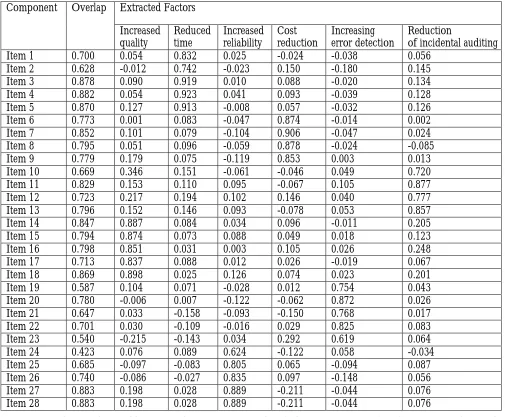
Table 3: Factor matrix (rotated correlation) exploratory factor analysis extracted for first-order effective internal controls
Component Overlap Extracted Factors Increased
quality
Reduced time
Increased reliability
Cost reduction
Increasing error detection
Reduction
of incidental auditing
Item 1 0.700 0.054 0.832 0.025 -0.024 -0.038 0.056
Item 2 0.628 -0.012 0.742 -0.023 0.150 -0.180 0.145
Item 3 0.878 0.090 0.919 0.010 0.088 -0.020 0.134
Item 4 0.882 0.054 0.923 0.041 0.093 -0.039 0.128
Item 5 0.870 0.127 0.913 -0.008 0.057 -0.032 0.126
Item 6 0.773 0.001 0.083 -0.047 0.874 -0.014 0.002
Item 7 0.852 0.101 0.079 -0.104 0.906 -0.047 0.024
Item 8 0.795 0.051 0.096 -0.059 0.878 -0.024 -0.085
Item 9 0.779 0.179 0.075 -0.119 0.853 0.003 0.013
Item 10 0.669 0.346 0.151 -0.061 -0.046 0.049 0.720
Item 11 0.829 0.153 0.110 0.095 -0.067 0.105 0.877
Item 12 0.723 0.217 0.194 0.102 0.146 0.040 0.777
Item 13 0.796 0.152 0.146 0.093 -0.078 0.053 0.857
Item 14 0.847 0.887 0.084 0.034 0.096 -0.011 0.205
Item 15 0.794 0.874 0.073 0.088 0.049 0.018 0.123
Item 16 0.798 0.851 0.031 0.003 0.105 0.026 0.248
Item 17 0.713 0.837 0.088 0.012 0.026 -0.019 0.067
Item 18 0.869 0.898 0.025 0.126 0.074 0.023 0.201
Item 19 0.587 0.104 0.071 -0.028 0.012 0.754 0.043
Item 20 0.780 -0.006 0.007 -0.122 -0.062 0.872 0.026
Item 21 0.647 0.033 -0.158 -0.093 -0.150 0.768 0.017
Item 22 0.701 0.030 -0.109 -0.016 0.029 0.825 0.083
Item 23 0.540 -0.215 -0.143 0.034 0.292 0.619 0.064
Item 24 0.423 0.076 0.089 0.624 -0.122 0.058 -0.034
Item 25 0.685 -0.097 -0.083 0.805 0.065 -0.094 0.087
Item 26 0.740 -0.086 -0.027 0.835 0.097 -0.148 0.056
Item 27 0.883 0.198 0.028 0.889 -0.211 -0.044 0.076
Item 28 0.883 0.198 0.028 0.889 -0.211 -0.044 0.076
7. Data Analysis
Investigating Data Normality Using Kolmogorov-Smirnov Test (K- S)
In order to use statistical techniques, firstly normal and non-normal distribution of collected data is tested, because if data have normal distribution, parametric tests can be used for testing hypotheses. To this end, results obtained from Kolmogorov-Smirnov test (K- S) regarding dependent and independent variables are investigated in this section. According to the obtained results, suitable tests are selected for investigating and testing research hypotheses.
Considering results of the following table, if significance level is larger than error level, null hypothesis is supported, and if significance level is smaller than error level, alternative hypothesis is supported.
Table 4: Result of normality test for research variables
Factor Sig. level Error level Conclusion
Reduction of audit process time 0.621 0.05 Normal
Reduction of audit operation costs 0.874 0.05 Normal
Reduction of incidental auditing 0.531 0.05 Normal
Increasing audit quality 0.228 0.05 Normal
Increasing detection of significant errors & distortions 0.854 0.05 Normal Increasing reliability of financial statements 0.574 0.05 Normal
Since significance level for all components is larger than error level 0.05, thus variables have normal distribution and parametric tests are used for testing research hypotheses.
Testing Research Hypothesis
Considering data obtained from research and using one-sample test, hypotheses 1 – 6 are tested and investigated.
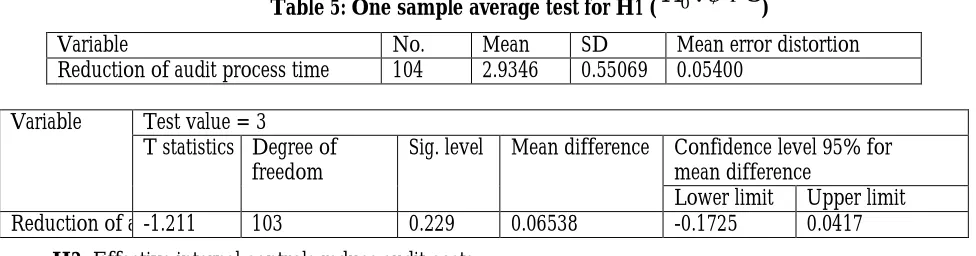
H1: Effective internal controls reduce audit time.
In order to investigate hypotheses, one sample average test was used. Results of this analysis are given in Table 5. As observed, sig. level is 0.229 which is larger than α = 0.05, thus research hypothesis is not supported. That
it, at error level 5 percent it cannot be claimed that effective internal controls reduce audit time. Table 5: One sample average test for H1 (
H
0:
3
)Variable No. Mean SD Mean error distortion
Reduction of audit process time 104 2.9346 0.55069 0.05400
Variable Test value = 3
T statistics Degree of freedom
Sig. level Mean difference Confidence level 95% for mean difference
Lower limit Upper limit Reduction of audit process time-1.211 103 0.229 0.06538 -0.1725 0.0417
H2: Effective internal controls reduce audit costs.
Table 6: One sample average test for H2 (
H
0:
3
)Variable No. Mean SD Mean error distortion
Reduction of audit process cost 104 3.0168 0.56738 0.05564
Variable Test value = 3
T statistics Degree of freedom
Sig. level Mean difference
Confidence level 95% for mean difference
Lower limit Upper limit Reduction of audit process cost0.302 103 0.763 0.01683 -0.0935 0.1272
H3: Effective internal controls reduce incidental auditing during audit period.
As observed in Table 7, sig. level is 0.000 which is smaller than α = 0.05, thus research hypothesis is
supported. On the other hand, positive upper and lower limit of confidence interval suggests research hypothesis support. That it, at error level 5 percent it can be claimed that effective internal controls reduce incidental auditing during audit period.
Table 7: One sample average test for H3 (
H
0:
3
)Variable No. Mean SD Mean error distortion
Reduction of audit process cost 104 3.6250 0.50723 0.04974
Variable Test value = 3
T statistics Degree of freedomSig. level Mean difference Confidence level 95% for mean difference Lower limit Upper limit
Reduction of incidental auditing12.566 103 0.00 0.62500 0.5264 0.7236 H4: Effective internal controls increase audit quality.
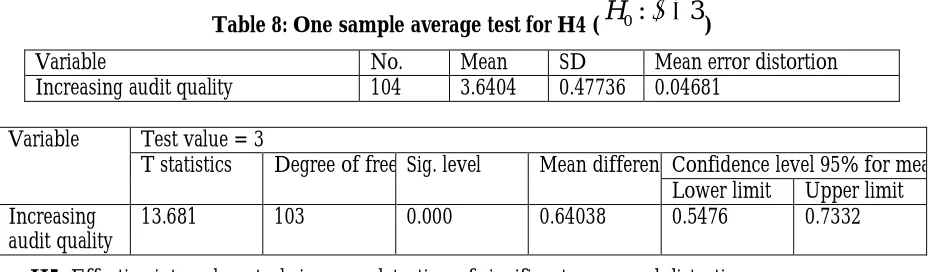
As observed in Table 8, sig. level is 0.000 which is smaller than α = 0.05, thus research hypothesis is
supported. On the other hand, positive upper and lower limit of confidence interval suggests research hypothesis support. That it, at error level 5 percent it can be claimed that effective internal controls increase audit quality.
Table 8: One sample average test for H4 (
H
0:
3
)Variable No. Mean SD Mean error distortion
Increasing audit quality 104 3.6404 0.47736 0.04681
Variable Test value = 3
T statistics Degree of freedomSig. level Mean difference Confidence level 95% for mean difference Lower limit Upper limit
Increasing audit quality
13.681 103 0.000 0.64038 0.5476 0.7332
H5: Effective internal controls increase detection of significant errors and distortions.
As observed in Table 9, sig. level is 0.000 which is smaller than α = 0.05, thus research hypothesis is
Table 9: One sample average test for H5 (
H
0:
3
)Variable No. Mean SD Mean error distortion
increasing detection of significant errors & distortions 104 3.5654 0.43751 0.04290
Variable Test value = 3
T statistics Degree of freedom
Sig. level Mean difference
Confidence level 95% for mean difference Lower limit Upper limit
increasing detection of significant errors & distortions
13.179 103 0.000 0.56538 0.4803 0.6505
H6: Effective internal controls increase reliability of financial statements.
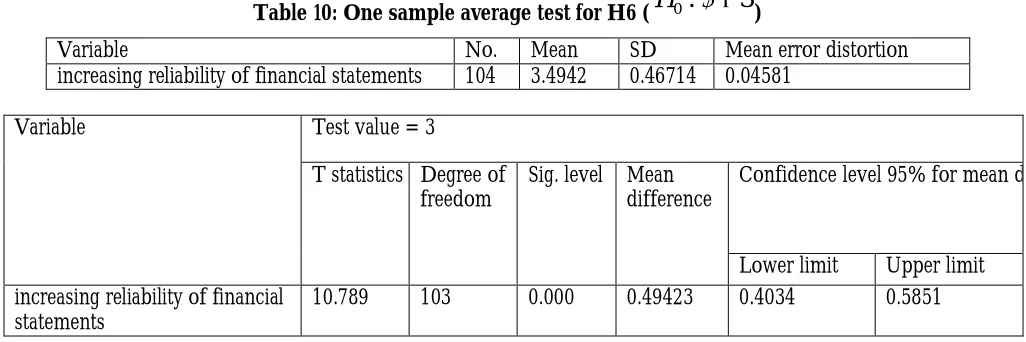
As observed in Table 10, sig. level is 0.000 which is smaller than α = 0.05, thus research hypothesis is
supported. On the other hand, positive upper and lower limit of confidence interval suggests research hypothesis support. That it, at error level 5 percent it can be claimed that effective internal controls increase reliability of financial statements.
Table 10: One sample average test for H6 (
H
0:
3
)Variable No. Mean SD Mean error distortion
increasing reliability of financial statements 104 3.4942 0.46714 0.04581
Variable Test value = 3
T statistics Degree of freedom
Sig. level Mean difference
Confidence level 95% for mean difference
Lower limit Upper limit increasing reliability of financial
statements
10.789 103 0.000 0.49423 0.4034 0.5851
Confirmatory Factor Analysis of Research Variables
In this section, results obtained from confirmatory factor analysis for each of research variables are given by AMOS software separately. It should be noted in order to reduce variables and considering them as latent variable, obtained factor loading should be above 0.3, and the model with optimal states is suitable model. The lower is chi square test, it is better, because this test indicates difference between data and model. Tests of Goodness of Fit Index (GFI) and Adjusted Goodness of Fit Index (AGFI) should be above 90 percent. RMSEA test should be as low as possible, because it is square mean of model errors.
Second Order Confirmatory Factor Analysis for Relationship between Internal Control Effectiveness and Audit Process
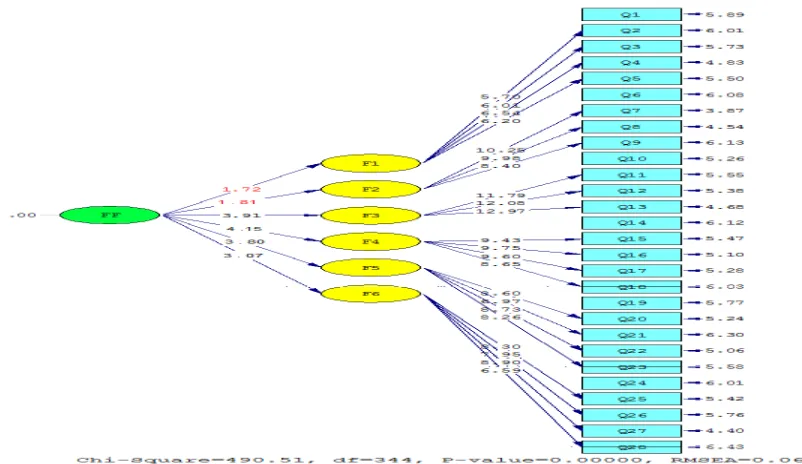
Second order factor analysis was used for reaching relationship between internal control effectiveness and audit process. Model fit indexes suggest that model is in relatively good fit, because degree of freedom of chi square is smaller than 3 and RMSEA is smaller than 0.08.
Fig 1.Measurement model for impact of internal controls affecting audit in auditor’s perspective in Audit Organization in second order standard estimation state
Fig 2.Measurement model for impact of internal controls affecting audit in auditor’s perspective in Audit Organization in second order significance value state
8. Conclusion, Discussion and Recommendations
Results of Hypothesis Testing
H1: This hypothesis was not supported. That is, it cannot be claimed that effective internal controls lead to time reduction in audit process. Hence, it is rejected. Findings of this hypothesis are not in consistency with findings by Hung and Han (1995).
H2: This hypothesis was not supported. That is, it cannot be claimed that effective internal controls lead to cost reduction in audit process. Hence, it is rejected. Findings of this hypothesis are not in consistency with findings by Clay and Haskin (1981).
H3: This hypothesis was supported. That is, it can be claimed that effective internal controls lead to reduction of incidental auditing during audit period. In the study by Cohen, Krishnamoorthy, and Wright (2002) studied corporate governance impacts on audit process. They stated that if the governance structure is strong, auditor can reduce case size and tests of costly content. Since presence of strong corporate governance suggests presence of effective internal controls in this research, it can be concluded results of this research are consistent with results obtained from this hypothesis.
H4: This hypothesis was supported. That is, it can be claimed that effective internal controls lead to increasing audit quality. It is consistent with findings by Abbott and Parker (2000). They concluded that presence of active and independent audit committees in institutes is associated with increased audit quality. Active and independent audit committee in the unit under auditing suggests presence of effective internal control in the unit.
H5: This hypothesis was supported. That is, it can be claimed that effective internal controls lead to increasing detection significant errors and distortions. It is consistent with findings by L Mini (1996) and Ioan-Ovidiu Spatacean (2012).
H6: This hypothesis was supported. That is, it can be claimed that effective internal controls lead to increasing reliability of financial statements. It is consistent with findings by Sadeghi (1997). He found that in case of negligence of independent auditors to weak points in internal controls of the companies, audit report would not be reliable. In other words, presence of effective controls has positive effect on auditor’s report concerning reliability of financial statements. Also, it is consistent with findings by Ashbaugh et al. (2008) which stressed out that audit committees and effective internal control system increase quality of financial reporting and reliability of financial statements. Reliable reports are important for groups which have in contractual relationship with the company, and effective internal controls are crucial in achieving reliable reports (Kinney et al., 1990).
Securities and Exchange Organization has recently adopted and announced internal control guideline, and delivery of board of director’s report about internal controls and delivery of independent auditor’s report will be bound in the near future (Securities and Exchange Organization, 2012). This guideline was adopted by committee of standards and education; however, it will be finalized in board of directors of Securities and Exchange Organization. Overall, benefits of this guideline weight over its costs, because it leads to more transparency in information in stock exchange market and hence investors feel more trust in the companies.
Proper implementation of internal control in the organization does not guarantee success of the organization in a short-term approach, rather updating and effectiveness of controls in an efficient long-term strategy should be taken into account. However, in both short and long term approaches, the major role of managers is making all staff committed to development of internal control systems through interaction and training. Thus, employee participation through direct participation in designing internal control unit in the organization, especially in control and its processes identification phase, is very effective. In addition, it should be noted that internal controls do not guarantee success of economic unit and internal control is not solution for all potential and possible problems. Some limitations in the current research included:
1. Inherent limitation of questionnaire
2. Lack of possibility to investigate reasons for omitting uncompleted questionnaires 3. Lack of possibility to totally investigate accuracy of respondents to questionnaires Recommendations for Future Works
1. It is suggested that value making and advisory roles of internal control in the organization is investigated.
3. Investigation of corporate governance role and audit committee in increasing independence of independent auditors
4. Investigation of reasons for disbelief of managers in business units to necessity and establishment of effective internal control
5. Investigation of impact of continuous changes of business units’ managers or lack of management stability on effectiveness of internal controls
6. Investigation of feasibility of auditor’s report on effectiveness of internal controls governing financial reporting in business units in the country.
References
Arbab Soleymani, M. (2008). Principles of Accounting, Audit Organization, Accounting and Auditing Research Center, Vol. 1
Rahmani, M. (2007). Sarbanes- Oxley Act, Accountant Blog (latest accounting rules and principles of Iran and the world)
Securities and Exchange Organization (2012). Internal Control Guidelines
Sadeghi, M. (1997). Impact of Management Letter of Independent Auditors on Internal Control System Companies Investigated by Audit Organization, Master's Thesis
Ghorbani, M. (2007). Management Assessment of Internal Controls, CPA Journal, No. 12, Year 4
Ghanbarian, R. (2011). Accounting of internal control: Internal controls from past to present, Journal of Accounting, No. 237
Working Group on Professional Accountants Working in IFAC Companies, (2011). Important guidelines and frameworks for internal control, Akhoondzadeh, M., Journal of Accounting, No. 237
Mohammadi, J. (2008). Accounting principles, Respina Publishing, First Edition Momeni, M. &Faal Ghayoom, A. (2007). Statistical analysis using SPSS, a New Book
Vadiee Noghabi, M. & Koochaki, M. (2008). Evaluating effectiveness of internal control system from the perspective of independent auditors and its impact on audit process, Journal of Development and Capital, No. 2
Taghi Nataj, G. & Bahramian, A. (2011). Evaluation of Internal Controls Effectiveness in Investment Company, Journal of Accounting and Auditing, No. 11
Maham, K. & Takroosta, M. (2012). Identifying barriers to independent audit assessment of internal controls, Audit Knowledge, No. 46, pp. 62-79
Abbott,L.j., Park,Y. and Parker, S. (2000), «The effects of audit committee activity and independence on corporate fraud», Managerial Finance(26):55-67
Ashbaugh-Skaife, H., Collins, D., LaFond, R., Kinney, W., (2008), «The effect of internal control deficiencies and their remediation on accrual quality», Accounting Review 83(1): 217–250
Clay R.J. & D.L. Haskin (1981), «Can Internal Auditors Reduce External Audit Costs?», The Internal Auditor
Cohen, J .R., Krishnamoorthy, G. and. Wright, A.( 2002), «corporate governance and the audit process», Contemporary
Accounting Research, 19(4):573-594.
Donald L Mini, Mautz R. K. And, (1996), «Internal Control and Auditing Program Modification», journal of Accounting
Review.
Hochberg Y., A. Vissing-Jorgensen, P. Sapienza, (2009), «A Lobbying Approach to Evaluating theSarbanes- Oxley Act of 2002», Journal of Accounting Research(47):583-519
Jang-Hua Hung & Hui-Lin Han (1995), «An Empirical Study on Effectiveness of Internal Auditing for Listed Firms in Taiwan», Internal Audit Conference
Kinney W.R.Jr (1999), «auditor Independence: A Lourdensome Constraint or Care Value? » Accounting Horizons, 69-75 Spatacean, Ioan-Ovidiu. (2012), «Addressing Fraud Risk by Testing the Effectiveness of Internal Control over