Michał Szeremeta
a–g, Iwona Ptaszyńska-Sarosiek
b, c, g, Zofia Wardaszka
b, c, g,
anna Niemcunowicz-Janica
a, e, fAnalysis of the Prevalence of Medicines and Psychoactive
Substances Among Drivers in the Material
of the Department of Forensic Medicine
at the Medical University of Bialystok
Department of forensic Medicine, Medical University of bialystok, PolandA – research concept and design; B – collection and/or assembly of data; C – data analysis and interpretation; D – writing the article; E – critical revision of the article; F – final approval of article; G – other
Abstract
Introduction. In recent years, the issue of drivers under the influence of medicines and psychoactive substances as a cause of collisions and accidents has been more significant.
Objectives. To evaluate the prevalence of medicines and psychoactive substances in the blood of drivers.
Material and Methods. The data, recorded in 2010–2011, was comprised of 274 blood samples of sober drivers (269 men and 5 women). 126 drivers within the group died immediately on the spot (mean age 29.7 years, range 19–53 years), 31 drivers survived the accident (mean age 32.4 years, range 24–69 years), and 117 drivers were stopped for traffic control (mean age 26.4 years, range 17–49 years). eLISa immuno-enzymatic blood tests detect-ing medicines and psychoactive substances were performed by the Neogen company. The presence of the tested substances was confirmed by gas chromatography and liquid chromatography with a mass detector (gc/MS and Lc/MS).
Results. from the total number of 274 individuals, the presence of psychoactive substances was found in 132 cases, which accounted for 48.2% of all subjects. The drivers found to be under the influence of medicines and psychoac-tive substances were most often stopped for a roadside survey, among whom the percentage of posipsychoac-tive results was 92.3% (108 cases out of 117 subjects). among the total number of positive findings the psychoactive substances used, alone or in combination with other agents, were tetrahydrocannabinols (42.4%), amphetamines (26.5%), opi-ates (25.7%) and benzodiazepines (15.1%), and their concentration in the blood did not exceed toxic levels. Conclusions. In the group of psychoactive substances most often used, either alone or in combination with other agents, there were tetrahydrocannabinols, whose high percentage of positive results in drivers stopped for a road-side control may be explained by commissioning studies on early screening. concentrations of the substances in most cases did not exceed toxic levels. Roadside examinations, on the basis of their alcohol-like effect, were per-formed primarily on male drivers (Adv Clin Exp Med 2014, 23, 2, 245–251).
Key words: drivers, road accidents, psychoactive substances, drugs.
adv clin exp Med 2014, 23, 2, 245–251 ISSN 1899–5276
ORIgINaL PaPeRS
© copyright by Wroclaw Medical University
In recent years, the issue of road users in charge of motor vehicles under the influence of medicines and psychoactive substances has been observed [1– 4]. The use of medicines to combat stress, depres-sion and insomnia, as well as psychoactive drugs, affects physical and mental health. Medicines and psychoactive substances usually cause cognitive and psychomotor capability decline, impairing perception, causing blurred vision, inhibiting
levels of concentrations of drugs and psychoactive substances in the blood of traffic fatalities, the ac-cident participants who survived and the drivers stopped by the police for a roadside survey. The as-sessment was based on the material of the Depart-ment of forensic Medicine, Medical University of bialystok in the years 2010–2011.
Material and Methods
The study object included 274 blood sam-ples of drivers who died at the scene (mean age 29.7 years, range 19–53 years) and the surviv-ing accident participants who suffered injuries for a period of time exceeding 7 days (mean age 32.4 years, range 24–69 years), as well as people driving motor vehicles stopped for a roadside survey by the police (mean age 26.4 years, range 17–49 years). The analysis conducted in the de-partment in 2010–2011 included 103 blood sam-ples taken during medicolegal autopsies, 23 blood samples taken from the deceased, sent from the site (including the Podlasie Province and neigh-boring provinces), and 31 blood samples from drivers who survived the accident. another 117 blood samples were taken from drivers from whom the blood was collected at hospital outpa-tient clinics in routine roadside surveys. all blood samples were examined at the Department of fo-rensic Medicine in bialystok on the basis of spe-cific requests from the Prosecutor’s Office and the police, which did not include blood tests for alcohol content. In all cases, previous studies on blood alcohol content came out with negative re-sults, and entities engaged in the criminal inves-tigations directing the blood to be tested by the Department of forensic Medicine, Medical Uni-versity of bialystok, decided to expand the toxi-cological studies panel. In all cases, the blood was collected with standard glass vial vacuum packag-es with a valid shelf life period.
The eLISa immuno-enzymatic blood tests detecting medicines and psychoactive substanc-es were performed by the Neogen company. Re-agent combinations were used for the detection of amphetamine, amphetamine/MDMa, cocaine and benzoylecgonine, tetrahydrocannabinols and its metabolites, medicines of benzodiazepines and the opioid compound group. In order to confirm the presence of the tested substances, the blood was analyzed by gas chromatography and liquid chromatography with a mass detector (gc/MS and Lc/MS). The collected data was statistical-ly anastatistical-lyzed in terms of the adopted distribution criteria and presented in a descriptive form and charts.
Results
In the study group of 274 drivers, examined in 2010–2011, there were 269 men and 5 women. as a result of traffic accidents, within this group, there were 124 men and two women killed. from the remaining 148 drivers, blood was taken either after a road accident during which the participants had not suffered fatal injuries, or at hospital out-patient clinics as part of a routine roadside survey. During the study, the vast majority were car driv-ers, equaling 269, which accounted for 98.2%. The other people were motorcyclists.
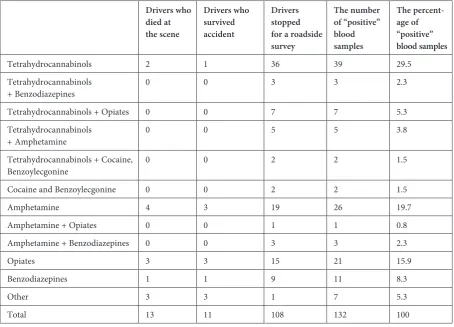
among the 126 deceased, in 13 cases the pres-ence of psychoactive substances was revealed, which accounted for 10.3% of the samples in this group. In the group of 31 drivers injured in road accidents, the percentage of “positive” results in the test samples was 35.5, corresponding to 11 cas-es. However, in the cases of the 117 drivers test-ed in hospital outpatient clinics within a routine roadside survey, the presence of psychoactive sub-stances in the blood was confirmed in 108 patients (92.3%) (Table 1).
Table 1. Distribution of “positive” cases according to the category of drivers
Drivers who died at the scene
Drivers who survived accident
Drivers stopped for a road-side survey
The number of examined blood samples
126 31 117
The number of “positive” blood samples
13 11 108
The percentage of “positive” blood samples
10.3% 35.5% 92.3%
In 26 cases, amphetamine was found as the only sub-stance, including over 19 people checked in roadside surveys, with 4 fatalities and 3 people who survived a road accident. among the 9 people whose blood was found to contain amphetamine along with other substances (tetrahydrocannabinols, opiates and ben-zodiazepines), they were all drivers stopped by the police for a roadside survey. In the group of 34 people whose blood revealed the presence of opiates, 21 peo-ple had only taken morphine. In 7 cases, the presence of morphine was found together with tetrahydrocan-nabinols, in 5 cases including benzodiazepines, and in 1 case together with amphetamine. These results were found only in blood taken from drivers as a re-sult of a roadside survey.
The benzodiazepine class of medicines was found in the blood of 22 patients (15.1%), 2 of which referred to road accident victims – a deadly one and one who survived the accident. Other “pos-itive” results (20 people) were found in the drivers controlled by the police. In that group of 22 peo-ple, solely benzodiazepines were detected in 9 cases. benzodiazepines together with opiates were detect-ed in 5 individuals. Six people were under the addi-tional influence of tetrahydrocannabinols (3 blood samples) or amphetamine (also 3 blood samples).
The substance most rarely taken by drivers was
cocaine. cocaine and benzoylecgonine were found in 4 cases, and related only to the drivers stopped for a roadside survey. The presence of benzo-ylecgonine proved cocaine had been used earlier. In 2 cases, benzoylecgonine was detected together with tetrahydrocannabinoids.
In 7 tested samples, the presence of medicines and other substances that could affect the psycho-motor performance of drivers was revealed. These were promazine and amitriptyline (in three cases identified among the fatalities), buprenorphine, doxepin and carbamazepine (in one case identi-fied among drivers who survived an accident). One person stopped for a roadside survey drove a vehi-cle under the influence of toluene (Table 2).
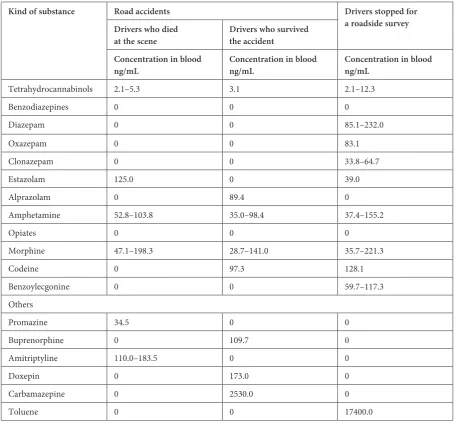
The analysis of the tested substance concentra-tions was based on the charts of Winek et al., 2001 [10]. In the blood of two traffic fatalities, the indicat-ed concentrations of THc were 2.1 and 5.3 ng/mL, thus ranged within the concentrations considered effective (> 2.5 ng/mL). Within this group of sub-jects, morphine was determined in the blood of 3 deceased, in 1 case at a therapeutic concentra-tion (< 100 ng/mL). In the blood of the deceased victims, the presence of amitriptyline (2 cases) was also found as well as promazine (1 case) and am-phetamine (4 cases), whose concentrations did not
Table 2. The number and prevalence of medicines and psychoactive substances in the blood samples
Drivers who died at the scene
Drivers who survived accident
Drivers stopped for a roadside survey
The number of “positive” blood samples
The percent-age of “positive” blood samples
Tetrahydrocannabinols 2 1 36 39 29.5
Tetrahydrocannabinols
+ benzodiazepines 0 0 3 3 2.3
Tetrahydrocannabinols + Opiates 0 0 7 7 5.3
Tetrahydrocannabinols
+ amphetamine 0 0 5 5 3.8
Tetrahydrocannabinols + cocaine,
benzoylecgonine 0 0 2 2 1.5
cocaine and benzoylecgonine 0 0 2 2 1.5
amphetamine 4 3 19 26 19.7
amphetamine + Opiates 0 0 1 1 0.8
amphetamine + benzodiazepines 0 0 3 3 2.3
Opiates 3 3 15 21 15.9
benzodiazepines 1 1 9 11 8.3
Other 3 3 1 7 5.3
exceed the therapeutic or effective concentration range (respectively: < 250 ng/mL, < 1000 ng/mL < 110 ng/mL). However, a concentration exceed-ing the therapeutic level was found in one person who had taken estazolam (> 100 ng/mL).
among the car accident injuries, the presence of THc was reported in the blood of one person (3.1 ng/ /mL). Morphine was detected in the blood of 2 peo-ple, one in therapeutic concentration (< 100 ng/mL) and one exceeding the therapeutic concentration (> 100 ng/mL). for other detected substances, amphet-amine (3 cases), carbamazepine, doxepin, buprenor-phine, codeine and alprazolam (1 case), the concentra-tion found did not exceed the therapeutic or effective level (respectively: < 110 ng/mL; < 12000 ng/mL, < 250 ng/mL < 110 ng/mL, < 340 ng/mL, < 102 ng/mL).
In the blood of 53 people, all stopped for a road-side survey, THc was detected with a concentration range of 2.1–12.3 ng/mL, including 14 people with
concentrations in excess of 2.5 ng/mL. In this group of subjects, amphetamine was indicated in the blood of 28 people, and in 7 cases these concentrations ex-ceeded the level considered to be effective. In 27 driv-ers, morphine was detected, including 8 patients with concentration higher than the therapeutic level. In the blood of the drivers stopped for a roadside check, the presence of benzodiazepines (diazepam – 14 cas-es, clonazepam – 4 cases and 1 case of oxazepam and estazolam, were also found) whose concentration did not exceed the therapeutic concentration range (re-spectively: < 4000 ng/mL, < 75 ng/mL, < 1400 ng/ /mL, < 100 ng/mL). In the blood of this group of pa-tients, there was also the presence of benzoylecgo-nine (4 cases), proving cocaine had been used earlier. Moreover, in one case, a therapeutic level of codeine was detected (< 340 ng/mL), and in one case, toluene at a concentration considered to be fatal (> 10000 ng/ /mL) (Table 3).
Table 3. The level of medicines and psychoactive substances in the blood samples of drivers (single values of concentrations of the substances are presented as data from one person, and in a range of concentrations in several probes)
Kind of substance Road accidents Drivers stopped for
a roadside survey Drivers who died
at the scene Drivers who survived the accident
Concentration in blood
ng/mL Concentration in blood ng/mL Concentration in blood ng/mL
Tetrahydrocannabinols 2.1–5.3 3.1 2.1–12.3
benzodiazepines 0 0 0
Diazepam 0 0 85.1–232.0
Oxazepam 0 0 83.1
clonazepam 0 0 33.8–64.7
estazolam 125.0 0 39.0
alprazolam 0 89.4 0
amphetamine 52.8–103.8 35.0–98.4 37.4–155.2
Opiates 0 0 0
Morphine 47.1–198.3 28.7–141.0 35.7–221.3
codeine 0 97.3 128.1
benzoylecgonine 0 0 59.7–117.3
Others
Promazine 34.5 0 0
buprenorphine 0 109.7 0
amitriptyline 110.0–183.5 0 0
Doxepin 0 173.0 0
carbamazepine 0 2530.0 0
Discussion
The issue of driving under the influence of medicines and psychoactive substances among drivers has become the subject of research in re-cent years, both in Poland and in other countries [1, 5–7, 11, 12]. The studies conducted in 2007 by the NHTSa (National Highway Traffic Safety ad-ministration), in 48 states of the U.S.a. among 10,000 drivers regarding the presence of 75 psy-choactive substances and their metabolites (in-cluding illegal substances, or substances available without a prescription), showed 11% positive re-sults in the group of daytime drivers and 14.4% of positive results among the nighttime drivers [13]. In the United States, driving under the influence of drugs is associated both with taking drugs, and the use of some medicines, for example in the treat-ment of chronic pain [12].
In Poland in 2011, the police conducted 5,679,950 sobriety checks and 10,594 controls of the presence of substances with alcohol–like effects (medicines and psychoactive substances). a simi-lar number of 10,000 drivers were tested each year in the last decade in Norway, on suspicion of driv-ing under the influence of alcohol or medicines and psychoactive substances [14]. according to the po-lice statistics, in 2011 there were more than 110,023 drivers stopped in Poland under the influence of al-cohol or substances with alal-cohol–like effects [9].
Due to the fact of the increasing number of drivers under the influence of alcohol and medi-cines and psychoactive substances in Poland and in 19 other countries of the european Union, the DRUID “Driving Under the Influence of Drugs, alcohol and Medicines” program was initiated. Its final results were provided to the public in the form of detailed reports during the Program Sum-mary Symposium on 27–28 September, 2011 in cologne, germany. The analysis conducted found that there is a wide variation in the prevalence of driving under the influence of psychoactive sub-stances across europe, from about 2.85% in fin-land (including 0.64% under the influence of alco-hol) to approximately 14.85% in Spain (including 3.92% under the influence of alcohol). The same study in Poland revealed 2.37% of people driving after the consumption of psychoactive substanc-es, including 1.47% under the influence of alco-hol [15]. The research carried out simultaneously in finland studying the presence of medicines in drivers’ blood on the basis of post-mortem exami-nations, and samples submitted for analysis by the police, revealed that the most common medica-tions taken by drivers were benzodiazepines [16]. Similar results were obtained in other Scandina-vian countries [1, 14, 17, 18].
In our examination, as well as within the DRU-ID program including the territory of Poland, the highest percentage in the group of substances with alcohol-like effects went to tetrahydrocannabinols, which were taken alone or in combination with other substances. The significantly high rate of tet-rahydrocannabinol use among drivers was not-ed by Jones et al., during an analysis in Swnot-eden in 1994–2004, the phenomenon of “driving under the influence of alcohol, medicines and psychoactive substances” [19]. Similarly, a high percentage of positive results for tetrahydrocannabinols in driv-ers’ blood analysis was recorded in 2005 by an Itian team of researchers, assessing the effects of al-cohol and the phenomenon of substances acting similarly to alcohol, on the risk of physical injury to drivers who underwent subsequent hospitaliza-tion [20]. In the case of medicines, as in Scandina-vian countries [21, 22], in the analyzed blood sam-ples of drivers, we most often found the presence of benzodiazepines, which in our studies in more than half of the cases were taken with other sub-stances. However, in a study published last year by bogstrand et al., conducted in a group of drivers admitted to the Traffic accidents Trauma Treat-ment center in Oslo, it was found that drivers who did not suffer fatal injuries most commonly used amphetamine [23]. amphetamine was also most frequently consumed in the group of 1403 road fa-talities in Sweden in 2003–2007 [21], and a group of persons stopped for traffic control in Sweden in 2001–2004 [24]. In our research, amphetamine was the second-most common psychoactive sub-stance, after tetrahydrocannabinols, which can be explained by the higher purchase priceof the drug and its smaller availability than THc. further-more, we found that drivers take opiates as often as amphetamine and within this group, in more than half of the cases it was morphine that was tak-en most ofttak-en. The same relationship in the study published in 2008 was found by Jones et al. [25].
In all the examinations cited in the discussion, there were no significant concentrations exceeding the toxicity values. Similar results were noted in our study, with the exception of toluene, the single occurrence in the mortal range can be explained by the adaptation to chronic use of solvents contain-ing this compound [10, 26].
due to the proven analytical methods and the pos-sibilities of results interpretation relatively well described in the literature [28]. according to the authors’ assessment of concentrations of select-ed substances in the blood, a reasonable action re-quires individual interpretation of each case.
The authors concluded that in the group of substances with alcohol-like effects taken alone or in combination with other agents, tetrahydrocan-nabinols were the most common. a much higher
percentage of positive results in drivers stopped for a roadside survey compared to drivers with injuries or fatal cases can be explained by commissioning an analysis after earlier screening. The concentration of the tested substances in most cases did not exceed toxic levels, excluding toluene, which was found with a concentration considered to be fatal, indicat-ing the tolerance formation to the compound. Re-search on the content of substances with alcohol-like effects was done primarily on male drivers.
References
Ojaniemi KK, Lintonen TP, Impinen AO, Lillsunde PM, Ostamo AI:
[1] Trends in driving under the influence of
drugs: a register-based study of DUID suspects during 1977–2007. accid anal Prev 2009, 41, 191–196.
Senna MC, Augsburger M, Aebi B, Briellmann TA, Donze´ N, Dubugnon JL, Iten PX, Staub C, Sturm W, [2]
Sutter K: first nationwide study on driving under the influence of drugs in Switzerland. forensic Sci Int 2010, 198, 11–16.
Morland J, Steentoft A, Simonsen KW, Ojanpera I, Vuori E, Magnusdottir K, Kristinsson J, Ceder G, [3]
Kronstrand R, Christophersen A: Drugs related to motor vehicle crashes in northern european countries: a study of fatally injured drivers. accid anal Prev 2011, 43, 1920–1926.
Legrand SA, Isalberti C, Van der Linden T, Bernhoft IM, Hels T, Simonsen KW, Favretto D, Ferrara SD, [4]
Caplinskiene M, Minkuviene Z, Pauliukevicius A, Houwing S, Mathijssen R, Lillsunde P, Langel K, Blencowe T, Verstrate AG: alcohol and drugs in seriously injured drivers in six european countries. Drug Test. anal. 2012, http://dx.doi.org/10.1002/dta.1393 www.drugtestinganalysis.com.
Galer-Tatarowicz K, Wiergowski M, Szpiech B, Reguła K, Jankowski Z:
[5] Narkomania w świetle działalności
orzeczniczej Katedry i Zakładu Medycyny Sądowej akademii Medycznej w gdańsku w latach 1996–2005. arch Med Sadowej Kryminol 2007, 3, 277–284.
Olszowy Z, Albert M, Celiński R, Kulikowska J, Nowicka J:
[6] Psychoactive agents in traffic users in the practice of
forensic Medicine Department, Medical academy of Silesia, Katowice. Probl forensic Sci 2005, 62, 210–215. Kała M, Adamowicz P, Chudzikiewicz E, Lechowicz W, Pufal E, Sykutera M, Piekoszewski W, Pach J, Śliwka K
[7] :
Substances acting similarly to alcohol in the organism of drivers. Probl forensic Sci 2005, 62, 133–144. Niemcunowicz-Janica A, Wardaszka Z, Ptaszyńska-Sarosiek I:
[8] badania nad obecnością środków odurzających
i substancji psychotropowych w organizmach uczestników ruchu drogowego w materiale Zakładu Medycyny Sądowej UM w białymstoku. arch Med Sadowej Kryminol 2009, 3, 194–198.
http://dlakierowcow.policja.pl/portal/dk/807/47493/ [9]
Winek CL, Wahba WW, Winek CL Jr., Balzer TW:
[10] Drug and chemical blood-level data 2001. forensic Sci Int
2001, 122, 107–123. Jones AW, Holmgren A:
[11] What non-alcohol drugs are used by drinking drivers in Sweden? Toxicological results from ten years of forensic blood samples. J Safety Res 2012, 43, 151–156.
Wilhelmi BG, Cohen SP:
[12] a framework for “driving under the influence of drugs” policy for the opioid using driver. Pain Physician 2012, 15, Suppl 3, 215–230.
Lacey JH, Kelley-Baker T, Voas RB, Romano E, Furr-Holden CD, Torres P, Berning A:
[13] alcohol- and
drug-involved driving in the United States: methodology for the 2007 National Roadside Survey 2011, 35, 319–353. Vindenes V, Lund HM, Andresen W, Gjerde H, Ikdahl SE, Christophersen AS, Øiestad EL:
[14] Detection of drugs
of abuse in simultaneously collected oral fluid, urine and blood from Norwegian drug drivers. forensic Sci Int 2012, 219, 165–171.
http://www.druid-project.eu [15]
Kriikku P, Wilhelm L, Rintatalo J, Hurme J, Kramer J, Ojanperä I:
[16] Phenazepam abuse in finland: findings from
apprehended drivers, post-mortem cases and police confiscations. forensic Sci Int 2012, 220, 111–117. Jones AW, Holmgren A, Kugelberg FC:
[17] concentrations of scheduled prescription drugs in blood of impaired
drivers: considerations for interpreting the results. Ther Drug Monit 2007, 29, 248–260. Gjerde H, Christophersen AS, Normann PT, Mørland J
[18] : Toxicological investigations of drivers killed in road
traffic accidents in Norway during 2006–2008. forensic Sci Int 2011, 212, 102–109. Jones AW, Holmgren A, Kugelberg FC:
[19] Driving under the influence of cannabis: a 10-year study of age and gen-der differences in the concentrations of tetrahydrocannabinol in blood. addiction 2008, 103, 452–461.
Giovanardi D, Castellana CN, Pisa S, Poppi B, Pinetti D, Bertolini A, Ferrari A:
[20] Prevalence of abuse of alcohol
and other drugs among injured drivers presenting to the emergency department of the University Hospital of Modena, Italy. Drug alcohol Depend 2005, 80, 135–138.
Jones AW, Kugelberg FC, Holmgren A, Ahlner J:
[21] five-year update on the occurrence of alcohol and other drugs
in blood samples from drivers killed in road-traffic crashes in Sweden. forensic Sci Int 2009, 186, 56–62. Simonsen KW, Steentoft A, Hels T, Bernhoft IM, Rasmussen BS, Linnet K:
[22] Presence of psychoactive substances
Bogstrand ST, Gjerde H, Normann PT, Rossow I, Ekeberg O:
[23] alcohol, psychoactive substances and non-fatal
road traffic accidents – a case-control study. bMc Public Health 2012, 12, 734. Holmgren A, Holmgren P, Kugelberga FC, Jonesa AW, Ahlnera J:
[24] Predominance of Illicit Drugs and Poly-Drug
Use among Drug-Impaired Drivers in Sweden. Traffic Inj Prev 2007, 8, 361–367. Jones AW, Holmgren A, Kugelberg FC:
[25] Driving Under the Influence of Opiates: concentration Relationships between Morphine, codeine, 6-acetyl Morphine, and ethyl Morphine in blood. J anal Toxicol 2008, 32, 265–272. Buszewicz G, Kiszka M, Czekajska-Łuckiewicz H:
[26] Interpretacja wyników pośmiertnych badań toksykologicznych
w zatruciach toluenem, na przykładzie pięciu przypadków. arch Med Sadowej Kryminol 2000, Suppl 1, 95–99. Vindenes V, Jordbru D, Knapskog AB, Kvan E, Mathisrud G, Slørdal L, Mørland J:
[27] Impairment based legislative
limits for driving under the influence of non alcohol drugs in Norway. forensic Sci Int 2012, 219, 1–11.
Wille SM, Raes E, Lillsunde P, Gunnar T, Laloup M, Samyn N, Christophersen AS, Moeller MR, Hammer KP, [28]
Verstraete AG: Relationship between oral fluid and blood concentrations of drugs of abuse in drivers suspected of driving under the influence of drugs. Ther Drug Monit 2009, 31, 511–519.
Address for correspondence:
Michał Szeremeta
Department of forensic Medicine Medical University of bialystok Waszyngtona 13
15-230 białystok Poland
Tel.: +48 857 485 950
e-mail: [email protected]
conflict of interest: None declared