
Marcin Tkaczyk
2, 1, A–F, Anna Jander
2, A–F, Jakub R. Stempień
3, A–FSocial and Professional Determinants
for Withdrawing and Withholding Chronic Dialysis
Among Polish Pediatric Nephrologists, Neonatologists
and Anesthesiologists*
1 Pediatric Didactics Unit, 4th Chair of Pediatrics, Medical University of Łódź, Poland
2 Department of Pediatrics and Immunology, Nephrology Division, Polish Mother’s Memorial Hospital Research Institute, Łódź, Poland
3 Department of Sociology, Chair of Humanities, Medical University of Łódź, Poland
A – research concept and design; B – collection and/or assembly of data; C – data analysis and interpretation;
D – writing the article; E – critical revision of the article; F – final approval of article; G – other
Abstract
Objectives.The aim of this multicenter nationwide study was to reveal the influence of social and non-medical fac-tors on qualifying children to commence chronic dialysis, to withhold it or to withdraw it. It was also important to compare the real and postulated significance of particular factors that were taken under consideration by pediatric nephrologists, neonatologists and anesthesiologists (intensivists).
Material and Methods.The survey was addressed to the whole population of specialists dealing with chronic renal replacement therapy for children at key pediatric nephrology centers in Poland.
Results.Most of the respondents accepted that withholding or withdrawing chronic dialysis is an alternative in certain clinical situations. The statistical analysis showed that the physicians’ social characteristics had little influ-ence on their preferinflu-ences when deciding about withholding or withdrawing chronic dialysis.
Conclusions. The study showed that non-medical factors did not influence physicians’ attitudes to the problem of withholding or withdrawing chronic dialysis (Adv Clin Exp Med 2014, 23, 5, 791–796).
Key words: children, chronic dialysis, dialysis withholding/withdrawing, pediatric nephrology, non-medical deter-minants.
Adv Clin Exp Med 2014, 23, 5, 791–796
ISSN 1899–5276 © Copyright by Wroclaw Medical University
In the last several years, significant progress in the technical aspects of dialysis have created op-portunities for applying renal replacement thera-py even in very difficult clinical cases (low birth weight children, multiple organ failure, multiple malformations). The decision to commence dialy-sis depends not only on nephrologists, but also on other specialists – neonatologists and anesthesiol-ogists working in intensive care units (ICUs) [1, 2]. In this unique clinical setting, the problem of fu-tile therapy often arises [3–5]. The situation is par-ticularly difficult when the patient is a child who does not understand the treatment procedures and manifests refusal or physical resistance [3, 6–8].
When clear national guidelines for particular
medical problems/diseases have not been imple-mented, physicians are forced to make decisions about commencing, continuing or discontinu-ing therapy on the basis of their own experience and data from the available literature. Do some so-cial factors have an impact on those decisions? In opinion of specialists, are the proper criteria being considered?
The aim of this study was to describe the in-fluence of selected social factors on opinions about non-commencement or withdrawal of chronic dial-ysis in children with CKD stage 5 chronic kidney dis-ease (CKD) among Polish pediatric nephrologists, neonatologists and anesthesiologists from different medical centers dealing with dialysis for CKD.
Material and Methods
An anonymous survey was designed as a mul-ticenter analysis including all 14 pediatric nephrol-ogy and dialysis centers in Poland. The Polish So-ciety of Pediatric Nephrology gave appropriate approval for the study. Fully anonymous paper questionnaires were mailed to the 14 centers with a request to deliver the forms to each specialist (ne-phrologist, neonatologist and anesthesiologist-in-tensivist) employed there who was involved with chronic dialysis in neonates or children. The esti-mated number of personnel this covered was 250 (about 100 nephrologists, 100 anesthesiologists and 50 neonatologists).
The survey, containing 29 questions (24 closed-ended and 5 open-closed-ended), was designed with the cooperation of physicians, a sociologist and a psy-chologist. The overall response rate for the ques-tionnaires distributed was 56% (140/250), which is quite a good result, according to Polish research experiences [9]. The highest number of respons-es was observed among nephrologists (74/100). A detailed description of the research sample is presented in the Table 1. The following social and professional characteristics of the respondents were collected: sex, marital status, religion, num-ber of children, specialization, clinical experience and professional position.
The statistical analysis was carried out using Statistica 7 PL statistical software package and Mi-croSoft Excel. The normality of distribution was tested by the Kolmogorow-Smirnow test. Student’s
t-test (p = 0.05) was performed in order to
com-pare arithmetic means for specified sub-groups. Finally, Spearman’s rank correlation coefficient was used.
Results
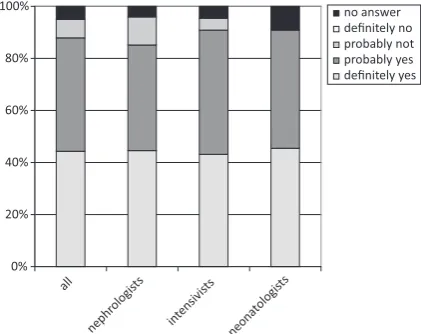
The basic empiric finding was that the vast ma-jority of the physicians surveyed (88%) stated that there are some situations that justify withdrawing/ withholding chronic dialysis. No significant ence in the structure of the answers from the differ-ent medical specialists was observed (Fig. 1). The vast majority of respondents that had already par-ticipated in the process of decision-making regard-ing the withdrawal/withholdregard-ing of dialysis (90%) would repeat the decision they had made.
The study aimed to identify various elements that are considered in decisions regarding qualify-ing patients for dialysis treatment. A list of 9 possi-ble factors was presented to the respondents. Their task was to describe the actual significance of each factor on a scale from 1 to 9, where 1 was “com-pletely meaningless” and 9 was “very important”. The factors specified were: (1) the patient’s age; (2) concomitant diseases; (3) mental and growth
Fig. 1. Are there situations that justify not commenc-ing chronic dialysis?
0% 20% 40% 60% 80% 100%
all
nephr ologis
ts
inten sivists
neon atolo
gists
no answer definitely no probably not probably yes definitely yes
Table 1. Detailed characteristics of the study group
Gender 97 female (69%) 43 male (31%)
Marital status 119 married or in a longterm
rela-tionship (85%) 21 single (widowed, divorced, single, sepa-rated) (15%)
Religion 124 believers (89%) 13 non-believers (10%) 2 lack of data (1%)
Parenthood 117 with children (84%) 23 no children (16%)
Professional position 96 junior doctors or physicians (69%) 44 in management (31%)
Age arithmetic means 47 y. (28–66 y.)
Overall professional experience 22 y. (2–45 y.)
Experience as a specialist 5 y. (1–38 y.)
retardation; (4) the parents’ opinion; (5) the pos-sibility of future transplantation; (6) the overall prognosis; (7) socio-economic issues; (8) legal is-sues; (9) the department’s usual practice. The sta-tistical analysis of the results (arithmetic mean) showed that the most important factors were con-comitant diseases, overall prognosis and the par-ents’ opinion. The factors of the least actual impor-tance were socio-economic and legal issues.
The respondents were asked not only about the actual importance of the specified elements, but also about their hypothetical ideal importance. The catalog of factors listed above was duplicat-ed, which allowed the researchers to assess Spear-man’s rank correlation coefficient. The results was rho = 0.9 (p = 0.001). This means that the rank-ings in both questions were very similar, indicating that in the opinion of Polish pediatric nephrolo-gists, neonatologists and anesthesiolonephrolo-gists, proper
criteria are used in the decision-making process qualifying patients for dialysis treatment, and no essential changes need to be implemented (Fig. 2). The role of the physicians’ social and profession-al characteristics as a potentiprofession-al influence on the deci-sion-making process was also considered. Student’s t-test was used to compare the arithmetic means for specified socio-professional groups. Do sex, age, re-ligion etc., influence physicians’ views of the hypo-thetical ideal importance of the factors considered in the decision-making process qualifying patients for dialysis? If so, the means calculated for those fac-tors would not be equal. In the analysis, the follow-ing characteristics were considered: (1) the respon-dent’s professional position (manager vs. physician); (2) whether the respondent had ever taken part in the decision-making process regarding withdraw-ing/withholding chronic dialysis (yes or no); (3) the respondent’s sex (male or female); (4) whether the
Fig. 2. What factors have and should have an influence on the decision to withdraw/withhold dialysis? (from 1 to 9, where 1 is “completely meaningless” and 9 is “very important”) [28]
arithme�c means
3.2 3.8
4.5 3.8
5.4 6.0 5.7
6.5 6.9
3.1 3.6
3.9 4.4
4.5 5.3
5.9 5.9
6.2
1 2 3 4 5 6 7 8 9
socio-economic issues pa�ent's age legal issues department's prac�ce mental and growth retarda�on possibility of transplanta�on parents' opinion overall prognosis concomitant diseases
respondent was a parent (yes or no); (5) the respon-dent’s religion (believer vs. non-believer); (6) the re-spondent’s age (lower or equal to the median vs. high-er than median); (7) the respondent’s marital status (married or in a longterm relationship vs. single).
The results of Student’s t-test showed that in most cases the factors listed above did not have a significant influence on the physicians’ attitude. For 63 pairs of arithmetic means compared, statis-tically significant differences were observed in only 5 cases: Physicians paid more attention to the pa-tient’s age than managers (4.2 vs. 3.0); mental and growth retardation was more important to those who had already participated in the decision-mak-ing process regarddecision-mak-ing withdrawdecision-mak-ing/withholddecision-mak-ing chronic dialysis, compared to those who had had no such experience (6.1 vs. 5.0). Fewer women than men attributed importance to the overall prognosis (6.2 vs. 7.2). Older respondents paid less attention to socio-economic issues (2.8 vs. 3.8) and legal is-sues (3.9 vs. 5.2) than their younger colleagues did. The detailed results are shown in Table 2.
Discussion
Pediatric nephrologists have recently begun to confront the problem of withdrawing/withholding chronic dialysis [3, 10–13]. Many authors postu-late that this difficult decision might be accepted in selected cases with a very poor prognosis and mul-tiple concomitant malformations or health prob-lems [14–18]. The decision to withdraw or not to commence a life-sustaining but futile therapy is difficult for every clinician who is limited by eth-ical and legal regulations [5, 19, 20]. Profession-al societies in North America and other Western countries have prepared guidelines not directly re-lated to withdrawing dialysis, but rere-lated to the non- commencement of any futile therapy [16, 19, 21, 22]. At the time of the analysis presented in the current article, there were no such recommenda-tions in Poland, but they were issued later by the Polish Society of Pediatricians [23]. The authors of this paper are convinced that this fact does not diminish the importance of the results obtained, which refer to physicians’ opinions and attitudes and to social (or even subjective) determinants.
A team of French researchers obtained re-sults similar to those presented in this paper. Key clinical factors influencing decisions to withdraw/
/withhold dialysis were (in order of importance) the possibility of further development, mental re-tardation, consequences for the family, additional malformations and the parents’ will [14]. The study reported in this paper showed that the same factors were the crucial ones, but multiple malformations, prognosis and the parents’ opinion had equal im-portance. However, the French study described only nephrologists’ attitudes [14], while the study presented in this paper provided an opportunity to investigate and compare the opinions of represen-tatives of different specializations (nephrologists, anesthesiologists-intensivists and neonatologists) dealing with the same group of patients. This may be considered as a strong point of the study.
The problem of non-medical factors that may influence physicians’ decisions has been inspiring research studies for a couple of decades [24–27]. Usually the results have shown that non-medical elements play a vital role in decision-making pro-cesses. However, non-medical elements were of-ten conceptualized as non-personal and objective, related mainly to the way health care is organized in a particular country. For example, in one study conducted in the USA [24] the list of non-medical factors associated with higher rates of hospitaliza-tion included hospital occupancy rates and low per capita income in the county. In the survey present-ed in this paper, Polish physicians reportpresent-ed them-selves to be resistant to the influence of non-med-ical factors. Nevertheless, it should be emphasized that in the presented survey the role of personal characteristics – non-medical factors of a subjec-tive status – was investigated, rather than the role of health-care organizations. This may explain the differences in the general conclusions of the pres-ent study and the US study.
As reported in a previous publication [28], med-ical factors were conclusive among the physicians surveyed in the study reported here. The primary de-cision-making responsibility should rest with a mul-tidisciplinary team in which a nephrologist should play the most crucial role. In the present analysis, all 3 groups of specialists – nephrologists, anesthesiolo-gists-intensivists and neonatologists – reported sim-ilar attitudes to the problem of withholding/with-drawing chronic dialysis in children. Moreover, the
detailed Student’s t-test proved that social/subjective
factors did not influence the attitude of investigat-ed physicians to the problem of withholding/with-drawing of chronic dialysis in children.
Table 2. Student’s t -test: factors that may influence physicians during the decision-making process qualifying patients for chronic dialysis Factor Professional position Had decided in past Sex Religion Age Marital status Parenthood Element mean physician mean-manager t -test (empiric) p decision yes decision no t-test (empiric) p women men t -test (empiric) p believer non-believer t -test (empiric) p older younger t -test (empiric) p single with partner t -test (empiric) p children no children t -test (empiric) p Patient’s age 4.2 3.0 2.22 0.028 3.8 3.4 0.74 0.460 3.9 3.8 0.17 0.869 3.7 4.4 0.76 0.451 3.5 4.1 1.32 0.189 4.2 3.8 0.63 0.529 4.1 3.8 0.54 0.588
Concomitant diseases
7.0 6.9 0.34 0.732 7.0 6.8 0.70 0.483 6.9 7.1 0.66 0.508 7.0 7.0 0.06 0.955 6.9 7.0 0.38 0.708 6.7 7.0 0.62 0.535 7.1 6.9 0.48 0.633 Mental and growth retardation 5.4 5.5 0.25 0.800 6.1 5.0 2.20 0.030 5.4 5.5 0.15 0.882 5.5 5.2 0.29 0.775 5.5 5.4 0.25 0.802 5.8 5.4 0.62 0.537 5.7 5.4 0.57 0.572 Parents’ opinion 5.4 6.4 1.94 0.054 6.3 5.5 1.50 0.137 5.7 5.7 0.02 0.985 5.7 5.7 0.07 0.948 5.6 5.9 0.51 0.611 6.1 5.6 0.72 0.475 6.4 5.6 1.35 0.178 Possibility of future transplantation 6.3 5.5 1.56 0.122 6.0 5.6 0.73 0.468 6.1 5.9 0.53 0.594 6.0 5.8 0.32 0.751 5.8 6.3 0.91 0.363 6.0 6.0 0.03 0.979 5.5 6.2 1.10 0.273 Overall prognosis 6.7 6.3 0.91 0.366 6.6 6.3 0.54 0.591 6.2 7.2 2.06 0.041 6.5 7.1 0.80 0.425 6.3 6.8 0.92 0.357 6.3 6.6 0.49 0.625 5.9 6.7 1.28 0.202
Socio-economic issues
References
[1] Bunchman TE: Infant dialysis: The future is now. J Pediatr 2000, 136, 1–2.
[2] Kjellstrand CM: Giving life – giving death. Ethical problems of high technology medicine. Acta Med Scand 1998, 725, 1–88.
[3] Auer J: Ethical issues in dialysis. Issues surrounding the withdrawal of dialysis treatment. Neph Dial Transplant 1998, 13, 1149–1151.
[4] Beauchamps TL, Childress JF: Principles of biomedical ethics. New York, Oxford University Press 2005.
[5] Jander A: The ethics of renal replacement therapy in newborn and infants. Bioet Zesz Pediatr 2008, 5, 59–63.
[6] Jander A, Nowicki M, Tkaczyk M, Makulska I, Zwolinska D, Latoszynska J: Chronic peritoneal dialysis in infants – preliminary results of the multicenter survey. Przegl Lek 2006, 63, 72–74.
[7] Lederman S, Scanes ME, Fernando ON, Duffy PG, Madden SJ, Trompeter RS: Long-term outcome of peritoneal dialysis in infants. J Pediatr 2000, 136, 24–29.
[8] Shroff R, Rees L, Trompeter R, Hutchinson C, Ledermann S: Long-term outcome of chronic dialysis in children. Pediatr Nephrol 2006, 21, 257–264.
[9] Choloniewski J: Ankietowanie pocztowe w Polsce. In: Mangione T. (aut.) Ankietowanie pocztowe w badaniach marketingowych i socjologicznych. Wyd. Nauk. PWN, Warszawa 1999, 162–163.
[10] Keating RF, Moss AH, Sorkin MI: Stopping dialysis of an incompetent patient over a family objection: is it ever ethical or legal? J Am Soc Nephrol 1994, 4, 1879–1883.
[11] Rutecki GW, Cugino A, Jarjoura A: Nephrologists’ subjective attitudes towards end-of-life issues and the conduct of terminal care. Clin Nephrol 1997, 48, 173–180.
[12] Sessa A: When dialysis becomes worse than death. Nephrol Dial Transplant 1995, 10, 1128–1130.
[13] Sjokvist P, Nilstun T, Svantesson A: Withdrawal of life support – who should decide? Differences in attitudes among the general public, nurses and physicians. Int Care Med 1999, 25, 949–954.
[14] Fauriel I, Moutel G, Moutard ML, Montuclard L, Duchange N, Callies I: Decision concerning potentially life-sustaining treatments in pediatric nephrology: multicentre study in French-speaking countries. Nephrol Dial Transplant 2004, 19, 1252–1257.
[15] Geary DF: Attitudes of pediatric nephrologists to management of end stage renal disease in infants. J Pediatr 1998, 133, 154–156.
[16] Grenda R: Ethical aspects of renal replacement therapy in children. Bioet Zesz Pediatr 2008, 5, 64–70.
[17] Riano I, Malaga S, Callis L: Towards guidelines for dialysis in children with end stage renal disease. Pediatr Nephrol 2000, 15, 157–162.
[18] Shooter M, Watson A: The ethics of withholding and withdrawing dialysis therapy in infants. Pediatr Nephrol 2000, 14, 347–351.
[19] Galla JH: Clinical practice guideline on shared decision-making in the appropriate initiation of and withdrawal from dialysis. J Am Soc Nephrol 2000, 11, 1340–1342.
[20] Stuczynska K: Futile therapy – legal aspects. Bioet Zesz Pediatr 2006, 3, 99–110.
[21] Royal College of Pediatrics and Child Health. Withholding or withdrawing life-saving treatment in children: a framework for practice. Royal College of Pediatrics and Child Health, London 1997.
[22] Patel S, Holley JL: Withholding and withhdrawing dialysis in the intensive care unit: benefits derived from consult-ing the renal physicians Association/American Society of Nephrology Clinical Practice Guideline, shared decision-making in the appropriate initiation of and withdrawal from dialysis. Clin J Am Soc Nephrol 2008, 3, 587–593.
[23] Polish Society of Pediatricians. Zaniechanie i wycofanie się z uporczywego leczenia podtrzymującego życie u dzieci. Polskie Towarzystwo Pediatryczne, Warszawa 2011.
[24] Rosenblatt RA, Moscovice IS: The Physician as Gatekeeper: Determinants of Physicians’ Hospitalization Rates. Med Care 1984, 22, 150–159.
[25] Shortell SM: Determinants of Physician Referral Rates: An Exchange Theory Approach Med Care 1974, 12, 13–31.
[26] Heide A, Vrakking A, Delden H, Looman C, Maas P: Medical and nonmedical determinants of decision making about potentially life-prolonging interventions. Med Dec Making 2004, 24, 518–524.
[27] Christakis NA, Lamont EB: Extent and determinants of error in doctors’ prognoses in terminally ill patients. West J Med 2000, 172, 310–313.
[28] Tkaczyk M, Jander A, Stempień JR: Czy wszystkie dzieci z V stadium przewleklej choroby nerek w Polsce pow-inny być dializowane, w opinii nefrologów, neonatologow i lekarzy intensywnej terapii? Pediatr Med Rodz 2010, 6, 133–140.
Address for correspondence:
Marcin TkaczykDepartment of Pediatrics and Immunology
Nephrology Division, Polish Mother’s Memorial Hospital Research Institute Rzgowska 281/289
93-338 Łódź Poland
Tel.: +48 42 271 13 91 E-mail: [email protected]
Conflict of interest: None declared
![Fig. 2. What factors have and should have an influence on the decision to withdraw/withhold dialysis? (from 1 to 9, where 1 is “completely meaningless” and 9 is “very important”) [28]](https://thumb-us.123doks.com/thumbv2/123dok_us/8769733.1756357/3.595.109.490.332.746/influence-decision-withdraw-withhold-dialysis-completely-meaningless-important.webp)
