Journal of Plant Molecular Breeding (JPMB) Vol.1/No.2/October 2013/ 17-27
Validation of a genus-specific gene; TPS, used as internal control in
quantitative Real Time PCR of transgenic cotton
S.M. Javadi1, M. Tohidfar2*, A. Haghnazari3 and Sh. Negari4
1. Department of Biomaterial Biotechnology Research Group, ACECR, Zanjan Branch, Iran. 2. Agricultural Biotechnology Research Institute of Iran Karaj, Iran.
3. Research Center of Biotechnology and Physiology, Zanjan University, Zanjan, Iran. 4. Laboratory of Molecular Biology, Center of Molecular Pathobiology, Tehran ,Iran. *corresponding author: E-mail: [email protected].
Received: October 2012 Accepted:June 2013
Abstract
Identification of genes with invariant levels of gene expression is a prerequisite for validating transcriptomic changes accompanying development. Ideally expression of these genes should be independent of the morphogenetic process or environmental condition.We report here the validation of internal control gene i.e.TPS (trehalose 6-phosphate-synthase) in cotton (Gossypium spp), using TaqMan system in quantitative Real Time PCR (qRT-PCR). The Gene expression was tested in five different G. hirsutum cultivars including Coker 312, Acala SJ, ZETA 2, Taghva, Neishabour and a diploid wild type; G. barbadense. Identical amplicons were obtained within these cultivars. No amplifications was achieved when DNA samples from barley (Hordeum vulgare), maize (Zea mays), rice (Oryza sativa), Fig (Ficus carica), pistachio (Pistacia vera), yew (Taxus baccata), wheat (Tirticum aestivum), rose (Rosa hybrida) and soybean (Glycine max) were used as template. Therefore, it was confirmed that the primers and probes designed in this study were specific for the identification and quantification of internal control gene. These results reveal the possibility of using the TPS gene as an internal control in cotton. In another word, this gene would be a suitable candidate as a reference gene in examination of gene expression, detection of transgenic cotton and determining e the zygosity as well as the copy number of the transgene.
Keywords: Gossypium spp, trehalose 6-phosphate-synthase gene (TPS), endogenous reference gene, RT- PCR, transgene.
Abbreviations: BHQ (black hold quencher), TPS (trehalose 6-phosphate-synthase), TET (tetrachloro-6-carboxyfluorescein).
Introduction
Real Time PCR is the most sensitive and flexible method for measuring gene expression. This can be efficiently used
Data obtained by gene expression methods can be strongly affected by different factors such as RNA extraction procedures, and cDNA synthesis. To tackle this obstacle, usually the level of gene expression will be compared with the expression level of a house keeping gene as an internal control. This is necessary that previous identified such genes, which can then be reliably used to normalise relative expression of genes of interest (Izaskun et al, 2010). Cotton (Gossypium spp.) is the most important fiber crop in the world and has been situated the target of various genetic modifications to improve its agronomic traits and fiber quality in the last decade. When new transgenic cotton plants are obtained, one early and essential step is their molecular characterization, such as determining transgene copy number and gene expression level. Development of endogenous reference gene for detection transgenic plant and gene expression is the basic step in risk assessment. Currently more than 17 million ha transgenic cotton exists and this cultivation area is anticipated to grow increasingly. Developing quantitative and precise instructions such as real time PCR in order to detect and identify such products is necessary (James, 2010). At present, the most creditable and widely used methodology that enables the primary detection of transgenic plants and their molecular characterization is the conventional PCR method. Among the PCR detection methods, fluorescence quantitative real-time (RT)-PCR is
considered to be an easy, useful and accurate method (Zhang et al. 2003). Using this method, a target gene (transegene) can be quantified by plotting a standard curve using known quantities of an endogenous gene and the consequent extrapolation based on the linear regression line. In order to make theses PCR procedures more standardized, the target sequences and plant genus-specific endogenous reference genes should be detected. This system requires both specific primers to the transgene and genus-specific primers complementary to an endogenous reference gene.
So far, much effort has been made to obtain the reference gene of different plants for the primary detection of GMOs and their molecular characterization. Several plants internal reference genes have been reported. For examples reference genes arezein or invertase 1 for maize (Valtilingom et al. 1999; Zimmermann et al. 1998), lectin or hsp (heat-shock protein), for soybean (Duijn et al. 1999), BnACCg8,cruciferin or HMGI/Y for rapeseed (James et al. 2010; Weng et al. 2005), LAT52 for tomato (Yang et al. 2005b) and SPS for rice (Ding et al .2004). However, there are only a few reports on an endogenous reference gene for GM cotton identification and quantification (Yang et al. 2005a).
19 depends on the availability of an appropriate endogenous reference gene. Reference genes should be species- or genus-specific, and exhibit a low level of heterogeneity among cultivars.
Therefore, this study was set to search for an appropriate cotton gene to be used as an endogenous reference gene for PCR amplification. Moreover, specific primers and probe for that particular cotton gene were designed, and the quantitative real-time PCR conditions were optimized. Finally, the specificity of the primers and probes designed to various species including cotton was tested using TaqMan PCR method.
Materials and methods
To select an appropriate cotton gene, TPS, to be used an endogenous reference gene for PCR amplification, all gene databanks (GenBank-Gene-nucleotide) were searched for sequences of a low copy number within the genome.
The seeds of five different cotton (G.hirsutum) cultivars, including Coker 312, Acala SJ, ZETA 2, Taghva, Neishabour and one diploid wild cultivar (G.barbadense) were provided by the Agricultural Biotechnology Research Institute of Iran (ABRII).The seeds or leaves of 9 different plants including barley (Hordeum vulgare), maize (Zea mays), rice (Oryza sativa), wheat (Tirticum aestivum), Fig (Ficusc arica), pistachio (Pistaci avera), yew (Taxus baccata), Rose (Rosa hybrida) and soybean (Glycine max) were collected from a number of agriculture research
institute across Iran. Transgenic cotton (Coker, Line 61), containing a synthetic cry1Ab gene developed by ABRII was also used (Tohidfar et al. 2008).
DNA extraction and purification
Plant genomic DNA used for real-time-PCR were extracted from 1g fresh leaves using the CTAB method (Sambrook and Russell 2001). The quality and quantity of DNA was estimated using a spectrophotometer based on the 260/280-nm and 260/230-260/280-nm UV absorption ratios and analyzed by 1% agarose gel electrophoresis.
All oligonucleotides for TaqMan were designed by Beacon Designer 7.0.The internal oligonucleotide probe specific to the candidate gene chosen were labeled at the 5׳ end with TET (tetrachloro-6-carboxyfluorescein), whereas 3׳ end was labeled with the BHQ (black hole quencher).
Optimization of PCR conditions
Following PCR program was carried out for TaqMan polymerase chain reaction: 2 min at 95 °C, 30 cycles; 8 s at 94 °C, 20 s at 60 °C and 1min at 72 °C.
established using cry1A(b) and the selected candidate gene. Then the standard calibration curve was plotted using logarithm of insect-resistant cotton concentration against ∆Ct CtTRANSGENIC−CtTPS), by duplicate amplification of reference DNA; Ct value can be defined as the threshold cycle value (Livak and Schmittgen 2001; Terry and Harris 2001).
Results and discussion
Selection of an endogenous reference gene for cotton
To select an appropriate cotton gene to be used an endogenous reference gene for PCR amplification, all gene databanks were investigated for sequences of a low copy reference gene within the genome, to produce a cotton-specific product. The several candidate genes selected were then blasted in the database to determine their homology. The results of homologous analysis indicated that the sequence of TPS gene (with accession No.AY628140) had the lowest homogeneity with the DNA sequences of the other plants. The TPS gene has one copy per Gossypium genome (AADD) and encodes trehalose-6-phosphate-synthase enzyme in the trehalose biosynthesis pathway (Javadi et al. 2007; Zimmermann et al 2004; Eastmond et al. 2003).
Following the reference gene selection and based on the full sequence of the TPS gene, an appropriate forward primer (655 to 677 bp, corresponding to the TPS gene sequence in the GenBank with the
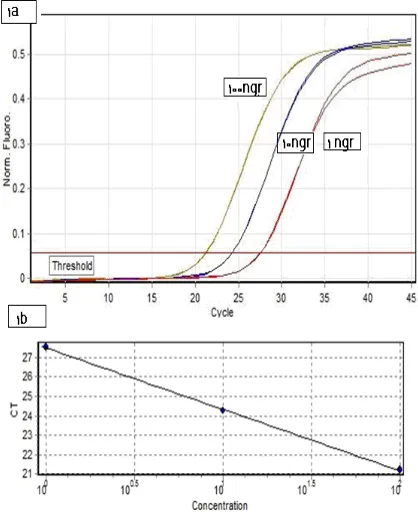
accession number of AY628140) and a reverse primer (731 to 754 bp), as well as a specific probe (681 and 704) were designed by Beacon Designer 7.90 software. The designed primer pair successfully amplified a 100 bp fragment. The details of the designed primers and probe are presented in Table 1. Finally, the specificity of the primers and the probe for TPS gene sequence when used in quantitative real- time PCR assays was confirmed (Figure 1).
Sensitivity of the real-timePCR assay for the TPS gene
Following the optimization of the magnesium and primer/probe concentrations, the sensitivity tests of Real Time-PCR was also performed (Figure 1). A serial dilution of the cotton genomic DNA was prepared at the concentrations of 100, 10 and 1 ng/µl in
Table 1. The primers and TaqMan probe used for Real Time-PCR.
PCR
system Name Orientation Sequence(5׳-3׳) Length (bp)
Endogeno us real-time PCR
TPS F Sense
5׳-ACGAACTTTC CCATTTCCTTT
CG-3׳
23
TPS R Anti-Sense
5׳-CGAGAAGGA GATACTTACTT
GCAG-3׳
24
TPS P
Probe
TET-5׳-CCCACAAATC CGCCTCTCCT CCGC-3׳-BHQ
21 order to determine the sensitivity of the real-time PCR assay for the selected reference gene; TPS. A 2 micro liter aliquot of the DNA template solution was added to the PCR reaction. In the real-time PCR assay, cotton genomic DNA as little as 20 ng resulted in a successful amplification and a consequent detection of the TPS gene in genomic DNA (Table 2).
Figure 1. Real-time PCR amplification and the standard curve established for TPS gene .1a
amplification plot of serial dilutions of cotton DNA (100 ng, 10ng, 1ng of cotton DNA) using the TPS-specific primers and probe described (shown in Table 1). Each sample was run in duplicate. 1b Standard curve obtained for the same samples. Correlation coefficient was 0.999 and reaction efficiency was 1.095. The calculated Ct values were plotted versus the log of each starting quantity.
Table 2. Sensitivity test of the TPS gene with single TaqMan RealTime-PCR.
Amount of DNA (ng/reaction)
Ct value
reaction Mean Standard deviation
1 2
100.000 21.24 21.19 21.21 0.025
10.000 24.25 24.24 24.24 0.007
1.000 27.49 27.56 27.52 0.035
Genus specificity of the cotton TPS gene as an endogenous reference gene
Figure 2.a. Genera specificity and allelic variation analysis of the TPS gene with the TaqMan real-time-PCR assay. (a) Specificity analysis of cotton TPS gene in TaqMan real-time PCR. The amplification plot was generated using 9 different plant genera corresponding to Hordeum vulgare, Zea mays, Oryza sativa, Triticum aestivum, Pistacia vera, Taxusbaccata, Rosa hybrida and Glycine max and Gossypium spp. seeds. No fluorescence signal was detected in these 9 different plants except for Gossypium spp.
Allelic variation of the TPS gene among Gossypium spp. cultivars
An ideal enodgenous reference gene should not exhibit allelic variation among varieties of the same species, while it should present a consistent low copy number in those cultivars (Yang et al. 2005 a). In the present study, the presence of allelic variation among a number of varieties of Gossypium spp. was investigated. In order to understand whether different Gossypium spp. cultivars exhibited allelic variation within the amplified TPS gene sequence, real-time PCR was performed using a fixed amount of DNA (20 ng) obtained from 6 different cotton cultivars. In real-time PCR analysis of the genomic DNA of the
Gossypium spp. cultivars, similar Ct values from 22.40 to 23.65 (Figure 2b) were obtained in duplicate amplifications. These results indicated that there were no major sequence differences among the different cultivars in this amplified region. The small amount of variation in the Ct values of the real-time PCR analysis also confirmed that the copy number of the TPS gene was consistent among the tested Gossypium spp cultivars.
Figure 2.b. Allelic variation analysis of TPS gene among Gossypium spp.cultivars. The amplification plot was generated using 5 different G. hirsutum cultivars and G. barbadense.
Zygosity level confirmation of the insect–resistant cotton samples (cry1A(b)) using duplex Real-time PCR.
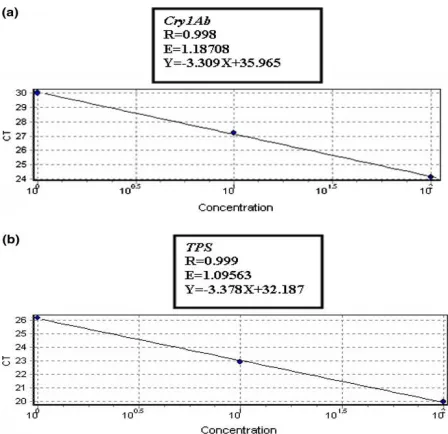
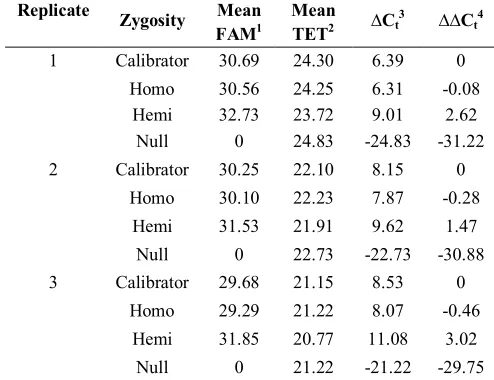
23 was compared to that of an endogenous gene. By amplifying both genes in the same reaction tube simultaneously, identical conditions were provided. Zygosity level of the transgene of interest was determined by comparing the ∆Ct value of the transgene amplification to that of the endogenous gene. In the comparative Ct assay described in this paper, the trehalose 6-phosphate-synthase gene or TPS was used as an endogenous internalcontrol. Molecular, genetic and biochemical analyses indicate the existence of one TPS gene copy per Gossypium genome (Kosmas et al. 2006). The successand validity of the assay depends on the assurance that both the endogenous and transgene amplification occur at approximately equal efficiencies (Weng et al, 2004 ) (Figure 3). The efficiencies obtained for the transgene and the endogenous internal control gene were 1.18708 and 1.09563, respectively. Comparative Ct values (∆Ct) were calculated by subtracting the Ct values obtained for the TET-labeled endogenous gene reactions fromthe Ct values obtained for the FAM-labeled transgene reaction. subtracting the ∆Cts of reference sample and the target. The homozygote nature of the target sample was confirmed using southern blot analysis in our previous study (Yazdanpanah et al. 2009). The relative concentration was calculated by the formula as: 2-∆∆Ct.
As cotton is an allotetraploid crop, using the amounts of relative concentration and according to Kosmas et al. (2006), homozygous plants were detected as
those which are having four copy of inserted gene. Delta delta Ct values were then used as an indication of the quantity of transgene copy number relative to that
Figure 3. Quantitative real-time PCRs for cry1Ab (a) and TPS (b) show high efficiencies. The similar slope of curves, Ct = f (-log[DNA]), demonstrates that both PCRs had similar efficiencies.
different copy numbers of a particular transgene. Variation in the copy number of the samples across different runs of PCR was minimal with coefficient of variation (CV) values being less than 2%. Based on this experiment, the difference between 1, 2, 3 and 4 copies of the transgene could be distinguished.
Table 4 shows the calculated Ct values in order to distinguish 1, 2, 3 and 4 copies. Finally, the results of zygosity estimation by real-time PCR were in line with our previous findings obtained by southern blot analysis (Yazdanpanah et al. 2009).
1. The internal oligonucleotid probe specific for cry1Ab labeled at the 5 end with FAM.
2. The probe specific for the endogenous gene TPS gene was 5 end-labeled with fluorescent dye TET
3. ∆Ct= Ct TET-labeled endogenous gene - Ct FAM-labeled transgene reaction
4. ∆∆Ct =∆Ct reference sample- ∆Ct target
Table 4. Calculated Ct values in three replications for differentiation between 1, 2, 3 and 4 copies of transgene.
DNA amount(copies)
Ct Value
Cv(%)a SDb
1 2 3
1 23.16 23.10 23.19 0.2 0.045
2 22.00 21.99 22.35 0.92 0.205
3 21.53 21.29 21.79 1.16 0.250
4 21.09 21.09 21.37 0.76 0.161
a
Coefficient of variation
b
Standard deviation
The other reference genes used in cotton include acp1, AdhC, Sah7 (Mazzara et al, 2006, 2007, 2008). The Sah7gene is present in both A-subgenome and D-subgenome, however, the size of the amplicons resulting from A- and D-subgenome differs slightly. However, unlike these reference genes, TPS is only present in a single copy in the entire cotton genome (AADD). In order for the TPS gene to be practically used as an endogenous reference gene of cotton, the amount of Cry transgenic cotton by using duplex quantitative PCR was determined. In this method, cry1A(b) and TPS gene, were efficiently amplified in a duplex PCR in the same reaction tube. Previous reports showed that the mean PCR efficiency was 101.4%, 90% and 91% for acp1, Sah7and adhC genes, respectively (Mazzara et al, 2006, 2007, 2008). In this study, the amplification efficiency of TPS gene was obtained at 109.5%.
The results of the experiments described here demonstrate that the TPS gene satisfies the criteria considered for an endogenous reference gene such as genera-specificity, low copy number and
Table 3. Comparative Ct values (∆∆Ct) for thee zygosity level determination of Cry1Ab cotton progeny.
Replicate
Zygosity Mean FAM1
Mean TET2 ∆Ct
3
∆∆Ct4
1 Calibrator 30.69 24.30 6.39 0
Homo 30.56 24.25 6.31 -0.08 Hemi 32.73 23.72 9.01 2.62 Null 0 24.83 -24.83 -31.22
2 Calibrator 30.25 22.10 8.15 0
Homo 30.10 22.23 7.87 -0.28
Hemi 31.53 21.91 9.62 1.47
Null 0 22.73 -22.73 -30.88
3 Calibrator 29.68 21.15 8.53 0
Homo 29.29 21.22 8.07 -0.46
Hemi 31.85 20.77 11.08 3.02
25 high homogeneity among Gossypium spp. cultivars.
Acknowledgment
The authors would also like to thank Shahin Ghadiri and Roghaie Azimkhani for providing the DNA samples. Our appreciation is also extended to Dr. Meisam Tabatabaei for their valuable comments on the manuscript.
References
Ding, J., Jia, J., Yang, L., Wen, H., Zhang, C., Liu, W. and Zhang, D .2004. Validation of a rice-specific gene, sucrose-phosphate synthase, used as the endogenous reference gene for qualitative and real-time quantitative PCR detection of transgenes.JAgric Food Chem, 52:3372–3377.
Duijn, GV., Biert, RV., Marcelis, HB., Peppelman, H. and Hessing, M. 1999. Detection methods for genetically modified crops. Food Control, 10:375– 378.
Eastmond, P.J., Li, Y. and Graham I.A. 2003. Is trehalose-6-phosphate a regulator of sugar metabolism in plants? J Exp Bot, 54:533-537.
Izaskun M, Sandra L, Julia W, Bettina H and
Marcos EC. 2010. Validation of reference
genes for quantitative real-time PCR during leaf and flower development in Petunia hybrid.BMC Plant Biology, 10:4-15.
James C. 2010. Global status of commercialized transgenic crops ISAAA Briefs, no.42.
Javadi, M., Azimkhani, R., Moradi, A. and Tadaioni, R. 2007. Investigation trehalosebiosyntetase in plants by
bioanformatictools. The fifth Iranian congress of biotechnology. Iran, Tehran. No.665.
Kosmas, S.A., Argyrokastritis, A., Loukas, M.G., Eliopoulos, E., Tsakas, S. and Kaltsikes PJ 2006. Isolation and characterization of drought-related trehalose 6-phosphate-synthase gene from cultivated cotton (Gossypium hirsutum L.). Planta, 223:329-39.
Mazzara, M., Bogni, A. and Van Den Eede, G. 2006. Event-specific methods for the quantitation of the hybrid cotton line. 281-24-236/3006-210-23 using Real-timePCR. JRC Scientific and Technical Reports (EUR collection). OPOCE press.
Mazzara, M., Bogni, A. and Van Den Eede, G. 2008. Event-specific method for the quantification of cotton Line MON 1445 using real-timePCR. JRC Scientific and Technical Reports (EUR collection). OPOCE press.
Mazzara, M., Bogni, A., and Van Den Eede, G. 2007. Event-specific methods for the quantitation of the hybrid cotton line LLCotton25 using Real-timePCR. JRC Scientific and Technical Reports (EUR collection). OPOCE press.
Prior F.A., Tackaberry E.S., Aubin R.A. and Casley W.L. 2006. Accurate determination of zygosity intransgenic rice by real-time PCR does not require standard curves or efficiency correction. Transgenic Res 15:261-265.
Sambrook, J., Fritsch, E.F. and Maniatis, T. 2001. Molecular cloning: alaboratory manual, 2nd edn. Cold Spring Harbor Laboratory Press, New York.
Tohidfar, M., Ghareyazie, B., Mosavi, M., Yazdani, Sh. and Golabchian R. 2008.Agrobacterium-mediated
hirsutum) using a synthetic cry1Ab gene for enhanced resistance against Heliothis armigera. Iranian Journal of Biotechnology, 6: 164-173.
VaItilingom, M., Pijnenburg, H., Gendre, F. and Brignon, P. 1999. Real-time quantitative PCR detection of genetically modified maximizer maize and roundup ready soybean in some representative foods. J Agric Food Chem, 47:5261–5266. Weng, A, Pan A, Yang L, Zeang C, Liu Z, and Zhang D. 2004. Estimating number of transgene copies in transgenic rapeseed
by Real-Time PCR assay with HMG I/Y as
an endogenous reference gene. Plant .Mol .Biol 22: 289–300.
Weng, H., Yang, L., Liu, Z., Ding, J., Pan and A. Zhang, D. 2005. A novel reference gene, high-mobility-group protein I/Y, can be used in qualitative and real-time quantitative PCR detection of transgenic rapeseeds. Plant .Mol .Biol, Rep 20:265-277.
Yang, L., Chen, J., Huang, Ch., Liu, Y., Jia, Sh., Pan, L. and Zhang, D. 2005 a. Validation of a cotton-specific gene, Sad1, used as an endogenous reference gene in qualitative and real-time quantitative PCR detection of transgenic cottons. Plant Cell Rep, 24:237-245.
Yang, L., Pan, A., Jia, J., Ding, J., Chen, J., Huang, C., Zhang, C. and Zhang, D. 2005 b. Validation of a tomato specific gene, LAT52, used as an endogenous reference gene in qualitative and real-time quantitative PCR detection of transgenic tomatoes. J Agric Food Chem, 53:183-190.
Yazdanpanah, F., Tohidfar, M., EsnaAshari, M., Ghareyazi, B., KarimiJashni, M. andMosavi, M. 2009. Enhanced insect resistance to bollworm (Helicoverpa
armigera) in cotton containing a synthetic cry1Ab gene. Indian J of Biotechnol, 8:72–77.
Zhang, Y., Zhang, D., Li, W., Chen, J., Peng, Y. and Cao, W. 2003. A novel real-time quantitative PCR method using attached universal template probe. Nucleic Acids Res, 31:20e123.
Zimmermann, A., Hemmer, W., Liniger, M., Luthy, J. and Pauli, U. 1998. A sensitive detection method for genetically modified MaisGard corn using a nested PCR-system. LebensmWissTechnol 31:664– 667.
27
نژ ﯽﺠﻨﺳ رﺎﺒﺘﻋا
TPSﯽﻤﮐ يﺎﻫ ﺶﯾﺎﻣزآ رد ﻊﺟﺮﻣ ﯽﻠﺧاد نژ ﮏﯾ ناﻮﻨﻋ ﻪﺑ
Real Time PCRﻪﺘﺨﯾراﺮﺗ ﻪﺒﻨﭘ رد
يﺮﻬﻣ ﺪﯿﺳ يداﻮﺟ 1 ، دﻮﻌﺴﻣ ﺮﻓﺪﯿﺣﻮﺗ 2 * ، ﯽﻠﻋ يﺮﻈﻧ ﻖﺣ 3 و ﻦﯿﻫﺎﺷ يرﺎﮕﻧ 4 1 - نﺎﺠﻧز ﯽﻫﺎﮕﺸﻧاد دﺎﻬﺟ ، 2 - ﮑﺗﻮﯿﺑ هﺪﮑﺸﻫوﮋﭘ ﻮﻨ ناﺮﯾا يژﻮﻟ ، ،جﺮﮐ 3 - وﺮﮔ نﺎﺠﻧز يزروﺎﺸﮐ هﺪﮑﺸﻧاد ه ﻮﻨﮑﺗﻮﯿﺑ ﻮﻟ و يژ 4 - يژﻮﻟﻮﯿﺑوﺮﮑﯿﻣ هﺎﮕﺸﯾﺎﻣزآ ، يژﻮﻟﻮﺗﺎﭘ تﺎﻘﯿﻘﺤﺗ ﺰﮐﺮﻣ ، ناﺮﻬﺗ * لﻮﺌﺴﻣ هﺪﻨﺴﯾﻮﻧ : ﺮﻓﺪﯿﺣﻮﺗ دﻮﻌﺴﻣ [email protected] هﺪﯿﮑﭼ ﺖﺳا مﻮﺘﯿﭘﺮﮑﺴﻧاﺮﺗ تاﺮﯿﯿﻐﺗ ﯽﺑﺎﯾزرا يﺎﻫزﺎﯿﻧ ﺶﯿﭘ زا ﯽﮑﯾ ﺖﺑﺎﺛ نﺎﯿﺑ ﺢﻄﺳ ﺎﺑ ﯽﯾﺎﻫ نژ ﯽﯾﺎﺳﺎﻨﺷ . ﻦﯾا نﺎﯿﺑ هﺪﯾا رﻮﻄﺑ ﺎﻫ نژ لآ ﺪﻨﮐ ﺮﯿﯿﻐﺗ هﺎﯿﮔ ﯽﮑﯾژﻮﻟﻮﻓﺮﻣ و ﯽﻄﯿﺤﻣ ﯽﻄﯾاﺮﺷ تاﺮﯿﯿﻐﺗ ﺎﺑ ﺪﯾﺎﺒﻧ . نژ ﻖﯿﻘﺤﺗ ﻦﯾا رد TPS ) trehalose 6– phosphate
synthase (
ﻪﺒﻨﭘ هﺎﯿﮔ رد )
Gossypium spp ( ﮏﯿﻨﮑﺗ ﻂﺳﻮﺗ Taqman Real-time-PCR راﺮﻗ ﯽﺑﺎﯾزرا درﻮﻣ ﯽﻤﮐ شور ﻪﺑ ﺖﻓﺮﮔ . رد نژ ﻦﯾا نﺎﯿﺑ 5 ﻣ راﻮﯿﺘﻟﻮﮐ زا ﺪﻨﺗرﺎﺒﻋ ﻪﮐ ﻪﺒﻨﭘ ﻒﻠﺘﺨ : Coker 312 ، Acala SJ ، ZETA 2 ، Neishabour Taghva ﻪﺒﻨﭘ ﺪﯿﺋﻮﻠﭙﯾد ﯽﺸﺣو راﻮﯿﺘﻟﻮﮐ و G. barbadense
ﺪﺷ ﯽﺳرﺮﺑ . ﺪﻣآ ﺖﺳد ﻪﺑ ﺎﻫراﻮﯿﺘﻟﻮﮐ ﻦﯾا ياﺮﺑ ﯽﺼﺨﺸﻣ ﺮﯿﺜﮑﺗ لﻮﺼﺤﻣ ، رد ﺗ ﭻﯿﻫ ﻪﮑﯿﺗرﻮﺻ ﮑ ﻮﺟ نﺎﻫﺎﯿﮔ رد يﺮﯿﺜ )
Hordeum Vulgare (
ترذ ) Zea mays (
ﺞﻧﺮﺑ
) Oryza sativa (
ﺮﯿﺠﻧا ) ficus carica (
ﻪﺘﺴﭘ ) Pistacia vera (