Assessment and Deployment of Ground Source Heat Pump for
Air Pollution Reduction in Tehran, Iran
Hossein Yousefia, Younes Noorollahia, Mohammad Mohammadia*, Pedram Bigdeloua,
Mahyar Taheri Bavil Oliaeib
a Department of Renewable Energies and Environmental Engineering, Faculty of New Sciences and
Technologies, University of Tehran, Tehran, Iran
b School of Industrial Engineering, College of Engineering, University of Tehran, Tehran, Iran
Received: 25 January 2017 /Accepted: 8 June 2017
Abstract
The use of renewable energies, especially in metropolises has led to a reduction in environmental pollution and greater access to clean, renewable and sustainable energy. This paper evaluates the effectiveness of a national plan adopted by the Tehran city council for reducing air pollutions. This plan is designed to increase the share of renewable energies in residential buildings. This study assumes that the extended renewable share is supplied by ground source heat pump (GSHP) systems. The number of Residential Building Permits (RBPs) issued by the city government is predicted in the next five years. Then the effects of using GSHPs on the amount of consumed electricity power and Gas are estimated by considering the policies intended for using GSHPs in Tehran. Finally, the reduction amount of air pollutants is calculated by considering the obtained results from the previous step. The reduction in gas
consumption is estimated to be 4,810,848 m3. As a result of this reduction, 9429 tons of CO2,
201 kg of SOx, and 10 tons of NOx are prevented from releasing into the atmosphere. The
increased amount of electricity power from running GSHPs in the residential buildings is predicted to be 11,182,543 kWh. The natural gas consumption savings is nearly 50% regarding using combined cycle power plants to generate electricity. The results demonstrated that the
plan leads to decrease the emission of CO2 and SOx, and increases in NOx emissions when the
excess electricity is supplied by the steam turbine, gas turbine, and combined cycle power plants.
Keywords: Air Pollution, Renewable energies, Heat pump, Residential buildings, Iran.
Introduction
Air pollution is one of the main challenges in metropolises. For instance, Sao Paulo, Delhi, Mexico City, Tehran, as well as various European cities have been experiencing severe air pollution in the recent years(Calderón-Garcidueñas et al., 2015). Industries, transportation, domestic heating, construction activities, and waste incineration result in augmentation of air pollution metropolises(Sari & Bayram, 2014). A number of efforts have been made for controlling the air pollution, among which employing renewable energies have been prominent
(Jiang et al., 2013). Renewable energies have a great potential in controlling air pollutants and moving toward a cleaner environment (Keleş & Bilgen, 2012).
Geothermal power is one of the most practical kinds of renewable energies has a considerable capability to contribute to sustainable energy development, and as one of the aspects of
sustainability, it can dramatically reduce air pollution (Kagel & Gawell, 2005). Amongdiverse
techniques of using geothermal energy, GSHPs have drawn many attentions in the last decades(Yang et al., 2010). GSHPs do not require deep excavation, and the relevant digging costs of such systems are than other geothermal techniques (Rey et al., 2004). Moreover, GSHP systems consume less electricity in comparison with conventional heat pumps, and as a result, GSHP systems produce less air pollution (Kim et al., 2013).
In the recent years, several studies have been carried out in GSHP systems. The overview of GSHPs in Europe is studied by Bayer et al. (2012). Koroneos and Nanaki (2017) assessed the technical and environmental performance of a ground source heat pump system by using Life Cycle Assessment (LCA) method in Greece. The results demonstrated that by using GSHPs the
emission of SO2 and NOX is reduced significantly. Younes Noorollahi et al. (2016) assessed the
capacity of the GSHP system in the heating and cooling mode for greenhouses in Iran. They used Crank Nicolson method to calculate the rate of heat transfer between soil and water in pipes. The results demonstrated that using GSHPs for greenhouses in Iran is not economically. Majuri (2016) studied the required policies for the development of GSHPs in Finland. This study indicates that quality assurance should be considered in the qualification of GSHPs installers.
The feasibility and performance assessment of GSHP for different case studies by Transient System Simulation (TRNSYS) can be found in Liu et al. (2017) and Emmi et al. (2015). Zhai et al. (2016) assessed the performance of GSHPs for heating and cooling mode in Shanghai Jiao Tong University. The results demonstrated that designed GSHPs can supply heating and cooling demand for the building. Huang and Mauerhofer (2016) addressed assessment of GSHP in Shanghai, China. They pointed out that the amount of energy saving for studied case is around 40.2%. The investment for installing GSHPs will be payback in 4 years. The evaluation of geothermal resources in Tunisia has been presented by Naili et al. (2016). They assessed the performance of GSHPs for cooling mode. The results demonstrated that the potential of geothermal resources in Tunisia is remarkable. However, low amount of this potential has been exploited. Moreover, the application of GSHPs in Tunisia is cost-effective.
Zhang et al. (2016) analyzed the performance of GSHPs for cooling and heating mode for five locations in China. The results demonstrated that the weighted average Coefficient of Performance (COP) of the heat pumps is around 3.36 to 5.94. Moreover, the value of heat pumps Energy Efficiency Ratio (EER) is about 1.95 to 4.35. Kharseh et al. (2015) addressed the effect of global climate change on the performance of GSHPs in three cities with different climate condition (i.e., Stockholm, Sweden (cold), Istanbul, Turkey (mild), and Doha, Qatar (hot)). Two buildings were analyzed in each city. The results demonstrated that the climate condition has a significant effect on the performance and energy consumption of GSHPs. The amount of reduction in heating load varied 10% to 55% by considering climate condition. Moreover, they pointed out that the changing rate of energy consumption varied from 8.5% in the cold climate to 18.7% in the hot climate.
Y Noorollahi et al. (2013) assessed the utilization of GSHP systems in order to restrain CO2
emissions in Tehran. They have calculated the heating and cooling load of a three-story
municipal building in Tehran via CARRIER HAP 4.3 and estimated the CO2 emissions through
172
CO2/m2/y. Additionally, they have estimated this potential reduction about 937.4 million tons
CO2/y for all of the residential buildings in Tehran in 2012.
This paper evaluates the effectiveness of a plan that has been adopted in order to reduce air pollution in Tehran via an extension of the renewable energies to residential buildings. It is assumed that the share of renewable energies in residential buildings is supplied just by GSHP systems. Subsequently, the amount of air pollution through the exploitation of GSHP systems is calculated and compared with the amount produced by conventional heating systems. The rest of this paper is organized as follows. Section 2 presents a plan of renewable energies in Tehran. The formal description of material and methods is presented in Section 3. Section 4 shows the numerical results. Section 5 describes the discussions. Finally, Section 6 is dedicated to paper conclusions.
Renewable energies plan in Tehran
Tehran city has confronted with air pollution since last decades. In Tehran, due to geographical conditions, the air pollutants can’t escape from the lower air layers to the upper ones (Afshar & Saadatpour, 2009). Tehran is located between the 30° and 45° latitudes, thus, in terms of the vertical atmospheric currents, are in the descent location of the atmospheric air masses. This fact leads to the virtually stable atmosphere on top of Tehran. According to meteorological data, air stability is observed in more than 270 days of a year in this metropolis, specifically in the fall and winter days. Moreover, Tehran lacks strong winds, and the wind rose in this city reveal that the windless days have the share of 46% during a year. In addition, the speed of 15 percent of winds blowing in Tehran is less than 3 m/s, which are nearly ineffective in removing contaminants. In a metropolis like Tehran, due to the presence of a great number of huge buildings and multitudinous towers lead to a reduction in the wind in traversing the city (Mansouri, 2012).
Due to the Tehran’s atmosphere is almost stable, the most efficacious method for handling the air pollution is abating the released emissions through the air. In the recent decade, some major plans have been implemented in Tehran for diminishing emissions such as the development of subway network, the constitution of Bus Rapid Transit (BRT) lines, rectification of gasoline quality, construction of new highways, replacement of old vehicles, and extension of green spaces and greenbelts. In the recent years, in order to further cut down on the emissions, the city government has exploited some renewable technologies such as installation of solar lights for supplying lighting in all of the public parks, solar water heaters for providing hot water needs in both public places and municipal buildings, PV panels for guide posts and traffic lights, and construction of a 3 MW power plant using the disposal system emissions as fuel. Despite, appropriate actions are taken to decrease air pollutants; however, it seems that further actions should be carried out.
As a result, in the city of Tehran, it has decided to extend renewable technologies to the residential buildings (Tehran-Municipality, 2014).This extension plan has been ratified by the Tehran city council and might implement during a five-year. In this plan, the policy has been made that, 1% of total RBPs issued by the city government from March 2014 to March 2019 are required to supply 10% of their total energy demand by renewable energies (Tehran-Municipality, 2014).
Material and Methods
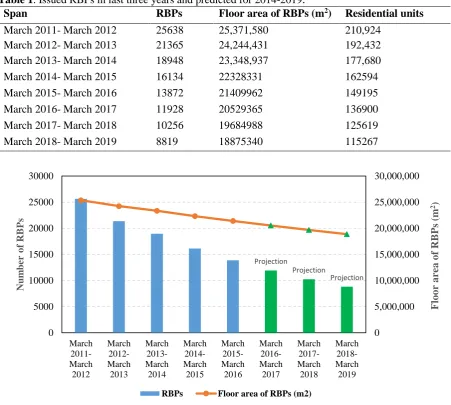
Iran, 2014), and also reveals the predicted values for next 5 year of the plan from 2014-2019. The results of the projected RBPs are shown in Fig. 1.
Table 1. Issued RBPs in last three years and predicted for 2014-2019.
Span RBPs Floor area of RBPs (m2) Residential units
March 2011- March 2012 25638 25,371,580 210,924 March 2012- March 2013 21365 24,244,431 192,432 March 2013- March 2014 18948 23,348,937 177,680 March 2014- March 2015 16134 22328331 162594 March 2015- March 2016 13872 21409962 149195 March 2016- March 2017 11928 20529365 136900 March 2017- March 2018 10256 19684988 125619 March 2018- March 2019 8819 18875340 115267
Figure 1. Issued RBPs in last three years and predicted for 2014-2019.
In this paper, we investigated the effect of using GSHPs on the reduction of air pollutants in Tehran. To calculate the reduction amount of air pollutants, in the first step, we investigate the effect of using GSHPs on the amount of consumed electricity power and Gas in the real
case study in Municipality of Tehran. Then, in the second step, by considering the obtained
result from the first step, we estimated the effect of using GSHPs on the amount of consumed electricity power and Gas by considering the policies intended for using GSHPs in Tehran. Finally, by considering the obtained results from the second step, the reduction amount of pollutants is calculated.
In the second step, to calculate the reduction of consumed Gas from using GSHPs in Tehran is calculated as follow:
T M
V A V (1)
Where, VTis the decreased amount of gas consumption in Tehran, is 1% (The number of
RBPs issued by the city government for using GSHPs from city government, A is the amount
Projection Projection Projection 0 5,000,000 10,000,000 15,000,000 20,000,000 25,000,000 30,000,000 0 5000 10000 15000 20000 25000 30000 March 2011-March 2012 March 2012-March 2013 March 2013-March 2014 March 2014-March 2015 March 2015-March 2016 March 2016-March 2017 March 2017-March 2018 March 2018-March 2019 Floor area of R B Ps (m 2) Num ber o f RB P s
172
of floor area of RBPs that considered to use GSHPs from 2014-2019 years. VM is the decreased
amount of gas consumption inMunicipality of Tehran.
The increased amount of gas consuming from using GSHPs is calculated as follow:
T M
E A E (2)
Where, ETis the increased amount of electric consumption in Tehran, 𝛼 is 1% (The number of
RBPs issued by the city government for using GSHPs from city government, A is the amount
of floor area of RBPs that considered to use GSHPs from 2014-2019 years. 𝐸𝑀 is the increased
amount of electric consumption inMunicipality of Tehran.
Numerical results
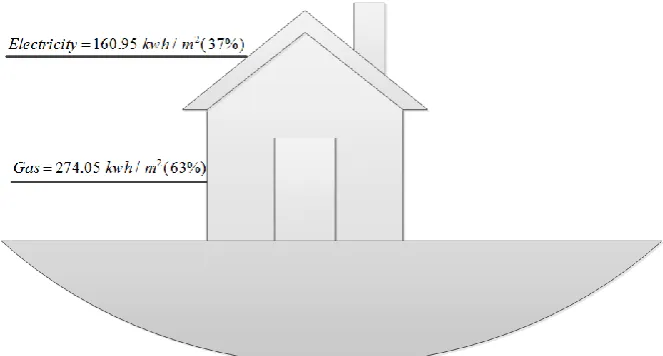
There have been some diffuse and sporadic reports on residential building energy consumption in Tehran in scientific sources (Ghaebi et al., 2014). In this study, we used the report of the Iranian Fuel Conservation Company (IFCO) to consider the average energy consumption in residential buildings. Based on the IFCO report, the average annual energy consumption for
residential buildings, which is known as Specific Energy Consumption (SEC), is 435 kWh/m2.
63% of this amount is provided by natural gas, whereas the rest (i.e. 37%) is provided by electricity (Eshraghi et al., 2014; Younes Noorollahi et al., 2007).
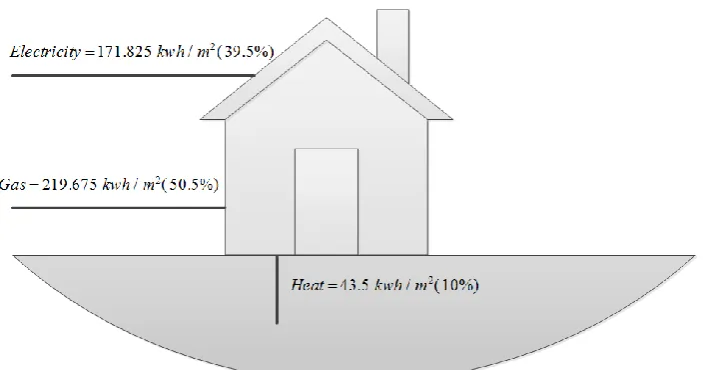
As mentioned earlier, 1% of the total RBPs issued by the city of Tehran in the planning interval is required to provide 10% of their total energy needs by renewable energies. It is assumed that this share is provided only by GSHP systems as heating equipment for buildings. In as much as the mean heating COP of GSHPs in Tehran is estimated to be 5 (Hesaraki et al., 2015), 20% of the GSHP energy input is provided by electricity, while 80% is provided by the heat from the ground beneath. Figs. 2-4, demonstrate the energy consumption breakdown before the plan, the role of the heat pump, and the energy consumption breakdown during the plan, respectively. As can be seen from Figs.2-4, 10% of building thermal energy can be provided from the ground beneath with 2.5% increasing in electricity consumption.
Figure 3. The role of the heat pump.
Figure 4. The energy consumption breakdown during the plan.
As can be inferred from the results of Figs. 2 and 4, the installation of the GSHP system will
lead to a reduction of 54.375 kWh/m2 in the natural gas consumption, however, at the same
time, the electricity consumption will rise by 10.875 kWh/m2. By taking into account 1% of all
RBPs floor areas in the next five years and the heating value of natural gas (National-Iranian-Gas-Company, 2015), the gas consumption decrease in Tehran can be calculated as Eq. 3.
𝑉𝑇 = 0.01 × 102827986 𝑚2× 54.375
𝑘𝑊ℎ
𝑚2 × 860.421
𝑘𝑐𝑎𝑙
𝑘𝑊ℎ×
1 𝑚3
10000 𝑘𝑐𝑎𝑙 = 4,810,848 𝑚
3 (3)
On the other hand, the electricity consumption increase in Tehran will be calculated as Eq.4.
𝐸𝑇 = 0.01 × 102827986 𝑚2× 10.875
𝑘𝑊ℎ
𝑚2 = 11,182,543 𝑘𝑊ℎ (4)
By considering 15.2% loss in the electricity distribution lines (Ministry-of-Energy, 2014), we can conclude that power stations have to produce the following amount of electricity:
𝐸𝑇∗ = 1.152 × 11182543 𝑘𝑊ℎ = 12,882,290 𝑘𝑊ℎ (5)
172
efficiencies of power stations the private sector has oversight of are 34.9%, 31.5%, and 43.6%,
respectively. The part of 𝑉 can be used for electricity generation in the power stations. Finally,
the required amount of gas, burning of which of gas to generate 𝐸𝑇∗, is presented in Table 2. As
can be seen from Table 2, all of the obtained amounts are remarkably less than 𝑉𝑇. Table 3
presents the amount of gas consumption savings.
Table 2. The required amount of gas for generating 𝐸∗.
Ministry of Energy Private sector
Power plant Efficiency (%)
Required gas (m3)
Power plant Efficiency (%)
Required gas (m3)
Steam turbine 37.1 2987653 Steam turbine 34.9 3175986 Gas turbine 29.4 3770134 Gas turbine 31.5 3518791 Combined cycle 45.6 2430744 Combined cycle 43.6 2542246
Table 3. Gas consumption savings.
Ministry of Energy Private sector
Power plant Savings in gas consumption (m3)
Percentage of saving%
Power plant Savings in gas consumption (m3)
Percentage of saving%
Steam turbine 1823195 37.9 Steam turbine 1634862 34.0 Gas turbine 1040714 21.6 Gas turbine 1292057 26.9 Combined cycle 2380104 49.5 Combined cycle 2268602 47.2
The amount of gas consumption decrease (𝑉𝑇), the electricity consumption increase (𝐸𝑇), as
well as the gas consumption savings of Tehran was calculated. It is evident that gas consumption decrease will contribute to air pollution reduction in Tehran. Table 4 demonstrated the rate of pollutant reduction per reduction of gas consumption. Therefore, the reduction amount of air pollution emission can be calculated as follows:
𝐴1= 4810848 𝑚3×
41.84 𝐺𝐽 1000 𝑚3×
46845 𝑔𝑟 𝐶𝑂2
1 𝐺𝐽 ×
1 𝑡𝑜𝑛 𝐶𝑂2
1000000 𝑔𝑟 𝐶𝑂2
= 9429 𝑡𝑜𝑛𝑠 𝐶𝑂2 (6)
𝐴2= 4810848 𝑚3×
41.84 𝐺𝐽 1000 𝑚3×
1 𝑔𝑟 𝑆𝑂𝑥
1 𝐺𝐽 ×
1 𝑘𝑔 𝑆𝑂𝑥
1000 𝑔𝑟 𝑆𝑂𝑥
= 201 𝑘𝑔 𝑆𝑂𝑥 (7)
𝐴3= 4810848 𝑚3×
41.84 𝐺𝐽 1000 𝑚3×
50 𝑔𝑟 𝑁𝑂𝑥
1 𝐺𝐽 ×
1 𝑡𝑜𝑛 𝑁𝑂𝑥
1000000 𝑔𝑟 𝑁𝑂𝑥
= 10 𝑡𝑜𝑛𝑠 𝑁𝑂𝑥 (8)
Table 4. Pollutant emissions through gas consumption of residential buildings in Tehran (gr/GJ) (Ghiaseddin, 2007).
Gases CO2 SOx NOx
Amount of emission 46845 1 50
On the other hand, generation of 𝐸𝑇∗ leads to an increase in air pollution at the locality of
power stations. The amount of produced air pollutant through power stations is reported in Table 5. As can be seen from Table 5, the amount of emission through gas consumption is less
than Mazout. Table 6 presents the amount of emissions associated with generating 𝐸𝑇∗ when
Table 5. Average pollutant emissions through electricity generation from various fuels in different power plants in Iran (gr/kWh) (Nazari et al., 2009).
Power plant Gas Mazut
CO2 SOx NOx CO2 SOx NOx
Steam turbine 633 0 2.694 1025 15.276 2.519 Gas turbine 782 0 1.907 1048 3.842 5.792 Combined cycle 450 0 2.295 622 2.325 3.782
Table 6. Pollution emissions associated with generating 𝐸∗ by gas as the input fuel in different power plants.
Power plant CO2 (ton) SOx (kg) NOx (ton)
Steam turbine 8154.49 0 34.70
Gas turbine 10073.95 0 24.57
Combined cycle 5797.03 0 29.56
Table 7. Estimated change in the air pollution emissions.
Power plant CO2 (%) SOx (%) NOx (%)
Steam turbine -13.5 -100 +244.9
Gas turbine +6.8 -100 +144.2
Combined cycle -38.5 -100 +193.8
Discussions
The city of Tehran government has implemented a number of plans for rectification of the air quality in this metropolis, Tehran still suffers from an intensive air pollution, thus, further measures have to be done for relieving this problem. The city’s plan, in which 1% of the total RBPs issued in the interval between March 2014 and March 2019 are required to supply 10% of their total energy demand by means of renewable energies, is one of these mitigating measures.
The number of RBPs annually issued by the city of Tehran has declined in the past three years, and further reduction is predicted by 2019. The number of RBPs will have decreased
from 25638 to 8819. The corresponding floor area is predicted to decrease to 18,875,340 m2 in
2019.
Based on the IFCO report, the SEC of residential stock is 435 kWh/m2, with the share of
63% (274.05 kWh/m2) for natural gas and 37% (160.95 kWh/m2) for electricity. In this study,
these shares are to be changed to 50.5% (219.675 kWh/m2) for natural gas, 39.5% (171.825
kWh/m2) for electricity, and 10% (43.5 kWh/m2) for the heat from the ground beneath for 1%
of the total RBPs issued by the city in the plan interval. The natural gas consumption reduction
in Tehran is 4,810,848 m3, of which partly can be utilized in gas-burning power stations for
generating 12,882,290 kWh electricity in order to supply the electrical energy needs of GSHP systems in Tehran. If the mentioned amount of electricity is generated in combined cycle power plants, the natural gas consumption savings can approximately reach 50%.
Our calculations demonstrate that the city’s plan will reduce natural gas consumption in
Tehran, and accordingly, 9,429 tons CO2, 201 kg SOx, as well as 10 tons NOx are prevented
from being emitted throughout the Tehran’s air. The plan leads to 13.5% reduction in CO2, a
100% decrease in SOx, and 244.9% increase in NOx emissions when the excess electricity is
177
kind of power plants, SOx emissions will be reduced to zero. In addition, CO2 emissions will
be restricted considerably unless gas turbine power plants are utilized for electricity generation.
On the other hand, NOx emissions will rise by far on account of the extremely high temperatures
in the combustion chambers of power plants which lead to the formation of a great deal of NOx.
Conclusion
This paper has evaluated the effectiveness of a plan for reducing air pollution in Tehran. The plan aims to increase the share of renewable energies usage in the residential buildings. It was assumed that the extended renewable share was supplied with GSHP systems. Calculations
indicated that the plan leads to a reduction in gas consumption of 4,810,848 m3 in Tehran. As
a result, 9429 tons CO2, 201 kg SOx, and 10 ton NOx is prevented from being emitted into the
Tehran’s air. The increase in electricity consumption as a result of the use of GSHP systems in the residential buildings of Tehran has been predicted to be 11182543 kWh. Finally, it was
ascertained that the CO2 and SOx emissions have been generally abated, while the NOx
emissions increased dramatically. The results reveal that this plan leads to decent results as to air pollution reduction in Tehran. The extra electricity generation for running GSHP systems are accompanied by some pollution emissions, but these emissions occur in distant places and can be eliminated in these areas before transferring to the Tehran. Furthermore, the plan is associated with great savings in natural gas consumption.
References
Afshar, A. and Saadatpour, M. (2009). Reservoir eutrophication modeling, sensitivity analysis, and assessment: application to Karkheh Reservoir, Iran. Environmental engineering science, 26(7), 1227-1238.
Bayer, P., Saner, D., Bolay, S., Rybach, L. and Blum, P. (2012). Greenhouse gas emission savings of ground source heat pump systems in Europe: A review. Renewable and Sustainable Energy Reviews, 16(2), 1256-1267.
Calderón-Garcidueñas, L., Kulesza, R. J., Doty, R. L., D'Angiulli, A. and Torres-Jardón, R. (2015). Megacities air pollution problems: Mexico City Metropolitan Area critical issues on the central nervous system pediatric impact. Environmental research, 137, 157-169.
Emmi, G., Zarrella, A., De Carli, M. and Galgaro, A. (2015). An analysis of solar assisted ground source heat pumps in cold climates. Energy Conversion and Management, 106, 660-675.
Eshraghi, J., Narjabadifam, N., Mirkhani, N., Khosroshahi, S. S. and Ashjaee, M. (2014). A comprehensive feasibility study of applying solar energy to design a zero energy building for a typical home in Tehran. Energy and Buildings, 72, 329-339.
Ghaebi, H., Bahadori, M. and Saidi, M. (2014). Performance analysis and parametric study of thermal energy storage in an aquifer coupled with a heat pump and solar collectors, for a residential complex in Tehran, Iran. Applied Thermal Engineering, 62(1), 156-170.
Ghiaseddin, M. (2007). Air Pollution (Sources, Effects, and Control). University of Tehran Press (UTP), 916.
Hesaraki, A., Holmberg, S. and Haghighat, F. (2015). Seasonal thermal energy storage with heat pumps and low temperatures in building projects—A comparative review. Renewable and Sustainable Energy Reviews, 43, 1199-1213.
Huang, B. and Mauerhofer, V. (2016). Life cycle sustainability assessment of ground source heat pump in Shanghai, China. Journal of Cleaner Production, 119, 207-214.
Jiang, P., Chen, Y., Geng, Y., Dong, W., Xue, B., Xu, B. and Li, W. (2013). Analysis of the co-benefits of climate change mitigation and air pollution reduction in China. Journal of Cleaner Production, 58, 130-137.
Keleş, S. and Bilgen, S. (2012). Renewable energy sources in Turkey for climate change mitigation and energy sustainability. Renewable and Sustainable Energy Reviews, 16(7), 5199-5206.
Kharseh, M., Altorkmany, L., Al-Khawaja, M. and Hassani, F. (2015). Analysis of the effect of global climate change on ground source heat pump systems in different climate categories. Renewable energy, 78, 219-225.
Kim, J., Jang, J. C., Kang, E. C., Chang, K. C., Lee, E. J. and Kim, Y. (2013). Verification study of a GSHP system Manufacturer data based modeling. Renewable energy, 54, 55-62.
Koroneos, C. J. and Nanaki, E. A. (2017). Environmental impact assessment of a ground source heat pump system in Greece. Geothermics, 65, 1-9.
Liu, Z., Xu, W., Zhai, X., Qian, C. and Chen, X. (2017). Feasibility and performance study of the hybrid ground-source heat pump system for one office building in Chinese heating dominated areas. Renewable energy, 101, 1131-1140.
Majuri, P. (2016). Ground source heat pumps and environmental policy–The Finnish practitioner's point of view. Journal of Cleaner Production, 139, 740-749.
Mansouri, N. (2012). Environmental Pollution (Air, Water and Wastewater, Solid Waste and Noise). Aradbook Press, 468.
Ministry-of-Energy. (2014). Iranian Energy Balance Report of 2012-2013. Retrieved from Tehran: http://www.moe.gov.ir
Naili, N., Hazami, M., Attar, I. and Farhat, A. (2016). Assessment of surface geothermal energy for air conditioning in northern Tunisia: Direct test and deployment of ground source heat pump system. Energy and Buildings, 111, 207-217.
National-Iranian-Gas-Company. (2015). Introduction to natural gas.
Nazari, S., Sohrabi-Kashani, A., Davari, S. and Delavar-Moghaddam, Z. (2009). Determination of CO2, SOx, and NOx Emission Factors in Iran’s Thermal Power Plants Comparing with North American Countries. Iranian Journal of Energy, 12(3), 25-36.
Noorollahi, Y., Bigdelou, P., Pourfayaz, F. and Yousefi, H. (2016). Numerical modeling and economic analysis of a ground source heat pump for supplying energy for a greenhouse in Alborz province, Iran. Journal of Cleaner Production.
Noorollahi, Y., Itoi, R., Fujii, H., Tanaka, T. and Motooka, N.-k. (2007). Geothermal resources exploration and wellsite selection with environmental consideration using GIS in Sabalan geothermal area, Iran. Paper presented at the Proceedings, Thirty-Second Workshop on Geothermal Reservoir Engineering Stanford University, Stanford, California, January.
Noorollahi, Y., Yousefi, H. and Farabi, H. (2013). Estimating the reduction of CO2 emissions through exploiting GSHP in the residential stock of Tehran. Paper presented at the 7th National Conference on World Environment, Tehran, Iran.
Rey, F., Martin-Gil, J., Velasco, E., Pérez, D., Varela, F., Palomar, J. and Dorado, M. (2004). Life cycle assessment and external environmental cost analysis of heat pumps. Environmental engineering science, 21(5), 591-605.
Sari, D. and Bayram, A. (2014). Quantification of emissions from domestic heating in residential areas of İzmir, Turkey and assessment of the impact on local/regional air-quality. Science of the Total Environment, 488, 429-436.
Tehran-Municipality. (2014). 2nd five-year development plan (2014-2018). Retrieved from Tehran: Yang, W., Zhou, J., Xu, W. and Zhang, G. (2010). Current status of ground-source heat pumps in China.
Energy Policy, 38(1), 323-332.
Zhai, X., Cheng, X. and Wang, R. (2016). Heating and cooling performance of a minitype ground source heat pump system. Applied Thermal Engineering.
Zhang, S., Zhang, L., Wei, H., Jing, J., Zhou, X. and Zhang, X. (2016). Field testing and performance analyses of ground source heat pump systems for residential applications in Hot Summer and Cold Winter area in China. Energy and Buildings, 133, 615-627.