DOI: 10.22063/poj.2016.1394
INTRODUCTION
During the past decades, a vast amount of studies have been carried out related to thermo-oxidative degrada-tion of polypropylene (PP) as well as stabilizadegrada-tion of this commodity polymer against thermal oxidation [1]. Thermo-oxidative degradation of PP during high-temperature melt processing as well as its solid state weathering proceeds via a free radical chain reaction
(the so-called autoxidation) which alters chemical structure of the polymer through generation of dif-ferent oxidation groups such as acids, ketones, and so forth [2]. The worst feature of the process is forma -tion of hydro-peroxide (POOH) which produces two additional active radicals (i.e., macro-alkoxy and hy -droxyl radicals) through breakage of peroxidic (O-O) bond (the so-called chain branching stage) [3]. The produced macro-alkoxy radical may convert to ketone
* Corresponding Author - E-mail: [email protected]
Evaluation of effects of thymolphthalein on
thermo-oxidative stability of polypropylene
Nikoo Karami
1and Reza Jahanmardi
2*1 Department of Polymer Engineering, South Tehran Branch, Islamic Azad University, Tehran, Iran 2 Department of Polymer Engineering, Science and Research Branch, Islamic Azad University, Tehran,
Iran
Received:10 May 2016, Accepted: 23 September 2016
ABSTRACT
T
he present work is aimed to find a new and efficient type of antioxidants for polypropylene. Hence, effects of 3,3-bis(4-hydroxy-2-methyl-5-propan-2-ylphenyl)-2-benzofuran-1-one, generally known as thymolphthalein, on thermo-oxidative stability of polypropylene in solid and melt states were evaluated and compared with those of SONGNOX 1010, an efficient commercially used antioxidant for the polymer. Oven ageing experiments followed by Fourier transform infrared (FTIR) spectroscopy showed that thymolphthalein increased thermo-oxidative stability of the polymer outstandingly in the solid state and its stabilization efficiency was comparable to that of SONGNOX 1010. In addition, measurements of oxidative induction time (OIT) and oxidation onset temperature (OOT) revealed that thymolphthalein improved thermo-oxidative stability of the polymer in the melt state significantly. It was also observed that thymolphthalein did not interfere with the stabilization action of SONGNOX 1010 in the polymer neither in melt nor in solid state. On the basis of the obtained results, a probable mechanism for the stabilization action of thymolphthalein in the polymer is proposed. Polyolefins J (2017) 4: 79-86Keywords: Antioxidant; degradation; polypropylene; stabilization.
fore, PP needs some kinds of stabilization against thermal oxidation for each stage of its life cycle. This is generally achieved by utilization of given amounts of proper additives which deactivate the radicals (re-ferred to as primary antioxidants), or decompose hydro-peroxide to inert species (referred to as second-ary antioxidants) [4].
Hindered phenols have been used widely as one of the most important primary antioxidants to protect PP during processing as well as in the final application as long-term thermal stabilizers [5, 6]. These antioxi -dants deactivate the propagating radicals by donating a labile phenolic hydrogen atom to the radicals ac-cording to a general stabilization mechanism shown in Figure 1. So, these antioxidants are known also as chain breaking donor antioxidants. However, these strong antioxidants suffer from some drawbacks; for instance, transformation of the antioxidant molecules to a colored compound during the stabilization mecha -nism may change the polymer’s color which, in turn, could cause some problems especially in clear poly-mer artifacts [7]. Furthermore, the increasing perfor -mance criteria for the polymeric materials in the mod-ern industry, such as shorter processing cycle times and more intensive processing conditions require higher stabilization levels. Hence, during the recent decades, many scientific and technical efforts have been devoted to discovering new types of antioxi-dants. Accordingly, efficacy of in situ stabilization by lignin, grafted polymers and
antioxidant-[11]. Results of the study proved that galbanic acid improved thermo-oxidative stability of the poly-mer strongly in the solid state and moderately in the melt state. They also postulated a mechanism for the stabilizing action of galbanic acid, in which allylic hydrogen atoms present in its molecular structure, played the main role. In order to further evaluate the proposed stabilization mechanism as well as finding new category of antioxidants for PP, the present work was performed to study thermo-oxidative stability of PP in the presence of another model chemical com-pound having allylic hydrogen atoms present in its molecular structure i.e., 3,3-bis(4-hydroxy-2-methyl-5-propan-2-ylphenyl)-2-benzofuran-1-one, generally known as thymolphthalein, with a molecular structure shown in Scheme 1 [12]. As it can be seen in Scheme 1, thymolphthalein has two phenolic hydrogen atoms in its chemical structure which may participate in its probable stabilization activity. However, these two hydrogen atoms could be simply eliminated through reaction of thymolphthalein with sodium hydrox-ide, which rendered sodium salt of thymolphthalein according to the reaction shown in Scheme 2 [13]. Thus, through comparing stabilization efficiency of thymolphthalein and that of its sodium salt, the roles of allylic hydrogen atoms (which are better referred as benzylic hydrogen atoms) and phenolic hydrogen atoms present in molecular structure of thymolphtha-lein could be distinguished. Accordingly, Jahanmardi et al. showed that sodium salt of thymolphthalein at a concentration of 1.0 wt% had strong stabilization ef
-Figure 1. Generally accepted mechanism for deactivation of
fects on the oxidation of polyethylene in solid and melt states and its efficiencies in these respects were shown to be similar to those of thymolphthalein [14]. Hence, they concluded that phenolic hydrogen atoms of thymolphthalein which are absent in the molecular structure of its sodium salt, did not play the main role in the stabilization action of thymolphthalein in poly -ethylene. Regarding the above mentioned findings, evaluation of thermo-oxidative stabilization efficiency of sodium salt of thymolphthalein in polypropylene was omitted in the present work and the study focused on the stabilization activity of thymolphthalein itself in polypropylene.
EXPERIMENTAL
Materials
The used PP (HP510M grade) with MFI of 9.0 g/10 min, density of 0.9 g/cm3 and crystalline melting
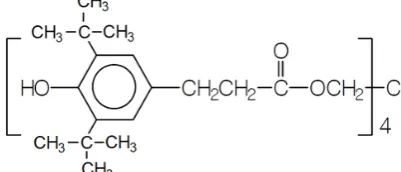
point of 167°C was obtained from Jam Petrochemical Company (Iran). Thymolphthalein with melting point of 253°C and methanol were purchased from Merck Company (Germany). SONGNOX 1010, as a white powder, with melting point of 118°C and molecular structure shown in Scheme 3 was obtained from Song -won Industrial Company (South Korea) [5].
Preparation of film samples
PP was mixed with desirable amounts of the selected additives at 190°C in a Brabender internal mixer with -in a period of 6 m-in, at a rotor speed of 60 rpm. The
prepared samples were then converted to thin films with a thickness of about 200 μm at 190°C and 100 bar within 4 min using a laboratory hot press. A film of the pure polymer was also prepared as the blank sam-ple. The formulations of the prepared film samples are given in Table 1. The film samples having each of thy -molphthalein and SONGNOX 1010 alone have been designated as T and S, respectively. The film sample having a mixture of both SONGNOX 1010 and thy -molphthalein has been designated as T+S.
Evaluation of thermo-oxidative stability of the pre
-pared film samples
Thermo-oxidative stability in solid state
Thermo-oxidative stability of the prepared PP film samples was evaluated using a standard accelerated ageing test which was carried out on 4×8 cm strips of the samples in a forced air-draft oven at 90°C for different periods of time. The chemical changes of the film samples due to oven ageing were followed by tak -ing their FTIR spectra at different time intervals us-ing a PerkinElmer FTIR spectrophotometer (USA). FTIR spectra were taken as average of 20 scans at a resolu-tion of 4 cm-1 in the range of 4000-400 cm-1. The rates of thermo-oxidative degradation of the prepared film samples were specified by evaluation of carbonyl in -dex (CI) at different aging time intervals, according to the following equation:
CI = A(1717)/A(905) – CI0 (1)
where, A is the absorbance at the given wavenumber
Scheme 2. Reaction of thymolphthalein with sodium
hydroxide [13]. Scheme 3. Molecular structure of SONGNOX 1010 [5].
Table 1. Formulation of PP film samples.
Sample designation Blank T0.1% T0.2% T0.5% T1% S0.1% T+S
PP (wt %)
Thymolphthalein (wt %) SONGNOX 1010 (wt %)
that, the results only represent the changes occurred during the thermal oxidation in the solid state.
Thermo-oxidative stability in melt state
In order to assess oxidative resistance of the prepared samples in the melt state, two different tests i.e., oxida -tion onset temperature (OOT) in oxygen atmosphere and oxidative induction time (OIT), were carried out. In the OOT test, the temperature of each sample (of about 10 mg weight) was elevated at a constant rate of 10°C/min from 25°C to 250°C, using a Zufa model ZF-DS-D2 DSC thermal analysis system (China). The samples were kept in an oxygen atmosphere with a flow rate of 50 cm3/min, from the commencement of
the test. The amount of oxidation onset temperature (OOT) for each sample was specified from its DSC curves as the temperature corresponding to the devia-tion from the baseline (incepdevia-tion of exothermal oxida-tive chain reaction) [16]. In the OIT test, samples of about 10 mg weight were heated in aluminum pans from 25°C to 200°C at 20°C/min under a nitrogen flow in the previously mentioned DSC instrument. The nitrogen atmosphere was then altered to oxygen instantly after the temperature was reached and equili -brated at 200°C. Flow rate of the both gases was 50 cm3 /min pursuant to ASTM D 3895-80. The value of
OIT was deduced from DSC curves as the time inter -val from oxygen introduction until the onset of exo-thermal oxidation reaction.
RESULTS AND DISCUSSION
Long-term thermo-oxidative stability in solid state
Carbonyl groups are the most important chemical groups formed on PP molecules during oxidation and their presence can be simply determined from their FTIR absorption band at 1800-1700 cm-1 [2, 17]. Hence, thermal oxidation of the prepared film samples due to ageing at 90°C was evaluated by tracking the
ageing for 1200 h, the spectra in Figure 3 indicate no increase of carbonyl groups during the same time of ageing. Therefore, it can be inferred that thymolphtha -lein plays the role of an efficient antioxidant for PP at a concentration of 0.1 wt% during oven ageing at 90°C.
In order to elucidate the efficiency of thymolphtha -lein in thermo-oxidative stabilization of PP in solid state, the rate of the thermal oxidation of all the film samples at 90°C was determined through measuring CI for the films from their FTIR spectra taken at dif -ferent time intervals during the ageing. The measured CI values are illustrated in Figure 4 in terms of oven ageing time. An intense increase of CI for the blank sample is seen in the figure indicating auto-oxidation of the polymer after an induction period. On the other hand, no growth in CI value of all other samples is seen even after 2000 h of ageing. Thus, it can be de -duced that thymolphthalein at concentrations of 0.1-1.0 wt% performs a significant stabilization function during the polymer ageing in solid. Moreover, the data presented in Figure 4 shows that no evolution of car-bonyl groups in the T+S sample happens after 2000 h of ageing indicating that thymolphthalein at a con-centration of 0.1 wt% does not interfere with the stabi -lization function of SONGNOX 1010 in the polymer during the course of oven ageing. Since SONGNOX 1010 acts as a chain breaking donor antioxidant in
Figure 2. FTIR spectra of blank film sample before and after
PP, thymolphthalein is not likely a chain breaking ac-ceptor antioxidant, but it expected to deactivate free radicals through abstraction of labile hydrogen atoms from these species [14].
Thermo-oxidative stability in melt state
Thermal oxidation of PP in melt state is an exothermic reaction whose incidence could be simply discovered by calorimetric methods. Thus, thermo-oxidative sta -bility of the PP samples in the melt state was evaluated by differential scanning calorimetry (DSC). The DSC curves of the blank and the T0.1% samples are illus -trated in Figure 5. As it is seen in the figure, the endo -thermic peak due to the melting of the pure polymer at 167°C remains unaltered for the T0.1% sample. How -ever, the onset of the exothermic peak of the polymer oxidation which is about 199°C for the blank sample is moved to 221°C by the addition of 0.1 wt% of thy -molphthalein. So, it could be directly deduced that thymolphthalein at a concentration of 0.1 wt% played the role of an effective antioxidant for the polymer in
the melt state.
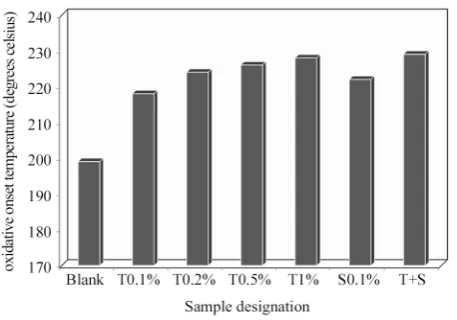
In order to clarify the effect of thymolphthalein in stabilizing the polymer against thermal oxidation in the melt state, the temperature corresponding to the deviation from the baseline (onset of thermal oxida-tion), defined as oxidation onset temperature (OOT), was measured for all the samples. Moreover, oxida -tive induction time (OIT) for all the samples was also determined from DSC curves obtained in isothermal tests as the interval from oxygen introduction until the commencement of the exothermal reaction. Values of OOT and OIT for PP are regarded as two important characteristics of the polymer stability against oxida-tive degradation in melt state. The measured values of OOT and OIT for all the samples are presented in Figures 6 and 7, respectively. As it is seen in the fig -ures, both OIT and OOT values have been consider
-Figure 3. FTIR spectra of T0.1% film sample before and
after oven aging at 90°C for 740 h.
Figure 4. Variations of carbonyl index (CI) of PP films in
terms of oven ageing time at 90°C.
Figure 5. DSC curves of the blank and T0.1% samples obtained in the heat-ramp experiments.
(a)
to the amount of thymolphthalein incorporated in the samples. This can be explained in terms of poor dis -tribution of thymolphthalein in PP which is due to the fact that melting point of thymolphthalein is above the processing temperature of the polymer and there-fore, a part of the additive remains solid during the melt processing of the polymer and cannot take part in the stabilization function. In addition, the amount of thymolphthalein that dissolves in PP and takes part in the stabilization of the polymer does not increase proportionally with the overall concentration of thy-molphthalein in the samples. This is because of low solubility of thymolphthalein in PP which is due to their dissimilar polarities. So, it seems that in order to overcome the problem, it is necessary to modify the chemical structure of the additive through assembling a long hydrocarbon chain onto molecular structure of thymolphthalein, e.g., via an esterification reaction between the phenolic groups present in its molecule and a fatty acid.
Moreover, the amounts of the improvement in OIT and OOT values of the polymer in the presence of 0.1% by weight of thymolphthalein alone (in the case of T0.1%) are similar to those obtained in the pres -ence of 0.1% by weight of SONGNOX 1010 alone (in the case of S0.1%). However, an interesting finding is that the both OIT and OOT values of T+S sample are
greater than those of T0.1% and S0.1% samples, re -spectively. So, it can be deduced that not only thymol -phthalein does not disturb the stabilization function of SONGNOX 1010 in the molten polymer but also, a synergism between the two additives is observed.
A possible mechanism for the stabilization action of thymolphthalein
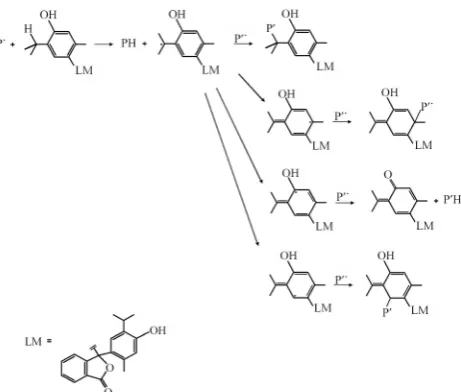
Although, it needs more evidences to propose the ex-act mechanism through which thymolphthalein en-hances thermo-oxidation stability of PP, but on the basis of the aforementioned findings and inferences, here we want to suggest a set of reactions which are likely associated with the stabilization mechanism of the additive. The proposed mechanism is illustrated in Figure 8. As it was mentioned earlier, phenolic hy -drogen atoms of thymolphthalein have been shown to play an unessential role in its stabilization action [14]. So, the benzylic 3º hydrogen atoms could be regarded as the main hydrogen atoms that are donated to free radicals during the stabilization of the polymer [11]. As it is seen in Figure 8, at the first step of stabili -zation mechanism of the additive, thymolphthalein could deactivate a free radical (P˙) through donating a benzylic 3º hydrogen atom from each of its two phe -nolic parts. The situation of the radical which is so formed on thymolphthalein molecule could be delo-calized through resonance by pie electrons present in the adjacent phenyl ring. The thymolphthalein radi -cal which is thus stabilized might deactivate another radical (Pʹ˙) through either donating another hydrogen atom or recombination. The above-mentioned process might be repeated on the same molecule of thymol-phthalein and so, more radicals could be deactivated by only one molecule of the additive.
Figure 6. values of oxidation onset temperature (OOT) obtained for PP samples.
CONCLUSION
In this work, effects of thymolphthalein on thermo-oxidative stability of PP in both solid and melt states were investigated. The efficiency of this new anti -oxidant in stabilizing the polymer against thermal oxidation in both melt and solid states was shown to be comparable to that of the commercially used anti-oxidant, SONGNOX 1010. Hence, thymolphthalein is expected to play the role of an efficient antioxidant in the polymer during its service life as well as its pro-cessing at high temperatures. Moreover, according to the obtained results, it was deduced that thymolphtha-lein acted as a chain breaking donor antioxidant and its activity could be attributed to the activity of two benzylic 3º hydrogen atoms present in its molecular structure. Accordingly, a probable mechanism for the thermo-oxidative stabilization action of the additive in the polymer was proposed.
REFERENCES
1- Bertin D, Leblanc M, Marque SRA, Siri D (2010) Polypropylene degradation: Theoretical and experimental investigations. Polym Degrad Stabil 95: 782-791
2- Gugumus F (2002) Re-examination of the thermal oxidation reactions of polymers 3. Various
reactions in polyethylene and polypropylene. Polym Degrad Stabil 77: 147-155
3- Ying Q, Zhao Y, Liu Y(1991) A study of thermal oxidative and thermal mechanical degradation of polypropylene. Makromol Chem 192: 1041-1058 4- Wang X, Wang B, Song L, Wen P, Tang G, Hua
Y (2013) Antioxidant behavior of a novel sulfur-bearing hindered phenolic antioxidant with a high molecular weight in polypropylene. Polym Degrad Stabil 98: 1945-1951
5- Voigt W, Todesco R (2002) New approaches to the melt stabilization of polyolefins. Polym Degrad Stabil 77: 397-402
6- Richaud E, Fayolle B, Verdu J (2011) Polypropylene stabilization by hindered phenols - Kinetic aspects. Polym Degrad Stabil 96: 1-11 7- Allen N S, Edge M (1992) Fundamentals of
polymer degradation and stabilization.3rd ed., Elsevier, 22-51
8- Marques M, Oliveira R, Araujo R, Amantes B (2014) In situ stabilization of polypropylene by lignin using a Ziegler-Natta catalyst. Polyolefins J 1: 17-24
9- Kim T H, Oh DR (2004) Melt grafting of maleimides having hindered phenol antioxidant onto low molecular weight polyethylene. Polym Degrad Stabil 84: 499-503
10- Shi X, Wang J, Jiang B, Yang Y (2013) Hindered phenol grafted carbon nanotubes for enhanced thermal oxidative stability of polyethylene. Polymer 54: 1167-1176
11- Jahanmardi R, Assempour H (2008) Effects of galbanic acid on thermal and thermo-oxidative stabilities of LLDPE. Iran Polym J 17: 799-806 12- Sabnis RW (2007) Handbook of acid-base
indicators. CRC Press, 361-390
13- Abbehausen C, Formiga ALB, Sabadini E, Yoshida IVP (2010) A β-cyclodextrin/siloxane hybrid polymer: Synthesis, characterization and inclusion complexes. J Braz Chem Soc 21: 1867-1876
14- Jahanmardi R, Pourattar P, Soleimani H, Shohani N (2016) Effects of thymolphthalein on thermo-oxidative stability of high density polyethylene in melt and solid states. Iran J Chem Chem Eng, in press
Stabil 91: 3390-3396
![Figure 1. Generally accepted mechanism for deactivation of alkoxy radicals by phenolic antioxidants [5].](https://thumb-us.123doks.com/thumbv2/123dok_us/8947850.1857218/2.595.52.282.620.738/figure-generally-accepted-mechanism-deactivation-radicals-phenolic-antioxidants.webp)