The effect of explicit and implicit corrective feedback on
the use of collocations in speaking assignments by Iranian
EFL learners
Moghadam, Elaheh Shoja
Department of English, Khorasan e Razavi Science and Research Branch, Islamic Azad University, Neyshabur, Iran ([email protected])
Ghafournia, Narjes
Department of English, Neyshabur Branch, Islamic Azad University, Neyshabur, Iran. ([email protected]; [email protected])
Received: 12 October 2015 Revised: 24 November 2015 Accepted: 2 February 2016
Available Online: 16 February 2016 DOI: 10.5861/ijrsll.2016.1344
ISSN: 2243-7754 Online ISSN: 2243-7762
OPEN ACCESS
Abstract
One of the main areas of research in first language (L1) and second language (L2) research
which has recently attracted a lot of attention is the significance of error analysis/correction
and its subsequent effects on language learning. There is a vast amount of research concerning
errors and corrective feedback in language learning. What had not yet been studied widely
enough and was the focus of this study, however, was what kinds of corrective feedback are
more effective with regard to Iranian EFL learners’ collocation error concerning three major
types of corrective feedback namely explicit and implicit corrective feedback that are
provided extensively in reaction to every collocation error during free discussions. To fulfill
the purpose of the study, 90 Iranian EFL learners, who were at the intermediate proficiency
level of English, were chosen. Later, they were randomly assigned to three groups, composed
of one control group and two experimental groups receiving oral implicit and explicit
corrective feedback on error of collocations. After seven sessions of treatment, a speaking test
taken from FCE test was utilized as the posttest. Based on the results, there were significant
differences between the means of the three groups on the posttest of collocational errors. The
explicit group significantly outperformed the implicit and control groups on the posttest.
Accordingly, it was concluded that explicit corrective feedback had been the most effective
method in correcting Iranian EFL learners’ collocatioal errors.
The effect of explicit and implicit corrective feedback on the use of collocations in
speaking assignments by Iranian EFL learners
1. Introduction
Collocations as an indispensible part of speaking play an important role in every day conversations. Moreover, they are considered as indicators of proficiency for language learners and have been always emphasized in speaking module assessment of international examinations such as IELTS. As collocations vary from one language and culture to the other, this area of language can be problematic for language learners because negative transfer may happen a lot. Consequently, the teacher should be cautious about these errors and try to correct them in an effective way (Larson, 1984).
Compared to L1 users, who acquired their phrases or chunk language and developed the competence to reconstruct the language with phrases from exposure to the environment, L2 intermediate and upper- intermediate learners seem to have the same ability to resort to the same strategies as L1 learners to learn chunk language (Schmitt, 2000). Consequently, it is possible for L2 learners to reach native-speaker like competence if the learners are capable of using the idioms fluently (Ellis, 2005). Some applied linguists (e.g., Zahedi & Mirzadeh, 2010) have focused the significance of getting the intermediate language learners’ attention to multiword idioms including collocations.
An increased knowledge of collocation not only allows learners to improve levels of accuracy, but also it aids fluency (Webb & Kagimoto 2011). Collocations improve learners' ability in oral communication, listening, and reading skills. From the perspective of pedagogy, collocations help learners to be aware of language chunks used by native speakers in writing and speaking (Namvar, 2012).The majority of Iranian EFL learners have knowledge of English grammar and vocabulary to some extent; however, they seem to have serious problems with the use of collocations. For instance; ‘make a mistake’ is an acceptable collocation in the English language. Iranian learners, who speak Persian say “Eshtebah Kardan”, which literally means “do a mistake”. However, when they say it in English, they think in their first language and instead of “make a mistake” they write or say “do a mistake.” Literally, Iranians say "Do a mistake" while English speakers say "Make a mistake".
Language is a charming area of knowledge which leads many researchers to live their lives investigating different areas of it. When it gets to consider second/foreign language learning, researchers take into account the whole body of language knowledge. One of the main areas of research in first language and second language researches, which have recently attracted a lot of attention, is the significance of error treatment/correction and its subsequent effects on language learning (Ellis, 2003).
Learners’ errors have been an indispensible part of language learning, and the way language teachers deal with them has changed by the advent of new ideas in the realm of language learning. The role of corrective feedback in learners’ interlanguage development has been a focus of much discussion in Second Language Acquisition (SLA) research over the past two decades. Giving oral or written assessment feedback has always been an important part of the teaching profession. Unlike in oral feedback sessions, where tutor and students can instantaneously clarify their intentions and perceptions, written feedback is more than one way (i.e. no immediate clarification of messages between the two parties is possible).Early reviews of error treatment go back to the 1970s, but the interest in corrective feedback increased considerably in the early 1990s as it was noticed that second language learners in communicative classrooms and immersion programs were able to gain almost native-like comprehension ability and relatively high fluency, but they still continued to have difficulties with second language accuracy (Lightbown & Spada, 1990).
has been neglected by both students and teachers (Lightbown & Spada, 1990). It is observed that a considerable number of teachers are not familiar with appropriate techniques to help their students improve their speaking ability with regard to the proper employment of collocations. In addition, the majority of students, including those at higher levels of L2 learning fail to use accurate collocations, needed for acceptable and native like speaking ability. The nature of the procedures adopted by the teachers in speaking correction and giving feedback should be an issue of great concern to the researchers.
According to Allwright (1995), Claudron (1977), and Long (1977), several problems such as inconsistency, ambiguity, and ineffectiveness of teachers’ correction have been identified. They put the lack of effectiveness of corrective feedback down to the ambiguous and unsystematic approaches adopted by the majority of teachers. Some EFL learners cannot express their thought because they are lacking the important collocations of a key word. As a result, they speak awkwardly, full of miscollocations, partially due to the effect of their mother tongue and lack of training in this regard. Most of these students know a large number of single item vocabularies, but they do not know how to combine them properly in speaking. Moreover, the significance of this study lies in its attempt to discover a new way of teachers' responses to learners' speaking, which can help to improve L2 learners' accuracy. The findings might contribute to the improvement of the techniques of teaching collocations. There is no agreement among the supporters on which types of feedback are more effective. Therefore, a deep study into less investigated forms of oral feedback can bring results of a great practical value. Consequently, some factors can be mentioned with regard to the significance of the current study. First, collocations as determining factors, which show the level of mastery of learners in speaking ability, have been always crucial to learners and teachers. Second, the studies that have considered cognitive differences as mediating factors in the notice ability of feedback are few in number (Lyster, 2004). However, the evidence they provide is intriguing. Thus, more studies on the subject are needed to probe the complex relationship between learning and individual differences.
One of the most important goals of learning a second/foreign language is developing the ability to speak. Chastain (1998) gives the highest importance to speaking competency among the four main competencies in a foreign language to be mastered. As he claims, a good level of proficiency in speaking can guarantee the growth in other level of proficiency such as reading, writing, and listening. He maintains that speaking can play two main roles; enhancing the retaining and activating the current proficiency level of EFL learners. Regrettably, due to lack of knowledge of some teachers in using the correct feedback, some learners lose their self-confidence in speaking or even learning a language. Consequently, paying much attention to the type of error made by learners and choosing the correct feedback is essential in a language classroom.
The present study aims at investigating the role of implicit and explicit corrective feedback on the application of collocations by Iranian intermediate EFL learners. It mainly concerns on the errors committed by the learners doing the tasks related to them and the implicit and explicit form of corrective feedback given to them by language teachers as well as learners' uptake of this kind of feedback.
2. Related review of literature
speaking skill.
Fluency in speaking is a crucial factor. As Zhang (2009) defines "fluency is the ability to speak or read quickly, accurately, and without undue hesitation, then automatic execution of certain aspects of L2 performance such as pronunciation, grammatical processing, and word recognition would, by definition, promote fluency. As de Jong et al. (2011) state "Lennon (1990) distinguishes a broad definition and a narrow definition. In the broad definition, fluency can be seen as overall (speaking) proficiency, whereas fluency in the narrow definition pertains to smoothness and ease of oral linguistic delivery. Brumfit (1984) assumed that fluency was “the maximally effective operation of the language system so far acquired by the student." In addition, Nunan (1999) states when a speaker speaks unexpectedly, he should continue without hesitation. Speaking fluently does not mean that a speaker should speak so fast. Sometimes pausing is also an important aspect of fluency which may be long but not numerous. Besides, when speakers speak fluently, they should be able to acquire the message without regarding any grammatical and other mistakes.
One of the problematic areas for EFL learners is learning collocations. Iranian learners like the other learners face various problems in producing oral collocations, therefore, the necessity to spend more time and energy by learners on mastering collocations is obvious. Using collocations is probably the most important part of turning passive words into active ones; therefore, a central component in the acquisition of a creative language system is collocation (Durrant, 2008). According to Ramirez (2012, p. 242), "collocation is the way in which words associate with one another and can be defined as word clusters, which are regularly used in spoken and written English." Henriksen (n.d. p. 30) defines collocations as "frequently recurring two-to-three word syntagmatic units which can include both lexical and grammatical words, e.g. verb + noun (pay tribute), adjective + noun (hot spice), preposition + noun (on guard) and adjective + preposition (immune to)." McCarthy (1990) believed that collocational knowledge comprises a significant part of native speakers’ linguistic competence, which can make difficulties for learners who are using second language for communication. According to Jinsuk (2001, p. 208), "it makes sense to regard collocations as items frequently occurring together and with some degrees of semantic unpredictability." This justifies the idea that it is important to spend time on collocations to improve fluency. As Bergstrom (2008, p. 5) states "an important aspect of being fluent in a language is the use of collocations, which are conventionalized word combinations that are often used together in a language." Shokouhi and Mirsalari (2010) define two groups of collocations:
Grammatical collocations consist of a noun, an adjective, or a verb plus a preposition or a grammatical structure such as an infinitive or a clause. (e.g. by accident). Lexical collocations consist of various combinations of nouns, adjectives, verbs and adverbs. (e.g. storms rage).
Although the collocations are important for L2 learners, researchers have indicated that collocations are an inherent problem for them and using collocations is one of the difficult aspects of vocabulary learning for learners of a foreign or second language including advanced learners and professional translators (Bahns, 1993; Hüttner, 2005; Millar, 2005; Martyńska, 2004; Taiwo, 2004; Walsh, 2005; Wray, 2000). Dechert and Lennon (1989) studied the acquisition of collocations by advanced learners and found that the subjects who had studied English for at least ten years with extensive contact with native speakers could not produce the language that conformed to native speaker criteria. Furthermore, their production caused misunderstanding and interrupted comprehension. Dechert and Lennon (1989) maintained that the errors made by the subjects are not grammatical, but lexical ones. They concluded that learning collocation is neglected and it needs more attention.
collocations. He classified English collocational patterns into ten categories of which the collocations of prepositions are among the most problematic patterns, while 'adjective+ adverbs' and 'fixed expressions' rank among the least problematic collocational patterns for them. He further concluded that collocational competence is an essential part of achieving native-like competence in English. Sadeghi and Panahifar (2013) studied on the use of different types of collocations in oral productions of Iranian EFL learners with the aim of identifying, categorizing and accounting for the inappropriate collocations produced.
2.1 Implicit and explicit corrective feedback
As for implicit feedback, there is no overt indicator that an error has been made while in explicit feedback there is. Implicit feedback often takes the form of recasts. Explicit feedback can take several forms: it may draw attention to the source of problem indicated (for example, ‘Not goed’) , where just negative evidence is presented; it may present explicit correction (for example, ‘No, not goed- went.’), where the feedback obviously shows that what the learner has stated is erroneous and supplies the correct form, so presenting both positive and negative evidence; or it may recommend metalinguistic feedback (for example, ‘ You need past tense.’), defined by Lyster and Ranta (1997) as ‘comments, information or questions related to the well-formedness of the learner’s utterance’ (ibid), which again just presents negative evidence .
On the other hand, Mackey and Gass (2006) declared that a number of studies have researched the effects of these two types of feedback on second language (L2) acquisition. These investigations show that both types of corrective feedback are influential in improving learning of the grammatical structures aimed when the feedback is emphasized and intensive. A number of the studies (e.g, Carroll & Swain, 1993; Nagata, 1993; Rosa & Leow, 2004) proved that explicit feedback was more influential than implicit feedback investigation of the influences of recasts and metalinguistic feedback on the learning of English past tense ‘- ed’ done by Ellis, Loewen and Erlam (2006). Ellis, et al also found that the explicit type of feedback was more influential than the implicit type. Nonetheless, some of other studies (e.g, Sanz, 2003) indicated no difference. Just one research (Leeman, 2003) reported that implicit corrective feedback was more influential than explicit feedback.
Meanwhile, Mackey and Gass (2006) reported that it is difficult to come to an exact conclusion considering the relative effectiveness of implicit and explicit corrective feedback according to researches for a number of reasons. First, the two types of feedback were not operationalized in the same way in all the researches. Implicit feedback was implemented as recasts in most of the investigations, but recasts can differ enormously. The explicit feedback also differed if it simply showed an error had been occurred, presented a correction, or involved metalinguistic information or some combination of these strategies. In addition, according to Zhang’s (2009) comment, the recasts are emphasized intensively on a single grammatical structure (Mackey, 2007). As Doughty (2003) remarks, a second reason why the results of previous investigations are difficult to interpret is the method of implementing and testing acquisition. Most of the researches did not include measures of implicit knowledge i.e. a general failing in form- focused instruction studies. And to complete this, the researchers found explicit corrective feedback to be the more influential (e.g., Mackey, 2007).
Finally, the previous researches differed in their selection of aimed grammatical structure. Some of the researchers investigated morphological features- for example, distinguishing nouns and verbs in Carroll and Swain (1993) and French grammatical gender in Lyster (2004) while other researchers examined syntactical features, for instance, dative alternation in Carroll and Swain (1993) or clitic pronoun position in Spanish in Sanz (2003). It is sensible to think that the influence of corrective feedback treatment will rely on the selection of the aimed structure (Mackey, 2007). Pienemann (1998), for instance, offers that the order in which grammatical structures are acquired as implicit knowledge include the processing implementations.
constitutes a rather easy rule to understand whereas dative alternation is much more difficult. In line with what was said, Mackey and Gass (2006) reports that, there is a clear need to regard carefully the choice of target structure, being aware of both the developmental stage of the students, and the conceptual complexity of the structure selected. In general, explicit instruction is more influential with simple rules. Nevertheless, this may just demonstrate the fact that the testing instruments only presented measures of explicit knowledge (Mackey, 2007). For intricate rules the picture is mixed. In two studies (Scott, 1989; de Graaff, 1997), the explicit instruction was more influential for acquiring complex structures.
2.2 Empirical background
A well-known study on the relationship between corrective feedback and learner uptake is by Lyster and Ranta (1997), who studied second language learners in immersion classrooms in Canada. They examined six corrective feedback types in terms of their frequency and distribution, as well as their effects on learner uptake. Lyster and Ranta (1997) discovered that the teachers had a strong tendency (55% of all occurrences) to use recasts as the strategy for corrective feedback (Lyster & Ranta 1997, p. 53), even though it was the least likely strategy to elicit student-generated repair (only 31% of all occurrences). They concluded that of the six feedback types, elicitation, repetition, clarification requests and metalinguistic feedback were the more successful in evoking student generated feedback. The teachers provided corrective feedback on 62% of the students’ erroneous utterances on average, and the researchers did conclude that more frequent corrections would probably be undesirable, but that teachers should more actively apply the different corrective techniques and not only the recasts.
In Iranian EFL context, numerous researches have been done to date. Vaezi, Zand-Vakili, and Kashani (2011) conducted a study on observational classroom research on corrective feedback and then presented an observational study of patterns of error treatment in an adult ESL classroom at two intermediate and advanced levels. Their study examined the range and types of feedback used by Iranian teachers in three different aspects (grammatical, phonological, and lexical). The findings of their study showed an obvious tendency for implicit types of reformulate feedback, namely, recasts at intermediate level, especially in relation to structural errors, leaving little opportunity for other feedback types and at advanced level recast was the most frequent one in phonological aspects. Moreover, contrary to Lyster and Ranta’s model (1997) findings proved lack of Iranian teacher’s feedback in relation to lexical errors.
A recent study by Rahimi and Dastjerdi (2012) had a two-fold objective, including both error correction and anxiety. Firstly, they investigated an effective error correction method for developing learners’ complexity, accuracy and fluency in speech in terms of immediate and delayed correction. Secondly, they aimed at measuring students’ anxiety levels while the teacher corrected their errors immediately and with some delay. Rahimi and Dastjerdi (2012) found out that delayed error correction has a positive effect on fluency and accuracy but not on complexity. In terms of anxiety experienced in relation to error correction their conclusion was that students who received delayed correction experience less anxiety and were more comfortable to participate in discussions.
effective in terms of its contribution to uptake and acquisition" (p. 181).
Metalinguistic instruction of feedback strategies is considered important in some studies for improving speaking abilities of the students. For example, Nassaji (2009) studied on the effects of feedbacks to speaking of pre-intermediate Iranian EFL learners' speaking. This study revealed the positive influence of form-focused instruction of feedback strategies. As Gholizade (2013) states "in their study, with concerning the differential effects of prompts and recasts, the result of the immediate post-test demonstrated the superiority of prompts in comparison to recasts which can be accounted for by taking into consideration the explicit-implicit dichotomy. Explicit feedback led to much more feedback appreciation" (p. 426). The aim of these studies is to deal with one of the most important issues in EFL, that is, whether teachers should focus on feedback or not, and if yes to which strategy of feedback should be focused.
According to Shorpour and Zarei (2015), "although students pay more attention to explicit corrective feedback than implicit corrective feedback (Mackey et al., 2007; Nassaji, 2009) and prompts more than recasts (Ammar, 2008), some researchers have proposed that the effects of implicit corrective feedback may be more lasting than those of explicit corrective feedback, which may be more effective in the short term memory (Ellis et al., 2006; Li, 2010; Mackey & Goo, 2007). Shorpour and Zarei (2015) studied on the efficacy of explicit corrective feedback (CF) with metalinguistic rules on picture-cued task of speaking assessment for production of seven common English tenses. Based on their oral proficiency at the beginning of the study, the two groups were homogenous, but the results revealed that the experimental group outperformed the control group in the immediate and delayed post-oral testing. As they state "the results also confirmed that the effect of error correction was more significant on present perfect tense and less significant on simple present tense" (p. 3565). The results in this study indicate the importance of providing explicit and metalinguistic corrective feedback. Conducting studies like this one may contribute to better teaching and testing oral skills to the foreign language learners.
Mendez et al. (2010) studied on the role of corrective feedback in the EFL classes in English language program, and they analyzed the corrective feedback techniques used by the EFL teachers in this program. For this, an exploratory study which integrated documentary and qualitative research was conducted. They interviewed five language instructors from the English language bachelors' program. The findings showed that the type of correction mostly used by teachers is teacher correction. These teachers frequently used the techniques such as repetition of error, recasting, body language, and metalinguistic feedback. They concluded that these teachers preferred implicit corrective feedback because in this way the students' styles, personalities, and attitudes could be considered. The teachers concerned the students' emotions, and they were afraid of demotivating them from learning the language. According to Mendez et al. "it also seems that instructors´ target for oral corrective feedback is phonology and morphosyntax, but semantics and pragmatics are the most neglected areas. The provision of corrective feedback seems unsystematic, inconsistent and ambiguous" (p. 1)
3. Research Questions
In accordance with the research objectives, the researcher formulates two research questions as follows:
Does explicit corrective feedback have any significant effect on the use of collocations in speaking assignments by Iranian EFL learners?
Accordingly, two null hypotheses are posed by the researcher as follows:
H01: Explicit corrective feedback does not have any significant effect on the use of collocations in speaking assignments by Iranian EFL learners.
H02: Implicit corrective feedback does not have any significant effect on the use of collocations in speaking assignments by Iranian EFL learners.
4. Methodology
4.1 Participants
The researcher selected 90 intermediate EFL male and female students, who were studying at Shokuh institute in Quchan in khorasan e Razavi in Iran. The students were aged between 15-24 years old. They divided into two experimental and one control groups. All these students passed 7 levels of Top Notch books. To capture their language proficiency, the researcher first administered the Nelson test and then decided to select the students whose scores fell between one standard deviation above and below the mean. In other words, the students at the intermediate level were selected.
4.2 Instrumentation
The instrument that used in this study was 50-item Nelson English Language Proficiency Test. This multiple-choice test included cloze passages, vocabulary, structure, and pronunciation tests that used to homogenize the participants. The English language proficiency test used in the present study was adopted from Fowler and Coe (1978). The reliability coefficient of this proficiency test was high, Cronbach Alpha = 0.82 (Hashemian, Roohani, & Fadaei, 2012). The scoring of the test was calculated out of 50, one score for each question. After that, students took a pre-test that was a combination of different questions about different topics in speaking. A pretest, an FCE test was used. It was a standardized measurement with four essential qualities – validity, reliability, impact, and practicality – and internationally used to describe language ability of learners. A post-test (the same version of FCE test) was used to check the efficiency of the treatment was used.
4.3 Procedure
At first, Nelson test was given to the students for the purpose of homogenizing the participants, and those students whose scores fall one standard deviation above and below the mean were elected for the study. After that, students took a pre-test that is a combination of different questions about different topics in speaking. In the treatment part, the two experimental groups received oral implicit, explicit, for ten sessions. The material of these exams extracted from numerous collocations books such as English collocations in use by (Michael Mccarthy, 2005) Key words to fluency by (George Woolard, 2005), Collocations organizer by (Mémoniak Kifékoi, 2015). In the class that implicit corrective feedback carried out, the students were given five minutes to prepare themselves to talk about a topic, and then they were supposed to speak in the class. If they had any mistakes, the researcher indirectly tried to direct the student to the correct answer by giving some clues orally. In the other class with explicit feedback, five minute of the class was allocated to each student to talk, too. If there were any mistakes, the researcher tried to guide the student to the correct answer by directly correcting them. After seven sessions of treatment, students were given post-test to investigate the result of the treatment.
4.4 Data analysis
the efficacy of each treatment.
5. Results and discussion
5.1 The first null hypothesis
In order to test the first null hypothesis, and to see if there is a significance difference between the performance of the participants in explicit corrective feedback group on posttest, a paired-sample T-tests was run. The result is reported in Table 1. As displayed in Table 1, the t-observed value is 11.183. This amount of t-value at 29 degrees of freedom is higher than the critical t-value of t, i.e., 3.67.
Table 1
Paired-Sample-test for pretest and posttest of the explicit group
Paired Differences
T df Sig.
(2-tailed) Mean Std.
Deviation
Std. Error Mean
95% Confidence Interval of the
Difference Lower Upper
Explicit Posttest- Pretest
5.43333 2.66113 .48585 4.43965 6.42702 11.183 29 .000
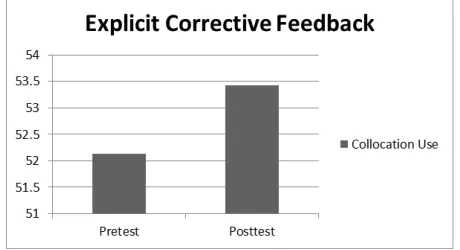
Based on the results, there is a significant difference in the performance of the explicit corrective feedback group on the posttest. The explicit corrective feedback group's mean score has increased from 52.00 to 57.43 (Table 2).
Table 2
Descriptive statistics for pretest and posttest of the explicit group
Mean N Std. Deviation Std. Error Mean
Explicit Posttest 57.4333 30 3.78457 .69097
Pretest 52.0000 30 3.23771 .59112
Figure 1 displays the improvement from the pretest to the posttest for the explicit corrective feedback group due to the treatment.
Figure 1. Pretest and posttest of the explicit corrective feedback group
5.2 The second null hypothesis
Table 3
Paired sample T-test for the pretest and posttest of the implicit group
Paired Differences
t df Sig.
(2-tailed) Mean Std.
Deviation
Std. Error Mean
95% Confidence Interval of the
Difference Lower Upper
Implicit Posttest -Pretest
.66667 2.18669 .39923 -.14986 1.48319 1.670 29 .106
Based on these results, there is a significant difference between the mean scores of the implicit corrective feedback group on the pretest and posttest. The implicit corrective feedback group performed better on the posttest. Their mean score has increased from to52.13 to 52.80 (Table 4). But this difference is not significant.
Table 4
Descriptive statistics for pretest and posttest of the implicit group
Mean N Std. Deviation Std. Error Mean
Implicit Posttest 52.8000 30 3.39777 .62034
Pretest 52.1333 30 3.21348 .58670
Figure 2 displays the improvement from the pretest to the posttest for the implicit corrective feedback group due to the treatment.
Figure 2. Pretest and posttest implicit corrective feedback group
The goal of this study was to analyze the difference between the effects of two types of feedback including explicit and implicit on learners' accuracy with regard to the application of the collocations in their speaking tasks. First, the researcher conducted a pretest to assess the students’ level of accuracy in using collocations in their speaking. Pre-test results indicated no difference in learners' performance before treatment. According to the results of this study, the significant main effects found for the factor explicit corrective feedback suggested affirmative answer to this research questions: explicit corrective feedback does have a significant effect on the use of collocations in speaking assignments by Iranian EFL learners. As the results reported in tables 1, 2, 3, and 4 (a) applying explicit corrective feedback has significant impact on the use of collocations in speaking assignments by Iranian EFL learners, (b) explicit corrective feedback group performed significantly better than implicit corrective feedback.
way round. These language forms comprise much of speech and writing. But there are many more collocations than words since many words occur in several different collocations. Consequently, the task of achieving proficiency in a second language is even greater than when vocabulary acquisition was considered in terms of learning words. In addition, grammar rules are too general to provide guidance for acceptable word combinations.
The obtained data of the study were in line with the results of the previous researches conducted by different researchers. Lewis (1993, 2000) addresses the mentioned problems by providing rationales for focusing on collocations and providing applications that complement the rationales. In his books, Lewis provided teachers with a guide to how to use collocations as well as providing clear explanations of the importance of doing so. He put much emphasis on the explicit teaching of collocations and mentioned inappropriate usage of collocations should be clearly explained and corrected by the instructor.
To account for individuals’ oral interaction in classroom discourse, Bybee (2006) has argued that speakers represent instances of language, including constructions and collocations which, via repetition of types and tokens, become increasingly entrenched. In his study, he concluded teaching of idiomatic expressions and collocations were enhanced when the teacher clearly mentioned the usage and the importance of these fixed expressions in natural every day conversations among the native speakers. In another research, Zarei (2002) found that Iranian EFL learners have problems with English collocations. She applied two methods for giving feedback, namely recast and asking for clarification. The first method belongs to implicit corrective feedback and the second to implicit one. The results of her study proved the fact that the students’ uptake was significantly higher while the explicit type of feedback was hired.
6. Conclusion
The goal of this study was to analyze the difference between the effects of two types of feedback including explicit and implicit on learners' accuracy with regard to the application of the collocations in their speaking tasks. According to the results of this study, the significant main effects found for the factor explicit corrective feedback suggested affirmative answer to this research questions: explicit corrective feedback have a significant effect on the use of collocations in speaking assignments by Iranian EFL learners. As the results reported in tables 1, 2, 3 and 4 showed, (a) applying explicit corrective feedback has impact on the use of collocations in speaking assignments by Iranian EFL learners, (b) explicit corrective feedback group performed significantly better than implicit corrective feedback.
Explicit feedback is provided when the teacher identifies an error the correct form, but implicit feedback refers to situations when the teacher only indicates that there is an error but does not provide a correction. Therefore, it is the student who should diagnose and correct it (Ferris, 2002). According to the analysis of findings in the study, the following conclusion could be drawn: Applying elicitation explicit corrective feedback on speaking errors regarding usage of collocations by the teachers may help students get better results in learning collocations and consequently in their speaking fluency. As a result, not only the present study found that the explicit corrective feedback had a greater effect than the implicit correct feedback, but it also found that both explicit and implicit feedback facilitated improvement in the more "treatable", rule-governed features than in the less "treatable" feature.
7. References
Allwright, R. L. (1995). Problems in the study of the language teacher's treatment of error. In M. K. Burt & H. D. Dulay (Eds.), On TESOL ’75: New directions in second language learning, teaching, and bilingual education (pp. 96-109). Washington, D.C.: TESOL.
Ammar, A., & Spada, N. (2006). One size fits all? Recasts, prompts and L2 learning. Studies in Second Language Acquisition, 28(4), 543-574. http://dx.doi.org/10.1017/S0272263106060268
Ayoun, D. (2001). The role of negative and positive feedback in the second language acquisition of the passé compose and the imparfait. The Modern Language Journal, 27(4).
http://dx.doi.org/10.1111/0026-7902.00106
Bahns, J. (1993). Lexical collocation. A contrastive view. ELT Journal, 47(1), 56–63. http://dx.doi.org/10.1093/elt/47.1.56
Basturkmen, H. (2012). Review of research into the correspondence between language teachers' stated beliefs and practices. System, 40(2), 282-295. http://dx.doi.org/10.1016/j.system.2012.05.001
Basturkmen, H., Loewen, S., & Ellis, R. (2004). Teachers' stated beliefs about incidental focus on form and their classroom practices. Applied Linguistics, 25(2), 243-272. ttp://dx.doi.org/10.1093/applin/25.2.243 Bergstrom, K. (2008). Vocabulary and receptive knowledge of English collocations among Swedish upper
secondary school students. Retrieved from
http://www.diva-portal.org/smash/get/diva2:219552/fulltext01
Brumfit. C. J. (1984). Communicative methodology in language teaching: The roles of fluency and accuracy. Cambridge, UK: Cambridge University Press.
Bybee, J. L. (2006). From usage to grammar: The mind’s response to repetition. Language, 82(4), 711-733. http://dx.doi.org/10.1353/lan.2006.0186
Bybee, J. L., & Hopper, P. (2001). Frequency and the emergence of language structure. John Benjamins: Amsterdam. http://dx.doi.org/10.1075/tsl.45
Carroll, S., & Swain, M. (1993). Explicit and implicit negative feedback: An empirical study of the learning of linguistic generalizations. Studies in Second Language Acquisition, 15, 357-386.
http://dx.doi.org/10.1017/S0272263100012158
Chastain, K. (1988). Developing second language skills: Theory and practice. Florida: Harcourt Brace Jovanovich.
Chaudron, C. (1977). A descriptive modal of discourse in the corrective treatment of learners’ errors. Language Learning, 27(1), 29-46. http://dx.doi.org/10.1111/j.1467-1770.1977.tb00290.x
De Graaf, Rick. (1997). The eXperanto experiment: Effects of explicit instruction on second language acquisition. Studies in Second Language Acquisition, 19, 249-297.
http://dx.doi.org/10.1017/S0272263197002064
De Jong, N. H., Steinel, M. P., Florijn, A., Schoonen, R., & Hulstijin, J. H. (2013). Linguistic skills and speaking fluency in a second language. Applied Psycholinguistics, 34(5), 893-916.
http://dx.doi.org/10.1017/S0142716412000069
Dechert, R., & Lennon, S. (1989). Collocational blends of advanced second language learners. In S. Weigle (Ed.), Learning vocabulary for different purposes (pp. 98-116). Oxford, UK.: Pergamon Press.
Dekeyser, R. M. (2000). The effect of error correction on L2 grammar knowledge and oral proficiency. The Modern Language Journal, 77(4), 501-514. http://dx.doi.org/10.1111/j.1540-4781.1993.tb01999.x Delshad, S. (1980). Persian and English prepositions compared and contrasted from a pedagogical point of view.
Unpublished Doctoral Dissertation. University of Texas, USA.
Doughty, C. (2003). Instructed SLA: Constraints, compensation, and enhancement. In C. J. Doughy & M. H. Long (Eds.), The handbook of second language acquisition (pp. 256-312). Blackwell Publishing. http://dx.doi.org/10.1002/9780470756492.ch10
Durrant, P. L. (2008). High-frequency collocations and second language learning. Unpublished Doctoral dissertation, University of Nottingham, UK.
Ellis, N. C. (2005). At the interface: Dynamic interactions of explicit and implicit language knowledge. Studies in Second Language Acquisition, 27, 305-352. http://dx.doi.org/10.1017/s027226310505014x
Ellis, R. (2001). Non-reciprocal tasks, comprehension, and second language acquisition. In M. Bygate, P. Skehan, & M. Swain (Eds.), Researching pedagogic tasks: Second language learning, teaching, and testing (pp. 23-48). Harlow: Pearson.
Ellis, R., Loewen, S., & Erlam, R. (2006). Implicit and explicit corrective feedback and the acquisition of L2 grammar. Studies in Second Language Acquisition, 28, 339-368.
http://dx.doi.org/10.1017/s0272263106060141
Farhadi, H., Jafarpur, A., & Birjandi, P. (1994).Testing language skills: From theory to practice. Tehran: SAMT. Ferris, D. R. (2004). The grammar correction debate in L2 writing: Where are we, and where do we go from here?
Journal of Second Language Writing, 13(1), 49-62. http://dx.doi.org/10.1016/j.jslw.2004.04.005 Ferris, D. R., & Roberts, B. (2001). Error feedback in L2 writing classes: How explicit does it need to be?
Journal of Second Language Writing, 10(3), 161-184. http://dx.doi.org/10.1016/S1060-3743(01)00039-X Fowler, H. (1906). The king’s English. Oxford: Clearendon Press.
Gholizade, R. (2013). The investigation of differential effects of recast and metalinguistic feedback on accuracy, fluency, and complexity of speaking performance of male and female EFL learners. Journal of Novel Applied Sciences, 2(9), 417-428.
Henriksen, B. (n.d.). Research on L2 learners’ collocational competence and development – a progress report. Retrieved from http://www.eurosla.org/monographs/EM02/Henriksen.pdf
Hill, J. (2002). Revising priorities: from grammatical failure to collocational success. In Michael Lewis (Ed.) Teaching collocation: Further developments in the lexical approach (pp. 47-69). Hove, England: Language Teaching Publications.
Hüttner, J. (2005). Formulaic language and genre analysis: The case of student academic papers. Views, 14(1), 3–20.
Jinsuk, H. (2001). Attaining fluency in English through collocations. Retrieved from https://www.google.com/#q=attaining+fluency+in+english+han+jinsuk
Johnson, K. (1995). Understanding communication in second language classrooms. Cambridge, MA: Cambridge university press.
Larson, M. (1984). Meaning – based translation: A guide to cross language equivalence. Lanham: University Press of America.
Leeman, J. (2003). Recasts and second language development: Beyond negative evidence. Studies in Second Language Acquisition, 25(1), 37-63. http://dx.doi.org/10.1017/S0272263103000020
Lewis, M. (2000). Learning in a lexical approach. In M. Lewis (Ed.), Teaching collocation: Further development in the lexical approach (pp. 126-154). Oxford: Oxford University Press.
Li, S. (2010). The effectiveness of corrective feedback in SLA: a meta-analysis. Language Learning, 60(2), 309-365. http://dx.doi.org/10.1111/j.1467-9922.2010.00561.x
Lightbown, P. M., & Spada, N. (1990). Focus-on-form and corrective feedback in communicative language teaching: Effects on second language learning. Studies in Second Language Acquisition, 12, 429-448. http://dx.doi.org/10.1017/S0272263100009517
Loewen, S., & Erlam, R. (2010). Implicit and explicit feedback in L2 oral French interaction. Atlanta: American Association of Applied Linguistics.
Long, M. H. (1977). Input and second language acquisition theory. In S. M. Gass, & C. G. Madden (Eds.), Input in second language acquisition (pp. 377-393). Rowley, MA: Newbury House.
Lyster, R. (2004). Differential effects of prompts and recasts in form-focused instruction. Studies in Second Language Acquisition, 26, 399–432. http://dx.doi.org/10.1017/s0272263104263021
Lyster, R., & Ranta, L. (1997). Corrective feedback and learner uptake: Negotiation of form in communicative classrooms. Studies in Second Language Acquisition, 19(1), 37-61.
http://dx.doi.org/10.1017/S0272263197001034
Lyster, R., & Saito, K. (2010). Oral feedback in classroom SLA. A meta-analysis. Studies in Second Language Acquisition, 32, 265-302. http://dx.doi.org/10.1017/S0272263109990520
Lyster, R., Saito, K., & Sato, M. (2013). Oral corrective feedback in second language classrooms. Language Teaching, 46, 1-40. http://dx.doi.org/10.1017/S0261444812000365
Mackey, A., & Goo, J. (2002). Interaction research in SLA: A meta-analysis and research synthesis. In A. Mackey (Ed.), Conversational interaction in second language acquisition: A series of empirical studies (pp. 407-452). Oxford: Oxford University Press.
Mackey, A., & Goo, J. (2007). Interaction research in SLA: a meta-analysis and research synthesis. In A. Mackey (Ed.), Conversational interaction and second language acquisition (pp. 407-453). New York: Oxford University Press.
Martyńska, M. (2004). Do English language learners know collocations? Investigations Linguisticae, 11, 1–12. McCarthy, M. (1990). Vocabulary. Oxford: Oxford University Press.
Méndez, E. H., Cruz, R. R., & Loyo, G. M.(2010). Oral corrective feedback by EFL teachers at Universidad de Quintana Roo. Retrieved from
http://www.fel.uqroo.mx/adminfile/files/.../hernandez_mendez_edith_et_al_2.pdf
Millar, N. (2005). The processing demands on non-native- like learner collocations on native speakers. Retrieved from http://www.lancs.ac.uk/postgrad/millarn/Files/Background%20to%20study.pdf
Nagata, N. (1993). Intelligent computer feedback for second language instruction. Modern Language Journal, 77, 330-339. http://dx.doi.org/10.1111/j.1540-4781.1993.tb01980.x
Namvar, F. (2012). The relationship between language proficiency and use of collocation by Iranian EFL students. 3L: The Southeast Asian Journal of English Language Studies, 18(3), 41– 2.
Nation, I. S. P. (2001). Learning vocabulary in another language. Cambridge: Cambridge University Press. http://dx.doi.org/10.1017/CBO9781139524759
Nunan, D. (1999). Second language teaching and learning. Boston: Heinle & Heinle Publishers.
Park, G. (2010). Preference of corrective feedback approaches perceived by native English teachers and students. The Journal of Asia TEFL, 7(4), 29-52.
Pienemann, M. (1998). Language processing and second language development: Processability theory. Philadelphia: John Benjamins. http://dx.doi.org/10.1075/sibil.15
Rahimi A., & Dastjerdi, H. V. (2012). Impact of immediate and delayed error correction on EFL learners’ oral production: CAF. Mediterranean Journal of Social Sciences, 3(1), 45-54.
Ramirez, A. T. (2012).The lexical approach: Collocability, fluency and implications for teaching. Revista de lenguas para Fines Específicos, 18, 237-254.
Robinson, P. (1996). Learning simple and complex second language rules under implicit, incidental, rule research, and instructed conditions. Studies in Second Language Acquisition, 18(1), 27-67. http://dx.doi.org/10.1017/S0272263100014674
Roothooft, H. (2014). The relationship between adult EFL teachers' oral feedback practices and their beliefs. System, 46, 65-79. http://dx.doi.org/10.1016/j.system.2014.07.012
Rosa, E., & Leow, R. P. (2004). Computerized task-based exposure, explicitness, type of feedback, and Spanish L2 development. Modern Language Journal, 88(2), 192-216.
http://dx.doi.org/10.1111/j.0026-7902.2004.00225.x
Russell, J., & Spada, N. (2006). The effectiveness of corrective feedback for the acquisition of L2 grammar. A meta-analysis of the research. In J. Norris, & L. Ortega (Eds.), Synthesizing research on language learning and teaching (pp. 133-164). Amsterdam: Benjamins.
Russell, V. (2009). Corrective feedback, over a decade of research since Lyster and Ranta (1997): Where do we stand today? Electronic Journal of Foreign Language Teaching, 6(1), 21-31.
Sadeghi, K., & Panahifar, F. (2013). A corpus-based analysis of collocational errors in the Iranian EFL learners' oral production. The Journal of Teaching Language Skills (JTLS), 4(4), 53-78.
Scott, V. M. (1989). An empirical study of explicit and implicit grammar teaching strategies in French. Modern Language Journal, 73(1), 14-22. http://dx.doi.org/10.1111/j.1540-4781.1989.tb05303.x
Shokouhi, H., & Mirsalari, G. A. (2010). Collocational knowledge versus general linguistic knowledge among Iranian EFL learners. The Electronic Journal for English as a Second Language, 13(4). Retrieved from http://www.tesl-ej.org/wordpress/issues/volume13/ej52/ej52a7/
3565-3575.
Taiwo, R. (2004). Helping ESL learners to minimize collocation errors. The Internet TESL Journal, 10(4). Retrieved from http://iteslj.org/Techniques/Taiwo-Collocation.html
Thornbury, S. (2002). How to teach vocabulary. Harlow: Longman.
Tomasello, M., & Herron, C. (1989). Feedback for language transfer errors: The garden path technique. Studies in Second Language Acquisition, 11, 385-395. http://dx.doi.org/10.1017/S0272263100008408
Vaezi, Sh., Zand-Vakili, E., & FardKashani, A. (2011). Patterns of corrective feedback in relation to error types Iranian adult EFL learners’ classes. European Journal of Scientific Research, 66(4), 517-531.
Walsh, M. (2005). Collocation and the learner of English. Retrieved from http://www.cels.bham.ac.uk/resources/essays/WalshLexis.pdf
Webb, S., & Kagimoto, E. (2011). Learning collocations: Do the number of collocates, position of the node word, and synonymy affect learning? Applied Linguistics, 32(3), 259-276.
http://dx.doi.org/10.1093/applin/amq051
White, E. M. (1994). Teaching and assessing writing: Recent advances in understanding evaluating, and improving student performance (2nd ed.). San Francisco: Jossey-Bass Publishers.
Wray, A. (2000). Formulaic sequences in second language teaching. Principle and practice. Applied Linguistics, 21(4), 463–489. http://dx.doi.org/10.1093/applin/21.4.463
Zahedi, H., & Mirzadeh, M. (2010). Collocational cloze: The effect of deletion procedure and gender. Iranian EFL Journal, 6(1), 143-157.
Zareie, A. (2002). What is wrong with collocation? An investigation of the Iranian advanced learners' problems with English collocations. A focus on lexical collocations. Iranian Journal of applied Linguistics, 6(1). Zhang, S. (2009). The role of input, interaction and output in the development of oral fluency. English Language