University of New Orleans University of New Orleans
ScholarWorks@UNO
ScholarWorks@UNO
University of New Orleans Theses and
Dissertations Dissertations and Theses
8-7-2008
Classifier System Learning of Good Database Schema
Classifier System Learning of Good Database Schema
Mitsuru Tanaka
University of New Orleans
Follow this and additional works at: https://scholarworks.uno.edu/td
Recommended Citation Recommended Citation
Tanaka, Mitsuru, "Classifier System Learning of Good Database Schema" (2008). University of New Orleans Theses and Dissertations. 859.
https://scholarworks.uno.edu/td/859
This Thesis is protected by copyright and/or related rights. It has been brought to you by ScholarWorks@UNO with permission from the rights-holder(s). You are free to use this Thesis in any way that is permitted by the copyright and related rights legislation that applies to your use. For other uses you need to obtain permission from the rights-holder(s) directly, unless additional rights are indicated by a Creative Commons license in the record and/or on the work itself.
Classifier System Learning of Good Database Schema
A Thesis
Submitted to the Graduate Faculty of the University of New Orleans in partial fulfillment of the requirements for the degree of
Master of Science in
The Department of Computer Science
By
Mitsuru Tanaka
B.E., Hiroshima Kokusai Gakuin University, Japan, 2001
Dedication
This thesis is dedicated to my parents Mr. Chiaki Tanaka and Mrs. Hisako Tanaka,
Acknowledgement
I would like to thank my thesis advisor Dr. Shengru Tu. Dr. Tu introduced me to a
research project, which required knowledge of database and artificial intelligence fields
and later motivated me to write a thesis on it. Artificial intelligence was a frontier field to
me. The fusion of the two fields presented many questions for me to explore in the
project. I thank Dr. Tu for answering to my questions and being supportive throughout
the completion of my thesis.
I would also like to thank Dr. Adlai DePano, and Dr. Golden Richard, III, for
becoming my thesis committee members.
I would also like to thank Dr. Lingyan Shu, who was the team leader in the
project, for helping me in the artificial intelligence studies.
I would also like to thank other faculty members and staffs for providing me with
Table of Contents
List of Figures ... vii
List of Tables ... viii
Abstract ... ix
Chapter 1: Introduction ...1
1.1 Applying the Classifier System to the Learning of Database Schema ...1
1.2 Organization...7
Chapter 2: Background ...9
2.1 Artificial Intelligence ...9
2.2 Machine Learning ...11
2.3 Previous Works on Classifier System...12
Chapter 3: An Intensive Study on Classifier System...15
3.1 Genetics-Based Machine Learning ...15
3.2 Genetic Algorithms ...16
3.2.1 Robustness of Genetic Algorithms ...16
3.2.2 Natural Selection...19
3.2.3 Reproduction...20
3.2.4 Crossover ...22
3.2.5 Mutation...24
3.2.6 Similarity Templates (Schemata)...26
3.2.7 Schema Theorem (Fundamental Theorem of Genetic Algorithms) ...26
3.2.8 A Simple Genetic Algorithm for a Knapsack Problem ...29
3.3 Components of Classifier System...34
3.3.1 Rule and Message System ...35
3.3.2 Classifiers...36
3.3.3 Apportionment of Credit System: Bucket Brigade...37
3.3.4 Genetic Algorithms in the Classifier System...37
Chapter 4: Implementation of a Classifier System in Java ...39
4.1 Requirements ...39
4.2 Input and Output ...40
4.3 Data Structures...42
4.3.1 Classifier ...43
4.3.2 Environmental Message...43
4.3.3 Population ...44
4.4 Class Diagrams ...45
4.4.1 Perform Class as the Rule and Message System ...46
4.4.2 AOC Class as the Apportionment of Credit System ...46
4.4.3 GA Class as the Genetic Algorithms...47
4.4.4 Reinforc Class for the Reinforcement Learning ...48
4.5 Knowledge Given to the Classifier System & Reward Functions ...50
4.6 Example Operations over the Classifiers...50
4.6.1 Operations of matchclassifiers in Perform...51
4.6.3 Operations of GA...54
4.6.4 Operations of payreward in Reinforc...55
Chapter 5: Result of an Experiment...57
5.1 Completely Well-Designed Database Schema as the Input...57
5.2 Badly Designed Database Schema as the Input...60
Chapter 6: Conclusion...63
References...64
Appendices...66
Appendix A: Permissions ...66
List of Figures
Figure 1.1: Alternatives for CUSTOMER and TELEPHONE ...4
Figure 1.2: An E-R Diagram without CUSTOMER Entity Set...5
Figure 2.1: A Six-Bit Multiplexer Function ...14
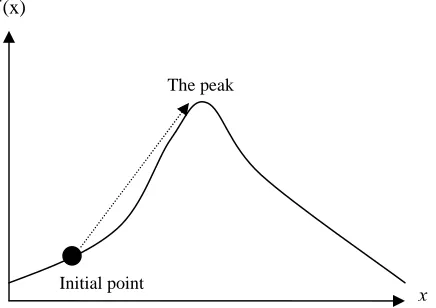
Figure 3.1: A Mountain with a Single Peak...17
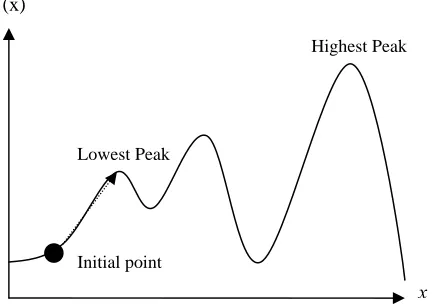
Figure 3.2: A Mountain with Multiple Peaks ...18
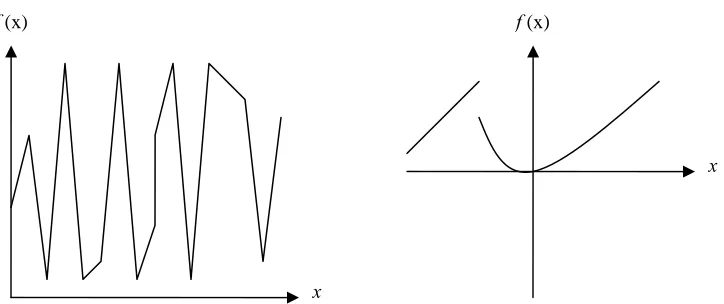
Figure 3.3: Noisy and Discontinuous Functions...19
Figure 3.4: Roulette Wheel for Reproduction...22
Figure 3.5: An Example Binary Representation of the Strings in a Knapsack Problem .31 Figure 3.6: A Learning Classifier System Interacting with its Environment ...35
Figure 4.1: The Input to the Classifier System ...41
Figure 4.2: System Tab with the Output...42
Figure 4.3: The Declarations of ClassType...43
Figure 4.4: The Declarations of PopType...44
Figure 4.5: An Iteration of the Classifier System ...45
Figure 4.6: The Class Diagram of Perform...46
Figure 4.7: The Class Diagram of AOC...47
Figure 4.8: The Class Diagram of GA...48
Figure 4.9: The Class Diagram of Reinforc...49
Figure 4.10: The Class Diagram of RewardCalculator...50
Figure 4.11: The Method matchclassifiers...51
Figure 4.12: Some Classifiers Matching to an Environmental Message ...52
Figure 4.13: The Method auction...53
Figure 4.14: The Method taxcollector...54
Figure 4.15: Relations and Mapping Cardinalities ...56
Figure 5.1: Well-Designed Input Schema...58
Figure 5.2: Mapping Cardinalities of the Well-Designed Input Schema...58
Figure 5.3: Initial Population Generated From the Well-Designed Input Schemas ...58
Figure 5.4: Top Five Classifiers of the Final Population in the Experiment with the Well-Designed Schemas ...59
Figure 5.5: Number of Classifiers with Strength Over 2 ...60
Figure 5.6: Number of Classifiers with Strength Over 10 ...60
Figure 5.7: Input in Which PROJ Is Modified...61
Figure 5.8: Initial Population Generated From the Badly Designed Input Schemas...61
List of Tables
Table 3.1: Example of Four Strings...21
Table 3.2: Four Strings with 0 Fitness Value ...24
Table 3.3: The Effect of Mutation ...25
Table 3.4: Weight and Profit of the Items for a Knapsack Problem...30
Table 3.5: String and Schema Processing by Genetic Algorithms for a Knapsack Problem...32
Abstract
This thesis presents an implementation of a learning classifier system which
learns good database schema. The system is implemented in Java using the NetBeans
development environment, which provides a good control for the GUI components. The
system contains four components: a user interface, a rule and message system, an
apportionment of credit system, and genetic algorithms. The input of the system is a set
of simple database schemas and the objective for the classifier system is to keep the good
database schemas which are represented by classifiers. The learning classifier system is
given some basic knowledge about database concepts or rules. The result showed that the
system could decrease the bad schemas and keep the good ones.
Keywords and Phrases: classifier system, machine learning, genetic algorithms, and
Chapter 1: Introduction
A classifier system is a machine learning system which uses genetic algorithms.
Genetic algorithms are based on the principle of Darwin’s survival of the fittest. They are
derived from a computational model of evolutionary genetics. They also have been
applied to search and optimization problems. Genetic algorithm based classifier systems
have been applied to a variety of learning tasks. In this thesis, the classifier system is
applied to learn good relational database schemas.1
1.1 Applying the Classifier System to the Learning of Good Database
Schema
Database design involves complex tasks. Databases are widely used in banking,
airlines, universities, or credit card transactions. Such databases are designed to manage
large bodies of information. To map the information to relational database, there are
many steps involved in the design. Database design usually involves the following phases
[1]: characterizing the data needs of the prospective database users, conceptual-design,
creating a specification of functional requirements, logical design, and physical design. In
these phases, there are many concepts, theories, or rules, which help the database
designers to produce good database schemas. These five phases involve complex tasks
when the information is large.
1
In the first phase to characterize the data needs of the prospective database users,
the database designer needs to interact extensively with domain experts and users to carry
out this task. The output of this phase is a specification of user requirements. If the client
is a bank, there may be a requirement that all the customers must be identified by their
customer identification values. In addition, there may be a requirement that a customer
must always be associated with a particular banker, who may act as a loan officer or
personal banker for that customer. Because of the first requirement, the database designer
must set up a constraint that the identification value given to the customer cannot be
assigned to other customers. The second requirement raises a question: what if the banker
associated with a customer quits? As the information gets complex, the requirements can
be large. These requirements or restrictions tend to complicate the designing of databases.
In the conceptual-design phase, the database designer translates the specification
of requirements to a conceptual schema of the database. The output is a schema that
provides a detailed overview of the enterprise. Usually, the entity-relationship model
(E-R model) [2] is used for this purpose. The output schema is described as an
entity-relationship diagram with the E-R model.
In the E-R model, a thing or object in the real world that is distinguishable from
all other objects is called an entity. For example, each person in an enterprise is an entity.
An entity is represented by a set of attributes, which are descriptive properties possessed
by each member of an entity set. For example, a person at a bank with an identification
number, a name, or a street may be the example attributes. An entity set is a set of entities
of the same type that share the same properties, or attributes. Therefore, the all customers
entities is defined as a relationship in the E-R model. For example, the relation between a
customer named Johnson and his associated banker named Smith can be described as a
relationship. A relationship set is a set of such relationships of the same type. The
relationships between customer and associated banker entity sets can be described as a
relationship set. Even though the E-R model captures such semantics among data and
depicts in an E-R diagram, there are some known issues.
Consider the entity set CUSTOMER with its attributes CUSTOMER_ID,
CUSTOMER_NAME, CUSTOMER_CITY, and CUSTOMER_STREET in (a) of Figure
1.1. It is possible to argue that (b) of Figure 1.1 can also be constructed from (a). In (b) of
Figure 1.1, TELEPHONE is considered to be an entity set with the attributes
TELEPHONE_NUMBER and LOCATION. Since TELEPHONE belongs to
CUSTOMER, there is a relationship CUST_TELEPHONE. This way, it is possible to
define a set of entities and the attributes among them in a number of different ways.
Database designers have to choose what is represented as entities and attributes. When
attributes are the choice in the decision, there will be a case that a relationship set is
constructed as in Figure 1.1. Depending on the choice, the schema will affect the later
CUSTOMER_ID CUSTOMER_NAME
CUSTOMER_STREET
CUSTOMER_CITY
CUST_ TELEPHONE (a)
(b) CUSTOMER_ID
CUSTOMER_NAME
CUSTOMER_STREET
CUSTOMER_CITY
TELEPHONE_NUMBER
TELEPHONE_NUMBER
LOCATION
CUSTOMER
CUSTOMER
TELEPHONE
Figure 1.1: Alternatives for CUSTOMER and TELEPHONE
In the specification of functional requirements, users describe the kinds of
operations (or transactions) that will be performed on the data. Example operations
include modifying or updating data, searching for and retrieving specific data, and
deleting data. Users usually have their own business requirements. The schema that
comes out of the second phase certainly affects this phase. Suppose that a bank has
entities as depicted in Figure 1.2. There are ACCOUNT and LOAN, but there is no
CUSTOMER that we saw from the previous example, and the design requires the
information about customers that are recorded in ACCOUNT. In the specification of
functional requirements, a bank may state some requirements as follows: whenever any
in the database. Suppose a customer comes to a bank, but the customer is not coming to
create an account or to make a loan. The banker has to keep the names and address of the
customer. Therefore, the banker needs to update the ACCOUNT, since it is the only
entity set containing the attributes CUSTOMER_NAME, CUSTOMER_CITY, and
CUSTOMER_STREET. The problem is that the customer does not have values for
ACCOUNT_NUMBER and BALANCE. Thus, the banker has to update with null values.
However, the primary key constraint does not allow the operation, and the update is
impossible. This way, the schema that came out of the second phase also needs to meet
the functional requirements. The users of database usually have many such requirements,
and the design must be done to meet these requirements.
ACCOUNT LOAN
CUSTOMER_CITY
CUSTOMER_STREET
LOAN_ID
AMOUNT CUSTOMER_NAME
BALANCE
ACCOUNT_NUMBER
Figure 1.2: An E-R Diagram without CUSTOMER Entity Set
In the logical-design, the fourth phase, the designer maps the conceptual schema
onto the implementation data model of the database system that will be used. The
implementation data model is typically the relational data model [3]. With the relational
data model, the output is the set of relation schemas, which allows us to store information
without unnecessary redundancy, yet also allow us to retrieve information easily. This is
process is called normalization [3]. If the E-R diagrams are carefully designed, the
relation schemas should not need much further normalization [1]. Normalization can be
left to the designer’s intuition during E-R modeling, and can be done formally on the
relations generated from the E-R model. Poor E-R model produces poor relation schemas.
The poor relation schemas have repetition, update, insertion, and deletion anomalies [4].
These anomalies are solved formally in the normalization of relation schemas. There are
first, second, third, Boyce-Codd, fourth, and fifth normal forms. These normal forms are
based on dependency structures. The BCNF and lower normal forms are based on
functional dependencies, fourth normal form is based on multivalued dependencies, and
fifth normal form is based on projection-join dependencies.
One of the formal approaches is based on the notion of functional dependencies.
Functional dependency (FD) shows the dependency among attributes. For example,
LOAN_ID always determines the AMOUNT in Figure 1.2, if a unique value is assigned
to each loan at the bank. In this case, the following FD holds:
LOAN_ID → AMOUNT.
Here, the FD states that the value of AMOUNT is always determined by the value of the
LOAN_ID. During the normalization process, database designers have to deal with the
functional dependencies. In the Boyce-Codd normal form (BCNF), there is a need to
calculate all the FDs among all the attributes in a relation schema, denoted F+, by
inference rules. This is an expensive computation and falls into a NP-complete problem
[5]. These functional dependencies are also used to find keys for relation schemas.
NP-complete problem [5]. Database designers have to deal with the functional dependencies,
in which such complexities exist.
In the last physical-design phase, database designers specify the physical features
for the database schemas that came out of the logical-design phase. Those features are for
example, file organization or internal storage structures. These physical structures are
carried out and changed in a relatively easy way. On the other hand, logical design is
usually harder and changes to logical design will affect a number of factors, such as
queries or updates. Therefore, the important phases are the four phases before the
physical design.
While nearly all the traditional industries have had their effective database models
established, some unconventional information systems in which multivalued
dependencies are significant still raise challenging database schema design problems. The
goal of our classifier system is to learn the database design tasks. The classifier system
tries to classify candidate database schemas to good and bad database schemas, given
some simple database knowledge. An anticipated result is to produce reasonable database
schema for the emerging information systems in which higher level of normalization is
needed.
1.2 Organization
In Chapter 2, background is provided. In Chapter 3, the classifier system is
discussed with details. Genetic algorithms and the components of classifier system are
stated. Chapter 4 shows the implementation of the system written in Java. How the
shows the result of an experiment with a simple database schema. Chapter 6 shows the
Chapter 2: Background
In this chapter, I have reviewed the related fields and existing literatures. First,
artificial intelligence is reviewed. The definition and the branches of artificial intelligence
are provided. In the following section, machine learning is presented. The definition of
learning and the example are provided. Finally, two successful applications of classifier
system are introduced.
2.1 Artificial Intelligence
Artificial intelligence is a term coined by John McCarthy in 1958 [6]. It is defined
as the science and engineering of making intelligent machines, especially intelligent
computer programs [7]. McCarthy defines the intelligence as the computational part of
the ability to achieve goals in the world. Varying kinds and degrees of intelligence occur
in people, many animals and some machines. The intelligence involves mechanisms. If
doing a task requires only mechanisms that are well understood today, computer
programs can give very impressive performances on these tasks. Such programs can be
considered somewhat intelligent.
Many branches of artificial intelligence exist, such as search, pattern recognition,
or learning from experience. In search, there is usually a requirement to examine a large
number of possibilities. For example, in a chess game, there would be an exponential
number of next possible movements. How to search or discover the best among such
candidates is the main goal of search. Pattern recognition filters raw data and identifies
characteristics in objects and compares what it sees with a pattern. In the recent movie
WALL-E, WALL-E was comparing a spork with two patterns of spoon and fork. The
robot’s action would require a pattern recognition program. In learning from experience,
a machine will try to learn just as humans learn from experience. A checker program may
improve its performance by successfully choosing the best move or relatively bad move
by evaluating each movement it made.
Many example applications of artificial intelligence exist today, such as speech
recognition, understanding natural languages, or heuristic classification. Recently, people
often speak with a machine over the phone. When one calls a company such as a
telephone company, a machine might answer requesting identification information. One’s
date of birth might be stated. Then, the person may hear “Sorry, I could not hear that.
Please repeat the date of birth.” Most likely, the telephone operator is an application of
speech recognition, which could not recognize the speech. The application that
understands a natural language may understand an event. For example, by scanning a
headline from a news company, the machine can understand what has happened. An
application of heuristic classification may advise whether to accept or reject a proposed
credit card purchase. Given the information about the owner of the credit card’s credit
history, or the item he is trying to buy, the application makes the decision. There may
also be an application that detects credit card fraud.
The scope of this thesis focuses on the branch of learning from experience. The
ability to learn is one of the central features of intelligence. A chess machine named Deep
Blue defeated a human world chess champion in 1997. With its powerful computational
world chess champion for the first time in history [8]. The success story of Deep Blue
further strengthened the possibility that a machine may learn just as a human learns. The
story brought up implications that artificial intelligence may be applied to various areas,
such as molecular dynamics, financial risk assessment, and decision support [9]. The
future may witness machines that learn from experience and behave just as humans do in
these areas. The branch of learning from experience has a close link to the field called
machine learning.
2.2 Machine Learning
Machine learning is a field of study concerning with a question of how to
construct computer programs that automatically improve with experience [10]. Since
computers were invented, researchers wondered whether computers might be made to
learn. The definition of learning is given as follows:
A computer program is said to learn from experience E with respect to some class
of tasks T and performance measure P, if its performance at tasks in T, as
measured by P, improves with experience E [10].
For example, a computer program that learns to play checkers might improve its
performance as measured by its ability to win at the class of tasks involving playing
checkers games, through experience obtained by playing games. For this example, the
task T is playing checkers. The performance measure P is the percent of games won
against opponents. The experience E is playing games against itself.
Many algorithms have been invented for learning tasks, and a theoretical
appeared. One type is called Genetics-Based Machine Learning (GBML). One of the
most common GBML architecture is called classifier system, which was introduced by
John Holland in 1978 [11]. Classifier system is a machine learning system which uses
genetic algorithms and reinforcement learning. Genetic algorithms provide a learning
method motivated by an analogy to biological evolution and are successfully applied to a
variety of learning tasks and other search or optimization problems. Reinforcement
learning uses reward to the actions that the system performs. Good actions are given
positive reward values and bad actions are given negative reward values. Classifier
system employs this genetic algorithms and reinforcement learning. Since the classifier
system is introduced, there have been a lot of applications.
2.3 Previous Works on Classifier System
David Goldberg applied the classifier system to a natural gas pipeline control task
in 1978 [12]. Natural gas was provided by a complex system composed of hundreds or
thousands of miles of large-diameter pipe consuming thousands of hours of compression
horsepower day in and day out. The consumption rate fluctuates depending on the time of
year and time of day. If the compressor is always running at its full power, the electricity
expenses will be high. Therefore, the control of flow rate must be done efficiently. Also,
the pipelines are subject to random leak events. The tasks assigned to the classifier
system were to send a flow rate as necessary, and alarm when leak is suspected.
As an input, environmental state was transmitted to the classifier system, such as
inlet and outlet pressure, inflow and outflow, upstream pressure rate, time of day, time of
to both operate the pipeline and alarm correctly. As the system takes actions, it learned
good pipeline operations. After 400 days of experience with the environment, the
classifier system learned good actions and bad actions successfully.
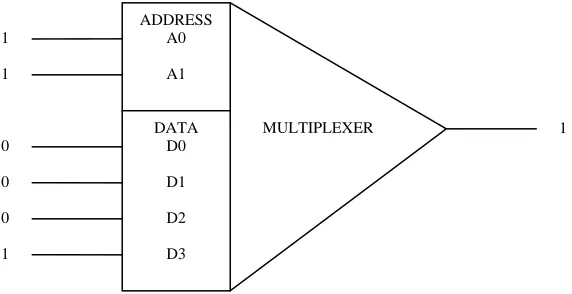
Stewart Wilson applied the classifier system to learning of a Boolean function
[13]. The classifier system learned a six-line multiplexer. The multiplexer function is
depicted schematically in Figure 2.1. Six signal lines come into the multiplexer. The
signals on the first two lines (the address or A-lines) are decoded as an unsigned binary
integer. This address value is then used to indicate which of the four remaining signals
(on the data or D-lines) is to be passed through to the multiplexer output. In Figure 2.1,
the address signal 11 decodes to 3, and the signal on data line 3 (signal = 1) is passed
through to the output (output = 1). Initially, the multiplexer function is not known by the
classifier system. Every time the input comes to the address line, the system tries to
output the correct output. When the output is correct, the system receives an appropriate
reward. As the system iterates, the classifier system learned the multiplexer and decoded
Figure 2.1: A Six-bit Multiplexer Function2
These two were some of the most successful applications of classifier system [11].
GBML such as classifier systems are applied to various fields, such as medicine, business,
or computer science. Classifier systems are used in arbitrary environment as seen in the
Goldberg’s application of classifier system to natural gas control. Such a dynamically
changing environment involves a certain level of complexity. Classifier system interacts
with such an environment with a large number of requirements, and learns to increase its
performance by processing many representation of knowledge with its mechanisms. Such
classifier system is often applied to fields where a lot of complex tasks are involved. ADDRESS
A0
A1
DATA D0
D1
D2
MULTIPLEXER
D3 1
1
0
0
0
1
1
2
Chapter 3: An Intensive Study on Classifier System
My thesis project was on applying the classifier system to database design. The
focus on my project was on the learning process of the classifier system. A precursor of
my project was an intensive study on the classifier system. In this chapter, the details of
classifier system are presented.
Classifier system, or learning classifier system, is the most common architecture
of genetics-based machine learning systems (GBML). Classifier system and learning
classifier system are often used interchangeably. Throughout this thesis, classifier system
is used for the term of the architecture. Classifier system learns syntactically simple string
rules called classifiers to guide its performance in an arbitrary environment [11].
Classifier system has three components: the rule and message system, the apportionment
of credit system, and the genetic algorithms.
3.1 Genetics-Based Machine Learning
The theoretical foundation of GBML was established by John Holland [14].
Holland studied natural adaptive system and its environment. He investigated whether it
is possible to formulate some key hypotheses and problems from relevant parts of
biology. He outlined how artificial systems can generate procedures enabling them to
adjust efficiently to their environments rigorously as natural biological systems. GBML
borrows the idea of genetics, the genetic properties of features of an organism. Such
GBML uses the genetic search called genetic algorithms, as their primary discovery
3.2 Genetic Algorithms
Genetic algorithms are search algorithms based on the mechanics of natural
selection and natural genetics [11]. They combine survival of the fittest among string
structures with a structured yet randomized information exchange to form a search
algorithm with some of the innovative flair of human search. Genetic algorithms have
two goals. One is to abstract and rigorously explain the adaptive processes of natural
systems. The other is to design artificial intelligence software that retains the important
mechanics of natural systems. If higher levels of adaptation can be achieved, existing
systems can perform their functions longer and better. Features for repair,
self-guidance, and reproduction are the rule in biological systems. The secrets of adaptation
on natural systems can be studied from natural biological systems. Genetic algorithms
have a power to adaptively interact with an environment. Genetic algorithms also have
robustness.
3.2.1 Robustness of Genetic Algorithms
Genetic algorithms came out with a central theme, robustness. The search is
robust if the balance between efficiency and efficacy necessary for survival in many
different environments [11]. Traditionally, there were three main types of search
methods: calculus-based, enumerative, and random. Genetic algorithms are more robust
search method, compared to the three traditional search methods.
Calculus-based methods are subdivided into two classes: indirect and direct. The
indirect methods seek local extrema by solving the usually nonlinear set of equations
resulting from setting the gradient of the objective function equal to zero. On the other
direction related to the local gradient. For example, the objective may be to find the peak
of a mountain as depicted in Figure 3.1. Indirect methods start finding the peak by setting
the initial points with slope of zero in all directions. Direct methods climb the function in
the steepest direction. Both of them successfully find the peak of the mountain. However,
when the mountain has multiple peaks as depicted in Figure 3.2, these methods do not
always find the highest peak, since their search relies on the local best in a neighborhood
of the current point. The calculus-based methods rely on the derivatives of local and it is
hard to find the maximum value always, and thus they are not robust.
f (x)
x
Initial point
The peak
Figure 3.2: A Mountain with Multiple Peaks f (x)
x
Initial point Lowest Peak
Highest Peak
Enumerative search method is straightforward. Given a finite search space, it
enumerates all the function values at every point, one at a time. The simplicity is very
attractive and the approach is very human-like. When the number of possible solutions is
small, then this method can be used. However, many practical spaces are too large to
search one at a time. In terms of efficiency, the method is not meeting the robustness.
Random search started attracting researchers as the shortcomings of
calculus-based and enumerative methods were recognized. In random search, the possible
solutions are randomly picked. The search ends when the function value reaches the
specified value by a user. Unfortunately, random search method is expected to do no
better than enumerative method, and thus lacking in efficiency [11].
These three traditional search methods are not robust search methods. The real
world problem spaces are discontinuous, noisy, and vast multimodal. There are many of
such functions as depicted in Figure 3.3. With calculus-based search, the result may not
efficient. Genetic algorithms differ from these methods in the following search
procedures:
1. The algorithms work with a coding of the parameter set, not the parameter
themselves.
2. The algorithms search from a population of points, not a single point.
3. The algorithms use payoff of objective function information, not derivatives or
other auxiliary knowledge.
4. The algorithms use probabilistic transition rules, not deterministic rules.
Genetic algorithms are theoretically and empirically proven to provide robust search in
complex spaces [11]. The organization of the algorithms borrows the idea of natural
selection described by Charles Darwin, and the operators of the algorithms have a close
link to the theory.
f (x)
x
f (x)
x
Figure 3.3: Noisy and Discontinuous Functions
3.2.2 Natural Selection
Darwin wondered about the origin of species and the evolution of organic living
same genus. He thought that all these results follow inevitably from the struggle for life.
Darwin introduced the term, natural selection [15], in 1859 and theorized about the
evolution. Natural selection is a principle that states as follows: “Owing to this struggle
for life, any variation, however slight and from whatever cause proceeding, if it be in any
degree profitable to an individual of any species, in its infinitely complex relations to
other organic beings and to external nature, will tend to the preservation of that individual,
and will generally be inherited by its offspring. The offspring, also, will thus have a better
chance of surviving, for, of the many individuals of any species which are periodically
born, but a small number can survive.” Living things reproduce. Organic living things are
subject to a strict natural environment. Living things that have adapted to the
environment have a higher chance to survive. Living things mutate themselves to survive
the environment, and the mutation is inherited by the reproduced successors. Genetic
algorithms have operators which are artificial versions of natural selection: reproduction,
crossover, and mutation.
3.2.3 Reproduction
Reproduction in genetic algorithms is a process in which individual strings are
copied according to their objective function values, f. Biologists call this function the
fitness function. The value indicates how much the individual is fitting to the
environment for survival. We can think the function f as the profitability or goodness that
we want to maximize. As stated in Section 3.1, genetic algorithms work with a coding of
the parameter set and search from a population of points. The parameter set is coded as a
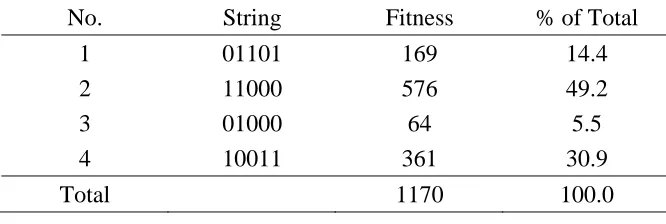
Let’s consider an example population having four strings of five-digit binary
numbers as depicted in Table 3.1. The objective function value is as follows:
2
( )
f x =x , where 0≤ ≤x 3 . 1
For example, in row 4 of the population, the value of f is with the objective
function equation. Other strings also have the fitness values according to the objective
function. In reproduction, genetic algorithms pick some strings to generate offspring for
the next generation according to their fitness function values. Then the reproduction
process replaces the strings having worst fitness values with the newly created strings
from the picked ones. Thus, the members who have higher fitness values tend to survive;
those members are reproduced and inherited by the offspring.
2
19 =361
No. String Fitness % of Total
1 01101 169 14.4
2 11000 576 49.2
3 01000 64 5.5
4 10011 361 30.9
Total 1170 100.0
Table 3.1: Example of Four Strings3
The percentage of the population total fitness is also shown in Table 3.1. In
genetic algorithms, a weighted roulette wheel by the percentage is used. Figure 3.4 shows
such a roulette wheel. The roulette wheel is a tool used to decide who to select to
generate new strings of offspring. To pick the offspring for the next generation, the
roulette wheel is turned. In this weighted wheel, the string No.1 has 14.4 percent of
3
probability to be picked for the next generation. The string No.2 has 49.2 percent of
probability, and thus has the highest probability to be picked for the next generation. In
this way, more highly fit strings have a higher number of offspring in the succeeding
generation. During the reproduction, picked strings are mated at random, and then a
crossover may proceed on each pair.
Figure 3.4: Roulette Wheel for Reproduction4
1
2 4
3
14.4%
49.2% 5.5%
30.9%
3.2.4 Crossover
The crossover operation is done as follows: an integer position k along the string
is selected uniformly at random between one and the string length less one [1, l – 1]. Two
new strings are created by swapping all characters between the positions k + 1 and the
length l inclusively. For example, consider the following mated strings A1 and A2 with a
value 4 for the k:
4
A1 = 0 1 1 0 | 1
A2 = 1 1 0 0 | 0
The character | is a separator and put at the position dividing the string. Here, the
swapping happens at the 5th character for each string. The resulted strings are as follows:
A’1 = 0 1 1 0 0
A’2 = 1 1 0 0 1
In these offspring, the characters before the position 4 are not swapped. The last element
of the string is modified by the swapping. The 0 of the A2 replaced the 1 of A1. The 1 of
A1 replaced the 0 of A2. Crossover happens in this way on each pair of the mated strings.
Each string has notions of what is important to be fitted in the environment. The
pairs picked during the reproduction are believed to have high-quality such notions. For
the binary example, the strings with high-quality notions are the ones who have 1 at the
first element. According to the objective function, to be fitted, the strings have to
maximize the fitness values by having 1s at lower positions, since the exponent increases
as the position goes to the left in the strings of binary representation. Such strings are
considered to be fitted to this example environment. The crossover operation performs
the exchange of high-quality notions between relatively fitted strings. Just as humans
borrow ideas that worked well in the past, crossover operation trades such information
between strings. When we notice a new idea, our performance sometimes gets better.
Crossover is an operation of such an information exchange. The strings with low fitness
values may get a chance to have new notions by exchanging information with other
relatively fitted strings during the crossover operation. Following the reproduction and
3.2.5 Mutation
Mutation is the occasional random alteration of the value of a string position.
Suppose there is the following string A:
A = 0 0 1 0 1
Mutation randomly picks the position. Let’s suppose the first element of the string is
mutated. The alteration is between 0 and 1 in the binary example. Since the A has 0 at the
first element, the value is altered to 1 as follows:
A’ = 1 0 1 0 1
Mutation prevents from losing some potentially useful genetic material, such as
the notion that lower positions with value 1 increases the fitness value. Consider an
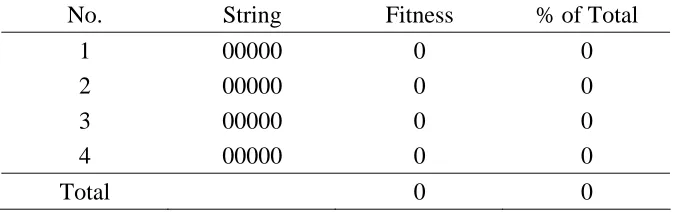
example of Table 3.2. There are four strings again, but each string has 0s for all the
elements, and thus all have the fitness value 0. In this case, reproduction and crossover do
not have any effect. Mutation takes place so that some strings will have new useful notion.
No. String Fitness % of Total
1 00000 0 0
2 00000 0 0
3 00000 0 0
4 00000 0 0
Total 0 0
Table 3.2: Four Strings with 0 Fitness Value
Suppose that No.1 and No.2 are picked and mated during the reproduction and
crossover. They do not affect in any way. Thus, we have two newly generated offspring
no effect. Suppose a mutation happens on the offspring, at the first element of the strings,
then we get the following:
A1’ = 1 0 0 0 0
A2’ = 1 0 0 0 0
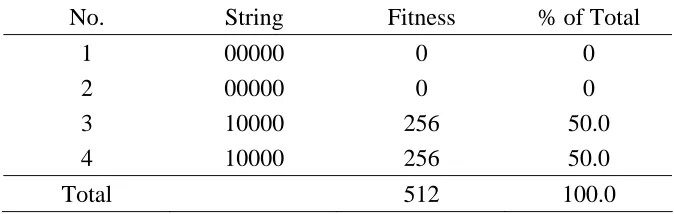
Then, let’s replace these with strings No.3 and No.4. The table change as in Table 3.3
with the new offspring. The mutation operation provides a means to inject a new notion
to the strings. Therefore, the operator is useful when no strings have good notions to
increase the performance in the environment.
These are the operators that genetic algorithms perform. These three operators are
computationally powerful and applied to many search problems. Within the strings that
they process, there are always similarities. Strings that have relatively high fitness values
share their particular similarities; strings that have relatively low fitness values also share
their particular similarities. Genetic algorithms see these similarities in the strings and
those similarities help genetic algorithm to search. The similarity is called similarity
templates or schemata.
No. String Fitness % of Total
1 00000 0 0
2 00000 0 0
3 10000 256 50.0
4 10000 256 50.0
Total 512 100.0
3.2.6 Similarity Templates (Schemata)
Genetic algorithms are advised by the similarity templates, or schemata. A
schema [16] is a similarity template describing a subset of strings with similarities at
certain string positions. Let’s consider strings over the ternary alphabet {0, 1, *}. The
character * is a “don’t care” symbol. A schema matches a particular string if at every
location in a schema a 1 matches a 1 in the string, a 0 matches a 0, or a * matches either.
For example, if there are five strings {10000, 00000, 11100, 00001, 01110}, a schema
*0000 matches two strings {10000, 00000}. *11** will match {11100, 01110}.
Sometimes, genetic algorithms are more interested in these similarity templates, rather
than the strings themselves. This is because these similarities describe the traits of highly
fitted or badly fitted strings. These schemata of short-defining-length are propagated
generation to generation by giving exponentially increasing samples to the observed best.
This is formally stated in what is called schema theorem.
3.2.7 Schema Theorem (Fundamental Theorem of Genetic Algorithms)
Schema theorem states that short, low-order, above-average schemata receive
exponentially increasing trials in subsequent generations [11]. A schema has two
properties: schema order and defining length. The order, denoted by o(H), is the number
of fixed positions. The defining length of a schema H, denoted by δ(H), is the distance
between the first and last specific string position. For example, for a schema 011**1*, the
order is 4 and the defining length is 5. For a schema 0******, the order is 1 and the
defining length is 0. Schemata and their properties are interesting notational devices for
rigorously discussing and classifying string similarities. They provide the means to
In the reproduction, the schema theorem states that, a particular schema grows as
the ratio of the average fitness of the schema to the average fitness of the population.
Suppose that at a time t, there are m examples of a particular schema H contained in the
population A(t). Then m is written as follows:
( , )
m m H t= .
A string Ai gets selected with the following probability pi:
/
i i j
p = f
∑
f .For each representative of H, there will be n p∗ i copies in the population A of size n.
Therefore, at time t +1, there is the following number of examples of a schema H:
1 2
( , 1) ( ... k) /
m H t+ = ⋅n f + f + + f
∑
fj, where 1…k are the representatives of H.The equation can also be written as follows:
1 2
( , ) ( ... ) / ( , )
( , 1) k
j
n m H t f f f m H t m H t
f
⋅ ⋅ + + +
+ =
∑
.Thus:
( , 1) ( , ) ( , ) / j
m H t+ = ⋅n m H t f H t⋅
∑
f , where f H t( , ) is the average fitness ofthe strings representing schema H at time t. The average fitness of the entire population is
written as follows:
/
j f =
∑
f n.Therefore, the m at the time t + 1 can be written as follows:
( ) ( , 1) ( , ) f H
m H t m H t
f
+ = .
This equation states that schemata with fitness values above the population average will
fitness values below the population average will receive a decreasing number of samples.
During the reproduction, we have this equation as a property.
Crossover disrupts schema sometimes when the separating point is in the defining
length of a schema. Thus we have to deal with the probability that a particular schema
survives during the crossover. Crossover survival probability is defined as follows:
( ) 1 1 s H p l δ ≥ − − .
This is because a schema tends to be disrupted whenever a site within the defining length
is selected from the length l – 1 possible position. If crossover is itself performed by
random choice, for example, with probability pc at a particular mating, the survival
probability is in the expression:
( ) 1 1 s c H p p l δ ≥ − ⋅ − .
Therefore, with reproduction and crossover, considering they are independent, the
following equation is given:
( ) ( )
( , 1) ( , ) 1
1
c
f H H
m H t m H t p
l f δ ⎡ ⎤ + ≥ ⎢ − ⋅ ⎥ − ⎣ ⎦.
With reproduction and crossover, schema H grows or decay depending on whether the
schema is above or below the population average and whether the schema has relatively
short or long defining length.
The mutation operator is the random alteration of a single position with a
probability pm, thus a single position survives at the probability 1 – pm. In order for a
schema H to survive, all of the order of schema have to survive. Therefore, the
.
( )
(1− pm)o H
For small values of pm (pm << 1), the schema survival probability is approximated by the
following expression:
1−o H p( ) m.
The three operators of genetic algorithms are quantitatively defined as above. The
concluded equations are given as follows:
( ) ( )
( , 1) ( , ) 1 ( )
1
c m
f H H
m H t m H t p o H p
l f δ ⎡ ⎤ + ≥ ⎢ − ⋅ − ⎥ − ⎣ ⎦.
A particular schema H receives an expected number of copies in the next generation
under reproduction, crossover, and mutation as given in this equation. Also, short,
low-order, above-average schemata receive exponentially increasing trials in subsequent
generations. This conclusion is defined as schema theorem5, or fundamental theorem of
genetic algorithms. The following section shows an example of genetic algorithm
operations for a knapsack problem, where some schemata are processed as concluded in
the schema theorem.
3.2.8 A Simple Genetic Algorithm for a Knapsack Problem
Knapsack problem is one of NP-hard problems [17]. Genetic algorithms are often
applied to this kind of complex problems to search the space. Knapsack problem is
defined as follows:
We are given an instance of the knapsack problem with item set N, consisting of n
items j with profit pj and weight wj, and the capacity value c. Then the objective is
5
to select a subset of N such that the total profit of the selected items is maximized
and the total weight does not exceed c.
The problem is formulated as follows:
maximize 1 n j j j p x =
∑
subject to ,
1 n
j j j
w x c
=
≤
∑
xj∈{0,1},j=1,...,n.
In this section, the genetic algorithms deal with the following particular instance:
There are a water bottle, a pan, a ring, a camcorder, and a laptop. These are single
items, and thus the genetic algorithm can not choose to put more than one item of
the same item in the knapsack. The profit and weight of each item is given in
Table 3.4. The capacity limit is 50. The genetic algorithm has to not only
maximize the total profit, but also choose items carefully so that total weight of
the items does not exceed the capacity limit.
Water Bottle Pan Ring Camcorder Laptop
Weight 5 30 1 10 20
Profit 1 2 40 10 20
Table 3.4: Weight and Profit of the Items for a Knapsack Problem
The genetic algorithm has to deal with 128 combinations, in addition to the capacity limit.
The combinations can be represented in binary. The example is in Figure 3.5. Here, the
The string is 11010 and the total weight and the total profit value are calculated as
follows:
(Total Weight) 11010 1 5 1 30 0 1 1 10 0 20= ∗ + ∗ + ∗ + ∗ + ∗ =45
(Total Profit) 11010 1 1 1 2 0 40 1 10 0 20 13= ∗ + ∗ + ∗ + ∗ + ∗ =
In this solution, the total weight is within the capacity, but the profit could have been
better. The example genetic algorithm works with this binary representation of the
solution space.
Figure 3.5: An Example Binary Representation of the Strings in a Knapsack Problem
Table 3.5 shows the processing of strings and schemata together by the genetic
algorithm for two generations. There are four strings which are randomly generated in the
initial population. They are the first generation of the population. The total weight and
profit for each string are calculated by the functions in the table. The total weight of the
string No.1 is exceeding the capacity limit of 50. Such strings are given a value 0 for the
profit.
1 1 0 1 0
Water Bottle
String Processing String No. Initial Population (Randomly Generated) Total weight w 1 n j j j w x =
∑
Total Profit f 1 n j j j p x =∑
Probability that ith String isSelected i f f
∑
Expected count (from Roulette Wheel) i f f Actual count (from Roulette Wheel)1 0 1 1 0 1 51 0 0 0 0
2 1 1 0 0 0 35 3 0.03 0.14 1
3 0 0 1 1 0 11 50 0.60 2.38 2
4 1 0 0 1 1 35 31 0.37 1.48 1
Sum 84 1.00 4.00 4.0
Average 21 0.25 1.00 1.0
Max 50 0.60 2.38 2.0
Schema Processing
Before Reproduction
String Representatives Schema Average Fitness ( )
f H
H1 1 1 0 * 0 2 3
H2 * 0 1 * * 3 50
Table 3.5: String and Schema Processing by Genetic Algorithms for a Knapsack Problem
String Processing Mating Pool After
Reproduction Mate (Randomly Selected) Crossover Site (Randomly Selected)
New Population Total Profit f (Cross Site At the
Symbol “|”) 1 n j j j p x =
∑
0 0 1 | 1 0 2 3 0 0 1 0 0 40
1 1 0 | 0 0 1 3 1 1 0 1 0 13
0 0 1 1 | 0 4 4 0 0 1 1 1 70
1 0 | 0 1 1 3 2 1 0 1 1 0 51
Sum 174
Average 43.5
Max 70
Schema Processing
After Reproduction After All Operators Expected Actual Count String
Representatives
Expected Count of Strings of a
particular Schema Actual Count String Represen-tatives Count of Strings of
a
particular Schema
0.14 1 2 0.09 1 2
2.38 2 1,3 2.98 3 1,3,4
The result of the roulette wheel matters in the reproduction. Out of four turns, the
string No.3 is picked twice and chosen to be the offspring. The offspring replaces the
worst string No.1, and resulting strings are as in the column of the mating pool. Those are
the result of reproduction. The crossover takes place on these. The mate and separating
point are determined by random choice. The result of the crossover produces the new
population. As seen in the table, the sum of the profit is increased.
What would be the bad or high-quality notion? The bad strings would be the ones
that have pan, since the pan is relatively heavy and not profitable. Clearly, the ring gives
high profit. Therefore, the strings having 1 at the third position would be good ones.
Example schemata having such notions are given as H1 and H2 in the table. H1 is a
schema having the bad notion, and the H2is the schema having the good notion. The H2
particularly increases according to the schema theorem. In the initial population, No.3 is
the string representing the schema. Therefore the value off H( 2)is 50. According to the
schema theorem, we can expect to have m f H⋅ ( ) / f copies of the schema during the
reproduction. Therefore, the m for H2 at time t +1 can be calculated as follows:
2
( , 1) 1 50 / 21 2.38
m H t+ = ⋅ = .
In Table 3.5, two strings No.1 and No.3 of the schema in the population after
reproduction can be seen. The average of the fitness values of the strings in the mating
pool is 33.5. Therefore, we can calculate the m as follows:
.
2
( , 1) 2 50 / 33.5 2.98
m H t+ = ⋅ =
After the crossover operation, the number of strings representing the H2 is 3 (No.1, No.3,
and No.4). Whereas the H2 increases its number of strings, H1 does not. The expected
This section showed the example of genetic algorithms with a particular instance
of knapsack problem. The genetic algorithms usually work with a large number of strings
representing the solution space. Some strings representing high-quality notions are
expected to increase. By repeating the generation of offspring, the genetic algorithms
give the solutions in the form of strings, which get better and better increasing the fitness
values of each. Genetic algorithms are computationally powerful and provide means to
search. Such genetic algorithms are used as a component in classifier system, where the
strings are called classifiers.
3.3 Components of Classifier System
A Classifier system is a machine learning system that learns syntactically simple
string rules, called classifiers [11]. The classifiers guide the performance of classifier
system in an arbitrary environment. A classifier system consists of three main
components:
1. Rule and message system
2. Apportionment of credit system
3. Genetic algorithm
A classifier system is depicted in Figure 3.6. The information of environment comes to
the system through detectors. The information is decoded as message by the detectors.
Classifiers react to the environmental message. Classifiers are the thought of the system
about the environment. Based on the classifiers, the system takes actions to environment
through the effectors. When the action of the system is good, the environment gives
to understand what is good or bad by receiving such a reward. This method is called
reinforcement learning [18]. Through these components, classifiers, and reinforcement,
the system learns the environment. The objective for the system is to learn the
environment and improve the actions. The information flows from the detectors to
effectors. The rule and message system helps the flow in the classifier system.
Environment 10#: 111 00#: 000 101 000 111 Detectors Action Information Reward
Apportionment of Credit System & Genetic Algorithm Learning Classifier System
0 1 1 Message Effectors 1 1 1 Classifiers
Figure 3.6: A Learning Classifier System Interacting with its Environment6
3.3.1 Rule and Message System
The rule and message system of a classifier system is a special kind of production
system [19]. The production system has the following form:
if <condition> then <action>. 6
When t tion is fired in a typical production system. The
he l indicates the length. For example, a message of a length 3 would be a 110. The
f
ssifiers
e syntactically simple string rules. The classifier has the following
ntax:
essage>.
e where a wild card character (#) is
hen t an environmental message, the classifier reacts. For
he condition is satisfied, the ac
rule and message system employs this form, which is powerful and convenient. The
message and classifiers are structurally friendly with this form. If limited to a binary
alphabet, the message has the following syntax:
<message> ::= {0, 1}l.
T
message is used as the environmental message causing the system to react, and a part o
classifiers.
3.3.2 Cla
Classifiers ar
sy
<classifier> ::= <condition> : <m
The condition is a simple pattern recognition devic
added to the underlying alphabet:
<condition> ::= {0, 1, #}l.
W he condition is matched by
example, the four-position condition #01# matches an environmental message 0010, but
it does not match an environmental message 0000. When the classifier’s condition is
matched, the classifier becomes a candidate to send its message for the next step. When
multiple conditions are matched to the environmental message, one classifier is picked
from them. The choice is done by the apportionment of credit system, called bucket
3.3.3 Apportionment of Credit System: Bucket Brigade
Classifiers are ranked by its strength. The strength is determined by the reward
point that classifiers acquired from the environment. When multiple classifiers are the
candidates to post the message for the next step, the rank by their strength has an effect to
the pick. The bucket brigade has two components: an auction and a clearinghouse. When
the multiple classifiers are matching, then auction takes place for them. A fish market
may be a good analogy for the auction. Buyers from restaurants are the classifiers while
the fish is the environmental message. The strength may be the money that the buyers
have. The buyers may be interested in particular fish. The salespeople or fishermen sell
the fish one by one during auctions. They name a fish, and some of the buyers react to it.
Some buyers may raise their hand and tell the seller the bidding price. Thus, they have to
compete. At the end, the highest bidder wins and the fish is taken by the winner.
Classifiers also compete with other classifiers who matched to the environmental
message. The clearinghouse manages the payment keeping a record of those who bid and
those who must pay.
3.3.4 Genetic Algorithms in the Classifier System
Genetic algorithms take a role to inject new, possibly better classifiers into the
classifier system. Every time an environmental message comes to the system, there is
single winner classifier from the population and it takes an action to the environment.
Winner classifiers receive reward value from an environment when their actions are
correct. The classifier system learns if the performance increases as it experiences the
environment. Genetic algorithms replace some of the classifiers to increase the
algorithms reproduce stronger classifiers, and exchange information between classifiers,
Chapter 4: Implementation of a Classifier System in Java
I implemented a classifier system in Java programming language. The system
consists of about 30 Java classes. NetBeans is chosen as the IDE, since it provides a good
control for GUI components in the development processes. Some class diagrams
presented in this chapter are generated by NetBeans. In this chapter, some design and
implementation features of the classifier system are presented: requirements, input and
output, data structures, class diagrams, knowledge given to the system and reward
functions, and some source codes with actual operations over the classifiers. How
database schemas can be represented as classifiers, and how those classifiers are
processed in the framework of classifier system are shown.
4.1 Requirements
The first requirement is to implement the classifier system, which can represent
database schemas as its classifiers, and process those in the architecture. The classifier
system has powerful mechanisms to process classifier strings with robust genetic
algorithms as the search method. Classifiers of database schemas react to environmental
messages. Then, the matching schemas compete in an auction. The winner schema is
evaluated and receives a reward value by the reinforcement mechanism. Enabling the
processes of the classifiers in those mechanisms is the first requirement that the system
should be able to do.
Following the implementation, the learning is the main requirement for the
some may be bad. The classifier system is given some basic knowledge about database
design so that it will think what is good and what is bad. For the learning, the task T is to
pick the better one among many candidates. The performance P is determined by whether
the choice gets better as it experiences the environment E, which is doing database design
by itself. When the system stops, the system prints the strongest classifiers of each
database schema for the entity set. Every time the system experiences the database design,
it ranks the classifiers by the strength. The classifier system increases the strength of
good classifiers and decreases the strength of bad classifiers according to the knowledge.
4.2 Input and Output
Figure 4.1 shows an example input. The classifier system takes a conceptual
schema, which is a set of entity sets with the primary-key and possible non-primary key
attributes. The classifier system will randomly generate hundreds or thousands of
combinations of the attributes for each entity set. Those are represented as classifiers and
are the candidates for the final schemas. In addition, the system takes mapping
cardinalities between the entity sets. This mapping cardinality shows relationship sets and
the cardinality, such as one-to-one or many-to-many. The relationship sets are limited to
Figure 4.1: The Input to the Classifier System
Figure 4.2 shows the system tab with a pane showing the current input, a result
pane, and a plot pane to analyze the learning. The result pane is to print the strongest
classifiers for each entity set when the system completes. The strongest classifiers are the
database schemas chosen as the best by the system when it stops. The plot is to count the
number of classifiers with certain strength values at a certain iteration time point. With
the plots, the increase and decrease of the strength can be seen. These are the output of
Figure 4.2: System Tab with the Output
4.3 Data Structures
In this section, some important data structures such as classifiers, environmental
message, and population are introduced with the syntaxes. Classifiers are the main data
structure, which are involved in almost all the operations in the classifier system.
Environmental message triggers the operations of classifier system. Population maintains
4.3.1 Classifier
Classifiers represent database schemas. The classifier system randomly generates
a large number of such classifiers for every entity set, and all of those are the candidates
and have a chance to be printed at the result pane when the system stops. The classifier is
named as ClassType in the program as in Figure 4.3. Each classifier is programmatically
structured this way. The classifier has its condition and message part (action) as in the
syntax of classifier. The strength is the value indicating how well the classifier is doing in
the environment. The bid is the value that classifiers bids during the auction. The value of
matchflag indicates if the instance of the classifier is matching to the environmental
message.
Figure 4.3: The Declarations of ClassType
4.3.2 Environmental Message
Environmental message is the same as the condition part of the classifier. Thus
the environmental message has the following syntax:
<environmental message> ::= <condition>.
The environment gives the value of the condition of a classifier, and some classifiers with
condition react to the environmental message and compete. Population is another data
structure maintaining classifiers and the record for who is matching or not matching.
4.3.3 Population
Population is represented as a PopType class in the program as in Figure 4.4. The
class maintains all the classifiers in a class named ClassArray. The nclassifier is the size
of classifiers. The variables from pgeneral to ebid2 are used in the process of the auction
and genetic algorithms. The initialstrength is the strength values given to all the
classifiers when they are initially generated. The rest of the variables are to maintain the
statistical information, such as the max strength value among classifiers.