Original Research Article
Effect of Simvastatin on Spatial Memory of Rats Receiving a High-Fat Diet
Asra Margedari1, Soheila Ebrahimi2, *Hamid Sepehri3
1
Department of Biology, Faculty of Science, Payame Noor University, Iran.2 Department of Biology, Faculty of Science, Payame Noor University, Iran,3 Neuroscience Research Center, Golestan University of Medical Sciences,
Gorgan, Iran ABSTRACT
Introduction: Several studies have demonstrated the role of high cholesterol in different diseases. A diet high in cholesterol or saturated fats can impair the cognitive function. The aim of this study was to investigate the impact of simvastatin on spatial memory of rats receiving a high-fat diet. Materials and Methods: In this study, 35 adult male Wistar rats were divided into five groups (N=7). The subjects were trained for five days four times a day in Morris water maze to find a hidden platform. Time elapsed and distance travelled for finding the hidden platform were considered as criteria for learning. Probe trial was used for evaluation of memory retrieval. Results: Consumption of high fat diet for four weeks reduced learning ability in the high-fat group, which spent longer time and travelled a longer distance compared to the control group. However, oral administration of simvastatin at doses of 5 and 10 mg improved memory function. Memory function in rats treated with the drug had a significant difference with that of in the high-fat group. However, no significant difference was found between the groups treated with different doses of simvastatin. Conclusions: simvastatin improves spatial memory performance in adult male rats receiving high-fat diet.
KEYWORDS: Spatial memory, Simvastatin, Morris water maze, High-fat diet
*Correspondence: Hamid Sepehri, Neuroscience Research Center, Golestan University of Medical Sciences, Gorgan, Iran, Telephone: +981732420515, Email: [email protected]
INTRODUCTION
According to the World Health Organization (WHO), obesity is an increasing global epidemic public health problem. However, this problem has been neglected in many countries [1]. High-fat diet and high blood cholesterol have been identified as risk factors of blood pressure. Clinical trials have suggested that lowering blood cholesterol levels could reduce the incidence of coronary heart disease [2]. Several diseases are associated with high-fat diet, such as metabolic disorders including liver dysfunction, hyperinsulinemia and hyperuricemia [3]. Obesity is associated with a model of chronic inflammation that leads to abnormal cytokine production and
activation of inflammatory signaling pathways. These inflammatory markers are associated with obesity, insulin resistance and risk of cardiovascular disease. Cytokines such as IL-6 and IL-β1 can disrupt neurophysiological mechanisms in cognition and memory [4].
High-fat diet and obesity can lead to adverse neurological changes and impaired memory function. For example, overweight older adults are at a greater risk for Alzheimer's disease and brain atrophy [5]. Winocur and Greenwood found that vitamins or minerals deficiency in older people with a high-fat diet could worsen age-related cognitive decline [6]. A high-fat diet also reduces brain-derived neurotrophic factor levels in the hippocampus (a modulator of synaptic plasticity), and reduces learning ability [7]. An extensive review showed that high-fat diet in laboratory animals reduces brain
function and causes behavioral changes. In these animals, the high-fat diet impaired the hippocampal function (memory, sensitivity and efficiency). Morphological changes in the hippocampus of animal models include reduction in neural progenitor cell proliferation, synaptic plasticity, integrity of the brain-blood barrier and the integrity of dendrites [8]. Cholesterol significantly reduces the number of cholinergic neurons and level of acetylcholine in the basal ganglia and in the cortex, respectively. Findings indicate that high cholesterol causes cerebrovascular dysfunction, which may play an important role in the pathology of Alzheimer’s disease. Cholesterol is unable to pass through the brain-blood barrier. In addition, high blood cholesterol can cause cholinergic dysfunction in the basal forebrain system that may contribute to spatial memory impairment [9]. Moreover, prospective studies indicate that high intake of saturated and trans-unsaturated fatty acids is a risk factor for Alzheimer's disease. Results of studies on humans and rodents showed that chronic high-fat diet increases the risk of cognitive decline and dementia [10].
Statins play important roles in reducing the risk of mortality from cardiovascular disease in millions of people around the world [11]. Simvastatin is an anti-hyperlipidemic lipophilic statin, used for treatment of
hypercholesterolemia and
hypertriglyceridemia (partially) [11]. Statins inhibit HMG-CoA reductase in liver and regulate low-density lipoprotein (LDL) receptor in hepatocytes, resulting in increased clearance of circulating LDL and reduced level of plasma LDL-cholesterol [12]. Evidence suggests that statins have beneficial effects, independent of their classic actions on lipoproteins such as reduction of inflammation in blood vessels, kidneys, and bone. The potential beneficial effects of these factors also include
increased production of nitric oxide in blood vessels and kidney [13]. Simvastatin increases the expression of protein kinase B (AKT) and endothelial nitric oxide synthase in the brain. Recent studies suggested statins as cholesterol-lowering drugs that may be a potential treatment option for Alzheimer's disease (14). Recent studies have shown that simvastatin therapy induces significant protective effects following spinal damage and intracerebral hemorrhage [8]. Traumatic brain injury (TBI) is a major public health problem worldwide. TBI treatment with statins improves spatial learning in non-neurogenic CA3 region of the hippocampus in post-TBI days. TBI treatment with statins increases neurogenesis and angiogenesis, and reduces the post-TBI neuron-loss. It also induces better therapeutic effect compared to treatment with same dose of atorvastatin [15].
Data show that the neurorestorative effect of simvastatin may be mediated through activation of AKT signaling pathway, upregulating the expression of growth factors, and induction of neurogenesis in the dentate gyrus of the hippocampus. As a result, simvastatin helps to restore the cognitive function in rats [16]. Statins may reduce inflammatory cytokine response following cerebral ischemia. They also have antioxidant properties that are likely to improve oxidative stress in brain ischemia. In addition to reduction of risk of stroke, statins are classified as drugs with neuroprotective properties that may also reduce ischemic effects of stroke in the parenchyma and cerebral arteries [17]. Simvastatin reduces cholesterol synthesis in brain of guinea pigs. Study of Kersh et al. showed that simvastatin reduces cholesterol levels in the synaptosomal plasma membrane by affecting the cholesterol homeostasis in the brain [12]. This study evaluated the effects of simvastatin on spatial memory of middle-aged rats with
high-fat diet in the Morris water maze (MWM).
MATERIALS AND METHODS Animals
In this study, 35 male Wistar rats aged 16 weeks and weighing 250-300 grams were randomly assigned into the following treatment and control groups:
1. Control group 2. High-fat group
3. Control group + 5mg of simvastatin 4. High-fat group + 10mg of simvastatin 5. High-fat group + 5mg of simvastatin The subjects were treated with a high-fat diet for four weeks. In addition to the high-fat diet, the subjects in the treatment groups were gavaged with different doses of simvastatin for four weeks.
Morris water maze (MWM) test
In this study, MWM was used for evaluate spatial learning. MWM is a circular tank with black walls (140cm diameter and 60cm depth) filled with water up to 30 cm [8]. The maze was supposedly divided into four quarters of North, South, East and West. Rescue platform was on one of these quarters, positioned on the bottom of the tank with a metal stand, 1.5 cm below the surface of water (out of rat’s sight). Some signs were placed outside the maze constantly during the experiment, so that the animal could memorize the position of the platform. The tank water temperature was set at 20-22 °C. Movement and behavior of
animals were recorded and controlled by a camera (152 cm above the water level). Data related to the experiment (latency, swimming path length) were extracted and then analyzed using maze router software. The maze was based on the assumption that animals have appropriate strategy to search their surrounding environment and escape from danger (in this case water), and achieve the desired result using environmental keys with minimum effort.
Statistics analysis
Mean results of all experiments were calculated on the maze router software. Data were analyzed using ANOVA and P-values less than 0.05 were considered as statistically significant.
RESULTS
Simvastatin enhance the learning ability of high fat diet rats
Analysis of the data obtained from the elapsed time for finding the hidden platform in the MWM showed that consumption of high-fat diet for two months decreased learning ability in the high-fat group. The subjects in the high-fat group spent more time to find the hidden platform on all experimental days (P≤0.05). Administration of 5 and 10 mg simvastatin significantly improved memory compared to the high-fat group. However, no significant difference was observed between groups treated with different doses of simvastatin (Figure 1).
Figure 1: Elapsed time required for finding the hidden platform in all experimental groups (data are shown as mean ± standard deviation).
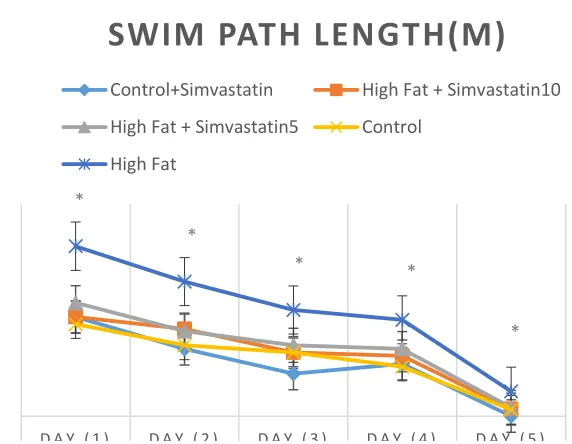
Results of the distance travelled on the hidden platform indicate that the high-fat diet group travelled farther than the other groups, while the groups treated with simvastatin travelled a shorter distance. The results of these groups differed significantly from those of high-fat group on all
experimental days (P<0.05). The group receiving 10 mg simvastatin had better performance, but no significant difference was observed between the groups receiving 5 and 10 mg simvastatin (Figure 2).
* *
* *
*
-5 0 5 10 15 20 25 30
D A Y ( 5 ) D A Y ( 4 )
D A Y ( 3 ) D A Y ( 2 )
D A Y ( 1 )
SWIM PATH LENGTH(M)
Control+Simvastatin High Fat + Simvastatin10
High Fat + Simvastatin5 Control
High Fat
Figure 2: Distance traveled for finding the hidden platform in all experimental groups on different days (data are shown as mean ± standard deviation).
Simvostatin improves the spatial memory in the rats with high-fat diet
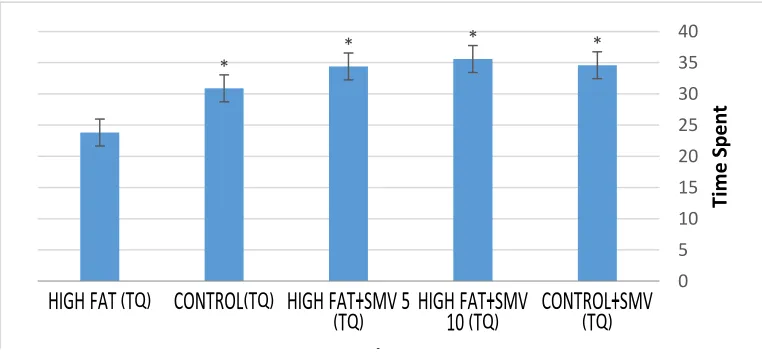
After the learning steps in the MWM, memory retrieval was evaluated by removing the hidden platform from the maze. At this stage, the time spent in the location of the platform was evaluated. Results showed that the group with high-fat diet spent less time in the targeted zone, which differed significantly from the control
group. However, the groups treated with simvastatin spent more time in the targeted zone, which also had a significant difference with the results of groups with the high-fat diet. This indicates the positive impact of simvastatin on spatial memory of rats (Figure 3).
* *
* *
0 5 10 15 20 25 30 35 40
Ti
me
Sp
en
t
Target Quaderant
Figure 3: Time spent in the target zone on the probe trial days for different groups (data are shown as mean ± standard deviation, SMV=simvastatin).
DISCUSSION
In this study, rats were trained for five days and behavior testing was carried out on day six. The results showed a significant correlation between the high-fat diet and the learning ability of rats in the MWM. Consumption of the high-fat diet for two months led to poor spatial memory performance in rats. Several studies have been performed on the relationship of learning with high-fat diet. Klein et al. showed that a cholesterol-rich diet reduces spatial learning and the ability to store long-term memory in radial maze, while increasing inflammatory responses and levels of beta-amyloid, tau (Thr181) phosphate and microbleedings in the cortex [9]. Experimental studies have supported the
relationship between cholesterol
consumption and amyloid synthesis. Administration of statin to patients also reduces the risk of developing dementia [18].
Ramirez et al. reported the positive effect of simvastatin on memory by reducing the damaging effects of AMPA including the severity of seizures, excitotoxicity, oxidative damage, neuritic dystrophy and apoptosis in the hippocampus and other structures of the limbic on the cortex. Only simvastatin could improve both episodic memory and working memory. Previous studies show that simvastatin and lovastatin (especially simvastatin) might have desirable therapeutic potential for treatment of
neurological diseases such as excitotoxicity, memory impairment and Alzheimer’s disease [19]. Collins et al. showed that treatment with statin rapidly reduces vascular incidents and ischemic stroke without affecting cerebral hemorrhage, even among people who do not have high cholesterol levels [20]. Lim et al. reported that intraperitoneal injection of simvastatin to TBI mice could reduce neuronal apoptosis, microglia, and expression of TNF-α, consequently reducing depression-like behavior in mice. Their results suggest that simvastatin may be a promising treatment for depression-like behavior caused by TBI [21].
Mehmet Alkanat et al. reported that subjects treated with10 mg simvastatin for four weeks had poorer spatial memory performance compared to those treated with 30 mg of simvastatin. Their results also indicated that simvastatin had no significant impact on the daily activities. Results of the spatial memory test in the mentioned study show that long-term administration of simvastatin impairs spatial memory only at dose of 10 mg/kg/day. These impairing effects may be related to intracellular cholesterol status in neurons and glia cells. However, these effects were not observed with doses above 30 mg [22]. Our results also show that subjects who have received higher doses of simvastatin had better spatial memory. The group on normal diet receiving simvastatin showed better spatial memory performance compared to the control group. This indicates that simvastatin could improve spatial memory performance in these rats regardless of their diet. However, spatial memory of the high-fat group was more impaired compared to other groups.
Administration of 30 mg simvastatin may increase the level of acetylcholine or dopamine in the frontal cortex, which could lead to improved spatial memory. It is well
known that dopamine and acetylcholine play important roles in neurocognitive functions, especially memory. Studies show that simvastatin suppresses the activity of acetylcholinesterase frontal cortex in rats. Statins and simvastatin-related memory loss has been reported as a side effect of discontinuing the drug in humans. However, there are no report on the effects of simvastatin on memory and its ability to cross the blood-brain barrier in a wide range of doses in mice [22].
CONCLUSION
It can be concluded that the four-week high-fat diet reduces the learning ability and the spatial memory in rat. However, these effects are reversible by oral administration of simvastatin. Enhanced spatial memory of the simvastatin treated rats suggests its positive effect on the cognitive function.
ACKNOWLEDGMENTS
This article has been derived from a MSc thesis financially supported by the Golestan University of Medical Sciences.
REFERENCES
1. Batch JA, Baur LA. Management and prevention of obesity and its complications in children and adolescents. Medical Journal Australia. 2005 [cited 2017 Jan 28];182(3). Available from:
https://www.mja.com.au/journal/2005/182/3 /3-management-and-prevention-obesity-and-its-complications-children-and
2. Yekeen LA, Sanusi RA, Ketiku AO. Prevalence of Obesity and high level of cholesterol in hypertension: Analysis of Data from the University College Hospital, Ibadan. African Journal of Biomedical Research. 2003; 6:129 – 132.
3. Asayama K, Ozeki T, Sugihara S, Ito K, Okada T, Tamai H, et al. Criteria for medical intervention in obese children: A new definition of “Obesity disease” in
Japanese children.official journal of the japan Pediatnic society. 2003 Oct 1;45(5):642–6.
4. PistellPJ, Morrison CD, Gupta S, Knight AG, Keller JN, Ingram DK, et al. Cognitive impairment following high fat diet consumption is associated with brain inflammation. Journal of Neuroimmunol. 2010;219(1–2):25–32.
5. Gustafson D, Rothenberg E, Blennow K, Steen B, Skoog I. An 18-Year Follow-up of Overweight and Risk of Alzheimer Disease. Archives of Internal Medicine. 2003; 163(13):1524–8.
6. Freeman LR, Haley-Zitlin V, Rosenberger DS, Granholm A-C. Damaging effects of a high-fat diet to the brain and cognition: a review of proposed mechanisms. Nutritional Neuroscience. 2014;17(6):241–51.
7. Molteni R, Wu A, Vaynman S, Ying Z, Barnard RJ, Gómez-Pinilla F. Exercise reverses the harmful effects of consumption of a high-fat diet on synaptic and behavioral plasticity associated to the action of brain-derived neurotrophic factor. Neuroscience. 2004;123(2):429–40.
8. Can ÖD, Ulupinar E, Özkay ÜD, Yegin B, ÖztürkY. The effect of simvastatin treatment on behavioral parameters, cognitive performance, and hippocampal morphology in rats fed a standard or a high-fat diet. Behavioural Pharmacology. 2012; 23(5-6):582–592.
9. Ullrich C, Pirchl M, Humpel C. Hypercholesterolemia in rats impairs the cholinergic system and leads to memory deficits. Molecular and Cellular Neuroscience. 2010;45(4):408–17.
10. Greenwood CE, Winocur G. High-fat diets, insulin resistance and declining cognitive function. Neurobiol Aging. 2005;26( 1):42–5.
11. Maggo S, Clark D, Ashton JC. The effect of statins on performance in the Morris water maze in guinea pig. European Journal of Pharmacology. 2012;674(2–
3):287–93.
12. Baytan SH, Alkanat M, Okuyan M, Ekinci M, Gedikli E, Ozeren M, et al. Simvastatin impairs spatial memory in rats at a specific dose level. The Tohoku journal of experimental medicine. 2008;214(4):341-9.
13. McFarlane SI, Muniyappa R, Francisco R, Sowers JR. Pleiotropic effects of statins: lipid reduction and beyond. The Journal of Clinical Endocrinology & Metabolism. 2002;87(4):1451-8.
14. Li L, Cao D, Kim H, Lester R, Fukuchi K-I. Simvastatin enhances learning and memory independent of amyloid load in
mice. Annals of Neurology.
2006;60(6):729–39.
15. Lu D, Qu C, Goussev A, Jiang H, Lu C, Schallert T, et al. Statins increase neurogenesis in the dentate gyrus, reduce delayed neuronal death in the hippocampal CA3 region, and improve spatial learning in rat after traumatic brain injury. Journal of Neurotrauma. 2007;24(7):1132–46.
16. Wu H, Lu D, Jiang H, Xiong Y, Qu C, Li B, et al. Simvastatin-mediated
upregulation of VEGF and BDNF,
activation of the PI3K/Akt pathway, and increase of neurogenesis are associated with therapeutic improvement after traumatic brain injury. Journal of Neurotrauma. 2008 Feb;25(2):130–9.
17.Vaughan CJ, Delanty N. Neuroprotective Properties of Statins in Cerebral Ischemia and Stroke. Stroke. 1999 ;30(9):1969–73. 18. WagstaffLR, Mitton MW, Arvik BM, Doraiswamy PM. Statin-associated memory loss: analysis of 60 case reports and review of the literature. Pharmacotherapy. 2003 ;23(7):871–80.
19. Ramirez C, Tercero I, Pineda A, Burgos JS. Simvastatin is the statin that most efficiently protects against kainate-induced excitotoxicity and memory impairment. Journal of Alzheimer's disease: JAD. 2011;24(1):161–74.
20. Collins R, Armitage J, Parish S, Sleight P, Peto R, Heart Protection Study Collaborative Group. Effects of cholesterol-lowering with simvastatin on stroke and other major vascular events in 20536 people with cerebrovascular disease or other high
risk conditions. Lancet. 2004
6;363(9411):757–67.
21. Lim S-W, Shiue Y-L, Liao J-C, Wee H-Y, Wang C-C, Chio C-C, et al. Simvastatin Therapy in the Acute Stage of Traumatic Brain Injury Attenuates Brain Trauma-Induced Depression-Like Behavior in Rats by Reducing Neuroinflammation in the Hippocampus. Neurocritical Care. 2017 ;26(1):122–32.
22. BaytanSH, Alkanat M, Okuyan M, Ekinci M, Gedikli E, Ozeren M, et al. Simvastatin impairs spatial memory in rats at a specific dose level. The Tohoku Journal
of Experimental Medicine. 2008
;214(4):341–9.