Paper received: 26.05.2007 Paper accepted: 07.07.2008
Project Management of Product Development
Janez Kušar*- Lidija B radeško - Jože D uhovnik - M arko Starbek
U niversity o f L jubljana, Faculty o f M echanical E ngineering, Slovenia
The m arket requires that com panies c o n tin u o u sly reduce their p ro d u c t a n d p ro c e ss d evelo p m en t tim e a n d costs, in o rd e r n o t to lo se th eir c o m p etitive a d v a n ta g e on the g lo b a l m arket. S h o rt p r o d u c t a n d p ro c e ss d evelo p m en t tim e in com bination w ith lo w co sts a n d a chievem ent o f re q u ire d q u a lity can be
o b ta in ed o nly by in teg ra tin g p r o je c t m a n a g em en t m eth o d s w ith concurrent en g ineering elem ents.
P ro ject m a n a g em en t o f orders co m b in e d w ith concurrent en g in eerin g elem ents allow s f o r considerable reduction o f d evelo p m en t time, red u ctio n o f costs, a n d p ro v id e s f o r a h ig h er quality o f order/product [ l j .
O rder p la n n in g p h a s e is very im p o rta n t in in teg ra ted p ro d u ct/p ro cess developm ent. In the trad itio n a l p ro d u c t/p ro c e ss developm ent, o n a v e ra g e o n ly 3% o f to ta l o rder d evelo p m en t tim e is u se d f o r p lanning, w hile a t the co n cu rren t concept this tim e in creases to about 20% [2],
The c o m p a n y w hich has d ecid ed f o r the in te g ra ted p ro d u ct/p ro cess d evelo p m en t as a m ode o f its operation, f i r s t h a s to ca rry o u t organization a n d inform ation redesign o f its b u sin ess p ro cess, as w e ll as to m ake system a n d operation p r o je c t m a n a g em en t guidelines.
The p a p e r p resen ts an exam ple o f p r o je c t m a n agem ent im plem entation in a com pany, the em phasis b ein g o n the d evelo p m en t o f p la n n in g p r o c e d u re a n d p r o je c t m a n a g em en t o f orders, as w ell as design o f a p r o je c t dossier.
© 2008 Journal o f M echanical Engineering. A ll rights reserved.
Keywords: project management, orders management, project management office, dossier, cuncurrent engineering
0 IN T R O D U C T IO N
M ass
production
w as
prevailing
production concept till the end o f the 20th
century, w hile today's com panies favor a
transition to project type o f production [3], This is
not only the
case
in com panies w hich
m anufacture
special
equipm ent
for
new
investm ents - this transition can also be seen in
com panies w hich have used m ass production
traditionally, e.g. in autom otive industry [4], so
the
com panies
now adays
have
to
deal
sim ultaneously w ith continuous and project
processes (F igure 1).
C ontinuous processes are carried out for
an "indefinite period o f tim e" - for an unknow n
custom er; they are used (according to the m arket
dem and) for providing new quantities o f
previously developed products.
Project processes are carried out once or in
standard repetitions; they are aim ed at achieving
precisely defined objective, for a know n
custom er, and their duration is lim ited to a
"definite period".
This paper is concerned only w ith m arket-
oriented projects arising from know n-custom er
orders. A n order is an expression o f a w ish or
requirem ent for supply or delivery o f a specified
product or service. T he project-oriented w ay o f
im plem entation o f such orders w ill be further
dealt w ith as project m anagem ent o f orders.
1 IN T R O D U C T IO N OF PR O JE C T
M A N A G EM EN T O F PR O D U C T
D E V E L O PM EN T
The
com pany
deciding
for project
m anagem ent o f orders has to perform four
im portant steps:
Step 1: training o f em ployees for project
m anagem ent o f orders.
Step 2: organization and inform ation changes in
com pany operation.
Step 3: creation o f system - and operational
guidelines for project m anagem ent o f orders.
Step 4: definition o f a m ethod for planning and
project m anagem ent o f orders.
Fig. 1.
P rocesses in a m anufacturing com pany1.1. Training of Employees for Project Management of Orders
A nalyses
o f
com pany
personnel
qualification for project m anagem ent o f orders
reveal that this know ledge is insufficient [5]. For
a successful use o f project m anagem ent it is
necessary that a critical m ass o f em ployees be
appropriately trained; these people w ill be project
m anagers, project team m em bers and heads o f
organizational units responsible for project
m anagem ent.
F or project m anagem ent o f orders it is
im portant to have the know ledge on: team w ork
and team philosophy [6] and [7], project
m anagem ent [8], netw ork planning techniques [9]
and [10], concurrent engineering [2], organization
o f
m anufacturing
system s
for
project
m anagem ent support [4] as w ell as IT and
com m unication support o f project m anagem ent
[11]-1.2. Organization and Information Changes in Company Operation
The
im plem entation
o f
project
m anagem ent o f orders in a com pany requires
considerable organizational and inform ational
changes. In com panies w ith traditional functional
organization, a transition is usually m ade to a
project-m atrix organization [12] in w hich project
team s take over com petences and responsibilities
(from functional units) for planning and project
m anagem ent o f orders. B y this organizational
change, the functional units o f the com pany
becom e operators o f project activities "only",
responsible for observing deadlines and quality
assurance.
B y increasing role o f projects
in
com panies, the need for suitable technical and
organizational support increases along w ith the
selection o f suitable labor forms. A t the end o f
1990's, a special organizational form appeared in
com panies: a project m anagem ent office (PM O)
[12]. This term is based on the fact that there is
usually a m ulti-project environm ent in com panies
and project m anagem ent is a m ode o f com pany
operation.
The need for PM O appeared due to the
requirem ent for em ploying unified project
m anagem ent m ethods and standards, as w ell as
for
achieving
higher
efficiency
in
the
m anagem ent o f tim e, resources, costs, quality,
risks and IT support.
PM O can be considered a critical link
betw een strategic com pany m anagem ent, w hich is
responsible for m anaging the com pany, and the
project m anagem ent, w hich is responsible for
m anaging projects [3], as presented in Figure 2.
PMO is not only professional, technical and administrative aid for project m anagement o f orders; it is also becoming an important service o f strategic m anagement o f the company for synchronous coordination o f various company portfolia, a source o f information and its flow between strategic and project management, management o f processes for data exchange and acquisition on project progress, as well as for harmonization o f project portfolio with strategic plans of the company [3],
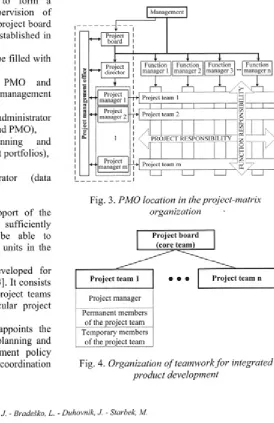
In order to make PMO operation successful it is necessary to ensure its position in the company organization scheme. Our experience shows [5] that project-matrix structure is the most suitable form; in this structure the PMO is responsible for project support on one hand, and to the company management on the other (Figure 3).
Strategic m anagement has to form a special body for operational supervision o f project m anagement (and PMO) - a project board [7]. Several project boards may be established in the company for various projects.
It is suggested that the PMO be filled with the following personnel:
• PMO head (m anagement o f PMO and coordination w ith the company management and managers o f functional units),
• project inform ation system administrator (information support for projects and PMO), • project process analyst (planning and
management o f projects and project portfolios), • control analyst (project control),
• project m anagem ent administrator (data acquisition and distribution).
PMO head has to have support o f the company m anagem ent and a sufficiently influential position in order to be able to coordinate the labor with functional units in the company.
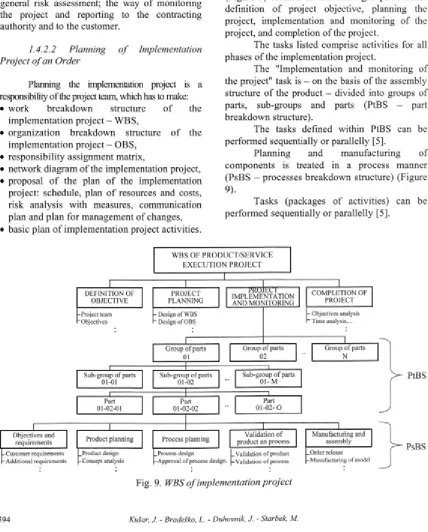
A tw o-level structure is developed for organization o f team w ork [1] and [13]. It consists of: project board (core team) and project teams for the im plem entation o f a particular project (Figure 4).
The com pany managem ent appoints the project board; it takes care o f the planning and implementation o f project management policy and strategy, and for guidance and coordination o f project-team work.
Project board is permanent and heterogeneous, consisting o f project managers and heads o f organization units. The general manager or his deputy, who is in charge o f the project management, usually manages the project board.
Project team is managed by the project manager. Permanent members o f the project team are representatives o f organization units, who work on the project throughout its duration. They are responsible for communication and information transfer between the project team and organizational units.
Project team can be extended with temporary members participating in the project for a limited time frame. In the integrated product development, the temporary members form sub teams, which are responsible for activities in concurrent engineering loops [
1
] and [2
],Management
Fig. 3. PMO location in the project-matrix organization
1.3. Creation of System- and Operational Guidelines for Project Management of Orders
Studies have shown that a company, which has decided to use project management o f orders, has to develop system- and operational guidelines (Figure 5), which have to be harmonized with other system- and operational guidelines o f the company.
For each project it is necessary to set up a project dossier - a data warehouse o f all data/documents produced in the project lifetime. For easier survey, the project dossier is divided into folders with documents related to a particular process type (Figure
6
). The project dossier has to be accessible to all project participants via the intranet.1.4. Method for Planning and Project
Management of Orders
The studies on introduction o f project management o f orders in companies have shown that the order management process has to be dealt with in a holistic manner. The data and
experience obtained during tender preparation are an important source o f information for the implementation project preparation.
Order management project therefore has to be carried out in two phases:
Phase 1 : Planning and management o f a tender. Phase 2: Planning and management of implementation project.
1.4.1 Planning and Management o f Making a Tender fo r an Order
A tender is made on the basis o f customer inquiry or internal initiative in an organizational unit o f the company. Company management should check whether the proposal is in accordance with objectives and strategies o f the company. If it is, then the company management orders that a tender be made and appoints an ad hoc project team, which (on the basis o f customer requirements and market analyses) obtains as much input data as possible and examines the history and experience on similar, reference projects.
Fig. 5. Overview o f system- and operational guidelines fo r project management o f orders
The course o f making a tender is presented in Figure 7.
Ad hoc project team is usually m anaged by the marketing-department representative. Its members are from development, technology, manufacturing and, when necessary, from other departments o f the company. The future project m anager is also a member of the ad hoc project team. The result o f work o f the ad hoc project team is an estimate o f the economic justification and feasibility o f the project, including risk analysis. If the estimated economic justification and feasibility o f the project are promising, the tender is m ade in accordance with the customer requirements. The tender contains technical and financial data, as well as data on deadlines - the Gantt chart o f the project tender.
If the tender is successful, a contract is signed, w hich defines: project deliverables, quality, deadline with milestones, costs and method o f paym ent, supervision and report on the course o f the project.
By signing the contract the foundations are made for planning and management o f the implementation project.
1.4.2 Planning and Management o f
Implementation Project o f an Order
Planning and management o f the implementation project o f an order consists o f a logical sequence o f all the activities needed for the preparation and implementation o f the project, as well as the documents resulting from individual activities.
Planning and management o f the implementation project o f an order for new product development is similar to execution o f a previously developed product, the difference being in individual activities.
Project m anager and project team are responsible for the execution o f planning and managing o f implementation project.
Planning and management o f implementation project o f an order is carried out in four steps (Figure
8
):Step 1: definition o f the objective o f implementation project.
Step 2: planning o f implementation project. Step 3: execution and monitoring o f implementation project.
Step 4: completion o f the implementation project.
1.4.2.1 Definition o f the Objective o f
Implementation Project o f ari Order
In order to define the objective o f implementation project it is necessary to:
• order implementation project, • define the implementation project.
Implementation project is ordered by the contracting authority - company management on the basis o f the signed contract. Order o f the project contains the data on: customer, project deliverables, project manager, project team composition, conditions for project implementation as regards on time, costs and resources.
Definition of the implementation project
is made by the project team on the basis o f a detailed study o f the project and the book o f customer requirements. Project definition consists of: summary o f the project - tender; starting
P R O J E C T D O S S I E R - D O C U M E N T S
Management orders an execution project and elects the project team PROJECT DEFINITION
(goals and strategy)
Project order, Project leader and team members election document
Goals and strategy, global risks Influential factors, important milestones
Reference project
HISTORY, EXPERIENCES
WBS, OBS, RESPONSIBILITY MATRIX, NETWORK DIAGRAM
Project WBS, Project OBS, Responsibility matrix, Network diagram
TIMES, SOURCES, COSTS
Baseline plan confirmation document (project consignee)__________
Launched activity list
Executed activity data, Activity in progress review, Tracking reports
Status and deviation analysis records (weekly) Accepted measures, changes
PROJECT EVALUATION
1r
Attained goals analysis Risk analysis and measures' effects
Course and deviation analysis Conclusions - experiences for future projects
PROJECT END Project team dissolvement document
points for the project - tender documentation; general and specific objectives o f the project; strategies for meeting the deadlines; scope o f the project; data on project manager, his deputy and project team members; data on other project participants: suppliers, sub-contractors, customer, control; reference project; feasibility study; the way o f ensuring the required resources; investment dynamics and ROI data; pre calculation; milestones: external and internal; general risk assessment; the way o f monitoring the project and reporting to the contracting authority and to the customer.
1.4.2.2 Planning o f Implementation
Project o f an Order
Planning the implementation project is a responsibility o f the project team, which has to make: • w ork breakdow n structure o f the
im plem entation project - WBS,
• organization breakdown structure o f the im plem entation project - OBS,
• responsibility assignm ent matrix,
• network diagram o f the implementation project, • proposal o f the plan o f the implementation
project: schedule, plan o f resources and costs, risk analysis with measures, communication plan and plan for m anagem ent o f changes, • basic plan o f im plem entation project activities.
Work breakdown structure (WBS)
represents a structured breakdown o f the whole project [
8
], [10] and [14] into smaller and manageable tasks. WBS is important in terms of the management o f time, costs and risks o f the project [15]. WBS defines the scope o f the project and all the activities necessary for project objectives completion.W BS o f the implementation project (Figure 9) consists o f four main groups o f tasks: definition o f project objective, planning the project, implementation and monitoring o f the project, and completion o f the project.
The tasks listed comprise activities for all phases o f the implementation project.
The "Implementation and monitoring o f the project" task is - on the basis o f the assembly structure o f the product - divided into groups o f parts, sub-groups and parts (PtBS - part breakdown structure).
The tasks defined within PtBS can be perform ed sequentially or parallelly [5].
Planning and m anufacturing o f com ponents is treated in a process manner (PsBS — processes breakdow n structure) (Figure
9)-Tasks (packages o f activities) can be perform ed sequentially or parallelly [5].
Organization breakdown structure (OBS) represents an organizational breakdown o f the company organization units, which are responsible for the execution o f WBS tasks/activities [16]. In addition to internal organizational units o f the company, OBS also comprises external contractors (suppliers, sub contractors, consultants, auditors).
The last OBS level consists o f resources to be used for the implementation o f project activities. An example o f an OBS project is presented in Figure 10.
OBS is a temporary organizational structure whose lifetime is equal to the lifetime of the project. It is managed by the project manager and project team members.
I f organizational units that are part o f the OBS are on various locations, OBS may be organized as a virtual company (by using modern IT and communication means) [17].
Responsibility assignment matrix (RAS)
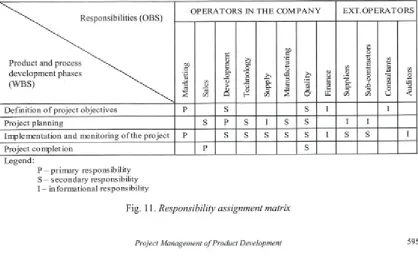
links the project organizational structure (OBS) w ith the project labor structure (WBS). Responsibilities o f operators from OBS versus tasks and activities in WBS are presented with symbols [16], An example o f RAS formation is presented in Figure 11.
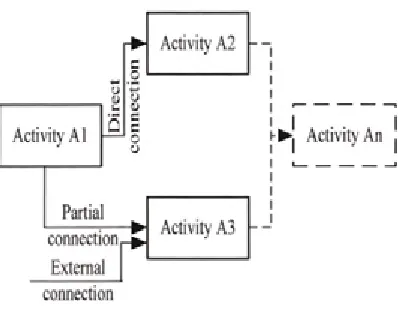
Project network diagram is a set of m utually logically linked activities, which have to be carried out in a precisely defined logical sequence and interconnected. It can be made in a form o f event- or activity network diagram. Preference is given to activity network diagrams
Fig. 10. OBS o f the project
due to their simplicity and possibility o f concurrent execution o f activities (partial dependence) [9].
Links between activities in a network diagram can be (Figure 12).
Direct connections - observed activity has to be finished before new activities can start e.g. testing can only be carried out after the prototype has been made; the prototype has to be made before testing.
R esp o n sib ilities (O B S )
P ro d u c t an d process d e v elo p m en t phases (W B S )
O P E R A T O R S IN T H E C O M P A N Y EXT. O P E R A T O R S
M a rk e ti n g S a le s D e v e lo p m e n t T e c h n o lo g y S u p p ly M a n u fa c tu ri n g Q u a li ty F in a n c e S u p p li e rs S u b -c o n tr a c to rs C o n su lt a n ts A u d it o rs
D efin itio n o f p ro ject ob jectiv es P S S I i
P ro ject p lan n in g S P s i S S I I
Im p le m en tatio n an d m onitoring o f th e p ro jec t P S S S S S I S S I
P ro ject c o m p letio n P s
L eg en d :
P - p r i m a r y re sp o n sib ility S - se c o n d a ry responsibility 1 - in fo rm atio n al resp o n sib ility
Partial connections (dependencies) - allow concurrent execution o f two or m ore activities.
External connections - join activity o f the observed project w ith activities o f other projects.
connection
Fig. 12. Project network diagram
W hen defining links between project activities in project management o f orders, extended w ith concurrent engineering elements, it is necessary to define the maximum partial overlapping and thus maximum overlapping o f tasks defined in WBS on PtBS and PsBS levels.
Netw ork diagram is a starting point for analyses o f duration, resources and costs o f the project. In view o f preserving the prescribed links between project activities, the network diagram is an indispensable aid for monitoring the project progress.
Proposal o f the implementation project plan w ith risk analysis is an output o f the project team in the project design phase. It contains: schedule w ith milestones, resource load plan, plan o f costs, and risk analysis o f the project.
Schedule w ith milestones comprises: durations o f activities, date o f starting the project, starting and completion dates o f activities including milestones, deadline for project completion, dates o f milestones, critical paths and time slacks.
Resource load plan can refer to labor force, production means or materials. Each activity is allocated one or more resources.
Project m anager and team members examine the resource load profile and if conflicts arise, they search for a suitable solution (in collaboration w ith PMO and managers o f
functional units at a project board meeting), which still assures the achievement o f project objectives.
In resource analysis the PMO has to harmonize the project portfolio w ith the resource portfolio.
Project cost plan is made on the basis of: fixed costs o f activities, fixed costs o f project m anagement, and variable costs o f resources used for carrying out activities.
Project cost plan is acceptable if the planned total project costs do not exceed the costs approved when the project was ordered.
PMO has to harmonize the project portfolio with the company costs portfolio.
There are several methods available for risk analysis o f implementation project activities
[7] and [18]. An analysis o f available methods has revealed that the most suitable tool for project managem ent o f products and services is the table o f “critical success factors”, as it represents an analytical aid to find, evaluate, reduce and rem ove risk. It is elaborated by the project team, w hich is responsible for planning and im plem entation o f the project. Analyses should be as extensive as possible and they have to cover all possible problems.
Procedure for designing the table o f critical success factors consists o f risk analysis and risk management.
Risk analysis consists o f the identification o f problem s or events, definition o f the probability o f their arising, evaluation o f their consequences and incidences, and risk calculation [
8
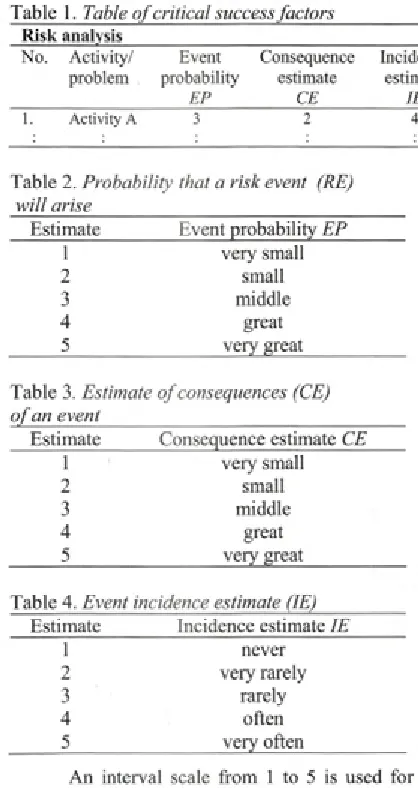
] ,During the identification o f problems, all tasks and activities, w hich are defined in the project W BS, are analyzed. Potential problems o f individual task are entered into the critical factor table (Table 1). If it is not possible to identify problem s related to a particular task, the latter is omitted.
Quantitative risk analysis is defined by risk activity level, w hich is calculated on the basis o f the following estimates:
• probability that a problem or risk event will arise,
Table 1. Table o f critical success factors
Risk analysis Risk management
No. Activity/ problem
Event probability
E P
Consequence estimate
C E
Incidence estimate
IE
Risk factor
R F
Measures Responsibility Signals
P - preventive C - corrective
1. Activity A 3 2 4 24
Table 2. Probability that a risk event (RE) will arise
Estimate Event probability EP
1
very small2
small3 middle
4 great
5 very great
Table 3. Estimate o f consequences (CE)
o f an event_________________________
Estimate Consequence estimate CE
1
very small2
small3 middle
4 great
5 very great
Table 4. Event incidence estimate (IE)
Estim ate Incidence estimate IE
1
never2
very rarely3 rarely
4 often
5 very often
An interval scale from 1 to 5 is used for the estimates [
8
] and [19].Probability that a problem or risk event w ill arise is estimated by means o f Table 2.
In order to estimate the consequences o f a problem or risk event, Table 3 is used.
In [
8
] the risk is defined only by estim ating the probability o f a risk event arising and the estimated consequences. The paper deals w ith project management o f cyclically recurrent projects, so experience derived from similar past projects can be used for estimating the incidence probability o f a risk event.Table 4 is used for estimating the incidence o f a problem or risk event.
RF - risk factor for the problem identified is calculated by:
RF = EP X CE X IE
EP - probability that a problem or risk event will arise,
CE - evaluation o f consequences if a problem or risk event arises,
IE - evaluation o f incidence of a problem or risk event arising.
If the calculated risk factor RF < 60, the risk is considered normal; no measures need to be prepared in advance. If RF > 60, the risk is high and measures need to be prepared in advance.
The threshold value o f 60 has been set on the basis o f the Paret principle [20]: 20% o f risks (high-risk-level activities) can cause 80% of problems or damage.
Risk management means definition o f measures and responsibilities for risk prevention, and signals that warn us when a risky event might occur.
I f the risk factor (RF) reaches the critical value (60), it is necessary to pay special attention to the problem. An additional analysis of possible sources o f problems is made, and suitable prevention or corrective measures are predicted.
A table o f critical success factors also has to contain the so-called signals, i.e. events signaling a new problem to responsible operators and thus allowing them to trigger a suitable measure(s).
Project manager, project team and operators o f activities are responsible for the implementation o f measures.
Project team forwards the finished proposal o f a project plan to the contracting authority (company management or project board), which issues a decision on the confirmation o f the baseline project plan, which consists a "copy" o f project plan proposal, which does not change during implementation and monitoring o f the project - it serves as a reference value for an analysis o f deviations o f actual project course from the planned course.
1.4.2.3 Implementation and Monitoring o f the Project
Project m anager (via the project management office) takes care o f activity plan implementation. Data on activities that have to start at a specified time are sent to team members (according to the responsibility assignment matrix) and thus to the competent organization units (included in the project OBS). Heads of these units take care o f the elaboration of operative activity implementation plan within the planned date o f start and end o f activities, and for the elaboration o f required documentation. Suitable system- and operating instructions are used for the implementation o f activities.
Project m anager is responsible for actual information on project status, i.e. periodical information retrieval on realization o f activities. The project team members from individual organizational units are responsible for on-time actual data acquisition on activity realization.
Project m anager and project team make a deviation analysis o f the current project status in comparison with the basic project plan; they analyze reasons for deviations and search for solutions to continue the project.
PMO helps the project manager during project updating and deviation analysis. PMO performs a simulation o f possible scenara, aind on the basis o f these the project manager suggests corrective measures. Problems that cannot be solved by the project team, are sent (together with a proposed solution) to the project board.
Project m anager documents all measures adopted, including data on holders o f their activities and results achieved.
M easures that influence other projects, always have to be analyzed by the PMO and confirmed by the project board.
1.4.2.4 Completion o f the Project
A fter the project has been completed, the project m anager and project team members perform project evaluation, which includes: analysis o f objectives achieved, deviations o f time, resources, costs, risk analysis and important conclusions for future projects. The project board confirms the project evaluation.
Project is completed when a total project dossier has been elaborated; it comprises full
documentation on project planning and management, as well as technical documentation on project deliverables (see Figure
6
). All these documents should be forwarded to the project management office for archiving. After the project dossier has been archived, the contracting body discharges the project manager and dissolves the project team.2 CASE STUDY
Implementation o f project management o f orders in real life is presented in a case o f a company which is a development supplier of components for automotive industry. Four groups o f products are the most important in its production programme: gearshift mechanism, hand brake, pedal component and engine bonnet pivot. As a development supplier, the company participates in a development project already in a new car concept, and it cooperates with the car producer at least three years before the production starts. By selecting a supplier, the car producer makes an important decision, because the supplier should be a long-term reliable partner; on the other hand, the supplier is in a risky position, as it is not known in advance whether a particular car model will be a market success.
In 2004, the company management decided to introduce project management as a mode o f company operation. They did it in four steps:
Step 1 : Training o f staff for project management. Step 2: Organization and information changes. Step 3: Creation o f system and operational guidelines.
Step 4: Implementation o f test project management o f orders (As-Is / To-Be process).
2.1. Training of Project Management Staff
tested their newly obtained knowledge in solving actual problems in their company.
2.2. Organization and Information Setup
In the past, the company was organized according to the functional principle. Based on an analysis o f a suitable company organizational form, the company management selected a balanced matrix company organization. The decision was based on the fact that project decision-m aking is equally divided between the project m anager (regarding project management and achievement o f goals) and heads o f company functional units (for carrying out project activities and ensuring product quality).
A product and service project board was appointed, managed by the company executive director and consisting o f project managers and functional unit heads.
A PMO was established for organizational and technical project management support. It was m anaged by the project management assistant to the executive director and it consisted o f project managem ent administrator, project control analyst, administrator and all professional project managers.
Fig. 13. Car pedal component
MS Project software was selected as a key tool for project management IT support. It was used together with MS Office software (Excel, Outlook), which will have to be linked with ERP and PLM system in the future. A question arises, which MS Project functions can be done by ERP system, and which tasks and project management processes should still be managed by MS Project.
The implementation of web version of MS Project Server will also be analysed. A project management portal was established on the company's intranet; all project participants can obtain the project-related data on that site.
2.3. Creation of System- and Operational Guidelines
Company management organized the creation of system- and operational guidelines. Project team, responsible for project management implementation in the company, made project management rules, where project management system was defined, as well as a procedure for project planning and management, and the content of a project dossier. The project management rules were adjusted to the company quality management rules. As an aid to project managers and project team members, a project management handbook was made, which contained practical guidelines and templates of all documents appearing in folders and project dossier. For execution o f individual processes (bid, product and process development and validation, test manufacturing) operational guidelines have been used that had already been made for the company quality management system, so they have been just harmonized with the project management rules.
2.4. Implementation of Test Project
Management of Orders
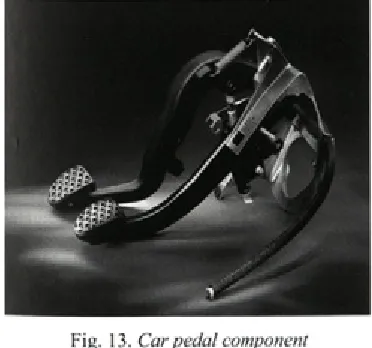
Company management selected a product and process development order o f a car pedal component (Figure 13) as a test project during the introduction o f project management o f orders. Contract for that project had already been signed; this was therefore an implementation project o f an order.
Project team was appointed for the implementation o f the project; its members were representatives from all the company functional units, and a senior project manager was elected as the project manager.
The project team carried out the project planning and management process in accordance with the procedures defined in chapter 2.4.
steps:
• Definition o f project objectives. • Project implementation plan.
• Project implementation and monitoring o f the project.
• Completion o f the project.
2.4.1 Definition o f Project Objectives
In order to define the project objective, the project team carried out two creativity workshops. During the first workshop the team members learnt about their tasks, competences and responsibilities, and they thoroughly studied the tender documentation and subject o f the contract.
During the second workshop the team members defined project objectives, suitable strategies, scope o f the project, global risks, impact factors and identified the project participants.
2.4.2 Project Implementation Plan
According to the plan o f introduction o f project m anagement, the company management
decided to create two project implementation plans for product order:
• Using the existing way o f order process implementation (As-Is)
• Using the project-management-of-orders system, extended w ith concurrent engineering elements (To-Be).
On the basis o f the project definition, the project team made a project implementation plan in several creativity workshops.
Project team members first made the project WBS structure (Figure 14). For individual project phases they defined tasks, subtasks and work packages as shown in Figure 9; they also defined the required project activities. Altogether 340 activities were defined.
During the definition o f implementation step activities and project monitoring, all processes, methods and procedures, defined by the APQP m ethodology for automotive industry, were precisely review ed [
21
].Afterwards, team members formed a project OBS (Figure 15); they included into it those functional units o f the company, which would provide resources for the implementation o f activities, as well as external suppliers and sub contractors.
Fig. 14. WBS fo r car pedal component
s
cd bßÖ td GS .2 P _oG GO <Dcdc/l .22C/55—(
<D C C/3G <D cd cd o -Co
ft
O Jxi N
&
T3G IShft
3<D ' o 1
H
Q-CÜ 2 >4)
Q I s
cn G •T-t
p £
a . CZ)
c
R esp onsibilities (O B S)
P ro d u c t a n d process d evelopm ent
p h a s e s (W BS) M
a n a g e m e n t P ro je c t t e a m M a rk e ti n g D e v e lo p m e n t & d e si g n In d u st ri a li z a ti o n Q u a li ty P ro d u c ti o n P u rc h a se C o o p e ra ti o n S u p p li e rs
P ro je ct p re p arin g S P S i i
D e v e lo p m e n t an d d esig n o f p ro d u ct S I p s s I
D e v e lo p m e n t an d d e sig n o f process S s p s i I i I
Q u a lifica tio n o f p ro d u c t an d p ro cess I s s s p s S s S S e rial p ro d u c tio n an d p ro ject com pletion p s
Fig. 16. Responsibilities assignment matrix fo r car pedal component
Responsibilities assignment matrix was m ade for easier coordination between project m anagem ent and functional-units management (Figure 16). The responsibilities were presented by sym bols (P - primary, S - secondary, I - inform ational responsibility).
During project planning, the creation o f a p roject network diagram was the most difficult and m ost critical task for the project team. Only the network diagram that realistically and logically defines dependencies between project activities can serve as a useful tool for further planning and management o f project im plem entation. Project team members made activity card (label) for every activity. Then they logically connected activities into a network activity diagram (Figure 17). In this process they defined the As-Is order implementation project process as precisely as possible.
A fter the network diagram had been made, the project team members defined duration o f
each activity they allocated the required resources and defined the data required for cost analysis.
MS Project software was used for time-, resources- and cost analysis. A period o f 644 days would be required for project implementation using the As-Is process.
During the risk analysis all project activities were checked, risk types were defined, risk levels were calculated and preventive and corrective measures were defined if necessary.
The output o f the project team was a proposal o f the implementation project plan with risk analysis. It was sent to the project board for confirmation. After the project has been confirmed its implementation could begin.
After the order implementation project had been made in accordance with the existing implementation process, the project team began designing an implementation project plan, which would, as far as possible, include elements o f concurrent engineering.
Legende: SS - start to start; FS - finish to start; FF - Finish to finish
Fig. 18. Part o f network diagram fo r car pedal component (concurrent engineering)
Procedure for designing implementation project plan is similar as in a classical project implementation, with the following important differences:
l . I t is necessary to ensure as much as possible concurrency o f process implementation, defined by the APQP methodology [21]. 2. It is necessary to find which activities within
processes can be executed concurrently, so that m aximum overlapping is achieved, and to define the values o f partial dependencies between netw ork diagram activities.
3. It is necessary to define concurrent engineering loops.
4. It is necessary to form teams (sub-teams) for im plem entation o f concurrent engineering loops.
It is obvious that by incorporating concurrent engineering elements, the project implementation changes because its processes overlap (APQP) and the netw ork diagram structure changes, too - the goal is to achieve as high concurrency as possible. Because o f a partial overlapping o f interdependent activities, their execution tim e may even extend - without extending the project duration time. Incorporation o f concurrent engineering elements does not influence the WBS and OBS project structures (Figure 18).
The process overlapping and partial dependencies between project activities require a high level o f collaboration between the holders o f responsibilities and operators o f activities, so it is necessary to introduce concurrent engineering loops [1] and [2], as shown in Figure 19.
P h a s e o f p r o d u c t d e v e lo p m e n t^ i
P ro d u c t d e s ig n lo o p
P r o c e s s d e s ig n lo o p
P r o d u c t a n d p ro c e ss q u a lific a tio n lo o p
T im e
Three concurrent engineering loops were defined for the car pedal component project: • product development loop
• process development loop
• qualification o f the product and process loop. W ithin an individual loop, various activities are being carried out concurrently by resources from various functional units and by external contractors. To ensure on-line inform ation exchange between operators o f various activities, sub-teams are formed within the project team for implementation o f concurrent engineering loops (Figure 20).
Fig. 20. Team structures o f concurrent engineering loops
Loop teams consist o f representatives (operators) from those functional units, which concurrently carry out activities o f an individual concurrent engineering loop.
Loop teams do not have permanent m em bers - they change depending on the loop for w hich the team is responsible or depending on the activities that will be carried out within this loop.
A fter all changes had been made, the project implementation time was reduced from 644 to 419 days, which is 35% reduction o f project duration.
The company management was aware that project implementation on the basis o f concurrent engineering elements is a very demanding process and its implementation is associated with a high risk. Nevertheless, they decided to implement this project in a new, more demanding way. They
were aware that they have insufficient knowledge o f concurrent engineering, so they asked the experts o f the Centre o f excellence for modem technologies on the Faculty of Mechanical Engineering in Ljubljana for technical assistance.
2.4.3 Implementation and Monitoring o f the Project
According to the project plan, the project manager sends (in electronic form - using MS Outlook) to team members and functional unit heads the information about activities that should start with a special document containing data on planned activities, their duration and the planned date o f beginning and completion. The same document has fields for entering dates o f actual beginning and completion o f activities.
A project team member from a particular functional unit is responsible for monitoring the implementation o f activities and for current reporting on status o f activities to the project manager, while functional unit head is responsible for the implementation o f activities within the prescribed deadline and for achievement o f the required quality. Reports on the implementation o f activities are made once a week.
Project manager promptly stores the actual data into the MS Project software.
Project team makes a weekly snapshot of project status. It finds out which activities have been finished completely and which have been finished just partially. On the basis o f these data a calculation o f the current project status is made. By comparing it with the initial plan, the team members find which activities are delayed, which are carried out according to the plan and which are carried out faster. Also important are the analyses o f critical activities, critical paths and the costs incurred so far. Problems and risks are identified (so called "status indicators" are an aid to the team members); they can be overcome by triggering an appropriate action plan made during risk analysis, and additional measures can be taken if necessary.
W eekly results on current situation snapshot are published on the project management portal, listed by the whole project activities and separately by activities allocated to individual functional units o f the company.
Project m anager reports on the project status and on the measures taken at the project board meeting, where the project status is being harmonized w ith other current projects.
An analysis o f all current projects, especially in terms o f the used resources and costs, is prepared by the PMO.
According to the contract, the project status data are sent to the customer, who thus has an accurate overview o f the project status and problems, and can participate in their solution.
2.4.4 Completion o f the Project
Project is com pleted when all the project activities have been carried out and the objectives met. W hen the project has been completed, the project team made evaluation o f project including:
• M eeting the deadlines and financial limits: project w as completed within the agreed deadline and w ithin the approved costs.
• Use o f internal and external resources: there were great difficulties w ith internal resources associated w ith coordination o f their involvement in other projects.
• Quality o f project m anagement and project deliverables: was in accordance with project m anagement rules and with the customer's expectations, which was confirmed by two audits made by a reviser authorized by the customer.
• Overview o f the planned and performed risk measures: there were m any more preventive and corrective m easures prepared than actually used.
• Experience obtained that is important for similar future projects: regular meetings of project team. Project team members have to be well prepared for a meeting - this is a precondition for short end effective meetings.
Likew ise all other project dossier documentation, the final report was also published on the project m anagement portal.
A fter the project has been completed, the company m anagem ent dissolved the project team
and appoints the sales department for execution o f post-contract obligations.
2.5. Establishment of Multi-project Environment
A fter the analyses o f the first results o f planning and management o f the test project, the company management decided that all new projects should be m anaged using the described procedure (one year later, more than 30 projects have been planned and managed in this way).
PM O is responsible for project coordination, especially for the use o f common resources and cost management.
Every week PM O sends a report on cumulative status o f all projects to the company management; the projects are classified in three categories:
• carried out according to the plan,
• carried out according to the plan w ith some discrepancies that are manageable,
• critical, whose discrepancies are difficult to control or even beyond control.
In each individual case the company managem ent acts according to its strategy.
3 CONCLUSION
This paper deals with market-oriented and value-added projects and services, especially cyclically repeated projects, i.e. projects of implementing a previously developed project/service in a specific form, in accordance with the customer's requirements, and projects related to new product/process development, which are afterwards submitted to a mass production.
Introduction o f project management into a company, as a mode o f business process operation, is a demanding task, because it requires changes in the integration and focus o f company fimctional units to the goals o f the company. It is important that project objectives have higher priorities than functional unit priorities, and that project-friendly environment is created in a company.
It is proposed that project m anagement be introduced in the company in four steps.
required for project management - and change their w ay o f thinking: from focus to the company goals, the employees have to focus to the custom er/m arket goals ("customer is the king" principle). Project management requires continuous and on-line exchange o f information, so it is important that employees learn to com m unicate in a way o f giving and receiving the right information, at the right time and related to the task they perform. In practice, a problem o f hiding information within the functional unit (or w ithin an individual person) can still be found. It is therefore important that the company establishes a knowledge management system.
Success o f introduction o f project managem ent also depends on organizational and informational changes. Authors o f this paper propose that a transition from a functional to a balanced-m atrix organization be made, w ith a possibility o f further transition to a project-type organization. Our proposal can be justified by the fact that in this case an important advantage o f functional units is retained. In these units specialist knowledge is concentrated, employees have permanent training available and they get to know modem trends in their field o f speciality. M em bers o f functional units participate in projects temporarily and during that time they give their maximum contribution to a successful project implementation. W orking in projects, they gain experience, which they later transfer back to their functional units.
It is important that (especially in early phases - during project and process development) the best and most qualified personnel is involved, so that decisions are made as fast as possible and optimal from the quality and cost point o f view.
In the company there are several projects m nning concurrently (even several dozens), so it is essential to set up a PMO, which supports the projects and provides management o f the whole com pany project portfolio.
Project management procedures have been form alized by making system and operational guidelines for project management, where procedures for the implementation o f individual project phases and the contents o f required documents, which make a project dossier, are defined precisely.
The market requires as short delivery time as possible and the highest possible quality, so it is necessary to extend the order/service project
planning and management methods with concurrent engineering elements. Concurrent engineering is based on teamwork, track and loop process o f implementation and incorporation o f concurrent engineering tools. IT and communication support are required for incorporation o f concurrent engineering elements (ERP, PDM and PLM systems).
The proposed methodology o f project management implementation, as well as planning and management o f products/services was tested in a company, which is a development supplier o f components for automotive industry. On the basis o f the proposed methodology o f project planning and management for products/services, the company management decided to create two versions o f a project plan.
The results have shown that the version of project implementation, extended with concurrent engineering elements, has some essential advantages: shorter delivery time, higher quality, somewhat lower costs, simultaneous elimination o f errors already in the concurrent engineering loops and not in later phases as in the sequential engineering. In spite o f a higher risk, associated with the implementation o f a project in this way, the company management decided to test the proposed new method and carry out the project in a new way. The customer agreed with that.
Insufficient capability and willingness o f project participants for on-time, continuous and accurate communication and exchange o f data and information turned out to be the main problem during project implementation.
Nevertheless, the results achieved have been encouraging, so further research will be focused mainly on the definition o f criteria for formation o f concurrent engineering loop teams, their internal and external information integration, and to methods for effective personal and technical communication.
4 REFERENCES
[1] Kušar J., Duhovnik J., Grum J., Starbek, M. How to reduce new product development time. Robot, comput.-integr.
m anuf, 2004,voi. 20, no. 1, p. 1-15.
[2] Prasad B. Concurrent Engineering Fundamentals, Integrated Product and
Process Organization, 1996, vol. I,
[3] Kendall I.G., Rollins C.S. Advanced Project Portfolio Management and the PMO, J. Ross Publishing, Inc., 2003. [4] Fleischer M., Liker K.J. Concurrent
Engineering Effectiveness: Integrating
Product Development Across
Organisations, Hanser Garden
Publications, Cincinnati, 1997.
[5] Kušar J., Rihar L., Kisiček K., Starbek M. Experiences at Project M anagement Office Implementation. Project network o f
Slovenia, 2004, voi. 7, no. 4, p. 42-46 (In
Slovene)
[
6
] Schlicksupp. H. Creative Search fo r Ideasin a Company. W atter der Gruyter, Berlin
- New York, 1977 (In German)
[7] Cappels M. T. Financially Focused Project
Management, J. Ross Publishing, Inc.,
2004.
[
8
] PM BOK Guide, A guide to the projectmanagement body o f knowledge, 3rd ed.,
New tow n Square: Project M anagement Institute, 2004.
[9] M eredith R.J., M antel J.S. Project
Management, A Managerial Approach
(fifth edition), John W iley &vSons, Inc., 2003.
[ 10] Badiru B. A. Project management tools fo r
engineering and management
professionals, Industrial Engineering
Press, Instiute o f Industrial Engineers, Norcross, Georgia, 1991.
[11] Bridges D., Crawford K. How to startu
pand rollout a project office,
http ://www. system corp. com/framesite/do wnloads/startup_frame.html,
2
. sept.2002
[12] Block T.R., Frame J.D. Today's ProjectOffice: Gauging Attitudes, PM Network,
A ugust 2001.
[13] Duhovnik, J., Starbek, M., Dwivedi, S.N., Prasad, B. Development o f innovative products in a small and medium size enterprise. Int. j. comput. appi, technol.,
2003, voi. 17, no. 4, p. 187-201.
[14] Badiru B. A. Project Management in
Manufacturing and High Technology
Operations, John W iley & Sons, Inc., N ew
York, 1996.
[15] Engineer J.S. Progressive Manufacturing,
J. Ross Publishing, Inc., 2005.
[16] Turner J.R. The Handbook o f project - based management, The M cGaww-Hill Compnies, 1993.
[17] Brezovar A. Process orientated organisation o f production in virtual
enterprices, PhD Thesis, University o f
Ljubljana, 2005 (In Slovenian).
[18] Goodpasture C.J. Quantitative methods in
project management, J. Ross Publishing,
Inc., 2004.
[19] Risk management guide fo r DOD
acquisition sixth edition, Department o f
defence, USA, 2006.
[20] M ichalski J.V., King G.D. Six sigma tools
navigator, Productivity press, New York,
2003.
[21] Stamatis D.H. Advanced Quality Planning,