Demographic Research a free, expedited, online journal of peer-reviewed research and commentary
in the population sciences published by the Max Planck Institute for Demographic Research Konrad-Zuse Str. 1, D-18057 Rostock · GERMANY www.demographic-research.org
DEMOGRAPHIC RESEARCH
VOLUME 21, ARTICLE 3 PAGES 65-74
PUBLISHED 10 JULY 2009
http://www.demographic-research.org/Volumes/Vol21/3/ DOI: 10.4054/DemRes.2009.21.3
Reflexion
Relationships between men’s gender attitudes
and fertility: Response to Puur et al.’s “Men’s
childbearing desires and views of the male role
in Europe at the dawn of the 21st century”,
Demographic Research
19: 1883-1912
Charles F. Westoff Jenny Higgins
©2009Charles F. Westoff & Jenny Higgins.
This open-access work is published under the terms of the Creative Commons Attribution NonCommercial License 2.0 Germany, which permits use, reproduction & distribution in any medium for non-commercial purposes, provided the original author(s) and source are given credit.
1 Introduction 66
2 Summary of Puur et al.’s data and measures 66
3 Examining a similar question with alternative data and measures 67
4 Results 68
5 Discussion 71
Demographic Research: Volume 21, Article 3 Reflexion
Relationships between men’s gender attitudes and fertility:
Response to Puur et al.’s “Men’s childbearing desires and views of
the male role in Europe at the dawn of the 21st century”,
Demographic Research
19: 1883-1912.
Charles F. Westoff1
Jenny Higgins2
Abstract
An analysis published in a recent edition of this journal (Puur, Olah, Tazi-Preve, and Dorbritz 2008) reported that, in eight European countries, men with egalitarian gender attitudes both desired and had more children than men with more traditional gender attitudes. These unexpected findings led us to explore a similar research question with an alternate dataset--the European/World Value Surveys. But we found--without exception--a negative association between men’s egalitarian attitudes and fertility, not only in the selected European countries but also in a considerable number of other developed countries. We explore possible reasons for and implications of these divergent findings.
1. Introduction
This paper was prompted by an analysis published in a recent edition of this journal (Puur, Olah, Tazi-Preve, and Dorbritz 2008) that showcased a provocative and potentially important finding. The authors explored cultural attitudes toward men’s social roles and their connections with men’s desired fertility in eight European countries. According to their measures, those men with more egalitarian gender attitudes both “desire[d] a higher number of children” and “realize[d] these plans by their late 30s and early and mid-40s, fathering more children than traditional men” (Puur et al. 2008, page 1901). The authors conclude that “egalitarian men seem to be pro-family indeed” (page 1901), which, “in the long run, [...] may indicate some positive prospects for Europe’s fertility development” (page 1902).
Despite several exceptions (Kaufman 2000; Philipov 2008; Tazi-Preve, Bichlbauer, and Gougon 2004), the previous literature overwhelmingly has associated more egalitarian gender role attitudes with lower rather than higher fertility. In contrast, if the findings of Puur et al. are reliable and generalizeable to other European countries, one might conclude that low fertility of the more developed countries may be reversing as egalitarian gender attitudes increase and people’s views of men’s roles change.
In light of the potential significance of these unexpected findings for the future level of fertility, we sought to explore the authors’ measures more closely and to seek confirmation of their reported association with fertility from other data sources.
2. Summary of Puur et al.’s data and measures
Data from the published article come from the 2002-2005 DIALOG project (Höhn, Avramov, and Kotowska 2008). Puur et al. limited their analyses to men aged 20-44 in Austria, Estonia, East and West Germany, Italy, Lithuania, Netherlands, and Poland, based on surveys conducted between 2001 and 2003.
As a proxy for more general gender attitudes, the authors focused on perceptions of men’s social roles, as assessed by the following three statements:
1) It is not good if the man stays at home and cares for the children and the woman goes out to work.
2) Family life often suffers because men concentrate too much on their work.
Westoff & Higgins: Relationships between men’s gender attitudes and fertility
The authors constructed a summary index based on the extent of respondents’ agreement with these statements (the middle item was reversed to be consistent with the direction of the scale). The authors assessed men’s gender attitudes with this scale, with a high summary score indicating a more egalitarian position and a low score a traditional orientation.
For the eight European countries studied, the authors found a positive association between the gender index and both the total number of children that men aged 20-44 expected and the actual number of children ever born for men 35-44. In other words, men with more egalitarian attitudes (according to the index they constructed) both desired and had more children than men with more traditional gender views. In light of the somewhat unexpected direction of the relationship reported, an important question arises. Has there been a fundamental reversal in direction of egalitarian attitudes’ influence on fertility, or are measurement issues responsible for this finding?
3. Examining a similar question with alternative data and measures
Motivated by the Puur et al. findings, we explored a similar relationship with data from the European/World Values Surveys. We proceeded with this endeavor despite the obstacles to creating a perfectly parallel analysis.The European/World Values dataset comprises surveys from approximately 100 countries conducted over the past two decades. We were able to include seven of the eight countries examined in the Puur et al. analysis (Austria, Estonia, West Germany, Italy, Lithuania, Netherlands, and Poland); East Germany was excluded because in the most recent European/World Values Survey in this country (1997), only 33 men ages 20-44 were surveyed.
The European/World Values dataset includes a set of five questions combined into an index labeled a “Gender Equality Scale” (Inglehart and Norris 2003). World Values Surveys specialists Inglehart and Norris (2003) developed the scale items based on “those commonly contained in the more comprehensive psychological scales of gender equality, tapping attitudes toward politics, the workforce, education, and the family” (pages 31-32). Factor analysis revealed that all five items tapped a single dimension, with a Cronbach’s Alpha of 0.54.
The scale assesses respondents’ level of agreement with the following five items:
1) On the whole, men make better political leaders than women do. 2) When jobs are scarce, men should have more right to a job than women. 3) A university education is more important for a boy than for a girl.
5) If a woman wants to have a child as a single parent but doesn’t want to have a stable relationship with a man, do you approve or disapprove?
Only three of the five items above were included in all of the European countries contained in Puur et al.’s analysis. Austria, Italy and the Netherlands only included three of the items (numbers 2, 4, and 5 above).
To be sure, the items above are hardly identical to those used by Puur et al., who focused in particular on attitudes toward men’s social roles and less so on attitudes toward women’s social roles. That said, given that the World Value Surveys items capture at least some underlying attitudes toward gender equality, we decided to proceed with the analysis despite the measurement differences.
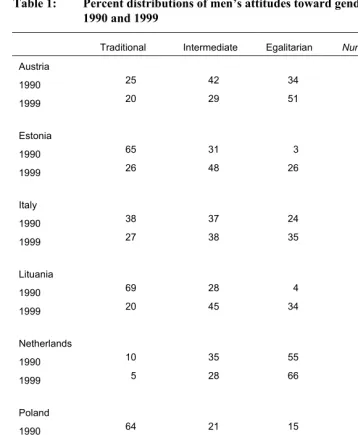
The surveys used in the Puur et al. article were conducted between 2000 and 2003. In order to increase comparability, we focused primarily on the European/ World Values Surveys conducted in 1999, although we used the 1990 survey to explore changes in gender attitudes over the decade (Table 1).
The published findings (Puur et al. 2008) relate both to the intended number of children and to the actual number of children ever born to men aged 35-44. Neither intended nor expected number of children were measured in the 1999 European/World Values Surveys; thus, our comparisons focus on the cumulative number of children ever born to men 35-44 years of age.
4. Results
As Table 1 indicates, the short period between 1990 and 1999 witnessed significant increases in egalitarian attitudes in all of the surveyed countries except West Germany. Particularly dramatic rises occurred in Estonia and Lithuania. As expected, and in accordance with Puur et al., our data revealed that the most egalitarian gender orientations are found in the Netherlands and Austria and the least egalitarian in Poland and Estonia.
Westoff & Higgins: Relationships between men’s gender attitudes and fertility
Table 1: Percent distributions of men’s attitudes toward gender equality 1990 and 1999
Traditional Intermediate Egalitarian Number of men, 20-44
Austria
1990 25 42 34 235
1999 20 29 51 270
Estonia
1990 65 31 3 266
1999 26 48 26 221
Italy
1990 38 37 24 534
1999 27 38 35 486
Lituania
1990 69 28 4 249
1999 20 45 34 242
Netherlands
1990 10 35 55 236
1999 5 28 66 232
Poland
1990 64 21 15 213
1999 39 36 25 216
West Germany
1990 23 35 43 426
1999 30 37 38 362
Table 2: Mean number of children ever born to men ages 35-44 in seven European countries by attitude toward gender equality in two studies
Published Study (Puur et al. 2008) European/World Values Surveys
Traditional Intermediate Egalitarian Traditional Intermediate Egalitarian
Country
Austria 1.4 1.7 1.7 1.3 0.9 0.9
Estonia 1.1 1.9 2.0 1.2 1.3 1.0
Italy 1.2 1.2 1.5 0.8 0.7 0.5
Lithuania 1.8 1.8 2.2 1.7 1.4 1.0
Netherlands 1.1 1.5 1.3 0.8* 0.6
Poland 1.8 2.1 2.3 1.5 1.1 1.1
West
Germany 0.8 1.1 1.3 1.4 1.0 0.6
*Due to small numbers of Dutch men in these two categories, we combined men with "traditional" and "intermediate" gender attitudes into one group.
1/6/2009
To widen the scope of our findings, we conducted the same analysis with all developed countries in the European/World Values Survey data, examining the association between children ever born to men aged 20-44 and the entire 5-item gender index (including the questions 1 and 3 not asked in three of the seven European countries). The countries included Australia, Canada, Japan, New Zealand, Singapore, South Korea, Taiwan, and the United States, as well as 23 European countries.
When using this expanded dataset, we encountered a statistically significant negative relationship between egalitarian attitudes of men and the number of children ever born for 17 of the 31 countries (not shown). The slope was uniformly negative in the other 14 countries, but simply failed to reach a significance level of .05. A similar pattern was found when analyses were confined to men aged 35-44, but the relationship was statistically significant in only 10 of the 31 countries. Finally, we examined the same set of data among women only, and we encountered even stronger results (not shown). This analysis of women is not directly relevant to Puur et al.’s findings, which focus exclusively on men. Rather, we explored the data in this way to determine whether any change in the association of fertility with perceived gender roles might be occurring among women.
Westoff & Higgins: Relationships between men’s gender attitudes and fertility
5. Discussion
This small study was prompted by a recent analysis by Puur et al., 2008, who found that, in eight European countries, men with egalitarian gender attitudes both desired and had more children than men with more traditional gender attitudes. We were surprised by the power, magnitude, and policy implications of these findings, so much that we moved to explore a similar research question with an alternate dataset—the European/World Value Surveys. Yet in analyzing data from the seven of the same eight countries, we reached a very different conclusion. Instead of a positive relationship between men’s egalitarian attitudes and fertility, we found—without exception—a negative association, not only in the selected European countries but also in a considerable number of other developed countries.
We also wish to draw attention to a recent analysis by Dimiter Philipov (Philipov 2008), which reported findings from 11 European countries using the same dataset as Puur et al. Using a three-fold approach to gender, Philipov reported mixed results between gender egalitarian attitudes and fertility. He found no statistically significant relationships between the three gender factors and intentions to have a second or higher order child. Among women, more modern attitudes were correlated with lower intentions to become parents, but the opposite correlation was observed for men in several countries.
What accounts for these divergent findings?
These three different sets of results are most likely a result of differences in measurement of “gender egalitarianism”. Philipov (2008), for example, divided gender issues into three categories: gender-role ideology, consequences for the family, and economic consequences. Only one of the four items in the gender-role ideology cluster was used by Puur et al. (“It is not good if the man stays at home and cares for the children and the woman goes out to work”). Another item in the Puur et al. paper is in the “consequences for the family” dimension (“Family life often suffers because men concentrate too much on their work”). The third remaining item in their index (“For a man the job should be more important than the family”) was not included in any of Philipov’s categories. None of the gender items we used in our own analysis are verbatim matches to those used by Philipov or Puur et al., although they pertain to gender ideology more than to economic or familial consequences.
and professional opportunities, participation in household decision-making, shared domestic labor, gender ideology attitudes, etc.) (Larsen and Hollos 2003). Other scholars have emphasized the importance of domestic labor over paid labor in shaping the relationship between gender and fertility; women who participate equally with their male partners and peers in the labor force but who still bear the brunt of labor at home are likely to want fewer children (McDonald 2000; Torr and Short 2004). As we described above, sometimes even the same survey will ask about gender in different ways in various countries, underscoring the cultural differences in gender systems and adding additional measurement challenges to demographers.
Further, even if demographers were able to agree on the multiple components of gender egalitarianism, challenges persist in how to measure the relationships between gender and fertility (Mason 1997). For example, most studies on this topic, including the three outlined here, are cross-sectional in nature, limiting our ability to see larger changes over time within the same cultural context. Karen Mason has warned against measuring gender at the individual, attitudinal level versus the aggregate level, given gender’s manifestation in all aspects of society—personal, political, cultural, and structural (Mason 1997). What’s more, several scholars have described how gender systems condition the impact of other influences on fertility rather than create it outright (Chesnais 1996; Mason and Smith 2000). So for example, men’s openness to equal sharing of domestic and parenting responsibilities will have a stronger influence on fertility outcomes in some settings over others, depending on the overall tenor of the gender system in a particular.
A final problem in comparing and evaluating studies on gender and fertility pertains to differences in measures of fertility and not merely differences in measures of gender equality. For example, although Puur et al. explored men’s desired as well as completed fertility, we were only able to examine children ever born (CEB) with the European/World Values Survey. Thus, analyses can also be stymied by non-parallel measures of fertility outcomes.
Thus, we wish to caution readers of Puur et al.’s analysis against drawing the universal conclusion that men with more gender egalitarian attitudes desire and have more children. Rather, their—and our—results might be best interpreted in the following way: some measures of gender egalitarianism in some countries appear to be positively associated with higher fertility, while other measures are negatively associated. Given the potential importance of the authors’ findings for the future of European fertility, such a cautionary interpretation seems wise.
Westoff & Higgins: Relationships between men’s gender attitudes and fertility
References
Chesnais, J.C. (1996). Fertility, family, and social policy in contemporary Western Europe. Population and Development Review 22:729-739. doi:10.2307/2137807. Höhn, Ch., Avramov, D., and Kotowska, I. (2008). People, population change and
policies: Lessons from the Population Policy Acceptance Study. [Great Britain]: Springer.
Inglehart, R. and Norris, P. (2003). Rising tide: Gender equality and cultural change around the world. Cambridge, UK; New York: Cambridge University Press. Kaufman, G. (2000). Do gender role attitudes matter? Family formation and dissolution
among traditional and egalitarian men and women. Journal of Family Issues 21:128-144. doi:10.1177/019251300021001006.
Larsen, U. and Hollos, M. (2003). Women's empowerment and fertility decline among the Pare of Kilimanjaro region, Northern Tanzania. Social Science & Medicine 57:1099-1115. doi:10.1016/S0277-9536(02)00488-4.
Mason, K.O. and Smith, H.L. (2000). Husbands' versus wives' fertility goals and use of contraception: The influence of gender context in five Asian countries. Demography 37:299-311. doi:10.2307/2648043.
Mason, K.O. (1997). Gender and demographic change: What do we know? In: G.W. Jones, Douglas, R.M., Caldwell, J.C., and D'Souza, R.M. (eds.). The continuing demographic transition. New York: Clarendon Press. Pp. 158-182
McDonald, P. (2000). Gender equity in theories of fertility transition. Population and Development Review 26:427-439. doi:10.1111/j.1728-4457.2000.00427.x. Philipov, D. (2008). Family-related gender attitudes: The three dimensions--"gender
role ideology", "consequences for the family", and "economic consequences". In: Ch. Höhn, Avramov, D., and Kotowska, I. (eds.). People, population change and policies: Lessons from the Population Policy Acceptance Study. Springer: 153-174.
Puur, A., Olah, L.S., Tazi-Preve, M.I., and Dorbritz, J. (2008). Men's childbearing desires and views of the male role in Europe at the dawn of the 21st century. Demographic Research 19(56):1883-1912.doi:10.4054/DemRes.2008.19.56. Tazi-Preve, I.M., Bichlbauer, D., and Gougon, A. (2004). Gender trouble and its impact
Torr, B.M. and Short, S.E. (2004). Second births and the second shift: A research note on gender equity and fertility. Population and Development Review 30:109-130.
doi:10.1111/j.1728-4457.2004.00005.x.