in the population sciences published by the Max Planck Institute for Demographic Research
Doberaner Strasse 114 · D-18057 Rostock · GERMANY www.demographic-research.org
DEMOGRAPHIC RESEARCH
VOLUME 3, ARTICLE 2
PUBLISHED 17 JULY 2000
www.demographic-research.org/Volumes/Vol3/2/
DOI: 10.4054/DemRes.2000.3.2
Fertility in second unions in Austria:
Findings from the Austrian FFS
Isabella Buber
Alexia Prskawetz
Fertility in second unions in Austria:
Findings from the Austrian FFS
Isabella Buber 1 Alexia Prskawetz 2
Abstract
The simultaneity of decreasing fertility and changing family structures in many European countries has led to a growing interest in fertility behaviour in its relation to different family structures. The growing prevalence of higher-order unions (and the consequences for parity progression arising therefrom) is one example of an ongoing change in fertility behaviour. Childbearing is not restricted to a single union but may extend over several partnerships. Fertility behaviour in higher-order unions is becoming more and more important for determining completed fertility. Motivated by the work of [Vikat et al. 1999], we investigate fertility behaviour in second unions in Austria, focusing on whether and how it is influenced by the number of pre-union children of either partner.
1
Austrian Academy of Sciences, Vienna, Austria;
phone: + 43 (0) 1 712 1284 15; fax: + 43 (0) 1 712 1284 11; e-mail: [email protected]
1. Introduction
Changing family structures together with greater instability of marriages in most industrialised countries require that we revise our traditional concept of families and, in particular, the concept of stepfamilies. Pre-marital childbearing and cohabitational unions are no longer the exception to families in the traditional sense. Childbearing is not restricted to a single-marriage union. In fact, it is not even restricted to a marital union at all. This is of great importance in relation to the concept of completed fertility over one’s life course, since divorce and re-marriage typically occur during the main reproductive years. To take into account these changes in traditional family structures the term stepfamily, formerly restricted to marriages only, has been extended to include cohabitational unions involving a child of only one partner (cf. e.g. [Bumpass et al. 1995]). This extended definition of stepfamilies takes into account the fact that divorced or separated partnerships are often followed by a cohabitational union and not necessarily by a second or higher-order marriage.
Demographic developments in Austria during the past few decades provide evidence that an increasing number of men, women, and children experience the formation of a stepfamily.
Illegitimate (non-marital) fertility has become very pronounced in Austria. In 1998, 30 per cent of all children were born out of wedlock, as compared to 18 per cent in 1980 and 13 per cent in 1970 [Austrian Central Statistical Office 2000]. At the same time, the total divorce rate increased from 18 per cent in 1970 to 26 per cent in 1980 and reached a level of 39 per cent in 1998. This indicates that 39 per cent of all current marriages will sooner or later end in divorce if the duration-specific divorce rate observed in 1998 remains the same in the future. Among divorced couples in 1998, 34 per cent had no children, 30 per cent one child, 27 per cent two children, and nine per cent three or more children. About 63 per cent of the children were below the age of 14. Moreover, a cross-tabulation of marriages in Austria by the family status of each partner at the time of marriage in 1998 (Table 1.a) shows that in three out of ten marriages, at least one of the partners was divorced or widowed. This latter figure had risen from 20 per cent in 1961. Summing up, these trends provide clear evidence for the potential for stepfamilies in Austria (see also [Note1] and [Buber and Prskawetz 1999]).
couple’s relationship to the broader family, which includes children already present at the time of union formation (see [Wineberg 1990]).
Our analysis contributes to the growing literature on stepfamily fertility, which up to now has been based mainly on American data (see the extensive literature review in [Vikat et al. 1999]). European studies are restricted mainly to four countries: Sweden [Vikat et al. 1999], Czechoslovakia [Kucera 1984], Germany [Heekerens 1986], and France [Toulemon 1997]. In line with these studies, we investigate the determinants of childbearing in stepfamilies by focusing on the effect of pre-union children on fertility in second unions (and more specifically, on the conception of the first shared child) [Note 2]. We disentangle the effects of pre-union children by their number, their place of residence (in the household vs. out ofhousehold) at the time of the formation of the second union, by distinguishing between a woman’s and a man’s pre-union children, and by the age of the youngest child at the time of the formation of the second union. Additionally, we also control for the history of the previous union, characteristics of each partner at the time of the formation of the second union, changes in characteristics of the second union as recorded each month during the observation since union formation, calendar time period, and time elapsed since the formation of the second union.
Since we focus on the conception of the couple’s first shared child in a second union, we try to control for the characteristics of both partners. While information on the respondent’s characteristics is generally rather complete in most surveys on union and birth histories, corresponding information for the respondent’s partner is usually missing or incomplete. Though the Austrian Family and Fertility Survey, on which we base our analysis, is of exceptionally high quality in terms of information on the partner’s union and birth histories, we nevertheless have to restrict part of our analysis to male or female respondents only.
As outlined in [Bulatao 1981], several studies have shown that the effect of a couple’s characteristics on childbearing may vary with parity. Hence, if pre-union children are present, the effect of these common characteristics on the first shared child is complicated by the fact that this child might be of higher-order parity for at least one partner. To control for such parity-specific effects we shall test for interactions between variables related to the number of pre-union children and variables referring to the couple’s characteristics.
We structure our analysis by testing various hypotheses about the effects of pre-union children on the intensity of the conception of a first shared child in higher-order unions. More specifically, we refer to the relative importance a first shared child might have for unions where pre-union children are present as opposed to unions where no pre-union children are present (see [Griffith et al. 1985] and [Vikat et al. 1999]). As outlined in [Bulatao and Arnold 1977] (p. 141) “the values or satisfactions individuals expect to attain through having children” in general and through having children with the current partner, “as well as the disvalues or costs they expect to incur”, influence the fertility pattern and fertility preferences. As “children of different parities may serve different functions for their parents and entail different material and non-material costs as well” ([Bulatao 1981], p. 23ff), the value of a first shared child in stepfamilies will depend on the number of pre-union children.
As outlined in the literature, a child might confer a union commitment and a parenthood effect. Since the birth of a first shared child “reflects the couple’s commitment to each other” ([Vikat et al. 1999], p.213), the rate at which a first child arrives in a second union should be independent of the number of children born to either partner before the second union. The parenthood effect is more closely connected to the fertility history of each partner separately, i.e., to the importance of childbearing for the individual’s status as opposed to the status of the marital union (see [Griffith et al. 1985], p.74). It should be present for those partners for which the first shared birth in a second union is also their first birth ever. For them the risk of a first birth in a second union should be independent of the number of pre-union children of their partner. If it is the case that stepchildren can be a substitute for biological children, then the parenthood effect may not be observed when pre-union children are present. The extent to which a stepchild is a substitute for one’s own child certainly depends on emotional and personal relationships between the stepparent and the stepchild (see [Bulatao and Arnold 1977]).
Besides the union-commitment and parenthood effect, a first shared child in stepfamilies may also confer a sibling effect. To the extent that pre-union children will act as half-siblings for children in new unions and substitute for biological children, we can argue as follows. The strong two child norm that is present in Austria [Note 3] may imply that stepfamilies with only one pre-union child may exhibit a higher intensity to conceive a first shared child as opposed to stepfamilies with two or more pre-union children.
childbearing phase later for economic or career reasons. Hence, life course experiences may put some restrictions on continued childbearing in higher-order unions. As further noted in [Griffith et al. 1985] the age of the youngest pre-union child may have different effects, depending on the number of pre-union children.
The age of the youngest pre-union child may also influence the parenthood effect and thereby have the opposite effect of the sibling effect. The younger the pre-union child at the time of the formation of the new union, the more likely it might be accepted by the step-parent and possibly substitute for a shared biological child. We would therefore expect increasing intensities of the conception of a first shared child, the older the youngest pre-union child is at the time of union formation.
2. Data and method of analysis
Our study is based on the Austrian Fertility and Family Survey (FFS) which contains information on individuals concerning partnerships, fertility, employment, education, and habitation [Doblhammer et al. 1997]. The retrospective histories of partnerships and fertility for each respondent allow us to determine the timing of all births in the current and any previous union [Note 4]. Additionally, each respondent was asked whether the partner already had children at the time of union formation and if this was the case, the respondent was asked for the number and residence (living in the current household or not) of the partner’s children at this time. Similarly, we can determine whether or not the respondent’s children live in the current household or not, since for each child of the respondent we know if and when the child has left the household.
Since we wish to analyse the influence of pre-union children on a couple’s shared fertility, we restrict our analysis to the second union [Note 5]. In second unions there are more pre-union children than in first unions; 59.6 per cent of all second unions but only 17.5 per cent of all first unions in the Austrian FFS data set record the existence of one or more pre-union children of at least one partner [Table 1.b]. Furthermore, 81.5 per cent of all higher-order unions in the Austrian FFS data set are of order two [Note 6]. Only 14.5 per cent are of order three and 4 per cent are of an order greater than three.
Among all second unions, the majority recorded at least one pre-union child. In 43.8 per cent of the cases one partner had at least one child while the other partner was still childless, and in 15.8 per cent of second unions both partners had pre-union children. In 38.8 per cent of second unions neither partner had a child [Table 1.b]. Among all third unions the situation is comparable to second unions. These numbers show that in a considerable percentage of higher-order unions at least one partner had one or more pre-union children.
Within the second union, which can, of course, be the current union at the time of the interview, we study the intensity of the conception of a first shared child [Note 7]. By choosing conception instead of birth as the event under consideration we take care of any reverse causality between the event and various covariates, e.g. marriage. If we had taken birth as the event, we would not have been able to verify the causal relationship between marriage and fertility, for instance [Note 8]. Moreover, this set-up of our data allows us to include children conceived within the union but born after the end of the union.
(c) the beginning and end of the second union. As was done in [Griffith et al. 1985], those records where the woman was 40 years or older at the start of the second union [Note 9] were excluded.
Comparing the birthdate of a child with the union biographies allows us to assign a child to a given union if it was born within that union. But what about a child born after the end of the first union and before the formation of the second union or a child born after the interview date? It is questionable whether a child born shortly before two partners moved in together should be defined as their shared biological child, since the data include no further information. To focus on the determinants of childbearing within the second union, we exclude records where a child was born 11 months prior to union formation [Note 10]. On the other hand, we keep those records where the woman was pregnant with the first child of the second union at the time of the interview. For those records where the woman was pregnant at the time of the interview, the event (i.e. the conception of the first child) is set as the expected date of birth – which is coded in our data set – minus nine months.
In the Austrian FFS data set the beginning of a union is coded as the date when the couple moved into a joint household. We start the observation nine months before the time of the formation of the second union, assuming that the couple is already exposed to the risk of the conception of a shared child before they set up a household together. This assumption allows us to include all births that occurred in the second union but were conceived prior to moving in together. The validity of this assumption is strengthened by the fact that about 68 out of a total of 339 children born in second unions were conceived before a common household was established. If the difference between the end of the first and the beginning of the second union is less than nine months, we distinguish between two cases. On the one hand, we determine the start of the observation to be the end of the first union if the latter ended in divorce. But if, on the other hand, the first union ended because the partner died, we set the starting time to be the time of formation of the second union, i.e., the date when the respondent forms a joint household with his/her second partner. Behind this latter assumption lies the fact that the death of a partner is not predictable, in contrast to an upcoming divorce. Our set-up is arranged such that that we exclude those unions where the conception of the first child of the second union falls within the first union. In the following analysis “start of the second union” is always to be understood as the time point when the respondent is assumed to be exposed to the risk of conceiving a first shared child. We set the start of the time of exposure nine months prior to union formation at the earliest, and at the date of union formation at the latest.
child who was born before the union, 151 records are censored at the date of disruption of the union and 199 records are censored at the date of the interview because no child was born.
Since we do not have any clear knowledge about the time dependence of the process, we model the intensity of the conception of a first common child within the second union using a
piecewise constant exponential model (see [Blossfeld and Rohwer 1995]):
h(t) = exp(αl(t)+A(t)β)
Here l(t) is the number of the interval of constancy that contains time t, and αk is a constant
associated with the kth time interval. A(t) denotes a row vector of categorical covariates (including also time-varying covariates, which may change their value over the process time), and β represents the associated column vector of coefficients assumed not to vary across time intervals.
We split the duration variable into eight time intervals: 1st – 5th month, 6th – 9th month, 10th – 15th month, 16th – 21st month, 22nd – 33rd month, 34th – 45th month, 46th – 69th month, and 70th month and later. Keeping in mind that for 71.3 per cent of all respondents the start of observation begins nine months prior to moving in together, these intervals can, for the majority of respondents, be described as following: nine to five months before moving in together, four to one month before moving in together, “formal” start of union (i.e. the time when the couple moved into a common household), up to five months after moving in together, six to eleven months after moving in together, second year, third year, fourth to fifth year after moving in together and finally sixth year onward.
Within each of these eight time intervals transition rates are assumed to be constant, but we allow transition rates to vary across the intervals. In a first step we postulate that only the baseline transition rate – as given by the interval-specific constant transition rates αk – can vary
across time intervals and that each covariate has the same proportional effect in each time interval. In a second step we test for interactions between covariates and interactions between covariates and the duration parameter. The latter extension allows us to test whether the proportionality assumption of the regression model is justified for each of the covariates under investigation.
3. Covariates
For each of the 695 respondents in our data set we calculate the number of pre-union
children of the respondent and his or her partner. We consider a child as belonging to the second
union if it is born at union formation or later [Note 11].
In contrast to the Swedish data used in [Vikat et al. 1999], the Austrian FFS includes very detailed information on the partner’s pre-union children and whether and how many pre-union children the respondent and the partner have brought into the new household, but the information on the partner’s pre-union children proved to be very inconsistent.
Consider the variable age of the youngest child at the start of the second union. To construct this variable we first verified the matching between stepchildren in the respondent’s birth biography and the number of the partner’s pre-union children indicated in the partner’s biography. Fifty persons reported that their partner brought at least one pre-union child into the household at the time of the formation of the second union, but only for twelve (among those 50) respondents did these children show up as stepchildren in the birth biography of the respondent him-/herself. Hence, for 38 respondents we do not have any information on the birth date of the partner’s pre-union children and consequently we cannot take into consideration these children in constructing the age of the youngest child at the start of the second union [Note 12]. As a solution to this data inconsistency we include the variable age of the youngest child only in regressions where we base our calculations on female respondents only. This practice is justified by the fact that the youngest child is the child that is most likely to be brought into the new household and women are more likely than men to bring their pre-union children into their second union. The age of the youngest child varies across the duration variable, but for our analyses we code the variable as a fixed covariate by calculating the age of the youngest child at
the start of the second union. The number of resident and non-resident pre-union children of
either partner is also a fixed covariate and is only recorded at the time of the formation of the
second union. Since we do not have any further information on changes of residence of the
partner’s children, we cannot re-code the variable for the point of time of the start of the second union. But one can argue that it is usually foreseeable at the start of a union if a pre-union child will join the joint household or not.
partner who does not have any pre-union children, may be stronger in the case of older children, since they are less likely to be considered substitute for a biological child. The distribution of occurrences and exposures across the different levels of the variable age of the youngest child is summarised in Table 2 of the Appendix.
Instead of explaining the intensity of conception of a first common child in terms of the respondent’s and partner’s characteristics and including the sex of the respondent as a further covariate (see [Vikat et al. 1999]), we directly distinguish between a woman’s and a man’s characteristics within the set of alternative covariates [Note 13]. We kept the gender in our models to be able to check whether our results differ between couples depending on whether the respondent is male or female. As we only know that it is the second-order union for the respondent, the argument would be that women who are partners of men for whom it is the second union are different from women who are themselves already in their second union. Similarly, the reverse argument holds for men, i.e., men in second unions may be different from male partners in unions that are the second unions for women.
Among the second unions considered in our study, 43.7 per cent of all female partners indicate at least one pre-union child, while only 26.8 per cent of male partners have had at least one pre-union child (Appendix, Table 1). Distinguishing between pre-union children living in the household and those not living in the household at the time of the formation of the second union emphasises our previous discussion. Female partners are more likely to bring their pre-union child(ren) into the newly formed household. 41.6 per cent of all female partners indicate that they have brought at least one of their pre-union children into the household, while the corresponding number for men is only 5.3 per cent (Appendix, Table 1). Even when we take into account that male partners indicate on average about 40 per cent fewer pre-union children than female partners, this difference is significant.
Some obvious differences between female respondents and female partners and male respondents and male partners, respectively, are clearly evident in our data set (Appendix, Table 2 and Table 3). About 54 per cent of all female respondents have pre-union children, as compared to 19 per cent of all women who are partners of male respondents. For men the difference is less pronounced. 36 per cent of all male respondents have pre-union children, while only 23 per cent of men who are partners of female respondents indicate having pre-union children.
Besides pre-union children, we have also experimented with a set of covariates that might pick up some individual characteristics (Appendix, Table 1).
For analysing the effect of the age of both partners we chose the representation woman’s
age at the start of the second union and man’s age at the start of the second union. 77.1 per cent
the woman’s age at the start of the second union) is particularly important since our results would otherwise be confounded by the argument that there is a negative age effect on fertility in second unions. Another argument for lower fertility could also be greater age-heterogamy (large age differences between the partners) in second unions.
To capture other characteristics of the first union in addition to any pre-union child, we also include the dissolution form of the first union and whether the respondent has been formerly
married. Since information on the characteristics of the preceding union is only available for the
respondent, we shall run gender-specific regressions in the next section once we have included these factors in our analysis [Note 14]. Before considering the distribution of occurrences and exposures across these covariates we have to explain briefly the relevant information contained in the Austrian FFS.
For each union the following dates and characteristics are recorded: union status (married vs. cohabiting) at time of union formation, date of marriage, the reason for union disruption if one had occurred (whether the respondent broke the union or his/her partner or both partners, or whether the partner died). To arrive at a compact representation for the covariate ‘dissolution form of the preceding union’, we have used only three alternative levels: separation (regardless of who ended the union), widowed and no answer. In our data set 91.1 (95.5) per cent of all female (male) respondents recorded a union disruption, 4.2 (1.5) per cent recorded that their first partner had died, and 4.6 (3.0) per cent gave no answer (Appendix, Tables 2 and 3). We include the dissolution type of the preceding union in our analysis since the fact whether second unions have come about because of divorce or of widowhood is likely to influence their character [Burgoyne and Clark 1981].
child not ‘feasible’. And the experience of a divorce might also negatively influence the attitude towards further childbearing.
4. Results
We structure our results by setting up models in which we combine both sexes and models which we run separately for female and male respondents.
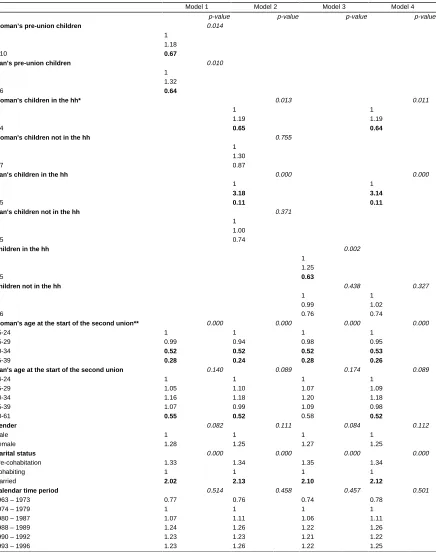
In models where we use both sexes (Table 3) we control for covariates that are available for each partner separately (age, pre-union children) and covariates that are specific to the current union (marital status, calendar time period, duration of union). To obtain a better understanding of the effect of pre-union children on the intensity of the conception of a first common child in a second union, we investigate different representations of the variable ‘pre-union children’. In our first model, we distinguish only between a woman’s and a man’s pre-union children (Table 3, Model 1). In a second step (Table 3, Model 2) we include information on the residence of pre-union children of each partner at the time of the formation of the second pre-union, i.e. whether the child lived in the household at the time of the formation of the second union or not. Our last alternative combines all pre-union children, regardless of whether they belong to the male or female partner, and only distinguishes between pre-union children living in the current household or not living in the household at the time of the formation of the second union (Table 3, Model 3).
The effect coefficients on pre-union children in Table 3 suggest that the intensity of the conception of a first common child in a second union depends essentially on pre-union children living in the household (Model 3) and on whose children one considers (Model 2).
Having more than one pre-union child living in the household at the time of the formation of the second union significantly decreases the intensity of the conception of a first common child as compared to the baseline level of no child in the common household. This result holds irrespective of whether we refer to the total number of pre-union children living in the household (Model 3) or to a gender-specific variable as in Model 2 [Note 15]. This correspondence no longer holds if there is a pre-union child present. The presence of one pre-union child living in the household at the time of the formation of the second union does not effect the rate at which the conception of a first common child occurs (as compared to having no pre-union child living in the household) if it is the woman’s child, but it significantly increases the intensity of the conception of a first common child if it is the man’s child (Model 2). Later on we show that it is a special combination of a woman’s and a man’s pre-union children living in the household that determines this high intensity.
The effect coefficients on the other covariates included in our regressions are robust across the four models (Table 3). While the woman’s age at the start of the second union is significant – the intensity of the conception of a first common child decreases with increasing age – the man’s age at the start of the second union does not significantly influence the intensity of a conception. This result supports the general findings that the woman’s biological age is an important factor as regards fertility in second unions but that the man's age is not. The intensity of the conception of a first child is twice as high for married couples as it is for couples who are cohabiting. The intensity is higher during the pre-cohabitation time than it is in the cohabitational period, but not significantly. The calendar period of observation turns out not to be significant, but there seems to be some increase in the conception intensity over calendar time.
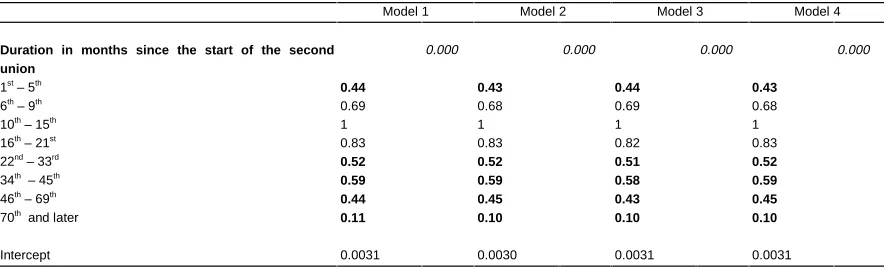
For the duration variable we observe a non-monotonic shape. The highest intensity of the conception of a first common child is observed from the 10th to the 15th month of observation. For 71.3 per cent of our respondents this period corresponds to the first half year after moving in together. For the period from the 16th to the 21st month, which corresponds to the second half of the first year after union formation for the majority of respondents, the intensity of the conception of the first child does not differ significantly from the baseline level of conceiving a child in the period from the 10th to 15th month. But from the 22nd month (the second year after union formation) onward, we observe a pronounced decline in the intensity of the conception of a first common child. From the fifth year onward, the intensity of the conception of a first common child is only one tenth of the baseline level.
Further interactions that proved to be statistically but not substantively significant are relegated to Appendix A.
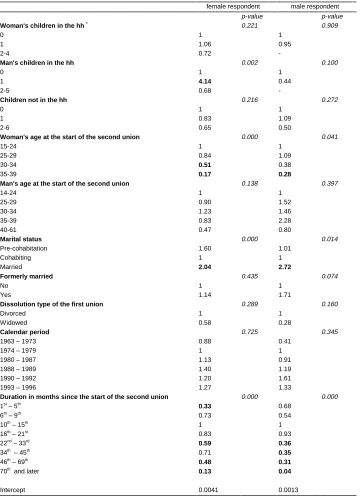
To control for characteristics of the preceding union (which are only available for the respondent) we run regressions for female and male respondents separately (Table 4 and Table 5). In fact, running gender-specific models might reveal another important aspect of our set-up that has been neglected so far. Recalling that we can only determine the order of the union for the respondent, the models in Table 3 neglect the fact that women whose second union we consider may be different from women that are partners of men whose second union we consider. It might be a reasonable assumption that men who enter a second union are more likely to have female partners for whom it might be the first union. On the other hand, women who enter their second union might be more likely to have male partners for whom it is already the second or a higher-order union [Note 17]. Hence, gender-specific models may result in differing effect coefficients on gender-specific variables, although we have not yet found any significant influence of the covariate “gender” on the conception intensities in models where both sexes are combined.
Gender-specific models show no significant influence on first conception intensities of the analysed characteristics of the first union, i.e. the dissolution type of the former union and whether or not the respondent was formerly married. We could not find a reduced risk of a first common child if the male respondent was formerly married, as [Heekerens 1986] did for German data and [Griffith et al. 1985] for U.S. data. Nor did we find a higher risk for previously widowed women compared to women whose first marriage ended in divorce, as was found for American data by [Wineberg 1990] [Note 18].
The effect coefficients on the other covariates are pretty much consistent with the results in Table 3 – with some exceptions that might well be caused by the previously mentioned caveat that the behavior of female respondents might differ from that of female partners of male respondents whose second union we consider. Most striking is the fact that among all pre-union children the presence of the man’s children in the household have an effect on the conception of the first shared child only for female respondents and not for male respondents. Further investigation shows that, again, this effect is caused by couples with the following characteristics: the woman – whose second union we are concentrating on – is still childless and the man brings one pre-union child into the common household.
5. Discussion
In this study we have considered the intensity of the conception of a first shared child among couples where the current union is the second union for at least one partner. Half of these couples had a child in their second union, which is consistent with the level of childbearing following remarriage found by [Griffith et al. 1985] and [Kucera 1984]. Among those who had a child in their second union, six out of ten conceived the child within the first two years. And among this group, three out of ten conceptions occurred even before the couple moved into a joint household. For the majority of couples, the shared pregnancy came rather quickly.
We sum up our results by considering the value a first child may confer if pre-union children are present as opposed to the situation where the first shared child in the second union is the first child for both partners.
The rate at which a childless respondent has a first shared conception is independent of the partner’s number of children, and it is not higher than for respondents who already have a pre-union child. We therefore conclude that our results do not support the presence of a parenthood effect. The explanation that a stepchild may substitute for a biological child and hence counteract the parenthood effect for childless partners does not seem to be valid either, for we could not find a significant interaction between the woman’s and the man’s pre-union children. However, the union commitment effect is present both for female and male respondents when they have fewer than two pre-union children, as it is if we restrict the hypothesis to pre-union children not living in the household at the time of the formation of the second union (compare Model 4, Table 3). These results are in agreement with the findings of [Kucera 1984] but in contrast to those of [Vikat et al. 1999] and [Griffith et al. 1985], where the union commitment effect is independent of the number of pre-union children. These differing results could stem from differences in information about the partner’s pre-union children contained in these studies. In the study by [Vikat et al. 1999] information on the partner’s pre-union children is restricted to responses to the question ‘Did the partner have any children who joined the current union?’ By contrast, our study allows us to control for the exact number of pre-union children from either partner.
living in the household corresponds to the results reported in [Kucera 1984] and [Toulemon 1997].
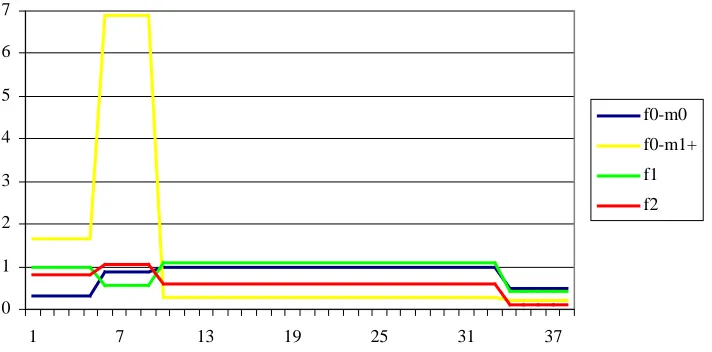
The Swedish study [Vikat et al. 1999] has shown that a man’s parity counts as much as the female partner’s parity in determining a couple’s shared parity. This is also the case for Austria, but in the Austrian data the man’s parity counts even more if he has a pre-union child living in the household (Model 4 in Table 3). This result is in accordance with the findings in [Toulemon 1997], who found that the risk of having a first shared birth increases if the man had a pre-union child living in the household. But as we have shown in Figure 1, the higher intensity of the conception of a first common child for couples where the man brings a child into the household only holds when the woman has no pre-union child living in the household at the time of formation of the second union. These results demonstrate that a first common child is conceived at a rate which not only depends on the man’s and the woman’s parity separately but also on the combination of the two. Even more specifically, the elevated intensity of the conception of a first common child for such couples will only hold during the first nine months after the start of the second union (compare Figure 1). This could indicate that the woman strongly wants to have a common biological child very quickly after the start of the union.
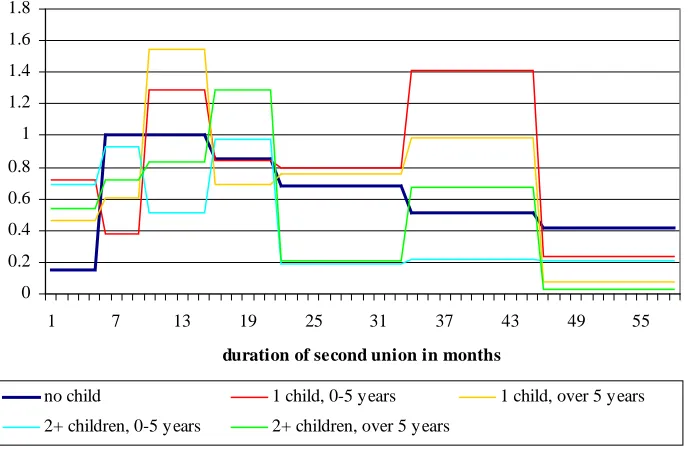
To control not only for the woman’s and the man’s parity but also for the age of the youngest child at the start of the union, we have had to restrict our analysis to female respondents only. The results (Table 5 and Figure 2) show that the age of the youngest child at the start of the union has an important influence on the rate at which a first common child is conceived in the second union. Not only do we observe higher first conception intensities if the youngest child is under the age of five at the start of the second union, our results also indicate that the intensity of conception may increase with the duration of the second union for those couples.
6. Acknowledgments
Notes
1. The fact that stepfamilies play a considerable role in the Austrian society has also been demonstrated in the study ‘Kindsein in Österreich’ by [Wilk 1998]. Among a representative sample of 2,745 children aged 10 who were interviewed in 1993 on various topics related to their family, school, spare-time, etc., about 6 to 8 per cent reported that they lived in a stepfamily.
2. Note that we use the respondent’s order of the union as the defining characteristic of stepfamilies as opposed to the common definition of stepfamilies that relies on the presence of pre-union children of either the respondent or the partner. Our definition of stepfamilies therefore excludes possible first unions of respondents where pre-union children are already present and, on the other hand, we include second unions where neither the respondent nor the partner has any pre-union children. The latter assumption is used so as to compare stepfamily fertility, i.e., if at least one partner has union children, with fertility if no pre-union children are present. The selection criteria of considering second pre-unions only will be discussed in section 2.
3. In the Austrian Family and Family Survey approximately 49% of all male and 51% of all
female respondents indicated two children as the ideal norm for a family [UNECE/UNPF 1999].
4. The beginning of a union is defined as the point in time the couple starts living together and sharing a common household.
5. 16.3 per cent of all respondents recorded a second or even higher-order union.
6. This number differs when we distinguish between male and female respondents. It is 76.0 per cent for male and 83.6 per cent for female respondents.
7. Pregnancies that did not lead to a live birth or an abortion were not considered in our analyses since the data available do not include such information.
8. In Austria a third of all children of parity one are conceived before marriage and born after marriage formation, the pregnancy being the incentive for the marriage. Although the first common child in a second union can be of parity two or higher and despite of the fact that the above percentage does not directly refer to second unions considered in our paper, one should keep in mind a couple’s tendency to marry when the woman is pregnant.
10.The exclusion of those who had a birth shortly before the union formation is similar as in [Griffith et al. 1985]. Children born more than 11 month before the formation of the second union are considered as pre-union children.
11.Our data set includes five records where the first child of the second union was conceived within the second union but born after the end of the second union. In none of the five cases was a third union recorded to which the child might have been assigned if the third union had been formed soon after the end of the second union.
12.We thank Elizabeth Thomson for the suggestion that we should conduct methodological
studies to verify whether men and women are equally good reporters of their own and their partner’s children. In U.S. data Elisabeth Thomson found that men’s reports of union and birth dates have more inconsistencies than do corresponding reports of women. Among those 38 respondents who underreported stepchildren 17 were women, and almost the same number (21 persons) were men, which corresponds to 3.4 per cent among female and 10.6 per cent among male respondents. We thereby confirm Thomson’s findings for our Austrian data as well.
13.We are grateful to Hans-Peter Kohler for suggesting this alternative viewpoint to us.
14.Only in the case that the couple was not married at union formation the respondent was asked whether the partner was single, married, widowed, divorced or separated at the time of union formation. If the couple was married when they moved into a joint household, this question was not posed and we have incomplete information on the partner’s previous union. This is why we had to run gender-specific regressions.
15.Our sample includes only one occurrence where the man brought two children into the
common household. The corresponding coefficient is significant and very small (0.11). To see whether our model is robust, we excluded this one case. The coefficient for “one child of the man living in the household” then changed from 3.18 to 3.13, which is still significant. In a second step we formed two categories for the man’s pre-union children living in the household at the time of the formation of the second union, namely “none” and “one or more”. In this case the covariate “man’s pre-union children living in the household” is no longer significant, indicating that the opposite and significant effects for “one” (3.18) and “two or more” (0.11) “neutralise” to 1.27, which is no longer significant. We therefore retain three levels of the covariate “man's pre-union children living in the household”.
16.Note that we have combined various levels of the three-way interactions, in particular we have reduced the duration variable to at most 4 levels.
childless female respondents (46.17 per cent). If we assume that women with pre-union children have also had previous unions to a higher extent, our argument follows.
18.While about half of all respondents reported that they have formerly been married, widowed respondents constitute a very distinct group: four per cent of female and two per cent of male respondents were widowed.
References
Austrian Central Statistical Office. (2000). Demographisches Jahrbuch Österreichs 1998, Vienna. Blossfeld, H.-P., G. Rohwer. (1995). Techniques of Event History Modeling: New Approaches to
Causal Analysis. Lawrence Erlbaum Associates, New Jersey.
Bumpass, L.L., R.K. Ralley and J.A. Sweet. (1995). “The changing character of stepfamilies: implications of cohabitation and nonmarital childbearing.” Demography, Vol. 32, No. 3, 425-436.
Buber, I. and A. Prskawetz. (1999). “Mein Kind - dein Kind - unser Kind: Der Einfluss von vor-partnerschaftlichen Kindern auf das Fertilitätsverhalten in zweiten Lebensgemeinschaften.”
Demographische Informationen 1997/1999, 11-19.
Bulatao, R.A. (1981). “Values and disvalues of children in successive childbearing decisions.”
Demography 18, 1-25.
Bulatao, R.A. and F. Arnold. (1977). “Relationships between the value and cost of children and fertility: Cross natural evidence.” International Population Conference, Mexico 1977, Vol. 1, 141-156.
Burgoyne, J. and D. Clark. (1981). Parenting in stepfamilies, in: R. Chester, P. Diggory and MB. Sutherland (eds.) Changing Pattern of Childbearing and Childrearing. London: Academic Press: 133-147.
Cherlin, A.J. (1992). Marriage, divorce and remarriage. Havard University Press.
Corijn, M., A.C. Liefbroer and J.d.J.Gierveld. (1996). “It takes Two to Tango, Doesn’t it? The Infleunce of Couple Characteristics on the Timing of the Birth of the First Child.” Journal
of Marriage and the Family 58: 117-126.
Doblhammer, G., W. Lutz and C. Pfeiffer. (1997). Tabellenband und Zusammenfassung erster Ergebnisse: Familien- und Fertilitätssurvey (FFS) 1996. Österreichisches Institut für Familienforschung.
Furstenberg F.F. (1980). “Reflections on remarriage.” Journal of Family Issues 1: 433-453 Griffith, J.D., H.P. Koo and C.M. Suchindran. (1985). “Childbearing and family remarriage.”
Demography 22: 73-88.
Heekerens, H.P. (1986). “Generatives Verhalten Wiederverheirateter.” Zeitschrift für
Bevölkerungswissenschaft 12: 503-517.
Hoem, J.M. (1987). “Statistical analysis of a multiplicative model and its application to the standardization of vital rates: A review.” International Statistical Review 55, 119-152. Hoem, J.M., A. Prskawetz and G. Neyer. (1999). “Third births in Austria: the effect of public
policies, educational attainment, and labor-force attachment.” Working paper 1999-002, Max Planck Institute for Demographic Research, Rostock.
Kucera, M. (1984) “Poldnost zen v opakovanych manzelstvich.” (Fertility of women in repeated marriages). Demografie 16, 289-96.
Rosenstiel, L.V., E. Spiess, M. Stengel and F.W. Nerdinger. (1984). “Lust auf Kinder? Höchstens 1.” Psychologie Heute 5, 20-31.
Thomson E., and J.M. Hoem. (1998). “Couple childbearing plans and births in Sweden.”
Demography 35, 315-322.
Toulemon, L. (1997). “The fertility of step-families: The impact of childbearing before the current union.” Paper for the Annual Meeting of Population Association of America, Washington, DC.
UNECE/UNPF (United Nations Economic Commission for Europe/United Nations Population Fund). (1998). Fertility and Family Surveys in Countries of the ECE Region. Standard Country Report. Austria, New York and Geneva: United Nations.
Vikat, A., E. Thomson and J.M. Hoem. (1999). “Stepfamily fertility in contemporary Sweden: the impact of childbearing before the current union.” Population Studies 53, 211-225. Wilk, L. (1998). “Chancen und Probleme von Stieffamilien.” Unpublished report, Linz.
Appendix A:
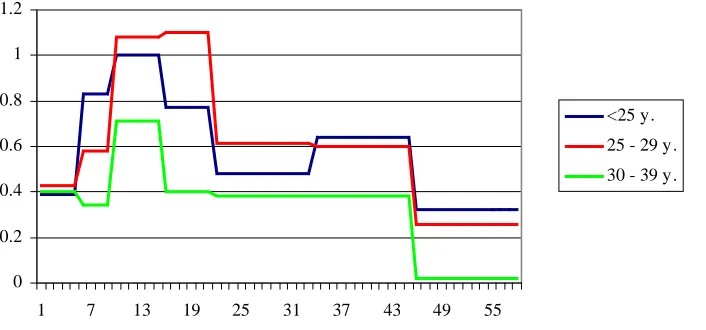
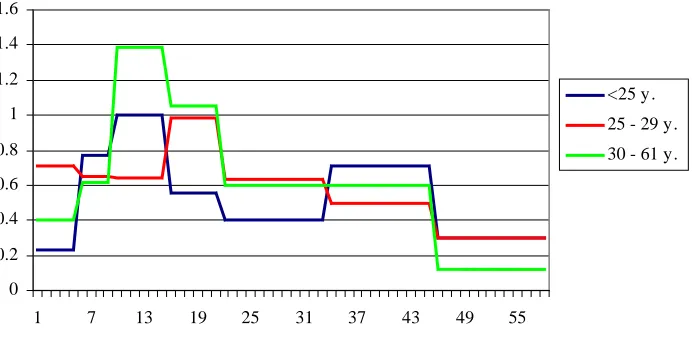
The shape of the duration effect differs across the woman’s and the man’s age groups (Figure 3 and Figure 4). For women the baseline hazard is slightly altered for the age group 25– 29. Not only is this the age group that exhibits the highest intensity of a first child. In addition, the duration across which this intensity can be observed is prolonged up to the 21st month as compared to the baseline hazard in Model 4 (Table 3), where the highest intensity could be observed from the 10th to the 15th month. For the man’s age the baseline hazard is shifted to the right in the age group 25–29, i.e., the highest intensity of the conception of a first child is observed from the 16th to the 21st month. In contrast, the highest intensities of the baseline hazard for the other age groups are observed already from the 10th to the15th month [Note 19].
Appendix B:
Appendix Table 1:
Basic counts in the present analysis
Factor Occurrences and exposures distributed Respondents distributed over selected characteristics by characteristics Occurences Exposures Number of
Half-months Per cent Respondents Per cent FIXED CHARACTERISTICS
Woman’s pre-union children
0 194 32,895 48.59 391 56.3
1 109 18,934 27.97 190 27.3
2-10 36 15,864 23.44 114 16.4
Man’s pre-union children
0 259 47,109 69.59 509 73.2
1 54 8,893 13.14 103 14.8
2-6 26 11,691 17.27 83 11.9
Woman’s pre-union children living in the household at the time of the formation of the second union
0 200 34,996 51.70 406 58.4
1 108 19,433 28.71 189 27.2
2-4 31 13,264 19.59 100 14.4
Woman’s pre-union children not living in the household at the time of the formation of the second union
0 328 63,098 93.21 664 95.5
1 9 2,549 3.77 21 3.0
2-7 2 2,046 3.02 10 1.4
Man’s pre-union children living in the household at the time of the formation of the second union
0 322 62,972 93.03 658 94.7
1 16 1,751 2.59 25 3.6
2-5 1 2,970 4.39 12 1.7
Man’s pre-union children not living in the household at the time of the formation of the second union
0 275 49,747 73.49 537 77.3
1 39 8,902 13.15 88 12.7
2-5 25 9,044 13.36 70 10.1
Pre-union children living in the household at the time of the formation of the second union
0 189 32,861 48.54 385 55.4
1 114 18,530 27.37 196 28.2
2-5 36 16,302 24.08 114 16.4
Pre-union children not living in the household at the time of the formation of the second union
0 268 47,401 70.02 519 74.7
1 44 9,655 14.26 97 14.0
2-6 27 10,637 15.71 79 11.4
Woman’s age at the start of the second union
15-24 170 27,852 41.14 314 45.2
25-29 122 17,926 26.48 222 31.9
30-34 35 13,656 20.17 102 14.7
35-39 9 8,031 11.86 53 7.6
Appendix Table 1 (cont’d): Basic counts in the present analysis
Factor Occurrences and exposures distributed Respondents distributed over selected characteristics by characteristics
Occurences Exposures Number of
Half-months Per cent Respondents Per cent Man’s age at the start of the second union
14-24 111 17,676 26.11 214 30.8
25-29 104 19,124 28.25 200 28.8
30-34 78 14,669 21.67 151 21.7
35-39 27 7,402 10.93 66 9.5
40-44 10 4,635 6.85 35 5.0
45-49 1 2,119 3.13 13 1.9
50-61 1 820 1.21 4 0.6
No answer 7 1,248 1.84 12 1.7
Gender
Male 76 17,329 74.40 199 28.63
Female 263 50,364 25.60 496 71.37
TIME-VARYING CHARACTERISTICS Marital status
Pre-cohabitation 56 9,413 13.91
Cohabiting 162 36,722 54.25
Married 121 21,558 31.85
Calendar time period
1963 – 1973 18 2,832 4.18
1974 – 1979 42 6,852 10.12
1980 – 1987 103 20,042 29.61
1988 – 1989 42 8,197 12.11
1990 – 1992 69 14,098 20.83
1993 – 1996 65 15,672 23.15
Duration in months since the start of the second union
1st – 5th 31 6,792 10.03
6th – 9th 37 5,142 7.60
10th – 15th 68 6,940 10.25
16th – 21st 48 5,864 8.66
22nd – 33rd 47 9,149 13.52
34th – 45th 45 6,895 10.19
46th – 69th 42 8,975 13.26
70th and later 21 17,936 26.50
Appendix Table 2:
Basic counts in the present analysis, female respondents
Factor Occurrences and exposures distributed Respondents distributed
over selected characteristics by characteristics
Occurences Exposures Number of
Half-months Per cent Respondents Per cent
FIXED CHARACTERISTICS Woman’s pre-union children
0 130 19,993 39.70 229 46.17
1 98 16,362 32.49 166 33.47
2-10 35 14,009 27.82 101 20.36
Man’s pre-union children
0 209 37,011 73.49 381 76.81
1 33 6,023 11.96 63 12.70
2-6 21 7,330 14.55 52 10.48
Woman’s pre-union children living in the household at the time of the formation of the second union
0 135 21,264 42.22 238 47.98
1 97 16,538 32.84 164 33.06
2-4 31 12,562 24.94 94 18.95
Woman’s pre-union children not living in the household at the time of the formation of the second union
0 253 47,214 93.75 474 95.56
1 9 1,642 3.26 16 3.23
2-7 1 1,508 2.99 6 1.21
Man’s pre-union children living in the household at the time of the formation of the second union
0 252 48,245 95.79 477 96.17
1 10 1,352 2.68 16 3.23
2-5 1 767 1.52 3 0.60
Man’s pre-union children not living in the household at the time of the formation of the second union
0 219 37,792 75.04 394 79.44
1 24 5,572 11.06 52 10.48
2-5 20 7,000 13.90 50 10.08
Pre-union children living in the household at the time of the formation of the second union
0 130 20,671 41.04 231 46.57
1 97 16,020 31.81 164 33.06
2-5 36 13,673 27.15 101 20.36
Pre-union children not living in the household at the time of the formation of the second union
0 212 35,672 70.83 378 76.21
1 29 6,811 13.52 63 12.70
2-6 22 7,881 15.65 55 11.09
Woman’s age at the start of the second union
15-25 133 20,072 39.85 212 42.74
25-29 95 14,113 28.02 167 33.67
30-34 30 10,969 21.78 83 16.73
35-39 5 5,210 10.34 34 6.85
No answer 0 0 0.00 0 0.00
Man’s age at the start of the second union
14-25 97 14,319 28.43 161 32.46
25-29 76 14,272 28.34 142 28.63
30-34 57 9,459 18.78 99 19.96
35-39 19 5,088 10.10 46 9.27
40-44 5 3,101 6.16 21 4.23
45-49 1 2,057 4.08 11 2.22
50-61 1 820 1.63 4 0.81
No answer 7 1,248 2.48 12 2.42
Dissolution type of the first union
Divorced 256 43,498 86.37 452 91.13
Widowed 8 2,966 5.89 21 4.23
Appendix Table 2 (cont’d):
Basic counts in the present analysis, female respondents
Factor Occurrences and exposures distributed Respondents distributed
over selected characteristics by characteristics
Occurences Exposures Number of
Half-months Per cent Respondents Per cent
Formerly married
No 125 17,420 34.59 222 44.76
Yes 152 30,972 61.50 271 54.64
No answer 1 341 0.68 3 0.60
Age of the youngest child at the start of the second union
No child 130 19,993 39.70 229 46.2
1 child 1-36 months 32 5,117 10.16 51 10.3
1 child 37-60 months 34 4,216 8.37 50 10.1
1 child 61-84 months 12 2,351 4.67 23 4.6
1 child 85+ months 20 4,678 9.29 42 8.5
2+ children 1-36 months 7 2,101 4.17 17 3.4
2+ children 37-60 months 12 3,083 6.12 27 5.4
2+ children 61-84 months 4 3,601 7.15 23 4.6
2+ children 85+ months 12 5,224 10.37 34 6.9
TIME-VARYING CHARACTERISTICS
Marital status
Pre-cohabitation 43 6,815 13.53
Cohabiting 124 26,984 53.58
Married 96 16,565 32.89
Calendar time period
1963 – 1973 16 2,170 4.31
1974 – 1979 37 5,744 11.40
1980 – 1987 85 15,527 30.83
1988 – 1989 32 5,864 11.64
1990 – 1992 45 9,950 19.76
1993 – 1996 48 11,109 22.06
Duration in months since the start of the second union 1st
– 5th
20 4,854 9.64
6th – 9th 31 3,683 7.31
10th
– 15th
50 4,946 9.82
16th
– 21st
33 4,198 8.34
22nd
– 33rd
40 6,725 13.35
34th
– 45th
39 5,085 10.10
46th
– 69th
31 6,664 13.23
70th
and later 19 14,209 28.21
Appendix Table 3:
Basic counts in the present analysis, male respondents
Factor Occurrences and exposures distributed Respondents distributed
over selected characteristics by characteristics
Occurences Exposures Number of
Half-months Per cent Respondents Per cent
FIXED CHARACTERISTICS
Woman’s pre-union children
0 64 12,902 74.45 162 81.41
1 11 2,572 14.84 24 12.06
2-10 1 1,855 10.70 13 6.53
Man’s pre-union children
0 50 10,098 58.27 128 64.32
1 21 2,870 16.56 40 20.10
2-6 5 4,361 25.17 31 15.58
Woman’s pre-union children living in the household at the time of the formation of the second union
0 65 13,732 79.24 168 84.42
1 11 2,895 16.71 25 12.56
2-4 0 702 4.05 6 3.02
Woman’s pre-union children not living in the household at the time of the formation of the second union
0 75 15,884 91.66 190 95.48
1 0 907 5.23 5 2.51
2-7 1 538 3.10 4 2.01
Man’s pre-union children living in the household at the time of the formation of the second union
0 70 14,727 84.98 181 90.95
1 6 399 2.30 9 4.52
2-5 0 2,203 12.71 9 4.52
Man’s pre-union children not living in the household at the time of the formation of the second union
0 56 11,955 68.99 143 71.86
1 15 3,330 19.22 36 18.09
2-5 5 2,044 11.80 20 10.05
Pre-union children living in the household at the time of the formation of the second union
0 59 12,190 70.34 154 77.39
1 17 2,510 14.48 32 16.08
2-5 0 2,629 15.17 13 6.53
Pre-union children not living in the household at the time of the formation of the second union
0 56 11,729 67.68 141 70.85
1 15 2,844 16.41 34 17.09
2-6 5 2,756 15.90 24 12.06
Woman’s age at the start of the second union
15-25 37 7,780 44.90 102 51.26
25-29 27 3,813 22.00 55 27.64
30-34 5 2,687 15.51 19 9.55
35-39 4 2,821 16.28 19 9.55
No answer 3 228 1.32 4 2.01
Man’s age at the start of the second union
14-25 14 3,357 19.37 53 26.63
25-29 28 4,852 28.00 58 29.15
30-34 21 5,210 30.07 52 26.13
35-39 8 2,314 13.35 20 10.05
40-44 5 1,534 8.85 14 7.04
45-49 0 62 0.36 2 1.01
50-61 0 0 0.00 0 0.00
No answer 0 0 0.00 0 0.00
Dissolution type of the first union
Divorced 79 14,379 82.98 190 95.48
Widowed 1 915 5.28 3 1.51
Appendix Table 3 (cont’d):
Basic counts in the present analysis, male respondents
Factor Occurrences and exposures distributed Respondents distributed
over selected characteristics by characteristics
Occurences Exposures Number of
Half-months Per cent Respondents Per cent
Formerly married
No 31 6,246 36.04 95 47.74
Yes 51 9,469 54.64 103 51.76
No answer 1 107 0.62 1 0.50
TIME VARYING CHARACTERISTICS
Marital status
Pre-cohabitation 13 2,598 14.99
Cohabiting 38 9,738 56.19
Married 25 4,993 28.81
Calendar time period
1963 – 1973 2 662 3.82
1974 – 1979 5 1,108 6.39
1980 – 1987 18 4,515 26.05
1988 – 1989 10 2,333 13.46
1990 – 1992 24 4,148 23.94
1993 – 1996 17 4,563 26.33
Duration in months since the start of the second union 1st
– 5th
11 1,938 11.18
6th
– 9th
6 1,459 8.42
10th – 15th 18 1,994 11.51
16th
– 21st
15 1,666 9.61
22nd
– 33rd
7 2,424 13.99
34th – 45th 6 1,810 10.44
46th
– 69th
11 2,311 13.34
70th
and later 2 3,727 21.51
Table 1a:
Cross-tabulation of marriages by marital status of bride and groom, Austria 1998
Groom single Groom widowed Groom divorced Bride single 26,846 (68.6%) 173 (0.4%) 3,663 (9.4%) Bride widowed 109 (0.3%) 65 (0.2%) 163 (0.4%) Bride divorced 3,575 (9.1%) 299 (0.8%) 4,250 (10.9%)
Source: [Austrian Central Statistical Office 2000]
Remark: Numbers in brackets indicate the percentage in each cell
Table 1b:
Existence of pre-union children among unions of different order in Austria
First union Second union Third union Fourth and higher union
All unions
Neither partner 82.1 % 38.8 % 38.9 % 39.5 % 74.9 %
Only partner 4.1 % 7.4 % 6.7 % 15.8 % 4.7 %
Only respondent 10.5 % 36.4 % 27.5 % 31.6 % 14.6 %
Both partners 2.9 % 15.8 % 22.8 % 13.2 % 5.2 %
No answer 0.3 % 1.6 % 4.0 % 0.0 % 0.6 %
Table 2:
Number of respondents excluded from the analysis and censoring by cause
Total number of records 6,120
A. Exclusions
Cause of Exclusion Count of exclusion
Fewer than two unions 5,296
Foreigner 29
Child died/was adopted before formation of second union 4 Incomplete information on partner’s pre-union children 8 Incomplete information on respondent’s pre-union children 10 No answer on beginning or end of the second union 13 Woman’s age at the time of the formation of the second union 40 years or above 37 Childbirth within 11 months before the formation of the second union 16 Conception of first child born in second union within first union 12
Sum of exclusions 5,425
B. Occurrences
End date
Conception of first child date of conception1 339
C. Censored Cases
Cause2 of censoring Censoring date Count of censored events
No child conceived date of interview 199
Adoption of child date of adoption 2
Death of a child born date of death 4
before the second union
Union disruption date of union disruption 151
1 We included ten couples where the woman was pregnant with the first child of the second union at the date of the
Table 3:
Relative risk of the conception of a first child in a second union; both sexes combined
Model 1 Model 2 Model 3 Model 4
p-value p-value p-value p-value
Woman’s pre-union children 0.014
0 1
1 1.18
2-10 0.67
Man's pre-union children 0.010
0 1
1 1.32
2-6 0.64
Woman's children in the hh* 0.013 0.011
0 1 1
1 1.19 1.19
2-4 0.65 0.64
Woman's children not in the hh 0.755
0 1
1 1.30
2-7 0.87
Man's children in the hh 0.000 0.000
0 1 1
1 3.18 3.14
2-5 0.11 0.11
Man's children not in the hh 0.371
0 1
1 1.00
2-5 0.74
Children in the hh 0.002
0 1
1 1.25
2-5 0.63
Children not in the hh 0.438 0.327
0 1 1
1 0.99 1.02
2-6 0.76 0.74
Woman's age at the start of the second union** 0.000 0.000 0.000 0.000
15-24 1 1 1 1
25-29 0.99 0.94 0.98 0.95
30-34 0.52 0.52 0.52 0.53
35-39 0.28 0.24 0.28 0.26
Man's age at the start of the second union 0.140 0.089 0.174 0.089
14-24 1 1 1 1
25-29 1.05 1.10 1.07 1.09
30-34 1.16 1.18 1.20 1.18
35-39 1.07 0.99 1.09 0.98
40-61 0.55 0.52 0.58 0.52
Gender 0.082 0.111 0.084 0.112
Male 1 1 1 1
Female 1.28 1.25 1.27 1.25
Marital status 0.000 0.000 0.000 0.000
Pre-cohabitation 1.33 1.34 1.35 1.34
Cohabiting 1 1 1 1
Married 2.02 2.13 2.10 2.12
Calendar time period 0.514 0.458 0.457 0.501
1963 – 1973 0.77 0.76 0.74 0.78
1974 – 1979 1 1 1 1
1980 – 1987 1.07 1.11 1.06 1.11
1988 – 1989 1.24 1.26 1.22 1.26
1990 – 1992 1.23 1.23 1.21 1.22
1993 – 1996 1.23 1.26 1.22 1.25
Table 3 (cont’d):
Relative risk of the conception of a first child in a second union; both sexes combined
Model 1 Model 2 Model 3 Model 4
Duration in months since the start of the second union
0.000 0.000 0.000 0.000
1st
– 5th
0.44 0.43 0.44 0.43
6th
– 9th
0.69 0.68 0.69 0.68
10th
– 15th
1 1 1 1
16th – 21st 0.83 0.83 0.82 0.83
22nd – 33rd 0.52 0.52 0.51 0.52
34th – 45th
0.59 0.59 0.58 0.59
46th – 69th
0.44 0.45 0.43 0.45
70th and later
0.11 0.10 0.10 0.10
Intercept 0.0031 0.0030 0.0031 0.0031
Table 4:
Relative risk of the conception of a first child in a second union, gender-specific pre-union experiences
female respondent male respondent
p-value p-value
Woman’s children in the hh * 0.221 0.909
0 1 1
1 1.06 0.95
2-4 0.72
-Man’s children in the hh 0.002 0.100
0 1 1
1 4.14 0.44
2-5 0.68
-Children not in the hh 0.216 0.272
0 1 1
1 0.83 1.09
2-6 0.65 0.50
Woman’s age at the start of the second union 0.000 0.041
15-24 1 1
25-29 0.84 1.09
30-34 0.51 0.38
35-39 0.17 0.28
Man’s age at the start of the second union 0.138 0.397
14-24 1 1
25-29 0.90 1.52
30-34 1.23 1.46
35-39 0.83 2.28
40-61 0.47 0.80
Marital status 0.000 0.014
Pre-cohabitation 1.60 1.01
Cohabiting 1 1
Married 2.04 2.72
Formerly married 0.435 0.074
No 1 1
Yes 1.14 1.71
Dissolution type of the first union 0.289 0.160
Divorced 1 1
Widowed 0.58 0.28
Calendar period 0.725 0.345
1963 – 1973 0.88 0.41
1974 – 1979 1 1
1980 – 1987 1.13 0.91
1988 – 1989 1.40 1.19
1990 – 1992 1.20 1.61
1993 – 1996 1.27 1.33
Duration in months since the start of the second union 0.000 0.000 1st – 5th
0.33 0.68
6th – 9th 0.73 0.54
10th
– 15th
1 1
16th
– 21st
0.83 0.93
22nd
– 33rd
0.59 0.36
34th
– 45th
0.71 0.35
46th
– 69th
0.48 0.31
70th
and later 0.13 0.04
Intercept 0.0041 0.0013
Table 5:
Relative risk of the conception of a first child in a second union,
female data set, age of youngest pre-union child included, and standardized for our other covariates
p-value Age of the youngest child at the start of the
second union
0.035
No child 1
0-3 years 3-5 years 5-7 years Over 7 years
1 child 1.10 1.34 1.08 0.91
2-10 children 0.89 0.72 0.26 1.64
Figure 1:
Baseline intensity of the conception of a first child in a second union by the woman’s and the man’s pre-union children living in the household at union formation, both sexes combined
Remark: f0_m0... no partner brings any child into the newly formed household
f0_m1+... no pre-union child of the woman but at least one pre-union child of the man lived in the household at the time of the formation of the second union
f1 ... one pre-union child of the woman lived in the household at the time of the formation of the second union, and any number of pre-union children for the man
f2 ... two and more pre-union children of the woman lived in the household at the time of the formation of the second union, and any number of pre-union children for the man
0 1 2 3 4 5 6 7
1 7 13 19 25 31 37
duration of second union in months
f0-m0 f0-m1+
Figure 2:
Baseline intensity of the conception of a first child in a second union by the woman’s pre-union children and age of youngest child at the time of the formation of the second union, female respondent
0 0.2 0.4 0.6 0.8 1 1.2 1.4 1.6 1.8
1 7 13 19 25 31 37 43 49 55
duration of second union in months
no child 1 child, 0-5 years 1 child, over 5 years
Figure 3:
Baseline intensity of the conception of a first child in a second union by the woman’s age at the start of the second union, both sexes combined
0 0.2 0.4 0.6 0.8 1 1.2
1 7 13 19 25 31 37 43 49 55
duration of second union in months
<25 y.
Figure 4:
Baseline intensity of the conception of a first child in a second union by the man’s age at the start of the second union, both sexes combined
0 0.2 0.4 0.6 0.8 1 1.2 1.4 1.6
1 7 13 19 25 31 37 43 49 55
duration of second union in months
<25 y. 25 - 29 y.
Figure 5:
Baseline intensity of the conception of a first child in a second union by the current marital status of the second union, both sexes combined
0 0,5 1 1,5 2 2,5 3
1 7 13 19 25 31 37 43 49 55 61 67 73 79 85
duration of second union in months
pre-cohabitation
cohabiting