‘The skies the limit!’ Open Skies – with limitations!
Sarah Jane Fox1
Fulbright-Lloyd’s of London
Coventry University, United Kingdom
Rosida Ismail2
Air Transport Management (MAVCOM, Malaysia)
Abstract
Although legal practitioners recognise the terminology ‘open skies’ there is no one accepted definition. The principle aim maybe the same, namely ‘to democratise aviation’ but interpretation
and practice translates through into variances and divisions as to how liberal nations are willing to be. This paper explores the concept and development of ‘open-skies’ with the intention of
questioning whether this hypothesis is a realistic and an accomplishable objective.
This paper commences with a relevant-contextualised, historical exploration of open-skies agreements. The development of the US and EU are analysed before the research discusses the on-going developments in terms of the ‘potential’ of, and ‘difficulties’ in, realising ASEAN-EU and ASEAN-US open skies agreement.
The findings show the challenges and successes within the global aviation sector as viewed from this triangulated approach, and the conclusion drawn is that there remains impediments which will be difficult to overcome.
Keywords
Policy and Regulation – Open Skies – Aero-politics – Liberalisation – EU-ASEAN-US comparison analysis.
Classification
1 Corresponding author: Sarah Jane Fox PhD; LLM (Distinction); FHEA; FCILT; FCMI; MCIHT. Sarah is a Fulbright-Lloyd’s of London, post-doctoral, Law Research Scholar. She is currently a visiting Professor at DePaul University, (IAL Institute) Chicago. Her research focuses on EU and International law, strategy, and policy conflicts. Sarah holds a Ph.D. in law and she is a recognised specialist in transport law and policy, particularly aviation law, policy, security, strategy and aero-politics. Sarah is also a Fellow (law) of the University of Liverpool and supports the Law Masters Programmes at the University of Liverpool, UK. Sarah has undertaken numerous consultancy projects in aviation and other transport/infrastructure security matters for the EU, Spanish, UK authorities, she is also an adviser to MAVCOM and a listed expert with the EU Parliament.
Air Transport Policy & Regulation, Aviation and Economic Development, Market Outlook & Future Development of Air Transport
1 Introduction
The term ‘open skies’ is arguably a misnomer. Whilst there are no physical borders there are most certainly political boundaries, which arguably stem back to a legacy of distrust amongst nations. Heritage is often difficult to overcome for air transport services, which remain inherently controlled by sovereign ‘state’ dominance. Air transport continues to battle archaic controls in terms of foreign investment and ownership rules, and whilst deregulation and liberalisation maybe
the ‘official’ direction – the skies are certainly far from open and we have yet to see and experience democratised aviation with equal freedom of opportunity across the globe.
Whilst aviation scholars and practioners recognise the terminology ‘open skies,’ there is no one
accepted definition as to the meaning of this phrase. The principle maybe the same, namely ‘to democratise aviation’ but interpretation and practice translates through into variances and divisions
as to how liberal nations are willing to be. Translating multilateral exchanges of market opportunity consistently maybe a desire, but one that has rarely been achieved, with even broader plurilateral agreements, such as the Multilateral Agreement on Liberalization of International Air Transportation (MALIAT), receiving minimal accession numbers. However, there have been some noticeable successes in terms of more liberalised regional and sub-regional agreements with the EU clearly showing that, as well as creating an open internal market, the united union of Member States is willing to geographically extend this development with external partners to the extent of opening up skies and creating Open Aviation Areas.
This paper explores the concept of ‘open-skies’ with the intention of questioning whether this
hypothesis is a realistic and an accomplishable objective. The focus of the research centres around the concept of open skies, and the partnership agreements of the EU, and the pursuit of ASEAN, for regional cooperative agreements. The developments, challenges and successes within the global aviation sector in terms of opening up the skies are discussed, as viewed from a triangulated approach, and conclusions are drawn as to where the future could potentially lie (Chart 1: triangulated approach).
a more liberalised approach to open skies, limited comment is passed on the relations of States, which inevitably involves history and politics, alongside the soft law area of policy. There is therefore expository research, combined with substantiated reasoning, and analogical opinions and discussion.
Chart 1:Triangulated research approach
Source: Authors
2 Origins: The Vision for Open Skies
The US was to be instrumental in developing the concept of open skies over a number of years, with the origins of open skies also traceable back to the US. In July 1955 the US President, Eisenhower, presented his vision of open skies.3 The meeting took place in Geneva between
representatives of the US, France, Great Britain and the Soviet Union. In this instance the terminology referred to arms control and in particular the policy concept involved the United States and the Soviet Union exchanging information and maps showing the exact location of their military installations. Once equipped with this information the notion extended to the other State undertaking aerial surveillance to verify and monitor the locations. As history confirms, this plan was not accepted by the Soviet Union, with President Khrushchev declaring Eisenhower’s ‘open skies’ concept as nothing more than an ‘espionage plot.’
3 Summit in Geneva, 21 July 1955. See F.E. Smitha, 2015. ‘Macrohistory and World Timeline: Tensions and Geneva, 1955’. Retrieved 27 September 2016 www.fsmitha.com/h2/ch24t6.htm. Also see W.W. Rostow, Open Skies Eisenhower's Proposal of July 21, 1955 (Austin: University of Texas Press, 1982), and W. Lambers (ed) "Open Skies" for Peace: Contributing to the Development of Peace Worldwideby the Creation of an Open Skies Regime for Aerial Observation (Lambers Publications, 2006).
Open Skies
EU-USThis vision of open skies may not fall within our current understanding for civil aviation, but perhaps there are similarities to factor in nonetheless. Firstly, for the Soviet Union, the idea of US
planes within their airspace, regardless of the fact that they were there to conduct ‘agreed’
surveillance of military bases, was unthinkable. This was of course inevitably related to the Cold War era, but this moreover was reflective and indicative of sovereign nations distrust of other global States, and the potential threat of the aircraft in terms of invading or compromising their sovereign land and (air) space. Ironically, some months later, this permission proved an unnecessary requirement when the US Eisenhower administration approved the use of high-altitude spy planes (the famous U-2s) for just this spying purpose.
This Geneva meeting of course related to the use of aviation directly concerned with military activities by State powers, however for civil aviation the underlying concept of distrust and sovereign control is also inherently evident and is ultimately a legacy of warfare and political relations.4 Subsequently, there arguably remains a correlation between the openness and trust of Governments, as reflected by military actions and policies, and external policies, which build upon such confidence in the trade world. Inevitably assurance and trust is consequently translated and transferred into the global arena, which sees more openness and access when trading and providing services internationally. Certainly, in theory this has proven to be the case; however, there is also evidence that in practice there is a limitation to the ‘trust’ element and that openness remains
equally subject to borders and competitive advantage.5
3 Breaking Down Barriers: ‘Stepping Stones’
In 1992 President George Bush did in fact sign the Open Skies Treaty, however rather than application to civil aviation, the Treaty established a regime of unarmed aerial observation flights over the entire territory of the then agreeing 25 signatories.6 In this sense, the Open Skies agreement constituted the most extensive international effort, to that time, on openness and
4 S.J. Fox ‘The evolution of aviation in times of war and peace: blood, tears, and salvation’, International Journal of
World Peace 31(4) (2014) 49-79.
5 S.J. Fox, ‘AVIATION: Green and level playing fields? A paradox of virtues: ‘DUMPING’ – Anti-competitiveness!’ Aviation: A Risky Business, paper series (forthcoming)
transparency in relation to military forces and activities. However, the Treaty was not to enter into force until 2002. The concept was to promote global confidence and world stability.
Civil aviation has continued to bare the brunt of nations’ reluctance to concede control of their skies, whether this is solely as a result of a history of a ‘world of warfare’ is arguably questionable. Since the end of the Cold War the pace of globalisation has rapidly quickened; and, whilst many industries have been subject to a more liberalised approach, welcoming and embracing the opportunities afforded through foreign investment and ownership, civil aviation remains subject to the reins of government control.7 Inevitably there remains a conflict of policies – trade vs. sovereign protectionism, security vs. competition, etc.8
That said, the premise of open skies was to be expanded into civil aviation with key significant dates running parallel to the principle of open skies in relation to military activities. 1992 and 2002 were also to be significant years for civil aviation development. Commencing in 1992, the US began to negotiate a series of civil aviation relationships with international partners commencing with the first ever Open Skies air services agreement with the Netherlands. This represented an important development in the liberalisation of air transport services from the post-Chicago restrictive model based on the maxim that, ‘all commercial international air passenger transport services are forbidden except to the extent that they are permitted.’9 Whilst it is often viewed that
the Chicago Convention10 created a restrictive economic environment for aviation, specifically air
service operations, this premise strictly speaking remains inaccurate. As Bartsch11 reinforces,
despite the initial Conference having two main threads, (i) technical and (ii) economical, consensus could only be reached in respect to the first objective, in reality, the less controversial strand. Hence it was left to individual International Civil Aviation Organization (ICAO) States and
therefore political ‘will’ to mutually exchange reciprocal commercial rights through air service
agreements (ASA’s), which were separately negotiated outside general trade diplomacy and related
agreements.12In essence, this lack of political ‘will’ arguably created the ‘the most complicated
7 A point continually reinforced by the industry – see for example the remarks of Tony Tyler (IATA) (2013). Royal Aeronautical Society Beaumont Lecture Series in London.
8 Fox, ‘AVIATION: Green and level playing fields? A paradox of virtues: ‘DUMPING’ – Anti-competitiveness!’ (n 5). 9 C. Thaine, ‘The Way Ahead from Memo 2: The Need for More Competition A Better Deal for Europe’, Air Law 10 (1985) 90, 91.
10 Chicago Convention - Convention on International Civil Aviation. ICAO Documents, Doc 7300. 11 R.I.C. Bartsch, International Aviation Law: A Practical Guide (London, New York: Routledge, 2012).
field of endeavour ever attempted by man.’13And, yet, even with these post 1990’s ‘open skies’
agreements – aviation has not experienced the same equality as is to be found in other cross-border services. Lykotrafiti14states that ‘[s]eventy years after the signing of the Chicago Convention a
very different geopolitical, social and economic landscape has emerged.’ Whilst this may certainly be true, the reality is that governments are only ‘willing’ to concede what they wish to in order to
aid their countries trade, whilst still importantly, retaining tight sovereign control over what is still
regarded as a ‘national asset.’ The comments made by Bartsch, are equally as applicable today as they were on reflecting on the atmosphere of the 1944 mid-war Chicago Conference, namely, ‘the overarching concern of the majority of the conference delegates was maintaining state
sovereignty.’15
3.1. Aviation: Clinging onto Sovereignty and Control
Defining a sovereign state in itself remains controversial. The terminology ‘country’ and ‘nation’
are words frequently used interchangeably for what political scientists call a ‘sovereign’ state.16
Historically state boundaries and borders have continued to move and to be challenged, mostly due to acts of aggression, revolution and declarations of independence. National sovereignty is inherently protected; yet, in a globalised world, recognition is accorded to the fact that cooperation and collaboration are essential factors in securing peace and achieving the integration of a world society. Aviation should be viewed as a critical component resulting in such global linkage, which ultimately enhances and develops the concept of globalisation further, in theory, shrinking the world and thus creating international unity. That said, the aspect of international cooperation however also risks challenges associated with sovereignty and hence can lead to the manifestation of state protectionism. Aviation in particular has witnessed such national reticence to liberalise.
The skies may, technically, be viewed as ‘borderless’ but the ability to freely fly is often restricted
by the lack of international cooperation. Just as the skies are protected17, so are the airlines that
bilateral or multilateral air service agreements (ASA).
13 M.J. Lester, Review of C. Codral, ‘European Airfares and Transport Services’, European Law Review 8 (1983) 212. 14 A. Lykotrafiti, ‘Liberalisation of international civil aviation – charting the legal flightpath’, Transport Policy 43 (2015) 85-95.
15 Bartsch, International Aviation Law: A Practical Guide (n 11). For more expansive commentary see Fox, ‘AVIATION: Green and level playing fields? A paradox of virtues: ‘DUMPING’ – Anti-competitiveness!’ (n 5). 16 J. Bartelson, ‘The Concept of Law – Revisited’, European Journal of International Law 17(2) (2006) 463-474 (2006).
utilise the air space – inherently, this stems back to the legacy of sovereign supremacy and control. Lykotrafiti18 refers to the fact that this principle extends ultimately to ‘economic sovereignty’ and
has culminated in what she expresses ‘appears to be the main obstacle to liberalisation’ particularly
pointing to the nationality restrictions embedded within the air services agreements, the capping of foreign investment in and the restriction of foreign control of national airlines. Whilst Mendes de Leon19 argues that the global liberalisation regime of the past two decades has ultimately affected
the operation of international air transport services also in a more liberalised manner, this has not transferred through into the realms of ownership, where little progress has been made in terms of the ownership restrictions (substantially owned and effectively controlled limitations). This reluctance within a globalised economy to embrace a more liberalised approach, in terms of accessing the international capital markets, potentially also identifies the difficulties in terms of reaching a consensus as to what open skies actually are, and hence, just how liberal nations are willing to be re advancing this concept.
Mendes de Leon refers to the so-called Ferreira doctrine, whereby traffic rights are intrinsically viewed as the ‘estate’ of a state, identifying that any transition from bilateralism to multilateralism ultimately requires Member States to move away from the concept of air traffic rights as national property, to a more liberalised extrinsic international property basis approach.20 In reality this
should be viewed as more of an ‘ideal’ concept, rather than a realistic and achievable outcome –
given the continued hesitancy shown even between close allies (such as the EU and US) to concede sovereign control and arguably equitable market access.
3.2. Defining ‘Open Skies:’ Civil Aviation
3.2.1. What Do You Mean by ‘Open Skies’?
(2016) 201–228 (discussion in relation to EU States protecting their airspace, despite the most extensive example of liberalisation by the EU of the aviation industry globally).
18 Lykotrafiti, ‘Liberalisation of international civil aviation – charting the legal flightpath’ (n 15).
19 P. Mendes de Leon (series editor) within the publication of B.F. Havel, Beyond Open Skies: A New Regime for
International Aviation (Wolters Kluwer, 2009).
The International Air Transport Association (IATA) via its IATA Agenda for Freedom21
emphasised that the concept of open skies is to be regarded as a higher degree of commercial freedom in the air transport sector, particularly concerning the following aspects: (1) capital markets – especially on airlines ownership limitations; (2) number of airlines’ designations by a
State; (3) traffic rights; (4) pricing; and (5) the needs for fair competition.
Meanwhile, ICAO applies the following definition in respect to ‘open skies’. Namely, it is a type of agreement which, while not uniformly defined by its various advocates, would create a regulatory regime that relies chiefly on sustained market competition for the achievement of its air services goals and is largely or entirely devoid a priori governmental management of access rights, capacity and pricing, while having safe-guards appropriate to maintaining the minimum regulation necessary to achieve the goals of agreement.22
Taking both these explanations together, open skies could be best described as an intention to democratise aviation, whilst not being uniform in nature, thus questionably not allowing the full aim to be achieved, the process nevertheless, provides a further stepping- stone within the process of liberalisation.
The US Open Skies current model serves to further evidence this by pointing to the fact that one primary objective is the desirability ‘to promote an international aviation system based on
competition among airlines in the marketplace with minimum government interference and
regulation;’ whilst furthermore, ‘encouraging individual airlines to develop and implement
innovative and competitive prices’ so as ‘to facilitate the expansion of international air transport opportunities’.23 Therefore, in reality, defining open skies remains problematic because of the
inconsistencies within the agreements actually drawn up and agreed, and hence, what is to be construed as, or in fact recognised as open skies undoubtedly remains uncertain. Therefore, whilst the intention maybe to liberalise – so as to achieve a less restrictive environment, the reality is somewhat different.
21 IATA Agenda for Freedom is a statement of policy principles by several States with an aim to set a more liberal guiding principles in the implementation of Air Transport. The multilateral Statement of Policy Principles was signed by seven countries of Bahrain, Chile, European Commission, Kuwait, Lebanon, Malaysia, New Zealand, Panama, Qatar, Singapore, Switzerland, United Arab Emirates and USA on 16 November 2009 at Montebello, Canada. The document was later adopted by ICAO during its 37th Assembly.
22 ICAO. 2004. ‘Manual on the Regulation of International Air Transport’. Doc No. 9626, 2.2-2.
4 The US-EU Position and Developments
From 1992 the US has continued to select partners for open skies development and whilst the US lists numerous collaborative associates, the 2002 developments in the EU24 created the concept of
one EU partner (as distinct from individual States retaining individual policies and in essence their
own airlines). Significantly the Court of Justice of the European Union (CJEU) ruling marked the start of the EU external aviation policy, having added clarity in respect to the distribution of
powers between the EU and its Member States (MS’s) in the field of the regulation of international
air services. Up until this point bilateral agreements between States had been concluded on an
individual (MS’s) basis. In substance, this judgment25was to emphasise the EU’s advancement to
the world in the field of liberalised air services, particularly from an internal market perspective.
The concept of the EU ‘Community Carrier’ had been recognised.
In 200326 the EU Council of Ministers granted the Commission two mandates (which had
previously been requested):27
(i) A negotiation mandate with the United States, and (ii) A negotiation mandate with all third countries.
4.1. US-EU Open Skies - Overview
The composition of the mandates related to the revision of clauses in respect to the ownership and
control of airline companies and all matters coming under the ‘exclusive external competence of
the Community,’ and enabled the Commission to negotiate on the basis of the Community's
economic and political priorities. The negotiations, particularly with the US, were to be a key development in the democratisation process for aviation services. Much has been written concerning both the 200828 and 201029 EU-US Open Skies agreements.30 However, in all reality,
24 Ibid, referring to the so-called ‘Open Skies’ judgment of 2002.
25 Case C-466/98 Commission v. United Kingdom [2002] ECR I-9427; Case C-467/98 Commission v. Denmark [2002] ECR I-9519; Case C-468/98 Commission v. Sweden [2002] ECR I-9575; Case C-469/98 Commission v. Finland
[2002] ECR I-9627; Case-471/98 Commission v. Belgium [2002] ECR I-9681; Case C-472/98 Commission v. Luxembourg [2002] ECR I-9741; Case C-475/98 Commission v. Austria [2002] ECR I-9797; Case C-476/98
Commission v. Germany, [2002] ECR I-9855.
26 5 June 2003.
27 As within the Communication from the Commission on relations between the Community and third countries in the field of air transport. Com 2003/0094.
28 The EU-US Air Transport Agreement, signed on 30 April, 2007, applicable from 30 March, 2008.
the EU-US Open Skies negotiations typify the difficulty in actually getting to an agreement stage. In the same way as the military counterpart, the discussions occurred over a series of sessions, which commenced in 2002 but repeatedly stalled over the following four years31 and then beyond
this time until the compromise was reached in 2007. The main focus on the negotiations was on competition, safety, pricing, state aid, the environment, consumer protection, and foreign ownership. And, arguably, the primary stumbling block preventing agreement related to cabotage (market access) particularly, allowing European airlines to carry passengers and cargo between two points within the United States.
In this regard it should be noted that the EU had already achieved the most expansive exchange of traffic rights in international aviation history through the single aviation market – with all (now
28) Member States (MS’s) enjoying all nine freedoms32 internally, without restriction (see the
appendix for an overview).
Under the Open Skies template, the sixth and seventh freedoms and not typically exchanged, and, in essence, the issue in the US-EU discussions preventing an initial agreement, ultimately
concerned trade and competitive opportunity, or more accurately perhaps, ‘advantage’ (as viewed,
by the EU - and particularly the UK) to the US airlines and ultimately to the US economy. The US Department of State, provides the rationale that,
Open Skies agreements between the United States and other countries expand international passenger and cargo flights by eliminating government interference in commercial airline decisions about routes, capacity and pricing. This frees carriers to provide more affordable, convenient and efficient air service to consumers, promoting increased travel and trade and spurring high-quality job opportunity and economic growth. Open Skies policy rejects the outmoded practice of highly restrictive air services agreements protecting flag carriers.33
In essence, the stalling in talks, and hence the difficulties in achieving particularly the first
30 A. Cosmas, P. Belobaba and W. Swelbar, ‘Framing the Discussion on Regulatory Liberalization: A Stakeholder Analysis of Open Skies, Ownership and Control’, MIT International Center for Air Transportation – White Paper.
International Journal of Aviation Management 1(1/2) (2011) 17-39. K. Done and D. Cameron, 2007. ‘Brussels warns US over threat to open skies’. Financial Times, 17 July 2007. J.A. Warden, ‘“Open Skies” at a crossroads: How the United States and European Union Should Use the ECJ Transport Cases to Reconstruct the Transatlantic Aviation Regime’, Northwestern Journal of International Law and Business 24 (2003-2004) at 227.
31 The bilateral summit in June 2004 was also to fail to reach an agreement and negotiations were subsequently halted in the run-up to the November 2004 American Presidential Election.
32 For an explanation of Freedoms of the Air see: ICAO, ‘The Manual on the Regulation of International Air Transport’, ICAO Doc. 9626, at 4.1-10. Retrieved 27 September 2016 www.icao.int/Pages/freedomsAir.aspx.
33 Emphasis added. US Department of Trade website. ‘Open Skies Partnerships: Expanding the Benefits of Freer Commercial Aviation’. Retrieved 27 September 2016 www.state.gov/documents/organization/159559.pdf.
agreement, actually demonstrates only too clearly the control and interference of governments in
civil aviation. Whilst the above statement ‘may’ hold true ‘once’ an agreement is achieved – the issue remains the degree of government control in the first place. This can clearly be demonstrated by the stance taken by the UK in aiding to protect the position of a former flag carrier –‘reports in
early 2006 indicated that British Airways was concerned that more than one third of its operating
profits could be ‘wiped out’ if a deal was agreed, due to the opening up of London Heathrow.’34
Hence there ultimately remains a conflict in reality, namely, in respect to the overall aim of open
skies: ‘affordable, convenient and efficient air service to consumers, promoting increased travel and trade…. job opportunity and economic growth’ vs. the protection of national airlines, particularly former ‘flag carriers,’ local jobs, economic growth. This equates to national (or regional) protectionism.
The first EU-US although achieving a degree of success was really a ‘limitation’ (or compromise) agreement. In the US the agreements was described by Secretary Peters as a ‘historic decision’ adding that ‘[t]earing down regulatory barriers allows us to foster more affordable and convenient air travel and gives our airline industry more opportunities to compete, innovate and
thrive;’35 whilst, the UK Transport Committee ultimately referred to the agreement as one of ‘Unequal Skies.’36Less than 60 days after the first stage agreement came in to affect, the second
stage negotiations commenced in May 2008 with the EU identifying several priority areas: further liberalisation of traffic rights; additional foreign investment opportunities; effects of environmental measures and infrastructure constraints; further access to Government-financed air transportation;
and wet-leasing.37 From the US perspective the focus was on broadening the agreement, rather
than deepening it, by extending its provisions to approximately 60 non-EU countries.38 This focus
on these different priorities inevitably reflects the different advantages to be gained by each party particularly relating to the increase in liberalisation of traffic rights by providing further market
opportunity into the territory of the other party (or as was the US’s objective, expanding past the
34 As per the ‘Aviation: Open Skies’ report in the House of Commons Library – SN/BT/455. 7 April, 2010, referring to the newspaper articles, ‘BA attacks US ‘open skies’ deal’, Financial Times, 19 January 2006; and ‘BA profits at risk if Brussels sacrifices Heathrow for open skies deal’, The Independent, 6 January 2006.’
35 Statement by Secretary Peters, 22 March 2007. Retrieved 12 Feb. 2016 www.dot.gov/affairs/peters032207.htm. 36 Transport Committee Opinion, published as Annex 1 to: European Scrutiny Committee ‘Fifteenth Report of Session 2006-07’, HC 41-xv, 2 April 2007, 9-11.
37 As per Article 21(2) of the first stage Open-Skies agreement.
EU). At the conclusion of the second stage talks whilst ‘an agreement’ had been reached it was reported that discussions on two of the key aims would continue, and that they ‘would’ ‘enter into effect at a later stage as they are subject to legislative changes on either side,’ namely, ‘[t]he reciprocal liberalization of airline ownership and control. ….. [which would] require legislative changes in the US’ and ‘[t]he right for EU airlines to fly between the US and a number of non-European countries (so-called 7th freedom right’).39
To date, advancements in respect to these matters have been slow to non-existent and certainly the US has not made any legislative changes in over 5 years to facilitate this advancement of outside investment and therefore more outside influence. So, whilst the agreement did not go as far as the EU had hoped, it did allow airlines to fly without restrictions from any point in the EU to any point in the US. The EU however continues to retain the position that the ultimate objective is to create a transatlantic Open Aviation Area, in the form of a single air transport market between the EU and the US. This would allow for the free flows of investment and have no restrictions on air services, including access to the domestic markets of both parties.
In contrast the aspects related to safety are in the main far less contentious in open skies negotiations with parties having an openly ‘shared’ aim, which is to make aviation safety for the
benefit of all users, after-all it is in no-ones interest to have unsafe travel which would reflect on the airline, the country and the government.
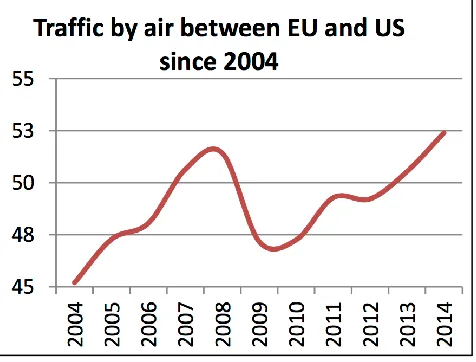
Table 1: Air Traffic between the EU and US since 2004
(As represented in passenger – millions)
Source: Eurostat
Since the first Open Skies Agreement the passenger movements between the two nations has consisted of noticeable peaks and troughs (Table 1: Air Traffic between the EU and US since 2004). However, since 2012 the trend seems to be more inclined towards constant growth.
The EU-US agreements were to be the second of two negotiated multilateral Open Skies accords for the US The first one being the 2001 Multilateral Agreement on the Liberalization of International Air Transportation (MALIAT) with New Zealand, Singapore, Brunei, and Chile, later joined by Samoa, Tonga, and Mongolia. Arguably, MALIAT amounted to little more than a token open skies accord, not providing an open investment regime and not facilitating any significant form of cross-border regulatory harmonisation.
Currently, as at 8 January 2016, the US lists 118 partners to Open Skies agreements.40
4.2. The EU – External Aviation Policy
[image:13.595.75.313.93.274.2]Since 2005 the EU has applied a three-pillar approach to its external aviation policy41 (See Table 2: pictorial pillar system)
Table 2: The EU ‘three-pillar’ external policy Road Map (based upon the 2005 definition)
40 Bureau of Economic and Business Affairs Washington, DC.
Source: Authors (based upon the EU external policy aviation ‘Road Map’)
Summarised, as well as bringing existing bilateral air services agreements, between EU Member States and third countries,42 in line with EU law, the EU has targeted key-specific
partners, (pillar 3) such as the US, in more expansive collaborative programmes (other focused partners have included – Australia, Brazil, Canada and New Zealand). Whilst, the remaining, pillar (pillar 2) has been aimed at creating the Common Aviation Area (CAA/also shown as ECAA) with neighbouring states, wherein, there has been a gradual opening of the market between the EU and its neighbours.43 This has resulted in regulatory convergence through the gradual implementation
of EU aviation rules so as to offer new opportunities both for the EU adjoining nations, operators and for consumers. Again this has been a successful and unprecedented approach by a United Union (arguably as is, or should equally be the case, for the US – a Union of States) from a US-EU comparison perspective, this has only partly been achieved by the US and certainly not at the same rate as the EU – potentially because the US is less willing to concede any aspect that would affect
42 See for example: Regulation (EC) NO 847/2004 of the European Parliament and of the Council of 29 April 2004 on the negotiation and implementation of air service agreements between Member States and third countries, OJ L 157, 30 April 2004, 7-17.
43 European Commission, ‘Communication from the Commission: A Community aviation policy towards its neighbours’. COM(2004) 74 final, 9 February 2004. Also see: ‘Developing the agenda for the Community’s external aviation policy’. COM(2005)79 final, 11 March 2005; ‘Communication from the Commission: Common aviation area with the Neighbouring Countries by 2010: progress report’. COM/2008/0596 final; Communication from the Commission to the Council and the European Parliament, ‘The EU and its neighbouring regions: A renewed approach to transport cooperation.’ COM(2011) 415 final, 7 July 2011.
1. Bilateral air service agreements
•Pillar 1: applies the 'Open Skies' ruling through the revision of agreements not in line with the EU law. This ultimately implies the amendment of some 1,500 plus bilateral agreements of the Member States, so as to encompass a more liberalised and horizontal 'equitable' approach
2. Common Aviation Area
•Pillar 2: is aimed at the adoption of agreements with neighbouring EU partners and the progressive opening up of markets and the phasing in of regulatory harmonisation
3. Aviation Agreements with key
stategic partners
•Pillar 3: concerns agreements negotiated by the EU with strategic partners and the
its trade (from a negative stance to the US that is). For instance, the US announced, only at the end of 2015, that it had achieved success with Mexico re advancing a more liberalised approach for aviation opportunities between the two adjoining neighbours. On Dec. 18 (2015) it was announced
that a ‘landmark agreement with one (US perspective) of our largest aviation partners will
significantly increase future trade and travel between the United States and Mexico…….’ The new agreement is said to ‘benefit US and Mexican airlines, travel[l]ers, businesses, airports and
localities by allowing increased market access for passenger and cargo airlines to fly between any city in Mexico and any city in the United States. Cargo carriers will now have expanded opportunities to provide service to new destinations that were not available under the current, more
restrictive agreement.’44
This arguably contrasts the more advanced liberalised and progressive approach adopted by the EU. The approach taken by the EU is to adopt a relationship with close partners, which allows the adoption of the part of the Acquis containing the European aviation rules. In this respect, the
starting point is safety, which remains the less contentious aspect of ASA’s. The process involves
the gradual opening up of the market by progressive regulatory harmonisation, which is implemented by successive phases. The ECAA is implemented through comprehensive air transport agreements that promote the overall economic, trade and tourism relations between EU neighbours. The parallel objective relates to (as well as safety) promoting fair competition and the implementation of common high security, environmental, and other standards.
Partners to the ECAA agreements have extended to South-Eastern and Northern Europe, and the Western Balkans and include agreements (amongst others) with Georgia, Israel, Jordan, Moldova and Morocco. The EU is currently completing negotiations with Ukraine whilst other neighbours
are/have been party to discussions (e.g. Lebanon, Tunisia and Azerbaijan). Ultimately, ‘the
prediction is that the wider European Common Aviation Area could encompass up to 50-55 states with a total population of up to 1 billion inhabitants.’45
Havel46refers to the EU’s initiatives, whereby, the EU seeks to develop liberal multilateral ASA’s with selected global partners and neighbours through the ECAA structure, as targeted
44 Air Transport World (ATW Online) Aaron Karp - Liberalized US-Mexico air services agreement signed. Friday, 18 December 2015 (at 11:56).
45 EU DG Move website. Retrieved 19 January 2016
https://ec.europa.eu/transport/modes/air/international_aviation/external_aviation_policy/neighbourhood_en.
‘aeropolitics’,47 wherein, the EU is seeking to ‘progressively dismantle the most pernicious
restrictions of bilateralism, including cabotage and the nationality rule…..’48 In many ways, the EU’s approach, certainly with respect to neighbours and selected global partners, could be seen as truly intent on liberalisation in the pursuit of democratised aviation; whereas, in contrast, the US is reluctant, with even its transatlantic EU partners, to advance nationality and ownership rules as
well as cabotage, across it’s highly-guarded territory. That said, the reality remains that the level of agreements concluded greatly varies in terms of the contents of the contract; and, there remains a
myriad of entitlements and agreed rights across the world. Even the EU’s focused ‘major’
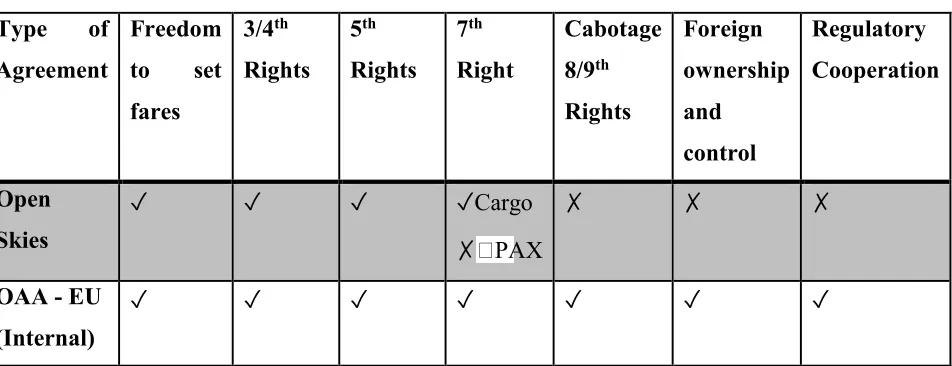
[image:16.595.75.551.457.640.2]partnerships with key identified nations, differs to varying degrees with the EU-Canadian Air Transport Agreement said to be one of the most ambitious to date. In much the same way as the EU-US Open Skies agreement, the intention was to allow an increase in investment opportunities to an unprecedented level alongside liberalisation of both traffic rights eventually leading to a fully Open Aviation Area between the two (based upon the principle of the Internal Market as a free open market amongst the 28 Member States, thus completing the concept of openness in the skies). (See Table 3: Comparison of OAA and Open Skies). However, the intended progression and developments have again not materialised to the ambition initially declared.
Table 3: Comparison of OAA and Open Skies
Type of Agreement
Freedom to set fares 3/4th Rights 5th Rights 7th Right Cabotage 8/9th Rights Foreign ownership and control Regulatory Cooperation Open Skies
✓ ✓ ✓ ✓Cargo
✗ PAX
✗ ✗ ✗
OAA - EU (Internal)
✓ ✓ ✓ ✓ ✓ ✓ ✓
Like the US, the EU remains intent on advancing international aviation opportunities, as identified in the new EU external aviation policy in which it outlined an ambitious policy targeting
47 The term being referred to by P.V. Murphy, DOT Acting Assistant Secretary for Policy and International Affairs, in his testimony to the Airline Commission, ‘Airline Commission Proceedings’, May 24 1993, 168.
growth market areas (December 201549). In this regard the EU specifically outlined that it would
be pursuing negotiations with other key aeronautical partners, notably identifying China and Japan. Other identified negotiations were to be conducted with the Gulf Cooperation Council (GCC) States, Turkey, Mexico and Armenia, as well as with ASEAN.
Alongside this, the EU continues also to bring bilateral agreements in line with the EU concept so as to recognise the union as one collective body. By 2015, the EU had concluded 50 Horizontal Agreements, which saw modifications to more than 1000 bilateral air services agreements of Member States with third countries.50 To this end, "national designation" clauses found within the
bilateral agreements is replaced by "EU designation" clauses. This means that the EU carrier established in a particular EU Member State is permitted to fly under the bilateral agreement of that EU Member State with a given third country.
5 ASEAN
The Association of Southeast Asian Nations (ASEAN) consists of ten Member States: Brunei (BNR), Cambodia (CAM), Indonesia (INA), Laos (Lao PDR), Mal (Malaysia), Myanmar (MYM), Philippines (PHI), Singapore (SIN), Thailand (THA) and Vietnam (VNM). The ASEAN, Economic Community (AEC) also recognises the importance of a single market and production base for a highly competitive region and recognises that aviation is an important element and driver to achieving this.
ASEAN has not concluded collective Air Transport Agreements in the same way as Europe has (Table 4: US and EU (Horizontal Agreements) with ASEAN States). Conventionally, all air transport services between ASEAN Member States still remain governed by restrictive bilateral arrangements as a result of strong nationalism sentiments post colonisation. Subsequently, due to emerging economics within the region in late 1990’s, several Member States have slowly, yet
progressively, liberalised their existing bilateral arrangements particularly on matters related to
49 Communication from the Commission to the European Parliament, the Council, the European Economic and Social Committee and the Committee of the Regions, ‘An Aviation Strategy for Europe’. COM(2015) 598 final, 7 December 2015.
market access.51 The liberalisation later spread to a sub-regional level52 and eventually to
ASEAN.53 In comparison to the liberal arrangements entered into by the EU, ASEAN’s
liberalisation could be considered a poor relative, and a half-hearted attempt, since ASEAN accord liberalisation of market access only up to 5th freedom, with seventh, eight and ninth freedom traffic rights still considered as off-limit.54 Ownership remains a highly sensitive matter for
limiting liberalisation with the majority of ASEAN Member States indicating strong opposition which would prevent controlled airlines operating with equal rights within their territory, suggesting that national protection remains the main divider and obstacle over the mutual interest
of ASEAN’s. Notwithstanding that, ASEAN remains optimistic and open to possibilities of having
[image:18.595.90.494.336.394.2]an ASEAN carrier, similar to the EU, in the future.55
Table 4: US and EU (Horizontal Agreements) with ASEAN States
Country US EU
BNR Open Skies Agreement 20 June
1997 No horizontal agreement
51 Malaysia entered into a liberal air traffic rights arrangement with Thailand in 2004 and Singapore in 2009.
52 The first ASEAN Transport Ministers Meeting in 1996, Bali, agreed for the Member States to vigorously pursue liberalisation of Air transport at a Sub-Regional level. The applicable sub-regional groups are: (1) Brunei, Indonesia, Malaysia, Philippines, the East ASEAN Growth Area (BIMP-EAGA); (2) Cambodia, Lao PDR, Myanmar, Vietnam (CLMV); (3) Indonesia, Malaysia, Singapore – Growth Triangle (IMS-GT); and (4) Indonesia, Malaysia, Thailand – Growth Triangle (IMT-GT). As a result, effective 2007 airlines were allowed to operate unlimited services up to fifth freedom between designated points within the sub-regions.
52 In general, the air transport liberalisation in ASEAN can be segmented into three initiatives: (1) The Roadmap for the Integration of Air Travel Sectors (RIATS) 2009; (2) Signing of ASEAN Multilateral Agreement for Full Liberalisation for Passenger Air Services (MAFLPAS) 2010; and (3) ASEAN Single Aviation Market (ASAM) 2010. The 13th ASEAN Summit has endorsed the establishment of ASEAN Single Aviation Market (ASAM) to be effective starting in 2015.Unlike MAAS and MAFLPAS, ASAM provides a greater coverage on air transport matters by taking the EU and the Australian-New Zealand SAM (unlimited 1st to ninth freedom) as examples. ASAM’s coverage is not limited to the economic elements only, but also aimed in harmonising the technical aspects of air transport. ASAM is ASEAN’s long-term progressive plan in developing and liberalising the air transport industry with the end result of creating a sustainable integrated one ASEAN aviation market to compliment and prosper ASEAN’s economies. 53 In general, the air transport liberalisation in ASEAN can be segmented into three initiatives: (1) The Roadmap for the Integration of Air Travel Sectors (RIATS) 2009; (2) Signing of ASEAN Multilateral Agreement for Full Liberalisation for Passenger Air Services (MAFLPAS) 2010; and (3) ASEAN Single Aviation Market (ASAM) 2010. The 13th ASEAN Summit has endorsed the establishment of ASEAN Single Aviation Market (ASAM) to be effective starting in 2015.Unlike MAAS and MAFLPAS, ASAM provides a greater coverage on air transport matters by taking the EU and the Australian-New Zealand SAM (unlimited 1st to ninth freedom) as examples. ASAM’s coverage is not limited to the economic elements only, but also aimed in harmonising the technical aspects of air transport. ASAM is ASEAN’s long-term progressive plan in developing and liberalising the air transport industry with the end result of creating a sustainable integrated one ASEAN aviation market to compliment and prosper ASEAN’s economies. 54 S.J. Fox and R. Ismail, ‘ASEAN Open Skies – Aviation Development in 2015: Blue or cloudy skies?’Annals of Air
and Space Law Vol. 41 (2016), no. 3 pp. 201-228.
Multilateral Agreement 01 May 2001
CAM - No horizontal agreement
INA US Indonesia Agreement
24 August 200456 Initiated 17 August 2009:
Horizontal Agreement LAO US – Laos Air Transport
Agreement (3 October 2008)57
US Signs Open Skies Accord with Laos (13 July 2010)
US – Laos Air Transport
Agreement of July 13, 2010 (13 July 2010)58
No horizontal agreement
MAL US - Malaysian Air Transport Agreement (21 June 1997).59
Annex III cancelled (07 August 2006)
Horizontal Agreement: signed 22 March 2007
MYM US-Burma Air Transport
Agreement (28 September 1949)
No horizontal agreement
PHI US-Philippines Air Transport
Agreement 3 October 1980 - US Philippines 1987 Amendment, 29 May 1987 - US Philippines 1989 Amendment, 24 April 1989 - Philippines Protocol to Air Transport Agreement of 20
November 199560
No horizontal agreement
SIN Multilateral Agreement on the Liberalization of International Air Transportation With Singapore 1 May 2001
Horizontal Agreement: signed 9 June 2006
THA US – Thailand Air Transport
Agreement 19 September 200561 No horizontal agreement
56 Air Transport Agreement between the Government of the United States of America and the Government of the Republic of Indonesia. Retrieved 28 September 2016 www.state.gov/documents/organization/114649.pdf. 57 US–Laos Air Transport Agreement (3 October 2008). Retrieved 28 September 2016
www.state.gov/documents/organization/114925.pdf.
58 US–Laos Air Transport Agreement 13 July 2010. Retrieved 28 September 2016 www.state.gov/documents/organization/144979.pdf.
59 US-Malaysian Air Transport Agreement 21 June 1997. Retrieved 28 September 2016 www.state.gov/documents/organization/114289.pdf.
60 Philippines Protocol to Air Transport Agreement of 20 November 1995. Retrieved 28 September 2016 www.state.gov/documents/organization/114316.pdf.
VNM - US – Vietnam Air Transport Agreement 27 August 2004 - Vietnam Air Transport Agreement
7 October 200862
- Vietnam Air Transport Agreement
18 May 2010
- Vietnam Air Transport Agreement
13 December 201263
Horizontal Agreement: 7 March 2006
Source: Authors
(Information as per the EU and US Dept. of State)
5.1. ASEAN’s Approach with Dialogue Partners
ASEAN was established based on the spirit of recognising the differences of each Member States and decisions are therefore made based on mutual consensus. Unlike the EU, centralised power is absent within ASEAN, hence ASEAN Member States are so-called not legally-bound to any of ASEAN initiatives. The only motivation that drives ASEAN is ‘good faith’ and arguably political willingness to prosper each nation in a stable region. Yet, this may also be seen as a limiter to concluding agreements due to the inability to achieve political consensus based upon unwillingness to lose control of a valuable national asset.
That said, ASEAN retains the approach based upon a formulated, and arguably agreed, mechanism for approaching Dialogue Partners in pursuit of open skies agreements. Via the Memorandum of Understanding on the ASEAN Air Service Engagement with Dialogue Partners, signed in 2010, ASEAN Member States have agreed upon the principle of centrality in engaging any arrangements with Dialogue Partners. The principle points out the requirement of Member States to initially liberalise their respective air services within the region (by ratifying existing relevant implementing protocols of ASEAN liberalisation) prior to extending the same right to Dialogue Partners.
The essence behind this principle is to ensure and maintain maximum and equal benefits among
ASEAN’s Member States through the creation and establishment of a fair and sustainable air
62 Vietnam Air Transport Agreement 7 October 2010. Retrieved 28 September 2016 www.state.gov/documents/organization/114920.pdf.
transport market within the region. This method also stresses therefore the need to prioritise ASEAN amongst the Member States individual political goals and further emphasises the benefit of an ASEAN single market.
However, the establishment of this ‘Principle’ is also a mechanism which leads to delays, and,
hence, is a hindrance for achieving the full potential of open skies with Dialogue Partners, as Member States are actually not obligated to enter into any ASEAN initiatives, based on the ASEAN Minus X Principle.64 Hence, States who are not ready to liberalise their markets may opt
to delay their participation despite having previously indicated their intention to meet deadlines for full implementation of an agreement. This is also aggravated by the fact that (unlike the EU) ASEAN does not have legal power to enforce any agreed decision lacking also any related court mechanism.
Upon reaching consensus on this ‘principle’ concept to negotiate, ASEAN started negotiations
with Dialogue Partners, the first negotiation commencing with China, in 2009. However, during the on-going negotiations, ASEAN had yet to conclude the full liberalisation processes intra-ASEAN.65 Hence, the first engagement with Dialogue Partners can best be described as
pre-mature. It may also be construed as a covert means to drive and push for a speedy conclusion of ASEAN intra-liberalisation agreements (ASEAN Multilateral Agreement of Air Services (MAAS) 66 and ASEAN Multilateral Agreement for Full Liberalisation of Air Services
(MAFLPAS).67
5.2. ASEAN-European Union
64 Article 21 of ASEAN Charter stipulated that in the implementation of economics commitments, a formula for flexible participation, including the ASEAN Minus X formula, may be applied where there is a consensus to do so. 65 Among challenges faced by ASEAN in fully achieving the full benefit of existing liberalisation initiatives are the non-readiness of several Member States to ratify the implementing protocols and the ASEAN mechanism of less autocracy – wholly based on mutual consensus which provide for leeway to non-participation to agreed economic initiatives via ASEAN Minus X Principle.
66 MAAS provided for limited liberalisation which was capped at unlimited third, fourth and fifth Freedom Traffic Rights between ASEAN capital cities and points designated under ASEAN sub-regional groupings of BIMP-EAGA, CLMV and IMT-GT.
The ASEAN-European Union (EU) dialogue relations were formalised in 1977 during 10th ASEAN Foreign Ministers Meeting68 (AMM) which paved the way for formal cooperation and
relationship between ASEAN and the European Economic Community (EEC). The relation was further strengthened via the signing of the ASEAN-EEC Cooperation Agreement in 1980.69 The
dialogue relations have since rapidly grown and expanded to cover a wide range of areas including political and security, economic and trade, social and cultural and development cooperation. The latter dialogue relations were steered by the 2007 Nuremberg Declaration on an EU-ASEAN Enhanced Partnership which sets out long-term vision and commitment of both sides to work together for common goals and objectives in the future, indicating the strong and cordial relations of both regions.70 The EU has for some time been a major development partner of ASEAN and is the biggest donor to the ASEAN Secretariat. 71
5.2.1. ASEAN-EU Air Transport Cooperation
Air traffic between ASEAN and the EU has been growing steadily in recent years and nearly doubled over the last 15 years to reach more than 11 million passengers.72 Both direct EU-ASEAN
traffic, as well as indirect connections via third-country hub airports has seen development since the 2005 levels. This translates to a 7 percent growth for direct traffic with actual origin-to-destination traffic (including both direct and indirect traffic) growing by more than 75 percent over this 10-year period.73 (Chart 2: Development of the EU-ASEAN market 2005-2015)
Chart 2:EU-ASEAN air transport market development 2005-2015
68 ASEAN, ‘Joint Communique Of The Tenth ASEAN Ministerial Meeting Singapore, 5-8 July 1977’. Retrieved 28 September 2016 www.asean.org/?static_post=joint-communique-of-the-tenth-asean-ministerial-meeting-singapore-5-8-july-1977.
69 7 March 1980.
70 Council of the European Union, The Nuremberg Declaration on an enhanced EU-ASEAN Partnership, 7588/07 (Presse 54), 15 March 2007.
71 In the budget cycle 2014-2020, the EU will support the ASEAN integration and the Secretariat with EUR 170 million. This is more than double the amount under the previous cycle (approximately EUR 70 million, 2007-2013). 72 European Commission DG Move, ‘Fact Sheet – International Aviation: an opportunity for growth and jobs in the EU aviation sector’, 7 December 2015.
Source:Com(2015)598 Final74
In 2013, trade with the EU consisted of 9.8 percent of ASEAN’s total trade with a value of
248,331.7 million USD and in the same year, tourist from EU made up to 8.8 percent of total tourists arriving into ASEAN.75 From a European perspective, the combined ASEAN region represents the EU’s 3rd largest trading partner outside of Europe.76 With a combined population of
1.1 billion, the ASEAN-EU air transport market is of increasing strategic importance to both sides.77
In 2009, ASEAN-EU embarked into their first aviation cooperation through the ASEAN Air Transport Integration Project (AATIP) which aimed to contribute towards sustainable ASEAN economic growth and integration of the ASEAN Economic Community (AEC) through the development of the civil air transport sector.78 AATIP has significantly contributed to the planning
and implementation of ASEAN Single Aviation Market (SAM) via rendering support to the development of harmonised frameworks in aviation safety, security, air traffic management, environmental protection, market liberalisation, application of competition laws and economic regulations within the ASEAN region. Hence, the EU and ASEAN have already demonstrated agreement in technical cooperation.
74 Ibid.
75ASEAN Secretariat, ‘ASEAN Community in Figures Special Edition 2014: A Closer Look at Trade Performance and Dependency, and Investment’, October 2014. Retrieved 28 September
www.asean.org/storage/images/ASEAN_RTK_2014/ACIF_Special_Edition_2014.pdf.
76 European Commission DG Move, ‘Fact Sheet – International Aviation: an opportunity for growth and jobs in the EU aviation sector’ (n 74).
77 Ibid.
5.2.1.1.1. ASEAN-EU Open Skies Arrangements
Following AATIP, both sides recognised and stressed the significant potential for further cooperation in air transport industry. Hence, during the first ASEAN-EU Summit held in 2014, both sides expressed the needs to address a wider range of areas of mutual interest and challenges to both regions, which include the intra and inter-regional integration and market liberalisation and the prospects for further co-operation between the two regions. At the first EU-ASEAN Aviation Summit, held in Singapore on 11-12 February 2014, the EU and ASEAN discussed the possibility of negotiating a comprehensive air transport agreement. Two years later it was said that the ASEAN-EU pact talks were progressing well – with the intention to create a massive liberalised commercial aviation market between the two groups.79
The EU has actively supported ASEAN's endeavour to establish a single aviation market, including through the ASEAN Air Transport Integration Project.
5.2.2. Analysis on the Possible Impacts of ASEAN-EU Open Skies Arrangements
In general, a liberal market between ASEAN and EU is envisaged to increase connectivity between the two regions. However, there is also possibility for the arrangement to be merely another
aeropolitical move, which only attempts to achieve agreed rights. Moreover, the possibility for success is hampered by the fact that, whilst the EU has legal personality and has clarified the position in respect to the distribution of powers between the EU and all Member States (in the field of the regulation of international air services) ASEAN has a far weaker mechanism based upon a principle of faith and political agreement amongst its States. Furthermore such an open skies arrangement has arguably not yet been shown to actually be commercially viable.80 Hence, the
benefits derived from ASEAN-EU open skies arrangements will therefore be dependent upon the following key criteria:
(i) Provision for fifth freedom rights;
(ii) Possible provision for sixth to ninth freedom; and
79 As reported in ATW Online, Singapore transport minister: ASEAN-EU air pact talks progressing, 14 February 2016. Retrieved 15 February 2016 http://atwonline.com/open-skies/singapore-transport-minister-asean-eu-air-pact-talks-progressing – commenting on the remarks of the Singapore transport Minister Khaw Boon Wan at the Singapore Airshow Aviation Leadership Summit (SAALS) in Singapore, 14-15 February, 2016.
(iii) Ownership and control of designated airlines.
Market access for third and fourth freedom is not a major issue for carriers of either region. In actual fact, most of the ASEAN and EU major carriers are presently operating direct flights based upon the existing bilateral rights. Horizontal EU agreements have in fact only been concluded with three of the ASEAN nations (Table 2) namely, Singapore, Malaysia and Vietnam; and even, since the conclusion of these, in conformity with the 2002 EU open skies judgement and the EU policy, some EU Member States have actually embarked on further liberalising their ‘own’ market
arrangements with individual ASEAN nations. For example somewhat questionably, the UK after the, Horizontal Agreement signed 22 March 2007, between the EU-Malaysia, entered into negotiations with Malaysia in order to seek more liberal arrangements between just these two countries.81 This could be said to be a very dubious approach by the UK in terms of the CJEU
findings which, its should be recalled, marked the start of an EU external aviation policy for all Member States and extended the exclusive competence of the EU in external aviation policy negotiations, meaning that an EU State could no longer act in isolation when negotiation international air service agreements. Whilst horizontal agreements have the objective to bring the bilateral agreements of all EU Member States with one specific third country into line with EU law which means that the Horizontal Agreement between the EU and Malaysia brings the bilateral agreements between Malaysia and the other EU Member States into line with EU law. That said, the Horizontal Agreements would not affect the volume of air traffic rights or any other provision of the respective bilateral agreements of EU Member States with a third country. But what this individual MoU actually means in essence is more favourable rights to the UK than to the other Member States, thus ultimately making very questionable the whole attempt at creating and establishing ASEAN-EU open skies, which may result in less favourable or disadvantageous conditions to the UK (in much the same way as was raised in the 2006 negotiations with the US). Of course, the recent referendum vote in the UK (23 June 2016) and the potential decision to leave the European Union throws into doubt the overall position of the UK with regards to open skies agreements conducted as a Member of the EU. Only time will tell whether the UK finds itself renegotiating ultimately with ASEAN collectively, or renegotiating once more individually with its Members, and of course also the US What should be borne in mind, in this regard, is the fact that
the UK was viewed very much as a key component in the negotiations between the EU and US in terms of more liberalised open skies and access to the European market. If the negotiations between the UK and EU were to result in changes to the agreement – this would no doubt be seen as a negative development in terms of liberalisation to air services and potentially would risk a Bermuda II82 (1977) bi-lateral style (or Bermuda two and a half - following some moderations in
1980) return, or likely a more liberalised updated bi-lateral Bermuda III type of agreement being developed.83 The very decision of the UK to leave the EU is based upon (whatever the
justification) ultimately of reclaiming its national sovereignty and hence control of state affairs –
the irony arguably going against the ‘ideal’ concept earlier discussed, of traffic rights becoming more of an international property basis approach. It should also be recalled again with somewhat stoicism, that during particularly the second open skies discussions with the US, the UK (along with the consensus of the EU States) was supportive of advancing the principle of more foreign
investment and controlling influence in ‘national’ airlines.
From the ASEAN perspective, some of the ASEAN service providers rather than expanding services have also in fact been retrenching.84 One of the possible explanations of this scenario is
however, that operations between ASEAN and EU involves long direct flights (more than 10 hours) which often resulted in low yield due to high operating cost. At the same time, airlines are forced to charge a high tariff rate in an attempt to maintain profitable or even a break-even yield, which subsequently translates to a risk to load factor performance. As a result, presently, only a handful of carriers, majority of which are the legacy airlines, operate direct services between both regions. This low connectivity has indirectly facilitated the aggressive penetration of Middle East carriers in the ASEAN-EU market, which connects via their strategically located hubs in between ASEAN and EU. Turkey therefore also remains strategically positioned to capitalise on this market due to its geographical location. The Gulf carriers have also a low tariff advantage, competitive in-flight services and products as well as moderate flying hours in connecting ASEAN and EU via their hubs, and as such they are fast taking the market share for the ASEAN-EU segments. Therefore, third and fourth freedom rights alone may not be sufficient to address these issue.
82 Agreement between the Government of the Kingdom of Great Britain and Northern Ireland and the Government of the United States of America Concerning Air Services, 28 UST 5367, TIAS No 8641, 23 July 1977 (Bermuda II). 83 It is not the intention of this paper to delve into possible scenarios re the UK in isolation but to currently recognise the UK as still being a Member of the EU.
Unlimited fifth freedom and sixth freedom rights may provide commercial flexibility for airlines of both sides to liberally strategise their commercial operations and subsequently react towards the emergence of Middle East carriers in their existing market. The possible fifth freedom intermediate points would therefore be points located within the Middle East and South Asia areas. As for fifth freedom beyond, ASEAN carriers maybe able to find points within the EU and ultimately points within the US as commercially viable locations; and also for the EU’s - points within ASEAN may ultimately be strategically advantageous for development within the Chinese, Japanese and Hong Kong markets. Open skies between ASEAN and the EU would therefore provide room for expansion for the EU carriers, within one of the emerging air transport market, particularly in connecting primary cities within ASEAN and beyond, such as Bangkok-Kuala Lumpur, Singapore-Denpasar and Dubai-Manila. As for ASEAN carriers, expansion within the EU and beyond, via fifth freedom rights, will be commercially ideal, primarily in carrying traffic from outside of the EU, even though they may face fierce competition from the EU and particularly from third party existing carriers. For example if the EU-ASEAN open skies were to be developed, this would no doubt also have an impact on the EU-US market and the open skies agreements in North America. Notwithstanding that, the establishment of connectivity to and between secondary cities of both regions, such as London-Kota Bharu or Lyons-Zambonga, just may be prove to be unlikely, due to insufficient demand.