2017 2nd International Conference on Computer Science and Technology (CST 2017) ISBN: 978-1-60595-461-5
Image Retrieval Relevance Feedback Based on
Grover Quantum Searching Algorithm
Hai-xin WEN
1,a*and Yin-wei ZHAN
11School of computer, Guangdong University of Technology, Guangzhou, China
*Corresponding author
Keywords: Grover quantum searching algorithm, Relevance feedback, Image retrieval.
Abstract. In order to improving the retrieval rate and speed for a large number of images, an algorithm of image retrieval relevance feedback based on Grover quantum search is proposed. Grover quantum searching algorithm solves the unsorted database search problem with computation complexity ofO( N/M), where the size of database is N and there is M target solutions. Making use of the image features re-weighted feedback to make up the deficiency of computer’s understanding of user’s needs, so that the system can effectively retrieve the image library and improve the retrieval precision. The experiment proves the feasibility and effectiveness of the algorithm.
Introduction
Content-based image retrieval refers to the use of image visual content, such as color, texture, shape, spatial layout, etc., from a large number of image data search for the users which satisfied their need. Due to the existence of the semantic gap [1], retrieval system cannot understand well what the users’ need which makes the retrieval accuracy is not ideal. So, the relevance feedback technology was applied to the field of image retrieval and achieved good results [2][3]. There’s a variety of technical support to achieve and SVM is more common used. However, the performance of SVM based RF system is not very effective as the average precision is 0.74[4] and 0.64[5]. We propose a feature re-weighted image retrieval relevance feedback algorithm based on Grover quantum search. From a length of n disorderly number of digging out a search for a target, using the classical algorithm on average need to find N/2 times, the probability of success is 0.5, the search complexity is O(N), and the search complexity of Grover search algorithm only O( N), Since the Grover algorithm can bring secondary acceleration to the classical algorithm, the Grover algorithm is used to accelerate the traditional machine learning algorithm[6][7] in recent years. We combine the Grover quantum search algorithm with the feedback process, which avoids the influence of the initial retrieval on the user's cognition and the limitation of the feedback effect.
Grover Quantum Search Algorithm and RF Algorithm
In Grover quantum search algorithm [8], assume to search in the space which contains
n
− = = 1 0 | 1 | N x x Nϕ (1)
The Grover iteration process can be divided into the following four steps:
1.Verify whether the search element is the required solution for these problems which are not solved by applying Oracle arithmetic operators.
i M
i i
I
O
τ τ=
− =
1
2 (2)
2. Conduct the Hadamard gate transformation n
H⊗ towards the result of 1.
− = 1 1 1 1 2 1
H (3)
3.The result of phase 2 is phase shifted, this results in a phase rotation of -1 for each of the basic quantum states except 0 . Namely:
− →
× x
x ( 1) |
| δ0 (4)
4. Conduct the Hadamard gate transformation towards the result of 3.
RF is a strategy for users to participate in the optimization of image query, it has high requirements toward the real-time and it has just a few markings samples [9]. Feature weight adjustment algorithm refers that the retrieval system analyzes the users return information based on the relevant feedback. The new weight plays an important role in offering different features to the images, and it can improve the weight of these features which have a close relationship with the image.
An Image Retrieval RF Algorithm Based on Grover Quantum Search Algorithm
Algorithm Description
Firstly, extract feature of each picture in the image library and getN'kind of pictures’ characters, record it as Fm , j=1,2,⋅ ⋅⋅,N' , the characteristics of the type M
T n m m m m m F F F
F =( (1), (2),..., ( )) ,
m
n refers to the dimension of featureFm.We take the weighted distance of Euclidean to measure the image distance, it can be recorded as k ij
n D w m , j i n j n
i=1,2,..., =1,2,..., ,, refers to the un-searched images and the images in the library. k =1,2,..., n .Represents the feedback k times.Also the weight of the measurement distance is adjusted by making the users to mark the irrelevant image, the formula [10]: 0001 . 0 * , , 1 = + + = + ε σ ε σ ε δ , k X k X k i k i i rel i r
w (5)
k Xr,i
σ refers the characteristic standard deviation of the i dimension got in the return image of thekcircles’ feedback. k
Xrel,i
= =
= k
l U l i k
l U l i k
i
F P
1 , 1
,
-1
δ (6)
=
k
l U l i
P
1
, refers to the number of non-correlation images in the first to the k rounds of the
non-correlation image falls within the range of the dimension value of the correlation image,
=
k
l U l i
F
1
, refers to the number of non-correlation features appearing from 1 to k.
In Grover quantum search algorithm, the phase rotation angle isπwhich is fixed. When the number of the researched targets is higher than the half of the database records, the probability of success is rapidly decreased. When the number of targets exceeds half of the database, then the algorithm fails. In order to improve this deficiency, many scholars at domestic and abroad have made continuous exploration and research, two main improvements algorithm will be introduced as follows: To improve the Grover algorithm based on π /2phase rotation [11], the value of these two-phase rotation is π/2, and it stays in the opposite direction. The two phase shift operators are:
=
− − = M
m m m i I U
1
) 1
( τ τ (7)
(1 )
V = +i φ φ −iI (8)
AssumeM/N=λ, the improved algorithm can be divided into two search processes: (1) When0<λ≤1/3, use basic Grover search.
(2) When1/3<λ<1, use the improved Grover search, it is divided into the following three steps:
1.(9)makesϕ the phase of the target state moves forwardπ/2this can make people get the intermediate state of the system superposition state:
ϕ τ τ ϕˆ ( (1 ) )
1
= − −
= M
m m m
i
I
(9)
2.(10) the final state of the system superposition state:
ϕ ϕ ϕ
ϕ~ =((1+i) −iI) ˆ (10)
3. Measureϕ~ ,can get one solution of the searched question based on probability which is at least25/27.
the values of phase rotation, its value can be calculated by using4arcsin(sin(α/2)sinθ).Therefore, in order to achieve the maximize probability of
success, and the required number of iterations is as follows:
= ) sin ) 2 / ( arcsin(sin
4 πα θ
R (11)
As sinθ= M/N , whenθis small,sinθ ≈θ,so when M <<N:
) / ( / ) 2 / sin(
4 M N O M N
R =
≈ α
π (12)
According to(12)we know that the number of iterations of the algorithm derived from the generalized Grover algorithm is determined byα:
(1) whenα =π,
≈ = M N R 4 ) sin ) 2 / ( arcsin(sin 4 π θ α
π (13)
(2) whenα =π/2,
≈ = M N R 2 2 ) sin ) 2 / ( arcsin(sin 4 π θ α
π (14)
(3) whenα=1.825π,
≈ = θπ θ α π sin 2 825 . 1 ) sin ) 2 / ( arcsin(sin 4
R (15)
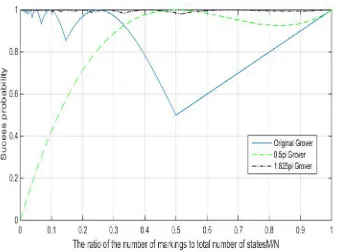
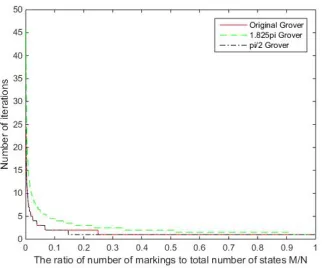
[image:4.612.231.400.455.581.2]After the Grover algorithm has been improved, its successful probability and the number of iterations can be seen from the following chart:
Figure 2. Comparison of the number of iterations after Grover algorithm has been improved.
Algorithm Flow
(1) The user inputs the images that need to be searched, the system returns to the initial search results after the calculation;
(2) The user selects the relevant image feedback to the system based on the evaluation of the retrieval results;
(3)The system recalculates the weight of the features based on the feedback images, and then gets a series of feature weight which can be used to guide the new round of retrieval. The weighted distance between the images is calculated and it has been put indist[1,2,...N],Find the required M pieces images by using Grover search algorithm. According to the Grover algorithm in the search list of the minimum value of the application[14], the operator is designed as follows:
<
=
others
y dist j dist y
f
, 0
] [ ] [ , 1 )
( (16)
yrefers to the subscripts which are generated randomly in the N sequence. After
having initialized the register and set the minimum value asdist[y],Mark all the subscripts which can satisfy dist[j]<dist[y] ,apply the improved Grover search algorithm. Consider the y’ as the output, ifdist[y′]<dist[y],change the initial index to y’,
return to y, and the search results of new images can be achieved.
Experimental Results
Experimental Environment
Our experiments were conducted in Corel standard test image library in which there are 1000 images. 10 types of images and each type includes 100 images. According to proposed algorithm, 20 images will be presented after one retrieval cycle. Matlab2014b is selected as Soft Development Platform and we set the initial value of feature weight in each dimension to 1. We use the color entropy, the gray histogram, the edge contour extraction based on the canny operator, totally 59 image feature vector.
We described retrieval accuracy as follows:
% 100 images retrieval of
total
images relevant of
number accuracy
Analysis
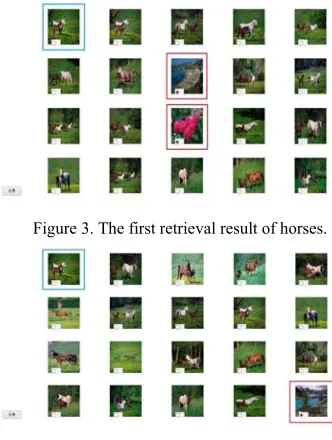
[image:6.612.216.382.117.337.2]Figure 3 shows the first retrieval result, input image is marked by blue box and the red one is irrelevant image which will be presented as a feedback.
Figure 3. The first retrieval result of horses.
Figure 4. The first feedback result of horses.
[image:6.612.178.436.515.657.2]Figure 5. The second feedback result of horses.
Table 1. Performance of three type of Grover(horses). Algorithm Number of
iterations Overall time(s) Number of feedback Original
Grover 4 0.06519 1
2 /
π Grover 6 0.07201 1
1.825π Grover
16 0.08271 1
Original Grover
4 0.06256 2
2 /
π Grover 6 0.07975 2
1.825π Grover
Table 2. Comparison of retrieval accuracy(horses). Number of
retrieval
Retrieval accuracy
Number of feedback
1 90% 0
2 95% 1
3 100% 2
As can be concluded from the 1-3, feedback algorithm contributes significantly to the improvement of retrieval accuracy. Irrelevant image is introduced as a feedback which prompts the recalculation of previously set feature weight of each dimension.All of those enable users to retrieve desired images effectively and accurately.
Conclusion from figure 1to figure3, table 1 and table 2 shows that the improved Grover has great ability to achieve a higher success rate but at the cost of increasing number of iterations; Original Grover fails to retrieve the images correctly at the time the number of those images are close to the image library in this test(please note that this image library means flowers or horses respectively, not the whole number of all the types) or just nearly 50% of it; In this case, as can be seen from experiments, our proposed algorithm performs well in the test without failure as original Grover do. Those improvements can be founded in experimental results not only in iterations, but also in the accuracy and success rate.
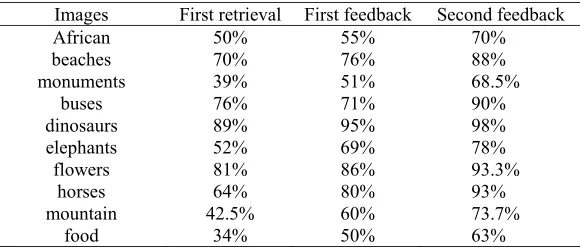
Table 3. Performance of proposed in 10 types of images. Images First retrieval First feedback Second feedback
African 50% 55% 70%
beaches 70% 76% 88%
monuments 39% 51% 68.5%
buses 76% 71% 90%
dinosaurs 89% 95% 98%
elephants 52% 69% 78%
flowers 81% 86% 93.3%
horses 64% 80% 93%
mountain 42.5% 60% 73.7%
food 34% 50% 63%
Significant improvement in Table 3 describes us that proposed algorithm do contribution to all the types of images in our experiments.
Summary
We combined Grover with a feedback mechanism which enables users take part in the retrieval. Feature weight is considered to be adjusted according to the feedback to select relevant images from irrelevant images, which provides system an opportunity to present retrieved images on the base of users’ feedback. Also, the compute complexity is decreased,O(N)in traditional algorithm but O( N/M) in Grover, which proves that the introduce of Grover do great help to speed up our image retrieval.
Acknowledgement
[image:7.612.162.453.360.484.2]References
[1] ZHANG Jing, SHEN Lansun, David Dagan FENG.A Survey of Image Retrieval Based on Visual Perception[J]. Acta Electronica Sinica. 2008, 36(3):494-499.
[2] Zhang L, Wang L, Lin W. Generalized Biased Discriminant Analysis for Content-Based Image Retrieval[J]. IEEE Transactions on Systems Man & Cybernetics Part B Cybernetics, 2012, 42(1):282-90.
[3] Zhao L, Tang J. Content-based image retrieval using optimal feature combination and relevance feedback[C]// International Conference on Computer Application and System Modeling. IEEE Xplore, 2010:V4-436 - V4-442.
[4] Seo K K. Content-Based Image Retrieval by Combining Genetic Algorithm and Support Vector Machine[J]. 2007, 4669:537-545.
[5] Yildizer E., Balci A. M., Hassan M., et al. Efficient content-based image retrieval using Multiple Support Vector Machines Ensemble[J]. Expert Systems with Applications, 2012, 39(3):2385-2396.
[6] Wittek P. Quantum machine learning what quantum computing means to data mining[M]. HARBIN INSTITUTE OF TECHNOLOGY UNIVERSITY PRESS, 2016. [7] Schuld M, Sinayskiy I, Petruccione F. An introduction to quantum machine learning[J]. Contemporary Physics, 2014, 56(2):172-185.
[8] ZHANG Yudong, WEI Geng, WU Lenan. An Improved Grover Quantum Searching Algorithm[J]. Signal Processing, 2009, 25(2):256-259.
[9] XUN Xiangli, ZHANG LIbiao, LIU Xiangdong. Image Retrieval Relevance Feedback Algorithm Based on Particle Swarm Optimization[J]. Acta Electronica Sinica., 2010, 38(8):1935-1940.
[10] YuWu.. Research on Content-based image Retrieval and Relevance Feedback Technology[D]. Northeast Normal University,2014
[11] LI Panchi, LI Shiyong. An improved measure in Grover quantum searching algorithm[J]. CAAL Transactions on Intelligent Systems, 2007, 2(1):35-39.
[12] LI Shiyong. Quantum Computation and improved Grover Algorithm[M]. HARBIN INSTITUTE OF TECHNOLOGY UNIVERSITY PRESS, 2009.
[13] Long G L, Li Y S, Zhang W L, et al. Phase matching in quantum searching[J]. Physics Letters A, 1999, 262(1):27-34.