2017 3rd International Conference on Computer Science and Mechanical Automation (CSMA 2017) ISBN: 978-1-60595-506-3
Image Interpolation by Pixel-Level Data-Dependent
Triangulation on Android Platform
Jun-Yi DUAN
1,a, Cheng-Ming LIU
1,b,*and Zhi-Hui YUE
1,c1
School of Software and Applied Technology, Zhengzhou University, Zhengzhou, China
a
[email protected], [email protected], [email protected]
*Corresponding author
Keywords: Image interpolation, DDT, Android.
Abstract. Smart mobile phones have become the most popular electronic equipment; many operations have been transferred from computers to mobiles. We achieved an image interpolation algorithm on android platform. This algorithm could generate high-resolution images from low-resolution images by the pixel-level data-dependent triangulation and a triangular interpolation. The algorithm we achieved on android is more lightweight and the result image is sharper.
Introduction
Image interpolation , an important component of image processing, has a wide range of application in computer vision and computer graphic. The aim of image interpolation is to Synthetic high-resolution image from low-resolution image. Accuracy of the algorithm directly affects the clarity of the image. There are many image interpolation algorithm or super-resolution reconstruction algorithm that have been proposed in recent years[1,2].They can roughly divided into three categories: polynomial-based interpolation, Learning-based interpolation and edge-directed interpolation[3].
Polynomial-Based Interpolation
It is widely known that Polynomial-based interpolation techniques, such as bi-cubic or bilinear interpolation are implemented by a function, which could map a relationship between known pixels in low-resolution and unknown pixels in high-resolution[4-6].These algorithms are simple but fast ,they are apply to android. However, high-resolution image interpolated by these algorithms are too smooth, and edges are blurred.
Learning-Based Interpolation
In recent years, algorithms of Learning-based have been paid more attention, these algorithms interpolate high-resolution by learning from examples. Chao Dong [7]has proposed a end-to-end deep learning algorithm, sparse representation[8] and Markov random field[9] are also included.
Edge-Directed Interpolation
Many algorithms are concentrated on edge-directed interpolation [10,11], since the edges of image are attractive to the human visual system. These algorithms make edge sharpness during the interpolation process. Cheng-ming Liu described a new image interpolation method by using scanning line algorithm which can generate C-1curves or surfaces[3].Lei Zhang and Xiaolin Wu[13] proposed a new edge-guided nonlinear interpolation technique through directional filtering and data fusion. Dan Su and Philip Willis [12] presented a novel image interpolation, the algorithm reconstruct high-resolution images from the pixel-level triangulation of low-resolution images.
Pixel-Level Date-Depend Triangulation
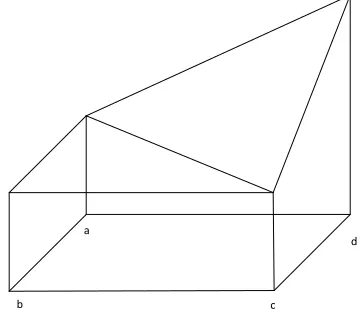
[image:2.612.218.398.167.323.2]We first introduce the idea of Dan Su and Philip Willis. The main consideration of the idea is that there is one edge is obliquely across a square of four pixels. In this case, the edge divides the square into flat and plateau. We could use two triangulations to roughly represent the plateau and flat. In Figure 1, a, b, c and d form a square of pixels, triangulation abc form the flat, triangulation acd form the plateau. If a pixel to be interpolated falls in the flat, the interpolation only use the value of a,b and c.
a
b c
d
Figure 1. Triangulation in a four-pixel square.
Triangular Interpolation
After dividing the known pixels, we need to interpolate inside the triangle. Commonly used triangular interpolation is Gouraud shading[14],which named after Henri Gouranud. Gourand shading could be used to compute the pixel values at any point in the triangle by the pixel values of three corners of the triangle as shown in Figure 2. In order to get the value of pixel Ip, values of Ia and Ib need to be
calculated first, it can be written as[15,16]:
Y1
YP
Y2
Y3
I1
Ia Ip Ib
I2
I3
Xa Xp Xb
Figure 2. Gouraud Shading.
Ia=I1- (I1-I2) (Y1-Yp) /(Y1-Y2) (1)
Ib=I1- (I1-I3) (Y1-Yp) /(Y1-Y3) (2)
Gouraud shading is universal, however, it is complex used in isosceles right triangle. In this paper, we use property of barycentric coordinate system to solve the problem and improve the algorithm speed.
A
B
[image:3.612.227.391.108.240.2]C P
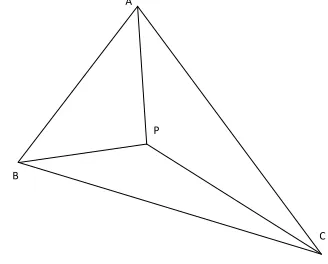
Figure 3. Barycentric coordinate system.
In geometry, the barycentric coordinate system is a coordinate system in which the location of a point of a simplex (a triangle, tetrahedron, etc.) is specified as the centre of mass, or barycentre, of usually unequal masses placed at its vertices[17],In a triangle, barycentric coordinates are also know as areal coordinates or area coordinates. For a point p in triangle ABC(see Figure. 3), it can be determined by
P=(1-u-v)A+uB+vC(u≥0,v≥0,u+v≤1). (5)
If coordinates of A,B,C,P is known, values of u and v can be get by the following equations:
P.x=(1-u-v)A.x+uB.x+vC.x. (6)
P.y=(1-u-v)A.y+uB.y+vC.y. (7)
Then value of P could be calculated by equation (4).In this paper, we use the factional part of point to be interpolated as the parameter u,v to reduce the amount of calculation and shorten the operation speed.
Implementation
Android NDK
The Native Development Kit (NDK) is a set of tools that we are allowed to use C or C++ code with Android[18]. The advantages of using NDK in Android apps are as follows:
1) Better platform portability.
2) Reusability of native language libraries.
3) improve performance in certain cases, especially computationally intensive ones like images or games.
In this paper, We build the app for NDK to make the algorithm faster.
Design and Implement
The algorithm for developing native app for Android is as follows:
1) Loading image, getting image information and put them into an array in Java. 2) Image interpolation by pixel-level data-dependent triangulation in C++. 3) Compose image in Java.
In step 2,the detailed algorithm of Image interpolation is as follows:
1) If |a-c|<|b-d|, when interpolating the high-resolution pixel falling in triangle acd, the algorithm won’t use the value of pixel b, otherwise, the algorithm won’t use the value of pixel d.
3) If |a-c|=|b-d|, the algorithm is same as bilinear interpolation.
Experiment
We use two quality mtrics,peak signal-to-noise ratio and calculating time to show the ability of algorithm we proposed.We compare the algorithm with bilinear interpolation and bicubic interpolation.In our test,we down-sample the original image by bilinear interpolation,then up-sample it to get the high-resolution by our algorithm or other method.We do experiments on a Android virtual machine with 4GB main memory created by a Lenovo computer with core i7-6700 [email protected] and 8GB main memory.All the algorithms are implemented by NDK, and the scale factor is 2×2 or 3×3.
[image:4.612.137.489.219.351.2](a) (b) (c)
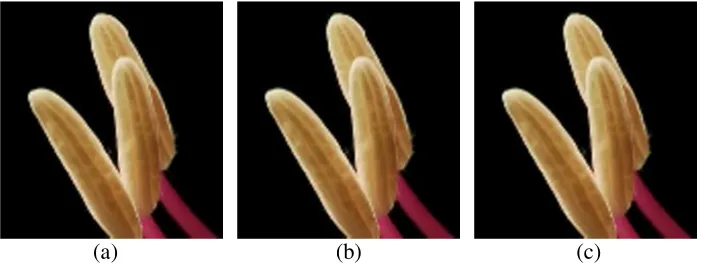
Figure 4. Result of image interpolation. From left to right are:(a) Bi-cubic interpolation; (b) Bilinear interpolation; (c) Our algorithm.
Figure 4 shows the results of image interpolation,compared with the bicubic interpolation and bilinear interpolation,our algorithm reduces the sawtooth phenomenon in the processing fo the edge .The PSNR value and calculating time are shown in Tables 1 and 2.We can see from PSNR value,when the image is magnified twice,our algorithm is better than bilinear,close to bicubic interpolation,when the image is magnified three times,our algorithm is better than bicubic and bilinear interpolation,the greater the magnification,the better the effect of our method.In Table 2,we can find our algorithm is the fastest.
Table 1. PSNR values.
bicubic bilinear our algorithm
Magnify 2 36.7112 35.8828 36.6087
Magnify 3 33.1495 32.4356 33.1613
Table 2. Calculating time.
bicubic[ms] bilinear[ms] our algorithm[ms]
Magnify 2 95633 21819 20966
Magnify 3 95633 36865 31878
Conclusions
Acknowledgement
This research was financially supported by the National Science Foundation(No. 61402420).
References
[1] Lehmann T.M Gönner C, Spitzer K, Survey:Interpolation Methods in Medical Image Processing, IEEE Transactions on Medical Imaging. 1999(18)1049-1075.
[2] T Acharya, P.S Tsai, Computational Foundations of Image Interpolation Algorithms, Acm Ubiquity. 2007(8) 1-17.
[3] CM Liu , ZK Wang , HB Pang , JX Xue. Image Interpolation via Sacnning line algorithm and discontinuous B-spline, Mathematical and Computational Applications. 2017 (22) 1-6.
[4] RG Keys, Cubic convolution interpolation for digital image processing, IEEE Transactions on Acoustics Speech and Signal Processing. 1981(29) 1153-1160.
[5] RG Keys, Cubic convolution interpolation for digital image processing, IEEE Transactions on Acoustics Speech and Signal Processing. 1981(29) 1153-1160.
[6] L Liang, Image Interpolation by Blending Kernels. IEEE Signal Processing Letters, 2008(15) 805–808.
[7] Chao Dong, Chen Change Loy, Kaiming He, Xiaoou Tang, Learning a Deep Convolutional Network for Image Super-Resolution, in Proceedings of European Conference on Computer Vision(Eccv). 2014(8692) 184-199.
[8] K.I. Kim, Y Kwon, Single-Image Super-Resolution Using Sparse Regression and Natural Image Prior, IEEE Transactions on Pattern Analysis & Machine Intelligence. 2010(32), 1127–1133.
[9] William T. Treeman, Egon C. Pasztor, Owen T. Carmachael, Learning Low-Level Vision, International Journal of Computer Vision. 2000(40) 25-47.
[10] Li X., Orchard M.T., New Edge-Directed Interplation. IEEE Transactions on Image Processing. 2001(10) 1521-1527.
[11] Akhtar P,Azhar F, A Single Image Interpolation Scheme for Enhanced Super Resolution in Bio-Medical Imaging, Bioinformatics and Biomedical Engineering (iCBBE), 2010 4th International Conference on. 2010 1-5.
[12] Dan Su, Philip, Image Interpolation by Pixel_level Data Dependent Trangulation, Computer Graphics froum. 2004(23) 189-201.
[13] Lei Zhang, Xiaolin Wu, An Edge-Guided Image Interpolation Algorihtm via Directional Filtering and Data Fusion, IEEE transactions on image processing. 2006(15) 2226-2238.
[14] C Naray anaswami, Efficient Parallel Gouraud Shading and Linear Interpolation over Triangles, Computer Graphics Forum. 1995, 14(1) 17-24.
[15] Junsheng Huang, Zhenjie Hou, An Improved Image Grid Pixel - level Interpolation Algorithm, Microelectronics and Computer. 2013(4) 103-106.
[16] Information on https://en.wikipedia.org/wiki/Gouraud_shading
[17] Information on https://en.wikipedia.org/wiki/Gouraud_shading