2016 International Conference on Artificial Intelligence: Techniques and Applications (AITA 2016) ISBN: 978-1-60595-389-2
Evaluation of Uncertainty in Measurement Based on Cloud Computing
Gang WU
1,2, Chao-qun WEN
1,2, Fan ZHANG
2, Chao ZHAO
2and Hai-tao WANG
2,*1School of Software Engineering, Beijing Jiaotong University, Beijing, China
2China National Institute of Standardization, Beijing, China
*Corresponding author
Keywords: Evaluation of measurement uncertainty, Cloud computing, Customized measurement modeling.
Abstract. Measurement uncertainty is an indispensable factor to describe the precision of measurement value. Evaluation of measurement uncertainty, however, is the obstacle for most of tests and measurements because of its complexity of modeling and calculation. Meanwhile, almost all current automatic uncertainty evaluation technologies are lack of customized measurement modeling, control flexibility, data sharing, or result comparison. Aimed at such issues, we propose uncertainty evaluation and calculation technologies and develop an accordant system based on cloud computing. According to the experiment result, the technologies and system are useful and efficient.
Introduction
In metrology, measurement uncertainty is a necessary description of the measured values. All measurements are subjected to uncertainty, and a measurement result could be complete only when it is accompanied by a statement of the associated uncertainty. Measurement uncertainty is based on probability, which reflects the precision of the quantity value. [1]
The process of uncertainty evaluation is very complex and required high double numerical. Different measure processes, measure instruments, and the different uncertainty evaluation model will cause different results. And the process of uncertainty evaluation can be classified two types which are type A and B. The calculation formulas may include partial differential, square root, multiple multiplication, and so on. But in most current measurement systems, there be neither uniform measuring model for different measurement purposes and objects, nor uniform numerical precision of results.
To improve the flexibility and expandability of uncertainty evaluation model, and to simplify the calculation difficulty, we propose an uncertainty evaluation technologies and develop a calculation system based on cloud computing, which provides an opportunity for customs to define their own uncertainty calculating model with uniform interface and manage the uncertainty values. For users, the system can also reduce calculation complexity mostly.
The paper is organized as follows. In Section 2 we present the implement methods of the cloud computing platform for uncertain evaluation system and in Section 3 we present the experiment results by using the could services that show that the convenient to calculate uncertainty and compare the calculate results for laboratory ability verification organizations.
Evaluation Based on Cloud Computing
Related Technologies
Cloud computing platform use many technologies, like high performance computing clusters, data storage, virtualization, servers resource schedule are the key technologies.
High Performance Computing Clusters. The new generation of high-performance computing center (HPCC) can’t provide traditional high-performance computing. The management of resources, virtualization, and massive task execution also be taken into account. In this way, cloud computing technology need to solve the high-performance computing first. The HPCC includes system configurations to support both parallel batch data processing and high-performance online query applications using indexed data files.
Data Storage. This is a big data era, the result is massive data storage, an amalgam of old and new best practices, skills teams, data types. All of these are expanding and realigning so that businesses can fully leverage big data, not merely manage it. The data storage system of cloud computing are Hadoop Distributed File System (HDFS) which is developed by Hadoop team.
Virtualization. Virtualization is a method of deploying computing resources. It separates the different levels of the application system including hardware, software, data, networking, storage and so on, breaks the division among the data center, servers, storage, networking, data and the physical devices, realize dynamic architecture, and achieves the goals of managing centralized and use dynamically the physical resources and virtual resources, improving the flexibility of the system, reducing the cost, improving the service and reducing the risk of management.
Architecture of the System
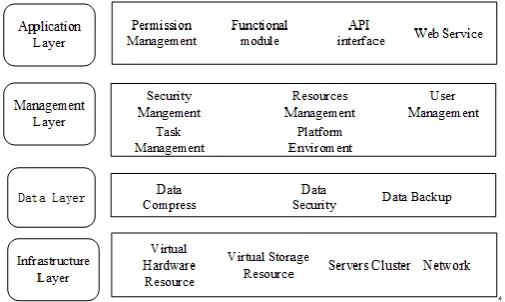
[image:2.595.173.426.534.685.2]To construct the cloud computing platform for uncertainty evaluation system, used servers cluster, virtualization, distribution technologies to integrate data and schedule and assign resources, cloud computing platform includes the interface of custom defined uncertainty calculate model, data storage of uncertainty related, computing resources, application system, and UI and so on. According to the demand of the system, we separate 4 layers like application layer, management layer, data layer, and infrastructure layer for uncertainty evaluation cloud computing platform. As the Fig. 2-1 shows, in application layer, provide user interaction interface and business handler of uncertainty evaluation, management layer is the core part of uncertainty evaluation system, responses process management, resource deploy and assignment, storage access, security and performance and so on, in database layer which response data management, data compression, and data security.
Figure 2-1. Architecture of cloud computing platform.
Custom Define the Uncertainty Evaluation Models
components of evaluation model dynamically, the components of evaluation model include type A and B also, meanwhile, calculate and save the uncertainty result for each component for the next steps.
For the configured uncertainty evaluation models, users can choose them whether to share, if you choose to share, the all other users of cloud platform who can use the model. Shared computing model can reduce time on user setup models and promote computational efficiency.
User Authority Controls in Cloud Computing
In this cloud computing platform, for the difficulty point is access control in user custom defined uncertainty calculate model, the own new, edit, delete the model under permission, but doesn't affect the uncertainty result which calculated by the models. Suppose that user A create a custom measurement model and sharing it, user B use this model to calculate some uncertainty results and saved. In this scene, when User A delete or modify the model which User B used, then can't affect User B, meanwhile, if one model be shared by someone, other users use the model as copy.
Experiments
We first present the processes of an example to calculate the combined standard uncertainty of electrical resistance. We then present experimental results for real data compare uncertainty evaluation result for an organization which provide laboratory ability verification.
Process of Custom Define Uncertainty Evaluation Model
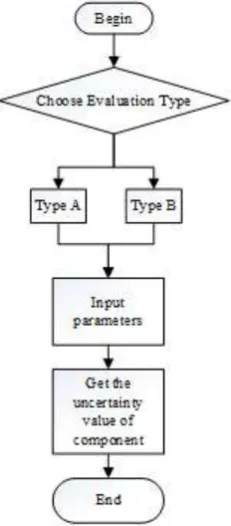
[image:3.595.242.358.460.724.2]To the users who experiences in uncertainty calculation, the normal processes is as Fig. 3-1. At first, you must understand how to calculate the uncertainty of measuring object, you know the measuring model, then choose one component in the model, for this component, choose Type A or Type B, or choose both to evaluate its uncertainty, when selected one type, input correspond parameters, click “calculate” button in the web page, you will get the uncertainty value of this component. All the component’s uncertainty value make up of combined standard uncertainty of one measuring object.
Figure 3-1. The calculate process of component’s uncertainty evaluation.
For example, user who want to calculate the uncertainty of electrical persistence Rref,
𝑅𝑟𝑒𝑓 = 𝑓(𝑅) = ∑ 𝑅𝑛 10
𝑛=0
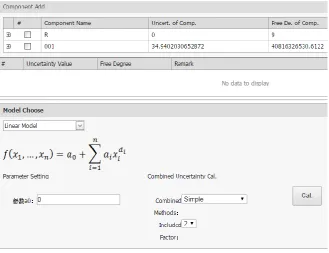
In this model, one component R is included, R have 10 evaluation times values, so choose Type A to calculate its uncertainty. Suppose that all the measurement value of R are 1000Ω, we calculated the uncertainty of R is 0. Linear Model is our defined measurement model, we use to calculate Rref,
[image:4.595.135.465.205.458.2]and the model also calculate sum of components. The Fig. 3-2 shows use linear model to calculate combined uncertainty of R.
Figure 3-2. Calculate combined uncertainty of R by linear model.
Laboratory Uncertainty Evaluation Results Compared
Users share their defined measurement model is a function in cloud platform, so, other users use the shared model and the result of uncertainty will be saved. The platform collect all the results of uncertainty value from the same measurement model, for one measuring object. We generate the charts to present uncertainty value distribution, as Fig. 3-3 shows as follow.
Figure 3-3. The chart shows measurement uncertainty of formaldehyde content.
[image:4.595.142.458.566.745.2]Conclusion
This paper summarized some lacks from the existing evaluation of uncertainty in measurement software, put forward two innovation points to boost uncertainty calculate numerical precise and simplify the processes. Add the function for labs provide uncertainty result compare to verify the ability among the labs.
Acknowledgement
This paper is supported by grants from Ministry of Science and Technology of the People’s Republic of China (2016YFF0204205) and China National Institute of Standardization (522016Y-4681, 522016Y-4486, 522014Y-3354, 2015QK241, 522014Z-3748-1, 522014Z-3440-01, 52Z0002-1-2016, and 522016Y-4682).
Reference
[1] Jinesh Varia. Cloud architectures- Amazon web services [EB/OL]. ACM Monthly Tech Talk, http://acmbangalore.org/events/monthly-talk/may-2008--cloud-architectures---amazon-web-service s.html, May, 2008.
[2] Zhang Weimin, Tang Jianfeng. Cloud Computing. Science Press, 2009.
[3] Information on https://en.wikipedia.org/wiki/Cloud_computing