2016 International Conference on Artificial Intelligence and Computer Science (AICS 2016) ISBN: 978-1-60595-411-0
Research on HCKM Algorithm Based on Parallel Clustering
Min ZHANG
1and Zhao-jie ZANG
2,*1College of Information and Engineering Dalian University, Dalian, China, [email protected]
2College of Information and Engineering Dalian University, Dalian, China, [email protected]
*Corresponding author
Keywords: Parallel, Clustering analysis, Canopy algorithm, Hadoop platform.
Abstract. With the explosive growth of data and the rapid increase in size, the method, using serial processing data to obtain information, apparently hasn’t met our requirements. Recently, the problem should be solved urgently has changed to how to find useful information from massive data quickly. Since the traditional K-medoids algorithm, which is sensitive to the initial cluster center, still exists many limitations in handling large datasets. Based on Hadoop platform, this paper puts forward a kind of Canopy-Kmedoids parallel algorithm, aiming to reduce the running time to a certain extent. According to the experimental results, the feasibility of algorithm has been proved in the changes of running time or speedup.
Introduction
Nowadays, with the explosive growth of knowledge, handling the massive data correctly and finding out the valuable knowledge to apply it into practical works have become a problem that needs to be resolved as soon as possible [1]. As a process, clustering aims to divide the data objects into a number of clusters, therefore, the cluster of objects is similar to each other, while the process between dissimilar objects of clusters is an unsupervised learning process. Clustering algorithm has been widely used in many fields, including business intelligence, machine learning, image processing and Web search etc [2]. K-medoids clustering algorithm which is simple and easy to operate has already been widely used in various fields of scientific researches based on its division [3-4]. Actually, the algorithm is sensitive to the initial value, and it can cause the local optimization problem easily, therefore, many scholars have been studying the algorithm.
Nowadays, literature [5] which implements the traditional K-medoids algorithm by MapReduce parallel processing could deal with large-scale datasets, but it still cannot solve the problem of sensitive initial center points. The method in literature [6] is used to calculate the density of information intending to obtain the initial centers, although the performance and the effect of clustering have been improved, the complexity of time has been increased.
According to the above problems, this paper proposed a new algorithm called HCKM algorithm: first, in order to avoid the sensibility of central point, we use Canopy algorithm to get the initial center point which was regarded as the center of K-medoids clustering center. Instead of selecting the cluster center blindly and the formulating K cluster improperly, it can get the clustering results which are more scientific and reliable; second, the algorithm solves the problem of handling massive data with the idea of parallelism. Experiments present a fact that the efficiency of algorithm has been improved greatly with the assistance of the clustering effect of HCKM algorithm.
Theoretical Basis
The description of the traditional algorithms of Canopy: Input: dataset D (D1, D2, D3,..., Di,...,Dn);
Output: cluster number K.
Step1: set up the initial center point and radius of the Canopy, randomly generated a number of Canopy.
Step2: calculate the new center of the Canopy.
Step3:re-division of the new Canopy center point and which area it belongs to. Step4: cycling step 2 and step 3, until K center position is no longer changed.
K-medoids algorithm thought is [8]:Dataset has N data objects, it is necessary to select K different data objects as the initial cluster center Ci in advance, then calculate the distance between each object to the cluster center, according to the calculated distance to assign them to the nearest cluster, order each cluster within a sequence, calculating the distance between the non cluster center point Ctest to the other points of the cluster, and summed Sumtest, if Sumtest < Sumi, then replace the original cluster center, continued iteration, until the new cluster center is no longer changed, end the algorithm.
The description of the traditional K-medoids algorithm: Input: dataset D (D1,D2,D3,Di,...,Dn), the cluster number K. Output: K cluster Ci.
Step1: choose any K objects as the initial center from the dataset D.
Step2: calculate the distance of each object to the center point and reassign them to the nearest cluster
Step3: calculate the non cluster center Ctest, if Sumtest < Sumi, replace the cluster center. Step4: cycling step 2 and step 3, until cluster center position is no longer changed.
Usually, the degree of similarity between the data or data objects between clusters can shows the convergence of clustering. Cluster similarity is small while the similarity between clusters is large, this means that the clustering effect is good; otherwise, the effect is poor. This paper uses the Euclidean function to measure the similarity within class, and to verify whether it is convergent in each iteration process if it is convergence, end the algorithm, otherwise, we will continue the clustering process until the function is convergent.
m i i i y x y x dist 1 2 ) ( ] ,[ (1)
Where the dataset x = (x1, x2,..., xm) and y = (y1, y2,..., ym) are two m dimensional data objects. Define the objective function to evaluate clustering results E as follows:
k 1 i 2 E i cx
x
c
i(2) Among them, the data of total is n, clustering number is k.
HCKM Algorithm Research
Traditional K-medoids algorithm required to choose the initial center by the researchers. Since the selection of the initial centers will influence the clustering effect to a certain extent, we adopt the Canopy algorithm to get the K cluster center in this paper. Instead of selecting the cluster center blindly and formulating K cluster improperly, it can help us get scientific clustering result.
Algorithm Theme
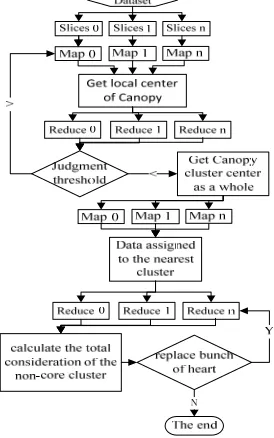
[image:3.612.246.383.129.348.2]The algorithm has two main parts; the first part intends to take the global center point of Canopy as the clustering center of K-medoids stage. The second part is the realization of K-medoids algorithm, the specific process is shown in Figure 1.
Figure 1. HCKM algorithm flow chart.
HCKM algorithm Process Steps
Step1: Initialize the Hadoop cluster environment, and upload the data to HDFS. Step2: Read data from the HDFS, parse the data into Key/Value format.
Step3: The Map operation is responsible for getting the local number of Canopy center.
Step4: Reduce operations take these center points again to the cluster, get the global centers of the Canopy.
Step5: Assign the center point of the step4 output to the clustering center of K-medoids.
Step6: Map operation is responsible for calculating the distances of all data objects to the cluster center point, and assigns it to the nearest cluster.
Step7: Reduce operations compare the total cost of each object in each cluster center to the cluster center to the total cost of each object, to determine whether have to replace the original cluster center. Step8: If a new center point is formed, calculating the distance between data objects and cluster centers, and distributing the data objects nearly.
Step9: Iterative Step6, Step7, Step8, until the center point is no longer changed, end the algorithm.
Cluster Data Analysis
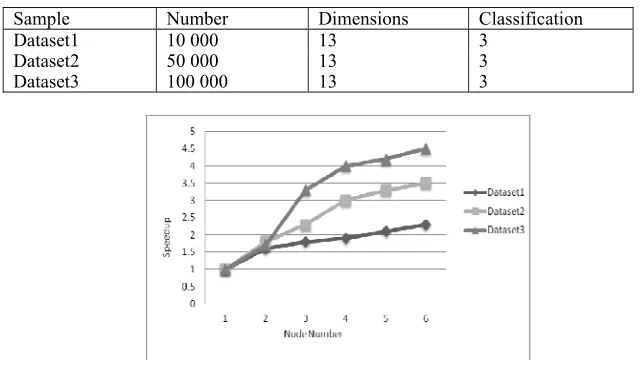
Table 1. Sample data.
Sample Number Dimensions Classification Dataset1 10 000 13 3
Dataset2 50 000 13 3 Dataset3 100 000 13 3
Figure 2. speedup of the HCKM algorithm.
This experiment is tested on K-medoids algorithm and HCKM algorithm in the same dimension for different orders of magnitude, through the speedup to measure the performance of parallel computing [9]. Fig. 2 shows that when the node number increased from one to six, due to the increase of traffic between each node, its speedup is becoming slower and slower , but the increase of it is more obvious when the number of the node increase; when the node number is two, it can be seen that the speedup of Dataset3 is smaller than the Dataset2’s, because the amount of Dataset3 data is far greater than Dataset2, resulting in data consumption in the communication time on the increase, obviously HCKM algorithm has a better speedup.
In a summary, the algorithm for test under the same dataset in a different order of magnitude, obvious that the improved algorithm not only greatly improve the efficiency of the algorithm, but also guarantee the accuracy of clustering.
Conclusions
Since the traditional K-medoids algorithm needs center initialization and time consuming in the process of dealing with large dataset, HCKM algorithm is proposed in this paper which can obtain the rough initial clustering center, and handle large dataset. The experimental results show that, compared with the traditional one, the HCKM algorithm has better speedup and performance, and can be well applied into the parallel computation of big data, while it is more suitable for the clustering analysis application of massive data.
References
[1] QinXiong Pie, Wang Huiju, Du Xiaoyong, etc. Big data analysis, the competition between RDBMS and graphs and symbiotic [J]. Journal of software, 2012, 23(1): 32-45. In Chinese
[2] Han Jiawei, Kamber M. Data mining: concepts and techniques [M]. San Francisco: Morgan Kaufmann Publishers, 2000.
[3] Sun Sheng, Wang Yuanzhen. Core-based Adaptive K-Medoids clustering [J]. Computer Engineering and Design,2009, 30(3): 674-675. In Chinese
[6] Pardeshi B., Toshniwal D. Improved K-medoids clustering based on cluster validity index and object density [C]//Proc of the 2nd IEEE International Advance Computing Conference, 2010: 379-384.
[7] Mao Dianhui. Based on the graphs of the Canopy-Kmeans algorithm [J]. Computer Engineering and Application, 2012 (27): 22-26. In Chinese
[8] Yao Lijuan, Luo, Meng Ying. A new K-medoids clustering algorithm [J]. Computer engineering and application, 2013, 49(19): 153-157. In Chinese