2016 International Conference on Computer, Mechatronics and Electronic Engineering (CMEE 2016) ISBN: 978-1-60595-406-6
Path Planning of Mobile Robot Based on Genetic Bee Colony Algorithm
Song WANG
1, Hong-xing LI
2* and Yi-nong ZHANG
21Beijing Key Laboratory of Information Service Engineering, Beijing Union University, Beijing
100101, China.
2College of Automation, Beijing Union University, Beijing 100101, China.
*Corresponding author
Keywords: Path planning, Artificial bee colony algorithm, Genetic algorithm, Grid method.
Abstract. In order to solve the problem of global path planning for mobile robot, a global optimization algorithm based on genetic bee colony algorithm is proposed. This algorithm is combining the global optimization strategy of the genetic algorithm and artificial bee colony algorithm. The improved crossover and mutation operator are introduced into the algorithm to increase the diversity of food source, effectively avoiding the swarm into local optimum, improving the ability of search for the food source. Besides, a strategy of adaptive selection has ability to search the optimal food source. A large number of the experiment and comparative analysis are carried out by using grid method in this paper. Experimental results show that this method has high precision and fast convergence speed, and it is an effective method for path planning.
Introduction
Path planning of mobile robot is an important branch of robotics [1], which refers to the robot in work environment with obstacles. According to a certain performance indicators, the robot can recognize surroundings constantly to read the size, location and distance of the obstacles, and bypassing all the obstacles efficiently. Path planning of the robot began in 1970s, the methods of path planning are generally divided into two kinds, classical planning methods and heuristic planning methods. The classic planning methods: artificial potential field [2], grid method [3] and so on, which have been applied in path planning. However, the classic planning method is not so effective in complex environment, and it has some deficiencies, such as artificial field potential method is to control the speed, and it has the defect that the valuable information of the distribution is discarded in the obstacles. Grid method is the most widely method of path planning at present, and the main problem of grid method is how to determine the size of grid cell to make the experimental result best. Many researchers have proposed some improved methods, such as Castillo [4], who use genetic algorithm for multi-objective optimal path to resolve planning problems. Karaboga[5] is inspired by the foraging behavior of bees, the ABC algorithm is first proposed in 2005. It is a kind of intelligent stochastic optimization algorithm of simulating the bees to search the food source. Bees rely on their different division of the labor to achieve the exchange of the information, in order to find optimum solution. ABC algorithm has been applied to solve the practical problems [6], such as Taguchi [7] hybrid bee colony algorithm, Gbest-guided artificial bee colony[8], etc. In this paper, the genetic bee colony algorithm is proposed to solve the path planning of mobile robot.
The Description of Path Planning
In this paper, grid method is used to divide planning space, and form a grid map which connects starting point and target point.
the map will be treated as obstacles. According to grid occupancy of an obstacle, the environmental space is divided into independent grid space, and an optimal path is searched from starting grid to target grid on the map. When grid method is used to modeling, the selection of grid size is a key factor.
The path planning is to prevent collision and to make the running path best. While the robot is closer to the obstacle, the probability of collision becomes greater. From a mathematical perspective, the path planning of the robot is a constrained optimal problem. The objective function needs to be minimized, and constraint condition gi(x)≤0,i∈{1,2,...,p}. Hence, the mathematical expression is defined as minf(x),xRn.
According to the characteristics of path planning, it can be transformed into Fmin by the length
function FL and collision function Fc. For path planning with waypoint N, the length function FL is defined as:
1 1 2 1 21 ) ( ) ]
[( N i i i i i
L x x y y
F
(1) where, (xi,yi) is the center of coordinate grid, and the next selected center of coordinating grid is
expressed as (xi+1,yi+1).
In the process of movement, the sum of all collision is Fc which is defined as:
N i k n k i c C F1 1 (2)
where, Cik is a function of meeting the k–th obstacle, and K is the number of obstacles. N is the
number of the path nodes.
Thus, from eqn.(1), eqn.(2) can be expressed as:
ds F k kF
F
L c1
0
min [ (1 ) ]
(3) where, L is the length of the path and k is the weighted coefficient.
Genetic Bee Colony Algorithm
The method of roulette selection is a common selection operator in ABC algorithm. When solving the large scale problems, this method often leads to locally optimal solution and even none optimal solution can be derived.
The Strategy of Adaptive Selection
In GBCA, the strategy of adaptive selection is designed to calculate the probability of selecting food source.
Assume that food source for the t-th generation is x(t)=(xt1,xt2,...,xtn), n is the total number of
food source, and the benefits of xik is F(xik), and the probability of adaptive selection is defined as:
α x F x F x P N j ik γ ik γ
ik
1 ) ( ) ( ) ( (4) where i∈[1,+∞], k∈[1,n], α and γ are regulatory factor and power index, respectively.When the value of F(xik) is large, the value of food source F is close to that of Fmax, and then
(1-F/Fmax)→0. γ will become very large, and the probability of selecting food source will be larger.
The probability of the t-th generation food source is followed and vice versa. The probability of the t-th generation food source xtkis defined as:
, , n α ) (x F ) (x F x P n j tj tk tk t 1 0 1 ) (
1 (7)
In early stage, the value α is larger which is beneficial to expand the search scope. When the value α is very small in the later, the algorithm can converge to global optimum solution quickly.
The Strategy of Crossover and Mutation
The Strategy of crossover and mutation can increase diversity by changing the bits of mutations and the probability of recombination. The crossover operator of food source sets is based on the maximum subsets of the similarity and probability Pc. Assume that two food source are set to A and
B, respectively, then the similarity is expressed as s(i,j)l/n,(0i,jm且i j). l is the length of longest common subset A, B, n is the length of food source sets and M is the size of the swarm.
For example, A=101010110, B=011010001, the largest public subset of A and B is 1010, and their length L = 4, and the length of the sets n=9. Therefore, the similarity of the A and B is S(I, J)=4/9. If the probability Pc=0.5, their similarity S (I, J)=4/9 < 0.5, the parent of food source is set to
A and B, and using the single-point crossover produces the offspring of A' and B' for 101010001,011010110, respectively. For the insertion variant, A = A1A2A3A4A5A6A7A8A9, A' is get
after insertion mutation, then mutate to be A' = A1A2A5A3A4A6A7A8A9.
The strategy of Improved Local Search
When the algorithm run to the later period, the food source has been nearly optimal. The effective number of the location has a smaller difference, which leads to the slower speed of the search. Therefore, it is very necessary to improve the ability of the search and the convergence rate of the algorithm. In the process of solving GBCA, the algorithm will produce many benefits of different food source at the stage of the scout. The benefits of new food source are sorted by the value of the benefits.
The value of the benefits F (x) is sorted by its size, x1 and x2 are set to corresponding function f
(x1) and f (x2), respectively, f (x1) < f (x2), and two values x1, x2 are no extreme points.
) ( 1 2 1
3 x x x
x
(8) where regulation factor θ is less than 1 and it is positive number, and it can adjust the size of the directions.
According to the mathematical derivation of the system, it can be concluded that whether f (x) is an increasing or decreasing function, they relation is f (x3) < f (x1) < f (x2) constantly.
When the algorithm searches the local area, two initial positions are randomly generated. Assume that the benefits of food source f (Xij-1) is smaller, the location of new food source is expressed as:
)
( 1 2
1 j i j i j i j
i X X X
X (9)
In accordance with the formula for several iterations, the benefits of new food source f (Xij) have
been less than original value, and always along the decreasing direction of their own.
Disturbance factor can be improved by the local fine tuning in the late stage of the evolution, as a result, a new formula of updating location is obtained as follows:
η j i j i j-i j
i X X X α rand ,
X 1( 1 2) (01)10
The process of GBCA
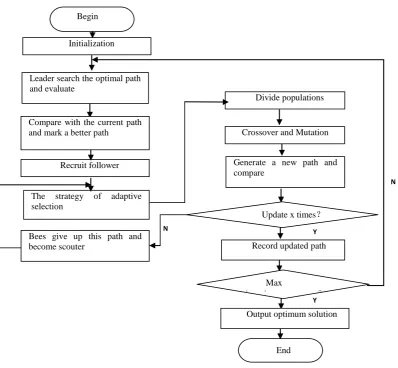
The process of GBCA is shown in Figure 1.
[image:4.595.99.498.114.482.2]
Figure 1. The process of GBCA.
Results and Discussions
In this experiment, the 25m×25m map of the grid scale is designed in this map. The obstacles are about 35% of the total number of the grids and they are irregular. The starting point of the robot is (0, 24), and the target point is (24, 0).
The following parameters in the GBCA and ABCA: the population size N=101, scout bee is set to 1, leader and follower bees are all 50. Furthermore the initial probability of crossover PC and mutation PM is set to 0.9 and 0.1, respectively. The number of time steps is set to 500. In the same situation, the GA is set to the same parameters for the path planning: N=101, PC = 0.9 and PM = 0.1. The running result of three algorithm is shown in Fig 2, fig 3 and fig 4, and statistical results are shown in Table 1.
From Figure 5 we can get that the average path and optimal path are decreased with the elevated number of iterations, and the trend of optimal path is more obvious. The proposed algorithm can find optimal path in shortest time, and it is obvious that the running result of GBCA is better than GA and ABCA.
Y The strategy of adaptive
selection
Crossover and Mutation
Generate a new path and compare
Y
Output optimum solution Recruit follower
Bees give up this path and become scouter
Compare with the current path and mark a better path
N
N
Divide populations
End
Initialization
Record updated path Update x times?
Leader search the optimal path and evaluate
Begin
Max
iterations ?
0 5 10 15 20 25 0
5 10 15 20 25
0 5 10 15 20 25
0 5 10 15 20 25
0 5 10 15 20 25 0
5 10 15 20 25
Figure 2. The curve of the GBCA. Figure 3.The curve of the GA. Figure 4. The curve of the ABCA.
0 100 200 300 400 500 30
40 50 60 70 80 90
Number of iterations
P
a
th
l
e
n
g
th
Shortest Length Average Length
Figure 5. The curve of average distance and optimal distance in GBCA. Table1. The experimental results of three algorithms.
The performance index GA ABCA GBCA
The shortest length /m 75.81 54.68 39.26
The average length /m 96.27 75.42 59.71
The average variance 4.83 2.57 0.86
Time consuming /s 386.81 215.19 141.65
The experimental results show that the GBCA is able to overcome the shortcoming of the ABC algorithm and solve the path planning of mobile robot effectively.
Summary
The path planning of mobile robot is a problem of complex multi-constrained optimization requires the shorter path and less time. In the later periods, bees have been unable to continue owing to have little difference in terms of the benefits. The ability of the algorithm is enhanced in local search, and the global convergence of the algorithm is greatly accelerated. Experimental results show that the proposed GBCA can find much more accurately optimal path planning of mobile robot in this study.
Acknowledgment
This research was financially supported by the project of Beijing Municipal Natural Science Foundation (4142018).
References
[1] C. Alexopoulos and P. M. MGriffin, Path planning for a mobile robot, IEEE Trans on System Man and Cybemetics, 22(2): 318-322,1992.
[image:5.595.68.517.67.411.2][3] M. Metea and J. Tsai, Route planning for intelligent autonomous land vehicles using hierarchical terrain representation, Robotics and Automation, pp.1947-1952, 1987.
[4] O. Castillo and L. Trujillo, Multiple objective optimization genetic algorithms for path planning in autonomous mobile robots, International journal of computers, Vol.6, pp.48-63, 2005.
[5] D. Karaboga, An idea based on honey bee swarm for numerical optimization, Technical Report-TR06, Erciyes University, Engineering Faculty, Computer Engineering Department, 2005.
[6] A Singh, An artificial bee colony algorithm for the leaf-constrained minimum spanning tree problem, Applied Soft Computing, 2009, 9(2):625-631.
[7] Jia-Ping Time, Hybrid taguchi-chaos of artificial bee colony algorithm for global numerical optimization, International Journal of Innovative Computing, Information and Control. 2013,9(6):2665-2688.