S T U D Y P R O T O C O L
Open Access
Cost-effectiveness of a stepped-care intervention
to prevent major depression in patients with type
2 diabetes mellitus and/or coronary heart disease
and subthreshold depression: design of a
cluster-randomized controlled trial
Susan EM van Dijk
1*, Alide D Pols
1,2, Marcel C Adriaanse
1, Judith E Bosmans
1, Petra JM Elders
2,
Harm WJ van Marwijk
2and Maurits W van Tulder
1Abstract
Background:Co-morbid major depression is a significant problem among patients with type 2 diabetes mellitus and/or coronary heart disease and this negatively impacts quality of life. Subthreshold depression is the most important risk factor for the development of major depression. Given the highly significant association between depression and adverse health outcomes and the limited capacity for depression treatment in primary care, there is an urgent need for interventions that successfully prevent the transition from subthreshold depression into a major depressive disorder. Nurse led stepped-care is a promising way to accomplish this. The aim of this study is to evaluate the cost-effectiveness of a nurse-led indicated stepped-care program to prevent major depression among patients with type 2 diabetes mellitus and/or coronary heart disease in primary care who also have subthreshold depressive symptoms.
Methods/design:An economic evaluation will be conducted alongside a cluster-randomized controlled trial in approximately thirty general practices in the Netherlands. Randomization takes place at the level of participating practice nurses. We aim to include 236 participants who will either receive a nurse-led indicated stepped-care program for depressive symptoms or care as usual. The stepped-care program consists of four sequential but flexible treatment steps: 1) watchful waiting, 2) guided self-help treatment, 3) problem solving treatment and 4) referral to the general practitioner. The primary clinical outcome measure is the cumulative incidence of major depressive disorder as measured with the Mini International Neuropsychiatric Interview. Secondary outcomes include severity of depressive symptoms, quality of life, anxiety and physical outcomes. Costs will be measured from a societal perspective and include health care utilization, medication and lost productivity costs. Measurements will be performed at baseline and 3, 6, 9 and 12 months.
Discussion:The intervention being investigated is expected to prevent new cases of depression among people with type 2 diabetes mellitus and/or coronary heart disease and subthreshold depression, with subsequent beneficial effects on quality of life, clinical outcomes and health care costs. When proven cost-effective, the program provides a viable treatment option in the Dutch primary care system.
(Continued on next page)
* Correspondence:[email protected]
1Department of Health Sciences and the EMGO institute for Health and Care
research, Faculty of Earth and Life Sciences, VU University Amsterdam, De Boelelaan 1085, 1081, HV, Amsterdam, The Netherlands
Full list of author information is available at the end of the article
(Continued from previous page)
Trial registration:Dutch Trial Register NTR3715
Keywords:Subthreshold depression, Depression prevention, Cost-effectiveness, Type 2 diabetes mellitus, Coronary heart disease, Stepped-care, Primary care, Nurse led treatment
Background
Subthreshold depression, the presence of symptoms of depression without fulfilling the criteria for major de-pression, is the strongest predictor for the onset of major depression [1,2]. Currently, major depression is a sub-stantial health problem throughout the industrialised world [3]. The 12 month prevalence of major depression ranges between 3 and 9% in high-income countries [4,5]. Among patients with type 2 diabetes mellitus (DM2) and/or coronary heart disease (CHD) estimates of the 12 month prevalence of major depression usually range from 10% to 20% [6-8]. Even more patients with DM2 and/or CHD experience subthreshold depression, i.e. 25%-40% [9,10]. More than 40% of diabetic patients with subthreshold depression will develop major depression within two years [9]. Similar estimates are found for pa-tients diagnosed with CHD [11].
Depression has been shown to adversely affect self-care and medication adherence related to DM2 and CHD [12,13], to negatively impact quality of life [14,15] and to be associated with poor health outcomes and an increased risk of mortality [16,17]. Moreover, DM2 and CHD patients with depression use healthcare services more often than their non-depressed counterparts, which is associated with a substantial increase in health care related costs. This effect cannot be explained by an increase in mental health care costs alone and remains present after adjusting for co-morbid medical conditions [18-21]. In addition, depression is associated with in-creased work absenteeism, which raises the total societal costs of depression even more [22].
Unfortunately, even when optimal treatment is given to all patients with major depression, only about 27 per-cent of the total disease burden can be averted [23]. Therefore, prevention of the onset of major depression among high risk patients may be a promising solution to reduce the burden for both patients and society substan-tially [24].
Meta analyses show that using preventive interven-tions, a reduction of about 25% in the incidence of major depression can be obtained [2,25]. Especially promising are preventive interventions that are offered in a stepped-care format [25]. The aim of stepped-care inter-ventions is to maximize the effectiveness of an interven-tion while making best use of available resources by offering the least intensive treatment necessary and by
tailoring the treatment to the patient’s preferences. By using such a format, it is possible to reduce the relative risk of the onset of depression by as much as 50% [25-27].
There is also evidence that stepped-care interventions can be used to treat existing major depression among patients with DM2 in primary care [28]. This stepped-care depression treatment was shown to be cost-effective in comparison with usual care as well. The additional costs associated with the implementation of the stepped-care program did not result in higher total health care costs over respectively a 2- and 5- year period [29,30]. This effect remained after adjusting for co-morbid medical conditions. A more recent study showed that a stepped-care program is effective in im-proving disease control in chronically ill patients with existing major depression [31]. All these findings com-bined suggest that stepped-care is a promising method to not only treat major depression in patients with DM2 and/or CHD, but also to prevent the onset of this dis-order in these patient groups. However, to the best of our knowledge, there are no studies evaluating the cost-effectiveness of a stepped-care program to prevent de-pression among DM2 and CHD patients.
Therefore, this study aims to evaluate the cost-effectiveness of a nurse-led indicated stepped-care pro-gram to prevent depression among primary care patients with type 2 diabetes mellitus and/or coronary heart dis-ease and subthreshold depression in comparison with usual care.
Methods/design Design
An economic evaluation from a societal perspective will be performed alongside a multi-center, cluster random-ized controlled trial with a one year follow up.
Ethical approval
Setting
The study will be carried out in approximately thirty general practices in the Netherlands. To select these practices, we will make use of the Academic Network of General Practitioners (GPs) of the Department of General practice and of the VU medical centre.
Randomization
Randomization will be done at the level of the participat-ing practice nurses to avoid contamination between the treatment groups and will be performed by a statistician blinded to characteristics of the general practices using a computer generated list of random numbers. Before pa-tients are recruited, participating practices will be ran-domly allocated to serve as intervention practices where the stepped-care treatment will be implemented, and control practices where care as usual will be given. Pa-tients will be allocated to either one of the treatment conditions, based on the general practice where they are registered. Blinding of patients, GPs and practice nurses is not possible due to the nature of the intervention.
Participants
Patients are eligible for this study if they are 18 years or older, are treated for DM2 and/or CHD in primary care, and have subthreshold depressive symptoms (a score of 6 or more on the Patient Health Questionnaire-9, or PHQ-9 [32]) without fulfilling the criteria for major de-pression according to the Diagnostic and Statistical Manual of Mental Disorders (DSM-IV), as measured with the Mini International Neuropsychiatric Interview (MINI) [33].
Patients are excluded from participation in the study when they have a major depressive disorder; cognitive impairment or dementia; a psychotic or terminal illness; a history of (a) suicide attempt(s); or insufficient Dutch language skills, visual impairments or illiteracy. Also, pa-tients cannot participate when they are pregnant, taking antidepressant medication, or when they have lost a sig-nificant other in the past 6 months.
Recruitment
To recruit eligible patients, in all participating general practices an initial list of adult patients with DM2 and/ or CHD is composed, based on diagnoses classified using the ICPC (International Classification of Primary Care) in the medical electronic information system; see Additional file 1 for details. This list is given to the gen-eral practitioner, who checks the preset inclusion criteria and excludes all patients that fulfill our preset exclusion criteria, based on the medical file and experiences with the patient. All remaining eligible patients will receive a letter on behalf of the general practitioner, in which all (at that point) necessary information regarding the
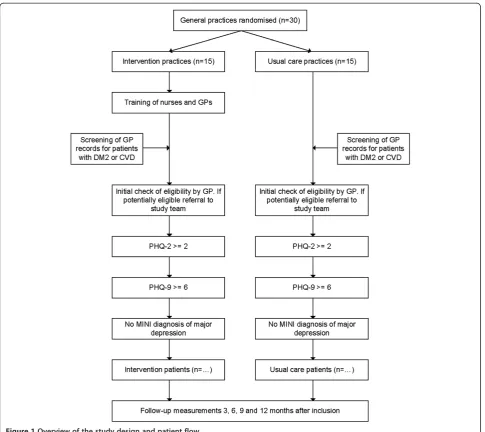
study, as well as an invitation to participate is included. When patients consider to participate, they are asked to fill out a two question screening form (Patient Health Questonnaire-2, or PHQ-2 [34]) that will be provided with the information letter and send it back using a prestamped envelope. All patients with a PHQ-2 score of 2 or more [34,35] will receive additional information from the research team. Based on this information in-formed consent is obtained for a telephone interview. During this interview the Dutch version of the PHQ-9 [36] and the MINI [37] will be administered. Patients scoring 6 points or more on the PHQ-9, but not having a major depression according to the MINI are eligible for the study and will be asked for written informed con-sent to participate. From this point on, patients are either enrolled in the stepped-care program or will re-ceive care as usual, depending on the general practice at which they are registered. An overview of the study design and patient flow is provided in Figure 1.
Intervention
The intervention is modelled after the flexible stepped-care intervention developed by van‘t Veer-Tazelaar et al. [26]. After receiving a specially developed training, prac-tice nurses in the intervention pracprac-tices will act as care managers and work together with the General Practi-tioner (GP) to provide the stepped-care treatment. The care managers coordinate the execution of the stepped-care program that consists of four evidence-based subse-quent treatment steps, lasting 3 months each. The flow of participants in the intervention group through the stepped-care program depends on their depressive symp-tom level, measured using the PHQ-9 every 3 months dur-ing 1 year. Participants who still have elevated depressive symptom levels (i.e. a PHQ-9 score of 6 or more) after concluding a step, are offered participation in the next step. A score below the cut off point results in a period of watchful waiting until an elevated PHQ-9 score indicates the need for the subsequent step of the intervention. By only offering more intensive treatment to patients who continue to have elevated depressive symptom scores, it is expected that patients will receive treatment tailored to their needs and that available resources are more effi-ciently used by providing the more intensive treatments only to those who need this. Patients who meet the MINI diagnostic criteria for major depression at baseline or at 3, 6, 9 or 12 months are referred to their GP by the practice nurse for further assessment. The following treatment steps are offered to participants:
Step 1: Watchful waiting
consent, patients are invited by their care manager for an introductory consultation. During this consultation patients will get acquainted with the care manager and they will receive an information brochure about mild de-pression with simple advices on how to cope with mild depressive symptoms. Patients will be informed about the stepped-care program and its rationale. In this step, no therapeutic intervention will take place.
Step 2: Guided self-help treatment
During this step, participants are offered a self-help course that is specially designed for patients with a chronic physical illness and depressive complaints [38]. During a visit to the general practice, the care manager will give the patient all necessary materials and explain the self-help course. Participants can work through the
course at their convenience. In doing so, they will be supported by their care manager, who will contact them every other week by phone to monitor their progress. If it is clear that after two weeks the patient has not started the course yet, the care manager will use motivational interviewing techniques by phone to activate the patient. When this does not have the intended activating effect on the patient after two more weeks, the care manager invites the patient to come to the practice to discuss the current depressive symptoms (a PHQ-9 will be adminis-tered). When depressive symptoms still exist, patients are offered to progress early to step 3.
Step 3: problem-solving treatment
[image:4.595.57.543.87.519.2]cognitive behavioural intervention that focuses on prac-tical skill building. It consists of a maximum of 7 ses-sions during which the stages of problem solving are explained and then applied to problems encountered in daily life. The goal of PST is to help patients regain con-trol of their lives [39,40].
Step 4: Referral to general practitioner
Participants with continuously elevated PHQ-9 scores after 9 months will be referred to their general practi-tioner by the care manager for further assessment of their depressive symptoms. The GP receives a summary of the treatment provided to discuss with their patient.
Usual care
In the usual care practices, practice nurses and GPs will be blinded to which patients are participating in the study. They will not receive any training and will provide care as usual to all their patients according to existing clinical guidelines [41-43]. Participants in the usual care group will have unrestricted access to care as normally provided by their general practitioner. Their healthcare uptake (includ-ing use of prescribed medication) will be recorded.
Training of the practice nurses
In the intervention practices, the practice nurses who are going to provide the stepped-care treatment will at-tend a two day training. This training focuses on how to implement the stepped-care program, how to provide guidance with the self help course using motivational interviewing techniques and how to provide the PST. The motivational interviewing techniques and the PST will be taught by a professional trainer. Before the trial starts, the trained practice nurses will perform two prac-tice sessions of PST by telephone. These sessions will be audio taped and evaluated by the training staff to detect possible competence and/or adherence issues. During the trial, all practice nurses are regularly supervised by the training staff. Nurses can also contact the training staff to discuss any questions or problems, should they arise. When practice nurses have previously received training in motivational interviewing and/or PST, they are offered to follow a personalized training program.
Outcomes
The primary clinical outcome is the cumulative inci-dence of DSM-IV major depressive disorder after 12 months according to the Mini International Neuro-psychiatric Interview (MINI) [33,37]. The MINI will be administered by telephone at baseline and after 6 and 12 months after baseline by qualified research assistants.
Depression severity will be measured using the PHQ-9 [32,44]. The PHQ-9 is a widely used validated instrument to measure depression symptoms in general practice.
Quality of life will be measured using the EuroQol (EQ-5D) [45]). The obtained EQ-5D scores will be used to calculate utilities according to the Dutch tariff. QALYs will be calculated using the area-under-the-curve method with linear interpolation between time points.
For the economic evaluation, costs will be measured using the TiC-P questionnaire [46]. Costs that will be in-cluded are costs for healthcare utilization, informal care, and work absenteeism and presenteeism. Medication use will be retrieved from the patient’s pharmacy. If avail-able, Dutch guideline prices will be used to value re-source use. Medication use will be valued using prices of the Royal Dutch Society for Pharmacy. Lost productivity costs will be calculated according to the friction cost ap-proach (friction period 154 days) using the mean age-and sex-specific income of the Dutch population. According to the friction cost approach a sick employee is replaced after a certain amount of time (the friction period) after which there are no lost productivity costs anymore. All costs will be adjusted to the year in which most data is collected using consumer price indices.
All secondary outcomes mentioned above will be ad-ministered at baseline, 3, 6, 9 and 12 months after inclu-sion through web-based questionnaires. If patients do not have access to the internet or prefer hard copies, we will provide these. In the intervention group, the PHQ-9 will also be administered by the nurse in the general practice for clinical monitoring and adjusting treatment when necessary.
Other secondary clinical outcomes include blood pres-sure, low-density lipoprotein (LDL) cholesterol and glycosylated haemoglobin (HbA1C). These outcomes will be measured at baseline and at 12 months follow-up and are performed as part of the usual care for this group of patients. Therefore, patients do not undergo any extra physical measurements.
To be able to control for possible confounders, demo-graphics will be measured at baseline, along with per-sonal and family history of mood disorders, using a subset of the Diagnostic Interview Schedule (DIS) [47]. The occurrence of co-morbid chronic illnesses will be assessed with the Dutch questionnaire chronic illnesses [48] at baseline and after 6 and 12 months, as well as locus of control [49]and social support [50]. All these measurements were previously used for the same pur-poses in the West Friesland Study [51]. In addition to this, anxiety symptoms will be measured at baseline, 3, 6, 9 and 12 months by the Hospital Anxiety and Depres-sion Scale- Anxiety (HADS-A) [52].
Mental health care utilization outside the general prac-tice will be assessed using the TiC-P questionnaire [46].
A process evaluation will be performed in which the barriers and facilitators of the stepped-care program and the experiences with the program will be evaluated. This will be done by organizing focus groups among volun-teering patients, general practitioners and primary care nurses. In addition, satisfaction with the received care will be measured in all patients after 12 months by using the CSQ [53,54]. An overview of all measurements and instruments is provided in Table 1.
Sample size
The trial is powered to detect a difference of 15% in the cumulative incidence rates of MINI/DSM-IV depressive disorder between the conditions after 1 year. The inci-dence rate is expected to be 30% in the usual care group and 15% in the intervention group based on findings from earlier studies [2,25,26]. Using a standard sample size calculation, 121 patients per group are needed, as-suming a power of 0.8 and an alpha of 0.05. However, we need to correct for the fact that there is a multilevel setting with three levels: GPs, patients and measure-ments. Therefore we have first adjusted for the fact that we do not have one, but multiple measurements per pa-tient. Assuming these measurements are clustered with an intraclass correlation (ICC) of 0.45, seventy-one pa-tients per group are needed. Subsequently, we adjusted this figure further for clustering of patients within GP practices. Assuming an ICC of 0.05 for clustering of pa-tients within the 30 GP practices, we need a total of 177 patients. Finally, we adjusted for a dropout rate of 25%, which means that 236 patients (118 patients per group) need to be included in this trial. This power calculation is based on the method described by Twisk in 2006 [55].
Statistical analyses
Baseline data will be presented comparing the two treat-ment groups.
All analyses will be on an intention-to-treat basis. Differ-ences between the stepped-care group and the usual care group will be tested using mixed model analyses. To test the cumulative incidence of depression over time, logistic mixed model analysis will be used. The obtained odds ratio describes the reduction in the risk of a MINI/DSM-IV de-pressive disorder in the intervention group relative to the control group. Linear and logistic mixed models (depending on the outcome) will also be used to test differ-ences in symptoms of depression and anxiety and quality of life between both groups over time. If necessary, the models will be adjusted for confounders.
Sub group analyses will be performed to check for an interaction effect between depression severity at baseline and improvement in depressive symptoms at 12 months. In case of unequal distributions of demographic variables between the two treatment groups, multivariate analyses techniques will be used to correct for these differences.
Economic evaluation
[image:6.595.57.538.550.734.2]Both a cost-effectiveness analysis and a cost-utility ana-lysis will be performed. Missing cost and effect data will be imputed using multiple imputation according to the MICE algorithm developed by Van Buuren [56]. The results of the imputed datasets will be pooled using Rubin’s rules [57]. Costs typically have a highly skewed distribution. Policy makers want to have information on the difference in mean total costs between the two treat-ment groups in order to be able to estimate the total health care budget needed for a specific condition [58]. Therefore, bias-corrected and accelerated bootstrapping with 5000 replications will be used to estimate 95% con-fidence intervals around the mean difference in total
Table 1 Overview of all measurements and instruments
screening baseline 3 months 6 months 9 months 12 months
Depression symptoms (PHQ-2) x
Demographics x
Depression symptoms (PHQ-9) x x x x x
Clinical depression (MINI) x x x
Health care costs (Tic-P) x x x x x
Quality of life (EQ-5D) x x x x x
Anxiety (HADS-A) x x x x x
Personal and family history (DIS) x
Social support x x x
Existing chronic illnesses x x x
Locus of control x x x x x
costs between the treatment groups. Incremental cost-effectiveness ratios (ICERs) will be calculated by dividing the difference in mean total costs between the treatment groups, by the difference in mean effects between the treatment groups. Bootstrapping will also be used to esti-mate the uncertainty surrounding the ICERs, which will be graphically presented on cost-effectiveness planes. Cost- effectiveness acceptability curves will be estimated as well. Cost-effectiveness acceptability curves show the probability that the stepped-care program is cost-effective in comparison with usual care for a range of different ceil-ing ratios (i.e. the willceil-ingness to pay for 1 extra recovered patient), thereby showing decision uncertainty [59].
Discussion
Based on earlier studies, there is substantial evidence that stepped-care programs for depression among pri-mary care patients are effective in both improving and preventing depression. However, evidence concerning the costs and effects of such programs among patients with DM2 and/or CHD and subthreshold depression in general practices is still missing.
Given the large number of DM2 and CHD patients with depressive symptoms, and the limited capacity for depression treatment in primary care, there is an urgent need to improve care for these patients. Since the pres-ence of subthreshold depressive symptoms is the largest risk factor for developing major depression, targeting preventive treatments to patients at risk for developing a major depression is a viable option to reduce the burden of depression in primary care. Stepped-care interventions are a very promising method to achieve this goal. The key of stepped-care, delivered by a care manager, is that treat-ment is tailored to the needs and preferences of the pa-tient while making the best use of available recourses. This will help optimizing health related outcomes, as well as keeping the treatment affordable by saving available re-sources for patients who really need them.
By testing a stepped-care program to prevent depres-sion among high risk DM2 and/or CHD patients in a primary care setting, this study is highly clinically and societally relevant. Moreover, because a structured evaluation of the feasibility of the stepped-care program is explicitly taken into account in the study design, the results of this cluster randomised controlled trial will greatly contribute to the practical evidence about pre-ventive treatment options for depression in patients with DM2 and/or CHD in general practice.
A strength of this study is that a pragmatic study design is employed; meaning that patients, treatments and proce-dures are similar to daily clinical practice. This greatly en-hances the generalizability of the findings of the study and therefore the possibilities to implement the Step-Dep treatment in a real-life primary care setting.
The relatively short 12 month follow-up period may turn out to be a limitation of this trial. It is possible that the potential health benefits of participating in the stepped-care program will not yet be fully visible after one year. Especially the beneficial effects of having less depressive symptoms on health care utilisation, work ab-senteeism, and clinical outcomes such as Hb1Ac, blood pressure and LDL cholesterol, may take longer than the follow up period of one year to reach full development. Katon and his colleagues, for example, found a signifi-cant reduction in total health care costs among DM2 pa-tients that participated in a stepped-care intervention to treat major depression after two years, but not yet after 12 months [30]. Other studies report similar results [60-62]. These findings can be explained by the fact that the extra costs of stepped-care interventions are made in the first year, while the cumulative effects of the ment will become more and more visible after the treat-ment is finished. Therefore it might be necessary to perform a follow up study when the results indicate such a delay in cumulative effects.
Another possible limitation is that it is not possible to blind patients and caregivers to the randomisation due to the nature of the stepped-care program. However, considering the pragmatic design of the study, this is a true representation of clinical practice and this also en-ables us to measure all possible effects of the interven-tion. We try to counter possible contamination between treatments groups by using a cluster randomized con-trolled design, in which staff from usual care practices are not trained to perform the stepped-care program until after the follow up period. That way, caregivers cannot unintentionally apply aspects of the stepped-care program to their usual care for patients.
Overall, this study will provide valuable information about the cost-effectiveness and feasibility of a stepped-care program in primary stepped-care to prevent major depression in DM2/CHD patients with subthreshold depression, both from a clinical and societal perspective. When the stepped-care program proves to be cost-effective, the re-sults of this study will offer a unique venture point for implementation of the stepped-care program into primary care and further research. The first results of this trial are expected in 2015.
Additional file
Additional file 1:ICPC codes used for recruitment.This file provides a list of all registration codes used to identify potentially eligible patients in the medical electronic information system of participating general practices.
Abbreviations
DSM-IV: Diagnostic and Statistical Manual of Mental Disorders-IV; EQ-5D: EuroQol- 5 dimensions; GPs: General Practices; HADS-A: Hospital Anxiety and Depression Scale-A; ICC: Intraclass correlation; ICERs: Incremental Cost-Effectiveness Ratios; ICPC: International Classification of Primary Care; LDL cholesterol: Low-Density Lipoprotein cholesterol; PHQ-2: Patient Health Questionnaire-2; PHQ-9: Patient Health Questionnaire- 9; PST: Problem Solving Treatment.
Competing interests
The authors declare that they have no competing interests.
Authors’contributions
SvD constructed the design of the study and drafted the manuscript. AP constructed the design of the study and revised the manuscript. MCA, JB, PE and HvM developed the study, constructed the design and revised the manuscript. MvT participated in the design of the study and revised the manuscript. The final manuscript was read and approved by all authors.
Acknowledgements and funding
This study is funded by ZonMw, the Netherlands Organisation for Health Research and Development (project number 80-82310-97-12110). Publication in this Open Access journal was funded by NWO, the Netherlands Organisation for Scientific Research.
The Authors would like to thank Hanna Joosten, data manager at the Department of General Practice, VU University Medical Centre, Amsterdam, for helping us out by estimating the feasibility of the trial based on a registration sample of the Academic Network of General Practitioners (GPs) of the Department of General practice of the VU medical centre.
Author details
1Department of Health Sciences and the EMGO institute for Health and Care
research, Faculty of Earth and Life Sciences, VU University Amsterdam, De Boelelaan 1085, 1081, HV, Amsterdam, The Netherlands.2Department of
General Practice and the EMGO institute for Health and Care research, VU University Medical Centre, Amsterdam, The Netherlands.
Received: 10 April 2013 Accepted: 24 April 2013 Published: 7 May 2013
References
1. Smits F, Smits N, Schoevers R, Deeg D, Beekman A, Cuijpers P:An epidemiological approach to depression prevention in old age. Am J Geriatr Psychiatr2008,16:444–453.
2. Cuijpers P, Van Straten A, Smit F, Mihalopoulos C, Beekman A:Preventing the onset of depressive disorders: a meta-analytic review of psychological interventions.Am J Psychiatr2008,165:1272–1280. 3. Mathers CD, Loncar D:Projections of global mortality and burden of
disease from 2002 to 2030.PLoS Med2006,3:e442.
4. de Graaf R, ten Have M, van Gool C, van Dorsselaer S:Prevalence of mental disorders and trends from 1996 to 2009. Results from the Netherlands Mental Health Survey and Incidence Study-2.Soc Psychiatr Psychiatr Epidemiol2012,47:203–213.
5. Kessler RC, Ustun T (Eds):The WHO World Mental Health Surveys.Cambridge: Cambridge University Press; 2008.
6. Anderson RJ, Freedland KE, Clouse RE, Lustman PJ:The prevalence of comorbid depression in adults with diabetes.Diabetes Care2001, 24:1069–1078.
7. Härter M, Baumeister H, Reuter K, Jacobi F, Höfler M, Bengel J, Wittchen HU: Increased 12-month prevalence rates of mental disorders in patients with chronic somatic diseases.Psychother Psychosom2007,76:354–360. 8. Rudisch B, Nemeroff CB:Epidemiology of comorbid coronary artery
disease and depression.Biol Psychiatr2003,54:227–240.
9. Bot M, Pouwer F, Ormel J, Slaets JPJ, De Jonge P:Predictors of incident major depression in diabetic outpatients with subthreshold depression. Diabet Med2010,27:1295–1301.
10. Thombs BD, Bass EB, Ford DE, Stewart KJ, Tsilidis KK, Patel U, Fauerbach JA, Bush DE, Ziegelstein RC:Prevalence of depression in survivors of acute myocardial infarction.J Gen Intern Med2006,21:30–38.
11. Hance M, Carney RM, Freedland KE, Skala J:Depression in patients with coronary heart disease: A 12-month follow-up.Gen Hosp Psychiatr1996, 18:61–65.
12. Gehi A, Haas D, Pipkin S, Whooley MA:Depression and medication adherence in outpatients with coronary heart disease: findings from the Heart and Soul Study.Arch Int Med2005,165:2508–2513.
13. Lin EHB, Katon W, Von Korff M, Rutter C, Simon GE, Oliver M, Ciechanowski P, Ludman EJ, Bush T, Young B:Relationship of depression and diabetes self-care, medication adherence, and preventive care.Diabetes Care2004, 27:2154–2160.
14. Ruo B, Rumsfeld JS, Hlatky MA, Liu H, Browner WS, Whooley MA: Depressive symptoms and health-related quality of life: the heart and soul study.JAMA2003,290:215–221.
15. Ali S, Stone M, Skinner TC, Robertson N, Davies M, Khunti K:The association between depression and health-related quality of life in people with type 2 diabetes: a systematic literature review.Diabetes Metab Res Rev 2010,26:75–89.
16. Lin EHB, Heckbert SR, Rutter CM, Katon WJ, Ciechanowski P, Ludman EJ, Oliver M, Young BA, McCulloch DK, Von Korff M:Depression and increased mortality in diabetes: unexpected causes of death.Ann Fam Med2009, 7:414–421.
17. Katon W, Lin EHB, Von Korff M, Ciechanowski P, Ludman E, Young B, Rutter C, Oliver M, McGregor M:Integrating depression and chronic disease care among patients with diabetes and/or coronary heart disease: the design of the TEAMcare study.Contemp Clin Trials2010,31:312–322.
18. Simon GE, Katon WJ, Lin EHB, Ludman E, VonKorff M, Ciechanowski P, Young BA:Diabetes complications and depression as predictors of health service costs.Gen Hosp Psychiatr2005,27:344–351.
19. Rutledge T, Vaccarino V, Johnson BD, Bittner V, Olson MB, Linke SE, Cornell CE, Eteiba W, Sheps DS, Francis J,et al:Depression and cardiovascular health care costs among women with suspected myocardial ischemia: prospective results from the WISE (Women's Ischemia Syndrome Evaluation) Study.J Am Coll Cardiol2009,53:176–183.
20. Bosmans JE, Adriaanse MC:Outpatient costs in pharmaceutically treated diabetes patients with and without a diagnosis of depression in a Dutch primary care setting.BMC Health Serv Res2012,12:46.
21. Egede LE, Zheng D, Simpson K:Comorbid depression is associated with increased health care use and expenditures in individuals with diabetes. Diabetes Care2002,25:464–470.
22. Smit F, Willemse G, Koopmanschap M, Onrust S, Cuijpers P, Beekman A: Cost-effectiveness of preventing depression in primary care patients. Br J Psychiatr2006,188:330–336.
23. Andrews G, Issakidis C, Sanderson K, Corry J, Lapsley H:Utilising survey data to inform public policy: comparison of the cost-effectiveness of treatment of ten mental disorders.Br J Psychiatr2004,184:526–533. 24. Cuijpers P, Beekman ATF, Reynolds CF:Preventing depression: a global
priority.JAMA2012,307:1033–1034.
25. Muñoz RF, Cuijpers P, Smit F, Barrera AZ, Leykin Y:Prevention of major depression.Annu Rev Clin Psychol2010,6:181–212.
26. van't Veer-Tazelaar PJ, van Marwijk HWJ, van Oppen P, van Hout HPJ, van der Horst HE, Cuijpers P, Smit F, Beekman ATF:Stepped-care prevention of anxiety and depression in late life: a randomized controlled trial. Arch Gen Psychiatr2009,66:297–304.
27. van't Veer-Tazelaar PJ, van Marwijk HW, van Oppen P, van der Horst HE, Smit F, Cuijpers P, Beekman AT:Prevention of late-life anxiety and depression has sustained effects over 24 months: a pragmatic randomized trial.Am J Geriatr Psychiatr2011,19:230–239.
28. Katon WJ, Von Korff M, Lin EHB, Simon G, Ludman E, Russo J, Ciechanowski P, Walker E, Bush T:The Pathways Study: a randomized trial of collaborative care in patients with diabetes and depression.Arch Gen Psychiatr2004,61:1042–1049.
29. Katon WJ, Russo JE, Von Korff M, Lin EHB, Ludman E, Ciechanowski PS: Long-term effects on medical costs of improving depression outcomes in patients with depression and diabetes.Diabetes Care2008,31:1155–1159. 30. Katon W, Unützer J, Fan MY, Williams JW Jr, Schoenbaum M, Lin EHB,
Hunkeler EM:Cost-effectiveness and net benefit of enhanced treatment of depression for older adults with diabetes and depression.Diabetes Care2006,29:265–270.
31. Katon WJ, Lin EHB, Von Korff M, Ciechanowski P, Ludman EJ, Young B, Peterson D, Rutter CM, McGregor M, McCulloch D:Collaborative care for patients with depression and chronic illnesses.N Engl J Med2010, 363:2611–2620.
33. Sheehan DV, Lecrubier Y, Sheehan KH, Amorim P, Janavs J, Weiller E, Hergueta T, Baker R, Dunbar GC:The Mini-International Neuropsychiatric Interview (MINI): the development and validation of a structured diagnostic psychiatric interview for DSM-IV and ICD-10.J Clin Psychiatr 1998,59:22–33.
34. Kroenke K, Spitzer RL, Williams JBW:The Patient Health Questionnaire-2: validity of a two-item depression screener.Med Care2003,41:1284–1292. 35. Arroll B, Goodyear-Smith F, Crengle S, Gunn J, Kerse N, Fishman T, Falloon K,
Hatcher S:Validation of PHQ-2 and PHQ-9 to screen for major depression in the primary care population.Ann Fam Med2010,8:348–353.
36. Zuithoff NPA, Vergouwe Y, King M, Nazareth I, van Wezep MJ, Moons KGM, Geerlings MI:The Patient Health Questionnaire-9 for detection of major depressive disorder in primary care: consequences of current thresholds in a crosssectional study.BMC Fam Pract2010,11:98.
37. Van Vliet I, De Beurs E:Het Mini Internationaal Neuropsychiatrisch Interview (MINI) Een kort gestructureerd diagnostisch psychiatrisch interview voor DSM-IV- en ICD-10-stoornissen.Tijdschr Psychiatr2007, 49:393–397.
38. Voordouw I, van Osch B, Terweij M:De cursus Leven met een chronische ziekte.Utrecht: Trimbos-instituut; 2005.
39. Bosmans JE, Brook OH, van Hout HPJ, de Bruijne MC, Nieuwenhuyse H, Bouter LM, Stalman WAB, van Tulder MW:Cost effectiveness of a pharmacy-based coaching programme to improve adherence to antidepressants.Pharmacoeconomics2007,25:25–37.
40. Mynors-Wallis L, Davies I, Gray A, Barbour F, Gath D:A randomised controlled trial and cost analysis of problem-solving treatment for emotional disorders given by community nurses in primary care. Br J Psychiatr1997,170:113–119.
41. Platform Vitale Vaten:Zorgstandaard Vasculair Risicomanagement deel I (voor zorgverleners).Den Haag: Platform Vitale Vaten; 2009.
42. Trimbos-instituut:Naar een zorgstandaard voor depressie: Checklists depressiezorg voor zorgaanbieders en zorgverzekeraars.Utrecht: Trimbos-instituut; 2007.
43. Nederlandse Diabetes Federatie:NDF Care Standard: Transparency and quality of diabetes care for people with type 2 diabetes.Amersfoort: Nederlandse Diabetes Federatie; 2007.
44. Wittkampf K, van Ravesteijn H, Baas K, van de Hoogen H, Schene A, Bindels P, Lucassen P, van de Lisdonk E, van Weert H:The accuracy of Patient Health Questionnaire-9 in detecting depression and measuring depression severity in high-risk groups in primary care.Gen Hosp Psychiatr2009,31:451–459.
45. Brooks R:EuroQol: the current state of play.Health Policy1996,37:53–72. 46. Roijen L, Straten A, Tiemens B, Donker M:Handleiding Trimbos/iMTA
questionnaire for Costs associated with Psychiatric illness (TiC-P).Rotterdam: Institute of Medical Technology Assessment (iMTA); 2002.
47. Robins LN, Helzer JE, Croughan J, Ratcliff KS:National Institute of Mental Health diagnostic interview schedule: its history, characteristics, and validity.Arch General Psychiatr1981,38:381–389.
48. Kriegsman DMW, Penninx BWJH, Van Eijk JTM, Boeke AJP, Deeg DJH: Self-reports and general practitioner information on the presence of chronic diseases in community dwelling elderly: A study on the accuracy of patients' self-reports and on determinants of inaccuracy.J Clin Epidemiol 1996,49:1407–1417.
49. Pearlin LI, Schooler C:The Structure of Coping.J Health Soc Behav1978,19:2–21. 50. Penninx BWJH, Van Tilburg T, Kriegsman DMW, Deeg DJH, Boeke AJP, van
Eijk JTM:Effects of social support and personal coping resources on mortality in older age: the Longitudinal Aging Study Amsterdam. Am J Epidemiol1997,146:510–519.
51. Bijl D, Van Marwijk H, Beekman A, De Haan M, Van Tilburg W:A randomized controlled trial to improve the recognition, diagnosis and treatment of major depression in elderly people in general practice: design, first results and feasibility of the West Friesland Study. Int J Psychiatr Clin Pract2003,8:135–140.
52. Spinhoven PH, Ormel J, Sloekers PPA, Kempen GIJM, Speckens AEM, Hemert AM:A validation study of the Hospital Anxiety and Depression Scale (HADS) in different groups of Dutch subjects.Psychol Med1997,27:363–370. 53. De Brey H:A cross-national validation of the client satisfaction
questionnaire: the Dutch experience.Eval Program Plann1983,6:395–400. 54. De Wilde EF, Hendriks VM:The Client Satisfaction Questionnaire:
psychometric properties in a Dutch addict population.Eur Addict Res 2005,11:157–162.
55. Twisk JW:Applied multilevel analysis: a practical guide.Cambridge: Cambridge University Press; 2006.
56. Van Buuren S, Groothuis-Oudshoorn K:MICE: Multivariate imputation by chained equations in R.J Stat Softw2011,45:1–68.
57. Rubin DB:Multiple imputation for nonresponse in surveys.New York: John Wiley & Sons; 1987.
58. Thompson SG, Barber JA:How should cost data in pragmatic randomised trials be analysed?BMJ2000,320:1197–1200.
59. Fenwick E, O'Brien BJ, Briggs A:Cost-effectiveness acceptability curves–facts, fallacies and frequently asked questions.Health Econ2004,13:405–415. 60. Simon GE, Katon WJ, Lin EHB, Rutter C, Manning WG, Von Korff M,
Ciechanowski P, Ludman EJ, Young BA:Cost-effectiveness of systematic depression treatment among people with diabetes mellitus.Arch Gen Psychiatr2007,64:65–72.
61. Katon WJ, Schoenbaum M, Fan MY, Callahan CM, Williams J Jr, Hunkeler E, Harpole L, Zhou XHA, Langston C, Unutzer J:Cost-effectiveness of improving primary care treatment of late-life depression.Arch Gen Psychiatr2005,62:1313–1320.
62. Katon W, Russo J, Von Korff M, Lin E, Simon G, Bush T, Ludman E, Walker E: Long-term Effects of a Collaborative Care Intervention in Persistently Depressed Primary Care Patients.J Gen Intern Med2002,17:741–748.
doi:10.1186/1471-244X-13-128
Cite this article as:van Dijket al.:Cost-effectiveness of a stepped-care intervention to prevent major depression in patients with type 2 diabetes mellitus and/or coronary heart disease and subthreshold depression: design of a cluster-randomized controlled trial.BMC Psychiatry201313:128.
Submit your next manuscript to BioMed Central and take full advantage of:
• Convenient online submission
• Thorough peer review
• No space constraints or color figure charges
• Immediate publication on acceptance
• Inclusion in PubMed, CAS, Scopus and Google Scholar
• Research which is freely available for redistribution