2017 2nd International Conference on Artificial Intelligence and Engineering Applications (AIEA 2017)
ISBN: 978-1-60595-485-1
Materiel Deployment Method Based on Ontology
XIN LI and JIAN HUANG
ABSTRACT
The effective deployment of materiel is one of the key problems for battle schema. The aim of this paper is to propose a method of materiel deployment which based on ontology. This method can be considered as matching problems: matching the requirement of task to the available weapon or equipment which can provide these capabilities and matching these weapon and equipment to the platforms that carry them. This paper use ontology to do definition work and the basic semantic between them, and then use SWRL (Semantic Web Rule Language) to set rules which can be used to reasoning the matching activities and in the end of the paper use an example to show this method is plausible.
KEYWORDS
Combat plan-making, materiel deployment, ontology, semantic reasoning.
INTRODUCTION
The complexity and the character of real-time of modern battle make it a tough work to make a combat plan. Thus, making a practicable plans in a short time is significant to win a battle. This paper seeks a way to make suggestion on materiel deployment to help commanders make a better plan.
The American Army have had some research on deployment problems, especially on mission and means problems. The “Missions and Means Framework (MMF)” 1 2 is a basis theory focusing on materiel deployment. The theory from the ability’s aspect breaks down the relationship between the task and materiel, and describes how the materiel and tasks will impact each other when one of them changes. Another project “Task-Oriented Deployment of Sensor Data Infrastructures” also focuses on the allocation, but especially on sensor and other information source 3.
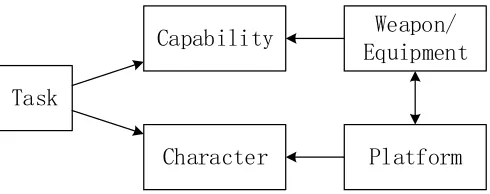
This paper proposes an allocation-method which is also based on capabilities. The allocation decision is consisted of the following three matching activities: matching tasks’ required capabilities to the weapon or equipment that provide that, matching weapon or equipment to platforms which carry them and matching the tasks’ characters to platforms which satisfy these characters. So, a key issue is that of defining sufficiently-rich representations of these various elements—tasks, missions, capabilities, requirements, weapons, equipment and platforms—to support the matching activities.
_________________________________________
Xin Li, College of Mechatronics Engineering and Automation, National University of Defense Technology, Changsha 410073, China; [email protected]
Task
Character
Weapon/ Equipment Capability
[image:2.612.177.422.67.164.2]Platform
Figure 1. Matching model.
Ontology is a specification of conceptual models 4. Using ontology can build formal models of the various elements that can be used with deductive reasoning mechanisms to produce matches that are logically sound. Thus, this paper’s work is based on the method of ontology.
ORGANIZATION OF THE TEXT
This paper answers why we have such a study on materiel deployment, introduce the method briefly and explain why we use ontology to get that approach. Section 2 introduces the organization of this paper. Section3 presents the materiel deployment method model, introducing how it works. Section 4 uses OWL 5 and SWRL 6 to build ontology model and matching rules. Section 5 has an experiment tested to verify the method can be used to allocate the materiel to task. In the last section, we draw conclusions and suggest directions for future research.
MATERIEL DEPLOYMENT METHOD – MATCHING MODEL
The Materiel deployment method is consisted of three matching activities set, shown in Fig.1:
MATERIEL DEPLOYMENT METHOD ONTOLOGY MODELING
In this section, we illustrate how to use OWL to build ontology models for task, capability, materiel and related knowledge’s, and how to use SWRL to establish semantic reasoning rules on this foundation.
Establishing a Conceptual Set for Deployment Model
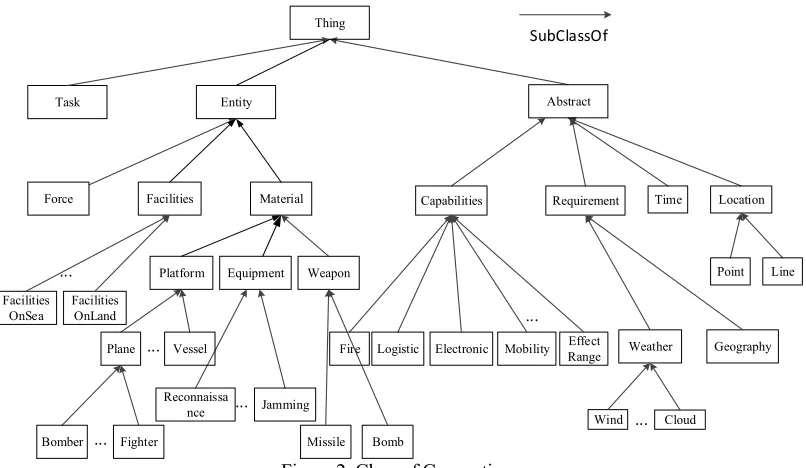
The aim of establishing the conceptual set is to establish a glossary for related domain knowledge. Only in this way, can make different systems have a common understanding of the knowledge, which has great significance. According to the characteristics of the matching mode, the main work of establishing conceptual set is to collect related knowledge and concepts of task, capabilities, requirements and materiel, and then classify and abstract the knowledge. To combine the top-down approach and bottom-up approach 7, finally here come the result as is shown in the Fig.2.
Establishing Properties Set
Every property is a binary relation, which stand for an abstraction of relationship between two concept’s individuals. The two concepts connected are domain concept and range concept. Here property is just like a verb, the domain concept is like a subject and the range concept is just like the object. In this way, the three parts represent a sentence which has a special semantic meaning. And by this mean, the concepts only have hierarchy structure (shown in Fig.2) can now have many other relationships, which make the concepts no longer isolate and now can always relate to another one by some relationship, which is closer to the real word. Table 1 presents some properties relate to task to make a better understanding of properties:
SubClassOf
Thing
Task Entity Abstract
Platform Equipment
Force Facilities
Weapon
Reconnaissa
nce Jamming
Plane Vessel
Bomber Fighter
...
...
Requirement
Weather Geography
Capabilities Time Location
Fire Logistic Electronic
Missile Bomb
...
Wind Cloud
Point Line
...
Mobility
...
Facilities OnLand Facilities
OnSea
Effect Range
...
[image:3.612.98.501.443.677.2]Material
TABLE 1. OBJECT PROPERTIES OF TASK.
Class
(Domain) Object Property
Class (Range)
Task
use Platform Platform
use Weapon Weapon
use Equipment Equipment
start Time Time
executionLoction Location
has Type Capability
TABLE 2. MATCHING RULES (PART OF).
Ruled Pseudo code
RuleSet1 Rule1.1
If (?x rdf:type Task), (?x rdf:hasTaskType “AirtoGround”)
Then Select (?y rdf:type Weapon) Where(?y rdf:hasTaskType “AirtoGround”)
Matching weapon or equipment to the
task’s type
RuleSet2 Rule2.1
If (?x rdf:type Weapon) Then Select(?y rdf:type Platform)
Where (?y rdf:Carry ?x)
Matching weapon/equipment to
platforms carry it
RuleSet3 Rule3.1
If (?x rdf:type Task), (?x rdf:hasLocation “Location1”), (?y rdf:type Platform) ,( ?y rdf:hasLocation
“Location2”),(|Location1-Location2|<LocationRequirement) Then (?y rdf:Requirementmatch “true”)
Matching platforms to task’s character
Establishing Matching Rules
Matching rules is the key issue of materiels deployment, since these rules are the base of reasoning activities which decide how to allocate the materiel.
When ontology model and reasoning rules are prepared, reasoning engine works. This paper use Jena engine which works in Java environment. The three main Rule Sets in our methods are shown in table 2.
EXPERIMENT
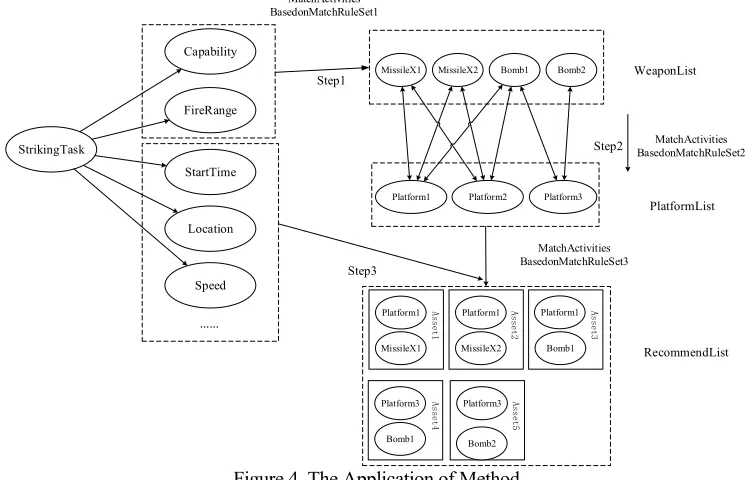
Here is an air combat mission which aims to destroy a command base. The mission has been divided into three tasks: early-warning task, striking task and covering task. Now the striking commander needs to decide what to use. And the example below will show how to use the method to have a quick plan to realize the materials deployment.
and have a wider fire range than the required. This results out the Missile1, Missile2, Bomb1 and Bomb2. Then, according to RuleSet2, Jena will find out the platforms
StrikingTask StartTime Location Capability Speed …… MissileX1 Bomb1 FireRange WeaponList MatchActivities BasedonMatchRuleSet1 MissileX2 Bomb2 Step1
Platform1 Platform2 Platform3
Step2 BasedonMatchRuleSet2MatchActivities
[image:5.612.108.482.92.332.2]PlatformList Platform1 MissileX1 Platform1 MissileX2 Platform1 Bomb1 Platform3 Bomb1 Platform3 Bomb2 Step3 MatchActivities BasedonMatchRuleSet3 RecommendList A s s e t 1 A s s e t 2 A s s e t 3 A s s e t 4 A s s e t 5
Figure 4. The Application of Method.
Which can carry these four weapons, getting the platfom1, platform2 and platform3. Based on the Platform List, Jena will select those platforms that satisfy the time-requirement, location-requirement and speed-requirement according to RuleSet3. As Platform2’s location exceeds the specified threshold, so it fails to match with this rule. The matching activities end here and only Platform1 and Platform3 left. Lastly, the reserved Platforms and weapon/equipment are combined as assets recommended to commander, as Asset1~Asset5.
CONCLUSION
From the example above, we can draw a conclusion that the method proposed by this paper can make contribution in materiel deployment, which provides suggestions about the materiel deployment. This is helpful for making plans in a short time. However, the matching rules mentioned are not sufficient enough to well reflect the real combat environment. In the future, we will make further combination with the real combat to build more rules to make the suggestions more reliable.
REFERENCES
1. Paul H. Deitz, James R. Michaelis, Britt E. Bray, et al. Kolodny$.The Missions & Means Framework (MMF) Ontology: Matching Military Assets to Mission Objectives [C]. 21st International Command and Control Research and Technology Symposium, London, 6-8 September, 2016.
3. Gomez M., Preece A., Johnson M.P., et al. An Ontology-Centric Approach to Sensor-Mission Assignment [C]. Knowledge Engineering: Practice and Patterns, International Conference, Ekaw 2008, Acitrezza, Italy, September 29 - October 2, 2008. p. 347-363.
4. Gruber T.R. Toward principles for the design of ontologies used for knowledge sharing [J]. International Journal of Human-Computer Studies, 1993, 43(5–6). p: 907-928.
5. Mcguinness D.L, Frank Harmelen. OWL Web Ontology Language Overview [J]. February, 2004, 63(45). p. 990–996.
6. Horrocks, Ian, Patel-Schneider, et al. SWRL: A Semantic Web Rule Language Combining OWL and RuleML [J]. World Wide Web Consortium, 2003.