Bispectrum of Stator Phase Current for Fault Detection of
Induction Motor
Juggrapong Treetrong, Jyoti K. Sinha*
School of Mechanical, Aerospace and Civil Engineering,
The University of Manchester, Seckville Street, P.O Box 88, M60 1QD, UK
Fengshou Gu, Andrew Ball School of Computing and Engineering
The University of Huddersfield, Queensgate, Huddersfield HD1 3DH, UK
Abstract
The number of research studies have shown that the fault in the stator or rotor generally show sideband frequencies around the mains frequency (50Hz) and it higher harmonics in the spectrum of the Motor Current Signature Analysis (MCSA). However in the present experimental studies such observations have not been identified, but any fault either in the stator or the rotor may distort the sinusoidal response of the motor speed and the main frequency so the MCSA response may contain number of harmonics of the motor speed and the mains frequency. Hence the use of the higher order spectrum (HOS), namely the bisepctrum of the MCSA has been proposed here because it relates both amplitude and phase of number of harmonics in a signal. It has been observed that it not only detects the early fault but also indicate the severity of the fault to some extent.
*Corresponding author
1.0. Introduction
Induction motors are the most widely used motors among different electric motors because of their high level of reliability, efficiency and safety. However, these motors are often exposed to hostile environments during operation which leads to early deterioration leading to the motor failure. It has also been observed that 30-40% of all recorded faults are generally related to the stator or armature faults caused due to the shorting of stator phase winding and 5-10% fault related to the rotor (broken bar and/or end ring fault) [1]. Hence the condition monitoring technique has generally been used to detect the fault at the early stage so that the remedial action can be done in much planned way to reduce the machine downtime and to maintain the overall plant safety.
results of the experimental cases of the induction motor with the healthy, stator winding short-circuits (stator fault) and broken rotor bars (rotor fault) conditions.
2.0. Higher Order Spectra (HOS)
The nrdorder moment function of a signal, x(t) is defined as,
)] (
)... (
) ( ) ( ) ( [ ) ,..., , ,
( 1 2 3 1 2 3
...x n n
xxxx
τ
τ
τ
τ
= E x t x t−τ
x t−τ
x t−τ
x t−τ
R ,
(1) where E[.] denotes the expectation operator, and
τ
as delay. The Power Spectral Density(PSD) is defined as the Fourier Transformation (FT) of a 2nd order moment function of Equation (1), and is computed as
PSD, Sxx(fk)=E[X(fk)X*(fk)], k = 1, 2, 3, …, N (2)
where Sxx(fk) is the PSD, X(fk)and ( )
* k
f
X are the DFT and its complex conjugate at frequency fk for the time series x(t). N is the number of the frequency points. E[.] denotes the mean operator here. Let us assume that the time domain signal, x(t), of the time length equals to t. This time signal has been divided into n number of segments with some overlap and each segment contains 2N number of data points with sampling frequency, fsHz. If Xr(fk) is the FT of the rth segment, xr(t), at the frequency, fk, then the averaged or mean PSD can be computed as
n f X f X f
n
r
k r k r x
xx
∑
== 1
* ) ( ) ( )
(
S , (3)
where fk =(k−1)df ,
N f
df s
2 =
The PSD gives only the content of different frequencies and their amplitudes in a signal. However, the HOS – Bispectrum and Trispectrum provide insights into non-linear coupling between frequencies (as it involves both amplitudes and phases) of a signal compared to the traditional PSD. For example, the Bispectrum is the double FT of a 3rd
amplitudes and phases) of the signal together with a frequency component summation of first two frequencies, and is mathematically expressed as
2 1 ) ( 2 2
1, ) 11 22
(τ τ e j π fτ fτ dτ dτ
xxx xxx + − +∞ ∞ − +∞ ∞ −
∫ ∫
= RB , (4)
where (
τ
1,τ
2)=E[x(t)x(t−τ
1)x(t−τ
2)]xxx
R is the 3rd order moment, and the
Bispectrum is computed by the signal DFT as
Bispectrum, ( , ) [ ( ) ( ) *( )]
m l m l m
l f E f f f f
f = X X X +
B , fl + fm ≤ fN
(5) n f f f f f f n r m l r m r l r m l
∑
= + = 1 * ) ( ) ( ) ( ) , ( X X XB (6)
The Bispectrum is complex and interpreted as measuring the amount of coupling between the frequencies at fl, fm, and fl + fm, and is described by ‘quadratic phase coupling’. It
has been assumed that if the frequencies, fl and fmare the pth and qth harmonics of
the motor RPM then the component of the bispectrum, B(fl, fm) has been represented as
pq
B for better understanding.
3.0. Experiment Study
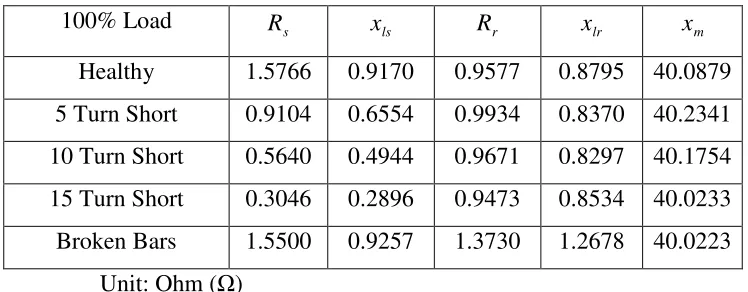
Table 1 The level of faults in the stator and the rotor
100% Load Rs xls Rr xlr xm
Healthy 1.5766 0.9170 0.9577 0.8795 40.0879 5 Turn Short 0.9104 0.6554 0.9934 0.8370 40.2341 10 Turn Short 0.5640 0.4944 0.9671 0.8297 40.1754 15 Turn Short 0.3046 0.2896 0.9473 0.8534 40.0233 Broken Bars 1.5500 0.9257 1.3730 1.2678 40.0223 Unit: Ohm (Ω)
Figure 1 Schematic of the test rig
4.0. Data Analysis
[image:5.595.95.513.271.516.2]0 0.05 0.1 0.15 0.2 0.25 0.3 0.35 0.4 -10
-5 0 5 10
Time, s
C
u
rr
e
n
t,
[image:6.595.103.476.95.403.2]A
Figure 2 A typical current signal
0 100 200 300 400 500 600
10-5 10-4 10-3 10-2 10-1 100 101
Frequency,Hz
C
u
rr
e
n
t
A
m
p
li
tu
d
e
,
A
[image:6.595.113.489.477.695.2]0 100 200 300 400 500 600 10-4
10-2 100
Frequency,Hz
C
u
rr
e
n
t
A
m
p
li
tu
d
e
,
A
(a)
0 100 200 300 400 500 600
10-4 10-2 100
Frequency,Hz
C
u
rr
e
n
t
A
m
p
li
tu
d
e
,
A
(b)
0 100 200 300 400 500 600
10-4 10-2 100
Frequency, Hz
C
u
rr
e
n
t
A
m
p
li
tu
d
e
,
A
[image:7.595.112.491.82.713.2](c)
0 100 200 300 400 500 600 10-4
10-2 100
Frequency, Hz
C
u
rr
e
n
t
A
m
p
li
tu
d
e
,
[image:8.595.113.488.82.278.2]A
Figure 5 The spectrum of the stator phase current for the broken rotor bars motor
0
50 100
150
200
0 50 100 150 2000
0.5 1 1.5 2 2.5 3
Frequency (f
l
), Hz
Frequency (f
m
), Hz
A
m
p
lit
u
d
e
,
A
3 B22
B24 B42
[image:8.595.122.487.347.604.2]0 50 100 150 200 0 50 100 150 2000 0.5 1 1.5 2 2.5
Frequency (fl), Hz Frequency (fm), Hz
A m p li tu d e , A 3 (a) 0 50 100 150 200 0 50 100 150 200 0 0.5 1 1.5 2 2.5 A m p li tu d e , A 3 (b)
Frequency (fm), Hz Frequency (f l), Hz
0 50 100 150 200 0 50 100 150 200 0 0.5 1 1.5 2 2.5
Frequency (fl), Hz Frequency (f
m), Hz
[image:9.595.167.446.82.729.2]A m p li tu d e , A 3 (c)
Figure 7 The bispectra of the stator phase current: (a) 5 Turns Short Circuit, (b) 10 Turns Short Circuit, and (c) 15 Turns Short Circuit
42 B 24 B 22 B 62 B 24 B 26 B 42 B 22 B 24 B 42
B B62
26
0
50
100
150
200
0 50 100 150 200
0 0.05 0.1 0.15 0.2 0.25 0.3 0.35
Frequency (fl), Hz Frequency (fm), Hz
A
m
p
li
tu
d
e
,
A
3
Figure 8 The bispectrum of the stator phase current for the broken rotor bars motor
4.1. Discussion
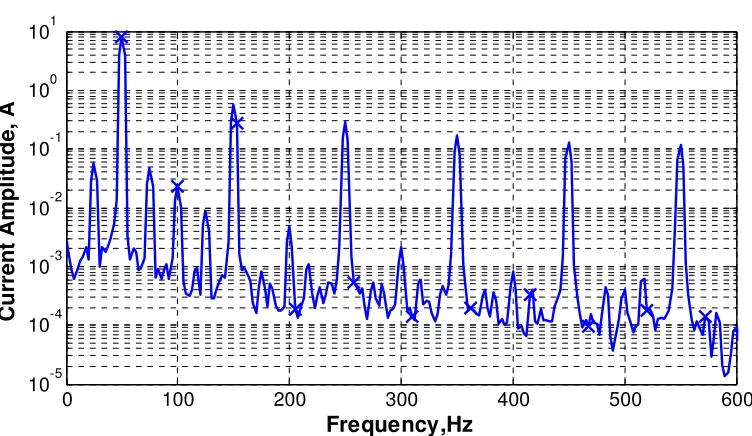
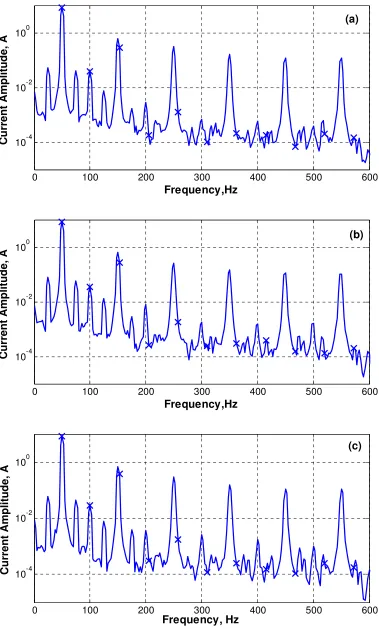
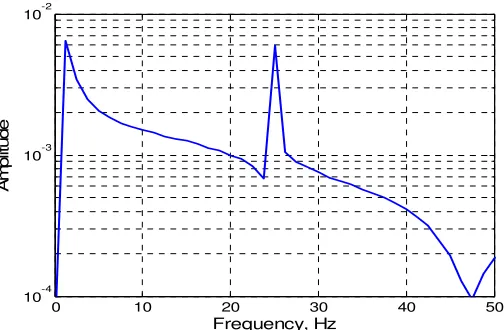
As can be seen from Figures 3-5, it is difficult to identify the faults based on the spectra with the frequency resolution of 1.25Hz of the current signals. All spectra almost look identical. In all cases, machine RPM (1x component) and its higher harmonics (2x, 3x,…) are present and no side band frequency at the main frequency related to the slip frequency has been seen to identify the fault as suggested in the earlier studies. The amplitude demodulation at a frequency for any signal removes that frequency, but modulated frequencies can be clearly identified from the demodulated signal. Hence here also, the amplitude demodulation at the mains frequency, 50Hz has been carried out for the phase current signals for the faulty rotor and stator conditions. The amplitude spectra of all the demodulated signals have shown only a single peak at the RPM of the motor. A typical such spectrum is shown in Figure 9 for the faulty rotor condition. Here again, the spectrum is not showing any peaks other than machine RPM which indicates that the frequency related to the slip frequency due to fault was not present in the current signal and so the identification just based on side-band was not possible for the present experimental cases.
22 B 12
B
42 B 21
B 11
B
0 10 20 30 40 50 10-4
10-3 10-2
Frequency, Hz
A
m
p
lit
u
d
[image:11.595.174.426.78.243.2]e
Figure 9 The spectrum of the amplitude demodulated stator phase current at mains frequency for the broken rotor bars motor
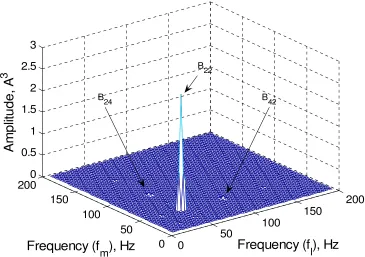
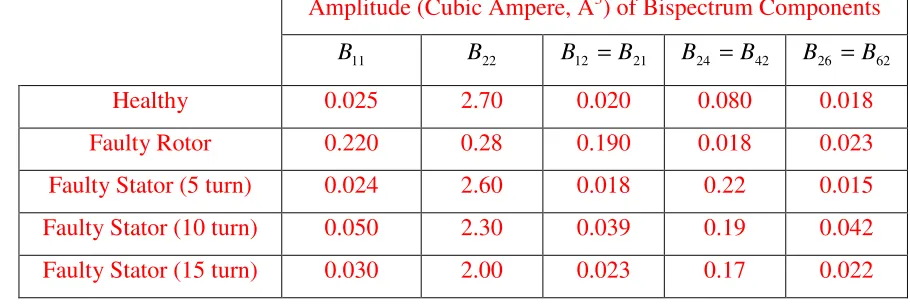
However, the bispectra of stator phase currents from the 3 different motor conditions seem to identify the faults as can be seen in Figures 6-8. The peaks in the bispectra plots are indicated by B11,B12, B21 and so on. Here B11 means the relation of 1x, 1x and 2x components, B12(=B21) the relation of 1x, 2x and 3x (1x+2x) components in a signal.
In the bispectrum, the only significant peak B22 has been seen for the healthy motor condition. However, the for the faulty stator cases the amplitude of the bisepctrum component, B22, decreases as the level of the stator fault increases and the significant increase in the amplitude of the bispectrum component, B24 (=B42) compared to the
healthy condition, nearly 2.4 times. Other peaks, B11, B12 (=B21) and
) ( 62 26 B
B = observed to remain comparable with the amplitudes for the healthy condition
(Figures 6-7). However, in case of the faulty rotor case the peak,B22, reduced
significantly from the healthy condition (nearly 0.10 times) and the faulty stator cases, but
other peaks, B11, B12 (=B21) increased significantly (nearly 8-10 times) compared to
the healthy and the stator fault cases. These observations are also summarized in Table 2.
Hence the based on the observation, it can be concluded that the bispectrum of the phase
current signal can identify and distinguish the rotor fault and stator fault of the electric
To confirm the robustness of the proposed study, the tests were conducted for different
load levels of the motor. The observation made in the bispectrum at 100% motor load for
the healthy, the stator fault and the rotor fault cases was consistent with the different load
conditions. Figure 10 shows the typical cases for the rotor fault at no load, 25% load, 50%
load and 75% load where it can be seen that the appearance of peaks in the bisepctra at
different loads is consistent with the bispectrum shown in Figure 8, hence method seems
to be robust for the fault detection in the motor.
0 50 100 150 200 0 50 100 150 2000 0.1 0.2 0.3 Frequency (f l), Hz Frequency (f
m), Hz
A m p li tu d e , A 3 (a) 0 50 100 150 200 0 50 100 150 200 2000 0.1 0.2 0.3 Frequency (f l), Hz Frequency (f
m), Hz
A m p li tu d e , A 3 (b) 0 50 100 150 200 0 50 100 150 200 2000 0.1 0.2 0.3
Frequency (fl), Hz Frequency (fm), Hz
A m p li tu d e , A 3 (c) 0 50 100 150 200 0 100 2000 0.1 0.2 0.3 Frequency (f l), Hz Frequency (f
m), Hz
[image:12.595.93.517.245.542.2]A m p li tu d e , A 3 (d)
Figure 10 The bispectra of the stator phase current for the broken rotor bars motor, (a) No Load, (b) 25% Load, (c) 50% Load, (d) 75% Load
5.0. Conclusions
A method that can identify the fault in the motor at early stage and also capable to
distinguish the rotor fault and the stator fault is always important so that the remedial
action can be carried out quickly. Hence the use of the higher order spectra (HOS),
namely the bispectrum has been tested and applied to the phase current signal of the
motor for this purpose. The bispectrum is the tool which relates both amplitude and phase
of number of harmonics in a signal. The motor phase current signal in case of any fault
mains frequency. It is because any fault (either in the stator or the rotor) may distort the
sinusoidal response of the motor phase current signal which results in number of
harmonics of the motor RPM and the mains frequency. This has already been observed in
the motor phase current spectra. But the amplitude spectra could not able to detect the
rotor and the stator faults for the induction motor used in the experiments, however the
bispectrum of the motor phase current successfully able to detect the stator and the rotor
fault and also able distinguish the stator and the rotor fault which is considered to be
useful information for fixing the problem quickly. Moreover, it has also been plan to test
the trispectrum, other kind of the HOS, to observe possibility of the further improvement
[image:13.595.75.530.352.506.2]in the motor fault diagnosis.
Table 2 Comparison of the bispectrum components amplitude for different fault conditions for the motor when operating at 100% load
Amplitude (Cubic Ampere, A3) of Bispectrum Components
11
B B22 B12 =B21
42 24 B B =
62 26 B
B =
Healthy 0.025 2.70 0.020 0.080 0.018
Faulty Rotor 0.220 0.28 0.190 0.018 0.023
Faulty Stator (5 turn) 0.024 2.60 0.018 0.22 0.015
Faulty Stator (10 turn) 0.050 2.30 0.039 0.19 0.042
Faulty Stator (15 turn) 0.030 2.00 0.023 0.17 0.022
6.0. References
[1] Nandi, S., Toliyat, H.A., Li, X., Condition Monitoring and Fault Diagnosis of Electrical Motors—A Review, Energy Conversion, IEEE Transactions 20(4)(2005) 719 – 729.
[2] Schoen, R.R., Habetler, T.G., Effects of time-varying loads on rotor fault detection
in induction machines, Industry Applications, IEEE Transactions 31(4)(1995) 900
– 906.
[3] Bellini, A., Filippetti, F., Franceschini, G., Tassoni, C., Kliman, G.B., Quantitative
evaluation of induction motor broken bars by means of electrical signature analysis,
[4] Ayhan, B., Chow, M.Y., Song, M.H., Multiple Signature Processing-Based Fault Detection Schemes for Broken Rotor Bar in Induction Motors, Energy Conversion, IEEE Transactions 20(2)(2005) 336-343.
[5] Henao, H., Razik, H., Capolino, G.-A., Analytical approach of the stator current
frequency harmonics computation for detection of induction machine rotor faults,
Industry Applications, IEEE Transactions 41(3)(2005) 801 – 807.
[6] G. Didier, E. Ternisien, O. Caspary, H. Razik, A new approach to detect broken rotor bars in induction machines by current spectrum analysis, Mechanical Systems and Signal Processing 21 (2007) 1127–1142.
[7] Kia, S.H., Henao, H., Capolino, G.-A., A High-Resolution Frequency Estimation
Method for Three-Phase Induction Machine Fault Detection, Industrial Electronics,
IEEE Transactions 54(4)(2007) 2305 – 2314.
[8] Marques Cardoso, A.J., Cruz, S.M.A., Fonseca, D.S.B., Inter-turn stator winding
fault diagnosis in three-phase induction motors’ by Park's vector approach,
Energy Conversion, IEEE Transaction 14(3)(1999) 595 – 598.
[9] Bellini, A., Filippetti, F., Franceschini, G., Tassoni, C., Closed-loop control impact
on the diagnosis of induction motors faults, Industry Applications, IEEE
Transactions 36(5)(2000) 1318 – 1329.
[10] Tallam, R.M., Habetler, T.G., Harley, R.G., Stator winding turn-fault detection for
closed-loop induction motor drives, Industry Applications, IEEE Transactions
39(3)(2003) 720 – 724.
[11] Henao, H., Martis, C., Capolino, G.-A., An equivalent internal circuit of the
induction machine for advanced spectral analysis, Industry Applications, IEEE
Transactions 40(3)(2004) 726 – 734.
[12] Aroquiadassou, G., Henao, H., Capolino, G.-A., Experimental Analysis of the dq0
Stator Current Component Spectra of a 42V Fault-Tolerant Six-Phase Induction
Machine Drive with Opened Stator Phases, IEEE International Symposium on
Diagnostics for Electric Machines, Power Electronics and Drives (SDEMPED
2007),6-8 Sept. 2007, pp 52 – 57.
[13] Nangsue, P., Pillay, P., Conry, S.E., Evolutionary Algorithm for Industrial Motor
Parameter Determination, Energy Conversion, IEEE Transaction 14(3)(1999)
447-453.
[14] Huang, K.S., Kent W., Wu, Q. H., Turner, D.R., Parameter Identification of an
International Symposium on Computer Aid Control System Design, Hawai,1999,
USA.
[15] Huang, K.S., Kent, W., Wu, Q.H., Turner, D.R., Effective Identification of
Induction Motor Parameters Based on Fewer Measurements, Energy Conversion,
IEEE Transaction 17(1)(2002) 55-60.
[16] Barut, M., Bogosyan, S., Gokasan, M., Speed-Sensorless Estimation for Induction
Motors Using Extended Kalman Filters, Industrial Electronics, IEEE Transactions
54(1)(2007) 272-280.
[17] Bachir, S., Tnani, S., Trigeassou, J-C., Champenois, G., Diagnosis by parameter
estimation of stator and rotor faults occurring in induction machines, Industrial
Electronics, IEEE Transactions 53(3)(2006) 963-973.
[18] Treetrong., J., Sinha, J.K, Gu, F., Ball, A.D., A Novel Model Parameter Estimation
of an Induction Motor using Genetic Algorithm, Proceeding of Signal and Image
Processing ~SIP 2008~. pp 623-015, 18-20 August 2008.
[19] Fackrel, J.W.A., White P.R., Hammond J.K., Pinnington R.J., Parsons T.A., The interpretation of the bispectra of vibration signals – I. Theory, Mechanical Systems and Signal Processing 9(3)(1995) 257-266.