The Discursive Constitution
of Software Development
Francis Cornut
Department of Management
London School of Economics and Political Science
Abstract
The successful development of software continues to be of central interest, both as an academic topic and in professional practice. Consequently, several software development approaches and methodologies have been developed and promoted over the past decades. However, despite the attention given to the subject and the methodical support available, software development and how it should be practiced continue to be controversial.
This thesis examines how beliefs about software development come to be socially established as legitimate, and how they come to constitute software development practices in an organization. It is argued that the emergence of a dominant way of conceiving of and practicing software development is the outcome of power relations that permeate the discursive practices of organizational actors. The theoretical framework of this study is guided by Pierre Bourdieu’s theory of symbolic violence and organizational discourse theory.
As a research method, ethnographic research techniques are utilized as part of a case study to gain deep insights into the standardization of software development practices. The research site is the IT division of a large financial services organization and is composed of ten units distributed across eight countries. The tumultuous development of a knowledge management programme intended to institutionalize a standard software development process across the organization’s units provides the case for this research.
Acknowledgements
Throughout the period of this PhD, my supervisor, Professor Chrisanthi Avgerou, has generously given of her time and wisdom. In supporting me on this intellectual journey, Chrisanthi has helped me become more the person I want to be. I simply could not wish for a better supervisor and mentor. First and foremost, my thanks go to her.
I am also indebted to Dr. Shirin Madon who, while serving as PhD Programme Director, lent me an attentive ear and helped me overcome the obstacles I encountered. Shirin has had a positive impact on my life – probably a lot more than she might imagine. I can never hope to repay her kindness.
Information Systems and Innovation Group at the London School of Economics is a vibrant intellectual environment, and I am indebted to its members who have contributed to my development on a day-to-day basis. In particular, I would like to thank Dr. Edgar Whitley who taught me many of the things that a researcher must know.
The LSE Studentship awarded by Information Systems and Innovation Group provided substantial resources for this study. I am grateful for its generous support.
Contents
1 Introduction ... 5
1.1 The standardization of software development ... 8
1.2 Contributions of the research ...11
1.3 Structure of the thesis ...13
2 Literature Review...15
2.1 Past debates and established ideas ...15
2.2 The formation of beliefs and practices ...29
3 Theoretical Framework ...38
3.1 Organizational discourse theory...39
3.2 Critical discourse theory ...43
3.3 Symbolic power ...52
3.4 Critical synthesis ...58
4 Research Methodology...67
4.1 Philosophical perspectives...67
4.2 Some difficulties with subjectivism ...70
4.3 Interpretivism as a preferred research approach ...73
4.4 Research strategy...74
4.5 Data collection method ...77
4.6 Data interpretation...80
5 Case Description ...87
5.2 The standardization of software development ...94
5.3 Software process improvement ...110
6 Empirical Findings ...118
6.1 Participant observations...118
6.2 Organizational texts...126
6.3 Connections and contradictions ...140
7 Analysis ...147
7.1 Field of struggles...147
7.2 Capital...151
7.3 Field of forces ...159
7.4 Symbolic power and software development...173
8 Conclusion ...176
8.1 Overview of the dissertation ...176
8.2 Contribution of the research...179
8.3 Limitations ...192
8.4 Future research: Beyond software...196
Appendix 1: IBTech’s Global Organization Chart...200
Appendix 2: Capability Maturity Models ...201
Appendix 3: Agile Software Development ...204
List of Tables
Table 1: Theoretical concepts used by Hirschheim et al. (1996) ...32
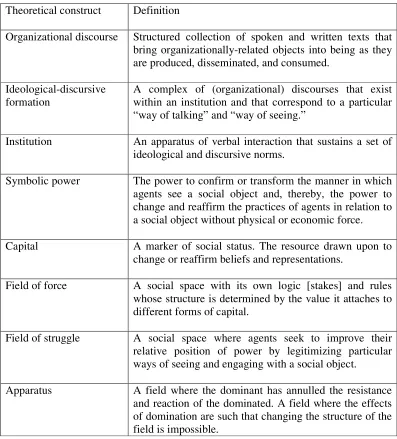
Table 2: Key theoretical constructs ...62
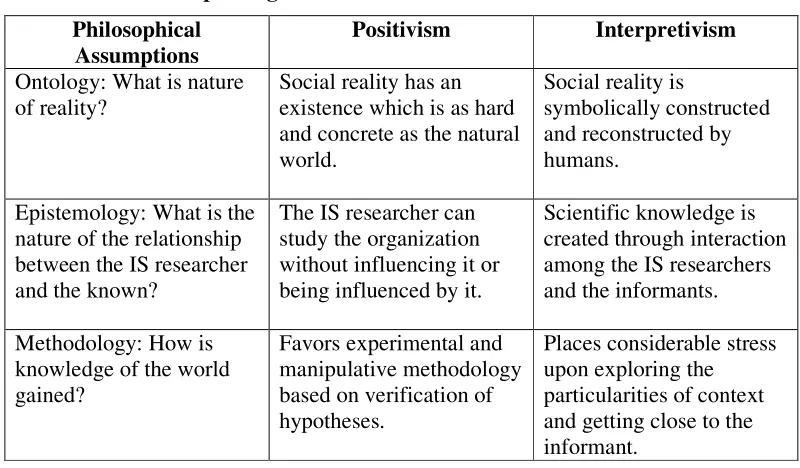
Table 3: Two main paradigms in IS research...70
Table 4: Pre-acquisition assets of America’s biggest banks ...88
Table 5: Number of permanent employees at IBTech per locations ...89
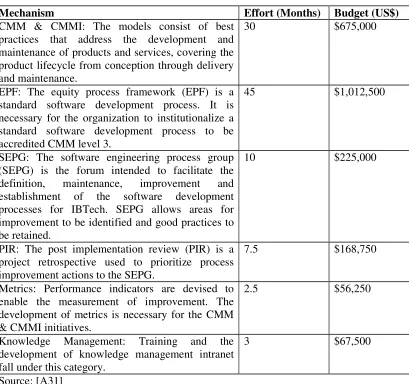
Table 6: The ‘learning organization’ program and its mechanisms ...92
Table 7: The CMM for software...95
Table 8: Seven organizational discourses ...127
Table 9: Strength of the connection between discourses ...141
Table 10: CMM for software – Maturity levels and key process areas...202
List of Figures
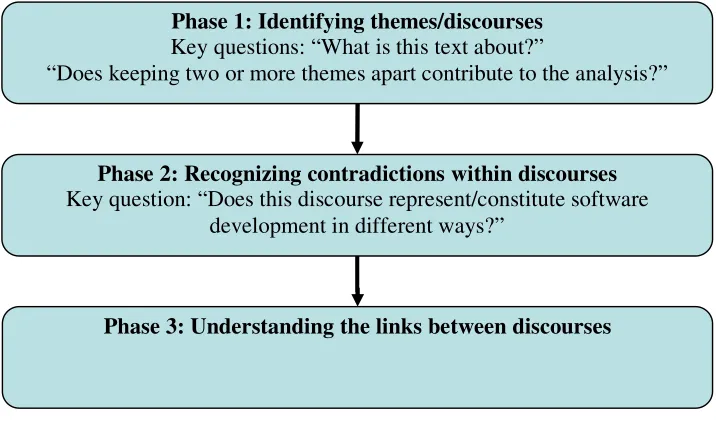
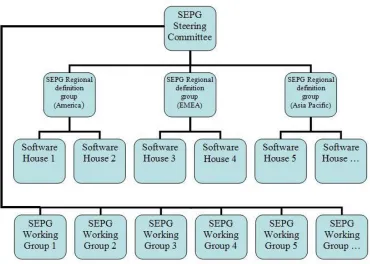
Figure 1: The analysis of texts and discourses ...82Figure 2: The learning organization governance structure ...93
Figure 3: Connections among discourses...141
1
Introduction
Four decades ago, it became recognized that developing good software was difficult. This emerging reality was in evidence in the high proportion of projects completed late and over budget, and in the density of errors in systems. Too often, systems did not function as intended and had to be substantially redesigned. The causes of what became known as the “software crisis” were multiple and cumulative, but essentially stemmed from general inexperience in developing large and complex software.
The software crisis affected both the corporate world and the military, but it is from the latter quarter that a response was first heard. In 1968, the NATO Science Committee convened a group of computer scientists and captains of industry to plot a course out of the software crisis. The general consensus that emerged from the NATO conference was that the answer to the software crisis lay in changing software construction from an ad hoc skill to an engineering discipline. In practical terms, this entailed formalizing software development.
There are two fundamental ways in which an organization can go about formalizing the development process. First, an organization can acquire a methodology and adapt it for its own particular needs. A methodology generally consists of a set of guidelines, techniques and tools based on a particular philosophy of software development (Avison and Fitzgerald, 2003; Wynekoop and Russo, 1997). A methodology makes explicit the tasks to be completed and restricts the number of arbitrary ways in which they can be completed. Secondly, an organization can implement a software process improvement (SPI) scheme to manage and control its software development process. SPI involves assessing the quality of the process and finding ways of systematically improving it (Paulk et al., 1993). Today, it is the capability maturity model (CMM) that crystallizes the basic concepts of SPI; as a result, CMM is widely regarded as the reference model in the field.
attempt to resolve the difficulties associated with developing software by relying on formal practices based on scientific engineering principles, there has always been a feeling of uneasiness with such practices. For as long as software development has been practised, it has been recognized that this activity requires a great deal of intuition and creativity. There is a sentiment that formal practices impose unwanted restrictions on the software development process, and that formal practices may take away the human aspect that is required in software development.
It is perhaps the apparent irrationality of software professionals and their practices that has, more than anything else, provided an impetus for the development and diffusion of formal practices. For outsiders to the field- particularly observers adopting the instrumental rationality of engineering- software professionals often appear to engage in activities that have little value. Instrumental thinking suggests that when an activity is pursued rationally – systematically, with a focus on the desired results – difficulties will be minimal. According to this line of reasoning, the problem of completing projects on time and within budget is principally attributable to the irrationality of the practices on which individuals are reliant (Baskerville et al., 1992; Introna, 1996).
In a similar vein, it is a frequently repeated statement that the universal laws on which traditional engineering disciplines are based do not necessarily apply to software development. Several commentators have pointed out that unlike the construction of a bridge or an airplane, during which projects, the laws of physics remain the same, the construction of software cannot be pursed as a strictly-sequenced activity—and, certainly, not as an automated one. In practice, many details only become known to software professionals as they progress in the implementation. Even if all the relevant facts are available to them at the outset of a project, human beings appear unable to comprehend fully the plethora of details that must be taken into account to design and build software (Parnas and Clements, 1986; Simon, 1957). This fact has led some commentators to conclude that software development has little to do with engineering, and that imposing the formalism of traditional engineering disciplines on software professionals will not improve the efficiency of the process or the quality of the applications.
Today, there may or may not be a software crisis, but there is definitely what might be called an “identity crisis” (Keil-Slawik, 1996). This condition is evidenced by the fact that no consensus as to what software development is, and how it should be practiced, has been reached after more than four decades, since the software crisis was first identified. To be sure, considerable advances have been made in the design and construction of software, and in the management of projects. Software projects are overall better managed than they used to be and programmers, more productive than ever (Krishnan et al., 2000; Sauer and Cuthbertson, 2003). However, the fact remains that software professionals are, even today, persistently engaged in an ideological struggle to justify their beliefs and their use of particular practices. The phrases that commentators use to describe this struggle, such as “emotionally complicated topics” and “methods wars” (Boehm and Turner, 2004), appear very apt.
resources (i.e. ideas and artefacts) available to them. Moreover, it would seem that such a process is informed by what the developer conceives software development to be (Russo and Stolterman, 2000b). This research endeavours to unpack how a collective agreement about the nature of software development may be negotiated, and what it should involve in terms of practices.
1.1 The standardization of software development
This thesis reports on an in-depth, qualitative case study documenting the tumultuous development of a knowledge management program intended to institute a standard software development process within an organization. The study organization is the IT division of a large investment bank and is composed of ten units, or software houses, geographically distributed in ten locations. The knowledge management program was primarily motivated by the perceived need to improve the quality of the software products and the efficiency of development process.
For the purpose of synergy and efficiency, organizations often engage in cross-unit transfers of internal best practices. Internal best practices are those work practices that are believed to be more effective at delivering particular outcomes than any other internal practices. In the past decade, the transfer of internal best practices has been high on the priority list of most IT organizations, and has been seen as critical to a firm’s ability to build a competitive advantage (Dyer and Singh, 1998; Szulanski, 1996). Consequently, a large number of IT organizations have undertaken programs with the objective of becoming able to systematically assess their practices and to ensure that the practices that are proven superior are institutionalized within the unit in which they are found or across the organization.
This vision had earned the knowledge management program the name ‘learning organization’ program.
The learning organization program resonated with several ideas that had pervaded the management discourse for the past decades. The most influential of such ideas included the application of management approaches aimed at creating process-oriented organizations and fostering continuous and effective learning (Hammer and Champy, 1993; Senge, 1990). Like countless other corporations, the study organization had found in those popular ideas an approach to determine how to best construct its work processes and to improve the quality of its output. In this sense, the learning organization program seemed, at first sight, rather innocuous; it appeared to be just another attempt to do more with less. However, as this thesis will gradually demonstrate, the program had far-reaching consequences for the organization.
Commentators have noted that the sort of program initiated by the study organization entails an intervention in the organizational culture and in the practices of software professionals. For Ngwenyama & Nielsen (2003), for example, it “is an attempt to change how software professionals think and act in their everyday organizational activity.” In this study, the learning organization program is understood as: an attempt to change how a majority of the software professionals think about and practice software development.
For the software houses involved in this study, adhering to a standard organizational process entailed abandoning valuable knowledge that comprises a tacit component. Face-to-face interactions and work within small groups, within a given software house, had produced highly idiosyncratic practices. Within the software houses, the development process was built from knowledge embedded partly in individual skills and partly in collaborative social arrangements. This study suggests that the constitution of standard organizational software process is a socio-political process involving negotiations among organizational actors to determine how software development should be thought of and practiced.
The organization had set itself the objective of institutionalizing a standard software process a year before the research began. During that year and the ten-month period during which fieldwork was conducted by the researcher, the organization experimented with different ways to come up with a standard software process. It initially attempted to develop the standard process from its own best practices, and failing this, went on to make use of a well-known methodology said to embed industry best practices. Both attempts turned out to be plagued by major difficulties. Over a period of almost two years, the organization was exposed to many ideas and practices. Some appeared highly appealing and exciting, while others disappointed and caused anxiety. This study unpacks how different visions of software development were constituted over almost two years, and how the values of the practices these visions presuppose were negotiated.
methods (Avison and Taylor, 1997; Boehm and Turner, 2004; Russo and Stolterman, 2000a), or by some philosophical and paradigmatic underpinnings found in the research literature (Constantine, 1993; Hirschheim et al., 1996). The focus of this study is in contrast to the practical situated context in which development takes place. It is submitted that approaching software development as being locally discursively constituted enables us to conceptualize in a more meaningful, and theoretically rigorous, manner the process by which beliefs about software development and practices are established as legitimate. In providing this theoretical approach, the thesis seeks to contribute to current research on software development.
An important proportion of the total budget of the learning organization program was allocated to fund SPI-related activities. This study focuses on SPI practices for two reasons. First, it is through SPI that the legitimacy of development practices was negotiated in the study organization. SPI provided the mechanism for negotiating the value of ideas across many locations and served as a means to constitute a standard software process. Moreover, the SPI practices in place, themselves, reveal a lot about what software development is in a particular organizational context. As will be explained in the details of this thesis, an organization that values efficiency and predictability is more likely to invest resources in the management of software development process than an organization that does not.
In light of the debate over the nature of software development, the overall research question addressed in this study is: How do beliefs about software development and software development practices come to be socially established as legitimate in a software development organization? This general research question is further defined in the following way: How are the contradictory needs for creativity and agility, on the one hand, and efficiency and productivity, on the other, negotiated? What bearings does the institutional context have on the manner in which software development is principally thought of and practiced in a software organization?
1.2 Contributions of the research
provide guidance for the selection and implementation of methodologies, tools, and approaches without paying much attention to organizational and social elements (Hirschheim and Klein, 2000; Wynekoop and Russo, 1997). As Russo & Stolterman (2000a) note, “Only a small percentage of information systems methods has employed in-depth studies of the actual process of system design and development”. Consequently, there is a great need for “in-depth studies of practice” that “create rich descriptions of practice, and come up with interpretations and analysis of this practice.”
This study answers the call of IS researchers for studies providing detailed accounts of the practices of software professionals. To obtain such an account, an in-depth immersion in the field was necessary. The focus is placed primarily on the practices of text production, diffusion, and interpretation of software professionals. The practice perspective chosen for this study has not been widely used in the IS field, and this study will yield some useful methodological findings. The adoption of a practice perspective informed by discourse theory will help to capture the influence of the institutional context within which individuals are situated, while acknowledging the purposeful, result-oriented nature of their practices.
devised with the aim of filling in this important gap in our understanding of software development.
1.3 Structure of the thesis
In this introductory chapter, issues surrounding the practice of software development have been introduced. The constitution of software development has been identified as the topic of the thesis. The role of tools, methods, and methodologies has been drawn to the foreground. Following this, a highlight of the contributions has been provided. The remaining of the thesis is organized as follows:
Chapter 2 describes the different ways in which software development has been conceived since the software crisis was first identified. An historical account suggests that tools, methods, and methodologies have played a centrally-important role in defining, at particular points in time, how to rationally practice and conceive software development. It is also in this chapter that the research questions are developed.
Chapter 3 establishes the research framework. The theoretical framework takes as its point of departure organizational discourse theory. Critical discourse analysis and the theory of symbolic power are combined to form a theoretical framework applicable to developing an enhanced understanding of the organizational phenomenon under study. The roles of institutions and the theme of power are central to the framework. The theoretical framework is sensitive to the effects of unequal power relations among organizational actors, and to the influence of institutional forces.
Chapter 5 presents the research setting and the knowledge management program intended to institute a standard software development within the organization. IBTech is an IT organization responsible for developing and maintaining the software products of an investment bank. A key feature of the organization is that its members are geographically-dispersed. The knowledge management program, whose evolution was followed over a 10-month period by the researcher, is principally based on the precepts of the CMM.
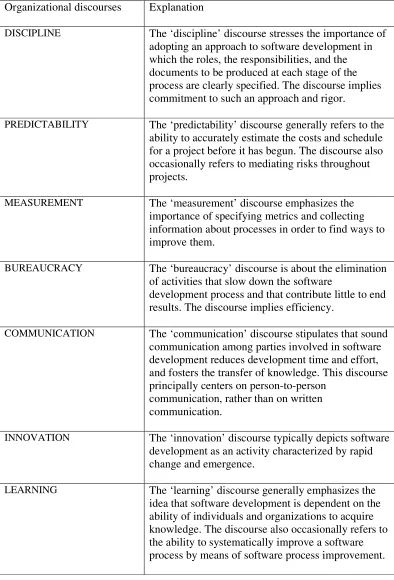
Chapter 6 presents the data collected and analyzed. Analysis of the organizational texts collected has revealed that seven organizational discourses form two conflicting ways to thinking of and practicing software development. Significantly, those two visions possess different degrees of legitimacy within the organization.
Chapter 7 theorizes the findings by critically engaging with Fairclough’s critical discourse analysis and Bourdieu’s theory of symbolic power. The analysis reveals how the particularities of the socio-institutional context induce organizational actors to practice and discursively represent software development the way they do. The correspondence between the micro and the macro is illuminated by paying particular attention to the relationship between the discursive and non-discursive practices of organizational actors, on the one hand, and the influence of the socio-institutional context, on the other.
Chapter 8 provides an overview of the thesis as a whole. The core contributions that this research makes to the IS literature are presented and followed by a discussion of the limitations of the research. Finally, some key areas for future research are identified.
2
Literature Review
Software development has been thought of and practiced in different ways over the past four decades. This chapter begins by chronologically tracing the evolution of software development. This evolutionary sketch suggests that tools and methods have played a significant role in defining how software development should be practiced in different contexts. The chapter then examines how the changing nature of software development can be accounted for. The research questions are also developed in this chapter.
2.1 Past debates and established ideas
2.1.1 Software development as applied science
Until the 1960s, very few individuals were professional programmers. Programming was essentially an ad hoc skill that technical individuals developed to resolve the problems of their fields involving the use of computers (Cerruzi, 1998). Consequently, there were no established principles or standards for writing code methodically. This unsystematic approach caused no major problems as long as programs remained simple.
As transistors replaced vacuum tubes in the early 1960s, computer performance improved spectacularly. More complex software projects were initiated and the problem of software started to dominate the problem of hardware. The lesson that was being learned at that time, simultaneously in many projects, was that software projects which were large, complicated, and involved unfamiliar aspects were particularly vulnerable to large, unanticipated problems. In the same vein, it was also becoming increasingly clear to software professionals that software programming did not scale up linearly; big projects required proportionally more manpower than small projects (Brooks, 1975).
could be tackled. The software crisis manifested itself in projects running over-budget and over-time, software of low quality, and code difficult to maintain. Some authors also identified programmer shortages as central to the crisis. The software crisis affected both the military and the corporate world, but it was particularly evident in America, where more than half of the global stock general-purpose computers were (Campbell-Kelly, 2003: 90).
The NATO Science Committee sponsored the first conference on software engineering in 1968, an event that was widely regarded as marking the origin of the software engineering discipline (Friedman, 1989; Mahoney, 2004). The conference set out to plot a course out of the software crisis. In defining software engineering as “the application of systematic, disciplined, quantifiable approaches to the development, operation, and maintenance of software” (NATO Science Committee, 1968), the committee made clear that the answer to the software crisis lay in changing software programming from an ad hoc skill, to an engineering discipline. In particular, it was recognized that mathematics would have to play an appropriate role in software engineering, just as it did in well- established engineering fields. Whether software development lent itself to the application of a scientific approach was not questioned.
During the late 1960s and early 1970s, the conviction that the use of sound programming technique, connected with mathematics and computational science, could improve the quality of the software gradually solidified. Formal methods were to provide the mathematically-based techniques for the construction of systems, especially large scale systems (Banach, 2007). In effect, it was believed that formal methods, such as structured programming, could offer a way out of the crisis.
Structured programming is based on a top-down approach. It recommends breaking down a program into simple subroutines with a single point of entry and using local variable within such subroutines. As a consequence, this programming paradigm makes it easier for programmers to understand small pieces of code without having to understand the whole program at once. Furthermore, it makes it easier to implement and test small operations, and tie them together into the whole program (Jackson, 1983). Dijkstra successfully made structured programming the educational standard, but did not succeed in making it a strict requirement.
In sum, during the late 1960s and early 1970s, the conviction that programming techniques could improve the quality of software prevailed. This conviction resonated with the sentiment that the software crisis could be hit at its core by establishing a strong mathematical foundation. The argument was put forward that expressing program designs in simple algebraic forms made it easier to avoid serious mistakes, and made the complexity of programs manageable. The sense of comfort that structured programming and other such programming techniques had created did not last long, however.
Boehm demonstrated in 1973 that the majority of errors in software were made during the design phase-- that is, before the construction of the software begins (Boehm, 1973). Moreover, being a mathematician, Boehm could make his point using the legitimate language of the time, mathematics. The argument laid out suggested that a solution to the software crisis was not to be found in better programming techniques. But Boehm did not stop there; three years later, he delivered a strong criticism of the mathematical approach to software engineering:
In defining software engineering as “the application of systematic, disciplined, quantifiable approaches to the development, operation, and maintenance of software,” the NATO Scientific Committee had omitted the term, ‘design.’ Being predominantly scientists and practitioners of a mathematical bent (physicists, engineers, etc.), members of the committee did not see design as being relevant, as it was felt to be outside the domain of the ‘measurable.’ However, by defining software engineering as “the practical application of scientific knowledge in the design and construction of computer programs and the associated documentation required to develop, operate, and maintain them,” Boehm (1976) sought to give design central importance.
More significantly, the work of Boehm initiates a shift in the way software development should be conceived. The US government, in general, and the Department of Defense, in particular, were important consumers of programming services, as well as sponsors of several of the large software projects. Many of these projects were conducted under the pressure of the competition between the USA and the USSR during the Cold War, and, more specifically, during the space race. The fact that NATO sponsored the first conference on software engineering is evidence of the strong presence of the military in the software world. However, governments are generally less subject to economic constraints than businesses, especially in a militarily-tense climate where national security is believed to be under threat. Thus, Boehm sought to develop a vision of software development that is more in tune with the logic of the market than with the logic of the military.
2.1.2 The methodology movement
framework for mapping the behavior of the system and the ways in which users will interact with it.
Interestingly, different countries have tended to develop and use their own types and styles of methodologies (Avgerou and Cornford, 1993). Moreover, the diffusion of methodologies has occurred through different channels across countries. In the United Kingdom, Structured Systems Analysis and Design Methodology (SSADM) was produced for the Central Computer and Telecommunications Agency (CCTA), a governmental office concerned with the use of technology in government. SSADM quickly achieved significant penetration in commercial IT because the government frequently imposed it on contractors. In America, on the other hand, the means of diffusion of structured analysis and design methodologies occurred principally through books and training materials intended for practitioners. De Marco, Yourdon, and Constantine were the figureheads of the new structured analysis and design movement. In 1978, De Marco published his seminal work, “Structured Analysis and System Specification” (De Marco, 1978), which signalled the beginning of the movement’s bandwagon. A year later, Yourdon and Constantine paired up to produce “System Design” (Yourdon and Constantine, 1979). To accelerate the propagation of his ideas and those of his like-minded colleagues, Yourdon established his own publishing house, Yourdon Press.
In the early 1990s, the diffusion of methodologies led the development of computer-aided software engineering (CASE) tools. CASE tools transferred the precepts and practices of methodologies into software intended for software professionals. Such tools arose out of developments such as Jackson Structured Programming and the software modelling techniques of SSADM and structured programming. CASE tools placed particular emphasis on analysis and design, but they frequently comprised modules and tools that supported code reuse, code translation, project management, and testing and quality control.
considerations. This prompted an interest in the so-called ‘hybrid manager.’ Earl & Skyrme (1992) argued that if a such a role could be created, filled by an individual with both a solid understanding of software development and a knowledge of the particular business, greater success would be achieved in development. Although the welcoming of soft elements seemed, at first sight, to take software development along a totally different path than that originally cleared by the scientists of NATO, it is must be recognized that the methodology movement also contributed to bringing software development close to industrial engineering.
The development of methodologies helped to popularize the application of scientific management to software development. Within academia and industry, it is still today a frequently-repeated statement that methodologies make possible the dissemination of an understanding of software development and development practices (Avison and Fitzgerald, 2006). Although methodologies often differ considerably (Avison and Taylor, 1997), they are almost always an application of division of labour to software development: they break software development into a discrete number of stages, prescribe a full set of necessary and sufficient activities within each stage, define the roles and responsibilities according to required technical competence, and seek to impose a ‘one best way’ on (knowledge) workers.
It is with Taylorism and the factory system in mind that the ‘software factory’ approach was developed (Johnson, 1991; Swanson et al., 1991). This approach suggested that software organizations could become more efficient and flexible by relying extensively on the strategic reuse of codes, product specifications and designs, documentation and manuals, test cases, and personal experience. The adoption of the software factory approach required the deliberate (rather than accidental) sharing of resources across different projects within an organization. The approach aimed to make software organizations benefit from economies of scope, “cost reductions or productivity gains that come from developing a series of products within one firm (or facility) more efficiently than building each product from scratch in a separate project” (Cusumano, 1991: 8).
in fact, nothing new. Already in the 1960s, subroutine libraries that were reusable in a broad array of engineering and scientific applications were built and used (Cusumano, 1989; Mahoney, 2004). The idea that software should be built from prefabricated components was first published in Douglas McIlroy’s address at the first NATO conference on software engineering (McIlroy, 1968). However, the software factory concept received attention in part because it resonated with another approach that also received a great deal of attention in the early 1990s, object-oriented system development (OOSD).
The object-oriented approach suggests that a computer program be viewed as a collection of objects interacting with one another. This view stands in marked contrast to that of the structured approaches introduced above, which conceptualize a program as a collection of functions or procedures. For this reason, it is often claimed that OOSD brought about a shift in paradigm.1
According to several practitioners, the effective reuse of component makes software development practices more efficient than those previously used (Booch, 1994; Coad and Yourdon, 1991; Jacobson et al., 1995; Johnson, 2002). Until recently, however, researchers expressed serious concern about the value of this approach. Several studies suggest that the adoption of object-oriented technology is often more a matter of fashion than of reasoned development (Smith and McKenn, 1996). For example, Briand et al. (1999), who studied the impact of object-oriented on systems development practices, note that “[object-oriented] technology adoption is mostly the result of marketing forces, not scientific evidence.”(Ibid.: 388)
In retrospect, the 1980s and 1990s witnessed the emergence and growth of a mixture of instruments intended to stabilize software development. In particular, this period was marked by the proliferation of methodologies and CASE tools designed to provide knowledge about the required practices of software development. At a more conceptual level, methodologies and CASE tools also provided adopting
1 The researcher does not see object-oriented as a programming paradigm, but rather as a design
organizations (perhaps unintentionally) with a vision of what software development was and how it should be practiced (Andersen et al., 1990; Mathiassen, 1998). The vision in force was the software factory. Although it is industrial engineering and scientific management, rather than mathematics and computational science, that provided the roadmap for the evolution of software development, one would presume that sufficient progress would have been made to overcome the software crisis. However, the 1994 figures of an America research firm, The Standish Group, implied that the software crisis was still very much alive.
A result from the Standish Group’s CHAOS report that received a considerable amount of attention was the reported 189% average cost overrun on so-called challenged projects (ie, projects not on time, on cost, and with all the specified functionality) (The Standish Group, 1994). The report has been criticized on many grounds, and the question of whether it meets the standards of a good academic study is still debated today (Jørgensen and Molokken-Ostvold, 2006). The popularity of the report among practitioners, and the rate at which it was cited in the mass media and by consulting firms, nonetheless says something important about the state of software development: a wealth of ill-founded, yet compelling, claims appear to have been formulated to maintain a climate of crisis. Consulting firms, technology vendors and other such knowledge merchants may be the most to blame, as it was they that had an interest in maintaining a sentiment of crisis in order to promote their ideas and products as crisis solutions (Glass, 2006). In a similar vein, the fact that the software crisis was still talked about, and that products and approaches were being developed and presented as ‘crisis solutions’ in the 1990s, suggests that the discipline remained anxious about the quality and appropriateness of its practices.
2.1.3 The quality turn and software process improvement
with the concept of (business) process popularized by Peters and Waterman in the book, “In Search of Excellence”(Peters and Waterman, 1982).
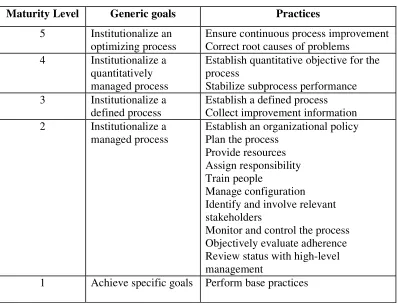
The popularity of quality management reached the software industry and gave rise to the Capability Maturity Model (CMM). The CMM is an application of quality management and process improvement to software development. The original concept of the framework was developed in the early 1980s by Watts Humphrey at IBM. Humphrey’s unique insight was that software organizations had to remove impediments to continuous improvement in a specific order if they wished to keep improving their processes capability over time. Appendix 2 describes the components of the framework.
The development of the CMM began formally in 1986 through a collaboration between the Software Engineering Institute (SEI) of Carnegie-Mellon University and the U.S. federal government. The goal was to produce a framework for the U.S. federal government to assess the capabilities of its contractors in the area of software development. The first version of the framework, released in 1991, gained rapid acceptance in the defense industry because the Department of Defense used the CMM process maturity level as an exclusion criterion for awarding many of its largest software acquisition contracts.
The introduction of the CMM is a major milestone in the evolution of software development. Most of the tools and methods mentioned previously seek to mitigate the risk of project failure by prescribing analysis, design, and development practices. The CMM instead draws attention to management of the software process. With the CMM, therefore, the relevant question is not what tools or methods are best, but what the most appropriate way of managing the software process is, in order to systematically eliminate defects by improving the process.
2.1.4 The emergence of the consumer software industry
sell them because of their perceived complexity. The availability of after-sales support was a criterion considered important in the choice of a software product, and was often offered by the software maker or by authorized distributors. A few hundred sales were generally needed to make a corporate/business software product successful (Campbell-Kelly, 2003: 208-209).
From the early 1980s, with the proliferation of personal computers in homes and schools, a market for personal computer software developed. This had the effect of making software products consumer items (Pugh et al., 1991). Consumer software was considerably less expensive than corporate/business software and sold in much greater volume: it was typically priced between $50 and $500, and several thousands of units were generally sold. Unlike corporate/business software products, consumer software products were more often than not developed by small groups of amateur programmers, and, in some cases, by a lone programmer (Friedman, 1989). The highly-successful database program dBase II, which was written by a moonlighting programmer, is a prominent example.
The personal computer explosion and the emergence of a consumer software industry had a noteworthy effect on the discipline of software development. As explained above, the consumer software industry developed and operated quite independently from the business and scientific software industry. It retained for some time its own rules and logic. Within the consumer software industry, the software crisis was not a tangible reality. As a consequence, programmers did not feel the need to appropriate the development practices of established software producing organizations and remained experimental. In a sense, it can be said that a new way of conceiving and practicing software development spun off the personal computer explosion (Campbell-Kelly, 2003: 227).
of a product family. Improving products incrementally helped to minimize the risks of releasing products whose features were inconsistent with what customers expected. In a similar vein, releasing products periodically enabled software organizations to remain in constant touch with the market (Gates, 1995: 14-35).
Prototyping became highly topical because it allowed customers to use a software product and give its designers feedback before the software product was released. The importance of prototyping was emphasized in a number of best-selling books and semi-academic publications (e.g., Cusumano, 1998; MacCormack, 2001). Often, Microsoft success stories were used to illustrate the importance of prototyping (e.g. Cusumano and Selby, 1997; MacCormack and Herman, 2000).
Producing families of software represented a radical break from developing ‘industrial strength’ software. Significantly, the production of families of software appeared better suited to the industrialization of the software development process than the sporadic production of large software. Indeed, producing families of software made code reuse possible on a large scale. Reuse enabled improvement in productivity and quality by incorporating components whose reliability had already been established (Selby, 2005; Wasserman, 1996). OOSD, which happened to promise more effective code reuse, emerged as particularly relevant in the context of the personal computer revolution.
incremental delivery of functionalities had the effect of reducing the need for structured methodologies. In the internet context, responsiveness and flexibility became the watchwords.
It is important to note, however, that the new software development practices that gained acceptance with the emergence of the personal computer and the internet did not invalidate the more conventional ones. For example, although developing iteratively and making software evolve in the manner of consumer products became recognized as appropriate practices to reduce risk and time to market, methodologies, quality-centric models, and other such applications of Taylor’s principles remained widely used. In fact, it seems that it is the development practices of the internet era that lend themselves best to the factory model because they encourage the reuse of components across the different software of a family. To be convinced, one just has to think how game engines, which form the core software component of a computer video game, tend to remain the same for a series of games, or how electronic catalogues are reused across different transactional websites.
While the new software development practices of the personal computer and internet era did not invalidate the more conventional ones, they presupposed different visions of software development. A dissonance seems to have developed at a conceptual level-- that is to say, at the level of how software development should be conceived of. Based on the literature so far reviewed in this chapter, it is quite clear that software development is principally about writing good quality programs on time and on budget, but is it more akin to creative work or factory work? Is software development more akin to a craft or a science? To make things even more complex: can creative work take place in a regimented factory environment? Are craft and science mutually exclusive? The feeling of discomfort in the discipline, vis-à-vis its identity, certainly predates the personal computer and the internet, but it becomes particularly evident when one follows the discipline’s evolution-- that is, when changes in practices and beliefs are examined chronologically.
level of bureaucratic activities that the reliance on methodologies tends to entail, encourage a focus on the activities that add value for the customer, and make the release of software more predictable by relying on the adaptive capability of programmers, rather than on rigorous planning. Although agile methodologies often differ considerably in terms of development practices, they all purport to re-establish software development as a creative and people-oriented activity. In 2001, famous members of the software community crystallized the values and principles behind this novel approach to software development by writing and signing the “Agile Manifesto” (see Appendix 3).
Agile methodologies seek to take software development along a totally different trajectory than that it has followed for the past 40 years. Since the first NATO conference, the prevailing belief has been that imposing discipline and rigor upon software development would make this activity more predictable and more efficient. CASE tools, methodologies, and quality centric model have all attempted, in one way or another, to do this. Agilists – proponents of agile development – argue that if development projects often go wrong still today, in spite of the use of sophisticated management and technological innovations, it is chiefly because software professionals have attempted to make an activity characterized by change and emergence predictable. Agilists maintain that software development can become more predictable if risks are mitigated throughout projects by relying on approaches that effectively empower the adaptive capabilities of humans. The key to this, agilists claim, is iterative development.
2.1.5 Open source development
The open source development model differs in many respects from the development approaches that have come and gone since the first NATO conference on software engineering: from an open source perspective, software development is neither a formally organized activity, nor an economic activity intended to generate profit. For this reason, some commentators see open source development as a radically new way of conceiving of software development (Raymond, 2000). However, it can be argued that open source development is nothing other than a return to an old approach, to a time when software was developed by its users and exchanged among a community of users. Indeed, from an open source perspective, as in the days when software development was an ad hoc activity, software is valued according to its usefulness or ‘use value’ (Adler, 2006).
While the vision of software development that the open source development approach entails may be old wine in new bottles, the practices it involves are unquestionably novel. In his 1997 essay, “The Cathedral and the Bazaar,” Raymond proposes a model for developing open-source software known as the ‘bazaar model.’ With the bazaar model, roles remain loosely-defined and development takes place in a decentralized way. The internet is the medium that renders the decentralization of the development activities and the collapse of the divide between developers and users possible. In the same spirit, Robles (2004) argues that the general structure of the software should be modular in order to allow for the parallel development of different releases. In sum, the open source development methodology represents a radical break from more traditional software development approaches, in which people are ascribed roles (e.g., coders, testers, architects) and in which the system design is done by a few architects in order to preserve the architectural integrity of a system.
context or a particular type of application is still hotly contested, and has recently spurred the development of think tanks and consultancy organizations (Peizer, 2006).
This chapter has, up to this point, mapped the evolution of software development as a discipline by examining the rise and demise of particular ideas and practices. This evolutionary sketch suggests that tools, methods, and methodologies have played a crucial role in defining how software development should be practiced at different points in time. Drawing on the academic literature, the remainder of this chapter will examine how the changing nature of software development is accounted for.
2.2 The formation of beliefs and practices
Hirschheim, Klein and Lyytinen (1996) set themselves the task of delineating the IS community’s understanding of information systems development (ISD). The general argument that the authors put forward is that researchers have conceptualized ISD in many different ways because they are relating and interpreting core research results from many schoolsof thought that differ in terms of research domains and research approaches. These schools of thought, the authors argue, form the intellectual structures of ISD.
For anyone with a basic knowledge of the social sciences, such an argument has a familiar ring to it. Burrell & Morgan (1979) have previously argued that social theory can be conceived in terms of four paradigms, based upon different assumptions with regard to the nature of social science and the nature of society. Before them, Anthony (1965) established fundamental categories according to which the field of decision making and management control was cultivated. Hirschheim et al.’s argument, in spite of being conventional, is interesting because it directly addresses the different ways in which ISD is conceived. It effectively makes us realize that ISD can be conceived in different ways. Moreover, the argument pays due justice to the crucial role that tools, methods, and methodologies play in shaping ISD. Let us take a closer look at the concept they develop.
developers conceive and practice ISD. Hirschheim et al. use the terms ‘object system class’ and ‘development strategy’ to distinguish between, respectively, the representation of ISD offered by scholars and the social practice of developing IS. The latter term deserves closer attention.
By using the term ‘development strategy,’ the authors seek to draw attention to the practical character of ISD work. A development strategy embeds a set of consistent and often deep-seated social practices that developers can draw upon while developing an IS:
[Development strategies] convey enduring and persistent development practices which are gradually solidified from the development experience and learning. Development strategies thereby “crystallize” existing know-how of workable development practices. They are emergent in the sense that they evolve while the programs are instantiated whereby material ISD methods and tools get more sophisticated. (Hirschheim et al., 1996: 27)
The choice of a development strategy, which may be intended or unintended, is fundamentally justified by the desire to achieve some desired outcomes that are in harmony with a set of development ‘principles.’ Principles, in Hirschheim et al.’s terms, are the “broad normative guidelines and evaluative and behavioral dispositions that underlie the application of specific tools and methods.” Development strategies are not developed from scratch, but assembled from tools and methods that provide the rules of actions, resources, and skills required to develop an IS. Principles guide the selection of the concrete methods and tools, and embody the norms “that give legitimacy of using certain tools and methods and thereby certain actions during system development.”
and interests do not change the problem itself, or may be seen as defining and understanding problems related to the use of information systems based on the assumption that the uniqueness of the situation affects the design choice. This sort of nuance, which is inherent in ISD research and practice, leads Hirschheim et al. (1996: 24) to recognize that IS development necessarily occurs by accepting specific development principles that are often ideologically invested-- that is, biased in favour of the use of particular tools and methods.
The first part of this chapter has already presented an overview of the principal tools and methods of the discipline over a period of approximately four decades. A relationship between the manner in which software development is principally thought of and practiced at a given point in time, and the prevalence of certain tools, methods, and methodology has already been observed. Hirschheim et al. offer an elegant explanation for this apparent relationship, but before taking a closer look at this explanation, let us first clarify what the authors mean by tools, methods, and methodologies. ‘Methods’ are conceived of as prescriptions and rules of action for the development of IS. ‘Tools’ are the material instruments for the execution of some procedures defined by the methods. When merged together, methods and tools form ‘methodologies’ (see Table 1). These definitions are not without problems (see, for example, Avgerou and Cornford, 1993), but the researcher accepts them without reservation in order to proceed with more important points.
Table 1: Theoretical concepts used by Hirschheim et al. (1996) Theoretical Concept Definition
Development Strategy Development strategies convey enduring development practices which are gradually solicited from experience and learning. Development strategies crystallize existing know-how of workable development practices.
Development Principle Development principles are the broad normative guidelines and evaluative and behavioral dispositions that underlie the application of specific tools and methods that build up the development strategy. Development principles embody the norms that give legitimacy to using certain tools and methods and, therefore, certain practices used during systems development.
Orientation An orientation represents a consistent set of attitudes, beliefs, assumptions and intentions which a developer brings to the process of IS change. An orientation captures the underlying values, goals and epistemological underpinnings that drive the development activity.
Method Methods are prescriptions and rules of action for the development of IS.
Tool Tools are material instruments for the execution of some procedures defined by methods.
Methodology Methodologies are the combination of tools and methods. Methodologies embody practices and cognitive frames that can be taught, shared and refined in practice.
Following Habermas (1984; 1987), Hirschheim et al. (1996:10) define an orientation as “a consistent set of attitudes, beliefs, assumptions and intentions that developers bring to the process of IS change.” In other words, orientations comprise the beliefs and epistemological underpinnings that drive the development activity. So, while the development principles provide rational justification and necessary ideologies for the use of concrete tools and methods, an orientation encompasses the beliefs and assumptions that form an understanding of what ISD is.
orientation that affects the adoption of principles: “First of all their [the development strategies] content depends on which domain and orientation have been chosen by the actor and how the change is consequently legitimized by accepting specific development principles” (Id.: 24). Elsewhere, Hirschheim et al. also suggest that the choice of orientation is the starting point of everything: “the choice of a development strategy is fundamentally justified by the desire to achieve some of the desired ‘outcomes’ that are in harmony with the development principles. The framework suggests that the outcomes depend on the actor’s dominant orientation” (Id.: 27). Thus, the beliefs, assumptions and intentions – that is, the orientation – that a developer adopts largely determine what ISD is in his or her eyes, as well as what the ensuing development principles should be.
A few examples of implicated issues are, at this point, appropriate to show the myriad of ways in which ISD can be conceived of. Implications for the practice can be identified for each example provided.
• Example 1: Should one see ISD as the construction of an IS or the resolution of an
organizational problem? In other words, is ISD a task best left to technical experts? (Hirschheim and Klein, 1989; Mumford, 1983) Mumford & Weir (1979) and Checkland (1981) address issue of participation. They believe that that the intended users of the system should play an active role in defining what the organizational problem to be resolved is.
• Example 2: Should one understand ISD as a rational, systematic activity or an
activity in which many of the important details generally become known to system developers as they progress with the implementation? (Boehm, 1988; Markus, 1983; Parnas and Clements, 1986; Stolterman, 1991)
• Example 3: Should one conceive of ISD as a predictable activity, along the lines
of factory work? Or should one see ISD as an art or a craft? These alternative conceptions of the activity are discussed in “Japan’s software factories: A challenge to U.S. Management” (Cusumano, 1991).
• Example 4: Should one see ISD as an activity that is inescapably bureaucratic? Or
should one see ISD as an activity where face-to-face interaction should be favoured in order to keep paperwork to a minimum? (Cockburn and Highsmith, 2001; Highsmith, 2002; McBreen, 2001)
• Example 5: Should one see ISD as an activity geared towards the construction of
an IS that meets particular requirements? Or should one see ISD as an activity geared towards the production of business value, even if this involves going beyond the requirements? (Fowler, 2003)
• Example 6: Should one see ISD as a commercial activity that produces fees and
• Example 7: Should one think of ISD as a purely-instrumental activity geared
toward resolving organizational and/or technical problems? Or should one think of software development as an activity that encompasses an important symbolic dimension; that is, ensuring the legitimacy of the organization in the eyes of both internal and external stakeholders? (Adler, 2006; Avgerou, 2000).
In valuing a particular way of thinking of ISD, the adoption of a certain set of practices is encouraged. For instance, in understanding ISD predominantly as a systematic and predictable activity (see Example 2 and 3 above), people’s attention is directed towards the waterfall model and other such plan-driven methodologies. On the other hand, adopting the spiral model makes sense in a context in which it is believed that ISD entails changes to the requirements as projects progress. As the seven examples presented above show, the literature provides ample evidence that beliefs influence how software development should be practiced. If beliefs are so decisive in framing how ISD should be conceived and practiced, how, then, do they become established in an organization? This leads us to formulate the following research question:
Research Question 1: How do beliefs about software development and software development practices come to be established as legitimate in a software development organization?
To be sure, as a number of scholars have observed, actors can change their orientations relatively quickly (Dubé, 1998; Dubé and Robey, 1999). Moreover, actors may adopt multiple orientations during ISD, especially if they have to interact with numerous different parties. Consequently, actors involved in a project may very well possess different (and even conflicting) beliefs about the nature of ISD and how it should be practiced.
Moreover, this research seeks to refine our understanding of what those beliefs involve in terms of practice adoption.
As noted above, the literature on ISD indicates that beliefs influence how software development should be practiced. This idea is well articulated in Hirschheim et al.’s article. In Hirschheim et al.’s terms, the ‘dominant orientation’ adopted by developers is largely responsible for determining the ‘development principles’ underlying the development activity. In other terms, it is submitted that the beliefs that actors bring to the development activity legitimize the use of certain tools and methods, and, therefore, certain practices. The proposition that beliefs influence how software development should be practiced is accepted as true by the research until evidence is found to contradict this proposition.
The management of the process of ISD, the role of methods, and the tasks of software professionals are themes that have remained central in the ISD literature (Mathiassen, 1996). Straddling these three broad themes is the question of balancing the need for creativity and flexibility with the need for operational efficiency and predictability (Boehm and Turner, 2004). The argument is put forth that ISD encompasses many non-routine activities and involves the resolution of emergent issues that require creative thinking and adaptability, but that it can, nonetheless, be made efficient thanks to a certain degree of standardization and formalization (Adler, 2006). Again, how an actor sees ISD along the continuum of creativity/flexibility – efficiency/predictability is very much a question of belief. The following research question is derived from the main research question:
Research Question 2: How are the contradictory needs for creativity and flexibility, on the one hand, and efficiency and predictability, on the other, negotiated?
vein, the wide-scale acquisition of tools and methods seems to be associated with some of the distinct ways of thinking about software that prevail in certain contexts. According to Hirschheim et al., the orientation that actors generally adopt in a particular context informs the normative guidelines and evaluative and behavioural dispositions (i.e. the development principles) that underlie the application of specific tools and methods (Hirschheim et al., 1996: 24). It would seem, therefore, that the context has a bearing on the acquisition and local appropriation of tools and methods. Moreover, since these tools and methods are, according Hirschheim et al., instrumental in determining what software development is all about, one can expect the context to influence how software development is predominantly thought of and practiced in an organization. Answering the following research question will help to answer the main research question of this doctoral dissertation:
Research Question 3: What bearings does the institutional context have on the manner in which software development is principally thought of and practiced in a software organization?
It is now accepted within organization studies in general, and IS research in particular, that institutional contexts shape organizational activities (Orlikowski and Barley, 2001). Institutionally-informed studies have made us realize that the legitimacy of particular ideas about organization and practices are often influenced by institutional forces. Researchers have provided compelling evidence that the trade literature, popular books, conferences, sales presentations, casual conversations among practitioners, and, most recently, electronic forums provide the channels through which ideas circulate and through which organizational practices are made to evolve (Sahlin-Andersson and Engwall, 2002a). These channels frequently provide a means to introduce and collectively determine how tools and methods for software development can be applied (Swanson and Ramiller, 1997).
normative dimension of institutions (Scott, 2003; Scott, 2001). Attention is directed to the taken-for-granted beliefs that constitute social reality and provide the normative frames that support social practices.
3
Theoretical Framework
From the middle of the 20th century, over a period of approximately two decades, sociology took as its principal object of inquiry the function of social structures. During this period, the prevailing belief was that these structures were functional in the sense that they ensured that society would operate smoothly. Emphasis was placed on the norms and value deemed necessary to organize relationships among members of society. Talcott Parsons, the figurehead of sociology during this period, stressed, and placed at the center of analysis, social structures, and ascribed to these structures social functions. Without strong structures, Parsons and his followers argued (Parsons, 1951; 1961), stability and internal cohesion of societies is impossible.
This sociological paradigm, known today as functionalism and structural-functionalism, is a macro sociological paradigm. It gives a great deal of attention to the structures of society. It looks at things on an aggregated scale. It favours the long-term – or a period time sufficiently long to explain the development of patterns of behavior – rather than the episodic. A common criticism directed at functionalism (and other macro sociological paradigms) is that it contains no sense of agency. Within this paradigm individuals are seen more or less as puppets, acting as their role requires. It is criticized for falling short of providing evidence of how intentions orient action without relying on notions such as roles and norms (Elster, 1990). More recently, functionalism has been criticized by conflict theorists, Marxists, feminists and postmodernists for giving far too much weight to integration and consensus, and neglecting independence and conflict (Holmwood, 2005).