2017 2nd International Conference on Manufacturing Science and Information Engineering (ICMSIE 2017) ISBN: 978-1-60595-516-2
Working Principle and Verification of
Electromagnetic Force Interaction Plunger
Pump
Xinliang Wang, Hongxin Zhang*, Qinghai Zhao, Xiaotian Jiang
and Dong Wang
ABSTRACT
The structure principle of the electromagnetic force interaction plunger pump is put forward. With the linear motor as the dynamic element, the armature plunger of the two cylinders is linked by the rack and pinion mechanism, and then the electric energy is converted into the fluid pressure energy. In the field of agricultural machinery, automotive or construction machinery have a broad application prospects. The structure and working process of the electromagnetic piston pump are described, and the stress and system efficiency of the gear rack and the mechanism are analyzed. Developed the principle to verify the prototype, through the test, with the armature plunger stroke increased electromagnetic force gradually increased from 130N to 450N, work more smoothly with water for the working fluid. The pump works is feasible, and the next step should be based on the optimal design and development of performance prototype to make a complete system of
product feasibility assessment.1
KEYWORDS
Electromagnetic Force; Plunger Pump; Working Process; Test; Prototype
1Xinliang Wang, Hongxin Zhang, Xiaotian Jiang, Dong Wang. College of Mechanical &
Electronic Engineering, Qingdao University, Qingdao, 266071.
INTRODUCTION
Pump is the second largest manufacturer of electromechanical products, In particular, the plunger pump has a lot of applications in agriculture, transportation, oil field and other fields because of its high pressure and efficiency. The traditional motor-driven piston pump system is a combination of two separate units of the motor and the plunger pump. The electromagnetic pump is a plunger pump driven by linear motor, which is a straight line wave motor, because the linear motor control system is complex and high cost, so it is mainly based on electromagnetic coil[1-3]: A permanent magnet is usually fixed on the plunger, and a plunger return spring is set. The electromagnetic coils push the plunger to press out the fluid when the power is energized[4]; You may not return spring, by changing the voltage direction, changing the polarity of the electromagnetic coil, permanent magnet will attract or pushing movement of the plunger[5-6]. Also, there is no permanent magnet, only the return spring is set, the electromagnetic coil can be used to attract the plunger and the plunger is pressed out of the fluid, the return spring of the power failure will push the plunger inhalation the fluid [7-9]. When the single cylinder of the electromagnetic pump works, the inertia of the plunger movement is difficult to balance, the work vibration is violent, and when the multi-cylinder works together, the linkage control of each cylinder is extremely complicated. In this paper, the concept of electromagnetic interaction plunger pump is proposed [10].
STRUCTURE AND WORKING PROCESS
Structure
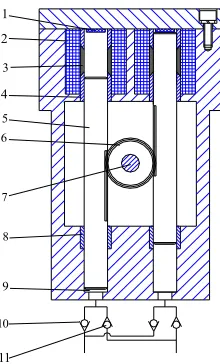
With the electromagnet as the power of the original, the armature under the plunger form the armature plunger components. The two cylinder armature plunger is connected and driven by gear rack mechanism. The pump section and the distribution system are identical to the conventional reciprocating piston pump. The buffer is very important in the plunger structure at the top and bottom dead center.
1. Buffer cushion 2. Solenoid 3. Non-magnetic ring 4. Guide sleeve 5. Armature-plunger 6.
[image:3.612.241.351.87.269.2]Interacting gear 7. Gear axle 8. Slide bushing 9. Pump chamber 10. Inlet check valve 11. Outlet check valve
Figure 1. Structure.
Working Process
When the pump is working, the magnetic coil of the left and right cylinder interacts with each other. When the electromagnetic coil is energized, it becomes a magnet and magnetizes the armature plunger of the cylinder, The armature plunger is moved upward by electromagnetic force, the corresponding pump chamber inhalation of low pressure fluid, through the rack and pinion the other cylinder armature plunger is driven down to complete the electric energy to the fluid pressure energy conversion. It is called electromagnetic force interaction plunger pump.
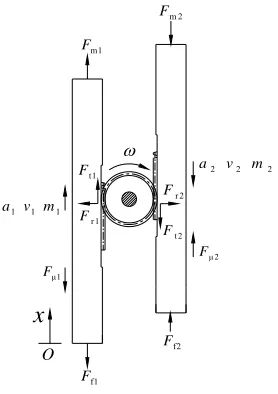
The armature plunger receives a smaller radial force, it can ignore the bending moment in the working process of the armature, and the moment of inertia and centrifugal force of the interactive gear. The basic balance equation of the pump working process are:
0
-- μ1 f1 1 1 t1
m1 F F F m a
F (1)
0
2 2 = +
+ +
-- Fm2 Ft2 Fμ2 Ff2 m a (2)
The armature plunger is the main force element in the pump working process and the force analysis is shown in figure 2.
1
2
8
9 5 4 3
7 6
10
Figure 2. Force Analysis.
In the figure, Fm1 and Fm2 are the electric magnetic force of the right and left cylinder, which are affected by the following factors: Armature plunger stroke (position), magnetic gap, the number of coil, magnetic ring position[11];Ff1 and Ff2 are the fluid forces of the right and left cylinder, which can be handled simply as the pressure of inlet and outlet, or through simulation calculation or experiment, the latter is more accurate[12-13].Fr1 and Fr2 are the radial force of the interaction gear on the left and right armature plunger,Ft1 and Ft2 are the tangential force of the interaction gear for the right and left armature plunger, gear tangential force Ft1 , Ft2 are equal gear radial force Fr1, Fr2 pressure angle multiplied by the cotangent;Fµ1 and Fµ2 are the frictional force of sliding sleeve for the right and left armature, which can be approximated as the radial force of the interaction gear multiplied the friction coefficient between the sliding sleeve and the plunger.
The efficiency of pump is the product of the following three parts: Electromagnetic conversion efficiency, mechanical transmission efficiency, fluid transmission efficiency.
Structure and Work Characteristics
The main characteristics of the structure and working process of the interaction plunger pump are as follows:
(1)Compared with the traditional electromagnetic pump, the electromagnetic force interaction piston pump does not reset the spring or permanent magnet, has the following characteristics: compact structure, easy installation. Due to the gear rack interactive mechanism, the two cylinders work well coordination without complicated electronic control system.
m1 F
m 2 F
1 1 1 a v m
2 2 2
a v m
(2)Because the left and right armature plunger synchronously reverse motion, the reciprocating inertia force mostly cancels each other, the system works smoothly.
(3) The electric magnetic interaction plunger pump has a wide of efficient working area through the structure optimization, which is beneficial to improve the overall operation efficiency. When the motor drive plunger pump system has a high volume efficiency in the use of disc distribution, the electric magnetic interaction plunger pump shall be matched with the rotary type distribution system [14].
(4)The electromagnetic interaction plunger pump has similarities with internal combustion pump working principle, internal combustion pump is continuously to the combustion chamber jet fuel; The motor driven plunger pump is intermittently supplied to the electromagnetic coil, the explosive magnetic field is generated, and the output fluid pressure of the armature plunger is driven by the electromagnetic force [15, 16].
(5)Relying on technical background, industrial background and market background, technology is easy to achieve.
VALIDATION OF WORKING PRINCIPLE
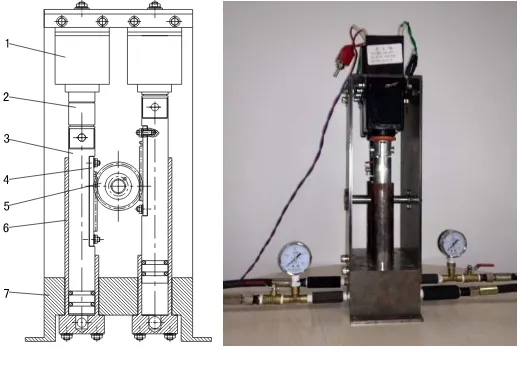
The principle verification prototype is shown in Figure 3.
(a) Structural diagram (b) Prototype
[image:5.612.168.428.402.586.2]1.Electromagnet2.Armature3.Plunger4.Rack5.Interacting gear6.Sleeve7.Pump body Figure 3. Prototype Structure.
prototype, two MQD1-15KG traction electromagnets were used as power components. The plunger adopts aluminum alloy material, which can reduce the reciprocating quality and the inertial impact. Using four check valves to achieve left and right cylinder distribution. The plates on both sides are fixed in the pump body, and the center supports the interactive gear shaft. The interaction gear meshes with the rack of the left and right cylinders, the plunger diameter of the prototype is 35mm, and the effective stroke of the plunger is 40mm.
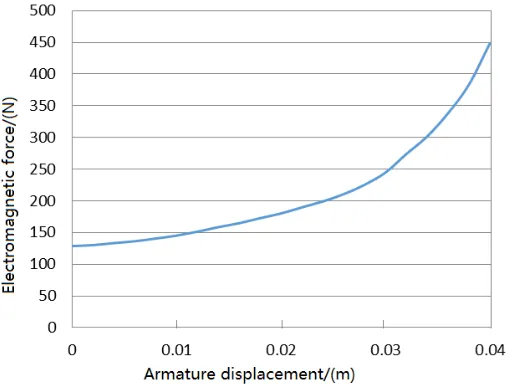
The relationship curve between the electromagnetic force of the MQD1-15KG traction electromagnet and the plunger position is shown in Figure 4. Plunger in the bottom deadline when the electromagnetic force of about 130N, the force monotonically increased to 450N.
[image:6.612.167.420.324.517.2]The working principle of electromagnetic force interaction piston pump is proved by prototype and test, the next step is to optimize the structure design and develop the performance prototype to make a complete product feasibility evaluation.
Figure 4. Relation between electromagnetic force and displacement of armature.
CONCLUSIONS
(2)The force balance equation of the armature plunger during the working process is established. The total efficiency of the system is related to the electromagnetic conversion efficiency, the mechanical transmission efficiency and the fluid transmission efficiency.
(3)Through the test single-cylinder armature plunger electromagnetic force increases with the trip, from 130N gradually increased to 450N.the principle is feasible and the noise is large. The next step should be to optimize design and develop performance prototype based on principle verification prototype to make a complete product evaluation.
ACKNOWLEDGMENTS
Te research work was supported by National Natural Science Foundation of China (Grant no. 51575286) and Shandong Province Science Foundation of China (no. 2014ZRB01503).
REFERENCES
1. Ming Li, Haitao Yang, Qiwu Tian, et al. Research and Test of Downhole Linear Motor Reciprocating Pump [J]. China Petroleum Machinery, 2014, 42(12): 94-97. (in Chinese with English abstract)
2. Qijun Lv, Tiezhu Zhang, Hong Zhao, et el. Linear Motor Based on AMEsim Modeling and Flow Characteristic Research of Reciprocating Pump [J]. Journal of Qingdao University(Engineering and Technology Edition), 2014, 29(1): 33-36. (in Chinese with English abstract)
3. Yongjun Hou, Ketao Cai, Peizhi Zhang. Research on motion characteristics of double-action tri-linear motor reciprocating pump [J]. Oil Field Equipment, 2009, 38(8): 12-16. (in Chinese with English abstract)
4. Guolai Yang, Shiwei Li, Junfeng Zhang. A new kind of design of the solenoid pump with magnet [J]. New Technology & New Process, 2014, (1): 41-43. (in Chinese with English abstract)
5. Xiaolan Dai. Data control constant flow plunger pump design based on linear motor [J]. Modern Design, 2011, (6): 36-38. (in Chinese with English abstract)
6. Yulong Bai, Shuping Wei, Guowei Xu. Electromagnetic pump modeling and simulation based on pseudo-bond graph methods [J]. Computer Engineering and Design, 2012, 33(3): 1222-1228. (in Chinese with English abstract)
7. Jianqiang Xu, Xiaofen Yang. Design method of the electromagnetic pump [J]. Drainage and Irrigation Machinery, 2004, 24(4): 3-4. (in Chinese with English abstract)
8. Zuyao Yu, Jiong Ke, Jiangtao Wen, et al. Transient driving characteristics of the high-frequency electromagnetic pump [J]. Chinese Hydraulics & Pneumatics, 2015, (2): 53-57. (in Chinese with English abstract)
9. Burkhard Horstkotte, Erich Ledesma, Carlos M. Duarte, et al. Improving pressure robustness, reliability, and versatility of solenoid-pump flow systems using a miniature economic control unit including two simple pressure pulse mathematical models [J]. Analytical Chemistry, 2010, 82(16): 6983-6990.
11. Lunwei Zhang. Yimin Xu. FEM analysis for magnetic force of proportion electro-magnet [J]. Machine Tools & Hydraulics, 2013, 41(17): 169-170. (in Chinese with English abstract) 12. Daozhai Yang, Hongxin Zhang, Jiang Yong, et al. Simulation of iteration method with
stationary point in working process of internal combustion pump [J]. Transactions of the Chinese Society of Agricultural Engineering, 2011, 27(11): 90-94. (in Chinese with English abstract)
13. Hong Zhao, Tiezhu Zhang, Hongxin Zhang, et al. Dynamic modeling and external characteristic simulation of three-cylinder internal combustion water pump [J].Transactions of the Chinese Society of Agricultural Engineering, 2009,2 5(3): 114-118. (in Chinese with English abstract)
14. Hongxin Zhang, Lianjun Cheng, Tiezhu Zhang, et al. Structural principle of rotating-sleeve distributing-flow system for reciprocating plunger pump [J]. Fluid Machinery, 2015, 43(8): 48-51. (in Chinese with English abstract)
15. Hongxin Zhang, Tiezhu Zhang, Hong Zhao, et al. Simulation study on working process of single-cylinder axial internal combustion engine [J]. Fluid Machinery, 2007, 35(3): 1-5. (in Chinese with English abstract)