2017 2nd International Conference on Manufacturing Science and Information Engineering (ICMSIE 2017) ISBN: 978-1-60595-516-2
Multi-agent System for Ammunition Depot
Management Based on Ambient Intelligence
Ping Sun, Guodong Li and Zhilu Zhang
ABSTRACT
This paper presents a dynamic multi-agent system for monitoring ammunition depots’ safety in execution time and surveillances the environment. The system architecture implements autonomous deliberative case-based agents with reasoning and planning capabilities, with the ability to operate in wireless devices and capable of obtaining information about the environment through WSN technology. Description and preliminary results of the prototype in a real environment are
presented.1
INTRODUCTION
Safety of ammunition warehouses is always an important prerequisite to ensure its effective functioning. In the process of ammunition depot management, it is necessary to take into account the environment, personnel, security risks and safety measures as well as the efficiency of operation. With the enhancement of the timeliness of the war, the accuracy and effective of ammunition support continues to improve, thus the informationization, digitization and automation of ammunition depot becomes a critical task to improve management efficiency and safety level.
analyzed. The ammunition depot safety problem is examined and the possibilities of multi-sensor network as a technology for ascertaining environment conditions in order to generate plans and maximize safety are discussed.
This paper focuses in the development of deliberative agents using case-based reasoning (CBR) architecture, as a way to implement adaptive systems to improve ammunition depot safety. Agents in this context must be able to respond to events, take the initiative according to their goals, communicate with other agents, interact with users, and make use of past experiences to find the best plans to achieve goals. The development of a deliberative agent that incorporates a Case-Base Planning (CBP) reasoning mechanism, derivative from CBR systems [1], specially designed for planning construction is proposed. CBP-BDI facilitates learning and adaptation, and therefore a greater degree of autonomy than that found in pure BDI (Believe, Desire, Intention) architecture [2]. A CBR-BDI agent [3] uses case-based reasoning as a reasoning mechanism, which allows it to learn from initial knowledge, to interact autonomously with the environment as well as with users and other agents within the system, and to have a large capacity for adaptation to the needs of its surroundings. We shall refer to the CBR-BDI agents specialized in generating plans as CBP-BDI agents.
AMMUNITION DEPOT MANAGEMENT PROBLEM
AGENTS ARCHITECTURE DESIGN
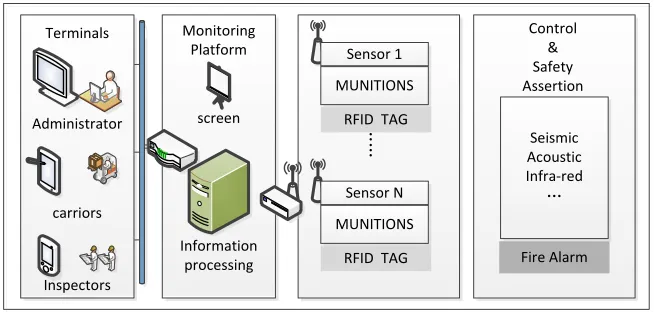
An ammunition depot in troops has been interested in improving the services offered to its users and has collaborated in the development of the technology presented here, providing their know-how and experimenting with the prototype developed. Figure 1 shows a diagram of the framework on which the depot is operating.
The framework of monitoring and management system is established according to the safety monitoring elements of ammunition depot. Based on wireless sensor network for data collection and transmission technology, combined with database technology to analyze data, work process of ammunition, environmental monitoring, the unity of the security system management. The system is divided into four parts: the data acquisition part of the ammunition warehouse, the network transmission part, the data analysis and processing and display part, and the intrusion detection and security control section.
Terminals
Administrator
carriors
Inspectors
Monitoring Platform
screen
Information processing
Sensor 1
Sensor N
……
MUNITIONS
MUNITIONS RFID TAG
RFID TAG
Control & Safety Assertion
Seismic Acoustic Infra-red
…
[image:3.612.133.460.318.474.2]Fire Alarm
Figure 1. The framework of the ammunition depot operating systems.
System Overview
protocols: request a testament, inform about monitoring data, inform about results, request a pick up assignment, request an intruder’s location, inform a manager about an abnormally temperature, et al.
The conclusions obtained after the analysis and design process let us conclude that the system is composed of five different agent types: the manager agent, the munitions agent, the sensor agent, the safety agent and the communication agent.
Manager Agent
[image:4.612.206.384.338.483.2]The Manager agent grasps all the dynamic information of ammunition depot, makes decisions based on the information collected, confirms the legality of the entry into the warehouse, and confirms and authorizes the monitoring and security plan. The Manager agent plays two roles the security role that controls the situation of the ammunition depot and manages locks and alarms; and the manager role that manages the record database and the inceptor and security personnel assignment. It must provide security for the storage, inceptor’s and security personnel’s assignment must be efficient.
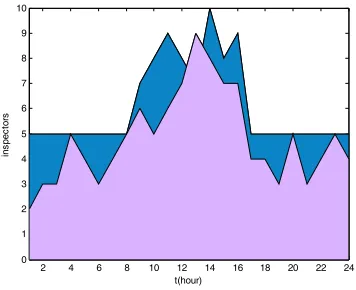
Figure 2. Number of nurses working simultaneously.
CBP Capabilities
A manager agent has been developed, as an autonomous deliberative cased-based planner (CBP-BDI) agent. This is the main agent in the system and its principal characteristics are described next. The manager agent implements the reasoning cycle of the CBP system by means of three capabilities: Update, KBase and VCBP (Variational CBP).
2 4 6 8 10 12 14 16 18 20 22 24 0
1 2 3 4 5 6 7 8 9 10
t(hour)
in
spec
to
Results and Conclusions
Figure 2 shows the average number of inspectors working simultaneously (each of the 24h of the day) at the ammunition depot, before and after the implantation of the management system, with data collected from one of the depots under experienced. The average number of munitions was the same before and after the implementation. The system facilitates the more flexible assignation of the working shifts at the depot; since the inspectors have reduced the time spent on routine tasks and can assign this time to extra activities. Their work is automatically monitored, as well as the munitions’ states. The stored information may be analyzed with knowledge discovery techniques and may help to improve the security and the efficiency.
REFERENCES
1. Corchado, J.M., Laza, R., 2003: Constructing Deliberative Agents with Case-based Reasoning Technology. International Journal of Intelligent Systems. Vol. 18 No.12, 1227-1241.
2. Pokahr, A., Braubach L., Lamersdorf, W.: Jadex, 2003: Implementing a BDI-Infrastructure for JADE Agents, in: EXP - In Search of Innovation (Special Issue on JADE), Vol. 3, Telecom Italia Lab, Turin, Italy, September, 76-85.
3. Nealon, J., Moreno, A., 2003: Applications of Software Agent Technology in the Health Care domain. Whitestein series in Software Agent Technologies.