ORIGINAL RESEARCH ARTICLE
A GENDER ANALYSIS OF VULNERABILITY TO
CLIMATE-RELATED FOOD SHORTAGES IN DEVELOPING COUNTRIES
THE CASE OF CAMEROON
*
Balgah Roland Azibo
Senior Lecturer & Senior Research Fellow, College of Technology, The University of Bamenda,
P.O. Box 39 Bambili, Northwest Region, Republic of Cameroon
ARTICLE INFO ABSTRACT
Climate change stimulates food shortages, especially in developing countries and sub Saharan Africa in particular, where agriculture is largely subsistence. That gender affects access to resources is a truism. However, how gender influences food shortages in climate-dependent, rain-fed agricultural systems is still largely unknown. We explore gender-related vulnerability to food shortages amongst 320 subsistence agricultural households in Cameroon, using both quantitative and qualitative methods. Results reveal a consistent pattern at the economic vulnerability sphere, as male headed households were less economically vulnerable to food shortages than female ones (p<0.000). However, significant, inconsistencies between gender groups were observed when social vulnerability was assessed: 58.6% versus 52.8% in favor of men regarding short term vulnerability to food shortages respectively (p = 0.036); and 60.2% versus 52.5% for women regarding long term vulnerability respectively (p = 0.094)) The truncated pattern for vulnerability to food shortage by gender in climate-dependent, rain-fed agricultural systems in our developing country case study allows us to conclude with the need to include physiological and political components into the vulnerability equation, as prerequisite for establishing clear patterns for gender effects on food shortages in developing countries, and for proposing gender-sensitive policy prescriptions of relevance to climate-related food shortages.
*Corresponding author
Copyright ©2017,Balgah Roland Azibo.This is an open access article distributed under the Creative Commons Attribution License, which permits unrestricted use, distribution, and reproduction in any medium, provided the original work is properly cited.
INTRODUCTION
The global food demand and supply is expected to rise steeply as a result of changing climate, population growth, shifting dietary preferences and increasing demands for renewable energy (FAO, 2009, Jehad et al, 2016). In 2009, the Food and Agricultural Organization of the United Nations (FAO, 2009) estimated that global food production must increase by 70% to meet the expected demand in 2050 (Yengoh, 2012). Regular (quantitative and qualitative) access to food by households especially in developing countries has been increasingly difficult in recent times as a result influential factors such as climate change, growing competition for land, and the volatility of food prices, with varied impacts on household vulnerability to food shortages and livelihoods, in different
communities and even by gender within the same communities (FAO, 2010a, IFAD 2009, IPCC, 2014). The most important prospects for reducing vulnerability to food shortages in the near future are seen in those developing countries where current land productivity is significantly lower than the actual potential. These differences between actual and potential production are believed to be especially wide in sub-Saharan agricultural systems where large portions of the land are still under subsistence farming (Molua, 2010, Yengoh, 2012). For instance, FAO (2009) estimates that while poverty rate in East Asia fell from 80% to 20 % between 1980 and 2005, it staggered at 50% in Africa over the same period. This contributed to the increase in number of people suffering from chronic hunger from 815 million in 1990 to 1.023 million in 2009, in spite of national and international efforts directed
ISSN: 2230-9926
International Journal of Development Research
Vol. 07, Issue, 09, pp.15065-15074, September,2017
Article History:
Received 14th June, 2017
Received in revised form
18th July, 2017
Accepted 02nd August, 2017
Published online 30th September, 2017
Citation: Balgah Roland Azibo. 2017. “A gender analysis of vulnerability to climate-related food shortages in developing countries. The case of
Cameroon".”, International Journal of Development Research, 7, (09), 15065-15074.
ORIGINAL RESEARCH ARTICLE OPEN ACCESS
Key words:
Gender, Vulnerability, Food Shortage,
towards fighting global poverty. Gender inequalities intersect with vulnerabilities, especially where limited access to resources, restricted rights and a muted voice in shaping decisions for women make them highly vulnerable, also to food shortages (Olubunmi, 2010, Tanyi-Tang, 2017). Olubunmi (2010) for instance found out that gender inequalities in the access and control of all livelihood assets (natural, physical, human and financial) exist among male and female household heads in Nigeria. This he thought, was a strong indication of gender inequalities in decision making. In the Sub-Saharan Region, women are often the ones who buffer the impacts of food crisis as they are often largely involved in food crop cultivation. This is also evident in Cameroon, where smallholder agriculture which accounts for more than 70% of the agricultural exports and is an important instrument for agricultural development policy and the fight against poverty is largely driven by women (Nzounkeu, 2012). Cameroon is often called the bread basket of Central Africa, to describe its contribution to food security in the region (Balgah, 2016). At the same time, it is a low income, food deficit country (Nzounkeu, 2012, Africa Report, 2013). Such controversy calls for further research.
One approach will be to look at the gender-food insecurity nexus, in the face of increasing vagaries of nature. It has been well established that increasing women‘s access to resources such as land, livestock, education, financial services, extension, technology and rural employment can rapidly empower them by boosting their agricultural productivity, economic growth and social welfare (Agarwal, 1994, FAO, 2011). Climate oscillations create completely new scenarios that need to be understood and managed by different gender groups involved in, or affected by subsistence agricultural systems common in many developing countries. Identifying gender-specific responses to food shortages for instance can enhance food self-sufficiency measures in countries whose agriculture is largely climate-dependent. This research contributes in this direction by exploring the dynamics of vulnerability to food shortages amongst small holder farmers in Cameroon from a gender perspective.
Statement of the problem
The majority of the poor people in developing countries depend on subsistence agriculture for their incomes, food entitlements and other aspects of livelihoods. Agricultural production therefore remains a key livelihood security determinant for households in many developing countries (Bogale and Shimilis, 2009, Yengoh and Brogaard, 2014). As mentioned earlier, gender inequalities intersect with vulnerabilities for instance through limited access to resources, which restricts rights and participation of disadvantaged gender groups (e.g. women) in decision making. Such inequalities may also shape household food decisions which tend to render disadvantaged groups highly vulnerable to quantitative and qualitative food insecurity (UNDP, 2007, IFAD 2013). Increasing uncertainty from climate change can have disproportionate food insecurity effects on different gender groups, especially in rural areas of developing countries, where subsistence, climate-related agriculture is dominant, and still constitutes a major source of livelihood for many (FAO, 2010a). In Cameroon, 50-80% of the country’s poor live in rural areas and relies primarily on subsistence agriculture (Baye, 2004, 2005).
Over 90% of all domestic food production in the country is done on small farms (Molua, 2010, Ngwa et al. 2015). Vulnerability to food shortage has been conjectured to be on a rise since the early 1970s, despite consistently large investments in the agricultural sector by the government, donors, international partners and non-governmental organizations (FAO, 2010a, Ejigayhu and Abdi-Khalil, 2013). Agricultural production in Cameroon is still heavily rain-fed, rendering the country highly vulnerable to food shortages. At the same time, the country is witnessing rapid population rates, especially in the urban cities, which increasingly depend on subsistence agriculture for food supply. The urban growth rate of in the Northwest Cameroon (7%) is 2.9% percentage points higher than the national average of 4.1% (BUCREP, 2010, Yengoh and Brogaard, 2014). This presents a growing potential for food shortages in the region, if food production does not increase at least at the population growth rate.
The Cameroon government recognizes the actual and potential roles agriculture to eradicate poverty and reduce vulnerability to food shortages and enhance economic growth in the country (Gokowski and Ndoumbe, 2004, Baye, 2005). However, knowledge on the influence of gender on vulnerability to food-related poverty in Cameroon is currently insufficient to render justice to the development and application of appropriate policy prescriptions in the agricultural sector. This study sets out to identify and empirically analyse gender differences on vulnerability to food shortages, using the case study of climate-dependent, subsistence agricultural households in the Northwest region of Cameroon. While the paper intends to commence the process of an eventual and appropriate inclusion of gender issues into the agricultural sector policy reforms in Cameroon, it hopes to stimulate similar interest in other parts of Cameroon in particular and in developing countries in general, as prerequisite towards establishing broad based policy prescriptions aimed at reducing vulnerability to food shortages across regions and countries.
A concise review of relevant literature
The concept of vulnerability revisited
(Hoddinott and Quisumbing, 2003, Schechter, 2006). Irrespective of disciplinary boundaries, it often carries along with it the possibility of witnessing negative impacts and/or outcomes (Alwang et al. 2001). The concept of vulnerability is approached in the development literature from three principal angles, namely vulnerability as expected poverty (VEP), as expected loss in utility (VEU) and as uninsured exposure to risk (VER), as well as using assets based measures (Heitzmann et al, 2002, Hoddinott and Quisumbing, 2003, Schechter, 2006). VEP captures the probability that a household will fall in to poverty in the future. VEU measures the difference between the utility derived from some level of certainty-equivalent consumption at times t and t+1, while VER captures the probability of having an ex post welfare loss as a result of a negative shock (Lignon and Schechter, 2003). Using assets-based measures, VEP can identify the probability of falling below some benchmark level of current consumption as a result of loss or degradation of assets (Alwang et al. 2001, Schechter, 2006, Raghav and Katsushi, 2008).
This study examines vulnerability of small holder farmers to food shortages by gender, based on a case study from Cameroon. Understanding vulnerability to food shortage becomes important when one considers the increasing variations in climatic factors and the impacts they may have on climate-dependent agricultural systems (IPCC, 2014). Higher temperatures and changing rainfall patterns have been reported to negatively affect farm yields, leading to decreasing food availability and accessibility, reduced economic growth and increased rural poverty (Kydd, 2004, Mendelssohn et al. 2006). Left on its own, climate variability will cause an estimated 90% drop in net crop revenue by 2100 in some regions in Africa, thus increasing the vulnerability of the poor African households to food shortages and livelihood insecurity (Boko et al. 2007, Godfray et al. 2010, FAO, 2010a and b, Mutunga, 2012). One way to curb these negative effects is to make efficient use of any existing gender disparities in the targeted agricultural systems. This calls for immediate research.
According to FAO (2010b), vulnerability to food shortages can take four basic forms. Firstly, it can be physiologic vulnerability to malnutrition mostly with certain age groups such as children and the elderly, pregnant women and lactating mothers. Capturing physiologic vulnerability often requires taking anthropogenic measures from the sampled population. Secondly, there is economic vulnerability which affects poor areas, groups, households or individuals in the form of livelihood threats, loss, high dependency ratio, loss of productive members and/or living in environmentally marginal areas. Economic vulnerability is often captured based on the abundance of economic/physiscal and financial livelihood assets (Scoones, 1998). Thirdly, there is social vulnerability
which affects unsupported old people, widows, orphans, minor and physically challenged people as well as female headed households. Social capital variables (e.g. perceptions, membership in groups and networks, etc) are often applied to capture social vulnerability (Moser, 1998, UNWFP, 2005). Fourthly, political vulnerability may affect for instance refugees, internally displaced persons or communities exposed to violence. Institutions, institutional environment and processes are indicators of political vulnerability (Hoddinot and Quisumbing, 2003). However it is construed, vulnerability is a forward looking concept aimed at assessing community and household exposure and sensitivity to future shortfalls.
Ultimately, the vulnerability of a household or community is determined by their ability to cope with their exposure to the risk posed by the shocks. According to the United Nations World Food Programme (2008), this ability to manage risks associated with shocks is determined largely on household and community characteristics, most notably their asset base and the livelihood and food security strategies they pursue. The interaction between natural, physical and human and psychological resources at individual and household levels affects their levels of vulnerability (Moser, 1998, UNWFP, 2005, Fujii, 2016). In this case study, we measure household vulnerability to food shortages by combining both monetary (economic) and non-monetary (social) indicators. This approach has been successfully used before in developing country contexts, where anthropogenic measures are often very difficult to illicit.1
Gender and the vulnerability-to-food-shortage nexus
For the simplicity sake, food insecurity and food shortage will be used interchangeably in this study. Food shortage (or insecurity) is a broad concept that includes issues related to the nature, quality, food access and security to food supply. Food security exists when all people at all times, have physical and economic access to sufficient, safe and nutritious food to meet their dietary needs and food preferences for an active and healthy life. Food insecurity (shortage) exists when a person suffers from a temporal decline in food consumption (transitory food shortage) or when a person is continuously unable to acquire sufficient food needed for normal life (chronic food shortage) (Manale et al. 2012). A household is said to be vulnerable to food insecurity if it currently experiences food shortages, when not all members have access to sufficient food needed to sustain a healthy life, or when this is anticipated in the future. The degree to which people are vulnerable to food shortages is partly a function of their social status, poverty, power and access to and control over resources, which are all to a certain extent contingent on existing gender relations (Agarwal, 1994, FAO, 2011, Manale, 2012).
In spite of international acknowledgement of the differential roles, experiences and skills existing between women and men, women still generally lag behind in terms of their recognized contribution to development, environmental sustainability efforts, the economy and politics (Agarwal, 1994). In sub-Saharan African countries, women provide 60% to 80% of the labour for food production and post-harvest management. However, female farmers’ yields are usually less than that of men because of highly limited access to resources (Olubunmi, 2010, Balgah, 2016, Tanyi-Tang, 2017). FAO (2011) contends that a gender balanced access to resources can potentially reduce the number of hungry people in the world by up to 150 million. Women in developing countries are particularly vulnerable to household food shortages because of usufruct or very limited access to natural and livelihood resources.
1
Women experience unequal access to resources and decision-making processes, with limited mobility in many rural areas in developing countries (Heidhues et al, 2004, Balgah, 2016). Contemporary evidence demonstrates that existing inequalities render women and girls more vulnerable to food shortages than men and boys (Olubunmi, 2010). According to Heidhues et al (2004), over 70% of the food insecure population in Africa lives in the rural areas. Ironically over 90% of the continent’s food is produced in rural areas, on rain-fed, climate-dependent small farms. It is therefore possible that although the role of small holder (subsistence) food production in reducing food shortage in Africa has been mentioned (Aliber and Hart, 2009, Baipheti and Jacobs, 2009, Balgah and Buchenrieder, 2011, Fumane, 2013), the producers may actually be exposed to food shortages, with possible significant differences across gender groups. Baipheti and Jacobs (2009) for instance observe that subsistence agriculture plays an important role in reducing household vulnerability to food shortages by improving welfare and reducing the effect of inflation in South African communities. While vouching for the promotion of subsistence agriculture, they caution for the need of a gender-sensitive approach, based on their observation that female-headed households were more vulnerable to food shortages and other aspects of poverty than male-headed ones. In the same context, Fumane (2013) using the household food insecurity access scale (HFIAS) developed by USAID reports that female-headed households in South Africa have a higher mean HFIAS value of 4.92 compared to 2.89 for male-headed households. Cultural restrictions on women‘s ability to participate fully in food production activities, and very restricted access and control over agricultural resources in most poor countries leave them particularly vulnerable in times of economic crisis (Kabeer, 1990, Manale et al. 2012, Fumane, 2013, Balgah, 2016).
A hypothesis that often emerges in the topical literature is that wealth, asset ownership (e.g. land, livestock) and income are good predictors of food insecurity (see for instance Iram and Butt, 2004, Feleke et al. 2005, Kidane et al. 2005, Babatunde et al. 2008). Therefore, households and gender groups with an abundance of these resources are expected to be more resilient to production or price shocks that create food shortages, than those with limited resources. Babatunde et al (2008) for instance found out that female-headed households were more vulnerable to food shortages than male headed households in Nigeria. They also contend that the food shortage problem could be tackled by increasing the farm sizes and crop output, especially for female-headed households. Manale et al (2012) on their part specifically found out that female-headed households in Kenya are 13% more vulnerable to food shortages than their male counter parts. More so, the female-headed households faced 3% and 12% higher probability of chronic and transitory food insecurity respectively than male-headed ones.
In Cameroon, the mean yield from male-managed maize farms is 1.8 tons/hectare compared to slightly below 1 ton/hectare from female-managed farms (Yengoh, 2012). This lower yield on female-managed farms is a reflection of the differences in access to factors of agricultural production between men and women. For instance while more than 85% of men used inorganic fertilizers in crop production; only about 54% of women did used inorganic fertilizers in the above mentioned study. Men on average provided up to 60% of the optimum fertilizer needs for their farms, while women provided
approximately only 30%. Similar differences were found in the use of other inputs and techniques that do have positive effects on crop yields, such as the use of compost, improved seeds, and animal droppings. As food prices rise, households are likely to smooth assets by reducing either the quality and/or the quantity of food they consume, or smooth consumption by depleting assets (Zimmerman and Carter, 2003). Vulnerability assessments in this domain should therefore pay attention to assets and/or existing food stocks, which often vary between rural and urban households.
In urban areas, female-headed households are reported to suffer a larger proportional drop in welfare than male-headed households as a result of the food price hikes (FAO, 2012). Given that Cameroon’s agriculture is principally rain-fed and predominantly a rural activity, it is possible that fluctuations in rainfall significantly account for observed changes to the returns in agriculture. The variability and unreliability of rainfall in particular, implies high risks in agriculture, possible deterioration of sectorial growth and hindrance to overall economic progress (Molua and Lambi, 2007). Understanding vulnerable to food shortages from a gender perspective can therefore enhance efforts towards reducing food shortage in the country. This research contributes in this direction, by examining the gender-related differences in vulnerability to food shortages in rural areas of the northwest region of Cameroon.
MATERIALS AND METHODS
Background of the research region
The empirical study was carried out in the Northwest region of Cameroon. Cameroon is a resource-rich country in central Africa. The poverty rate which currently stands above 40 percent has been frequently blamed on endogenous obstacles such as increasing natural and manmade disasters (Innocent et al, 2016), mismanagement, widespread corruption and high unemployment rates. Small scale agriculture is dominant and is the most important activity in rural areas (Yengoh and Brogaard, 2014). This probably explains why the poor in Cameroon are largely concentrated in the rural areas (Baye, 2004). Even so, agriculture contributes around 30% to the GDP of the country, and remains a major employer for almost 70% of the population (Ambagna et al, 2012, Balgah, 2016).
The northwest region is the third most populated region in the country. Over 80 percent of all its inhabitants rely on agriculture for their livelihoods. Poverty rate in the region (51 percent) is 21 percentage points higher than the national average (Yengoh, 2012). This tropical region is traditionally characterized by two seasons: a rainy season from mid-march to mid-October (with mean annual rainfall of 2400 mm) and a dry season from mid-October to mid-March, although increasing shifts have been observed due to climate variability. Its population of around 2 million inhabitants is distributed in 7 administrative divisions (Balgah, 2016, Innocent et al, 2016).
Sampling design and methods
rurality. In Cameroon, rain-fed subsistence agriculture is mostly practiced in the rural areas (Yengoh, 2012). The purposive selection was therefore not only aimed at meeting the objectives of the research but also to reflect the general reality in the Country. From each division, 2 sub divisions were randomly chosen for data collection on farmers’ vulnerability to food shortages. 8 villages (that is 2 from each of the 4 sub divisions) were further randomly selected to narrow down the sampling frame. Female and male heads of households were then purposively and randomly selected from the 8 villages respectively and interviewed. The empirical research targeted 40 (male and female) household heads per village. Like most communities in Cameroon, household headship in the northwest region of Cameroon is dominated by men (Quisumbing, 1996, Balgah, 2016). Therefore, while male respondents were randomly selected due to their relative abundance, female household heads were actually targeted and included in the sample. This was essential to allow for subsequent analysis by gender. A total of 320 respondents (146 females and 174 males) were interviewed at the end of the survey. The sampling unit was therefore both the male and female heads of farming households in the eight selected farming communities in the Northwest region of Cameroon. Additional household level data was collected from the individual household heads. Both quantitative and qualitative primary data were collected from the sampled male and female farming household heads in the selected communities in Northwest Cameroon. Contact visits were made to the 8 villages prior to field work, in order to discuss with the different stakeholders on the research procedures and arrange for logistics in the communities. Pretesting of the questionnaires was done during the contact visits, and subsequent adjustments and revisions made on the questionnaire prior to the final field research.
Quantitative data was elicited using the standardized, pre-tested and revised questionnaire. The structured questionnaire captured (1) socioeconomic information (such as house hold size, sex, education, religion, marital status, land holding); (2) economic and social vulnerability to food shortage; and (3) the management strategies implemented by interviewees (preventive, mitigation and coping). The questionnaires were administered with the help 4 enumerators who were recruited and trained for the purpose of data collection, prior to the fieldwork. Qualitative information was captured by employing Participatory Rural Appraisal (PRA) tools, particularly focus group discussions. 16 focus group discussions (that is, two per community) were organized during the data collection process. Focused group discussions centered on decision making processes within the family, access and control over family assets, division of labor within the family, food security and activity profile in the family. The focus groups were held separately for females and males, to reduce any form of influences. Field observations, and key informant interviews complemented the focused group discussions. Empirical data was collected from 7-30 October 2014 in all the selected communities. Secondary data obtained from previous research works, journal publications, and books of relevance to the topic complemented the empirical data.
Data analysis and interpretation
Upon completion of the field work, the data was coded and entered into the Statistical Packages for the Social Sciences (SPSS) soft ware version 20.0.
The data was analyzed using this software and results were generally interpreted observing a 95% confidence interval. Only the socioeconomic and vulnerability to food shortage results will be presented and discussed in the next section of this paper.
RESULTS AND DISCUSSION
Socio-economic characteristics of the sample
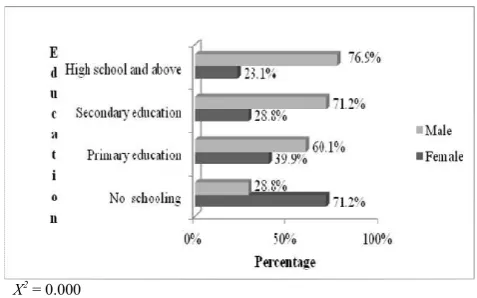
In this section, some of the socio-economic characteristics of the sample are presented and discussed. In general the presentation and discussion is done in a comparative manner by gender, that is, by comparing the empirical results between the male and female household heads. It is worth mentioning that from the 320 respondents, 45.6% were female household heads while 54.4% were male household heads. The female representation is a near census, considering the patriarchal dominance in the research communities. A significant difference in educational achievement was observed between the male and female household heads, as presented in figure 1 below. One observes from figure 1 that the majority of those who had no formal schooling in the research area (71.2%) were the female household heads. On the other hand, for all those who had completed primary education, secondary education as well high school and above education, the majorities were the male household heads (60.1%, 71.2% and 76.9% respectively).
In general, the proportion of educated male household heads is significantly higher than that for their female counterparts (69.4% and 30.6% respectively, P = 0.000). This trend is consistent, as one ascends the academic ladder. The results mirror previous contentions for a preference for education of the male child over their female counterpart, which has been seen as a determinant for limited access to other livelihood resources (Agarwal, 1994, Tanyi-Tang, 2017). The consistency of this result is further reflected in the literacy rates of both the male and female household heads in the sample, which was found to be significantly higher for the men than for women (67.4% and 32.6% respectively, Chi-square = 36.623, P = 0.000). The percentages reflect the national trends for Cameroon: 81.2% literacy rate for males and 68.9% literacy rate for females (The CIA World Fact Book, 2016), even though they are both lower than the national figures.
[image:5.595.314.553.580.729.2]X2 = 0.000
Fig. 1: Educational achievement of household head
the female household heads. As expected, a majority (56.4%) of those who are involved in agricultural activities are the women while the men represent the minority (43.6%). This finding is also reflected in table 2 which displays information on those whose main occupation is farming. 87% of the female household heads as opposed to 67.2% of the male household heads reported that they largely depended on agriculture as their main source of livelihood. These results clearly indicate that there are agriculture-dependent (predominantly male) household heads whose primary occupation is not agriculture. Such results seem to suggest that these male household heads depend on their wives and children to produce the food needed at the household. This conjecture is reflected in table 1 below, where it can be seen that 13% of the women as opposed to 32.8% of the men are either involved in other activities including business and formal employment.
[image:6.595.46.284.250.391.2]X2= 0.408
Fig.2: Household heads’ involvement in farm activities
Further examination of additional socio-economic variables reveals significant differences between male and female household heads, for instance at the level of household size and mean age at the time of interview. The mean household size of the female headed households was 6 persons (5.76±2.483) while that for the male headed household was 8 persons (7.66±5.102, P = 0.000). Male headed households therefore have more labor which can be crucial in improving productivity in subsistence agricultural production systems predominant in the research region, as larger household sizes provide a source of more and unpaid labour than smaller ones (Yengoh, 2012, Balgah, 2016).
In the same line, the mean age of the male household heads was significantly higher than that of the female household heads (50 years (50.24±14.916) and 45 years (45.05±13.468) respectively, P = 0.002). This difference is likely to have an effect on the vulnerability to food shortages in the research area. In subsistence based agriculture, higher mean age is considered a valuable asset, as older household members bring along experience which is important for risk management, and therefore can contribute to enhancing food security for the households (Berhanu, 2007, Epo, 2010). Ample contemporary evidence for this conjecture in developing countries is largely existent (see for instance Tshediso (2013) and Ngwa and Balgah (2016) who confirm this in independent works on determinants for food and livelihood security in South Africa and Cameroon respectively).
[image:6.595.80.520.592.644.2]As can be further seen in table 2 the estimated monthly income for male headed household as well as their annual expenditures on clothing and foot wear is significantly higher than that for the female headed household (FCFA62,160±89,220 for the men and FCFA19,640±22,620 for the women, P = 0.000; and FCFA113,170±181,200 for the men and FCFA69,490±79,210 for the women, P = 0.020 respectively). Lower incomes of the female headed households probably support the popular adage that women in developing countries are mostly involved in food crop cultivation while the men concentrate on cash crop cultivation (Agarwal, 1994, Epo, 2010), or that they are inherently more conservative, and therefore less extravagant in terms of spending than men (Agarwal, 2000) . The higher mean income for the male headed households (about FCFA42, 500 more) can be used to buffer vulnerability to food shortages in a way that will not be possible in female headed ones, as long as the money is not largely used for other activities. As Tshediso (2013) explains, the quantity and quality of a household’s expenditure patterns are highly correlated with the purchasing power of the household. Therefore, everything being equal, the higher the household monthly income, the more the household can spend for food in times of shortages. Bashir et al (2010) also hold similar contentions. By Engel’s law, male headed households with higher incomes should also be able to spend more on nonfood items. This is reflected in their significantly higher annual expenses on clothing and foot wear, compared to female headed ones.
Table 1: Main occupation of household head
Sex of household head Farmer Business Salaried worker Casual worker Retired/handicapped Total
Female 127 7 4 6 2 146
87% 4.8% 2.7% 4.1% 1.4% 100%
Male 117 11 7 28 11 174
67.2% 6.3% 4% 16.2% 6.3% 100%
X2 = 0.000
Table 2: Analysis of livelihood based socio-economic variables by gender of household head
Variable Gender N Mean Std. Deviation Std. Error Mean P-value
Household size Female 145 6.0 2.483 0.206 0.000
Male 174 8.0 5.102 0.387
Age of household head (Years) Female 139 45.0 13.468 1.142 0.002
Male 166 50.0 14.916 1.158
Estimated mean monthly household income (FCFA) Female 126 19,640 22,620 2,015 0.000
Male 154 62,160 89,220 7,190
Estimated annual household expenditures on clothing and foot ware for (FCFA)
Female 108 69,490 79,210 7,620
0.020
Male 143 113,170 181,200 15,150
Notes:
1. Means have been rounded to the nearest appropriate whole numbers
2. FCFA means Franc de la Communauté Financière d’Afrique
[image:6.595.65.534.676.764.2]Respondents were further asked to give a subjective self-evaluation of their poverty status. In line with other results this far, more female than male household heads evaluated themselves to be poor (60.7% and 39.3% respectively) and average (55.9% and 44.1% respectively). On the other hand more of the men (51.5%) categorized themselves to be rich as compared to women 48.5% who feel they are richer than most of the other households in the research area (see figure 3).
[image:7.595.35.288.156.299.2]X2 =0.1825
Fig. 3: Self-assessment of household head
Vulnerability to food shortages
An overview of the socioeconomic variables suggests that male headed households are less poor, better off and consequently less vulnerable to food shortages than the female headed households. Nevertheless comprehensive conceptualization of vulnerability goes beyond the economic (monetary) dimension to include physiological, social and political (non-monetary) components (Lignon and Schechter, 2003, Hoddinott and Quisumbing, 2003, FAO, 2010b). We endeavou to capture the non-monetary aspects in our attempt to broaden our understanding of gender-related vulnerability within a developing context. Respondents were then asked about their perceptions as to their current levels of household vulnerability to food shortages, based on their overall analysis of both monetary and non-monetary assets. The results are presented in figure 4 below.
Notes:
Following Henry et al (2000 and 2003), short term food insecurity was
estimated as the probability that the household will witness a food shortage spell in the next one month, while long term food insecurity will the probability of a food shortage in a period that spans up to one calendar year.
X2 = 0.036 and 0.094 for Short long and term food insecurity
respectively
Fig.4: Self-assessment of vulnerability to food shortages by gender
The results show 58.6% of the male household heads and 52.8% of the female household heads predicting their
households to be currently vulnerable to short term food shortages (P = 0.036). A significantly higher percentage of the male household heads (60.2%) as compared to their female counterparts (52.5%) perceive higher probabilities of witnessing food shortages in the long term (P = 0.094). This result resonates with previous contentions that women in many subsistence agriculture based developing countries concentrate on food crops, while the men concentrate on cash crops (Agarwal, 1994, Ngwa and Balgah, 2015). The perception for witnessing a future food shortage is rationally lower for inherently conservative female households with food stocks than for male headed households with little or no food stocks (Agarwal, 2000). In addition, smaller household sizes for female headed households as compared to male headed ones naturally means less mouths to feed, and culminates in lowered perceptions of vulnerability to food shortages. Findings of this nature from developing countries abound (UNWFP, 2005, Babatunde et al, 2008, Baipheti and Jacobs, 2009, Ambagna et al, 2012, Tshediso, 2013).
Ambagna et al (2012) for instance reported that subsistence farming had a positive effect on both short term and long term food security amongst smallholder farmers in Cameroon. Babatunde et al (2008) and Tshediso (2013) independently observed that larger household sizes increased dependency ratio, food expenditures and competition for limited resources and consequently increased vulnerability to food shortages amongst South African households. Our results however contradict some research findings in other developing countries (Feleke et al, 2005, Kidane et al, 2005, UNWFP, 2005, Olubunmi, 2010, Tunde, 2011, Manale et al, 2012). Olubunmi (2010) for instance identified higher food insecurity incidence amongst female than male headed households in Nigeria (0.49 and 0.38 respectively). UNWFP (2005) and Tunde (2011) also found greater proportion of small holder women farmers in Timor Leste and Nigeria respectively to be vulnerable to food insecurity (food shortages) than the men. Such contradictions provide justification continuous research that can illuminate consistent trends on the vulnerability to food shortages for male and female headed households in developing countries. Lastly, both household types were asked about the number of meals consumed in the household the day before the interview. This was not different by gender, as both households reported an average of 2 meals per day each. That this is one meal short of the expected number of meals/day suggests that all the households are vulnerable to food shortages, irrespective of the gender of the household head.
Conclusion and recommendation
[image:7.595.37.288.530.666.2]less vulnerable to food shortages than female ones. However, a review of non-monetary, perceptive (social) components reveals different results. While the male household heads are more confident in their perceived ability to manage short term vulnerability to food shortages, it is the female headed ones who become more confident in the phase of long term food security. The empirical results lead to a number of conclusions. Firstly, vulnerability amongst climate dependent households common in developing countries is likely to vary by gender of the household head. The dominant economic capacity of male headed households is consistent with better access and control to resources for men than women that have been reported in many developing countries (Agarwal, 1994, Quisumbing, 1996; Balgah, 2016).
Lowered perceptions for long term food insecurity amongst female headed households is attributable to their large involvement in subsistence agriculture and the conservative attitudes believed to be inherent to them (Agarwal, 2000). However, trend consistency is still to be fully established across developing countries, for other aspects of vulnerability. In fact, our empirical results mirror some findings, but refute others. It seems as if the trend can quickly be misleading, if one concentrates only on the money-metric dimensions of vulnerability. As was observed in our case study, the male dominance became blurred once socially oriented perceptions were included in the vulnerability equation. Nevertheless, the accumulation of assets remains crucial for consumption smoothing during periods of food shortages in climate-dependent, subsistence agriculture-based communities in developing countries (Schechter, 2006). Secondly, the male dominance observed in our case study is likely to persist for a long time, especially in those developing countries where gender stereotypes render reversal paradigms in gender roles almost impossible, as they are rooted in strong traditions and customs (Quisumbing, 1996, Balgah, 2016). As long as men have more access and control over resources than women, and as long as they remain household heads by societal design, they are likely to command lesser vulnerability to food shortages in climate dependent agricultural communities than women. Perhaps a better approach to reduce exposure to food shortages for such households will be to enhance the capacities and capabilities of both men and women in order to reduce short and long term vulnerability to climate-related food shortages in developing countries. It must be mentioned that our case study fails to provide a holistic gender analysis of vulnerability to food shortages, as it does not include anthropogenic (physiologic) and political vulnerability components. Nevertheless, both household types reported an average of two meals per day, which in our opinion is one meal short of expectation. The quality and quantity of the meals were however not captured during the survey. We recommend that these (anthropogenic) components be included to the extent possible in future research that aims at establishing a comprehensive picture of the influence on of gender on food shortages in developing countries. Only under such conditions can results be largely relevant for policy prescriptions aimed at curbing the effects of climate change on food security in climate-dependent, subsistence agriculture based communities in Cameroon in particular, and in other developing economies.
Acknowledgement
The author wishes to acknowledge the financial support of the Volkswagen Foundation Germany, which facilitated data
collection and analysis. The farmers and enumerators in northwest Cameroon are also acknowledged for providing and collecting the empirical data on vulnerability to food shortages respectively. The work of the research assistant, Mr. Ngwa Kester in entering the data and helping in the analysis is also recognized. Special appreciation goes to the anonymous referees for their comments, which were crucial in improving the quality of the final paper.
REFERENCES
Africa Report 2013. Cameroon Economic Growth Slows to 4.7 percent in 2013 – IMF
Agarwal, B. 1994. A Field of One’s Own: Gender and Land Rights in South Asia. Cambridge: Cambridge University Press.
Agarwal, B. 2000. Conceptualizing environmental collective action: Why gender matters. Cambridge Journal of Economics 24, pp. 283-310.
Agriculture and Food Security 1:19 doi:10.1186/2048-7010-1-19
Aliber M. and Hart T. (2009), Should Subsistence Agriculture be Supported as a Strategy to Address Rural Food Insecurity? Agrekon, 2009, 48 (4), pp. 434-458
Alwang, J., Siegel, P., Jorgensen, S., 2001. Vulnerability: A View from Different Disciplines, Social Protection Discussion Paper No. 0115, Washington DC: The World Bank
Ambagna, J., Kane, G. and Oyakale, A. 2012. Subsistence Farming and Food Security in Cameroon: A Macroeconomic Approach, Life Science Journal, 9 (4), pp. 3949-3954
Babatunde R.O., Omotesho O.A., Olorunsanya E.O. and Owotoki G.M. 2008. Determinants of Vulnerability to Food Insecurity: A gender-based analysis of farming households in Nigeria, Indian Journal of Agricultural Economics 63 (1), pp. 116-125
Baipheti M. and Jacobs P. 2009. The Contribution of Subsistence Farming to Food Security in South Africa.
Agrekon, 2009, 48 (4), pp. 459-482
Balgah, R. A., Buchenrieder, G. (2011), Does technology adoption reduce risks for smallholder farmers in Cameroon? Pakistan Journal of Social Sciences, 8(1), pp. 13-22.
Balgah, R.A. 2016. Applying Participatory Rural Appraisal to unlock Gender Group Differences in Some Communities in Rural Cameroon, Asian Journal of Agricultural Extension, Economics and Sociology 12(3), pp.1-11.
Bashir, M., Schilizzi, S. and Pandit, R. 2012. The Determinants of Rural Food Security: the case of Landless Households of the Punjab, Pakistan. Crawley: School of Agricultural and Resource Economics, The University of Western Australia
Baye, F. M. 2005. Alternative methods for setting poverty lines: Measuring poverty in Cameroon. Pakistan Economic and Social Review, 43(1)107-132.
Baye, F.M. 2004. Non-parametric estimates of poverty lines: Measuring urban-rural contributions to poverty changes in Cameroon. Paper presented at the 2004 CSAE conference on Growth, Poverty Reduction and Human Development in Africa, \oxford, 21-22 March 2014.
Presented to the School of Graduate Studies of Haramaya University, Ethiopia.
Bogale, A. and Shimelis, A. 2009. Household Level Determinants Of Food Insecurity In Rural Areas Of Dire Dawa, Eastern Ethiopia, African Journal of Food Agriculture Nutrition and Development, Rural Outreach Program 9( 9), pp. 1914-1926
Boko, M., Niany, A., Nyong,C., Vogel, A., Githeko, M., Medany, B., Osman-Elasha, Tabo, T., Yanda, P., Parry., Canzini,O., Palutitof, J., Van Linden, P., and Hanson, E., 2007. African climate change 2007:Impacts, adaptation and vulnerability. Contribution of working group 2 to the Fourth Assessment Report of the Intergovernmental Panel on Climate Change, Ed.Cambridge University Press, Cambridge UK, pp. 433-467.
BUCREP 2010. La population du Cameroun Resultats du 3eme RGPH. Vol. V: Etudes monographiques regionals; Tome 7:Nord-Ouest. Yaoundé: Bureau Central des Recensements et des Etudes de la Population (BUCREP). Central Intelligence Agency (CIA) 2016. The World Fact
Book, https://www.cia.gov/library/publications/the-world-factbook/fields/2103.html (Accessed 22.04.2017).
Discussion Paper (UN/ACC) No. 6, Geneva, Switzerland. Ejigayhu S. and Abdi-Khalil E. 2013. Determinants of Food
Insecurity in Addis Ababa City, Ethiopia, Invited paper presented at the 4th International Conference of the African Association of Agricultural Economists, September 22-25, 2013, Hammamet, Tunisia.
Epo, B. 2010. Determinants of Poverty in Cameroon: A binomial and Polychotomous Analysis. University of Yaoundé II SSRN:http://ssrn.com/abstract=1424672 (Accessed on 23.02. 2014)
FAO (Food and Agricultural Organisation) 2009. The State of Food Insecurity in the World, 2008. Rome, FAO.
FAO 2010a. The State of Food Insecurity in the World 2009: Economic Crises-Impacts and Lessons learnt. Rome, FAO. FAO 2010b. Assessment of Food Security and Nutrition Situation in Nepal, An input for the preparation of National Medium-Term Priority Framework for FAO in Nepal, United Nations Complex, Pulchowk, Nepal.
FAO 2011. The State of Food Insecurity in the World, Rome, Food and Agriculture Organization of the United Nations. FAO 2012. “Managing Systems at Risk” The State of the
World’s Land and Water Resources for Food and Agriculture (SOLAW), (Accessed on 4.06. 2017).
Feleke, S, T., Kilmer, R. and Gladwin, C. 2005. Determinants of food security in Sothern Ethiopia at household level,
Agricultural Economics Journal, (33) pp. 351-363.
Fujii, T. 2016. Concepts and Measurement of Vulnerability to Poverty and Other Issues: A Review of Literature. ADBI Working Paper 611. Tokyo: Asian Development Bank Institute. Available at: https://www.adb.org/ publications /concepts-and-measurement-vulnerability-poverty accessed on 12.07. 2017).
Fumane, N. 2013. Determinants of Vulnerability to Food Insecurity in a South African Township: A Gender Analysis, Mediterranian Journal of Social Science, 4 (14), pp. 311-317
Gockowski, J., Ndoumbe, M. 2004. The adoption of intensive monocrop horticulture in southern Cameroon. Agricultural economics, 30(3), 195-202.
Godfray, H., Crute, L., Hadalad, D., Lawrence, J., Muir, N., Nisletts, J. Pretty, S., Robinson, C., Tomin and Whiteley, R. 2010. The future of the global food system,
Philosophical Transactions of the Royal Society B:
Biological Science 365 (1554), pp. 2769-2777.
Heidues, Atsian,A.Nyangito, H. Padilla,M. and Ghersi, G. 2004. Development Strategies and Food Nutrition Security in Africa. An assessment, 2020 Discussion paper No. 38, International Food Policy Research Institute, Washington DC, USA
Heitzmann, K., Canagarajah, R.S. and Siegel, P.B. 2002. Guidelines for assessing the sources of risk and vulnerability. Social Protection Discussion Paper No. 0218. Washington DC: The World Bank.
Henry, C., Sharma, M., Lapeneu C. and Zeller M. 2003.
Microfinance Poverty Assessment Tool, Washington DC: The World Bank.
Hoddinott, J. and Quisumbing, A. 2003. Methods for Microeconometric Risk and Vulnerability Assessments. Social Protection Discussion Paper No. 0324, Washington DC: The World Bank.
Holzmann, R. 2001. Risk and Vulnerability: the Forward Looking Role of Social Protection in a Globalizing World. Social Protection Discussion Paper No 0109. Washington DC: The World Bank.
IFAD 2013. Smallholders farmers, food security and environment. Enabling poor rural people to overcome poverty, International Fund for Agricultural Development International Fund for Agricultural Development of the United
Nations (IFAD) 2009. Smallholder Agriculture and Food Security in the 21st Century Proceedings of the Governing Council Round Tables, in Conjunction with the Thirty-second Session of IFAD’s Governing Council.
International Fund for Agricultural Development of the United Nations (IFAD) (2009), Smallholder Agriculture and Food Security in the 21st Century Proceedings of the Governing Council Round Tables, in Conjunction with the Thirty-second Session of IFAD’s Governing Council.
IPCC 2014. UN Climate Change Chief Christiana Figueres! Latest IPCC Findings point to Extreme Climate Change Risk, Plethora of Opportunities for Climate Action. Bonn: United Nations Climate Change Secretariat.
IPPC, Parry, M., Canziani, O., Palutikof, P., Van D. and Hanson, E. 2007. Climate change 2007. Impacts, Adaptation and Vulnerability. Contribution of working group 2 to the fourth Assessment Report of the Intergovernmental Panel on Climate Change, Cambridge University Press, Cambridge.UK.pp.976
Iram U. and Butt, S. 2004. Determinants of household food security: An empirical analysis for Pakistan. International Journal of Social Economics, 31(8), pp. 753 – 766.
Jehad M. H. Ighbareyeh, A. Cano-Ortiz, Cano Carmona,E., Mohammed M. H. Ighbareyeh, Asma A. A. Suliemieh, and Shahir hijjeh 2016. Effect Of Bioclimate Factors On Olive (Olea Europaea L.) Yield: To increase the Economy and Maintaining Food Security in Palestine. International Journal of Development Research 6(12), pp. 10648-10652. Kabeer, N. 1990. Women, household food security and coping
strategies. Nutrition Policy
Kidane, H., Alemu, Z. and Kundhlande, G. 2005. Causes of household food security in Koredegaga peasant association, Oromiya Zone, Ethiopia. Agrekon 44(4), pp. 543-560 Kydd, 2004. The Malawi 2002 flood crisis: The rural
development chanllenge. Journal of modern Africa studies
42, pp.343-361
Lignon, E. and Schechter, L. 2003. Measuring Vulnerability.
Manale, K., Simon, W. and Bekele, S. 2012. Determinants of Food Security in Kenya, a Gender Perspective, Contributed Paper prepared for presentation at the 86th Annual Conference of the Agricultural Economics Society, University of Warwick, United Kingdom 16 - 18 April 2012
Mendelsohn, R., Dinar, A. and Williams, L. 2006. The distributional impact of climate change on rich & poor countries, Environment and Development Economics
11(02), pp. 159–178
Molua, E. 2010. Farm incomes, gender differentials and climate risk in Cameroon: typology of male and female adaptation options across agro ecologies, Integrated Research System for Sustainable Science, United Nations University, and Springer 2010
Moser, C. 1998. The Asset Vulnerability Framework: Reassessing Urban Poverty Reduction Strategies, World Development 26 (1), pp. 1–19
Mouloa, E. And Lambi, C. 2007. Impacts of climate change on agriculture in Cameroon. The World Bank, Development Research Group.
Mutunga, N. 2012. Can livelihood approaches adequately evaluate the determinants of food insecurity to inform interventions in Kenya?, PhD Thesis Submitted to African Centre for Food Security College of Agriculture, Engineering and Science School of Agricultural, Earth and Environmental Sciences. University of KwaZulu-Natal, Kenya
Ngwa, K. and Balgah, R. 2016. Determinants 0f Livelihood Security among Disaster Victims in Rural Cameroon,
International Journal of Recent Scientific Research 7, (1), pp. 8328-8334.
Ngwa, K., Mbue, N., Balgah, R., and Ruby, T. 2015. Natural Disasters, Vulnerability and Livelihood Security in Rural Cameroon. International Review of Basic and Applied Sciences 3 (9), pp. 108-121.
Nzouankeu A.M. 2012. Food Insecurity in Cameroon: Are New Strategies Bearing Fruit?, Yaoundé, University of Yaoundé, Cameroon, www.thinkaafricapress.com/ (Accessed on 08.11.2014)
Olubunmi, I.Y. 2010. Gender Dimensions in Agriculture, Poverty, Nutrition and Food Security in Nigeria, Department of Agricultural Economics, University of Ibadan, Nigeria.
Quisumbing, A. R. 1996. Male-female differences in agricultural productivity: Methodological issues and empirical evidence. World Development, 24(10), 1579-1595.
Raghav, G. and Katsushi, I., 2008. Measuring Vulnerability and Poverty: Estimates from Rural India, United Nations University-World Institute for Development Economics Research (UNU-WIDER), Research Paper No. 2008/40. Schechter L. 2006. Vulnerability as a measure of chronic
poverty. Paper presented in a Workshop on Concepts and Methods for Analysing Poverty Dynamics and Chronic Poverty, University of Manchester, 5 October 2006, 17pp. Tanyi-Tang, A. 2017. The Search for Self-Reliance: Women,
Education, Theatre and Development. International Journal of Development Research 7(7), pp. 13822-13825 Tshediso, J. 2013. Determinants of the Food Security Status of
Household Receiving Government Grants in Kwakwatsi, South Africa, Mediterranean Journal of Social Science, 4 (1), pp. 147 -153.
Tunde, A. M. 2011. Perception of Climate Variability on Agriculture and Food Security by Men and Women Farmers in Idanre L.G.A, Ondo State. Nigeria, Ethiopian Journal of Environmental Studies and Management 4 (2), pp. 19-32.
United Nations Development Programme (UNDP) 2007.
Human Development Report– Fighting climate change: Human solidarity in a divided world, New York, UNDP. United Nations World Food Program (UNWFP) 2005. Food
Insecurity and Vulnerability Analysis in Timor Leste, Dili, Timor Leste, Oxfarm, Australia
Yengoh, G. 2012. Determinants of yield differences in small-scale food crop farming systems in Cameroon, Department of Physical Geography and Ecosystem Sciences, Geobiosphere Science Centre, Lund University, Sölvegatan 12, SE-223 62, Lund, Sweden, Agriculture and Food Security 2012, 1(19), pp.1-17
Yengoh, G. and Brogaard, S. 2014. Explaining low yields and low food production in Cameroon: a farmers’ perspective,
Goejournal, 79(3), 279-295.
Young M. H. 2008. Global Climate Change: What does it mean for the World's Women? Population Action International (PAI) blog. www.population.org/./global-climate-change-what-doe.html (Accessed on 07.11.2016) Zimmerman, F. and Carter, M. (2003), Asset Smoothing,
Consumption Smoothing and the Reproduction of Inequality under Risk and Subsistence Constraints. Journal of Development Economics 71, pp. 233–260.