BIROn - Birkbeck Institutional Research Online
Irving, J. and Rattan, Amarpreet (2009) The number of lattice paths below a
cyclically shifting boundary. Journal of Combinatorial Theory, Series A 116
(3), pp. 499-514. ISSN 0097-3165.
Downloaded from:
Usage Guidelines:
Please refer to usage guidelines at or alternatively
BIROn
- Birkbeck Institutional Research Online
Enabling open access to Birkbeck’s published research output
The number of lattice paths below a cyclically shifting
boundary
Journal Article
http://eprints.bbk.ac.uk/2889
Version: Pre-print
Citation:
© 2009 Elsevier
Publisher version available at:http://dx.doi.org/10.1016/j.jcta.2008.08.003
______________________________________________________________
All articles available through Birkbeck ePrints are protected by intellectual property law, including copyright law. Any use made of the contents should comply with the relevant law.
______________________________________________________________
Deposit Guide
Contact: [email protected]
Birkbeck ePrints
Birkbeck ePrints
Irving, J.; Rattan, A. (2009) The number of lattice paths below a
BOUNDARY
J. IRVING AND A. RATTAN
ABSTRACT. We count the number of lattice paths lying under a cyclically shifting piece-wise linear boundary of varying slope. Our main result can be viewed as an extension of well-known enumerative formulae concerning lattice paths dominated by lines of integer slope (e.g. the generalized ballot theorem). Its proof involves a classical “reflection” argu-ment, and a straightforward refinement of our bijection allows for the counting of paths with a specified number of corners. We also show how the result can be applied to give elegant derivations for the number of lattice walks under certain periodic boundaries. In particular, we recover known expressions concerning paths dominated by a line of half-integer slope, and some new and old formulae for paths lying under special “staircases”.
1. INTRODUCTION
The term lattice pathis used throughout to refer to a path in the integer lattice Z×Z
with unit steps up and to the right (i.e. steps(0, 1)and(1, 0), respectively).
Let a = (a0, . . . ,am−1) be a weak m-part composition of n (recall that this means the
ai are nonnegative integers summing ton). This paper concerns the enumeration of
lat-tice paths from the origin that lie weakly under the piecewise linear boundary curve ∂a
defined by
x =aiy+ i−1
∑
j=0
aj, fory∈ [i,i+1].
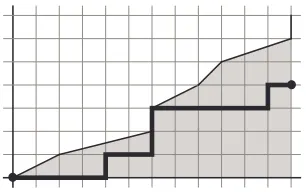
Any point or path lying weakly under∂a) is said to bedominatedby a. For instance, the
boundary ∂a corresponding toa = (1, 2, 3, 2) is shown in Figure 1, along with a path it
dominates.
Let D(a) be the number of paths from (0, 0) to (n,m) dominated by a. (For example, the numbers D(a) for various 3-part compositions of 6 are given above their respective
FIGURE1. A path dominated bya= (1, 2, 3, 2).
D(4,1,1) = 5 D(3,1,2) = 9
D(0,4,2) = 18 D(1,4,1) = 11
D(2,3,1) = 9
D(4,2,0) = 3 D(1,1,4) = 20
D(2,2,2) = 12 D(1,2,3) = 18
D(2,0,4) = 15
FIGURE 2. The number of paths dominated by cyclically shifted boundaries.
boundaries∂ain Figure 2.) When all parts ofaare the same, it is well-known [5, Exercise
5.3.5] thatD(a)is a generalized Catalan number. In particular, we have
D(a,a, . . . ,a
| {z } mcopies
) = ( 1
a+1)m+1
(
a+1)m+1
m
, (1)
where the case a = 1 corresponds with the classical Dyck paths counted by the usual Catalan numbers. However, for generala, no simple formula forD(a)is known. Indeed, it is unlikely that such a formula exists, though the Kreweras dominance theorem [5, Section 5.4.7] does give a determinantal expression. It is the purpose of this paper to show that simple enumerative formulae do hold provided we consider paths dominated byall cyclic shiftsof an arbitrary composition.
integerj, letahji denote thej-th shift ofa, namely
(2) ahji = (a−j,a−j+1, . . . ,a−j+m−1),
where the indices are to be interpreted modulo m. Then the rows of Figure 2 illustrate the boundaries∂a,∂ah1i, and∂ah2i for the compositionsa = (1, 2, 3),(1, 1, 4),(2, 0, 4) and
(2, 2, 2).
Notice that in each of the top three rows of the figure there are a total of 36 dominated paths from(0, 0)to(6, 3). There are this many also in the bottom row if the three identical cyclic shifts ofa= (2, 2, 2)are taken into account. That is,D(a) +D(ah1i) +D(ah2i) =36 for each of these 3-part compositions a of 6. This is a special case of a more general phenomenon, which we now explore.
Define alattice path boundary pair (LPBP)to be an ordered pair(P,(a,j)), whereP is a lattice path beginning at the origin, a is a weakm-part composition, and j is an integer with 0 ≤j <m. IfP is dominated byahjithen we say(P,(a,j))is agood pair, otherwise it is abad pair. LetA(a,t)be the set of all LPBPs of the form(P,(a,j)), whereP terminates at the pointt. LetB(a,t)andG(a,t)be the subsets ofA(a,t)consisting of bad and good pairs, respectively. Clearly,A(a,t) = B(a,t)∪G(a,t), with the union disjoint.
The following theorem is our main result. After its discovery, we found an essen-tially equivalent conjecture in earlier work of Tamm [9]. Though Tamm’s paper concerns paths under periodic boundaries (see Section 5 for further details), the conjecture itself is coarsely formulated in the language oftwo-dimensional arrays, with a proof only in the casem=2.
Theorem 1. Let a be a weak m-part composition of n and let t = (k,l), with 0 ≤ k ≤ n,
0≤l ≤m. If the point(k+1,l)lies weakly to the right of∂ahjifor all j, then
(3) |A(a,t)| =m
k+l l
,
(4) |B(a,t)| =n
k+l l−1
,
and
(5) |G(a,t)| =|A(a,t)| − |B(a,t)|= m(k+1)−nl k+1
k+l l
.
Clearly the hypotheses of Theorem 1 are satisfied by any terminus (k,l) that is domi-nated by all cyclic shifts ofa. In particular, setting(k,l) = (n,m) in the theorem explains our previous observation that there are 36 = (6+33−1)dominated paths for each row of Fig-ure 2.
Corollary 2. For any weak m-part compositionaof n, we have
D(a) +D(ah1i) +· · ·+D(ahm−1i) =
n+m m−1
.
Now consider the compositiona = (a,a, . . . ,a)ofn =ma. Observe thatahii =afor all
i, while ∂ais simply the line x = ay. Applying Theorem 1 and dividing bym to remove
the effect of boundary rotation yields the following well-known result, often referred to as thegeneralized ballot theorem. (See the survey article [7] for more information.)
Corollary 3. If k≥al, then there are
k−al+1
k+1
k+l l
lattice paths from(0, 0)to(k,l)that lie weakly below the line x =ay.
In the next section we give a bijective proof of Theorem 1. Of course, since (3) is trivial, this amounts to proving (4). We do so by showing that bad paths are in bijection with a less restrictive set of paths, in the spirit of Andr´e’s [1] reflection principle. In fact, our proof is a generalization of the bijection used in [6] to prove Corollary 3. (Our bijection reduces to that of [6] in the case when all parts of a are the same, though an allowance must be made for the cyclically shifting boundary.)
Section 3 contains a brief account of an alternative derivation of Theorem 1 using the Cycle Lemma. In Section 4 we present a refinement of the theorem that counts paths with a specified number of corners. Finally, Section 5 illustrates a handful of applications to the enumeration of lattice paths lying under periodic boundaries. Interestingly, each of these applications pivots on the fact that the hypotheses of Theorem 1 require only (k+1,l), and not the terminus(k,l), to be weakly right ofa.
2. A PROOF OFTHEOREM 1
Throughout this section we have in mind a fixed weak compositiona = (a0, . . . ,am−1)
ofnand its corresponding boundary∂a. For arbitraryj ∈Zwe interpret the symbolajto
meanajmodm.
For any lattice point p = (x,y)with 0 ≤ x < nand 1 ≤ y ≤ m, and for any integer j, define thej-th shift of p (relative toa)to be the point
σ2(p)
p
∂a
∂a2
FIGURE3. A point pand its shift ph2i.
p1
σ1(p 1)
σ2(p 1)
σ3(p 1)
p4
σ1(p4)
σ2(p 4)
σ3(p4)
FIGURE 4. The setsB1and B4relative to the compositiona= (1, 2, 3, 2).
where the modular reductions in the first and second coordinate are understood to yield representatives in{0, 1, . . . ,n−1}and{1, 2, . . . ,m}, respectively. Informally,phjiis in the same position relative to∂ahjias pis to∂a. (See Figure 3.)
Finally, we define the relations≤,., and<on lattice points as follows:
• (x1,y1)≤(x2,y2)⇔ x1 ≤x2andy1 ≤y2
• (x1,y1).(x2,y2) ⇔x1 ≤x2andy1<y2
• (x1,y1)<(x2,y2)⇔ x1 <x2andy1 <y2
For 0≤i < n, let pi = (i,yi), whereyi is the least integer such that the point(i,yi)lies
strictly above∂a. Define
(7) Bi :={pi,phi1i,phi2i, . . . ,phim−1i}.
to be the set of lattice points having the same relative positions to the boundary curves
∂a,∂ah1i, . . . ,∂ahm−1ias the pointpihas toa. (See Figure 4.) Note that the setsB0, . . . ,Bm−1
are not disjoint.
LetBi(a,t)be the set of all bad LPBPs of the form(P,(a,j)), where the pathP
termi-nates att and its firstbadstep (i.ethe first step crossing ∂aj) lands at the point phiji ∈ Bi.
Then clearlyB(a,t) =Sn−1
i=0 Bi(a,t), with the union being disjoint. We shall prove
b11 b2
1
b31
b01
b24 b34
b04 b14
FIGURE5. Construction of B1={b1j}andB4 ={b4j}relative toa= (1, 2, 3, 2).
Observe that no two points in any given setBican have the sameycoordinates. In fact,
letsi =m+1−yi, so thatp
hsii
i hasy-coordinate 1, and define
(8) bij = phsi+ji
i , for 0≤ j<m.
Then
(9) Bi ={bi0,b1i, . . . ,bmi −1},
where the y-coordinate of bij is j+1 and b0i . b1i . · · · . bmi −1. For example, for the sets B1 and B4 of Figure 4 we have s1 = 3 ands4 = 2, respectively, and the appropriate
relabellings are shown in Figure 5.
Let 0 ≤ k ≤ nand 0 ≤l ≤ m. We sayBi iscomplete with respect to the point t = (k,l) if
bli−1 is weakly to the left oft. For instance, the setB1in Figure 5 is complete with respect
tot = (3, 3), while B4 is not. The motivation behind this definition will be made clear in
the proof of the following lemma.
Lemma 4. If Biis complete with respect to t = (k,l)then
|Bi(a,t)| =
k+l l−1
.
Proof. We shall give a reflection-type correspondence betweenBi(a,t) and the setU of all lattice paths from(−1, 1)tot.
LetBij ⊆ Bi(a,t) consist of those LPBPs in which the first bad step lands at the point
bji. Since they-coordinate ofbijis j+1, clearlyBij =∅for j≥l. ThusBi(a,t) = Slj−=01Bij,
with the union disjoint.
SinceBiis complete with respect tot, we haveb0i . · · · .bl
−1
i ≤ t. That is, on each of
the linesy=1, . . . ,y =l there is a point inBithat is weakly to the left oft. It follows that
any path from(−1, 1)totmust intersect one of these points. For 0≤ j <l, letU jbe the set of paths from (−1, 1) tot that avoid the points b0i,b1i, . . . ,bij−1 but meet bij. Then, by our previous comment,U =Sl−1
j=0Uj, with the union disjoint.
We now define a mapping ψj : Bij −→ U j for each j = 0, . . . ,l−1. Given L ∈ Bij,
t
1
0
2
(-1,1)
C
P2 P1'
t
1
0
(-1,1)
D
P' 2
3 t
1
0
2
A
3 t1
0
B
2
P1
P2
P
FIGURE 6. An illustration of the mapψj : Bij −→ U j. Herea = (1, 2, 3, 2),
i = 4, j = 2, and si = 2. The boundary∂ahsi+ji = ∂ah4i = ∂ais shown in
panel A. Throughout, the pointbijis indicated with a circled j.
A. We havebji = (x,j+1)for somex, and L= (P,(a,si+j))for some path P whose
first bad step is an up-step from(x,j)tobji.
B. Remove this step to break P into two parts: the first, P1, is a path from (0, 0) to
(x,j), and the second,P2, is a path from(x,j+1)to(k,l).
C. RotateP1through 180◦and translate to obtain a new pathP10 beginning at(−1, 1) and terminating at(x−1,j+1).
D. JoinP10 andP2by adding a right-step from(x−1,j+1)tobij, thus creating a path
P0 from(−1, 1)to(k,l). Finally, setψj(L) =P0.
To ensureψjis well defined we must check that indeedP0 ∈ Uj. The only contentious
issue here is whetherP0avoids the pointsb0i, . . . ,bij−1. To see why this is the case, consider the piecewise linear curveCobtained by joining the pointsb−i 1,b0i, . . . ,bij, where
(10) b−i 1 := (−a−si+ (i+a−1+a−2+· · ·+a−si mod n), 0).
See Figure 7A for an illustration. Since (6) and (8) give
bri = (i+a−1+a−2+· · ·+a−(si+r) modn, r+1), for 0 ≤r≤ j,
the slope of the line segment frombri tobri+1is ∆∆xy = a−(si+r+1) for−1≤r≤ j. That is, the
j+1 segments ofChave slopesa−si,a−(si+1),a−(si+2), . . . ,a−(si+j), listed in order from left
to right. Sinceahsi+ji = (a
−(si+j),a−(si+j−1), . . . ,a−(si+j−m+1)), this identifiesCas the first
t
1
0
2
(-1,1)
A
P2 P1'
C
t
1
0
(-1,1)
B
C'
2
P2 P1'
FIGURE 7. Proving that the map ψ2 : B42 −→ U2 illustrated in Figure 6 is
well defined. The point bi−1 is indicated with an open circle. The shaded region in panel B fits perfectly into that of Figure 6A after a 180◦rotation.
ShiftC to the left one unit to obtain a new curveC0that terminates at(x−1,j+1). (See Figure 7B.) Since, by definition,P remains weakly below∂ahsi+ji, so too does the subpath P1. SinceP10 and C0 are obtained by rotating P1and ∂ahsi+ji, respectively, it follows that P10 must remain weakly aboveC0. But b0i, . . . ,bij−1 lie on C, so they lie strictly belowC0, and thereforeP10 avoids these points. The same is clearly true ofP0, and this establishes thatψjis well defined.
We claimψj : Bij −→ U j is a bijection. Observe that this establishes Lemma 4, since
the setsBi(a,t) = Slj−=01Bij andU =Sli−=01Uj are then equinumerous and the cardinality
ofU is clearly(lk−+1l).
To prove ψj is bijective, we construct the inverse map φj : Uj −→ Bij. (See Figure 8
for an illustration.) Suppose P0 ∈ U j. The first point P0 intersects amongst b0
i, . . . ,b j i
is bij and it is clear that the step landing at bij is horizontal. Remove this step to split P0
into two paths: Call the left part P10 and the right part P2. Let C0 be the piecewise lin-ear curve obtained by joining the points b−i 1,b0i, . . . ,bij (where b−i 1 is given by (10)) and shifting the result one unit to the left. Then, as above, the segments of C0 have slopes
a−(si+j),a−(si+j−1), . . . ,a−(si+1),a−si, so thatC
0 is simply the firstj+1 segments of
∂ahsi+ji
rotated 180◦ and translated. Since P10 lies weakly aboveC0, the curve P1 obtained by ro-tatingP10by 180◦and translating its origin to(0, 0)must lie weakly under∂ahsi+ji. Attach P1 toP20 by a vertical step to form a new pathP. Then L = (P,(a,si+j))is a bad LPBP
in whichP terminates attand has its first bad step landing at bij. Setφj(P0) = L, so that
clearlyφj◦ψj(L) = Landψj◦φj(P0) = P0, as required.
Theorem 1 now follows immediately from Lemma 4 and the following result:
t
0
(-1,1)
B
2
1
P2 P1'
t
0
(-1,1)
A
P'
2
1
t
0
C
2
1
P2
P1
t
0
D
1
P
2
C'
FIGURE8. Construction ofφj : Uj −→ Bij, witha= (1, 2, 3, 2),i=4, j=2,
andsi = 2. The pointbij is indicated with a circledj, andb−i 1 with an open
circle. The boundary curve in panel D is∂ahsi+ji =∂ah4i.
Proof. The setBi is not complete with respect totif and only if it contains some point of
the form(k+δ,l)with δ ≥1. But Bi consists of those points that lie immediately above
∂ahji for somej. Thus(k+δ,l) ∈ Bifor someδ≥1 precisely when(k+1,l)is strictly left
of some boundary∂ahji. The result follows.
3. A CYCLELEMMAPROOF OFTHEOREM 1
We now sketch an alternative proof of Theorem 1 using the cycle lemma [4]. The for-mulation most applicable here is the following:
Cycle Lemma. Let i = (i0, . . . ,im) be a sequence with integral entries ij ≤ 1 having positive
sum k=i0+· · ·+im. Then there are exactly k cyclic shifts ofiwith all partial sums positive.
The following result is the key to our alternative proof of Theorem 1.
Lemma 6. Leta be a weak m-part composition of n, and let t = (n,l), where0 ≤ l < m. Let G∗(a,t) be the set of good LPBPs of the form (P,(a,j)) whereP is a path from (0, 0) to t that
terminates with a right step. Then
|G∗(a,t)|=
n+l−1
l
(m−l).
Proof: Let W be the set of words of lengthn+lon the alphabet {R,U}that containlU’s and n R’s and end with anR. We give a bijectionΩ : W ×[m−l] −→ G∗(a,t), where
Let(w,k) ∈ W ×[m−l]. Factorwintomblocks w = w0· · ·wm−1 as follows: Suppose
a = (a0, . . . ,am−1), and parsewfrom left to right lettingw0, . . . ,wm−1in turn be maximal
contiguous substrings such that
• wiis empty ifai =0,
• wicontainsai R’s and ends with anRifai >0.
Observe that this decomposition ofwis unique.
Consider the integer sequenceu= (1,−u0, 1,−u1, . . . , 1,−um−1), whereuiis the
num-ber ofU’s inwi. The entries of usum tom−(u0+. . .+um−1) = m−l > 0, so the cycle
lemma implies there are exactlym−lcyclic shifts ofuwhose partial sums are all positive. Clearly such shifts must be of the formuh−2si, where 0≤s<m. (See (2) for the definition ofuh−2si.) Suppose the good shifts are uh−2s1i, . . . ,uh−2sm−li, where s
1 < · · · < sm−l. Set
j=skand form the wordw0 =wjwj+1· · ·wj+m−1, where the indices are to be interpreted
modulom. Fromw0, construct a lattice pathP originating at(0, 0)by treatingRandUas right and up steps, respectively.
Set Ω(w,k) := (P,(a,−j)). Observe that indeed Ω(w,k) ∈ G∗(a,t), since P clearly terminates at(n,l)with a right step and
uh−2ji has all partial sums positive
⇐⇒ uj+· · ·+uj+d <d+1, for 0≤d <m
⇐⇒ P has at leastaj+· · ·+aj+dright steps before its(d+1)-st up step, for 0≤d <m
⇐⇒ P is dominated byah−ji = (aj,aj+1, . . . ,aj+m−1).
Moreover, this construction of (P,(a,−j)) from (w,k) can be reversed, as follows: (1) recoverw0 fromP, (2) parse w0 as above, but relative to the compositionah−ji, to obtain
wj,wj+1, . . . ,wj+d and hence w, (3) retrieve u from w0, . . . ,wm−1, and (4) deduce k by
applying the cycle lemma tou.
Thus Ω : W ×[m−l] −→ G∗(a,t) is bijective, and since |W| = (n+ll−1), the result
follows.
Example 7. Let n=12, m=7, l =4,a = (1, 3, 0, 2, 4, 0, 2)and take
(w,k) = (RRRURRRRRURRUURR, 3).
Then we have
FIGURE9. The path constructed in Example 7.
where e denotes the empty string. This gives u = (1, 0, 1,−1, 1, 0, 1, 0, 1,−1, 1, 0, 1,−2), and the m−l =3cyclic shifts ofuwith all partial sums positive are seen to be
uh0i = (1, 0, 1,−1, 1, 0, 1, 0, 1,−1, 1, 0, 1,−2)
uh−4i = (1, 0, 1, 0, 1,−1, 1, 0, 1,−2, 1, 0, 1,−1)
uh−6i = (1, 0, 1,−1, 1, 0, 1,−2, 1, 0, 1,−2, 1, 0).
Thus s1=0, s2=2, s3 =3, so that j=s3 =3and
w0 =w3w4w5w6w0w1w2 =RRRRURRUURRRRRUR.
Figure 9 shows the path P corresponding to w0 and the dominating boundary ∂ah−ji = ∂ah−3i.
It is now easy to establish Theorem 1 in the special case where the terminal point ist=
(n,l)for some 0≤l ≤m. In particular, we clearly have|G(a,(n,l))| =∑li=0|G∗(a,(n,i))|, so Lemma 6 gives
|G(a,(n,l))| = l
∑
i=0
(m−i)
n+i−1
i
=m
n+l l
−n
n+l l−1
, (11)
in agreement with (5). Moreover, we have the usual lattice path recursion
|G(a,(k+1,l))| =|G(a,(k,l))|+|G(a,(k+1,l−1))|
provided (k+1,l) is weakly right of every shift of∂a. Using (11) as an initial condition
and iterating the above recursion allows us to determine |G(a,(k,l))| for any terminal point (k,l) satisfying this same condition. Thus we have an inductive proof of (5). The details are more tedious than illuminating and are omitted here.
4. A REFINEMENT: COUNTINGPATHS WITH ASPECIFIEDNUMBER OFCORNERS
An up-right corner in a lattice path is a point at which an up step terminates and is immediately followed immediately by a right step. Observe that for anycpoints(Xj,Yj)
satisfying
[image:13.612.230.383.65.162.2]there is a unique lattice path from(0, 0) to(k,l) having up-right corners at exactly these points. Since the theXj’s andYj’s can be chosen in(kc)and(
l
c)ways, respectively, it follows
that there are(kc)(lc)lattice paths from(0, 0)to(k,l)with exactlycup-right corners. LetCc be the set of all LPBPs whose paths have exactlycup-right corners. The follow-ing theorem is a generalization of [7, Theorem 3.4.2], and our proof is inspired by that of [6, Theorem 5].
Theorem 8. Let abe any weak m-part composition of n and let t = (k,l) be a point dominated by all cyclic shifts ofa. Then
|G(a,t)∩Cc| =m
k c
l c
−n
k−1
c−1
l+1
c+1
.
Clearly this is a refinement of Theorem 1, and unsurprisingly our proof relies on a corresponding refinement of Lemma 4. Note that the hypothesis regarding the terminal pointt = (k,l)is slightly stronger than that of Theorem 1. That is, we require(k,l), rather than(k+1,l), to be dominated by allahji.
Indeed, our refinement of Lemma 4 requires a slightly stronger notion than complete-ness. With the sets Bi defined as in (7), we say Bi is strongly complete with respect to
t = (k,l)if the pointbil−1isstrictlyto the left oft.
Theorem 8 follows immediately from the following two results. We assume the nota-tion of Secnota-tion 2 throughout.
Lemma 9. Suppose0 ≤ k ≤ n, 0 ≤ l ≤ m, and the point(k,l) is dominated byahji for all j. Then each of the sets B0, . . . ,Bn−1is strongly complete with respect to t = (k,l).
Proof. This is an obvious modification of Lemma 5.
Lemma 10. If Bistrongly complete with respect to t= (k,l), then
|Bi(a,t)∩Cc|=
k−1
c−1
l+1
c+1
.
Proof. We prove the lemma by giving a bijection between Bi(a,t)∩Cc and pairs of
sequences(X,Y) ∈Zc×Zc+1satisfying
0≤X1 <· · · <Xc =k−1 and 1≤Y1<. . . <Yc+1 ≤l+1.
Fix such a pair(X,Y). SinceBi is strongly complete with respect to(k,l), we have
x(bci−1) ≤k−1=Xc,
j ≥r−1, so the minimality ofrimplies eitherr =1 or Xr−1 < x(bir−2) ≤ x(bij). Thus we
have a chain of points
(X1,Y1) <· · · <(Xr−1,Yr−1) <bij ≤(x(bij),Yr+1−1)<
(Xr+1,Yr+2−1) <· · · <(Xc−1+1,Yc+1−1).
It is easy to verify that there is a unique pathP from (−1, 1)to(k,l)passing through all these points such that:
• P has r−1 right-up corners at (X1,Y1). . .(Xr−1,Yr−1), and no further right-up
corners strictly left ofbij,
• the steps ofP terminating atbijand originating at(x(bji),Yr+1−1)are horizontal, • P hasc−rup-right corners at(Xr+1,Yr+2−1), . . . ,(Xc−1+1,Yc+1−1), and no
further up-right corners strictly right ofbij.
By construction, P avoids b0i, . . . ,bij−1 but meets bij. So we can apply the bijection φj
(see the proof of Lemma 4) to get an LPBP φj(P) = (P0,(a,si+j)) ∈ Bi(a,t). Observe
that ther−1 right-up corners ofP to the left ofbijbecome up-right corners ofP0through rotation, while thec−rup-right corners of P to the right ofbijare preserved inP0.
We now check for corners atbjiand(x(bij),Yr+1−1). There are two cases to consider. If
Yr+1−1>Yr, thenP0does not have an up-right corner atbjibut does at(x(bij),Yr+1−1).
Otherwise Yr+1−1 = Yr, in which case bij = (x(bij),Yr+1−1) and P0 has an up-right
corner at this point.
In either case,P0 has exactly(r−1) + (c−r) +1=cup-right corners in total. That is,
φj(P) ∈ Bi(a,t)∩Cc. Sinceφj is bijective, so too is the correspondence (X,Y) 7→ φj(P)
described here. This completes the proof.
In analogy with up-right corners, we say aright-up corner is formed when a right step is followed immediately by an up step. It is convenient to treat an initial up step as a
virtualright-up corner. Then, lettingCcbe the set of all LPBPs whose paths have exactlyc
right-up corners (real or virtual), we have:
Theorem 11. Letabe any weak m-part composition of n and let t = (k,l)be a point dominated by all cyclic shifts ofa. Then
|G(a,t)∩Cc|=m
k+1
c
l−1
c−1
−n
k c−1
l c
.
FIGURE10. The boundary∂1,3and a path it dominates.
of good paths withc−1 up-right corners. Indeed, Theorems 8 and 11 show this common number to be(c−n1)(mc).
5. COUNTINGPATHS DOMINATED BYPERIODICBOUNDARIES
Leta = (a0, . . . ,am−1)be a weak composition ofn, and letdbe the least positive integer
such that ahdi = a. Clearlyd dividesm. In the case that d < m we say aisperiodic with
period d. For example(3, 1, 2, 3, 1, 2)has period 3. Ifahas perioddthenahii =ahi moddi. Thus
(12) |G(a,t)| = m
d D(a,t) +D(a
h1i
,t) +· · ·+D(ahd−1i,t),
where D(a,t) denotes the number of paths from (0, 0) to point t dominated by a. The left-hand side of this equality can generally be evaluated by Theorem 1, and in certain special cases this allows us to deduceD(a,t).
The cased = 1 is particularly straightforward. Here we havea = (a)m = (a,a, . . . ,a), and (12) givesD(a,t) = m1|G(a,t)|. This is precisely our earlier proof of Corollary 3.
The case d = 2 involves compositions of the form a = (a,b,a,b, . . . ,a,b) = (a,b)m, where a,b are distinct nonnegative integers. In the following discussion it will be conve-nient to write ∂a,b for the “infinite” boundary curve ∂(a,b,a,b, . . .). See Figure 10 for an
illustration of∂1,3and one path that it dominates.
Theorem 12, below, gives explicit formulae for the number of paths under∂a,b or∂b,ato
certain special endpoints. This result is also implicit in Tamm [9, Propositions 2,3], where it appears in generating series form. The proof given there follows a probabilistic argu-ment (originally due to Gessel) reliant on Lagrange inversion, whereas our derivation is purely combinatorial.
Theorem 12. Fix integers a,b with0≤a<b and set c =a+b. For n≥0let
p1
p0
p2
q0
q1
q2 p3
q3
r
FIGURE11. The pointspi,qiin the casea=2,b =5 and a pathP ∈ P32,5.
LetPna,b andQna,b, respectively, be the sets of lattice paths from the origin to pn and qn that lie
weakly under∂a,b. Define setsPnb,a andQbn,asimilarly, but for paths weakly under∂b,a. Then
|Qna,b|= Mn, |Qbn,a|=0,
(13)
|Pna,b|= Nn+1
2
n−1
∑
i=0
MiMn−1−i, |Pnb,a|= Nn−1
2
n−1
∑
i=0
MiMn−1−i.
(14)
where
Mn = b −a cn+b
(
c+2)n+b
2n+1
and Nn = b
−a cn+b−a
(
c+2)n+b−a−1 2n
.
Proof. A glance at Figure 11 will make the proof more clear. It illustrates several points
pi,qiin the casea =2,b =5, along with the boundaries∂2,5,∂5,2and a path P ∈P32,5.
Let a = (a,b)n+1 and b = (b,a)n+1, so a path lies under∂a,b (respectively,∂b,a) if and
only if it is dominated bya(respectively,b).
Clearly |Qbn,a| = 0 since qn is not dominated by ∂b,a. Moreover, since ah2ji = a and
ah2j+1i =bfor allj, we have
|G(a,qn)| = (n+1) |Qan,b|+|Qnb,a| = (
n+1)|Qan,b|.
The pointr := (cn+b, 2n+1) one unit right ofqn is dominated by botha andb.
Theo-rem 1 may therefore be applied, and it gives|G(a,qn)|= (n+1)Mn. This establishes (13).
A similar analysis yields
|Pna,b|+|Pnb,a|= 1
n+1|G(a,pn)| =2Nn. (15)
Observe thatPnb,a ⊂ Pna,b. In fact, a path is dominated byb if and only if it is
domi-nated byaand misses each of the pointsq0, . . . ,qn. Now consider a pathP ∈ Pna,b\Pnb,a,
and letibe the largest index so thatP meetsqi. ThenP exitsqiwith a right-step tor, and
p 1 p0 p2 q0 q 1 q2 p 1 p0 p2 q0 q 1 q2
FIGURE 12. The boundaries ∂0,3 and ∂3,0 and corresponding staircases
U(R3U2)2R3and(R3U2)3.
by∂a,b. (See Figure 11.) But pn−r=qn−i−1, so we effectively haveP00 ∈Qna,−b1−i. Hence
|Pna,b| =|Pnb,a|+|Pna,b\Pnb,a| =|Pnb,a|+ n−1
∑
i=0
|Qai,b||Qna,−bi−1|.
Formulae (14) now follow from (13) and (15).
When a= c−21,b = c+12 for an odd positive integerc, observe that a path is dominated by∂b,aif and only if it lies weakly under the linecx =2y. So Theorem 12 can be applied to
give the following enumeration of paths under a line of half-integer slope. An equivalent result also appears as [9, Theorem 1].
Corollary 13. Let c be an odd positive integer. The number of lattice paths from(0, 0)to(cn, 2n) that lie weakly below the line cx=2y is given by
1
cn+1
(
c+2)n
2n
−1
2
n−1
∑
i=0
MiMn−1−i, where Mi = 1
2i+1
(
c+2)i+ c+12
2i
.
Another special case of Theorem 12 worth mentioning is that when a = 0, where we count paths from(0, 0)topn = (b(n+1)−1, 2n)orqn = (b(n+1)−1, 2n+1)dominated
by∂b,0 or∂0,b. Observe that a path to either point is bounded by ∂0,b if and only if it lies
weakly under the “staircase”U(RbU2)nRb. (See Figure 12.) Similarly, the paths dominated by∂b,0are precisely those that lie weakly under(RbU2)n. Forn≥1, such paths begin with
bright steps, and removing these putsPnb,0in correspondence with the set of paths from (0, 0)to(bn−1, 2n)that lie weakly beneath(U2Rb)n.
Corollary 14. Let Cn = n+11 (2nn)be the n-th Catalan number. There are • 2C2n+1paths from(0, 0)to(2n+1, 2n+1), and
• 22n+1Cn−C2n+1paths from(0, 0)to(2n, 2n)or(2n, 2n±1)
that lie weakly under U(R2U2)nR. Moreover, there are 22n+1Cn −C2n+1 paths from (0, 0) to (2n−1, 2n)lying weakly under(U2R2)n.
Proof. The desired result rests upon the convolution identity
(16)
n−1
∑
i=0
C2i+1C2n−(2i+1) =C2n+1−22nCn.
This is easily seen to be equivalent to the functional equation
(17) D(x)2= 1
xD(x)−C(4x
2),
where C(x) = ∑nCnxn is the Catalan generating series and D(x) = 12(C(x)−C(−x))is
its odd part. To establish (17), expandD(x)2 = 14(C(x)−C(−x))2and substitute
C(x)2+C(−x)2 = 2xD(x)
C(x)C(−x) = 2C(4x2)−1xD(x),
which themselves are readily derived from the well-known identitiesC(x) = 1+xC(x)2
andC(x) = 21x(1−√1−4x), respectively.
Apply Theorem 12 with a = 0,b = 2, noting that Mn = 2C2n+1, Nn = C2n+1 and
using (16) to simplify the results. This gives |Q0,nb| = 2C2n+1 paths to (2n+1, 2n+1)
and |Pn0,b| = 3C2n+1−22n+1Cn paths to (2n+1, 2n) under U(R2U2)nR. Since paths to (2n+1, 2n+1) pass through either (2n+1, 2n) or (2n, 2n), there are |Qn0,b| − |Pn0,b| =
22n+1−C2n+1 paths to(2n, 2n) underU(R2U2)nR. Clearly there are this same number of
paths to(2n, 2n±1).
Finally, paths to(2n−1, 2n)under(U2R2)n are in bijection withPnb,0, and Theorem 12
yields|Pnb,0| = 22n+1Cn−C2n+1. Alternatively, we could rotate and flip to view these as
paths from(0, 0)to(2n, 2n−1)dominated byU(R2U2)nR.
Letabe a composition of periodd, and consider a terminust= (k,l)such that the point
(k+1,l)is dominated by all cyclic shifts ofa, but no shift exceptaitself dominatest. Then we clearly haveD(ahii,t) =0 fori ≥1, so applying Theorem 1 in tandem with (12) gives a closed form expression for D(a,t). Indeed, the key to our proof of Theorem 12 was to determine|Qna,b|in exactly this way.
Theorem 15. Let s,t and n be positive integers. Then there are
1
n
(
s+t)n−2
tn−1
lattice paths from(0, 0)to(sn−1,tn−1)lying weakly beneathUt−1(RsUt)n−1Rs−1.
Proof. Let a = (0t−1,s)n, so that a is a tn-part composition of sn with period t. Note that a path from(0, 0)to(sn−1,tn−1)lies weakly beneathUt−1(RsUt)n−1Rs−1precisely when it is dominated bya. Furthermore, none ofah1i, . . . ,aht−1idominate(sn−1,tn−1), whereas all of them dominate(sn,tn−1). The result follows immediately from (12) after applying Theorem 1 with terminus(k,l) = (sn−1,tn−1).
Setting s = t = k in Theorem 15 yields the following elegant Catalan result, first ap-pearing as [2, Theorem 8.3] with a proof based on the Cycle Lemma. Our need for the terminal point to be dominated by exactly one cyclic shift of the boundary sheds light on the observation of those authors that the ostensibly similar problem of counting paths to
(nk,nk)dominated by(UkRk)n is in fact much more complicated.1
Corollary 16. Let n and k be positive integers. Then there are kCnk−1lattice paths from(0, 0)to
(nk−1,nk−1)lying weakly beneathUk−1(RkUk)n−1Rk−1.
We conclude with some comments on recent work by Chapmanet al.[3]. They consider lattice paths that remain strictly below the staircase boundarySs,tbeginning at(0,t),
mov-ing to the rightssteps, then uptsteps, to the rightssteps,etc.That is,Ss,t is described by (RsUt)n, but is shiftedtunits upward to originate at(0,t). Their main results concern the enumeration of two types of paths avoidingSs,t, namely those from(0, 0) to(sn+1,tn),
and those from (1, 0) to (sn,tn−1). They employ a Cycle Lemma argument similar in structure to our proof of Lemma 6 to obtain compact expressions counting both types of paths, even allowing for the refined enumeration of paths with a specified number of corners. These same results can be obtained from our methods, as follows.
First observe that a path from(1, 0) to(sn,tn−1)avoidingSs,t can be shifted left one
unit to give a path from (0, 0)to(sn−1,tn−1)lying weakly belowUt−1(RsUt)n−1Rs−1. Such paths are counted by Theorem 15, above, in agreement with [3, Corollary 4].
Now consider a pathP from(0, 0)to(sn+1,tn)lying strictly belowSs,t. ClearlyP =
UjR· P0for some 0≤ j≤t−1 and some pathP0from(0,j)to(sn,tn). Leta= (0t−1,s)n. ShiftP0to the origin and append jup steps to create the pathP00 =P0·Uj from(0, 0)to
(sn,tn). (See Figure 13.) It is easy to check thatP00 is dominated byah−ji, and that every
1Noy and de Mier [8] have recently introduced a very elegant approach to the enumeration of lattice
A B
FIGURE13. (A) The staircaseS4,3(dotted line), a pathPthat avoids it (solid
line), and the area dominated by the associated composition a = (02, 4)3 (shaded). (B) The pathP0is dominated byah−2i = (4, 02)3.
such path can be obtained in this way. Thus there are∑tj=0−1D(ah−ji)paths to(sn+1,tn)
that avoidSs,t. From (12) and Theorem 1, the sum evaluates to
1
n|G(a,(sn,tn))| =
1
n
(
s+t)n tn−1
,
again in accord with [3, Corollary 4].
In fact, [3, Theorem 3] gives formulae for the number of paths avoiding Ss,t with a
specified number of corners. For instance, performing the analysis above, but replacing Theorem 1 with the more refined Theorem 8, shows that the number of paths from(0, 0) to(sn+1,tn)that avoidSs,t and havecup-right corners is
t
sn c−1
tn c−1
−s
sn−1
c−2
tn+1
c
.
Note that we have used c−1 instead of c in Theorem 8, since the mapping P 7→ P00
described above reduces the number of up-right corners by 1.
ACKNOWLEDGEMENTS
JI would like to thank Hugh Thomas for some helpful discussions, and in particular for suggesting a proof of Corollary 2 upon which the argument for Lemma 6 is based. AR is supported by aNatural Sciences and Engineering Research Council of CanadaPostdoctoral Fellowship.
REFERENCES
[1] D. Andr´e. Solution directe du probleme resolu par M. Bertrand.C. R. Math. Acad. Sci. Paris, 1887. [2] J. Bonin, A. de Mier and M. Noy. Lattice path matroids: Enumerative aspects and Tutte
polyno-mials.J. Combin. Theory Ser. A, 104:63–94, 2003.
[3] R. J. Chapman, T. Chow, A. Khetan, D. P. Moulton and R. J. Waters. Simple formulas for lattice paths avoiding certain periodic staircase boundaries.preprint.
[5] I. P. Goulden and D. M. Jackson.Combinatorial Enumeration. John Wiley and Sons, Dover Reprint, 2004.
[6] I.P. Goulden and L. Serrano. Maintaining the spirit of the reflection principle when the boundary has arbitrary integer slope.J. Combin. Theory Ser. A, 104:317–326, 2003.
[7] C. Krattenthaler. The enumeration of lattice paths with respect to their number of turns. In N. Bal-akrishnan, editor, Advances In Combinatorial Methods and Applications, pages 29–58. Birkh¨auser, Boston, 1997.
[8] M. Noy and A. de Mier. A solution to the tennis ball problem.preprint.
[9] U. Tamm. Lattice paths not touching a given boundary.J. Statistical Planning and Inference, 105:433– 448, 2002.
DEPARTMENT OFMATHEMATICS ANDCOMPUTINGSCIENCE, ST. MARY’SUNIVERSITY, HALIFAX, NS, B3H 3C3, CANADA
E-mail address:[email protected]
DEPARTMENT OFMATHEMATICS, ROOM2-376, MASSACHUSETTSINSTITUTE OFTECHNOLOGY, CAM
-BRIDGE, MA, 02139-4307, USA