LIBYAN VEHICLE PLATE RECOGNITION USING
REGION-BASED FEATURES AND PROBABILISTIC NEURAL
NETWORK
1KHADIJA AHMAD JABAR,2MOHAMMAD FAIDZUL NASRUDIN 1School Of Computer Science, Universiti Kebangsaan Malaysia, Bangi, Malaysia; 2Center For Artificial Intelligence Technology, Universiti Kebangsaan Malaysia, Bangi, Malaysia.
E:1mail [email protected],2[email protected]
ABSTRACT
Automatic License Plate Recognition (ALPR) has wide range of commercial applications such as finding stolen cars, controlling access to car parks and gathering traffic flow statistics. Existing Libyan License Plate Recognition (LLPR) methods are not presented promising results due to their inefficient features for the extracted characters and numbers. In this work, an improved LLPR method is presented. The method is composed of five stages: pre-processing, license plate extraction, character and numbers segmentation, feature extraction and license plate recognition. In the pre-processing, undesired data, such as background noises are removed. Then, the license plate is extracted using few mathematical morphologies, Connected Component Analysis (CCA) and Region of Interest (ROI) extraction. After that, characters and numbers from the image regions of the license plate are extracted. A combination of geometrical features and Gabor features are considered to represent each of the character and word in the plates. Then, the recognition is done by using a template matching and a Probabilistic Neural Network (PNN) classification. The performance of the proposed method is evaluated and tested using 100 self-collected images of Libyan national license plates. The experimental results have shown that the proposed method has produced promising results and superior than other existing methods.
Keywords: Automatic license plate recognition, Image processing, Feature extraction, Probabilistic Neural network.
1. INTRODUCTION
Automatic vehicle identification is an image processing technique of identifying vehicles by their license plates. The aim of using automatic vehicle identification systems is to effective traffic control and security applications such as access control to Prohibited areas and tracking of wanted vehicles.
Each country has its own license plate (LP) numbering system with consideration of characteristics such as: colors, language of characters and style (font) and sizes including difference from state to state in terms of types of LPs. Beside that, there are countries, which do not yet have an automatic license plate recognition (ALPR) system. Apart from that, the environmental and physical conditions of the LP are also affected the in overall processes. Because of these reasons, research on the LP detection and recognition process is still taking place. The Libyan LPs make
use of Arabic words with numbers written in English compared to LP of Egypt, Saudi Arabia or other Arab countries where numbers are also written in Arabic (in Libyan) as shown in figure 1.
[image:1.612.319.519.531.655.2](a) (b)
Figure 1:Libyan License Plates.
first stage, the image of a car is obtained using a camera. In this stage, it is important use the correct camera particularly with respect to its parameters, type, resolution, shutter speed and orientation. In the second stage, the license plate is extracted from the image. Important features to be sought in this stage include boundary, color and characters’ existence. The third stage entails the segmentation of the license plate. The characters are then extracted by projecting their color information, labeling them, or matching their positions with templates. The fourth stage entails recognition of the extracted characters. Here, classifiers or template matching are employed, for instance, fuzzy classifiers and neural networks.
In this paper, automatic license plate recognition is studied for Libyan license plates. This paper is structured as follows: related works are discussed in section 2. Section 3 presents the proposed framework for this study. The experimental results and performance evaluation are discussed in section 4. Finally, section 5 concludes the paper.
2. RELATED WORKS
In this section, previous studies of license plate recognition methods are reviewed. This review involves ALPR for Arabic and non-Arabic countries.
A live and robust method for license plates’ localization and identification was proposed by [2]. These methods finds the optimal adaptive threshold after the image’s intensity values is modified to locate the vehicle’s edges. An algorithm is then applied. This algorithm employs the morphological operators in constructing the regions of the candidate. Each region’s characteristics then undergoes extraction process to allow the differentiation between the license plate region and other candidate probable regions. This differentiation is determined by the percentage analysis of the plate’s rectangularity. A colour filter was employed to strengthen the algorithm for the license plate localization (LPL). The proposed algorithm is also useful in handling distorted images because it can effectively provide identification and modification to the plate rotation.
[3] introduced the template matching approach in recognizing character image. The author used the method on the Egyptian and Saudi Arabian systems, and in fact, this method can be
extended to other countries as well. Using this method, a table which consists of names of the countries with matching Arabic characters is constructed. The items on the table become the inputs which would then be matched with the license plate. A total of 400 license plate images taken in outdoor setting were used for this method. This method attained 90% recognition accuracy and the time used by this method to recognise vehicle plate was 1.6 seconds.
A license plate recognition system was introduced by [4]. This system is particularly for Saudi Arabia LPs with two templates which are utilised for recognizing Arabic and Indian numbers with limited Arabic and Latin alphabets. Pre-processing is the first step which involves conversion of the original image to grey scale, removal of noise, detection and thresholding of edge, and localization of the LP. Then, characters segmentation is performed. Number and distribution of black pixels from the horizontal projection records in allocated regions of the character image are used in feature extraction. Recognition process is based on regions and this limits comparisons.
Abulghasem proposed an integrated method based on Radial Basis Function Neural Network for detecting and recognizing Libyan license plates [5]. The proposed method includes license plate detection, license plate extraction, character and numbers segmentation, feature extraction and recognition. In the detection stage, connected component analysis is used to locate unique objects, from which the unwanted objects are removed using the filtering process. Geometric and Global features are used to prepare the identified objects before their classification as Plate and non-Plate using RBFNN. In the recognition process, for character segmentation, a simple template is derived to extract and differentiate digits and Arabic words. Statistical and structural features are used in feature extraction, while the classification is performed using RBFNN. As their experimental results shown, the proposed method achieved 93% and 91% for accuracy rates for detection and recognition respectively.
countries were used to test this method. As indicated by the outcomes, their proposed methods were able to segment and extracted the characters and words from the plates accurately, however, the method is sensitive to noises.
[7] proposed an Iranian vehicle license plate recognition system. This system was modified to enable it to reflect the local context together with a hybrid classifier that could recognize the characters in the license plate. The method adopts the technique of modified template-matching by analysing the target color pixels in detecting the vehicle's license plate’s location. Additionally, using a modified strip search, the authors could localize the standard color-geometric template employed in Iran and in several other countries in Europe.
[8] proposed an algorithm for automatic license plate recognition. However, the algorithm proposed focuses on the Lebanese license plates whose certain features well manipulated to decrease errors in recognition. As shown their simulation, there was a reduction in recognition errors when the Lebanese license plates are written in two formats, Arabic and Hindi. In order to improve the performance, the proposed algorithm also includes an option to benefit from the presence of the license plates in both the front and back of the car. Nonetheless, the proposed method was not applied in real setting and therefore, there were no real results for the license plate recognition.
3. PROPOSED FRAMEWORK
This section presents the proposed framework for Libyan license plate recognition in this study. The proposed framework is consisted of four stages as: Pre-processing, License plate localization, Character and number (C&N) segmentation, and License plate recognition as shown in figure 2.
Image Capturing and Pre-processing
Character and Number (C&N) Segmentation
Feature Extraction
[image:3.612.329.520.75.274.2]License Plate Recognition Licensee Plate Extraction
Figure 2: The Proposed Framework.
3.1 Pre-processing
The pre-processing aims to get the input image and improve the quality of the image for further image processing. The pre-processing is consisted of image color mode conversion and image binarization.
3.1.1 Image color mode identification
The input image is necessary in colour mode identification. For the images, the colour mode can be RGB or gray scale. However, the image’s original input is normally of RGB mode; RGB mode is colour mode. Identification of colour mode can be done using colour channel extraction. As an example, three channels means RGB image.
3.1.2 Image binarization
Binary images comprise images with pixels with two possible values of intensity. These pixels are usually displayed as black and white, where black is usually represented by “0” and white by either “1” or “255.” The production of binary images is usually by thresholding a colour or grayscale image. Thresholding separates an object in the image from the background. Object’s colour, which is normally white, is called the foreground colour; while the rest, which is normally black, is called the background colour.
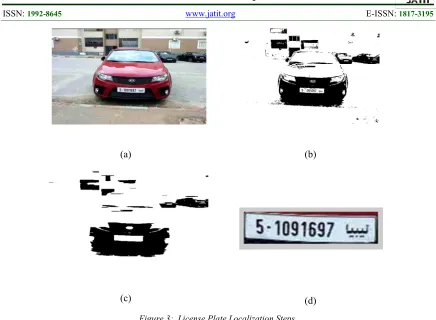
3.2 License Plate Localization
Component Analysis (CCA) and region of interest plate extraction.
3.2.1 Morphological operation
In the context of mathematical morphology, the structuring element can be equivalent to the convolution kernel in linear filter theory. The morphological operation are basically involved dilation, erosion, closing and opening operators. Mathematical operations are basically required two elements to do the operations. The mathematical operations are as, dilation, erosion, opening and closing. Thus, with two sets, A and B, Minkowski addition expressed is as below:
⊕B =⋃ ∈ ( + ) (1)
Meanwhile, Minkowski subtraction is expressed as below:
⊝B =∩ ∈ ( − ) (2)
Based on these two Minkowski operations, the basic operations of mathematical morphology of dilation and erosion are demonstrated as below:
Dilation,
( , ) = ⊕B =
⋃ ∈ ( + )
(3)
Erosion,
( , ) = ⊝B =
∩ ∈ ( − )
(4)
where −B = (−β|β∈ B). The closing and opening can be defined using the combination of dilation and erosion. In MATLAB, the implementation of Morphology operation is made possible with the structuring elements of strel and bwmorph functions.
3.2.2 Connected components analysis
Connected components labelling is used to scan an image. Then, the image’s pixels are grouped into components in accordance to the connectivity of pixel. In other words, each pixel in a connected component share identical values of pixel intensity and each pixel is inter-connected in some way. Using connected component labelling, an image is scanned pixel-by-pixel for the identification of connected pixel regions. Connected pixel regions entail adjacent pixels regions that possess identical intensity values set.
3.2.3 Region of interest extraction
(a) (b)
[image:5.612.88.524.68.388.2](c) (d)
Figure 3: License Plate Localization Steps. 3.3 Character and Numbers Segmentation
In character segmentation procedure, the characters and numbers from the image of license plate are extracted. There are a variety of aspects that make up the complex character segmentation task. These include frame and orientation of plat, variance of light, image noise and space mark. Thus, in order to overcome these difficulties in character segmentation, a number of procedures have been proposed. The segmented region was analysis for different region properties.
3.3.1 Thresholding
Threshing is performed using a thresholding function. This function comprises im2bw which has grey-scale and a threshold value. Grey-scaling converts the image of the region to grey colour. As for the thresholding value for this implementation, it is set to 0.4.
3.3.2 Labelling analysis
Component Connected Analysis (CCA) is employed in the segmentation of characters and number. Following the thresholding process, extraction of characters and numbers (from the
plate) is performed using labelling analysis and geometrical features such as area.
3.3.3 Spatial normalization
Figure 4:Characters And Word Segmentation.
3.4 Feature Extraction
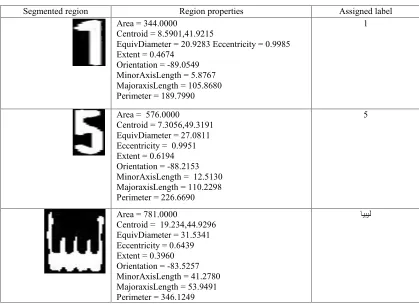
The primary use of shape features is for desorption of object. In this study, the features of geometrical shape are utilized in the feature extraction part. In MATLAB, a connected component analysis which takes the role as the regionpropos function enables the extraction of features of the geometrical shape. There are
numerous features for shape properties, and these features are combined as representative to the character and numbers. In this study, geometric features are considered to represent the characters and numbers. These features are as:
1st: Area, 2nd: Centroid, 3rd: Eccentricity, 4th: EquivDiameter 5th: Extent
[image:6.612.96.515.319.626.2] 6th: MajoraxisLength 7th: MinorAxisLength 8th: Orientation 9th: Perimeter
Table 1 presents the extracted geometry features for representative numbers and words in a plate. Table 1: Illustration Of Extracted Features For Characters.
Segmented region Region properties Assigned label
Area = 344.0000
Centroid = 8.5901,41.9215
EquivDiameter = 20.9283 Eccentricity = 0.9985 Extent = 0.4674
Orientation = -89.0549 MinorAxisLength = 5.8767 MajoraxisLength = 105.8680 Perimeter = 189.7990
1
Area = 576.0000
Centroid = 7.3056,49.3191 EquivDiameter = 27.0811 Eccentricity = 0.9951 Extent = 0.6194 Orientation = -88.2153 MinorAxisLength = 12.5130 MajoraxisLength = 110.2298 Perimeter = 226.6690
5
Area = 781.0000
Centroid = 19.234,44.9296 EquivDiameter = 31.5341 Eccentricity = 0.6439 Extent = 0.3960 Orientation = -83.5257 MinorAxisLength = 41.2780 MajoraxisLength = 53.9491 Perimeter = 346.1249
ﺎﯿﺒﯿﻟ
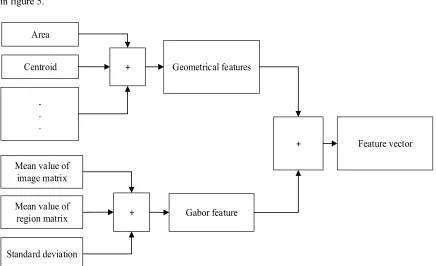
Meanwhile, Gabor feature is for representing the characters and numbers extracted. This feature integrates with convolution matrix used for extraction of feature. For Gabor feature, the mean value and standard deviation of image matrix are studied. The generation of the Gabor feature involves three
functions: mean value of image matrix, mean value of region matrix, and standard deviation.
[image:6.612.96.515.322.624.2]simply these features by a vector refer as shown in figure 5.
Mean value of image matrix
Mean value of region matrix
Standard deviation
Gabor feature
+
Geometrical features
+
Area
Centroid
.
. .
+
[image:7.612.90.526.110.376.2]Feature vector
Figure 5: Feature Vector Generation.
3.5 License Plate Recognition
This step encompasses the recognition of the extracted characters and numbers by way of template matching and a classification such as the techniques of probabilistic Neural network (PNN). These techniques are described below:
3.5.1 Template matching
This step aims to recognize the characters and number in the plate. A template matching algorithm used in this study for this recognition purpose. However, before template matching usage, it is required to have a predefined template to perform matching process between new plate and predefined template. In order to generate a predefined template, we use the preprocessing and license plate detection steps from pervious phases. The results of previous steps are segmented the character and numbers regions. Then the features for these regions are extracted, and the characters and numbers are labeled using a manually assigned label. As presented in Table 1, it shows examples for digits 1, 5 and Libya (ﺎﯿﺒﯿﻟ) word with extracted feature and assigned label. The same process performs for all the number 0 to 9 and Libya word to generate the predefined samples. After
generating a predefined template, the pre-processing and license plate detection processes are performed for any new image. The matching process is check whether the new image is similar to template or not based on Euclidean distance, if it is similar the recognition process was identifying the character or word. In this template matching process, the Euclidean distance is applied for each feature of template image and new plate image.
3.5.2 Probabilistic neural network (PNN)
As indicated, template matching is performed to recognize the character or word from the plates. However, in a situation where the character or word cannot be recognized, the engine of neural network will be employed to predict the segmented regions that belong to the character and word’s classes. Thus, PNN predicts the segmented region is belonged to character or number classes. It also predicts the character’s digit. Following the new character prediction, the features of the character are moved to template matching module. This updates the template to allow future recognition.
entail the description of sets’ training and testing and the PNN express usage for our implementation.
a) PNN Training
The input for PNN comprises extracted regions which include plates, character and numbers regions. However, predefined dataset needs to be used before the employment of PNN for training. In this study, the training dataset contains 70 images.
b) PNN Testing
PNN also requires the previously mentioned image pre-processing steps to be done to the image and the detection of white areas that satisfy the value of threshold. Then, the image’s identified objects which are to be tested are forwarded to PNN for further testing. As indicated by the trained data set, the outcomes
produced by the PNN are identical to that of license plate in the new image. The detected is generated from the region which was identified from the preceding step. The following provides the details of Implanted PNN.
4. EXPERIMENTAL RESULTS AND
PERFORMANCE EVALUATION
This section presents the experimental results and performance evaluation for the proposed method in this study.
4.1 Experimental Setup
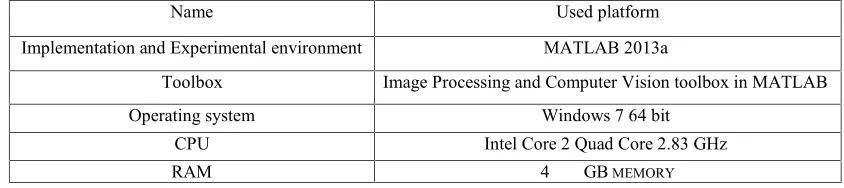
[image:8.612.80.502.361.455.2]In this section, the details of our platform for the implementation, experiment and performance evaluation is presented. Table 2 shows the details of experimental setup in our platform.
Table 2: Details Of Experimental Setup In The Proposed Platform
Name Used platform
Implementation and Experimental environment MATLAB 2013a
Toolbox Image Processing and Computer Vision toolbox in MATLAB
Operating system Windows 7 64 bit
CPU Intel Core 2 Quad Core 2.83 GHz
RAM 4 GBMEMORY
4.2 DATASET
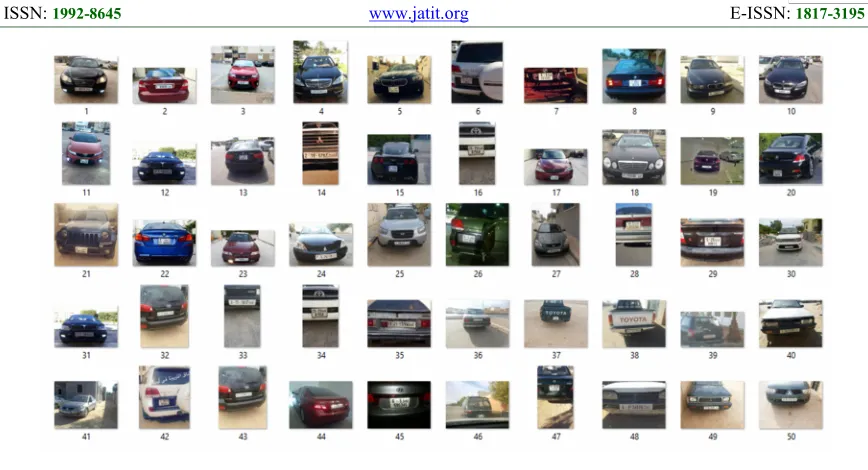
Figure 6: Sample Libyan Cars.
4.3 PERFORMANCE EVALUATION
In this section, the performance of proposed method is evaluated. The performance evaluation is carried out using standard performance evaluation metrics. The metrics are as: precision,
recall and f-score. These metrics are used to calculate number of false and true recognition of plates. In order to calculate the metrics some variables are required to define as shown in Table 3.
Table 3: Definitions Of Performance Evaluation Variables.
Variables Definitions
True Positive (TP) Correctly identified characters and numbers. False Positive (FP) Incorrectly identified characters and numbers. False Negative (FN) Incorrectly identified other regions as characters or numbers.
Using the defined variables the metrics can be calculated by following equations,
= +
(1)
= +
(2)
= (1 + ). ( . ) +. (3)
Where , , , and denotes the true
Table 4: Performance Measurements For Different Number Of Features.
Recall Precision F1-score
1stfeature +Gabor 83.1203 80.1517 81.60901
1stand 2nd features+Gabor 83.1203 80.1517 81.60901
1-2-3 features+Gabor 83.7986 80.8058 82.27499
1-2-3-4 features+Gabor 83.1203 80.1517 81.60901
1-2-…-5 features+Gabor 82.4421 79.4978 80.94318
1-2-…-6 features+Gabor 83.1203 80.1517 81.60901
1-2-…-7 features+Gabor 83.7986 80.8058 82.27499
1-2-…-8 features+Gabor 83.1203 80.1517 81.60901
1-2-…-9 features+Gabor 83.1984 80.2127 81.60901
As depicted in Table 4, the PNN classification method is tested with different number of features. The best result was obtained using all the 9 features including (These 9 features are listed in Table 1). Therefore, the optimal feature representation was obtained based on integration of all the features.
[image:10.612.93.302.531.608.2]Finally, the performance of the proposed method compares with other existing method to show the outperformed method. The other existing method is (Abulgasem, 2012). To fair comparison, Abulgasem’s features and classification are implemented. The features and classification of Abulgasem used horizontal and vertical lines as features and Radial Basis Classification (RBF) for classification, character and number recognition. The features investigated in this study and Abulgasem’s features are individually implemented with PNN and RBF classification methods. Table 5 and 6 show the calculated performance measurements based on PNN and RBF classification methods respectively.
Table 5. Performance measurement based on PNN Feature
extraction process
Recall
(%) Precision(%) F1-score(%)
The proposed
feature 84.19 81.18 82.66
Abulgasem
(2012) 81.16 78.84 79.99
Table 6: Performance Measurement Based On RBF. Feature
extraction process
Recall (%) Precision
(%) F1-score(%)
The proposed
feature 82.64 79.68 81.13 Abulgasem
(2012) 79.66 77.39 78.51
As shown the in Tables 5 and 6, the feature extraction of this study in PNN and RBF classification methods presented better performance in compared to Abulgasem’s feature extraction process. Therefore, the proposed method of this study presented outperformed performance in compared to Abulgasem’s work in Libyan license plate recognition, because the proposed features contain important information for a better recognition.
5. CONCLUSION
[image:10.612.93.303.645.712.2]other existing methods to show the superior method in license plate recognition. For the future work, this study can be extended to test the proposed method in real-time license plate recognition.
REFERENCES
[1] Ganoun, A., “Automatic Localization System of Libyan License Plates”.Vehicle Power and Propulsion Conference (VPPC), 2015 IEEE, pp. 1-4.
[2] Rastegar, S., R. Ghaderi, G. Ardeshipr & N. Asadi, “An intelligent control system using an efficient License Plate Location and Recognition Approach”, International Journal of Image Processing (IJIP) Volume (3)(5), 2009,pp: 252-264.
[3] Khalil, M., “Car plate recognition using the template matching method”, International Journal of Computer Theory and Engineering
2(5), 2010, pp: 1793-8201.
[4] Alginahi, Y. M., “Automatic arabic license plate recognition”, International Journal of Computer and Electrical Engineering 3(3), 2011, pp: 454-460.
[5] A Abulgasem, N., "Libyan vehicle license plate detection and recognition using radial basis function", Thesis Universiti Teknologi Malaysia, Faculty of Computer Science and Information System, 2012.
[6] Mohammad, K., S. Agaian & H. Saleh, "Arabic License Plate Recognition System", 2013.
[7] Ashtari, A. H., M. J. Nordin & M. Fathy, "An Iranian License Plate Recognition System Based on Color Features", Intelligent Transportation Systems, IEEE Transactions
on 15(4) 2014, pp: 1690-1705.