Journal of Criminal Law and Criminology
Volume 1 | Issue 4
Article 10
1911
Book Reviews and Notes
Follow this and additional works at:
https://scholarlycommons.law.northwestern.edu/jclc
Part of the
Criminal Law Commons
,
Criminology Commons
, and the
Criminology and Criminal
Justice Commons
This Book Review is brought to you for free and open access by Northwestern University School of Law Scholarly Commons. It has been accepted for inclusion in Journal of Criminal Law and Criminology by an authorized editor of Northwestern University School of Law Scholarly Commons.
Recommended Citation
BOOK REVIEWS AND NOTES.
DIE CHE MIE IN DEn RECHTSPFEEGE. By Prof. Dr. M. Dennstedt,
Director of the State Chemical Laboratory, Hamburg. A guide for jurists, police and prosecuting officers, etc. With 151 illus-trations and 27 plates. Akademische Verlagsgesellschaft, Leipzig, 1910. Pp. X, 422.
This volume is a development of a series of lectures delivered by the author in Hamburg, under the auspices of the high school author-ities, and its avowed aim is to provide a guide and reference book for the use of jurists to assist them to a more thorough understanding of the language and methods of chemical and other technical experts called to aid them in their cases. The book is also intended to be an introduction to the study of more highly specialized works on the various subjects covered. The volume begins with a chapter describ-ing fundamental principles of chemistry, these bedescrib-ing brought out in conjunction with descriptions of the more common elements and some of their compounds. The descriptions are enteriningly written, by their chatty style betraying in some measure the lecture course origin of the work. -Many experiments are described in detail and illustrated by drawings. Next follows a chapter on poisons, the inorganic poisons first, then the organic. Here, again, the author's aim is to describe general methods of procedure and underlying chemical prin-ciples rather than minute technical detail. While discussing the metallic poisons occasion is taken to instruct the reader in the princi-ples of gravimetric, volumetric and electrolytic analysis, and under the head of alkaloids, the general methods of extraction with immisci-ble solvents are described. Other chapters treat of the classification and examination of inflammables and explosives, the examination of blood stains, seminal stains, etc., the chemistry of and methods of testing paper, ink, lead-pencil marks, as met with in the detection of forgeries and falsification of documents, and the principles and use of photography in this connection. A chapter on the subject of the
chemistry of food and condiments includes water, milk, cheese, butter, oleomargarine, lard, miscellaneous vegetable oils and fats, meat and meat products, sugar, confectionery, honey, preserves, flour and its products, alcoholic beverages, such as whisky-, beer, wine and cognac; vinegar, coffee, tea and cocoa, the spices and tobacco.
To cover such an extremely wide range of subjects within a space of 400 pages necessarily restricts each to a brief survey, espe-cially as no chemical knowledge is presupposed on the part of the reader, and each subject is treated at first in a very elementary
BOOK REVIEWS.
ner. The author, however, has succeeded in compressing a large amount of valuable information into an extremely brief space, and in spite of the fact that the work is primarily intended for beginners, the trained chemist will also find much t6 interest him, sufficient to riake the book a useful addition to his library. The frequent com-ments of the author upon the impoi"tance of a better understanding between counsel and expert will appeal to those engaged in forensic work.
The book is clearly printed, contains few typographical errors, and has a good index-an aid to handy reference unfortunately not
always found in German works. Jos.PHr A. DEGHUEE.
New York City.
STRAP UND ZIVILRECHTLICHE VERANTWORTU-G DES A1IZTES. By
Dr. A. Kuhner, of Eisenach. Sammlung Klinischer Vortrdge. Johann Ambrosius Barth. Leipzig, 1910.
This is an exhaustive discussion of the legal responsibilities of physicians and surgeons in the practice of their profession in Ger-many and elsewhere. Problems arising in emergency cases, in faulty diagnoses, when treatment is refused by the patient or when bad re-sults follow treatment for fractures, abortions and child delivery are considered fully, and must be read in the original to be fully
un-derstood. E. A. SPITZKA.
Philadelphia.
LA DEimixCUE, ciA IFrANTIL, PARt Bonifacio de Echengaray. Bilboa, Miguel Aldama, 1909. Pp. 121.
The rather imperfect statistics of Spain in relation to juvenile delinquency are here brought together and presented in both tabular and graphic form. The movements of crime in young persons are noted in relation to different ages, groups and kinds of offenses. The result is the same as that found in many other countries of Europe; the family life has been seriously disturbed, temptations multiply, arrests increase, prisons do not reform youth. The author offers a few constructive propositions at the end: separation of children from adult criminals; establishment of reform schools; personal
watch-care over neglected and morally imperiled youth. C. R. H,
ON TIHE WITNESS STAND: ESSAYS ON PSYCHOLOGY AND CUNIE. By Hugo Munsterberg.. New York: Doubleday, Page & Co., 1909. Pp. 265.
MUNSTERBERG: ON THE WITNESS STAND.
On the Witness Stand contains eight essays, most, if not all, of which appeared originally under other titles in monthly periodicals. The central theme underlying these essays is that experimental psychology is now in a position to render positive service to juris-prudence and that jurists can no longer either ignore" or ridicule the claims of the psychologist that modern scientific methods of investi-gating mental conditions should be brought into the courtroom.
The first "paper" details certain class experiments conducted by the author at Harvard University, the purport of which is to warn against "blind confidence in the observations of the average normal man," and to suggest the need "for a more careful study of the indi-vidual differences between those on the witness stand."
The second article describes the "event-test" experiments con-ducted in Germany, explains paramnesia and ideational types and, by dint of numerous anecdotes, seeks to make clear the extent and the nature of the falsification that may unconsciously take place in the memory of the witness.
Under the caption, "The Detection of Crime," the author argue-that "the 'third degree' may brutalize the mind and force either cor-rect or falsified secrets to light ;" whereas "the time-measurement of associations is swifter and cleaner, more scientific, more humane, and more reliable in bringing out the truth which justice demands" (p. 109). The application of the method is illustrated by the author's use of it to ascertain the truthfulness or untruthfulness of the alleged confession of a notorious Idaho murderer.
The next section explains how the psychologist, by means of in-struments of precision, goes about the task of detecting and of meas-uring emotional expression. Here, again, Munsterberg believes that "experimental psychology can furnish amply everything which the
court demands"-though with a qualification to be mentioned later. Perhaps the most impressive and startling portion of the book is that which details a case that arose in Chicago, in which, our author contends, an innocent man was hung because the "third-degree" methods had extorted from his weak and easily unbalanced mind an untrue confession. It is shown very clearly that such an event is entirely possible, that it might be the resultant of a tendency that is found in all minds, and that "there is nowhere a sharp line to be drawn between the symptoms of real mental disease and the varia-tions in normal personalities" (p. 151). "The cross-examining law-yers," it is declared, "turn their attention nostly backward to the time of the crime and overlook too often the mental state at the time of the trial."
MUNSTERBERG: ON THE WITNESS STAND.
"leading questions" in the interrogatory after a "picture-test" are given, and the mechanism of suggestion is described.
No one will doubt that the very atmosphere of the courtroom breathes suggestion, that the testimony of witnesses is woefully dis-torted by the suggestion often implicit in the lawyer's questions, or that the juryman, himself, may become, by the influence of sugges-tion, a most dangerous .factor in the outcome of the trial. Doubt may, however, be felt, and legitimately, of the assertion that "the psychological experiment can measure the degree of this constitu-tional weakness with exactitude" (p. 196), if the psychological ex-periment in question is to be limited, us the author implies (p. 186), to a test of suggestibility to the size-weight illusion, because recent work in the laboratory teaches us that the same person may exhibit different degrees of suggestibility when tested by different methods. No fault can be found with the discussion of hypnotism and crime. The essential features of this discussion are, perhaps, these thiee: the hypnotic condition is but an exaggeration of a normal condition of consciousness; hypnotic suggestion to commit crime cannot, in all probability, break down a strong inner resistance; the proposal to utilize hypnosis for the cure or prevention of crime de-mands careful consideration because of the complex social and moral issues involved.
The eighth and final essay deals with the prevention of crime. The -author contends that there is no justification. for the concept of the "born criminal." Criminals do, undoubtedly, spiing largely from a class that has inherited from abnormal and degenerate parents an "insufficient capacity and resistance of the central nervous system." To prevent the development of the criminal, therefore, we might have recourse to the doctrines of eugenics and demand that society so arrange matters that "such mentally weak and inferior persons are not born at all" (p. 247). For the rest, society must do two things: it must strengthen the impulses that make for decency and social solidarity, and it must study and remove the influences that weaken the resistance against temptation. In particular, the exploitation of crimethrough millions of copies of vulgar newspapers is a special source of danger that should be abolished. Likewise, the proper regulation of the use of alc6hol is a problem of great complexity
and of equally great impbrtance in the prevention of crime. As for
the criminal who has become a professional, he is nearly always lost,
MUNSTERBERG: ON THE WITNESS STAND.
may be defended against the imputation of culpable ignorance and neglect of the contribution of modern psychology to the problems of jurisprudence. The reviewer is, however, inclined to think that Pro-fessor Munsterberg, if pressed, would be the first to admit that he had been guilty of an occasional hyperbole. 'He would, we think, explain that On the Witness Stand, like his recent books upon the relation of psychology to therapeutics and to education, was written pri-marily to interest the public in the possibilities of applied psychol-ogy. That the articles bearing upon the legal profession have ful-filled this purpose there can be no doubt, and in so far the author has justified their appearance.
The real question, in our opinion, is whether his method is justi--fiable; whether, to interest the American public, the man of science must so far imitate the methods of the daily press as to disregard the finer limits of professional accuracy for the sake of catching the eye and awakening the imagination of the reader. It might be pointed out that some of those who have been most expert in the art of popularizing the results of the exact sciences-one may cite such writers as iuxley, Tyndall, Clifford, Helmholtz, Henle, and Mach -have found it possible to set forth in attractive form the subject-matter of sciences intrinsically much less interesting than psychology without doing violence to their facts.
Yet, as a matter of fact, there are, in the volume itself, numer-ous examples of qualification that may be overlooked by. the hasty reader. For instance, the author says of the use of the diagnostic-association method (p. 109) : "Of course, we are only at the begin-ning of its development; the new method is still in many ways imper-fect, and if clumsily applied may be misleading," etc. Similarly, after making the statement, to which we have already referred, that there is "really no doubt that experimental psychology can furnish amply everything which the court demands" [in measuring emotional expression], he continues on the same page to say: "And yet, it seems to me that a great reluctance and even a certain scepticism as to the practical application of these methods is still in order." To the lay reader this may well seem inconsistent, if not confusing.
Every jurist should read this book; he may not agree with the author's position, but he cannot fail to be stimulated to reflection
upon the problems that are raised. Guy IMNTRosE WHIPPLE.
Cornell University.
DIE REFOR1- DEs DEUTSCHEN SCHWURGERICHTS. Von M. Liepmann.
-eidelberg. CarZ Winter's Universititsbuchhandlung, 1910.
Pp. 263.
FYor years a controversy has. raged- .about the. German
LIEPMANN: REFORM DES SCHWURGERICHTS.
to be divided into three camps: those who would do away with the court altogether, rejecting the system and all its works; those who cleave to it and regard any attempt to meddle with it as an attack on the fundamentals of popular government; and a third group which acts in a mediating capacity between the two extremes just noted and which, while acknowledging the grave defects of the Sclhwnrge-richt, believes that the time has not yet come for abolishing it, though eventually the jury court must go.
The present study of Professor Liepmann is a contribution to the general discussion provoked in German juristic circles by the pro-posed draft of an ordinance touching criminal procedure of Septem-ber 1, 1908, and a new revision of certain phases of the "Geriehtsver-fassunggesetz," or law touching the judicial organization. This lat-ter "Novelle" was drawn up by the Imperial Department of Justice, passed by the Bundesrat and sent to the Reichstag March P6, 1909. The changes proposed in the bill were very few. Aside from the granting of jury fees and some purely redactional modifications, the only innovation was a clause reducing the number of .jurors who should be summoned in the "prachliste," twenty-two instead of thirty, and permitting a going to trial when only eighteen of the jurors summoned, instead of twenty-four, should appear. In other respects both the organization of the court and the procedure re-mained unaltered. If, however, the bill accomplished nothing else, it succeeded in provoking no inconsiderable discussion among both the legal profession and the laity.
The result of this agitation has been, in the opinion of Professor Liepmann, decidedly in favor of the German jury court, and an affirmation of its value for the future also. )But while insisting on the retention of trial by jury, Professor Liepmann believes in certain modifications of it. The customary number of jurors, viz., twelve men, can scarcely be justified. A reduction of this number would re-sult in an increase of the feeling of personal responsibility on the part of each juror, and would certainly not detract at all from the value of the institution. Further, the process of constructing the jury should be simplified so as to relieve jurors, summoned for a specific case, from being deprived of their liberty and kept from the conduct of their business, at the dictum of some court officer, until,
by peremptory challenge, they are sent home again, and only the
ANTONINI: ANTROPOLOGIA CRIMINALE.
criminal acts. There should be a clearer definition of what should and should not constitute "mitigating circumstances."
With certain proposed modifications, such as the attempt to strengthen the juristic element of the jury system but the formation of juries out of eleven laymen and one judge chosen from the Supe-rior Court, or such as giving the jury the decision as to the guilt of the defendant and a share as well in the allotment of the penalty, Pro-fessor Liepmann has little sympathy.
It is exceedingly difficult to outline, in the few words at the dis-posal of the reviewer, the closely packed arguments of this work. The book is well written in clear and forcible German.
Leland Stanford University. BUrT EsTEs HOWARD.
ANTROPOLOGIA C.RMINALE. By Dr. G. Antonini. Ulrico Hoepli, Milan, Editor, 1906. Pp. 167.
The old publishing house of Ulrico Hoepli added another vol-ume to its extensive library of popular manuals by the publication of this little book by the director of the insane asylum of Udine. The author calls it "a guide for formulating medico-legal opinions, on questions of responsibility for crime." Whether or not this text-book adds anything new to the library of the medico-legal expert, yet as a popular treatise it is admirable for its clearness of presentation and
avoidance of abstruse terms.
A large parl of the book is devoted to the "Precursors" of crim-inal anthropology, with a brief review of the text-books by the lead-ing Italian criminologists. His defense of Lombroso is influenced by
his affection for the late leader of the Italian school.
The chief value of the little book is the common-sense consider-ation of the duty of the medical expert on the question of mental re-sponsibility in the trial of criminals. After pointing out the defects of present legal tests the author sets out to explain what the duty of the medical expert must be in contributing his knowledge and ex-perience to the due application of the existing law. He sums up the expert's duty under the present legal tests as follows: "In all cases where the accused may be classed either as criminal or 'average-nor-mal,' the expert should declare him legally responsible; when, how-ever, the accused is suffering, or was suffering at the time of the act, from some clinical form of mental disease, then he should be certified as n6t responsible." In other words, he insists that under present legislation a clinical test is the only fair one to be applied by the psychiatrist.
The question then reduces itself to whom may be classed as "average-normal." "Average and normal man does not mean a per-fect man," says the author. "We can state only that in this class belong all those who, not being unmoral by nature, present no signs
TARNOWSKY: LES FEMMES HOMICIDES.
of degeneration and commit a crime through endogenous' causes with-out reaching the state of either disease or criminality."
Tests for such a diagnosis are given briefly and clearly by the author. The method is largely an inquiry into the personality and character of the accused, for, as the author says, "the freedom of one's acts" imposed as a test by law must be sought for "in the sound-ness of those mental processes which determine a man to a given choice; for will does not mean action, but reaction."
New York City. GINo C. SPERANZA.
L-s FEmuEs HoncxmDEs par Le Dr. Pauline Tarnowsky, avee 40 planches hor texte contenant 146 figures et 8 tableaux anthro-pom6triques. Paris, Felix Alcan, 6diteur, 1908. Pp. 591, 8'. It is not my intention, at present to make an extensive review of this important work on female homicides of Russia. Dr. Pauline Tarnowsky, the author of this work, is a distinguished Russian crim-inologist and the only woman crimcrim-inologist of the world. She pre-sents a special study of 160 cases of female homicides. The methods of ixesearch are given in detail, then follow chapters on the signs of physical degeneration, heredity, and biology applied to.the study of the criminal.
Madam Tarnowsky classifies female homicides from the point of view of the genesis of the crime, as follows:
I. Female homicides due to passion: a. Homicides from cupidity;.
b. Homicides under the influence of maternal 16ve; c. Homicides under the influence of sexual love; d. Homicides from jealousy;
e. Homicides from vengeance;
f. Homicides from repeated outrages; g. Homicides from hatred and cruelty. II. Homicides due to diminished receptivity: a. Homicides due to moral obtuseness;
b. Homicides due to the genital sense and its deviations. III. Female homicides by occasion (accidental assassinations).
IV. Female homicides due to nervous and mental, troubles. This classification naturally has many intermediate forms.- It is, in a way, a biological classification aiming. to generalize human' life as a whole.
In each of the 160 cases, twenty measurements were made of the head and face. Other measurements were height, length of arms, hands', and arm reach, etc. Points were noted as to puberty, mater-nity, face, forehead, eyebrows, hair, eyes, ears, teeth, palate, mouth, chin, nose, etc. Other points are number of crimes, age at which first crime was committed, motive, and season of year.
TARNOWSKY: LES FEMMES HOMICIDES.
As to heredity, Madam Tarnowsky says that certain persons in-tellectually endowed show deficiency in moral sense. Others, on the contrary, are highly moral but mediocre in intellect. Others pos-sess the same measure of moral and intellectual faculties when in a state of calm, but the least fatigue or excitement tends to provoke in them a dis-equilibrium between their intellectual and moral qualthes. In the study of the 160 cases it is mainly A study of "superior de-generacy," especially where there is absence of the moral sense.
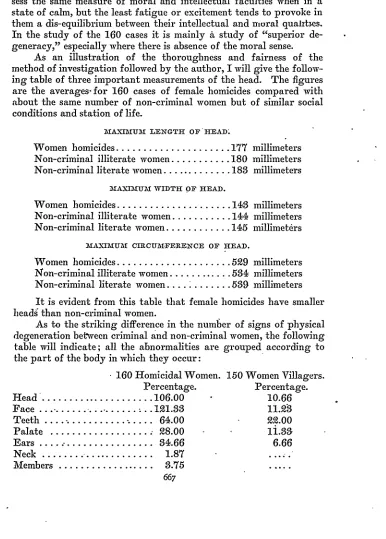
As an illustration of the thoroughness and fairness of the method of investigation followed by the author, I will give the follow-ing table of three important measurements of the head. The figures are the averages, for 160 cases of female homicides compared with about the same number of non-criminal women but of similar social conditions and station of life.
M£AXIMUMN LENGTH OF HEAD.
Women homicides ... 177 millimeters Non-criminal illiterate women ... 180 millimeters Non-criminal literate women ... 183 millimeters
M5AXIMUM1 WIDTH OF HEAD.
Women homicides ... 143 millimeters Non-criminal illiterate women ... 144 millimeters Non-criminal literate women ... 145 millimeters
IAXIMU£M CIRCUMFERENCE OF HEAD.
Women homicides ... 529 millimeters Non-criminal illiterate women ... 534 millimeters Non-criminal literate women ... 539 millimeters
It is evident from this table that female homicides have smaller
heads than non-criminal women.
As to the striking difference in the numbier of signs of physical degeneration between criminal and non-criminal women, the following table will indicate; all the abnormalities are grouped according to the part of the body in which they occur:
160 Homicidal Women. 150 Women Villagers.
Percentage. Percentage.
Head... 106.00 10.66
Face ... ;.. 121.33 11.23
Teeth ... 64.00 22.00
Palate ... 28.00 A1.Sa
Ears ... 34.66 6.66
Neck ... 1.87
Members ... 3.75
[image:10.612.45.431.111.650.2]DUPRAT: CRIMINALITE DANS L'ADOLESCENGE.
The close connection indicated here between homicide and
physi-cal degeneracy could hardly be accidental.
From similar comparative tables the author concludes that with a relatively badly developed cranium, with less capacity, homicidal women show numerous signs of degeneration: distrophia of face, head, ears, teeth, functional alterations of sense organs,-affected also with hereditary taint, and presenting still greater physical and sexual distractions.
Criminal women are violent and impulsive or morally obtuse, with no notion of evil, with abnormally perverted genital functions, or affected with nervous and mental troubles. They present a real variety aside from the type given of a certain race, rather a dis-trophic product, the defective fruit of a feeble and morbid vital en-ergy. The relatively large number of physical signs of degeneracy in female homicides, as compared with normal women, shows that we have to do with persons of an abnormal congenital development. For these deviations of development are hereditary and not acquired. This hereditary morbidity, physical and moral and bad social condi-tions are the two general causes of crime.
Washington, D. C. ARTHU1 MACDONALD.
LA CRtimiNALITE DANS L'ADOLESCENCE: CAUSES ET REMEDIES D'UN MAL SOCIAL ACTUEL. By G. L. Duprat. Paris: Felix Alcan, 1909. Pp. 260.
The author insists in the introduction upon the necessity of an impartial study of the facts with regard to juvenile crime. He then divides the book into three main sections, the first dealing with the character and extent of juvenile crime, the second with its causes, the third with the remedies for it.
In the first chapter of the first part he discusses the kinds of criminality which characterize the different stages of childhood and devotes special attention to the changes in character which result from the physiological transformation which takes place at puberty. The following chapter contains judicial statistics by, means of which the author believes he proves that juvenile crime has increased greatly in recent years, even more than crime in general. For example, he states that "M. Henri Joly a montr6 comment en cinquante ans, en France, de 1838 b 1888, Paccroisement num6rique de la criminalit6 g6n6rale a 6t6 de 133 per cent, mais 'de 140 per cent chez les mineurs
de moins de 16 ans et de 247 per cent chez les mineurs de 16 A !21
ans.' " He gives figures for other countries also to show a similar in-crease. Elsewhere in this chapter he recognizes the fact that changes in the rigorousness with which the law is enforced will affect the ber of crimes dealt with by the law independent of changes in the num-ber of crimes committed. But he does not mention the fact that an
DUPRAT: CRIMINALITE DANS L'ADOLESCENCE.
increase'in the number of acts stigmatized as criminal by the law will increase the number of crimes as indicated by judicial statistics. While the author is probably right in believing that juvenile crime has increased greatly in recent years, more statistics and a more careful analysis of them than are to be found in this chapter are needed before this belief can be proved conclusively.
In the third chapter of part one he discusses the criminological types to be distinguished among adolescent criminals. He believes these types are to be traced to three distinct pathological states, infantilism, moral imbecility and mental debility.
In part two he discusses numerous causes of juvenile crime. Under the head of morbid heredity he discusses the pathological heredity resulting from alcoholism, professional intoxications such as lead poisoning, arsenic poisoning, etc., syphilis, tuberculosis, etc. He contends that natural selection does not work freely now in elim-inating the unfit, but that many with a morbid heredity are preserved and reproduce themselves. The lack of education and training in the family, in the schools, and in the trades and professions is empha-sized. The immoral education furnished by criminal and immoral parents and associates is also described.
The economic conditions which lead to crime are described, such as unemployment, overwork, immigration, pauperism, gambling, the desire for luxury, etc. An attempt is made to show that a criminal evolution is taking place as a result of a social dissolution growing out of the disintegration of the family and an excessive individualism manifesting itself in anarchistic and demagogic tendencies. This belief in a general social dissolution is decidedly exaggerated and must grow out of a one-sided view of the principal social tendencies of the day.
The third part deals with the remedies for adolescent crime, among those discussed being penitentiaries, reformatories, reform schools, colonies, juvenile courts, probation, etc. Many preventive measures are discussed, such as care of children morally abandoned, punishment of negligent parents, preventive education, including special educational facilities for abnormal children and moral and sexual education. The general social reforms are discussed also as measures preventive of juvenile crime.
This is one of the best books published up to date upon this subject about which little of value has been written as yet. The book is well arranged and furnishes a good outline for a study of this sub-ject. But there is not enough material to fill in the outline. Like practically all the books on juvenile crime, it consists largely of vague generalizations and emphasizes more than ever the need for accurate and concrete information upon this subject. Not until a large number of individual cases have been carefully studied can we
HEGEL: PHILOSOPHISCHE -DES STRAFRECHTS.
hope to have this information, and those who wish to write upon
this subject should first undertake this task. M. Duprat has thought and written a great deal upon philosophy, psychology and sociology, thus enabling him to recognize the many-sided character of this prob-lem. But he has not undertaken the task of gathering the statistical and other information which would give us an exact quantitative as well as qualitative knowledge of the extent, character and causes of juvenile crime. He has, therefore, failed, as every one who has pre-ceded him has failed, to give us a satisfactory treatment of this
sub-ject. MAUXucE PARAIELEE.
University of M¢issouri.
HEGEL'S PHILOSOPHISCHE BEGRUNDUNG DES STRAFRECHTS UND DEREN
AUSBAU IN DEE DEUTSCHN STLAFRE*CTSWlSSEiNSCHAFT. Von
Dr. jur. Ewge a Sulz. Berlin: Verlag Dr. Walther Rothschild, 1910. Pp. 77.
This little book, as the title implies, sets itself an interesting task and accomplishes it admirably. There can be no doubt that Hegel's system, particularly his philosophy of penal law, was more than a mere philosophy of the time and fashion, reckoning as it does most of all with reality and thus coming nearest to meeting this first demand of the present. That Hegel's philosophy has adapted itself so well to all changes in ideas up to the present is owing chiefly to the doctrine of evolution which it contains and which. Hegel intro-duced into the field of the "Geisteswissenschaften." It was this idea of evolution that gave to his philosophy its elasticity and endurance. Dr. Sulz traces Hegel's ideas-through their process of adaptation to the practice and results of subsequent and most recent investigations, treating as representative the teachings of Abegg, K6stlin, H4lschner, Berner and von Bar. That the examination ends with Bar's system does not mean that the conclusion of the development of Hegel's course in the philosophy of law has been reached, but rather that this system is intended to show how "a kernel may be
peeled out of the many colored rind of Hegel's theories" that is acceptable to modern thought. Lasson's philosophy of law, for instance, might stand in the same place or that most promising 'Neo-Hegelianism," which is associated with Kohler's name.
South Easton, Mass. ADALMERT AL BRECHT.
SCHUTZ DER KRIAIINELL GEWORDENEN JUGEND IA1 STRAFILECHT UND
STr.AFPFEOZESs NACH DEM£ ENTWURF EINER
STRAFPEIOZESSORD-NuNG, vou Landgerichtsdrektor Dr. Becker, Zahn und Jaensch. Dresden, 1909. Pp. 36.
BECKER: SCHUTZ DER KRIMINELL JUGEND.
attention to juvenile delinquents. "The project was under consider-ation for legislative action in 1909. Dr. Becker discusses the tech-nical portions of the German law as it now stands and as it will have to be amended in order to deal more sanely with ju enile delinquents. In the interest of their reformation,- definite sections of the civic and state ordinances are considered together with the proposed revision. Few statistics of general value are presented in the pamphlet. One nlay note, however, that the figures show that only 80 per cent of their youngsters put on probation do well. The main trend of the-paper is to favor such features in the new law as shall definitely tend to treat juvenile delinquerits more through the processes of education
than through the processes of punishment by law.
Chicago. WTILLiAm HEALY.
LE CRIMIE ET LA SOCIETE. By J. Maxwell. Paris: Ernest
Flam-marion, 1909. Pp. 360. 3 fr. 50.
Students of criminology will welcome this text in criminal soci-ology by a French physician who is assistant to the procurer general in the Court of Appeals of Paris. Dr. Maxwell has written a very interesting and valuable book on criminal sociology. He defines criminal sociology as concerning itself with the relations between society and the offender. It studies crime in so far as it is a social phenomena, and so from an objective point of view. Dr. Maxwell takes up the discussion successively of the concept of criminology. and the criminal, the subjective and objective elements in criminology, the nature of the criminal will, the insane criminal, criminal responsi-bility, the classification of criminals, the social reaction against crime, social prophylaxis, and social defense and punishment.
The work, as has already been, said, constitutes a valuable addi-tion to the literature of criminal sociology, and it is to be hoped that it will soon be translated into English. The writer of this notice would take occasion to criticize the book in only one important re-spect, and that is in regard to its classification of criminals. Dr. Maxwell divides criminals into two fundamental classes: habitual criminals and occasional criminals (les criminels d'occasion). The former class he subdivides into congenital habitual *criminals and acquired habitual criminals. Under the heading of congenital habit-ual criminals he puts, rightly, first, insane criminals whose condition he says appears to result nearly always from hereditary predisposi-tion; secondly, the born criminals of the Lombrosian type whose dis-tinctive trait is inadaptability to civilized society; thirdly, moral imbeciles, persons with a congenitively defective moral sense; and fourthly, vagabonds. Under the heading of criminals by acquired habit he would place all who are the victims of circumstance or who acquired from bad surroundings in their youth or childhood criminal
MAXWELL: LE CRIME ET LA SOCIETE.
habits. He finds that criminals by- acquired habit are of three types: the pervert, the weak (les d~biles), and the excited (excitis).
Without stopping to criticize these divisions, one must raise a question concerning the category of occasional criminals which the author makes co6rdinate with that of habitual criminals. He admits himself that the expression "occasional criminal" is ambiguous, but defends it on the ground that in the case of the occasional criminal it is the opportunity (occasion) which is the true cause of the crim. inal act, while in the case of the habitual criminal, whether congenital or acquired, it is the internal impulse which is the true cause. Ac-cordingly, the author classifies occasional -criminals by the various stimuli in the external environment which excite crime, such as those connected with hunger, poverty, intoxication, and the like. It is quite evident from this subordinate classification that the occasional criminal is not necessarily a single offender in our author's view. The only, mark which distinguishes him from the habitual criminal is that in his case the external stimulus is the true cause of the criminal act. Manifestly from a psychological standpoint a person who com-mits two crimes, whether the stimuli are internal or external, is an habitual criminal and is, therefore, to be classed either in one cate-gory or the other of habitual criminals. .There seems to be, then, no place for the class of "occasional criminals" in the sense in which our author uses the expression unless he means by it "single offend-ers," and in that case his very complex classification of occasional criminals is superfluous. As the writer of this notice has elsewhere pointed out, a psychological classification of criminals on the basis of habit can only give us three possible principal categories: born or instinctive criminals, criminals by acquired habit, and single offenders.
C. A. E.
THE PRINCIPLES or ANTHROPOLOGY AND SOCIOLOGY IN THEiR
RE-LATIONS TO CRIMINAL PROCEDURE. By Maurice Parmelee, M. A. New York: The MacMillan Company, 1908. Pp. 410.
PARMELEE: PRINCIPLES OF ANTHROPOLOGY, ETC.
Lombroso and others of the "positive school." No mention is made of the work of Manouvrier, Gross, Tarde, Krafft-Ebing, Naecke and other critics of Lombroso, and but a passing mention is made of Lacassagne. As a result the reader hardly receives an adequate impression of the state of criminological theory as a whole, for the Lombroson doctrines have not been accepted as proved by the majority even of professed criminologists, and certainly not by anthropologists in general. Professor Parmelee, however, seems to accept them without much reserve and the remainder of the book is devoted to an application of these theories to criminal law and crim-inal procedure. The result is, as might be expected, much that is interesting and suggestive but not always valid.
In chapter third, on "Society and the Criminal," the author declines to formulate a definition of crime, stating that it is at present impossible to do so. He says:
"This is because crime does not exist in the abstract but its existence depends on the one hand upon certain acts committed by individuals called criminals, and on the other hand upon the effect
these acts have upon other individuals."
Individuals are called criminals, however, simply because they commit crimes. The author formally rejects the legal definition of crime, -yet he necessarily accepts it as a working hypothesis, since the
criminals and their crimes, which are the subjects of investigation, are only determined to be such by virtue of the legal definition. It is, of course, true, as the author says, that "the legal definition does not help us to a knowledge of the inherent nature of crime." It may also very well be that from the standpoint of a scientific sociology or of a science of criminal law it may be necessary to look for a more inclusive and objective definition of crime. The author discusses the theory of Garofalo of the "natural offense" in this connection. Garofalo's formulation of the natural offense as a violation of the feelings is not convincing, yet the general concept of a natural offense as determined by the nature of society itself seems valid. This' and the legal offense may, however, be neither mutually inclusive nor exclusive. This question is broader than the field of criminal law alone; it arises as to the nature of law in general. As to crime, how-ever, it is so much a part of our political theories that legislation is especially fitted to deal with criminal law and it is so undeniable an historical fact that the organized state and government have very largely been the causes of developing the concept of crime and de-fining it that the term has acquired a. technical meaning which it would seem best not to disturb but to use, as does Garofalo, a new term for the idea of the natural offense. To refuse the accepted meaning to the term crime can only befog the discussion.
GUDDEN: DER JUGENDLICHEN VERBRECHER.
and procedure, including the topics of trials, evidence, the jury and the judiciary. The discussion of criminal law in chapter five, for instance, suffers from the vagueness of the term crime as used by the author. "Penal 'responsibility," he says (page 191), "has been based on moral grounds instead of upon the dangerousness of the criminal, which is the dnly logical basis in accordance with the principle of social defense.' The dangerousness of the crim-inal to society seems to consist, in the author's view, not in what he does but in what he is. This is the basis' of the theory of the individualization of punishment discussed in -chapter four. "In-dividualization," he says, "is the process of adjusting a penalty to the character of a criminal. * It is necessary to diagnose the character of the criminal and then to prescribe the appropriate treatment." As a matter of fact it is the author's theory, there-fore, rather than that of the criminal law which is based on moral grounds. He would extend the field of criminal law over morals, and punish the criminal, not for the specific injury which he has done, but for his bad character. Students of law and jurispru-dence are quite clear that this is not within the domain of law. The least that can be said is that the burden of proof is on the proponent of any such theory to show wherein the accepted views
as to the delimitations of the respective fields of law and ethics
are wrong. E.L.
DIE" BE IANDLUNG DER JUGENDLICHEN VERBRECHE IN DEIM YEn-.
EIGTEN STAATEN voN NORDAINIErIicA. Von Dr. H-avs Gudden, a. o. PiROFESSOR FUlR PSYCIIIATRIE, Munchen. Nurnberg: Fried-rich Korn, 1910. Pp. 166.
The author of this report is a man of much experience in the examination of criiinals. For years he has been employed to ren-der written diagnoses to the Bavarian Courts-having been pointed to this work under the German usage, which in this ap-pointive procedure is so eminently fair-minded and rational.
Dr. Gudden spent several months in this country studying our methods of handling juvenile delinquents, and his detailed report ap-pears to- be a very fair-minded account of what he observed here. He goes into the history of our methods and then gives a good deal of specific information with regard to Juvenile Courts and the spe-cial institutions, particularl Pontiac, Elmira, and the Chicago Parental School. His general conclusions on the subject, and how he evaluates American methods in comparison with German, are best illustrated by his paragraph of final remarks.
Freely translated, the gist of his paragraph is as follows: "It is clear that mere retributive punishment, with its sentences defi-nitely limited, as to- time, can bring about neither an effectual
MEILI: INTERNATIONAL STRAFRECHT.
tection to society nor an improvement to the offender, nor a lessen-ing of crime. This is a fact which the adherents of the retributive
theory can not escape. Delinquency is, as Kraepelin puts it, a
so-cial disease, and hence must be treated as such. Among the means which limit this social disease, and are especially fitted to guide de-linquent youth into paths of virtue, the type of institution developed in America has proved of undoubted value, and the adoption of such methods in Germany can only prove a blessing. What is now called juvenile justice in Germany is only a phantom without flesh and blood, because it deals first and last with imprisonment, and be-cause specially developed educational institutions and a well organ-ized precautionary and protective system of supervision are lack-ing. So long as the state remains insensible to the long run of its own financial interest, and does not rouse itself to a fundamental change in the treatment of juvenile criminals, all of its fine laws for compulsory education will remain worthless and the benefit of con-ditional sentences will remain nil."
Earlier in the report Dr. Gudden insists that the desideratum is to have the character of the offender, and not the character of the offense, govern the length of term in an institution.
Chicago. WILLIAm HEALY.
BARTOLUS ALS HAUPT DER ERSTEN SCHULE DES INTERNATIONALEN STRAFRECHTS. By Dr. F. Meili. Zurich: Orell Fussli, 1908. Pp. M.
DIE HAUPTSACHLICHSTEN ENTWICKLUNGS-PERIODEX DES
INTERNA-TIONTALEN STRAFRECHTS SEIT DER
INITTELALTERLICH-ITALIEN-ISCHEN DOXTRIN. By Dr. F. Meili. Zurich: Orell Fussli,
1908. Pp. 116.
These monographs may be regarded in the light of historical in-troductions to the author's main treatise upon the international problems of criminal law, which has just recently made its appear-ance (September, 1910) and which will be reviewed in an early num-ber of the JOUR-NAL. The author availed himself of the oppor-tunity of making a detailed investigation of the brigin of Conti-nental theories upon the conflict of criminal law and procedure, prior to the publication of his larger work. The material appears there also, but in more abridged form.
MEILI: INTERNATIONAL STRAFRECHT.
legislation exercised by the North Italian cities, beginning with the 12th Century. As the criminal law of these city states varied both from the Roman common law and from each other, the question naturally arose as to the application of this legislation to non-resi-dents. While it would have been manifestly impossible to apply dif-ferent systems of criminal law within the same jurisdiction, Bartolus nevertheless favored certain nodifications in the nature and severity of the penalty applied to aliens guilty of a breach of local statutes of which they could have had but an imperfect knowledge.
Crimes committed by native citizens within other jurisdictions were under certain circumstances punishable in the local jurisdiction. This doctrine, so different from that of the English law, still sub-sists, in one form or other, upon the Continent. The author points out the political conditions responsible for the theory and the detailed development which it received at the hands of Bartolus and his successors.
In the second work Dr. Meili follows the doctrine of the-medim-val Italian School to the period of their adoption in other countries, and outlines the modifications to which they were subjected. The importance laid in France upon the local competence of tribunals finally led to the adoption of the strict territorial principles by the Netherlands School, the influence of which, through the writings of Hluber, finally reached England and the United States.
The territorial principle has been consistently opposed by the author in the fields of both the civil and criminal law, as being feudal in origin and inadequate to the demands created by modern condi-tions. He traces the development of a different doctrine adopted in Germany and elsewhere, which may be generalized as one of compe-tency to entertain jurisdiction whenever the local state has an in-terest in the punishment of the offense, irrespective of the place where it was committed.
Modern legislation is considered in the light of its historical de-velopment, and the author concludes in his usual practical style, with the hope that certain legislative questions, especially those directed toward the avoidance of double jeopardy, should be settled by
inter-national conference. ARTHUR K. KUHN.