BIROn - Birkbeck Institutional Research Online
Powell, Philip and Walsh, Anita (2018) Whose curriculum is it anyway?
Stakeholder salience in the context of degree apprenticeships.
Higher
Education Quarterly 72 (2), pp. 90-106. ISSN 0951-5224.
Downloaded from:
Usage Guidelines:
Please refer to usage guidelines at or alternatively
Whose curriculum is it anyway? Stakeholder Salience in the context of Degree Apprenticeships
Professor Philip Powell, School of Business, Economics and Informatics, Birkbeck, University of London
Dr Anita Walsh, School of Business, Economics and Informatics, Birkbeck, University of London
Abstract
A ‘Degree Apprenticeship’ model has recently been introduced into the UK higher education system as part of wider changes to vocational training. The system has experienced numerous rapid changes in regulation and funding, and it is now little understood by many stakeholders. Distinguishing different phases in UK higher education, and using a salience model as a lens for analysis, this paper identifies and examines stakeholders in terms of their influence on the higher education curriculum. The new Degree Apprenticeship model is funded by an employer payroll levy and it requires higher education institutions to deliver
training to specific standards. This research explores the implications of the model for the higher education curriculum, concluding that the direct involvement of employers in the design and delivery of vocational higher education introduces untried elements into UK higher education on the assumption that the funding requirement will lead to a change in employer behaviour. This, coupled with the opening of higher education provision to private providers, transfers power over the curriculum to those with potentially no commitment to wider public values, and may offer a threat to the international standing of UK higher education. This paper contributes to research in understanding how higher education systems respond to, and actors cope with, imposed change.
Keywords: Degree Apprenticeship, market, stakeholder salience, curriculum, vocational education, private providers
‘The curriculum is never simply a neutral assembly of knowledge … It is always part of a selective tradition, someone’s selection, some group’s vision of legitimate knowledge’ (Apple, 2001).
Traditionally, the shape and content of the Higher Education (HE) curriculum has been the province of the academic disciplines. The established model has been one whereby novice students are inducted into the practice of an academic discipline by experts in that discipline. However, this traditional model of higher education has been subject to increasing criticism in the UK, especially from Government, with respect to its effectiveness, inter alia, in preparing students for future employment, and for its lack of responsiveness to employer needs.
A variety of governments have attempted to encourage higher education institutions to amend the form and content of the curriculum, for example, with the introduction of an employability agenda in the UK. Yet, the impact of these various interventions has been limited. However, more recently, the UK higher education landscape has undergone rapid, large-scale change. Its system has unfrozen from a traditional model dominated by the academic disciplines and by professional bodies which are their partners, and is refreezing
around a different model that puts employers and perhaps private HE providers at the centre of curriculum design and delivery. The role of various stakeholders in higher education in terms of their influence over the curriculum has therefore changed considerably, but this seems little understood by any of the stakeholders.
counts’ (Mitchell, Agle and Wood, 1997, p.853), this paper focuses on understanding the impact of current changes on teaching within higher education institutions (HEIs), and on the structuring of the curriculum through which their output of qualified students is achieved, especially those destined for the workplace. Application of this model to the various changes wrought by Government – as funder and regulator of higher education - offers an insight into likely effects of recent policy changes, particularly in the context of Degree Apprenticeships. The paper identifies the extent to which apparently unanticipated consequences could create dangerous or definitivestakeholders by accident rather than by design.
other employees, with the higher education institution having some responsibility for their welfare.
The recent changes to the UK system which introduce an apprenticeship model into higher education therefore represent a major departure in curriculum design and learner identity. Individual learners cannot apply directly to a university to take a Degree Apprenticeship (it is the employer that commissions the award) and their primary identity will be as employee
rather than as student. Indeed, legally the apprentice is defined as an employee. In addition, groups of employers outline the required content for the Degree Apprenticeship award in terms of the requirements of a work role, rather than those of an academic or professional discipline.
The unintended consequences of the UK system changes, and the rise of stakeholders with
accidental powers (Mitchell, Agle and Wood, 1997) merit consideration. Using a stakeholder salience model, this research attempts to interpret the changing higher education landscape. The structure of the paper is as follows: it starts by outlining the rapid transition that UK higher education has undergone, identifying a number of distinct phases. It then distinguishes the major stakeholders in the UK higher education system, and, in order to provide insight into the changing stakeholder relationships, uses stakeholder salience theory to map developments. Finally, the paper concludes by examining the consequences of these changes.
Changing UK Higher Education Landscape
the institutions, fees increase their autonomy and their capacity for innovation’ (Eicher 1998, p.36) thereby increasing the financial independence of universities. They feel that private contributions more effectively co-ordinate demand and supply, act to motivate students, and perform the role of price in highlighting the perceived value of degree programmes (Nkrumah-Young and Powell, 2011, p.6).
Discussions around the distribution of tuition fee costs have tended to focus on the state-student funding balance. And, until recently, this has been the focus of the funding debate in the UK, with an emphasis on the benefits created by individualisation and privatisation of higher education studies. Employers have incurred some of the costs associated with apprenticeships outside higher education, and would incur some of the costs associated with Degree Apprenticeships. However, the move to an employer payroll levy for apprenticeships introduces a new actor into the UK higher education domain. While employers have always been consumers of higher education outputs (usually shaped by the academic disciplines), it is now proposed that they will have a major voice in shaping the higher education curriculum. Employers have had input into curricula in the past via HEI advisory bodies, Government consultations and via membership of professional bodies. But, it is argued here, the changes now enacted place employers as the prime drivers of curriculum development.
The UK higher education context has changed rapidly in a relatively short time, and the relative positions of major stakeholders in the higher education environment have changed considerably. During the period from the 1990s to date, three phases – massification, high fees, and apprenticeships - can be identified where conditions in higher education are sufficiently different for them to be analysed distinctly.
Phase 1 Massification: covers the period of the 1990s until 2012 – a much longer period than that identified for the other phases. Major changes took place: the abolition of the
Department of Business, Innovation and Skills commissioned the Wilson Review on ‘how we make the UK the best place in the world for university-industry collaboration’ (White Paper, p.6). For student fee-payers there was the introduction of a National Student Survey (NSS) in which final year undergraduate students rated various aspects of their courses. However, for the most part, the massive expansion in higher education was presented as more of the same, and the beginnings of the era of student as consumer did not impact significantly on the relative positions of the stakeholder groups.
Phase 2 High Fees: 2012/13 to 2015/2016 was a short period during which the pace of change accelerated. Fees increased to a maximum of £9,000 per annum as part of the Government’s intention to ‘enable greater competition, while removing unnecessary regulation’ (White Paper, 2011, p.18). In addition, the Government committed itself to making it ‘easier for new providers to enter the sector. We will simplify the regime for obtaining and renewing degree-awarding powers’ (White Paper, 2011, p.5). New private providers of higher education were given access to public funding via student loans. The result of this extension was that a limited number of private providers took advantage of the legislation to massively increase delivery of existing, externally-accredited vocational qualifications. The government’s assumption was that different types of institution would charge different fee levels, yet (as had been the case when a fee level of £3,000 had been introduced) most institutions, whatever their nature, recognising a link between price and perceived quality, and acknowledging delivery costs, set their fee level high. Average fees across the higher education sector were £8,735 per annum (Wyness, 2015, p.2), little short of the prescribed maximum, meaning that price differentiation hardly existed. This was not consistent with the Government’s claim that ‘universities will be under competitive pressure to provide better quality and lower cost’ (White Paper, 2011, p.2), with the result that the Government’s emphasis on wide availability of information to support student choice was less significant.
which is more responsive to the needs of industry. Degree Apprenticeships build upon the earlier introduction of Higher Apprenticeships, but Gambin and Hogarth (2016) report a low volume of Higher Apprenticeships and argue that these qualifications are often substitutes for other training modes.
Degree Apprenticeships will be largely funded by a payroll levy of 0.5% of salary costs on all large employers, effective from April 2017. The levy is intended to answer a structural decline in UK investment in skills and will, according to the Government, put investment in training, and apprenticeships, on a long-term, sustainable footing (Department of Business, Information and Skills, 2015). The levy will be collected from larger employers, public and private, in the UK. Larger employers in England can use the levy to support all of their post-16 apprenticeships. Employers will have direct control over apprenticeship funding through a voucher mechanism and their apprenticeship fund will be toped up by a 10% contribution from Government. The levy then, is both a funding mechanism and one by which Government wishes to influence employer behaviour.
Having been appointed to a job which provides a Degree Apprenticeship, apprentices will be paid employees rather than students; they will pay no tuition fees and will therefore gain a degree with little or no debt. This is in stark contrast to their non-apprentice fellow students, who face the current £27,000 fees plus inflation increases. In addition, although both students and apprentices incur living costs while studying, apprentices, as employees, are earning while studying. Employers, having grouped together to design Degree Apprenticeship standards for their particular sector, will commission Degree Apprenticeships from higher education institutions that are registered as Training Providers. Funding for Degree Apprenticeships is managed by a body called the Skills Funding Agency, rather than the Higher Education Funding Council for England which has, thus far, been the funder and regulator of UK higher education.
The changes outlined are radical and rapid, impacting differentially on stakeholders and affecting their salience in terms of the nature of HE provision. The next stage of this paper identifies the major stakeholders that have the most important roles relating to curriculum structure in the UK higher education system.
There are a variety of major stakeholders in UK higher education. This paper focuses on the important actors potentially influencing curriculum structure, leaving aside other players such as trade unions, schools, society and parents, all of which have a stake in UK higher education, but who have little or no influence over programme design Six stakeholders are considered as crucial in the old and new landscapes – higher education institutions, students, government, employers, professional bodies and new entrants to HE provision. The role of each is now considered in turn.
Higher Education Institutions
The UK higher education sector contains a wide range of higher education institutions with different missions, but, during the Phases under consideration, all have experienced a move away from institutional autonomy and academic freedom towards a greater monitoring of their activities. There has been a more directive Government stance towards institutional policies, challenging institutional autonomy. In addition, the formalisation of quality assurance processes has placed a considerable administrative burden on the sector. This has, in part, been justified by the increase in scale of provision – whereas in a small and fairly homogenous higher education system ‘reliance upon implicit, shared assumptions and informal networks and procedures [for quality assurance] may have been possible and sufficient’ (Quality Assurance Agency, cited in Becher and Trowler, 2001, p.13), in a large heterogeneous sector this cannot work. Other external pressures come from the ‘constant underlying narrative about employers desiring more graduates with adequate skills to fill high-skilled jobs’ (Guild HE response to Green Paper, 2016, p.4). Universities are therefore under pressure to meet external standards, and, as Becher and Trowler (2001, p.13) point out, ‘to generalize, deprofessionalisation of academic life is clearly occurring, while traditional ideas about the special status and knowledge claims of academics have rapidly become outdated’.
Students
graduate tax. In terms of their relationship to higher education institutions, since the 1990s, students have moved from a relatively paternalistic relationship with their institution, where academics consulted students but had clearly recognised expertise, to more of a consumer role. A National Student Satisfaction survey, which feeds into a national league table, was introduced in 2005, and this has been accompanied by ‘a near universal innovation – student course evaluations – opinion polls in short’ (Graham, 2002, p.47). A Times Higher Education review claims that ‘in a rare moment of political solidarity, the Government and the Opposition agree on one thing: it is time for students to become more demanding and for universities to deliver what they demand. In short, the political consensus is that students are now consumers’. This is emphasized in the 2011 White Paper ‘Students at the Heart of the System’, where Government (2011, p.2) states, ‘we will empower prospective students by ensuring much better information on different courses. We will deliver a new focus on student charters, student feedback and graduate outcomes’ and, by ‘putting financial power in the hands of learners make[s] student choice meaningful’ (2011, p.5). However, before the arrangements proposed in 2011 had had time to take full effect, the 2016 Green Paper proposed further shifts towards a market in higher education. Commenting on the Green Paper consultation, Vieru, National Union of Students Vice President (HE), claimed:
This Green Paper constitutes the biggest changes to higher education since 1992, it changes the landscape of institutions … under the false belief that competition drives quality … this is the university Hunger Games and the ones losing out are the students and academics.
Government
were intended to shift the cost of higher education to graduates, allowing the Government to make large cuts to higher education funding. However, due to the miscalculations relating to varying fee levels, these reforms did not achieve much, if any, savings (Wyness, 2015, p.2). And, although the Government has reduced public funding for higher education, this has been accompanied by ‘a dramatic increase in regulation and compliance requirements, with formal performance appraisal of teaching and research now well embedded’ (Greenaway and Haynes, 2003, p.150). It is in this context that Degree Apprenticeships have been made a ‘central part of current Government policy’ (Universities UK, 2016b, p.1), with an employer levy funding higher education participation for Degree Apprentices.
Employers
Employers, whose interaction with higher education institutions will be transformed by Degree Apprenticeships, are a much broader constituency than the Professional Bodies. Employers’ previous relationship with higher education institutions was often limited to recruitment rounds for graduates, though, as discussed, they have always influenced curricula design indirectly. However, having consistently reported dissatisfaction with the quality of university graduates entering the workplace (Confederation of British Industry, 2014), employers (via the Government) have influenced the widespread adoption of ‘employability’
Professional bodies
There is a large range of Professional, Statutory and Regulatory Bodies (PSRBs) in the UK, whose main purpose is to protect the interests of their members. In the UK, examples of PSRBs include the General Medical Council, the British Computer Society, the Solicitors’ Regulation Authority and the Royal Society of Chemistry. Their relationship to the higher education curriculum varies considerably. Low level involvement with universities typically involves offering student membership of the professional body, whiIe involvement from statutory regulators (for example, in medicine, engineering, nursing, law) is substantial. Traditional PSRBs are an established part of the quality assurance processes for higher education – the Russell Group (of large, research-intensive higher education institutions) when responding to the recent (UK Government consultative) Green Paper refers to ‘extensive audit and reviews by a wide range of Professional, Statutory and Regulatory bodies’, and PSRBs are involved in setting subject benchmark statements. In contrast to the almost extinct Sector Skills Councils which have a skills-based approach, it is claimed that PSRBs have a discipline-based approach which fits well with higher education institutions. It is therefore not surprising that a Department for Innovation, Universities and Skills study in 2008 found relations between the professions and higher education institutions are positive (HEBRG, 2011). However, the attitude to PSRBs is not universally positive, in its response to theGreen Paper, the Quality Assurance Agency (2016, p.22) stated:
We would have concerns about the acquisition of degree awarding powers by professional, statutory and regulatory bodies (PSRBs), as this may simply risk shifting the issues in relation to anti-competitive behaviour elsewhere and become a disincentive for those bodies to accredit the course of other providers’.
New Providers
UK higher education has traditionally been dominated by public institutions. Private providers were scarce, though this changed over the period under investigation. New higher education providers in the UK are mainly private colleges, most of which deliver higher vocational awards which are validated by a national awarding body, although a few have degree awarding powers in their own right. Until recently, the UK had few private higher education providers, yet the Government places considerable faith in the power of new providers to stimulate a market in higher education. In the 2011 White Paper (p.5), they declared:
‘We will make it easier for new providers to enter the system … We will review the title ‘university’ so there are no artificial barriers against smaller institutions … We will once more decouple degree-awarding powers from teaching in order to facilitate externally-assessed degrees by trusted awarding bodies’.
These providers were envisaged to have ‘new strengths’, possibly in the form of ‘particularly well-honed teaching models that are especially efficient or cover niche areas’
In addition, the entry of new private providers into the higher education market is not generally welcomed by other stakeholders. In their response to the consultation on the recent Green Paper Guild HE (2016, p.17) stated:
‘we think the anti-competitive aspects of the current validation arrangements may have been overstated by government and exist more in theory than in practice – the fact remains that the validation arrangements have allowed a number of new providers to enter the market and subsequently to achieve their own degree awarding powers’.
Referring to earlier arrangements for new providers, they remind the Government that, ‘providers with no financial backing were able to operate hand to mouth – only viable for so long as the publicly backed tuition fees kept coming in’ (2016, p.18). The Royal Society’s response to the Green Paper points out that new providers have tended to offer low cost courses, rather than the more expensive STEM subjects, and argues that, if such a pattern continued, new entrants would not fill the identified skills gap (2016, p.11).
Having identified the time periods and the stakeholders in UK higher education, this research now describes the introduction of the new Higher and Degree Apprenticeships, before bringing these elements together to assess changing stakeholder salience.
Higher and Degree Apprenticeships
cooks. A standard (including an Assessment Plan) must exist for an apprenticeship to be offered – if there is no standard, then there can be no apprenticeships in that area. The employer is responsible for selecting a training provider, which in the case of Higher and Degree Apprenticeships will usually be a higher education institution – public or private. Generally, despite the fact that higher education has had no formal input into the design of a standard, the higher education institution delivers and awards the academic qualification and will usually be required to assess elements of the apprenticeship certification.
In terms of delivering the requirements of the Apprenticeship standard, there are two approaches:
i) The higher education institution delivers an academic qualification; the higher education institution will then need to assess elements of the Apprenticeship, according to the pre-defined Apprenticeship Assessment plan (there is an Assessment Plan for each Apprenticeship Standard).
ii) The higher education institution develops a qualification that combines the requirements for the qualification with the requirements of the Apprenticeship Standard and Apprenticeship Assessment plan.
In each of the above approaches, employer involvement in assessment is required, as well as ‘independent assessment based on apprentices’ application of skills and knowledge’ (UUK, 2016, p.6) which will be undertaken by an Independent Assessor appointed by the employer.
co-ordinate demand and supply. They have allocated a major stakeholder role to employers, who have previously mostly consumed higher education outputs but have had little involvement in inputs, and often none in the design of degree programmes.
The Times Higher Education (THE) publication explains that fast-expanding private provision offers access to millions of new students. 30 per cent of global higher education enrolment is now private (UNESCO). A 2008 UUK report into private higher education argues that the newest private providers operate with commercial business models, depending on tuition fees from students for their income; students are therefore seen as consumers. More generally across the HE sector, the relationship between HEIs and students has had to change too, in order to align with UK consumer protection laws. Most private institutions focus on undergraduate teaching and training through vocationally-oriented programmes, and undertake little or no research. The THE points out that, in this business model, power is concentrated in provider management, with academic faculty holding little authority or influence, including over academic content of programmes. In addition, effective quality assurance has become a dilemma as governments seek to regulate the private sector. Initially, many countries placed few regulations on the establishment of private institutions, and the market attracted operators who were more interested in profit than in quality of provision.
The number of Degree Apprenticeships is currently small. UUK (2016b) estimates around 2,000 starts in 2016 - for comparison around 650,000 students applied for undergraduate study in the UK in 2017. UUK identifies 70 UK HEIs that are intending to offer degree apprenticeships which is around half the total HEIs in the UK.
Stakeholder Salience
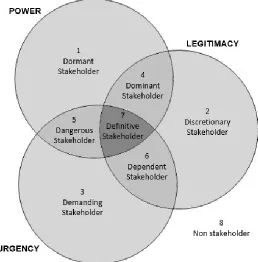
to coercive, utilitarian or normative means for imposing its will in the relationship. Legitimacy is seen as a desirable social good - it is more over-arching than individual self-perception and is recognized by groups, communities or cultures. Urgency is based on time sensitivity and criticality: the importance of the claim or the relationship to the stakeholder. Combining these attributes generates seven types of stakeholder: dormant, discretionary, demanding, dominant, dependent, dangerous, and definitive. In addition, there is an eighth group which are non-stakeholders. These eight groupings are mapped in Figure 1.
Figure 1, Stakeholder typology (adapted from Mitchell et al., 1997)
Unpacking Figure 1 identifies that:
(1) Dormant stakeholders possess the power to impose their will but, by not having a legitimate relationship or an urgent claim, their power remains under-utilised.
(2) Discretionary stakeholders possess legitimacy, yet have no power for influencing issues and they have no urgent claims. There is no pressure to engage in a relationship with such a stakeholder.
(3) Demanding stakeholders exist where the sole stakeholder relationship attribute is urgency. Such stakeholders have urgent claims while possessing neither legitimacy nor power.
(5) Dependent stakeholders are characterised by a lack of power, though they have urgent and legitimate claims. These stakeholders must depend on others to carry out their will. Any influence dependent stake holders gain is advocated through the values of others.
(6) Dangerous stakeholders possess urgency and power, but not legitimacy. They may therefore be coercive or ‘dangerous’. The use of coercive power often accompanies socially illegitimate status.
(7) Definitive stakeholders possess power, legitimacy and urgency. Any stakeholder can become ‘definitive’ by acquiring the missing attribute(s) or by having the missing attributes thrust upon them.
(8) Non-stakeholders possess none of the attributes and, thus, do not have any type of relationship with the issue
The stakeholder salience model has been used in a variety of contexts, from understanding changes in the automotive industry supply chain (Howard et al, 2003), public health (Page, 2002), business and educational policy (McDaniel and Miskel, 2002) to social and environmental policy (Zyglidopoulos, 2002). The advantage that the model offers in the fast-changing context of UK higher education is that it is dynamic which ‘permits the explicit recognition of situational uniqueness’, together with the recognition that ‘each attribute [power, legitimacy, urgency] is a variable, not a steady state, and can change for any particular entity’ (Mitchell, Agle and Wood, 1997, p.868). Thus, while offering an insight into an existing situation, the stakeholder saliency model also recognises that stakeholders can move from one category to another, and are not confined to any particular situation in an on-going dynamic.
Using a perspective from discourse analysis, this paper concurs with Hammersley and Atkinson (1983) that, ‘Official documents … should be treated as social products, they must
importance allocated to the various stakeholders involved. This research therefore uses a close examination of documentary evidence to understand how stakeholder relationships have changed in UK higher education. In a higher education context in which, as Brown argues, ‘We have increasingly seen an ideologically driven policy that markets are the best way of delivering goods and services, that higher education is a product or service like any other, [and] that consumers rather than producers should determine what is produced’
(2013, p.119), the authors have analysed both the Green Paper and responses thereto. As Alvesson and Skoldberg (2008, p.209) point out, ‘social institutions and social relations are constructed and reproduced through communicative actions’. The terms used in any discourse can be considered at a ‘discursive’ and an ‘ideational’ level – the latter relating to values and beliefs. The authors therefore considered the documents under study to identify what Wright Mills termed ‘the vocabulary of motives’ – ‘the way in which people account for and try to explain their motives (Alvesson and Skoldberg, 2008, p.208). Using this perspective and the categories defined in the Stakeholder Salience model, the authors analysed the market rhetoric contained in Government documents – for example, ‘under competitive pressure to provide better quality and lower cost’, ‘enabling greater competition,
while removing unnecessary regulations’ (White Paper, 2011, p.8 and p.18). – and responses which challenged it. One example is the UUK claim that, ‘there are and should be high thresholds for new entrants to not only protect students from poor quality, negligent providers but to protect the UK’s world leading reputation when it comes to universities’ (2016a, n/p). Evidence from the documentary analysis is then used to populate Table 1, and is subsequently explained. Reviewing actual policy proposals together with the consultations and responses involved, discourses used in the documentary evidence were analysed independently by each of the authors, using the stakeholder salience model to identify and assess stakeholder attributes in each phase. The outcomes of these analyses were then compared. A high degree of consistency in categorization was exhibited, and where there were divergent views, the data was jointly re-analysed and consensus reached.
Stakeholder Salience Phase 1 Salience Phase 2 Salience Phase 3
HEIs Dominant Dangerous Dependent
Government Dominant Discretionary Dangerous
Employers Discretionary Dependent Dangerous
Professional Bodies Dominant Discretionary Dormant
[image:20.595.86.538.74.148.2]New Providers Dormant Dangerous Definitive?
Table 1: Changing stakeholder relationships over time
The analysis identifies significant change in the stakeholder relationships over the three phases of change in UK higher education. It is evident that each stakeholders’ attributes change in each of the phases. This suggests a system in flux and that stakeholders may struggle to understand and adapt to their changing roles. In a steady state at Phase 1, professional bodies combined with higher education institutions to dominate the curriculum, the pedagogy and the employment outputs of the system – students. In addition, prior to the pressures of decreasing economic resources and rapidly increasing student numbers, Government was a contributor to this stable partnership. Students and employers were perceived to have what Wenger would term legitimate peripheral participation – they were a recognised part of the system, but they had little, if any, impact on curriculum structure. The demands of the two groups were not urgent, although employers were consistently expressing dissatisfaction with system outputs.
curriculum design, except in a small number of cases where they commissioned tailored programmes.
During the move from Phase 1 to Phase 3 and with the introduction of Degree Apprenticeships, higher education institutions have lost their dominant position with regards to determining curriculum content. Although universities have urgent and legitimate claims relating to curriculum design, in this context they must depend on influencing the employers who will commission their programmes to exercise those claims. They have therefore become dependent. In the stable situation outlined above in Phase 1, no stakeholder might be deemed dangerous, yet by Phase 3, two stakeholders, Government and employers, fall into that category. Through their determination to achieve a market model in higher education – despite the fact that the British Social Attitudes Survey indicates the majority of the population consistently oppose high levels of student debt (Holmwood et al, 2016, p.4) – the Government is introducing untested policies without allowing time for any unintended consequences to become apparent. In Phase 3, with the introduction of the Degree Apprenticeship, a student sub-group has emerged which will be debt-free, but who will have ceded any influence over choice of curriculum to employers. Despite the claim in UK Government rhetoric that students were to be at the heart of the new higher education market system, Degree Apprentices will be in the same position as higher education institutions – reliant on influencing employers with regards to the structure of their studies, and therefore dependent. The biggest loss of power appears to be for the Professional Bodies, who have moved from a dominant position in terms of the curriculum in Phase 1 to a dormant position in Phase 3. Dormant stakeholders do have power over the curriculum in professional practice programmes, but it seems that their close and harmonious relationship with higher education institutions has meant that they have lost legitimacy with a wider audience. Some apprenticeship standards, such as accounting, do incorporate professional qualifications. However, as discussed, professional bodies’ preferred process for measuring and assuring teaching excellence, advocated by the Institution of Engineering and Technology (2016) has not been adopted.
Discussion and Conclusions
The UK higher education landscape has changed rapidly in the last few years, and does so again from 2017. As one professional body, the Chartered Institute of Personnel and Development points out apprenticeship reform has been a high profile attempt to increase employer engagement, and they claim that, ‘In part, this is because apprenticeships are a form of training that politicians of all parties believe voters recognize and value’ (2015, p.12). The Conservative Party election manifesto of 2017 promised to increase apprenticeships at all levels to 3 million by 2020, and there is now a need to ‘deliver’ on the commitment. Yet this change in approach to skills development, including those professional skills needed at higher levels, cannot be achieved without active employer involvement. Indeed, the UK Government has stated explicitly that the employer levy is intended to change employer behaviour, and to encourage productivity and choice in the higher education curriculum. Consideration of the stakeholder salience model in the context of these changes, indicates considerable stakeholder reordering leading to unintended and unanticipated consequences, in addition to those which are intended and anticipated. An indication of the scale of the changes is given by the fact that all the identified stakeholder groups have changed their position more than once over the three phases outlined. Despite the market rhetoric claiming that students will be at the heart of the higher education system, for those student stakeholders who are Degree Apprentices, it will be their employer who will determine what they are taught. The students themselves will move from the ‘heart of things’ to the ‘periphery of things’, but they will graduate debt-free, in contrast to their fellow students who fund their own degree studies largely through loans. The Government perceives the Degree Apprenticeship to have a role in broadening participation in higher education, and it may be that, for those students for whom finance is a concern, Degree Apprenticeships will be the award of choice.
that while employers’ influence over the development of Higher Apprenticeships might make them more attractive, it is unclear that employers want that influence. The proposed model, which includes a requirement for employers to support apprentices in their learning and development for the duration of their studies, may be more expensive in terms of time and more inconvenient in terms of internal workplace arrangements. However, if the Degree Apprenticeship model functions well in terms of meeting employer need it is likely that employers will recruit school leavers, rather than graduates, as they will be easier to tailor to organisational needs. In such a case the primary relationship for the Degree Apprenticeship student would be the one with their employer, with the higher education institution potentially acting as a provider of credentials/qualifications rather than of education. Of course, higher education institutions have long entered into a variety of partnership models with employers. Yet, most of these arrangements are not curriculum- or student-focused and most are one-to-one. The apprenticeship model is, at heart, many-to-one, with employers grouping together to develop curriculum standards.
The impact on widening participation in higher education of Degree Apprenticeships is contested. On one hand, employer funding removes a barrier to participation from students who are unable or unwilling to take on student loans. However, as employers will be the primary conduit by which degree apprentices are recruited, HEIs will have less ability to influence the composition of degree apprentice cohorts. Widening participation has been outsourced to employers, some of whom clearly do see this as a duty, others may not. As King et al (2016) point out, employers have confidence in Higher National Diplomas and Higher National Certificates as stable and familiar awards. However, Degree Apprenticeships are ‘new and difficult concepts to explain’ (King et al, 2016). In addition, Rowe et al (2016) argue that there is a risk that employers who are competitors in a sector will not collaborate. They also point to ‘early evidence signaling excessively bureaucratic and cumbersome application and data collection mechanisms’ which may discourage employer engagement (2016, p.360).
workforce. If all entrants to an industry are trained to the same standard, then the background and educational diversity which is the hallmark of innovation may be mitigated. It is perhaps apposite that, while successive UK Governments have sought to bring the market into higher education, they have now established a monopoly standard in each domain developed and overseen by a small group of employers. There is no provision for competing standards. Thus, while apprentices may be more able to change jobs once graduated as their training may be better understood by prospective employers, they may be of less value in the long term as they have substituted on the job training for the educational skills that traditional higher education provides.
Professional bodies’ influence on the curriculum appears to have been sidelined. In the new landscape, they appear to have been marginalized - in the 2011 White Paper the reference is to Sector Skills Councils helping to develop standards for courses. The scope of the occupational areas covered by professional bodies is not as large as that of more general employers, but they have experience with occupations requiring high levels of expertise. As Holmwood et al (2016, p.5) point out:
‘The movement of vocational training in nursing, school teaching, social work … and so forth into universities has, until now, been recognized as a necessary requirement for the development of high-quality practitioners capable of adjusting to change over time in their professions’.
The language used by the UK Government in proposing the new landscape is, perhaps, informative. In the context of Degree Apprenticeships higher education institutions will be commissioned by employers to provide employee development, rather than a more general education. Funding for the Degree Apprenticeship will come from the Skills Funding Agency rather than from an established higher education funding body – the strong implication being that, although engaging in study for a higher education award, students will now be employees receiving skills development. Higher education provision will therefore be split between employer-funded, vocationally-relevant, but more focused, programmes, and the wider range of higher education programmes where students are self-funding through loans or where they are supported by their family. However, it can be difficult to differentiate higher education institutions on the basis of a course curriculum, however detailed that may be, and Holmwood et al (2016) point out that universities have vastly increased their expenditure on the fabric of the institutions (for example, on new student accommodation and social space) and on presentation of the image of an institution. This focus on lifestyle choice emphasizes the social university experience at the expense of engagement with the challenge of higher level learning. The contrast between the education experience offered to self/other funding students, and that offered to Degree Apprentices, where their performance in the workplace and in the university will be consistently monitored, is considerable.
quality sector’. There is evidence from the United States that many students, particularly those whose family has no prior experience of higher education, are not informed consumers, and are therefore vulnerable to exploitation. Higher education is a major UK industry and a major earner of foreign exchange. Internationally, UK higher education has been seen as a quality brand. UUK argue that, ‘To protect the UK’s international reputation high barriers to entering the sector should remain. This includes for degree awarding powers and new providers applying for university title should pass a public interest test’ (2016a, p.5). No such test has been introduced, with the risk that lessening regulation on all to facilitate private entry and more competition may adversely affect brand standing.
One of the key concerns of the UK Government is the affordability of the higher education system as student numbers increase. Currently, in the UK degree funding system, the biggest item of expenditure for the UK Treasury is the maintenance and fee loan subsidy/write-off (the, so called, RAB charge). The Institute of Fiscal Studies explains the current system for
funding undergraduate higher education as follows:
‘Tuition fees are capped at £9,000 per year. Students do not have to pay these fees up front; they are entitled to government-backed loans... The loans taken out by students incur a real interest rate of RPI+3% whilst they are studying, and a real interest rate of between 0% and 3% once they have left university, depending on their income. Individuals do not start making repayments until their income rises above £21,000. They must repay 9% of their income above this threshold, and continue doing so until their loan is fully repaid or for 30 years, whichever comes first. Any outstanding debt that remains at this point is written off.’ (2015, n/p)
government costs, the lower RAB charge will mitigate these savings. The system may therefore not be much cheaper than the current one for the taxpayer.
References
Alvesson, M. and Skoldberg (2008) Reflexive Methodology: New Vistas for Qualitative Research Sage Publications
Apple, in Palmer, J. (Ed) (2001) Fifty Modern Thinkers on Education: From Piaget to the Present Routledge, London
Becher, T. and Trowler, P.R. (2001) Academic Tribes and Territories : Intellectual Enquiry and the Culture of the Disciplines (2nd Edn) Society for Research into Higher Education/Open University Press, Buckingham
Chartered Institute of Personnel and Development (2015) Policy Report – Unlocking workplace skills: What is the role for employers? CIPD
Confederation of British Industry (2014) Gateway to Growth: CBI/Pearson Education and Skills Survey
Department of Business, Innovation and Skills (2011) White Paper Higher Education: Students at the Heart of the System
Department of Business, Innovation and Skills (2015) Apprenticeships Levy: Employer owned apprenticeship training Consultation document August 2015
Eicher, J-C. (1998) ‘Financing Higher Education: Innovation and Changes’ European Journal of Education Vol 33(1) pp31-39
Eicher, J. & Chevaillier, T. (2002). Rethinking the Financing of Post-Compulsory Education.
Higher Education in Europe XXVII (1-2), pp.69-88.
Gambin L. & T Hogarth T. (2016) Counting the cost, reconciling the benefits: understanding employer investment in Higher Apprenticeships in accounting, Accounting Education, 25:5, 502-518,
Greenaway, D. and Haynes, M. (2003) ‘Funding Higher Education in the UK: The Role of Fees and Loans’ The Economic Journal Volume 113, No. 485 pp 150-166
Guild HE (2016) ‘Guild HE Responds to the Higher Education Green Paper’ available on Guild HE website at: guildhe.ac.uk
Higher Education Better Regulation Group (2011) Professional, Statutory and Regulatory Bodies: an exploration of their engagement with Higher Education
Holmwood, J., T. Hickey, R. Cohen and S. Wallis (2016) In Defence of Public Higher Education : Knowledge for a Successful Society Convention for Higher Education
Hogarth T. and Gambin L. (2014) 'Employer investment in Apprenticeships in England: an exploration of the sensitivity of employers in the construction sector to the net costs of training', Construction Management and Economics, 32 (9), 1-12.
Hogarth, T., Gambin, L., Winterbotham, M., Baldauf, B., Briscoe, G., Gunstone, B., Hasluck, C., Koerbitz, C. and Taylor, C.(2012) 'Employer Investment in Apprenticeships and Workplace Learning: The Fifth Net Benefits of Training to Employers Study', BIS Research Paper Number 67. London: BIS
Howard, M., R. Vidgen and P. Powell (2003) ‘Overcoming Stakeholder Barriers in the Automotive Industry: Building to Order with Extra-Organisational Systems’ Journal of Information Technology, vol. 18, pp.27-43.
Inside Government Briefing on Apprenticeships 17 November 2015
Institute of Engineering and Technology (IET) (2016) The IET’s response to the BIS Green Paper on ‘Fulfilling Our Potential: Teaching Excellence, Social Mobility and Student Choice’ letter dated 16 January 2016
Jarvis, P. (1999) The Practitioner-Researcher: Developing Theory from Practice Jossey Bass, San Francisco
Kelly, A.V. (1995) Education and Democracy: Principles and Practices Paul Chapman Publishing Ltd., London
King, M., Waters, M., Widdowson, J. and Saraswat, A. (2016) ‘Higher technical skills: learning from the experiences of English FE colleges and Australian technical and further education institutes’ Higher Education, Skills and Work-Based Learning Volume 6 (4) pp 329-344
Kupper, H. (2002). Management Mechanisms and Financing of Higher Education in Germany. Germany: LMU.
McDaniel, Julie E.; Miskel, Cecil G. (2002) Stakeholder Salience: Business and Educational Policy. Teachers College Record, v104 n2 p325-56 Mar
Mitchell, R.K., B.R. Agle and D.J.Wood (1997) ‘Towards a Theory of Stakeholder Identification and Salience: Defining the Principle of Who and What really counts’ The Academy of ManagementReview Vol 22(4) pp 853-886
Nkrumah-Young, K. and P. Powell ‘Exploring Higher Education Financing Options’ (2011)
European Journal of Higher Education, 1(1), pp 3-21
Page, C. (2002) ‘The Determination of Organization Stakeholder Salience in Public Health’
Journal of Public Health Management & Practice September, 8(1), Issue 5, pp 76–84
Quality Assurance Agency (2016) ‘Fulfilling Our Potential: Teaching Excellence, Social Mobility and Student Choice’ QAA’s Response to Green Paper QAA 1434 Quality Assurance Agency for Higher Education, Gloucester
Royal Society (2016) Royal Society Response to the Higher Education Green Paper Fulfilling Our Potential: Teaching Excellence, Social Mobility and Student Choice available at royalsociety.org
Times Higher Education (2009) Global revolution 26 November 2009
Universities UK (2016a) Fulfilling Our Potential: Teaching Excellence, Social Mobility and Student Choice Universities UK Response to Green Paper available at universitiesuk.ac.uk
Universities UK (2016b) The Future Growth of Degree Apprenticeships UUK, London
Welcome to our consumers 26 November 2009, Hannah Fearn
Wyness, G. (2015) Paying for Higher Education paper EA026 Centre for Economic Performance, London School of Economics and Political Science
Ziderman, A. & Albrecht, D. (1995). Financing Universities in Developing Countries. London: Falmer
Zyglidopoulos, S. (2002) ‘The Social and Environmental Responsibilities of Multinationals: Evidence from the Brent Spar Case’ Journal of Business Ethics Volume 36, Issue 1, pp.141– 151.