Cooper, Richard P. and Byde, C. and de Cecilio, R. and Fulks, C. and Morais,
D. (2018) Set-shifting and place-keeping as separable control processes.
Cognitive Psychology 105 , pp. 53-80. ISSN 0010-0285.
Downloaded from:
Usage Guidelines:
Please refer to usage guidelines at or alternatively
1
Set
-
Shifting and Place
-
Keeping as Separable Control Processes
Richard P. Cooper, Catherine Byde, Roberto de Cecilio1, Chelsea Fulks & Danila Morais
Department of Psychological Sciences, Birkbeck, University of London
Abstract: We present three experiments using a sequential binary choice task that explore the relationship between two proposed cognitive control functions: set-shifting and place-keeping (i.e., keeping track of one’s place within a sequential task). The task involves switching from one stimulus-response mapping to another across trials, according to a predefined sequence and in the face of occasional brief interruptions. Response-stimulus interval, interruption length and interrupting task were varied. The robust finding across all experiments was that varying response-stimulus interval led to standard effects attributable to set-shifting, while varying interruption length led to standard effects attributable to place-keeping, but in no cases did the factors interact. We interpret the results as supporting the view that set-shifting and place-keeping are achieved by separable control processes and illustrate this interpretation with a computational model of performance on the task.
Corresponding Author: Richard P. Cooper
Department of Psychological Sciences Birkbeck, University or London Malet Street, London WC1E 7HX United Kingdom
Phone: +44 20 7631 6211 Email: [email protected]
Word Count: 17,966 (excluding title, references, author affiliations, acknowledgments, appendix, figures and figure legends)
Keywords: cognitive control; set-shifting; place-keeping; executive function; task interruption; procedural error
2
Set
-
Shifting and Place
-
Keeping as
Separable Control Processes
Richard P. Cooper, Catherine Byde, Roberto de Cecilio, Chelsea Fulks & Danila Morais Department of Psychological Sciences,
Birkbeck, University of London
Abstract: We present three experiments using a sequential binary choice task that explore the relationship between two proposed cognitive control functions: set-shifting and place-keeping (i.e., keeping track of one’s place within a sequential task). The task involves switching from one stimulus-response mapping to another across trials, according to a predefined sequence and in the face of occasional brief interruptions. Response-stimulus interval, interruption length and interrupting task were varied. The robust finding across all experiments was that varying response-stimulus interval led to standard effects attributable to set-shifting, while varying interruption length led to standard effects attributable to place-keeping, but in no cases did the factors interact. We interpret the results as supporting the view that set-shifting and place-keeping are achieved by separable control processes and illustrate this interpretation with a computational model of performance on the task.
1
Introduction
Almost 25 years ago Rogers and Monsell (1995) lamented the fact that, while it had “long been understood that cognitive processes require control processes to organize them”, the mechanisms supporting that control were “to put it mildly – poorly understood” (p. 207). Much progress has been made in the intervening years (see, Logie, 2016, for a recent summary and discussion), yet the majority of studies have focused on one aspect of cognitive control or “executive function” (whether it be related to set-shifting, response inhibition, etc.), typically using relatively simple tasks. There is of course good reason for this, as initial progress would not have been possible without good levels of process purity (i.e., tasks whose performance primarily involves the operation of a single putative executive function) and high levels of experimental control over the many variables that affect performance on tasks that require elements of cognitive control.
Yet many tasks, particularly those outside of the laboratory, involve multiple putative cognitive control mechanisms working together if optimal (or even good) levels of performance are to be achieved. Indeed, even the Wisconsin Card Sorting Task (WCST: Milner, 1963), which is widely used in the clinical assessment of executive functioning and where large numbers of perseverative errors are taken to indicate an impairment of such function, requires the coordinated operation of multiple processes to maintain a sorting rule in memory, process both positive and negative feedback, inhibit the use of failed sorting rules, and infer, select and apply alternative potential sorting rules. While the WCST is often considered to be a “set-shifting” task (i.e., a task that primarily taps the executive function of set-shifting: Miyake et al., 2000), the avoidance of perseverative errors actually requires the successful coordinated functioning of several different control processes (Stuss et al., 2000). Significant research questions therefore remain concerning the operation of control processes in more complex tasks.
3
literature spanning a century of work (see Monsell, 2003, and Vandierendonck et al., 2010, for reviews and, in the latter case, a theoretical synthesis), and place-keeping, a control process introduced more recently by Altmann et al. (2014) in order to account for participant performance on sequential tasks in the face of interruptions. We begin by reviewing the two processes before introducing a variant of Altmann et al.’s (2014) UNRAVEL task. We argue that performance of the task recruits both set-shifting and place-keeping processes, and present three experiments which suggest that these processes operate independently. On the basis of these results, we further argue that distinct representations of task are involved in the cognitive processes underlying set-shifting and place-keeping, and illustrate this with a computational model that simulates key behavioral effects.
1.1 Set-Shifting
“Task set” refers to the configuration of the cognitive system required to perform a specific task (see, e.g., Logan & Gordon, 2001; Schneider & Logan, 2007), including the configuration of attentional and response-selection processes, the priming or activation of learned stimulus-response associations, and so on. Thus a color-naming task set would consist of attentional orientation to color input, activating associations between visual color inputs as stimuli and the corresponding verbal names as responses, and setting a suitable response-selection threshold for verbal output, while a word-reading task set would consist of attentional orientation to visual word inputs, activation of associations between visual word inputs as stimuli and the corresponding verbalizations as responses, and perhaps a similar response-selection configuration. Set-shifting is held to be required whenever higher order processing requires changing from one task set to another (i.e., whenever task-switching is required).
While a number of empirical paradigms have been developed to explore set-shifting, it is typically evidenced by choice reaction time tasks where participants respond by categorizing blocks of stimuli in different ways on different trials. Participants take longer to respond, and are more likely to err, on trials following a change in the categorization rule compared to trials that do not require a change in the rule – the so-called switch cost. There is debate about the cognitive processes that give rise to this cost. One view is that switch costs reflect management of interference from the preceding task set on the new task set (e.g., Allport & Wiley, 2000). A competing view is that they reflect processes involved in reconfiguring the cognitive system for the new task set (e.g., Rogers & Monsell, 1995). A middle ground is advocated by Vandierendonck et al. (2010), who argue that set-shifting requires both interference management and task set reconfiguration.
4
predictable, participants may use the RSI to reconfigure the cognitive system in preparation for the upcoming task set, but that stimulus presentation is necessary to complete these reconfiguration processes (e.g., Rogers & Monsell, 1995; Meiran, 1996). Alternatively, the RSI may allow dissipation or inhibition of the activation of the previous (competing) task set, with stimulus presentation being necessary to optimize performance and minimize interference from activation of other task sets (e.g., Allport & Wiley, 2000). A third interpretation proposed by De Jong (2000) is that participants are indeed fully able to reconfigure their cognitive systems during a sufficiently long RSI, but that they do not do this on all trials. On some trials they may “fail-to-engage” in preparation. On this account the residual switch cost is an artefact of averaging RT over trials. De Jong (2000) supports this interpretation through an analysis of RT distributions.
Regardless of the precise origin of the residual switch cost, or of switch costs more generally, it is important to note for current purposes that the established view is that the processes required for task-set reconfiguration, i.e., processes related to the inhibition or disengagement of the current task set and/or the priming/engagement of the subsequent task set, must occur whenever switching from one task-set to another. That is, set-shifting is not a process that only occurs in studies that explicitly measure switch costs. It is a process, or collection of processes, that occur whenever a change of task set is required, as, for example, when it is necessary to respond to different aspects of a stimulus on successive trials.
1.2 Place-Keeping
Studies of set-shifting typically require participants to switch between two or sometimes three tasks, with the target task on any trial being cued either explicitly or implicitly by some aspect of the stimulus, such as its position on the screen. Yet many tasks, particularly real-world tasks, are temporally extended and sequential in nature – they consist of multiple steps that should be performed in order but without explicit order cues. A fundamental question therefore concerns how the cognitive system generates sequential behavior. Prior to the cognitive revolution is had been argued that such behavior was the result of stimulus-response S-R chains (e.g., Washburn, 1916; Watson, 1920; cited in Lashley, 1951), with one response in a sequence serving as the stimulus for the next S-R link. Lashley (1951) argued against this account on the grounds that the elements of sequential behaviors (both in the domains of language and skilled movement) have super-ordinate structure: R1 is not invariably followed by R2. Rather, R1 might be followed by R2 in one situation but by R3 in another. Lashley’s alternative proposal was that sequential behavior was governed by higher-order task representations which excite or partially activate elements of the sequence, with sequential order of those elements achieved through dynamic processes (the details of which he did not specify) operating on the partially activated elements.
5
to both perseverative errors (where steps are inappropriately repeated) and anticipatory errors (where steps are left out).2 Altmann et al. (2014) found that interruptions, even of just a few seconds, increase the probability of perseverative errors more than the probability of anticipatory errors. The authors interpret their findings within an information-processing model in which sequential processing relies upon associative links from the representation of the current step to the representation of the next step (i.e., a form of context-specific chaining), combined with activation decay to discourage reselection of recently completed steps (see Altman & Trafton, 2015).
Hambrick and Altmann (2015) elaborate on these findings by showing in an individual differences study that place-keeping ability (measured in terms of sequential accuracy on the interrupted UNRAVEL task, as described below) correlates with fluid intelligence (as measured with Raven’s advanced progressive matrices), but not with working memory capacity, set-shifting or multi-tasking ability. They further argue that place-keeping is itself an executive function, i.e., one of a “suite of mental operations that coordinate and supervise other mental operations in the service of performing some task” (p. 104), and relate the function to more general mechanisms responsible for goal-management. On this view it is of similar theoretical importance to more widely accepted executive functions, such as set-shifting as described above. Critically, place-keeping is argued by Altmann and colleagues to be pervasive. That is, while their empirical investigations of place-keeping have been focused on the effects of interruption within a specific sequential task, the mechanisms that support place-keeping are held to operate in any complex task where steps must be completed in a prescribed order.
1.3 The UNRAVEL Task
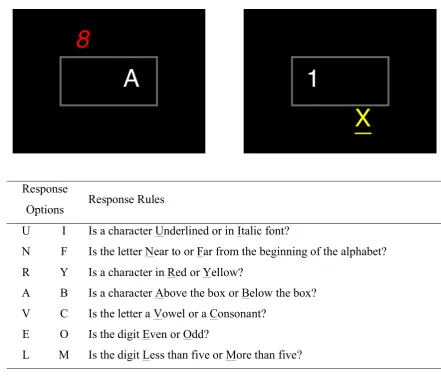
The UNRAVEL task (Altmann et al., 2014; Altmann & Trafton, 2015; Hambrick & Atlmann, 2015; Altmann & Hambrick, 2017) is a sequential binary choice response task in which successive steps involve responding to different dimensions of a compound stimulus. The order of the steps (i.e., the dimension for each successive response) is encoded in the acronym “UNRAVEL”, which serves as mnemonic. Two potential stimuli from the task are shown in figure 1. On the first step, participants are instructed to respond (by typing with their preferred fingers on a standard computer keyboard) with the letter ‘U’ if the stimulus contains an underlined character or ‘I’ if it contains an italic character. (Exactly one character in each stimulus is either underlined or italic.) On the second step, participants are instructed to respond with the letter ‘N’ if the letter in the stimulus is near the beginning of the alphabet and ‘F’ if it is far from the beginning. (Letters in the stimulus are either ‘A’, ‘B’, ‘U’ or ‘X’, so again there is no ambiguity in the response.) The procedure continues, with the possible responses on each step given by the rules in figure 1 and the step determined by cycling through the seven letters of “UNRAVEL” (i.e., after the ‘L’ step, participants are instructed to return to the ‘U’ step). Critically, the response options on each step are different, so it is possible to infer from a participant’s response their place in the UNRAVEL sequence.
2
6
1.4 Set-Shifting and Place-Keeping in the UNRAVEL Task
The UNRAVEL task was initially developed as a means of exploring error following interruption on a sequential task. Thus, Altmann, Trafton and colleagues (Altmann et al., 2014; Altmann & Trafton, 2015) compared the types of errors made by participants when interrupted at random points in the UNRAVEL sequence. On trials that were not preceded by an interruption, participants occasionally left steps out (i.e., they made anticipation errors). More rarely they repeated steps (i.e., they made perseverative errors). On trials following a brief interruption (of 2 to 3 seconds), however, the rate of anticipatory errors increased slightly (from approximately 1.0% of trials to 1.5% of trials), while the rate of perseverative errors increased more markedly (from less than 0.5% to almost 3.0% of trials), with longer interruptions resulting in even more perseverative errors.
As noted above, Altmann et al. (2014) interpret their results in terms of a cognitive operation of “place-keeping” that is held to be involved in maintaining one’s position within a sequential task. However, the basic (uninterrupted) UNRAVEL task also shares many key features with tasks commonly used to investigate set-shifting. As with the tasks reviewed by Monsell (2003), for example, stimuli are multidimensional and on
Response
Options Response Rules U
N R A V E L
I F Y B C O M
Is a character Underlined or in Italic font?
Is the letter Near to or Far from the beginning of the alphabet? Is a character in Red or Yellow?
Is a character Above the box or Below the box? Is the letter a Vowel or a Consonant?
Is the digit Even or Odd?
[image:7.595.64.506.63.439.2]Is the digit Less than five or More than five?
7
different trials participants are required to respond to different dimensions, switching the dimension of the response (and hence the task set) on successive trials. In other words, the basic UNRAVEL task is a kind of set-shifting task in which the participant must shift set on each trial, using an internally maintained record of his/her position in the UNRAVEL sequence (which must be updated between each step) to determine the task set appropriate for each successive stimulus.
The UNRAVEL task does not include repeat trials with the same task set, and so it does not afford calculation of, for example, switch costs. However, if the basic UNRAVEL task does recruit set-shifting processes, then one would anticipate that variables known to affect set-shifting performance should also affect performance on the UNRAVEL task. As discussed above, one such variable that has been extensively studied is the response-stimulus interval. Given that the required task set on successive UNRAVEL trials is deterministic and known to the participant, increasing the response-stimulus interval between UNRAVEL trials should, on the assumption that the UNRAVEL task requires set-shifting, result in faster response times.
A second variable of interest in the (interrupted) UNRAVEL task is the temporal duration of interruptions. In the experiments of Altmann et al. (2014), participants were occasionally interrupted by a secondary task between trials of the UNRAVEL task. The secondary task involved using the keyboard to copy either 4 (experiment 1) or 2 (experiment 2) characters that appeared on screen. Unsurprisingly, temporally longer durations led to more sequence errors. Interruption length is therefore a key variable that appears to affect the effectiveness of place-keeping processes on the interrupted UNRAVEL task.
1.5 Overview of the Argument and Structure of the Paper
8
mechanisms underlying set-shifting and place-keeping are separable. In the discussion we consider implications of these findings for theoretical and computational accounts of the two control functions, and extend an existing computational model of set-shifting with place-keeping mechanisms in order to provide a theoretically novel account of our results.
2
Experiment 1
Experiment 1 sought to establish the independence or otherwise of place-keeping and set-shifting by replicating the Altmann et al. (2014) study but manipulating two variables: the response-stimulus interval within the UNRAVEL task and the length of the interruption. If successive steps on the UNRAVEL task involve set-shifting as argued in the introduction, and if place-keeping and set-shifting are independent, then manipulation of the response-stimulus interval within the UNRAVEL task should affect response times on that task (with longer response-stimulus intervals allowing greater preparation of the upcoming subtask, and hence resulting in shorter response times), but such a manipulation should have no effect on performance of the interrupting task or on resumption of the UNRAVEL task. Conversely, interruption length should affect the likelihood of a sequence error occurring on resumption of the UNRAVEL task (with longer interruptions resulting in more sequence errors) and this should not be modulated by response-stimulus interval. The alternative possibility is that the greater task-set preparation afforded by longer response-stimulus intervals will improve place-keeping and hence result in lower post-interruption error rates on the UNRAVEL task when the response-stimulus interval is longer.
2.1 Method
2.1.1 Participants
Forty-five adult participants from the Birkbeck student community completed the study in exchange for course credit. Data from five participants were excluded because of equipment failure. The final sample therefore comprised 40 participants (25 female, mean age 27.3 years; 15 male, mean age 24.2 years).
2.1.2 Design
The experiment involved manipulation of two within-subjects factors: response-stimulus interval (at three levels: 0 msec, 250 msec, and 500 msec) and interruption length (short, medium, long). The dependent measures were accuracy and response time on each task (i.e., on the UNRAVEL task and on the interrupting task, as described below) and number and type of errors on baseline trials of the UNRAVEL task (i.e., those not preceded by an interruption) and post-interruption trials of the UNRAVEL task.
2.1.3 Interrupting Task: The Text-Copying Task
9
completion of the task participants were instructed to press the return key, which was only enabled when the correct number of letters had been typed. This led to immediate continuation of the UNRAVEL task from the point at which the interruption occurred. Note that participants were not required to achieve perfect accuracy on the text-copying task, though accurate copying was stressed, and all participants achieved high levels of accuracy on the task. (See the results subsection.)
2.1.4 Procedure
Participants were first given an in-depth verbal introduction to the UNRAVEL task. In this introduction the acronym was highlighted, emphasizing each letter step-by-step together with its corresponding pair of response options. Once the task had been explained, participants were directed to a written summary of the instructions for each step, which was posted on the wall in their line of sight. This summary remained visible throughout the task. No instructions were given about typing responses with specific fingers (i.e., participants were free to use their individual typing preferences). Participants then completed two practice blocks of the task (administered on a standard PC with 21” monitor and 16:9 aspect ratio) to ensure that they understood the task.
The first practice block consisted of 56 UNRAVEL trials (i.e., 8 repetitions of the full UNRAVEL sequence) and no interruption trials. Interruption trials, where participants were presented with a screen asking them to copy a string of letters as described above, were introduced on the second practice block. In this block there were two 4 letter, two 8 letter and two 12 letter interruptions, distributed randomly throughout the UNRAVEL sequence according to a translated exponential distribution with minimum separation of 3 UNRAVEL trials and a mean separation of 6 UNRAVEL trials between interruptions, as per the specification of Altmann et al. (2014). The mean number of UNRAVEL trials in this second practice block was 42, but the number of trials per participant varied depending on the number of trials between interruptions, which itself varied as described above. An experimenter remained present during the practice blocks to give assistance if needed. Moreover, during the practice blocks the program that administered the task provided feedback to participants on a trial-by-trial basis if they made an error on either task, indicating the correct response. In the case of the UNRAVEL task, and in this second practice block only, the program also indicated from which step the participant should resume. The response-stimulus interval (i.e., the interval between UNRAVEL trial responses and the presentation of the subsequent stimulus, whether it be another UNRAVEL trial or the interruption task) in the practice blocks was fixed within participants but varied between participants, being either 0 msec, 250 msec or 500 msec. Note that, in all cases, completion of the interrupting task led immediately to resumption of the UNRAVEL task. That is, in all cases there was no interval between the participant entering their response to the interrupting task and presentation of the next UNRAVEL stimulus.
10
given within the experimental blocks. Instead, accuracy feedback was provided on screen at the end of each block (e.g., “That completes block 1. You scored 95% on this block.”). Each participant was individually tested in one session lasting between 45 and 60 minutes.
As in previous work with the UNRAVEL task, a different compound stimulus was presented on each trial, with successive stimuli differing in the digit, the letter, the position of the element outside of the box, the position or color of the colored element, and the position or font decoration of the italic/underlined element. Moreover, participants potentially had unlimited time to respond on each trial (i.e., trials did not time-out).
Prior to embarking on data collection the experimental procedure was reviewed and approved by the departmental ethics committee.
2.2 Results
2.2.1 UNRAVEL Accuracy and Response Time
One would anticipate that speed and accuracy on the UNRAVEL task will vary as a function of trial type. For example, one would anticipate faster and more accurate responses on ‘R’ trials (discriminating red or yellow) than ‘V’ trials (discriminating whether the letter is a vowel or consonant), simply because the former is a more practiced discrimination. Such an analysis would not be informative with respect to our hypotheses. We therefore pool the data from all trial types and focus first on UNRAVEL accuracy and response times on baseline trials (i.e., on trials not immediately preceded by an interruption) as a function of response-stimulus interval.
UNRAVEL trials with response time of greater than 20 seconds (less than 0.1% of trials) were excluded from analysis, as were those immediately following an interruption. On the remaining trials, accuracy was generally high (see figure 2, left), resulting in a negatively skewed distribution. A one-way within-subjects ANOVA on the accuracy data (arcsine transformed, to reduce skew) revealed no effect of response-stimulus interval (F(2, 78) = 0.009, p = 0.991, 𝜂!! = 0.000). In contrast, response time on
correct trials decreased with response-stimulus interval, from a mean of 2610 msec to a mean of 2295 msec as response-stimulus interval increased from 0 msec to 500 msec (see figure 2, right), and a one-way within-subjects ANOVA revealed that the effect of response-stimulus interval on response time was significant (F(2, 78) = 15.685, p < 0.001, 𝜂!! = 0.287). Follow-up t-tests indicated that all pairwise differences were
significant (0 msec versus 250 msec: t(39) = 2.847, p = 0.007; 250 msec versus 500 msec: t(39) = 3.258, p = 0.002; two-tailed probabilities in both cases).
11
𝜂!! = 0.096). While the rank order of mean response times reflected interruption length (2610 msec, 2629 msec, 2861 msec, 3094 msec for none, short, medium and long interruptions), the only statistically significant pairwise difference was that between RT following long interruptions compared with baseline trials (i.e., 3094 msec versus 2610 msec: t(39) = 2.885, p = 0.006, two-tailed).
With regard to potential effects of response-stimulus interval on post-interruption response time our interpretation does not make clear predictions given that the RSI preceded but did not follow interruptions. Arguably, such effects might be attenuated (compared to baseline trials), given that any preparation prior to an interruption will wholly or partially dissipate during the completion of the interrupting task. A two-way within-subjects ANOVA on response time on correct post-interruption UNRAVEL trials was performed to test whether the effect of response-stimulus interval on baseline UNRAVEL trials persisted in post-interruption trials. While mean response times were slower for short response-stimulus intervals than long response-stimulus intervals (2861 msec at 0 msec RSI versus 2686 msec at 500 msec RSI), the effect was not significant (main effect of response-stimulus interval: F(2, 78) = 1.735, p = 0.183, 𝜂!! = 0.043).
However, there was (as would be anticipated from the preceding analysis) an effect of interruption length (F(1.551, 60.488) = 10.038, p = 0.001, 𝜂!! = 0.205) on
post-interruption response time, with the longest post-interruptions leading to significantly longer response times than the shortest interruptions (2967 msec versus 2584 msec; t(39) = 3.775, p = 0.001). Response-stimulus interval and interruption length did not interact in their effects on post-interruption response time (F(4, 156) = 0.934, p = 0.446, 𝜂!! = 0.023).
2.2.2 The Text-Copying Task
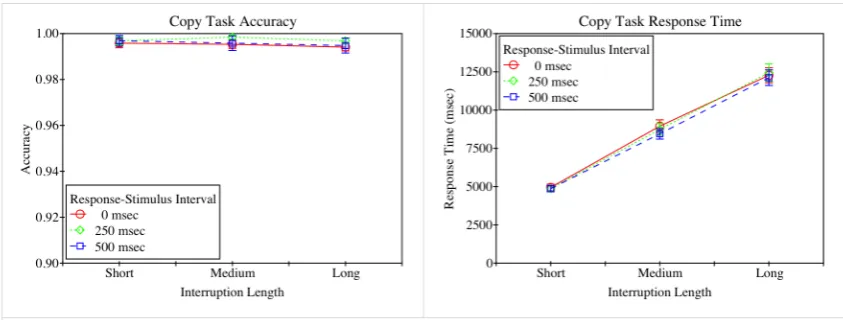
[image:12.595.86.509.71.228.2]In the analysis of performance on the interrupting task responses of more than 4 seconds per character were removed. (Only one response was excluded based on this criterion). Accuracy (i.e., the proportion of characters copied correctly) and response times, as a function of response-stimulus interval and interruption length, of the remaining data are shown in figure 3. As the figure shows, accuracy was high in all conditions, with no apparent effect of condition. The accuracy data was arcsine transformed to reduce skew due to the ceiling effect. A two-way ANOVA on the resultant data revealed no
12
significant effect of response-stimulus interval (F(2, 78) = 1.330, p = 0.270, 𝜂!! = 0.033),
no significant effect of interruption length (F(2, 78) = 1.919, p = 0.154, 𝜂!! = 0.047), and
no significant interaction (F(4, 156) = 0.225, p = 0.924, 𝜂!! = 0.006).
A similar ANOVA was performed on response times for the interrupting task. The analysis revealed a significant effect of interruption length (F(1.169, 45.584) = 392.812, p < 0.001, 𝜂!! = 0.910), as would be expected, but no significant effect of
response-stimulus interval (F(2, 78) = 2.430, p = 0.095, 𝜂!! = 0.059) and no interaction between
response-stimulus interval and interruption length (F(2.840, 110.769) = 1.069, p = 0.363,
𝜂!! = 0.027).3 Planned comparisons revealed, as expected that 12 letter interruptions
took significantly longer than 8 letter interruptions at each level of response-stimulus interval (t(39) ≥ 11.455, p < 0.001, in all cases) which in turn took significantly longer
than 4 letter interruptions (t(39) ≥ 14.259, p < 0.001, in all cases). This analysis
confirms that the interruption length manipulation was effective in altering the time participants spent performing the interrupting task and validates the following analyses of post-interruption responses as a function of interruption length.
2.2.3 Sequence Errors on the UNRAVEL Task
Recall that a key feature of the UNRAVEL task is that the response options on each step are different. Consequently one can infer, from a participant’s response, the step to which the participant was responding. Critically, one can therefore detect and categorize sequence errors. Following Altmann et al. (2014), we encode such errors in terms of whether they are anticipatory (i.e., skipping forward) or perseverative (i.e., repeating a recent step), and in terms of the difference between the expected and actual step. More specifically, if a participant skips a step (e.g., responding with a ‘R’ or ‘Y’ when on the N step), we encode the response as an “A1” (anticipate one step) sequence error. If, on the other hand, the participant repeats the step before last (e.g., responding with an ‘N’ or ‘F’ when on the A step), we encode the response as a “P2” (perseverate two steps) sequence error.
3
Sphericity was violated for all analyses involving interruption length (both here and in experiments 2 and 3), and so Greenhouse-Geisser corrections to degrees of freedom were applied in all cases.
[image:13.595.85.507.71.231.2]13
Figure 4 shows the proportion of errors of each type for baseline (i.e., non-interrupted) UNRAVEL trials (left) and post-interruption UNRAVEL trials (right, showing each level of interruption length) in experiment 1. Given the experimental design, each participant completed, for each level of response-stimulus interval, approximately 102 baseline trials and exactly 18 trials following an interruption (6 trials following a short interruption, 6 trials following a medium interruption, and 6 trials following a long interruption). Thus, each participant had 102 opportunities to err on baseline trials in each of the three (within-subjects) cells of the experimental design but only 6 to err following an interruption in each of the nine (within-subjects) cells. The proportion of post-interruption errors, particularly when considered within a single cell of the experimental design, is therefore a coarse measure. Moreover many participants performed without error in at least one experimental cell. Therefore, for clarity, the upper panels of figure 4 show the data for each response-stimulus interval condition (but pooled over interruption duration where applicable) while the lower panels show the data pooled over response-stimulus interval.
[image:14.595.86.512.69.388.2]14
anticipatory errors were observed to be more common than perseverative errors following baseline trials, but the opposite was observed in post-interruption trials. Elaborating on Altmann et al.’s results, a comparison of P1 versus A1 error rates (log transformed, to reduce skew) as a function of interruption level (none, short, medium, long), using a 2 (error type) by 4 (interruption level) ANOVA, found no main effect of error type (F(1, 39) = 2.953, p = 0.094, 𝜂!! = 0.070), but a main effect of interruption level (F(2.355, 91.833) = 19.676, p < 0.001, 𝜂!! = 0.335), and a significant interaction (F(2.449, 95.526) = 3.258, p = 0.033, 𝜂!! = 0.077), suggesting that the rates of
perseverative and anticipatory errors varied as a function of interruption level. Follow-up related t-tests on P1 versus A1 error rates revealed a significant difference in favor of A1 errors on baseline trials (t(39) = –2.603, p = 0.013, two-tailed), no significant difference following short interruptions (t(39) = 1.308, p = 0.199, two-tailed), and a significant difference in favor of P1 errors following medium interruptions (t(39) = 2.631, p = 0.012, two-tailed). While P1 errors were relatively more frequent than A1 errors following long interruptions, the comparison did not approach significance (t(39) = 0.412, p = 0.683, two-tailed).
The preceding analysis collapses across response-stimulus interval on the UNRAVEL task, but a second key question concerns whether response-stimulus interval on the UNRAVEL task affects the rate of each type of error, either on baseline trials or on trials immediately following an interruption. A differential effect of response-stimulus interval across interruption length would suggest some form of shared mechanism underlying the cognitive processes that support set-shifting and place-keeping. In order to explore this question a 3 (response-stimulus interval) × 4 (interruption level: none, short, medium, long) multivariate analyses of variance (MANOVA) was performed on the (log transformed) proportions of each type of error (i.e., with six dependent measures: A1 errors, A2 errors, A3 errors, P1 errors, P2 errors and P3 errors). This analysis revealed no significant interaction between response-stimulus interval and interruption length (Pillai’s Trace = 0.912, F(33, 7) = 2.207, p = 0.139, 𝜂!! = 0.912) and
no significant effect of response-stimulus interval (Pillai’s Trace = 0.465, F(12, 28) = 2.024, p = 0.061, 𝜂!! = 0.465). In contrast to the absence of effects related to response-stimulus interval, the effect of interruption length was significant (Pillai’s Trace = 0.706, F(17, 23) = 3.256, p = 0.005, 𝜂!! = 0.706).
In considering the results of this MANOVA it should be stressed that the data are heavily skewed as errors are relatively rare, particularly following base-line trials.4 Consequently the results must be interpreted with caution. While it appears that interruption length does, and response-stimulus interval does not, affect the rate of each type of error, additional evidence is necessary to make a more convincing case. In particular, to test for a null effect of response-stimulus interval (or its interaction with interruption length) on sequence errors, a series of Bayesian repeated measures ANOVAs were conducted on the sequence error data (untransformed proportions) using the JASP package (JASP Team, 2018; Version 0.8.5.1). Bayes factors for inclusion of each of the three potential model factors (RSI, interruption length (IL), and their interaction) for each error type (P3, P2, P1, A1, A2, A3) are shown in table 1. With the exception of A2 and A3 errors (which were rare), the data provide strong evidence (BFInc >> 1) for models with a single factor (interruption length). In contrast, the results
4 Reanalysis of the data excluding the baseline trials, i.e., via a 3 × 3 MANOVA, reduces the violation of
15
generally provide evidence against (BFInc << 1) models that include RSI or the RSI × IL interaction term.
2.3 Discussion
The results of experiment 1 a) support the interpretation of the UNRAVEL task as involving the same cognitive processes as involved in more typical set-shifting tasks, b) extend the results of Altmann et al. (2014) concerning place-keeping and the relative proportions of perseverative and anticipatory errors in baseline performance and following an interruption, and c) suggest that cognitive processes that support set-shifting and place-keeping operate independently.
First, response time on the UNRAVEL task was faster with larger response-stimulus interval. This is consistent with an interpretation of UNRAVEL performance whereby participants are able to use the response-stimulus interval to prepare for the forthcoming task (either by activating components of the forthcoming task-set or by inhibiting those of the previous task-set), as in standard task-switching procedures where the response-stimulus interval is varied (e.g., Rogers & Monsell, 1995). Note however that increasing the response-stimulus interval from 0 msec to 250 msec lead to a reduction in response time of 142 msec, while increasing it from 250 msec to 500 msec led to a further reduction of 167 msec. In other words, when preparation time was available, the reduction in response time was somewhat less than the increase in preparation time, but further extending the preparation time resulted in a significantly greater reduction in response time. Moreover the reduction in response time did not appear to have been the result of a speed-accuracy tradeoff, as accuracy was not poorer in the 500 msec RSI condition (when responses were relatively fast) than in the 0 msec RSI condition (when responses were relatively slow).5 These results are all as would be expected based on prior work within more standard task-switching paradigms and support the claim that set-shifting processes are involved in configuring the cognitive system (through active
5 Recall that participants completed two blocks of UNRAVEL trials at each level of response-stimulus
interval. Further analysis, reported in the supplementary materials, found that UNRAVEL response time was faster on the second block for each level of response-stimulus interval, as would be expected from learning, but that the speed-up was independent of response-stimulus interval. That is, the reduction in response time was affected by response-stimulus interval but not practice, further supporting our conjecture that task-switching is an integral process within the UNRAVEL task. This independence of response-stimulus interval and practice on UNRAVEL response time held for all three studies reported here.
P3 P2 P1 A1 A2 A3
RSI 0.021 0.629 0.069 0.029 0.039 0.047 IL 34.563 356.533 3.6 × 10⁵ 4.9 × 10⁵ 1.158 0.019 RSI × IL 0.002 0.880 0.015 0.002 0.024 2.4 × 10⁻⁴
[image:16.595.86.506.74.156.2]16
excitation of the upcoming task-set or through inhibition/dissipation of the previous task-set) between steps of the UNRAVEL task.
Second, interruption length was, unsurprisingly, proportional to the number of letters copied in the text-copying task. That is, “larger” interruptions did indeed take longer. While this is to be expected, it licenses analysis of sequence error behavior as a function of interruption length. This analysis demonstrates that: a) in trials not preceded by an interruption, anticipatory sequence errors are more common than perseverative sequence errors, but b) perseverative sequence errors increase in relative frequency following an interruption, and this increase is monotonically related to the duration of the interruption. These results extend those of Altmann et al. (2014) (who considered 2 letter and 4 letter interruptions in separate experiments), by showing in a single study that the rates of both anticipatory and perseverative errors increase with the duration of the interruption, though the rate of perseverative errors appears to increase more than that of anticipatory errors with longer interruptions. The increase in the rate of each error type can therefore not be attributed to between-study differences (e.g., subtle differences in task instruction or participant characteristics, as might be argued for the results of Altmann et al., 2014), but reflect within-subject differences in task-related processing during interruptions of different lengths.
Third, while response-stimulus interval affected performance on the UNRAVEL task, it had no discernable effect on performance of the interrupting task (text-copying), either in terms of response time or accuracy. More critically, response-stimulus interval did not affect sequence error rates, either on baseline trials (i.e., those trials not preceded by an interruption) or on post-interruption trials. Thus, the effects of response-stimulus interval and size of interruption appear to be orthogonal. This suggests that the information-processing mechanisms responsible for set-shifting and those responsible for place-keeping are independent. More specifically, it appears that task-position maintenance during an interruption operates on a different representation of task-set than the mechanism that achieves task-set activation within the sequential task. As argued in the introduction, this is not a necessary result.
While increasing the RSI from 0 msec to 500 msec appears to allow preparation of the next step, it does not alter the relative or absolute number of anticipatory or perseverative errors on such steps. This suggests a stage-like approach to task-set processing within the UNRAVEL task, where the current step is first retrieved and then prepared. Altering the response-stimulus interval affects preparation but not retrieval of the current step. Interruptions, by contrast, disrupt retrieval, specifically favoring the production of perseverative errors, with all levels of interruption having a more dramatic effect on perseverative errors than on anticipatory errors.
17
however, that whatever the origin of these differences might be, they do not alter the qualitative effects of the independent variables.
3
Experiment 2
Experiment 2 was designed to replicate the findings of experiment 1 using a different interrupting task, thereby supporting the claim that the effects found in experiment 1 reflect effects attributable to control processes rather than to the specific interrupting task. That is, if place-keeping and set-shifting are effected through independent processes or processes operating on separate representations, then the effects of interruption length and response-stimulus interval should hold regardless of the specific interrupting task. Moreover, given that the argument for the independence of the underlying processes is driven by the absence of an interaction between the variables (i.e., a null effect, albeit one in the presence of other effects), then failure to find any interaction on the key dependent measures in a second study will strengthen the conclusions of experiment 1.
3.1 Method
3.1.1 Participants
Forty-three adult participants were recruited from Birkbeck’s volunteer panel and paid £7.50 to complete the study. Data from three participants were excluded because of equipment failure. The final sample therefore comprised 40 participants (26 female, mean age 27.8 years; 14 male, mean age 36.1 years).
3.1.2 Design
The design was the same as for experiment 1.
3.1.3 Interrupting Task: Dot Counting
In experiment 2 the interrupting task was a dot-counting task. For this task, the screen showed a rectangular box (450 pixels wide, 350 pixels high) containing up to 13 red dots, with each dot being 10 pixels in diameter and positioned at random and without overlap within the box. The box was centered on the screen, which was a standard 1680 by 1050 pixel 21” monitor. Participants were asked to count the number of dots and use the keyboard to enter their answer. No instructions or constraints were given on use of specific fingers for typing the response. The primary UNRAVEL task resumed as soon as the participant pressed the return key (i.e., as in experiment 1, there was no interval between responding to the interruption and presentation of the subsequent UNRAVEL stimulus).
3.1.4 Procedure
18
3.2 Results
All analyses proceeded as per experiment 1.
3.2.1 UNRAVEL Accuracy and Response Time
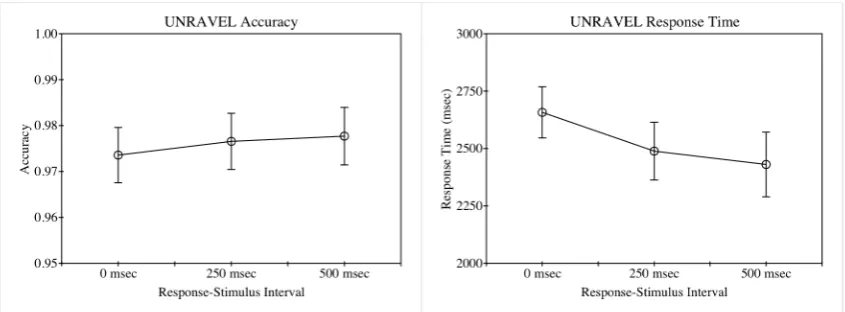
As for experiment 1, UNRAVEL trials with response time of greater than 20 seconds (less than 0.1% of trials) were excluded from analysis, as were those immediately following an interruption. On the remaining trials, accuracy was generally high (see figure 5, left), resulting in a negatively skewed distribution. As with experiment 1, a one-way within-subjects ANOVA on the accuracy data (arcsine transformed, to reduce skew) revealed no significant effect of response-stimulus interval (F(2, 78) = 1.594, p = 0.210, 𝜂!! = 0.039). Also in agreement with experiment 1, response time decreased with
response-stimulus interval, from a mean of 2658 msec to a mean of 2431 msec as response-stimulus interval increased from 0 msec to 500 msec (see figure 5, right), and a one-way within-subjects ANOVA revealed that the effect of response-stimulus interval on response time was significant (F(2, 78) = 10.361, p < 0.001, 𝜂!! = 0.210). Follow-up t-tests indicated that response time was significantly slower when response-stimulus interval was 0 msec than when it was 250 msec (t(39) = 3.847, p < 0.001, two-tailed) or 500 msec (t(39) = 4.113, p < 0.001, two-tailed). The difference between response time when the response-stimulus interval was 250 msec compared to when it was 500 msec did not reach significance (t(39) = 1.048, p = 0.301, two-tailed).
A one-within ANOVA on the RT on correct baseline and post-interruption trials from blocks with RSI of 0 msec, revealed a significant effect of interruption length (F(3, 117) = 3.997, p = 0.009, 𝜂!! = 0.093). As in experiment 1, the rank order of mean response
times reflected interruption length (2658 msec, 2862 msec, 3163 msec, 3315 msec for trials following no, short, medium and long interruptions). Mean RT following long interruptions was significantly longer than that following short interruptions (t(39) = 2.117, p = 0.041, two-tailed) and baseline trials (t(39) = 3.803, p < 0.001, two-tailed).
[image:19.595.87.510.74.230.2]19
preceding analysis) an effect of interruption length (F(2, 78) = 10.710, p < 0.001,𝜂!! =
0.215) on post-interruption response time, with the longest interruptions leading to significantly longer response times than the shortest interruptions (3341 msec versus 2795 msec; t(39) = 4.160, p < 0.001). Response-stimulus interval and interruption length did not interact in their effects on post-interruption response time (F(3.238, 126.267) = 0.731, p = 0.545, 𝜂!! = 0.018).
3.2.2 The Dot-Counting Task
Responses of more than 4 seconds per dot were excluded from analysis of performance on the dot-counting task (a total of 4 responses, all from the same participant). Accuracy (i.e., the proportion of dot-counting trials where the participant’s answer was correct) and response times as a function of response-stimulus interval and interruption length are shown in figure 6. Interruption length affected accuracy (F(1.174, 45.777) = 12.300, p < 0.001, 𝜂!! = 0.240) and response time (F(2, 78) = 147.203, p < 0.001, 𝜂!! = 0.791), but response-stimulus interval did not (accuracy: F(2, 78) = 0.904, p = 0.409, 𝜂!! =
0.023; response time: F(2, 78) = 0.005, p = 0.995, 𝜂!! = 0.000). The variables also did
not interact (accuracy: F(2.764, 107.778) = 0.517, p = 0.656, 𝜂!! = 0.013; response time: F(4, 156) = 0.649, p = 0.629, 𝜂!! = 0.016).6
Planned pair-wise comparisons confirmed that counting 12±1 dots took longer (mean: 8516 msec) than counting 8±1 dots (mean: 5774 msec; t(39) ≥ 8.099, p < 0.001, in all
cases), which took longer than counting 4±1 dots (mean: 3443 msec; t(39) ≥ 10.642, p <
0.001, in all cases). Accuracy tended to be lower for longer interruptions (means: 94.4% for 12±1 dots, 98.9% for 8±1 dots, 99.7% for 4±1 dots), with accuracy on the longest interruptions being significantly lower than on the shortest interruptions, regardless of response-stimulus interval (t(39) ≥ 2.287 p≤ 0.028, in all cases).
As in experiment 1, the analysis of response time confirms that the manipulation of the number of dots to be counted was effective in yielding temporally longer interruptions, though unlike experiment 1, accuracy on longer interruptions tended to be lower than accuracy on shorter interruptions. This is not surprising given the nature of the
6
Accuracy data in this analysis were arcsine transformed to reduce skew.
[image:20.595.87.509.71.230.2]20
interrupting task – participants were more likely to err when counting approximately 12 dots than when counting approximately 4 dots.
3.2.3 Sequence Errors on the UNRAVEL Task
Figure 7 shows the proportion of errors of each type for baseline (i.e., non-interrupted) UNRAVEL trials (left) and post-interruption UNRAVEL trials (right, showing each level of interruption length) in experiment 2. As in the previous experiment, the number of opportunities to err in each cell of the experimental design (particularly following an interruption) was low. Therefore in both cases the data are pooled over response-stimulus interval for clarity. Echoing the analysis of sequence errors for experiment 1 and comparing P1 and A1 error rates (log transformed) as a function of the presence and length of preceding interruption, a 2 (error type) by 4 (interruption level) ANOVA revealed significant main effects of error type (F(1, 39) = 10.657, p = 0.002, 𝜂!! = 0.215)
and interruption level (F(3, 117) = 17.038, p < 0.001, 𝜂!! = 0.304), as well as a
significant interaction (F(2.054, 80.119) = 3.692, p = 0.028, 𝜂!! = 0.086). Follow-up
[image:21.595.87.512.73.391.2]21
two-tailed) and medium interruptions (t(39) = 3.017, p = 0.004, two-tailed) but no significant difference between error types following long interruptions (t(39) = 1.577, p = 0.123, two-tailed).
As in experiment 1, the second issue of concern relates to whether response-stimulus interval affects the rate of each type of sequence error, either on baseline trials or following an interruption. A 3 (response-stimulus interval) × 4 (interruption level: none, short, medium, long) multivariate analyses of variance (MANOVA) was performed on the (log transformed) proportions of each type of error (i.e., with six dependent measures: A1 errors, A2 errors, A3 errors, P1 errors, P2 errors and P3 errors). As was the case in experiment 1, this analysis revealed no significant interaction between response-stimulus interval and interruption length (Pillai’s Trace = 0.730, F(29, 11) = 1.026, p = 0.510, 𝜂!! = 0.730) and no significant effect of response-stimulus interval
(Pillai’s Trace = 0.291, F(12, 28) = 0.959, p = 0.508, 𝜂!! = 0.291). In contrast to the
absence of effects related to response-stimulus interval, the effect of interruption length was significant (Pillai’s Trace = 0.673, F(18, 22) = 2.518, p = 0.021, 𝜂!! = 0.673).
As with experiment 1, the results of this MANOVA must be interpreted with caution since the error data are sparse and skewed.7 Again, the critical findings relate to the lack of an effect of response-stimulus interval in the presence of an effect of interruption length. Analogous Bayesian analyses to those following experiment 1 support the null effect of RSI or its interaction with interruption length (see table 2), at least for those errors that occur with sufficient frequencies to allow interpretation of the results (P2, P1, and A1). Moreover, the fact that the critical results echo those of experiment 1 further raises confidence in their reliability.
3.3 Discussion
While there are some differences between the results of experiment 1 and experiment 2, the gross patterns are the same: a) response-stimulus interval affects RT measures on the UNRAVEL task but not sequence errors, while b) interruption length affects post-interruption sequence errors, but c) the two manipulations do not interact in any analysis on any dependent measure. These findings support the view that the independent
7 As in the case of experiment 1, reanalysis of the data excluding the no-interruption condition, i.e., via a
3 × 3 MANOVAs, reduces the violation of homogeneity of variance but yields qualitatively equivalent results.
P3 P2 P1 A1 A2 A3
RSI 0.046 0.021 0.019 0.035 0.166 0.026
IL 0.267 6.708 2.3 × 10⁶ 9.269 0.400 0.011 RSI × IL 4.4 × 10⁻⁴ 1.5 × 10⁻⁴ 0.002 0.004 0.004 1.3 × 10⁻⁴
[image:22.595.76.512.74.159.2]22
variables affect distinct aspects of task-set processing that operate independently in the control of behavior on the interrupted UNRAVEL task.
The most obvious difference between the results of experiment 1 and experiment 2 relates to performance on the interrupting task. Participants made more errors when counting dots than when copying letters, and accuracy on dot-counting was particularly poor when the number of dots was high. Notwithstanding this, the manipulation of the number of dots achieved its purpose – more dots resulted in longer interruptions.
Turning to the interruption data, it is clear that the mean interruption length was somewhat shorter in experiment 2 (mean of 3443 msec, 5734 msec and 8516 msec for short, medium and long interruptions) than in experiment 1 (4895 msec, 8713 msec, and 12268 msec, respectively). However, this difference in duration is not clearly mirrored in sequence error rates (e.g., 0.97%, 1.67% and 3.33% for A1 errors in experiment 2 versus 0.83%, 1.67% and 4.03% for the equivalent in experiment 1). It appears that the interrupting task of experiment 2 produces slightly greater interference (per unit time of interruption) than that of experiment 1. This may be because the interrupting task in this experiment – dot counting – requires more cognitive processing than that of experiment 1 – copying characters. Alternatively (or in addition), it may be because dot counting potentially has a sequential element (at least when there are many dots and the task cannot be completed by subitizing), and it may be that this places demands on place-keeping, thus leading to greater interference.
4
Experiment 3
Experiments 1 and 2 show that the variables that affect place-keeping do not appear to affect set-shifting, and vice versa. They further suggest that these results are independent of the interrupting task. That is, not only are the processes supporting place-keeping and set-shifting independent or separable, but the nature of the interrupting task does not modulate the effects of either. Experiment 3 was designed to further explore this apparent independence of place-keeping and set-shifting by using a further interrupting task – in this case, a simple arithmetic task derived from that used in the study of interruptions by Botvinick and Bylsma (2005). In that study, participants repeatedly performed a relatively complex hierarchical sequential task (preparing instant coffee), with interruptions on 80% of trials. Interruptions were subtraction problems in which participants were required to calculate the change following a cash transaction (e.g., $5.00 tendered for a purchase of $1.60 → change is $3.40). In order to
control the length of the interruption experiment 3 used simple 1 digit addition and subtraction, but varied the number of problems (from 1 to 3) in order to vary the interruption length. Use of the arithmetic interrupting task is further motivated by the question of whether interrupting tasks with no obvious sequential character (in contrast to the task of experiment 2) would lead to similar results.
4.1 Method
4.1.1 Participants
Forty adult participants were recruited from Birkbeck’s volunteer panel (27 female, mean age 32.5 years; 13 male, mean age 28.8 years). Participants were paid £7.50 to complete the study and all participants’ data were included in the analyses.
4.1.2 Design
23
4.1.3 Interrupting Task: Single Digit Arithmetic
In experiment 3 the interrupting task consisted of one, two or three single digit addition or subtraction problems (e.g., 7 – 3 = ?) presented in succession. The problems appeared on screen and participants were required to type their response using the standard keyboard (and whichever fingers they chose) and then press the return key. As in the earlier experiments, participants were required to provide a response but that response was not required to be correct in order to proceed. Interrupting task accuracy was calculated as the proportion of arithmetic problems answered correctly within each interruption (i.e., 0/3, 1/3, 2/3, or 3/3).
4.1.4 Procedure
The procedure was identical to experiments 1 and 2 except that the interrupting task was replaced with the single-digit arithmetic task described above. On short interruption trials participants were asked to complete one single-digit arithmetic problem. On medium interruption trials two problems were presented in succession. On long interruption trials three problems were presented in succession. Participants were not informed of the number of arithmetic problems in any interruption – they were instructed to complete the arithmetic problems until an UNRAVEL stimulus reappeared. Thus, in contrast to experiments 1 and 2, pressing the return key did not always result in presentation of the next UNRAVEL stimulus.
As in the previous experiments, participants were given practice on the interrupting task prior to the main experiment (again as part of the second block of practice trials), with feedback given on the practice trials but not on the experimental trials. Also as with previous experiments, prior to embarking on data collection the experiment received ethical approval from the departmental ethics committee.
4.2 Results
4.2.1 UNRAVEL Accuracy and Response Time
[image:24.595.86.508.70.226.2]24
reduce skew) revealed no significant effect of response-stimulus interval (F(2, 78) = 1.369, p = 0.260. 𝜂!! = 0.034). In agreement with both experiment 1 and experiment 2,
response time decreased with response-stimulus interval, from a mean of 2581 msec to a mean of 2351 msec as response-stimulus interval increased from 0 msec to 500 msec (see figure 5, right), and a one-way within-subjects ANOVA confirmed that the effect of response-stimulus interval on response time was significant (F(2, 78) = 7.879, p = 0.001, 𝜂!! = 0.168). Follow-up t-tests indicated that response time was significantly
slower when the response-stimulus interval was 0 msec than when it was 500 msec (t(39) = 4.292, p < 0.001, two-tailed), as was the response time when the response-stimulus interval was 250 msec compared to 500 msec (t(39) = 2.451, p = 0.019, two-tailed). The difference between response time when the response-stimulus interval was 0 msec compared to when it was 250 msec did not reach significance (t(39) = 1.295, p = 0.203, two-tailed).
A one-within ANOVA on the RT on correct baseline and post-interruption trials from blocks with RSI of 0 msec, revealed a significant effect of interruption length (F(3, 117) = 12.834, p < 0.001, 𝜂!! = 0.248). Mean RT on the UNRAVEL task was slower in trials
preceded by a short, medium or long interruption (3215 msec, 3157 msec, 3239 msec) than in baseline trials (2581 msec; all t(39) > 4.917, p < 0.001, two-tailed), but interruption length did not affect RT.
Mean post-interruption response times were again slower for short response-stimulus intervals than for long response-stimulus intervals (3084 msec at 0 msec RSI versus 3211 msec at 500 msec RSI), but a two-way within-subjects ANOVA revealed that the effect was not significant (main effect of response-stimulus interval: F(1.703, 66.435) = 1.421, p = 0.248, 𝜂!! = 0.035). The effect of interruption length on post-interruption
response times was also not significant (F(2, 78) = 1.543, p = 0.220,𝜂!! = 0.038), nor
was the interaction between these variables (F(4, 156) = 1.621, p = 0.172, 𝜂!! = 0.040).
4.2.2 The Arithmetic Task
[image:25.595.77.501.80.236.2]25
interval and interruption length are shown in figure 9. Interruption length had a marginally significant effect on accuracy8 (F(2, 78) = 2.981, p = 0.057, 𝜂!! = 0.071) and
a significant effect on response time (F(1.408, 54.906) = 317.531, p < 0.001, 𝜂!! = 0.891). Response-stimulus interval did not affect either accuracy (F(2, 78) = 0.126, p = 882, 𝜂!! = 0.003) or response time (F(2, 78) = 0.048, p = 0.953, 𝜂
!
! = 0.001). The
independent variables also did not interact on either measure (accuracy: F(4, 156) = 0.535, p = 0.710, 𝜂!! = 0.014; response time: F(2.978, 116.158) = 0.829, p = 0.480, 𝜂
! ! =
0.021).
Planned comparisons confirmed that completing 3 arithmetic problems took longer (mean: 6213 msec) than completing two (mean: 4452 msec; t(39) ≥ 9.684, p < 0.001 in
all cases), which took longer than completing one (mean: 2560 msec; t(39) ≥ 11.456, p
< 0.001, in all cases). As in the case of the earlier experiments, the analysis of response time confirms that the manipulation of the number of arithmetic problems was effective in yielding longer interruptions. Again, this is to be expected given the nature of the interrupting task.
4.2.3 Sequence Errors on the UNRAVEL Task
Figure 10 shows the proportion of errors of each type for baseline (i.e., non-interrupted) UNRAVEL trials (left) and post-interruption UNRAVEL trials (right, showing each level of interruption length) in experiment 3. As in figures 4 and 7, the upper panels show the (lack of) effect of response-stimulus interval while the data in the lower panels are pooled over response-stimulus interval for clarity. Echoing the analysis of sequence errors for the previous experiments, comparing P1 and A1 error rates (log transformed) as a function of the presence and length of preceding interruption, a 2 (error type) by 4 (interruption level) ANOVA revealed no significant effect of error type (F(1, 39) = 0.028, p = 0.867, 𝜂!! = 0.001), a main effect of interruption level (F(2.011, 78.441) =
7.541, p < 0.001, 𝜂!! = 0.162), and no significant interaction (F(2.193, 85.518) = 1.808, p = 0.150, 𝜂!! = 0.044). Follow up related t-tests comparing P1 and A1 error rates (not
licensed by the ANOVA, but reported for completeness and comparison with the previous studies) revealed a significant difference in favor of A1 errors on baseline trials (t(39) = –2.663, p = 0.011, two-tailed), but no significant difference following short interruptions (t(39) = –0.954, p = 0.346, two-tailed), medium interruptions (t(39) = 0.784, p = 0.438, two-tailed), or long interruptions (t(39) = 1.409, p = 0.167, two-tailed).
As in the previous experiments, a multivariate ANOVA with (log transformed) error type (P3, P2, P1, A1, A2, A3) as the dependent measures and response-stimulus interval (3 levels) and interruption length (4 levels: none, short, medium, long) as within-subjects factors was conducted to determine whether interruption length affected the proportion of any error type (either singly or in conjunction with response-stimulus interval). There were no significant effects when all six dependent measures were entered into the MANOVA (interruption length: Pillai’s Trace = 0.513; F(16, 24) = 1.581, p = 0.151, 𝜂!! = 0.513; response-stimulus interval: Pillai’s Trace = 0.304; F(10,
30) = 1.313, p = 0.268. 𝜂!! = 0.304; the interaction between response-stimulus interval
and interruption length: Pillai’s Trace = 0.561; F(23, 17) = 0.944, p = 0.559, 𝜂!! =
0.561). Note however that the durations of interruptions in this experiment were lower than in experiments 1 and 2. Post-interruption error rates were correspondingly lower, with few errors occurring at offsets of greater than 1. A MANOVA restricted to just P1
8
26
and A1 error types yielded a significant effect of interruption length (Pillai’s Trace = 0.347; F(6, 34) = 3.015, p = 0.018, 𝜂!! = 0.347) but no significant effect of
response-stimulus interval (Pillai’s Trace = 0.158; F(4, 36) = 1.685, p = 0.175, 𝜂!! = 0.158) and
no interaction between the factors (Pillai’s Trace = 0.267; F(12, 28) = 0.849, p = 0.604,
𝜂!! = 0.267).
[image:27.595.86.509.79.393.2]