Celik, Dilek and Magoulas, George (2019) Challenging the alignment of
learning design tools with HE lecturers’ learning design practice. In: Scheffel,
M. and Broisin, J. and Pammer-Schindler, V. and Ioannou, A. and Schneider,
J. (eds.)
Transforming Learning with Meaningful Technologies:
14th
European Conference on Technology Enhanced Learning, EC-TEL 2019,
Delft, The Netherlands, September 16–19, 2019, Proceedings.
Lecture
Notes in Computer Science 11722. Springer. ISBN 9783030297350. (In
Press)
Downloaded from:
Usage Guidelines:
Please refer to usage guidelines at or alternatively
HE Lecturers' Learning Design Practice
Dilek Celik1 and George D Magoulas1
1 Knowledge Lab, Birkbeck College, University of London, UK {dilek, gmagoulas}@dcs.bbk.ac.uk
Abstract. Extensive research has been carried out for the development of learn-ing design tools; nevertheless, their adoption by HE lecturers remains low. Shar-ing, guidance, and various forms of representation are the main pillars of learning design tools. However, these features do not seem to be sufficient reasons to con-vince lecturers to adopt these tools in daily learning design practices in HE. This is attached to the gap between learning design tools and actual learning design practice of university lecturers. Sociomateriality provides an analytical lens for unpacking complex practices for identifying the design space of digital tools for learning design without predetermined boundaries. This paper is a first step in exploring how we can follow sociomaterialty in un-packing complex learning design practices in HE to inform the development of software for learning design. It conducts a survey with one hundred ten university lecturers on their learning design practices. It analyses data through sociomaterial theory and derives a so-ciomaterial evaluation framework. This is used as an instrument for the analysis of seven available learning design tools. A misalignment between tools and HE lecturers’ learning design practice is revealed. Points of misalignment extend the space for what it means to design digital tools that support-learning design prac-tices in HE, and they could be used to highlight areas for improvement to inform and strengthen further the way we design support tools for learning design.
Keywords: Learning Design Tools, Learning Design, Sociomateriality.
1
Introduction
The past decade has seen an expanding body of literature that seeks to develop Learning Design (LD) tools. LD tools have been conceived to enable teachers to define or portray efficient teaching ideas so that they can be shared with, and adopted by, other teachers. To our knowledge, there are twenty-nine LD tools in the LD [1], which is quite a lot when considering the maturity of the LD [2].
The notion of sociomateriality has been introduced in [10]. It has been established on the agential realist philosophy [11] and offers an analytic lens for unpacking com-plex practices for identifying the design space of technology [12]. The use of socio-materiality as a theoretical and emergent concept in educational studies has been brought to the agenda and it is used in technology-enhanced related studies resulted with valuable findings [13].
The present study aims to explore the alignment of LD tools and HE lecturers’ LD-P using sociomaterial theory as an analytical lens in un-packing complex practices and inform further development in software tools for LD. To this end, a survey with one hundred ten HE lecturers about their LD-P is conducted. The data are analysed through the sociomaterial theory to derive a sociomaterial evaluation framework. This is used to analyse seven LD tools in terms of their matching/mismatching with LD-P.
The present study is significant as it extends existing studies focusing on an aspect, which has not been studied adequately in the LD, i.e. how LD tools align with HE lecturers’ LD-P. The findings potentially take the LD studies beyond the current stage by providing misalignment points of LD tools with HE lecturers’ LD-P using sociomateriality, therefore, informing the software design for LD.
The remainder of this paper is as follows. Section 2 discusses the related work. Sec-tion 3 discusses the methodology. SecSec-tion 4 presents the evaluaSec-tion framework and Section 5 analysis seven LD tools and presents the misalignment points of these tools with LD-P of HE lecturers. Section 6 presents the discussion, Section 7 presents the conclusions, and future works.
2
Related Work
There have been limited studies into the HE lecturers' LD-P regarding how they design for learning, what influences their decisions, and what supports they use [4, 9]. The study described in [5] was the first step in understanding LD-P of HE lecturers. [5] focused on North American college teachers’ LD-P and concluded, however, that further in-depth research is needed about the actual decisions teachers make about the form of instruction. The other studies point out the importance of contextual factors in LD-P such as discipline, class size, year level, or teaching space [6, 7]. Later, [8] and [4] focused on the factors that shape HE teachers' design decisions, with the work described in [8] focusing on the specific context of Australian HE teachers. The most recent study by [9] focused on how novice teachers go about technology-enhanced learning design processes.
An evaluation framework for LD tools was proposed in [14]. Later, this framework was reconceptualised in [1]. However, both of these attempts did not exploit empirical evidence about HE lecturers’ LD-P.
Further work on design principles for LD tools was conducted in [15]. However, these principles were derived from conceptualisation and ongoing development of a single LD tool rather than from an analysis of HE lecturers’ LD-P.
useful in studying information system phenomenon that integrates entanglement of so-cial entities and technological artefacts (e.g. [17, 18, 19, 20]).
3
Methodology
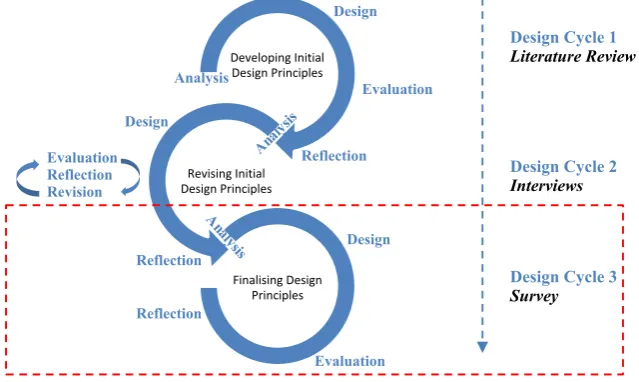
The alignment of LD tools with LD-P in HE was investigated through a process of analysis, design, evaluation, and revision of design-based research (DBR) project which integrates three iteration cycles [20]. The cyclic structure of the whole develop-ment process is illustrated in Fig. 1. This study employs the Design Cycle 3 from Fig. 1 highlighted with a red rectangle.
[image:4.595.129.449.358.549.2]In the analysis phase, the study conducts surveys on HE lecturers’ LD-P and need analysis on LD tools with one hundred ten HE lecturers and analysis the data using qualitative data analysis method. In the design phase, the data is investigated using sociomaterialility and the evaluation framework is developed based on that. In the evaluation phase, seven LD tools are evaluated using the evaluation framework. In the reflection phase, misalignment points are revealed.
Fig. 1. The methodological framework of the study
The target population of the online survey was HE lecturers from a variety of coun-tries, disciplines, and levels of teaching. The random sampling method was adopted [21]. The participants were randomly selected, and the online survey was sent to them via his/her institutional email address using an online survey tool, Survey Monkey (https://www.surveymonkey.com/). The survey was conducted individually, where par-ticipants filled the online survey in their appropriate time [21].
The survey was completed by 61 males and 49 female HE lecturers. The participants were from 27 different countries. The participants had taught courses at various levels in HE institutions: Bachelor’s (66), Master’s (75), Doctorate (63). Most of the partici-pants had more than 15 years of teaching experiences. 21 of them had 1-5 years, 20 of them had 6-10 years and 22 of them had 11-15 years of teaching experiences.
Developing Initial Design Principles
Revising Initial Design Principles
Finalising Design Principles
Design Cycle 1 Literature Review
Design Cycle 2 Interviews
Design Cycle 3 Survey Analysis
Analys is
A nalys
is
Design
Design
Reflection
Reflection
Reflection
Evaluation
Design Evaluation
Reflection Revision
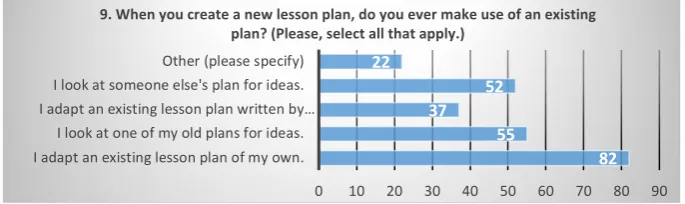
A survey is developed based on the key elements revealed in the LD [24]. The content validity of the survey instrument was confirmed by three pilot studies. The survey comprised of three sections: the first section, “Demographics”, contained three multiple choice questions about sex, teaching experienceof participants, and country, one open-ended question on lecturing domains and one checkbox question about levels of teaching. The second section, “LD tools”, contained one checkbox question, one mul-tiple-choice question, four open-ended questions, and a matrix/rating scale question. The participants could refer to up to three LD tools that they had experienced and they were asked to specific questions about these tools. The third section, “LD-P of HE lec-turers”, contained five open-ended questions, five checkbox questions, and one ma-trix/rating scale question to examine how HE lecturers design for learning, what factors influence their design decisions, and what tools they use. Therefore, the resulting sur-vey comprised of thirty-five questions. Fig. 2 shows some of the questions and the HE lecturers’ responses.
Fig. 2. Selected questions from the online survey
The qualitative data analysis steps were followed using the QSR NVivo software (www.qsrinternational.com) for the analysis [21]. These involve preparing the data for analysis, reading all the data, start coding, using coding to generate description, advanc-ing how the themes will be presented, and interpretation.
After having analysed data in Nvivo, socio-materiality was used as an analytical lens to explore the data using the following sociomaterial questions (Q1) What are the actors - human and non-human- involved in the LD-P? (Q2) What are the entangled relations of these actors? In the sociomaterial literature, human actors are people; non-human actors refer to technological artefacts; abstract concepts refer to any other actors that might have an influence in the domain under investigation. Q1 is answered identifying the actors involved in the HE lecturers’ LD-P and creating them as nodes in Nvivo by scrutinising the survey data. The Q2 is answered identifying the relations between ac-tors by looking at the entwined relations of the acac-tors in the LD-P of HE lecturers.
The seven LD tools are chosen among the most cited LD tools in the LD to be used in the sociomaterial analysis.
The research adhered to our college’s ethics framework and code of practice on re-search integrity (College’s Ethics Link will be provided after the review process).
82 55
37 52 22
0 10 20 30 40 50 60 70 80 90
I adapt an existing lesson plan of my own. I look at one of my old plans for ideas. I adapt an existing lesson plan written by…
I look at someone else's plan for ideas. Other (please specify)
4
Sociomaterial Evaluation Framework
Investigation of the analysed data using the sociomateriality led to the identification of sixty-one actors involved in the HE lecturers’ LD-P: four of them are identified as human actors; fourteen are technological artefacts; forty-three are abstract concepts.
Names, descriptions, number of files (number of respondents who mentioned to the actor) coded, number of references (number of times respondents referred to the actor) of human actors and digital artefacts are presented in Table 1 and Table 2 respectively.
Table 1. Human Actors
Human Actors Description Files References
Lecturers The main actors of LD-P. 110 110
Students The main target audience and a key actor of LD-P. 4 4 Co-lecturer Following a co-teaching model has an influence on
LD-P as sessions and assessments are planned together.
1 1
Colleagues Colleagues are involved in LD-P informally discussing LD ideas in a social network.
[image:6.595.126.473.369.582.2]7 8
Table 2. Technological Artefacts
Technological
Artefacts Description Files References
Virtual Learning Environment (VLE)
LDs need to be deployed into VLEs at the end. 28 28
Website Lecturers create websites to share course design. 3 3 Whiteboard Whiteboards are used to draw the overall LD structure. 7 7
Wiki Wiki is used to share learning designs. 1 1
Google Docs They are to develop the LDs together with colleagues. 1 1 Mind Map Tools Lecturers create a mind map of LDs using the tools. 6 6 Note-taking tool Note-taking tools are used to outline the LDs. 1 1 Paper-based tools Paper-based tools are used to draft a plan of LDs. 39 40 Post-it It is used to brainstorm LD ideas and organise them. 1 1 Video Tools Video tools are used to create videos for the class. 2 2 Slide Tools Slides are used to bring LD ideas together and to
pre-sent.
68 67
LD Tools LD tools are used to design LDs. 3 3
Word Processors Word processors are used to designing LDs. 2 2 Learning
Technologies
Technologies that can be used to enhance the learning experience.
3 3
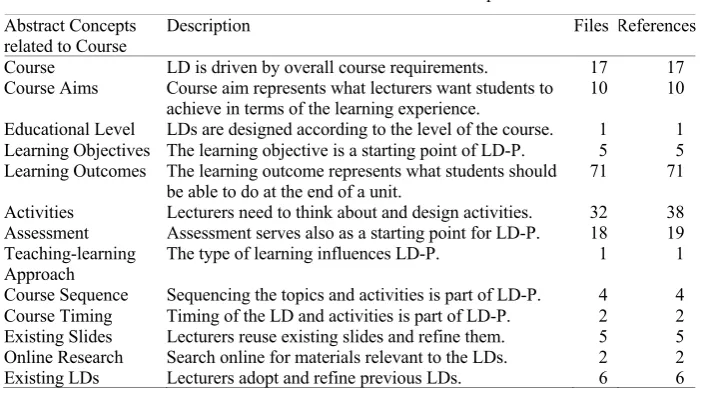
[image:6.595.130.474.653.710.2]Abstract concepts are grouped into four themes: human-related, course-related, in-stitutional, and feedback related - these are presented in Table 3, Table 4, Table 5, and Table 6 respectively.
Table 3. Human-Related Abstract Concepts
Abstract Concepts related to Human Actors
Description Files References
Lecturers' Values Lecturers’ values influence LD-P. 1 1
Table 4. Course Related Abstract Concepts
[image:7.595.129.470.592.708.2]Table 5. Institutional Abstract Concepts
Table 6. Feedback-Related Abstract Concepts Students' Access to
Resources Availability of institutional or remotely ac-cessible resources is important. 1 1 Students' Motivation Students' motivation influences LD-P. 1 1
Time Lecturers and students’ time affect LD-P. 1 1
Abstract Concepts related to Course
Description Files References
Course LD is driven by overall course requirements. 17 17
Course Aims Course aim represents what lecturers want students to achieve in terms of the learning experience.
10 10
Educational Level LDs are designed according to the level of the course. 1 1 Learning Objectives The learning objective is a starting point of LD-P. 5 5 Learning Outcomes The learning outcome represents what students should
be able to do at the end of a unit.
71 71
Activities Lecturers need to think about and design activities. 32 38 Assessment Assessment serves also as a starting point for LD-P. 18 19 Teaching-learning
Approach
The type of learning influences LD-P. 1 1
Course Sequence Sequencing the topics and activities is part of LD-P. 4 4 Course Timing Timing of the LD and activities is part of LD-P. 2 2 Existing Slides Lecturers reuse existing slides and refine them. 5 5 Online Research Search online for materials relevant to the LDs. 2 2
Existing LDs Lecturers adopt and refine previous LDs. 6 6
Abstract Concepts re-lated to Institutions
Description Files References
National Standards LDs need to align with national standards. 1 1
Cultural Norms Workplace culture shapes LD-P. 1 1
Institutional Standards LDs need to align with institutional standards. 3 3 Resources Availability of learning resources influences LD-P. 1 1
Syllabus The syllabus influences LD-P. 4 4
Course Book Some lecturers follow book chapters in their course. 4 4 Availability of
Technology Availability of technology in the classroom affects LD-P. 1 1
Curriculum The curriculum influences LD-P. 3 4
Delivery Method How the course is delivered influences LD-P. 15 15
Abstract Concepts related to Feedback
Description Files References
Feedback Feedback is about how well the lesson went
in relation to the LD. 3 3
Personal Notes Lecturers note the things that need
improve-ment during class time. 1 1
Observation Lecturers observe the way students react in
class to indirectly get feedback. 10 10
Review at the end Lecturers review LDs at the end of a course. 1 1 Success Criteria Lecturers measure LDs according to
From the above-shared tables shared, it can be seen that some of the actors are men-tioned by several participants while others are highlighted by few HE lecturers. From the sociomaterial perspective, anything that has an influence on the practice matters and should not be neglected. Therefore, all the actors mentioned have equal value in LD-P. The sociomaterial perspective allowed us to analyse the various ways technology is enacted into LD endeavours to achieve teaching-learning tasks in HE institutions. To design tools that follow sociomaterial design principles we need to investigate current LD artefacts, e.g. tools and approaches, analysing actors involved and their boundaries practices. To this end, an evaluation framework for the analysis and evaluation of LD tools is developed next. Its utility is further demonstrated by evaluating the alignment of seven LD tools with LD-P from the sociomaterial perspective in the next section.
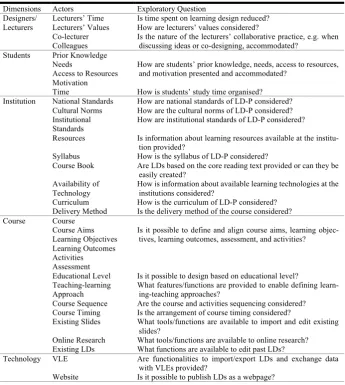
Based on the definition given to each actor by HE lecturers and the information presented in the tables above, the dimensions of the sociomaterial framework are pre-sented in Table 7. It comprised of six dimensions: lecturers/designers, students, institu-tion, course, technology, and feedback. Even though HE lecturers mentioned sixty-one actors, we combined some of the related actors and associated those actors with thirty-five questions which can be used to explore the various aspects or features of LD tools. The formed dimensions are defined as follows.
• “Designers/Lecturers” dimension considers LD-P from the HE lecturers’ per-spective. According to the results given in the above-presented tables, lectur-ers’ time and values are two important actors that need attention, and HE lec-turers practice LD in collaboration with a design co-lecturer and colleagues. Therefore, it would be useful to explore the role of these actors in LD tools using questions like the three questions shown in Table 7.
• The “Students” dimension deals with whether the artefact (e.g. LD tool) offers features that enable designers to meet students’ requirements. Students’ prior knowledge, needs, access to resources, motivation, and time are the factors for consideration when taking up LD-P.
• The “Institution” dimension is about considering the organisational and national requirements when a designer practises LD. According to HE lecturers’ view, national standards, cultural norms, institutional standards, resources, syllabus, course book, availability of technology, curriculum, and delivery method all have an influence on LD-P in organisational contexts.
criteria.
Self-reflection Lecturers reflect on LDs at the end of a course. 10 10 Learning Analytics (LA) LA can be exploited as a feedback mechanism. 1 1 Formal Students’ Evaluation This is a standard formal evaluation method. 21 22
Examination Exam results are also used as feedback. 3 3
Feedback Form The institutional feedback forms are used. 10 10
Survey A survey is a way of getting feedback. 22 22
Informal Students’ Evaluation Feedback is received via informal methods. 38 38 Written Students’ Evaluation Students write anonymous comments to the
lecturers about the course. 6 6
Discuss with Students Lecturers discuss the lesson with students. 38 38 Word of mouth Word of mouth is a way of getting students’
• The “Course” dimension considers the actors related to aspects of a course. Course, course aims, learning objectives, learning outcomes, activities, assess-ment, educational level, teaching-learning approach, course sequence, course timing, existing slides, online research, existing LDs are the main components of LD at the course level and they need to be defined.
• “Technology” dimension is concerned with the requirements or impact of technology in LD-P, such as desirable features of LD tools (exporting/import-ing LDs in different file formats, communication and interoperability tools, advice, guidance and recommendation capabilities), and other technological artefacts relevant to LD-P.
[image:9.595.126.472.331.717.2]• “Feedback” dimension considers if LD tools integrate any kind of feedback mechanism. Personal feedback, formal students’ evaluation, informal stu-dents’ evaluation, and LA are the kind of feedback used by HE lecturers.
Table 7. Sociomaterial Evaluation Framework for LD tools
Dimensions Actors Exploratory Question
Designers/ Lecturers
Lecturers’ Time Is time spent on learning design reduced?
Lecturers’ Values How are lecturers’ values considered?
Co-lecturer Is the nature of the lecturers’ collaborative practice, e.g. when
discussing ideas or co-designing, accommodated? Colleagues
Students Prior Knowledge
How are students’ prior knowledge, needs, access to resources, and motivation presented and accommodated?
Needs
Access to Resources Motivation
Time How is students’ study time organised?
Institution National Standards How are national standards of LD-P considered?
Cultural Norms How are the cultural norms of LD-P considered?
Institutional
Standards How are institutional standards of LD-P considered?
Resources Is information about learning resources available at the
institu-tion provided?
Syllabus How is the syllabus of LD-P considered?
Course Book Are LDs based on the core reading text provided or can they be
easily created? Availability of
Technology
How is information about available learning technologies at the institutions considered?
Curriculum How is the curriculum of LD-P considered?
Delivery Method Is the delivery method of the course considered?
Course Course
Is it possible to define and align course aims, learning objec-tives, learning outcomes, assessment, and activities? Course Aims
Learning Objectives Learning Outcomes Activities Assessment
Educational Level Is it possible to design based on educational level?
Teaching-learning Approach
What features/functions are provided to enable defining learn-ing-teaching approaches?
Course Sequence Are the course and activities sequencing considered?
Course Timing Is the arrangement of course timing considered?
Existing Slides What tools/functions are available to import and edit existing
slides?
Online Research What tools/functions are available to online research?
Existing LDs What functions are available to edit past LDs?
Technology VLE Are functionalities to import/export LDs and exchange data
with VLEs provided?
Wiki Is it possible to publish LDs as a Wiki? Whiteboard
Whiteboard, mind-map tools, post-it, note-taking tools, and pa-per-based tools are used in the conceptualization of LD. Is it possible to draft the ideas in the LD tool?
Mind Map Tools Post-it Note-taking tool Paper-based tools
Google Docs Are facilities to export LDs in various file formats available?
Word Processors Slides Making Tools
Video Tools What feature to enable video integration is provided?
LD Tools What features for communication, interoperability and data
ex-change with other LD tools are available?
Learning Technology What feature to suggest learning technology is provided?
Feedback Personal Feedback Is it possible to put notes regarding LDs in the LD tool?
Formal Students’ Evaluation
Is it possible to integrate the results of formal evaluations within the tool to inform the designers?
Informal Students’
Evaluation
Is it possible to integrate the results of informal evaluations within the tool to inform the designers?
Learning Analytics Is it possible to integrate LA into LD tools?
5
Analysis of LD Tools
[image:10.595.124.474.143.337.2]This section employs the sociomaterial evaluation framework developed in the pre-vious section to evaluate well-known seven LD tools. The LD tools analysed are: ILDE [22], OpenGLM [23], WebCollege [24], exeLearning [25], CADMOS [26], the Learn-ing Designer [27] and the ScenEdit [28] - the version presented in the cited paper was considered for the analysis of each tool.
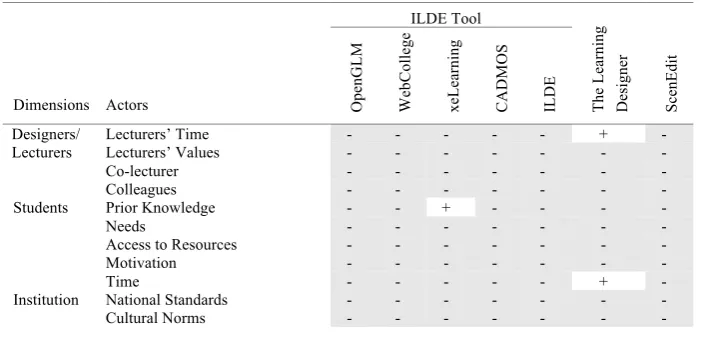
Table 8 provides an overview of the alignment/misalignment identified: the align-ment points are indicated with “+” and misalignalign-ment points are indicated with “-” and highlighted with a grey background colour.
[image:10.595.124.481.543.713.2]From Table 8, we see that even though there are various human and non-human actors engaged in the LD-P of HE lecturers and they all, have explanatory value when trying to understand the various ways technology is enacted into LD in HE, we see barely overlap of these actors with existing LD tools.
Table 8. Evaluation Framework for LD tools
Dimensions Actors
ILDE Tool Th e Le ar ni ng De si gn er Sc en Ed it Op en GL M We bC ol le ge xe L ea rni ng CA D M O S IL D E Designers/ Lecturers
Lecturers’ Time - - - + -
Lecturers’ Values - - - -
Co-lecturer - - - -
Colleagues - - - -
Students Prior Knowledge - - + - - - -
Needs - - - -
Access to Resources - - - -
Motivation - - - -
Time - - - + -
Institution National Standards - - - -
Institutional Standards - - - -
Resources - - - -
Syllabus - - - -
Course Book - - - -
Availability of Technology - - - - -
Curriculum - - - -
Delivery Method + + + + + -
Course Course + + + + + + +
Course Aims + + + + + + +
Learning Objectives + + + + + + +
Learning Outcomes + + + + + + +
Activities + + + + + + +
Assessment + + + + + + +
Educational Level + + + + + + +
Teaching-learning Approach + + + + + + +
Course Sequence + + + + + + +
Course Timing - - - + -
Existing Slides + + + + + + -
Online Research + + + + + + -
Existing LDs + + + + + + -
Technology VLEs + + + + + + -
Website - - - -
Wiki - - - -
Whiteboard - - - -
Mind Map Tools - - - -
Post-it - - - -
Note-taking tool - - - -
Paper-based tools - - - -
Google Docs + + - - + + -
Word Processors + + - - + + -
Slides Making Tools - - - -
Video Tools - - - -
LD Tools - - - + -
Learning Technology - - - -
Feedback Personal Feedback - - - -
Formal Students’ Evaluation - - - -
Informal Students’ Evaluation - - - -
Learning Analytics - - - - + + -
The “designers” dimension is slightly covered by the Learning Designer. The other tools did not take into account the designers-related actors.
The “students” related actors are barely covered by exeLEarning and ILDE tools. The other tools did not consider the students-related actors that influence LD at all.
The “course” dimension with its relevant actors are the actors covered mostly by the LD tools. Among the course related actors, course timing is not taken into account by any LD tools except the Learning Designer. Another point to highlight is here is that ScenEdit partially covered course related actors: course timing, existing slides, online research, and existing LDs are not adequately represented.
These seven LD tools do not offer any functionalities to gather direct feedback about the course. Only ILDE tool recently announced edCrumble [15] that considers integrat-ing LA into LD tools. In addition, the Learnintegrat-ing Designer provided analytical pie chart to inform the lecturers in terms of the proportion of the pedagogy chosen for LD.
6
Discussion
Analysing the LD-P of HE lecturers from sociomaterial perspective extends our un-derstanding of LD-P by revealing the actors’ complex interrelations and the boundaries that come into existence in LD-P. In the literature, there have been studies that investi-gated LD-P of the HE lecturers, such as work by [2, 4, 5, 6, 7, 8, 9]. However, these studies did not consider the complex sociomaterial environment and all the actors. Un-like these studies, where the main emphasis was on human-centric factors, this study contributes by considering all the human and non-human actors as a matter in LD-P. Furthermore, to the best of our knowledge, this study is the first one challenging the alignment of LD tools with LD-P in HE identifying misalignment points, as summa-rised below.
M1: None of the LD tools analysed in this study cover all the actors involved in
the LD-P of HE lecturers. ILDE is the most recent tool developed in the LD field and
it is dedicated to bringing various LD tools together. Nevertheless, according to the proposed sociomaterial framework, ILDE still requires enhancements to accommodate the actors highlighted by the HE lecturers that participated in this study.
M2: Another point highly valued by HE lecturers, which is not unfortunately
widely supported by LD tools is the designing for learning collaboratively. ILDE,
OpenGLM, WebCollege, exeLearning, CADMOS and the Learning Designer provide a function for only adapting and sharing LDs from others and editing them. However, HE lecturers collaborate with colleagues or co-teachers in the design of the LDs.
M3: HE lecturers’ time is an important factor that influences LD-P. Most LD
tools do not adequately consider this issue, apart from the Learning Designer.
M4: The information regarding students’ prior knowledge, needs, access to
re-sources, motivation, and time are influencers of LD-P. Although these actors are
widely acknowledged, they are not adequately accommodated in the LD tools.
M5: HE lecturers’ LD-P is shaped by the national and institutional standards
and they deploy the LDs into the VLE that is chosen by the institutions. The LD
tools evaluated in this study do not consider national and institutional standards. The LDs developed within ILDE, OpenGLM, WebCollege, exeLearning, and CADMOS can be deployed into VLEs. However, they still do not support all kind of VLEs.
M6: Course timing is an important component of LD. However, it rarely is taken
into account by LD tools - see the Learning Designer.
M7: At the end of the designing for the learning process, HE lecturers deploy their LDs into the VLE, but LD tools encounter with several challenges in terms
of data exchange and interoperability and offer limited functionality. The LD tools
M8: Supporting export of LDs into well-known file formats. The HE lecturers LDs are usually in the form of slides or word processor file. Even though, some of the tools export LDs in word processor format, they do not support any other formats.
M9: HE lecturers use various ways to get feedback regarding how well the
les-son went in relation to the LD. Personal notes, observation of the students during the
class time, review at the end of the class, self-reflection, and student criteria are the forms of getting personal feedback used by HE lecturers. However, LD tools are not sufficiently equipped to provide relevant functionalities.
M10: HE lecturers use several ways to get feedback from students regarding
how well the lesson went in relation to LD formally and informally. Examination,
feedback forms, and survey are the kinds of receiving formal feedback from students used by HE lecturers. The informal ways of getting feedback from students are written students’ evaluation, discussing with students, and word of mouth.
M11: HE lecturers care about LA. HE lecturers see LA as an additional feedback
mechanism to get valuable information about their students’ performance and learning experience. However, even though there is an effort such as [15], more research is needed to link LA with LD.
6.1 Limitations
The findings of this study are subject to some limitations due to the nature of data, and methodological choices. It is essential to bear in mind the possible bias in the re-sponses and analysis process. In order to avoid bias, increase objectivity, explore the credibility and therefore to improve transferability of the results of the study, the num-ber of the participants to the survey is kept high. The sample size of this study was sufficiently large compared to the existing studies in the LD (32 was the largest sample size identified in the recent LD literature [8]).
7 Conclusions and Future Works
In this paper, we have explored the alignment of LD tools with LD-P of HE lecturers from sociomaterial perspective. A survey designed and conducted with one hundred ten HE lecturers on their LD-P helped to identify relevant actors and led to the design of a sociomaterial evaluation framework for LD tools. Guided by the framework’s thirty-five exploratory questions, we analysed the alignment of seven LD tools to identify points of misalignment with LD-P. The identified misalignment points are summarised in eleven bullet points and discussed.
LD tools’ adoption and embedding in educational organisations, and of the require-ments for these tools.
References
1. Celik, D., Magoulas, G.D.: A Review, Timeline, and Categorization of Learning Design Tools. In: 15th International Conference on Web-Based Learning. pp. 3–13. , Rome, Italy (2016).
2. Prieto, L.P., Tchounikine, P., Asensio-Pérez, J.I., Sobreira, P., Dimitriadis, Y.: Exploring teachers’ perceptions on different CSCL script editing tools. Comput. Educ. 78, 383–396 (2014).
3. Dagnino, F.M., Dimitriadis, Y.A., Pozzi, F., Asensio-Pérez, J.I., Rubia-Avi, B.: Exploring teachers’ needs and the existing barriers to the adoption of Learning Design methods and tools: A literature survey. Br. J. Educ. Technol. 49, 998–1013 (2018).
4. Bennett, S., Agostinho, S., Lockyer, L.: Technology tools to support learning design: Implications derived from an investigation of university teachers’ design practices. Comput. Educ. 81, 211–220 (2014).
5. Stark, J.S.: Planning introductory college courses: Content, context and form. Instr. Sci. 28, 413–438 (2000).
6. Norton, L., Richardson, J.T.E., Hartley, J., Newstead, S., Pl, D., Norton, L.I.N., Mayes, J.: Teachers’ Beliefs and Intentions concerning Teaching in Higher Education. High. Educ. 50, 537–571 (2005).
7. Bennett, S.S., Agostinho, S., Lockyer, L., Kosta, L., Jones, J., Harper, B.: Understanding university teachers’ approaches to design. In: ED-MEDIA World Conference on Educational Multimedia, Hypermedia & Telecommunications. pp. 3631–3637. , Chesapeake, Virginia (2008).
8. Bennett, S., Thomas, L., Agostinho, S., Lockyer, L., Jones, J., Harper, B.: Understanding the design context for Australian university teachers: implications for the future of learning design. Learn. Media Technol. 36, 151–167 (2011).
9. Nguyen, G.N.H., Bower, M.: Novice teacher technology-enhanced learning design practices: The case of the silent pedagogy. Br. J. Educ. Technol. 49, 1027–1043 (2018). 10. Orlikowski, W.J.: Sociomaterial Practices: Exploring Technology at Work. Organ. Stud. 28,
1435–1448 (2007).
11. Barad, K.: Getting real: technoscientific practices and the materialization of reality. Differ. A J. Fem. Cult. Stud. 10, 87–128 (1998).
12. Orlikowski, W.J., Scott, S. V.: Sociomateriality: Challenging the Separation of Technology, Work and Organization. Acad. Manag. Ann. 2, 433–474 (2008).
13. Fenwick, T.: Sociomateriality and Learning : a critical approach. Sage, London, UK (2015). 14. Britain, S.: Learning design systems: current and future developments. In: Rethinking Pedagogy for a Digital Age: Designing and Delivering E-Learning. pp. 103–104. Routledge, Oxford, UK (2007).
15. Albó, L., Hernández-Leo, D.: Identifying Design Principles for Learning Design Tools: The Case of edCrumble. In: 13th European Conference on Technology Enhanced. , Leeds, UK (2018).
Systems. pp. 1–10. , New Orleans, USA (2018).
17. Sesay, A., Ramirez, R., Oh, O.-O.: Digital Transformation in Police Work: A Sociomaterial Perspective on Police Body Worn Cameras (BWC). Proc. 50th Hawaii Int. Conf. Syst. Sci. 4266–4275 (2017).
18. Jones, M.: A Matter of Life and Death: Exploring Conceptualizations of Sociomateriality in the Context of Critical Care. MIS Q. 38, 895–925 (2017).
19. Doolin, B., McLeod, L.: Sociomateriality and boundary objects in information systems development. Eur. J. Inf. Syst. 21, 570–586 (2012).
20. Amiel, T., Reeves, T.C.T.: Design-Based Research and Educational Technology : Rethinking Technology and the Research Agenda. Educ. Technol. Soc. 11, 29–40 (2008). 21. Creswell, J.W.: Research Design. SAGE Publications, Thousand Oaks, California,
California (2014).
22. Hernández-leo, D., Chacón, J., Prieto, L.P., Asensio-pérez, J.I., Derntl, M.: Towards an Integrated Learning Design Environment. In: 8th European Conference on Technology Enhanced Learning (EC-TEL). pp. 448–453. , Paphos, Cyprus (2013).
23. Derntl, M.: OpenGLM : Integrating Open Educational Resources in IMS Learning Design Authoring. In: The Art & Science of Learning Design. pp. 157–168. Sense Publishers, Rotterdam (2015).
24. Villasclaras-Fernández, E., Hernández-Leo, D., Asensio-Pérez, J.I., Dimitriadis, Y.: Web Collage: An implementation of support for assessment design in CSCL macro-scripts. Comput. Educ. 67, 79–97 (2013).
25. Britain, S.: A Review of Learning Design: Concept, Specifications and Tools. (2004). 26. Boloudakis, M., Katsamani, M., Retalis, S., Georgiakakis, P.: CADMOS: A learning design
tool for Moodle courses. In: Moodle Research Conference. pp. 25–32. , Heraklion, Crete-Greece (2012).
27. Laurillard, D., Charlton, P., Craft, B., Dimakopoulos, D., Ljubojevic, D., Magoulas, G., Masterman, E., Pujadas, R., Whitley, E.A., Whittlestone, K.: A constructionist learning environment for teachers to model learning designs. J. Comput. Assist. Learn. 29, 15–30 (2013).
28. Emin, V., Pernin, J.-P., Aguirre, J.L.: ScenEdit: An intention-oriented authoring environnment to design learning scenarios. In: European Conference on Technology-Enhanced Learning (EC-TEL 2010). pp. 626–631. , Barcelona, Spain (2010).