Linguistics and Literature Studies 4(2): 142-148, 2016 http://www.hrpub.org DOI: 10.13189/lls.2016.040207
Oral Speech: How Much Information is Hidden
b
ehind It
Yerchak Mikalai
Department of Psychology, Minsk State Linguistic University, Belarus
Copyright©2016 by authors, all rights reserved. Authors agree that this article remains permanently open access under the terms of the Creative Commons Attribution License 4.0 International License
Abstract
The idea that any thought is a temporary formation, consisting of images, emotions and signs is postulated. Some thoughts may contain only images, others – only emotions, and still others, only words. If thoughts consist only of images or emotions (or both), such thoughts are practically unconscious (we are not aware of them). Other thoughts may consist only of signs or mostly of signs, mixed with images and/or emotions. In this case we are already well aware of the contents of such thoughts. The hypothesis was tested in a laboratory experiment in which the participants were asked to listen to several short stories and give signals every moment they had more or less vivid images or emotions. It was discovered, that images appeared to represent the main characters of a story, to reflect something important or new, some change or choice. Emotions helped generate hypotheses concerning events to happen or serve as a kind of reaction to what had already happened. Later on the participants were requested to recollect some thoughts they had expressed to someone or someone's thoughts expressed to them. Then they were asked to specify whom every idea was addressed, what had been present in the idea but was missing in the oral statement. It was concluded that any thought might be regarded as a 3-D representation which had to be transformed into a one-plane speech expression.Keywords
Image, Thought, Sign, Emotion, Speech1. Introduction
Suppose a young man wants to have a cup of coffee. Let’s try to imagine how this thought might be represented in his mind. Just like a string of the appropriate words or in some other way? Although the majority of people don’t think about the problem at all and many really believe that they think in words still the reality might be quite different. We know that many two-year old children can’t speak. But it doesn’t mean that they don’t think. Most probably they do it using the means they have: sensations, images, emotions and different gestures (signs). These means can effectively be used in the process of thinking later in life as well. The above
mentioned young man for instance doesn’t need to name the
person, wanting coffee because it is obvious for him. And how does he know that he wants coffee? Quite probably thanks to some signals, coming from the appropriate receptors, located in his stomach. As to a cup of coffee, it may be represented in his mind as an image, consisting of the appropriate flavor of black coffee he used to have in the coffee shop near the underground station he passes by on his way home. As we see, the information, preserved in his mind is rather definite, has many aspects and attitudes. When expressed in speech this thought loses much of its richness and specificity.
So the aim of the article is to come to a conclusion what our thoughts consist of, how we can understand them and what factors and conditions stand behind the words, expressing any thought. To be frank we are not always sure that we understand another person's thought correctly and we often say: «What do you mean by saying so»? It's not surprising that some scientists argue that 75% (100%) of the information is rendered in nonverbal form. The complexity of the problem becomes still more evident if we speak about people, belonging to different cultures and speaking different languages.
constitutive function in thought. G. Kaufmann concludes logically that thinking shouldn't be regarded as separate from its symbolic expression, occurring in its own super-physical realm; as for concepts, they should be understood as a seriously misleading maneuver to regard them as some kind of mental objects or entities, as a kind of basic elements of thought in the form of «abstract ideas» or «internal structures». So the problem of thinking (or thought) seems to remain solved only partially and when asked what a thought might consist of we would be in difficulty searching for an answer.
Soviet psychologists define «thought» as the principal element of thinking, aimed at search of connections; it can be expressed in words of a language, but can also resemble associations of meaningful images. Lev Vygotsky underlined the fact that a thought and its expression in speech are different phenomena. A thought doesn't consist of separate words. What is simultaneous in thought is successive in speech. Alexander Sokolov discovered that the electrical activity of the speech organ muscles depended on the difficulty of the proposed task for the subjects; as that type of activation was detected not only in the process of verbal reasoning but also in nonverbal thinking, he concluded that a thought is always linked to a language.
As we can see most scientists agree, that our thoughts might consist of words and images. But there arises the problem with words, because if a thought consisting of words is equal to what is said in oral speech then it's just silent speech. Another problem concerns emotions, that play so marked a role in our life that even the term «emotional intelligence» was coined to underline its importance. Sometimes emotion is mentioned as something, that tincture image and thought in the flow of consciousness. But there's every reason to believe, that emotion is the third critical componentof a thought.
So the preceding material suggests that a thought might be considered as a dynamic temporary formation, constructed of signs (words, phrases), images and emotions in a particular proportion. Some thoughts may, of course, contain only images, others – only emotions, and still others, only words. If they contain only images or only emotions (or both), then the thoughts are practically unconscious and we can’t definitely say what we are thinking about. Other thoughts may consist only of signs or mostly of signs, mixed with images and/or emotions. In this case we are already well aware not only of the contents of the thought, but also of the language being used in the thought process.
2. Experimental Study of Text
Comprehension
It is possible to think of an experimental procedure which could help us discover how images and (or emotions) are associated with speech.
Experiment 1: Initial Evidence of Image and Emotion Generation during Text Comprehension
The above materials show that oral speech perception may be looked upon as the most appropriate way to throw some light on the problem. To test the hypothesis experimentally, speech comprehension was regarded as transition of speech stream into more concrete elements that include images and emotions. The experimental set consisted of two tape recorders and a buzzer; 40 students (17-19 years old) and 40 primary school children (8-9 years old) took part in the experiment. The participants were to listen to some short stories in Russian, that were played over the first tape recorder, and in the process of listening to respond with the buzzer when they became conscious of every new image. The signals were registered on the second tape recorder simultaneously with the sounding text. Listening to the recording right after the experiment allowed an analysis to be performed to identify those elements of the text that had stimulated appearance of certain images. Each participant was also asked to describe the images he had had in the process of listening to the text.
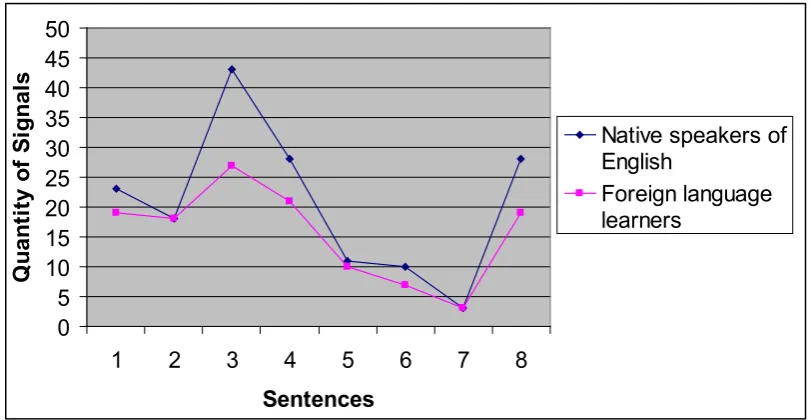
When the responses were tallied, it became evident that the maximum and the minimum amounts fell on the same text elements in both the groups, indicating that the adults and the children had understood the texts. Most important, the curves, representing the dynamics of image appearance were similar (see Fig. 1 and Fig. 2 as an example). One could thus arrive at the conclusion, that in most cases images appears when the participants hear text elements, that describe the maincharacters of the text, reflect somechange,
something new, a quick succession of events.
Another experiment was carried out with two newgroups of participants who were asked to listen to the same texts as had been used in the first experiment and to signal the moments when they experienced some emotion. The moments when emotions emerged in the participants’ consciousness (and the corresponding curves) appeared to be quite similar to those in the first experiment (the texts were the same). However, the overall quantity of responses was considerably smaller (about 2-3 times). Nonetheless, they still fell on the same text elements. The data analysis, including the participants’ self-reports, allowed us to conclude that in the process of text comprehension emotions might have two main functions: a) Help generate hypotheses concerning what’s going to happen, and b) Serve as a kind of reaction to what has already happened in the story. In subsequent experiments the procedure was made even simpler: participants were asked to tap on the desk with a pencil and their responses were registered on a copy of the text by the experimenter.
Experiment 2: Cross-Linguistic Exploration of Images and Emotions during Text Comprehension
image/emotion appearance dynamics, individuals who are studying English as a second language would have the dynamics of image/emotion appearance similar to that of native speakers of English. In other words the similarity of dynamics might serve to indicate adequate text comprehension; one might also say that the contents of the story caused similar thought elements in the minds of people, belonging to different cultures. The hypothesis was tested in an experiment conducted in two phases. In the first phase testing involved 30 students of Minsk Linguistic University, who were studying English as a second language. They listened to a set of short stories (texts 1 and 3 of the set are presented in the Appendix) and signaled (using the pencil tap) when they experienced images (texts 1, 2) or emotions (texts 3, 4). In the second phase, 20 native speakers of English (students at the University of California, Berkeley) were tested with the same materials and procedure.
The participants were asked some questions before the experiment, concerning frequency and some peculiarities of their image and emotion functioning. Most reported that they could easily imagine places they had visited and the majority remembered episodes from their childhood. Very few participants reported having no emotional reactions to the surrounding world. 56% of the Russian-speaking subjects and 35% of the native speakers of English noted that words always had an important influence on their mood.
A questionnaire administered after the experiment was designed to learn about the participants’ imagery and
emotion experiences during the experimental procedure. Most of them reported having both vivid and vague images, stimulated by separate phrases. Nevertheless 33% of the participants reported having images under the influence of separate words. It is also important to note that nearly 80% mentioned they could clearly sense the moments when the images (mostly visual and in color) arose in their consciousness. In terms of emotions, relatively few participants (30% in either group) reported having experienced very vivid emotions.
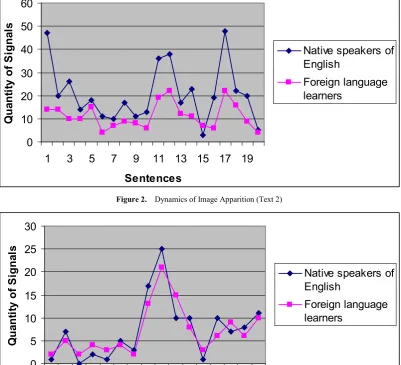
The primary analysis was based on the participants’ responses during text comprehension. Consistent with the experimental hypothesis, the curves were essentially identical for the native and non-native English speakers (Fig. 1, 2, 3, 4).
[image:3.595.102.508.429.639.2]From Fig. 1 and the corresponding text (the appendix), we can see that the participants report having images at the moments where the main character is introduced or there is some action and a change in the situation (sentences 1-4). The final phrase of the text, containing an unexpected answer of the character’s partner, stimulates a new image. The same idea can be inferred from Fig. 2. Fig. 3 indicates the moments of text perception when the participants reported experiencing emotions. This was most evident in the process of perceiving the 8th 9th and 10th phrases, corresponding to the culminating point of the story. A similar result is seen in Fig. 4, reflecting the importance of word choice in stimulating emotion appearance.
Figure 1. Dynamics of Image Apparition (Text 1)
0
5
10
15
20
25
30
35
40
45
50
1
2
3
4
5
6
7
8
Sentences
Q
ua
nt
ity
of
S
igna
ls
Native speakers of
English
Figure 2. Dynamics of Image Apparition (Text 2)
Figure 3. Dynamics of Emotion Apparition (Text 3)
Figure 4. Dynamics of Emotion Apparition (Text 4)
0
10
20
30
40
50
60
1
3
5
7
9 11 13 15 17 19
Sentences
Q
ua
nt
ity
o
f S
ig
na
ls
Native speakers of
English
Foreign language
learners
0
5
10
15
20
25
30
1
3
5
7
9
11
13
15
Sentences
Q
ua
nt
ity
o
f S
ig
na
ls
Native speakers of
English
Foreign language
learners
0
5
10
15
20
1
5
9 13 17 21 25 29 33
Sentences
Q
ua
nt
ity
o
f S
ig
na
ls
Native Speakers of
English
[image:4.595.104.506.388.717.2]In all of the experiments reviewed here images appear to represent the main characters of the stimulating material, to reflect something important or new, some change or some choice. These results are consistent with G. Kaufmann’s idea, regarding problem-solving - the novelty-variable appears to be the important cause of the participants’ need for visual imagery. It is also possible to hypothesize that the links between images and emotions on the one hand and the language of the stories (signs) on the other hand are stronger when the listener hears the story in his (her) native language: the 20 native speakers of English reported having more images and emotions than the 30 non-native English speakers. Nonetheless in both the groups there were participants, who reported having very many images and those who had few images. Most important, there was great consistency concerning the moments when the images were experienced.
In this respect it’s worth noting Luria’s description of a man with extraordinary memory in the process of reading a text [2]. He never missed a single detail and more often than most people could be carried away by a story. But he experienced quite peculiar difficulties, because practically every word stimulated an image in his mind. Because of the uncontrollable image emergence it was difficult for him to concentrate on what was essential in the text. Images were thus the dominant component of his cognitive system. Coming back to the results of the experiments one can say, that this extraordinary individual is at one extreme of the normal distribution curve. On the opposite side are those, who have no images at all. But the majority of people (like the participants of the experiments) are in-between the two extremes.
One concern with these experiments is that the images and emotions are reported in part because of the experimenter’s instructions; one might believe people are normally able to understand a story without them. But a simple self-observation in the process of listening to someone’s story about her (his) trip to some peculiar place will show, that one can’t get along without images (emotions). Just as one can't read a story or a novel without picturing the situations, the scenes or the heroes. But self-observation in such cases is not easy, as well as in the cases when we think about looking for a new job or a new place of living. We usually don’t recognize all of the images and emotions we experience. However, they must exist as without them no system of signs (a language) would be possible.
Strong evidence in favour of the multiple links between signs, images and emotions, allowing them to function as one integral mechanism, can be found in literature.
Let's consider how numerous links between signs and images are formed. They appear early in childhood. Ivan Pavlov, as it is well-known, regarded images as the first signal system. The more images a child has acquired the more intensive is his speech development. Here's some observation: by the end of the first year, a boy the author had been observing, used the sound “GAR” to name a guitar, a bag and dumbbells, pointing to each object with his finger.
But one month later the sound referred only to a guitar (both to the real object and to its picture or a schematic drawing); the bag and dumbbells had acquired their own sound associates. The example is consistent with Karl Pribram’s idea that a child starts communicating with other people using phrases, consisting of separate speech sounds, naming some object or emotional state [3]. By the end of the second year the phrases become more accurate and their reference to the surrounding world more clear.
Most important data can be obtained from studies, concerning speech and consciousness formation in blind and deaf children. As it is with all infants their first steps in psychic development begin with learning different elements of the surrounding world. Their images of this world are not visual or auditory but tactile, olfactory, gustatory. When such a child acquires the appropriate images there appears a possibility to attach signs to them, stimulating rapid speech development.
Deep understanding of verbal information is, as a rule, based on images. It’s not surprising that some chemists spoke of “seeing” the appropriate formulas, and many poets (Pushkin, Lermontov, Mayakovsky among them), used to make drawings when looking for the most appropriate word in a poem. The French mathematician Hadamard was of the opinion that success in math requires the creation of space schemes “in order to have a simultaneous view of all elements of the argument, to hold them together to make a whole of them glance all the elements of an idea, to unite them in one whole unit…” (Cited in Gordon, 1963, p. 114) [4 ]. R.N. Shepard recounted instances in which biologists, physicists, architects, musicians, writers, chess masters, artists and surgeons claimed that images were central to their creative output [ 5 ].
The links between images and emotions are formed very early too and in course of time are getting still stronger. Consider how emotionally a 2-month old child reacts to people’s faces. Later on even geometric forms can be estimated from emotional point of view.
Certain emotions find expression in the appropriate signs (words and phrases), and the corresponding type of intonation. It’s the sense of what is being said that determines the intonation. In this way the sense is most closely linked to the emotional component. No wonder emotional words are memorized better than common words. Experiment 3: What is to be discovered behind a verbal utterance
had been present in the thought but were not expressed in the utterance.
Let's analyze some of the thoughts that the participants considered worthy of mentioning.
Participant A. «If everything what I had dreamed of once came true, life would be absolutely uninteresting and might have made me commit suicide». The phrase was pronounced during a friendly conversation with a friend; most probably just to reflect a certain aspect of personal experience. Dominance of the sign component (the words here express the person's philosophy or world outlook) seems to be quite evident.
Participant B. «There's no such thing as everlasting love because some day it comes to an end». The judgment was addressed the participant's boy-friend while discussing further development of relations. In spite of the more or less emotional topic of the conversation, this phrase might be regarded as expressing the participant's world outlook and dominance of the sign component seems to be doubtless.
Participant C. «Everything in this world happens in the only possible and the most favorable for us way». The participant expressed the idea to her friend when the latter complained of having abandoned the former place of work as her boss was a willful person. The thought is the person's philosophic generalization and reflection of her optimistic world outlook. Although the participant uses the phrase in order to comfort her friend in some way, still one can see the obvious dominance of the sign component.
Participant D. «Teaching foreign languages on the basis of the computer program «The 25th shot» might be dangerous for a pupil's mind». The thought was spoken out during the lecture on methods of teaching foreign languages after watching some of the programs in action. Here the dominance of the sign component is also evident in spite of possible effect of images the participant had had during the program demonstration.
Participant E. «Time and distance cannot produce any effect on people's feelings if they really and truly love each other. The main thing is the desire to be together». The phrase seems to be not very emotional judging by its contents. But the situation in which it was said shows that the thought is based on the feeling of anxiety before parting of the dear person. The participant is anxious that long separation might deaden the other person's feelings.
Participant F. «Soon the child is to go to the kindergarten». The dominance of emotional component in the thought becomes evident when the participant informs about her anxiety and fear of the problems that might arise when the child starts visiting the kindergarten.
Participant G. «You know, I have so much to do today and I am so tired». The participant declines an invitation to come to someone's place because doesn't want to see the person. The emotional component is dominant here as well. In fact this is the case when the words reflect only a very small part of what is present in the participant’s thought.
Participant H. «It's a wonderful day today». The words are
addressed to a boyfriend; the woman participant means to say that it's so nice to be with him that even the day seems to be just wonderful. The emotional component of the thought could have been expressed in many other ways, while the sign component in the situation doesn't matter much.
Participant I. «It's infinite happiness and pleasure to be holding in my arms this little life and feel the beating of the tiny heart». The participant remembered how some days before she had been to church as godmother and had been holding a one-month old baby for 20 minutes and had been experiencing the emotion-thought.
Participant J. «You should have given a hint it was your birthday yesterday». The thought was expressed by the participant's friend who came to her house the following day and saw flowers and presents; he realized it had been the participant's birthday but he had had no idea about it and surely felt ill at ease. One might conclude that image (perception) and sense of guilt served as a basis for the thought in the case.
Participant K. «Why are you smoking in the room? The smoke is spreading all over the apartment and one can't breathe». The phrase was addressed to the participant's brother and meant to blame him with being inattentive to the other members of the family. In this case perception (image) stimulates the emotion and these two components find expression in the above cited words.
Participant L. «The weather is getting worse and worse every day». The participant addressed the words to her mother on their way home from a shop. It was an overcast day and she was cold and melancholy. Evidently the phrase is based on the perception of the day (image) and the appropriate emotion.
All other examples also speak in favor of the hypothesis. Some thoughts really contain only images, others – only emotions, and still others, only words. Some other thoughts are constructed of signs (words, phrases), images and emotions in a particular proportion. The experiments help to see in a different light the role of emotion in thinking. It usually is regarded as a phenomenon, influencing the process of thinking in some way but not as an important component of a thought.
It's interesting to compare the above hypothesis with Johnson-Laird's mental models [2]. The researcher is of the opinion that models can embody abstract predicates that are not visualizable; images, in contrast, represent how something looks from a particular point of view. They are projected from the visualizable aspects of underlying models. A mental model, representing more abstract relations and its associated subconceptual apparatus is likely to be lying behind a scientist's picture of the world.
3. Conclusions
phrases), images and emotions in a particular proportion: a 3-D formation. Some thoughts may contain only images, others – only emotions, and still others, only words. Some other thoughts may consist mostly of signs, mixed with images and (or) emotions. To test the hypothesis the participants were asked to listen to several short stories and give signals every moment they had more or less vivid images or emotions. Many more similar experiments were carried out later and they confirmed the hypothesis. So it was possible to go further and ask people to recollect some thought they expressed to someone or someone's thought expressed to them. Then they were asked to specify whom the idea was addressed, what had been present in the thought but disappeared from the phrase. In other words how much information, presented in a thought, didn’t appear in the appropriate phrase. As we can finally conclude, any thought may be regarded as a 3-D representation which is to be transformed into a one-plane speech expression.
The proposed materials can also be looked upon as a cross-cultural study of the language and thought problem. The data can foster mutual understanding between people, belonging to different cultures, as they are supposed to help discover similarity and difference in thoughts and their expression in speech.
APPENDIX
Text 1.
(1) Late one evening Mr. Gray arrived at a small railway station. (2) The journey by train that day had not been at al interesting and Mr. Gray was cold and tired and hungry. (3) He was looking forward to a simple but satisfying meal and a brightly burning fire and then a hot bath and a comfortable bed.
(4) While he was walking to a taxi rank, he said to a local man who was also walking there. (5) “As this is my first visit to this part of the country and I was in too much of a hurry to find out about hotels before I left home, I would very much like to know how many you have here”.
(6) The local man answered, “We have two”.
(7) “And which of the two would you advise me to go to?”
Mr. Gray asked then.
(8) The local man scratched his head for a few moments and then answered, “Well, it’s like this: whichever one you go to, you’ll be sorry you didn’t go to the other”.
Text 3.
(1) Mrs.C. went shopping twice a week. (2) She shopped for her own family and for some old people who couldn’t get to the shops. (3) She always went to the same supermarket. (4) One day she met a friend in there. (5) She had just chosen a piece of cheese from the shelf. (6) The two of them talked and walked round the shop together. (7) Then when her friend went out Mrs. C. went with her. (8) At once the shopkeeper caught her and told her she had taken a piece of cheese without paying. (9) Mrs. C. was shocked and while she was trying to explain what had happened outside the shop, people stopped to see what was happening. (10) Mrs. C. knew many of them and felt very ashamed. (11) It looked as though she was a criminal! (12) She said she would pay for it at once. (13) But the shopkeeper called the police. (14) A police car came to the shop and she was taken away. (15) When they got to the police-station she was questioned for three hours. (16) After this she was charged and was told she would have to go to court.
REFERENCES
[1] Kaufmann, G. Imagery, Language and Cognition / G. Kaufmann.Universitetsforlaget, 1980. – 192 p.
[2] Luria, A.R. (1968). The Mind of a Mnemonist. New York: Basic Books.
[3] Pribram, K. H. (1971). Languages of the Brain. New Jersey, Prentice-hall.
[4] Gordon, W.J.J. (1961). Sinectics. The Development of Creative Capacity. New York: Harper & Row,