International Journal of Emerging Technology and Advanced Engineering
Website: www.ijetae.com (ISSN 2250-2459,ISO 9001:2008 Certified Journal, Volume 3, Issue 1, January 2013)
77
Investigation of Performance and Emissions of CNG Fuelled
VCR Engine
P. M. Darade
1,
R. S. Dalu
2 1M. Tech Student, Thermal Engineering, Government College of Engineering, Amravati.
2Asso. Professor, Department of Mechanical Engineering,Government College of Engineering, Amravati.
Abstract— The development of alternative fuels such as natural gases has become very essential because of the continuously decrease in the petroleum reserves and also their contribution for pollutants. CNG is now emerging as an alternative energy source for the automobile sector and gaining the interest of much research work nowadays. In the proposed work, experimental investigation of the performance as well as emissions had been carried out on a single cylinder four stroke 257cc VCR spark ignition engine also its comparison with the LPG as well as gasoline at the same operating conditions is done.
From the analysis it is investigated that the desired performance characteristics brake thermal efficiency and brake specific fuel consumption except exhaust gas temperature for CNG are improved with the increase in compression ratio as well as load as compared to LPG and gasoline fuelled engine while the emission characteristics of hydrocarbon, carbon monoxide and carbon-di-oxide except nitrogen oxides are found to be better for CNG compared to LPG and gasoline. Thus CNG is found to be a better fuel in both the regards.
Keywords—Performance of IC engine, CNG, LPG,
Emission
I. INTRODUCTION
Energy is the prime mover of economic growth and is vital to the sustenance of a modern economy. Future economic growth crucially depends on the long-term availability of energy from sources that are affordable, accessible and environmentally friendly. The world is presently confronted with the twin crises of fossil fuel depletion and environmental degradation. Indiscriminate extraction and lavish consumption of fossil fuels have led to reduction in underground-based carbon resources. To
meet the required demand the alternative fuels used in gasoline and diesel engines are becoming the subject of
interest today. Alternative fuels which promises a harmonious correlation with sustainable development, energy conservation, efficiency and environmental preservation, has become highly pronounced in the present context.
Natural gases are found to be superior as compare to fossil fuels due to higher efficiency and lower emissions.
There are three forms of natural gas: liquefied natural gas (LNG) liquefied petroleum gas (LPG) and compressed natural gas (CNG). Both LNG and CNG are based on methane. The difference is LNG made by refrigerating natural gas to condense it into a liquid while CNG still in the gaseous form. LNG is much denser than natural gas or CNG. That means LNG is good for large trucks that need to go a long distance before they stop for more fuel. LPG is based on propane and other similar types of hydrocarbon gases. These hydrocarbons are gases at room temperature, but turn to liquid when they are compressed [1].
CNG resources are available in abundant quantity and wide spread geographically, based on the current consumption rates of the fossil fuels, the reserves of natural gases are sufficient to supply energy needs for almost 200 years. The availability of the CNG and the demand to use it for power generation has led to manufacturing of the gas engines. Most of the engines are modified from the petrol or diesel engines to run on gas by introducing the gas governing, ignition, carburetion also some changes in design by changing the compression ratio, valve timing, and changes in combustion chamber. Optimized gas engines are expected to produce less carbon monoxide near zero reactivity of methane. However the main problem that all researchers and manufacturers are facing now with CNG engine is the low power output due to losses in volumetric efficiency, low flame speed and absence of fuel evaporation. This lack of engine performance is cause by two main factors the one is CNG fuel characteristics and other is the improper operating conditions of the CNG engine. Therefore, most of the researches on CNG engine are directed to accomplish these factors.
International Journal of Emerging Technology and Advanced Engineering
Website: www.ijetae.com (ISSN 2250-2459,ISO 9001:2008 Certified Journal, Volume 3, Issue 1, January 2013)
78
Higher compression ratio, increases the pressure, temperature, mixture concentration of the compressed gases results in high thermal efficiency and improved fuel economy in I.C. engines [3], whereas if the compression ratio is higher, the fuel will get pre-ignite causing knocking which could damage the engine [4].
The experimental study [5,6] on CNG bi-fuel proved that performance characteristics like torque, power, BSFC, except thermal efficiency are decreased while emissions characteristics like CO, CO2 and HC on CNG
engine are obtained very much lower than as compared to petrol for all speed range.
II. CNGAS AN ALTERNATIVE FUEL
CNG is a mixture of hydrocarbons in gaseous form, consists of approximately 80-90 % of methane along with some percentage of ethane, propane, nitrogen [7]. The main source of CNG fuel are mainly underground reserves, it can also be made from agricultural waste, human waste and garbage. Thermodynamic properties of CNG, LPG and Petrol are described in the Table no.1.1,
CNG has low energy density, and hence it is compressed to a pressure of 200 to 250 MPa to enhance the vehicle on-board energy storage [1]. CNG is colorless, odorless, non-toxic, lighter than air and inflammable. The advantages of CNG compared to gasoline & diesel are as follows [8, 9]
a)Unique combustion and suitable mixture formation properties.
b)Due to high octane number of CNG, engine operates smoothly with high compression ratios without knocking.
c)Higher flammability compared to gasoline that make it appropriate to run on lean burn technology will leads to lowering exhaust emissions and fuel operating cost. d)CNG is safer, lighter, burns cleaner and dissipates
quickly than most of the other fuel.
e)It ignites quickly, it ignites only when the gas to air ratio is between 5-15% by volume.
f) Because it is a clean burning fuel, engine durability is very high; it reduces the required maintenance of vehicle.
g)Also it does not mix up with the lubricants to dilute it or reduce its viscosity so that lubricant consumption is lower.
h)Higher self-spontaneous temperature makes it safer in case of leakage.
Both the SI and CI engines can be converted to run on CNG by using the Bi-fuel and duel fuel conversion kit respectively. Considering the advantages and suitability, CNG seems a very attractive and suitable option as alternate fuel.
The main drawback of CNG is its lower flame speed compared to petrol. This lower flame speed causes the total combustion duration prolonged compared with petrol fuel. It lacks latent heat of vaporization and has poor combustion stability.
III. EXPERIMENTAL SETUP AND DETAILS
Experimentation work was carried out on Greaves MK-25 spark ignition engine which was then replaced by over-head piston, the up and down movement of piston causes change in clearance volume of engine resulting into change in compression ratio.
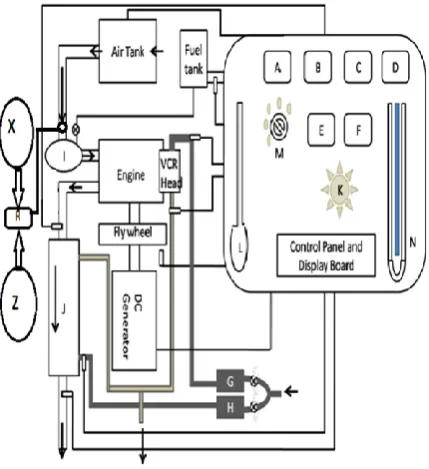
Over- head piston displacement allows to change compression ratio of engine from 2.5 to 8, engine is provided with mechanical governor which governs the speed of engine and the signals of various sensors are collected on a control panel fitted with various meter. The engine is converted into a bi-fuel natural gas engine Experimental analysis has been done for CNG, LPG and gasoline under steady state conditions with varying load and compression ratio. For CNG and LPG operation, the engine is fitted with fully loaded CNG pressure conversion kit, only supply lines were different. Further details of engine are described in Table 1.2 and Fig 1.1 shows schematic sketch of actual setup.
TABLE.1.1
THERMODYNAMIC PROPERTIES OF CNG, LPG & PETROL [ 6,10]
Properties CNG Petrol LPG
Formula CH4 C4-C12 C3H8 Stoichiometric ratio 17.2 14.2 15.6 Octane/Cetane number 120 90-100 100 Auto Ignition Temp oC 540 257
410-580 Higher heating value (MJ/kg) 49 43 45 Lower heating value (MJ/kg) 45.9 42.2 44 Density @ 25 oC (kg/m3) 2.52 749 0.72
Minimum Ignition Energy(MJ) 0.26 0.33 0.3 flame propagation speed(m/sec) 0.43 0.5 0.48
International Journal of Emerging Technology and Advanced Engineering
Website: www.ijetae.com (ISSN 2250-2459,ISO 9001:2008 Certified Journal, Volume 3, Issue 1, January 2013)
79
[image:3.595.312.554.163.373.2]AVL Digas444 type of five gas analyzer is used for exhaust gas analyzer it is provided with exhaust inlet which used to insert into the exhaust pipe of sample gas. The gas is then sucked by analyzer separating out condensate before analysis of gas. Thus four gases were analyzed for the experimentation.
Figure 1.1: Detail of engine setup and instrumentation
A- Digital temperature Indicator connected with thermocouples with K type thermocouple having range 0-600o C
B- Digital Tachometer Indicator connected with flux cut type sensor (rpm)
C- Voltmeter (Volt).
D- Ammeter (amps).
E- Fuel rate indicator provided with load cell to the fuel tank and duel indicator in (Gms) & (Kg/hr.) F- Air rate indicator connected to air tank with duel
indicator in (mm of H2O) & (m 3
/hr.)
G- Rota meter for measurement of water flow to VCR head.
H- Rota meter for measurement of water flow rate to the calorimeter.
I- Carburetor J- Calorimeter
K- Loading knob
L- Manual fuel measurement arrangement
M- Temperature indicator knob
N- U-tube manometer for manual measurement of air flow
R- CNG reducer or vaporizer
X- CNG Cylinder with electronic weighing bridge Z- LPG Cylinder with electronic weighing bridge.
IV. PERFORMANCE CHARACTERISTICS
The various performance parameters such as brake thermal efficiency, exhaust temperature, brake specific fuel consumption under study are summarized as follows
4.1 Brake specific fuel consumption
Fuel consumed for one kilowatt power generation in one hour is defined as brake specific fuel consumption. For the engine running on the CNG fuel, the specific fuel consumption was always lower than that for the gasoline as well as LPG throughout the speed range. This was mainly due to the higher heating value of the CNG (49MJ/kg) as compared to that of the petrol (43 MJ/kg), & LPG (45MJ/Kg) and the slow burning of CNG as compared to that of the petrol.
The brake specific fuel consumption decreases when heading towards loading condition, brake specific fuel consumption for full load condition is least. Comparison with fuel consumption shows you opposite trend of graph, fuel consumption increases with increase in load. The gradually decreases in BSFC is observed as the load increases which is higher for gasoline and least for the CNG. As the compression ratio increases there is increase in fuel consumption and reduction in BSFC is observed for all the three fuels.
[image:3.595.54.269.213.448.2]From the graph 1.1 at higher load, constant speed 2500rpm and varying compression ratio, it is observed that at lower compression ratio, BSFC for CNG is observed to be higher but as the compression ratio increases BSFC decreases, the specific fuel consumption for CNG is observed to be lowest at compression ratio 8 and higher loading condition. LPG shows higher BSFC as compared to CNG.
TABLE 1.2 ENGINE SPECIFICATION
Sr.
No. Specification Value
1 BHP (Greaves) 3
2 Rated speed 3000 RPM
3 No. of cylinders 1
4 Compression Ratio 2.5:1 TO 8:1
5 Bore 70 mm
International Journal of Emerging Technology and Advanced Engineering
Website: www.ijetae.com (ISSN 2250-2459,ISO 9001:2008 Certified Journal, Volume 3, Issue 1, January 2013)
80
Graph 1.1: BSFC at Full Load and Varying CR
4.2 Brake Thermal efficiency
Brake thermal efficiency is the function of actual power gain from total supplied energy input. More heat input gives you better results thus higher the calorific value of fuel, better will be the performance. Increase in compression ratio results into reduction in clearance volume, the change in volume causes change in brake mean effective pressure to higher value. The BSFC is inversely proportional to that of the brake thermal efficiency, as BSFC decreases, BTE increases.
From the graph 1.2 at BTE at higher load, constant speed 2500rpm and varying compression ratio, it is observed that as the BSFC decreases, the brake thermal efficiency increases with the increase in the load. Better thermal efficiency for CNG is obtained higher at CR 8 is a result of complete combustion due to proper air-fuel mixing, higher calorific value and thus it shows least brake specific fuel consumption. Lower calorific value of gasoline need higher fuel supply for producing same power at given rpm. Likewise the brake specific fuel consumption for LPG shows intermediate behavior between CNG and gasoline except at CR 3.
Graph 1.2: BTE at Full Load and Varying CR
4.3 Exhaust Gas Temperature
Slower flame propagation speed of the CNG than petrol allows the combustion to precede until the end of the expansion stroke which increases the exhaust gas temperature for the CNG operation. Also it goes on increasing with the increase of engine load. The exhaust gas temperature of the CNG and LPG is always higher than that of the gasoline throughout the load range.
From the graph 1.3 shows the exhaust gas temperature is higher for CNG at the higher load while LPG has moderate values and gasoline has least values. The same trend of behavior is observed with the increasing compression ratio and the values for EGT increases with the increase in compression ratio. This is due to reduction in the clearance volume causes the better explosion of the final combustion gases in the exhaust system would have resulting in an increase in the flame temperature.
V. EMISSIONS CHARACTERISTICS
The HC. CO, CO2 emissions from CNG fuelled
engines are less than that of gasoline engines. Theoretically, these emissions from CNG fuelled engine should be lower due to the gaseous form which gives an excellent mixing and less carbon CH4 for CNG as
compared to that of C3H8 for LPG and C4-C12 for
gasoline.
Graph 1.3: Exhaust Temp. at Full Load and Varying CR
5.1 Carbon Mono-Oxide
Carbon monoxide is product of incomplete
International Journal of Emerging Technology and Advanced Engineering
Website: www.ijetae.com (ISSN 2250-2459,ISO 9001:2008 Certified Journal, Volume 3, Issue 1, January 2013)
81
Graph 1.4: CO Emissions at Full Load and Varying CR
The graph 1.4 shows CO emissions for CNG and LPG are lower and decreases as compression ratio increases. In all case the carbon mono-oxide shows increasing trend for higher loading the result may be due to less reaction time for more fuel supplied. Higher combustion temperatures is another reason of the low CO emission of the CNG fuelled engine. At high combustion temperatures, the CO get converts to CO2 during
combustion. CO bars are decreased for higher loading conditions and the observations with increase in compression ratio shows decrease in carbon monoxide emission which may be the result of more rapid combustion and higher temperature.
5.2 Hydrocarbon
Hydrocarbon is also product of incomplete combustion of fuel. The formation of hydrocarbon is due to lack of proper air supply. HC emission indicates power loss. When gasoline tested of engine the HC emission was significantly high. From the analysis of graph 1.5, it is proved that hydrocarbon emission decreases with increasing compression ratio except for gasoline fuelled engine. The rate of combustion or reaction increases with increase in temperature which results into lower hydrocarbon emission. Hydrocarbon emissions are lower for CNG is an indication of complete combustion. The gasoline HC emissions are obtained higher for all CR and all the loadings. The HC reduction for CNG is 70-80% lowers than that of petrol and 30-40% lowers than that of LPG. In general as the compression ratio increases, the hydrocarbon emission decreases.
Graph 1.5: HC Emissions at Full Load and Varying CR
5.3 Carbon Di-Oxide
The composition of gas showed that the CNG consists mostly of methane (CH4) whereas the gasoline (C8H18)
compound packed less hydrogen per carbon (2.5) while for LPG it is C3H8 Thus, the percentage of carbon in the
methane, i.e., the CNG was lower than that of the petrol. This led to the lower emission of CO2 for the CNG than
the petrol.
The emissions of CO2 increase with the increase in the
loading also slightly decrease with increase in compression ratio. Gasoline shows almost the higher percentage of CO2 emissions for all the CR and loadings.
As already explained for CNG, CO2 emissions obtained
are lower as compared to gasoline as shown in graph 1.6.
International Journal of Emerging Technology and Advanced Engineering
Website: www.ijetae.com (ISSN 2250-2459,ISO 9001:2008 Certified Journal, Volume 3, Issue 1, January 2013)
82 5.4 Nitrogen Di-Oxide
Nitrogen oxides are generated from oxygen and nitrogen under high pressure and temperature conditions in the engine cylinder. The NOx emissions are strongly influenced by the lean fuel with high cylinder temperatures or high peak combustion temperature. A fuel with high heat release rate at premix or rapid combustion phase and lower heat release rate at mixing controlled combustion phase would produce the NOx [4].
Graph 1.7: NOx Emissions at Full Load and Varying CR
The value of the NOx increases with the compression ratio as well as loading, the graph 1.7 shows that CNG and LPG having much higher NOx compared to that as of gasoline. The NOx obtained for CNG and LPG is higher than that of gasoline. Higher compression ratio with increase in temperature are favorable for emission of NOx, Further increase in load causes significant temperature rise, thus result of which shows bar of NOx peak at higher loading and higher compression ratio. Higher NOx is obtained for CNG at CR 8 and full loading condition.
VI. CONCLUSION
In this study, the effect of compression ratio on the performance and emissions of single cylinder spark ignition engine fuelled with CNG, LPG and gasoline was studied, based on the experimental study, the following results can be concluded as follows
1) The BSFC for CNG is always less than that of the gasoline and slightly less than the LPG. BSFC decreases with the increase in compression ratio as well as loading for all fuels used.
2) BTE increases with increase in CR and at all the loading conditions as BSFC decreases. Thus CNG shows higher BTE as compared to LPG and Petrol. LPG also shows higher BTE as compared to petrol.
3) The value of the EGT increases with the compression ratio as well as loading. CNG and LPG shows much higher EGT compared to that as of gasoline.
4) CO emission goes on decreasing with CR advancement but has minute variation; it is also observed that CO emission for Gasoline is more as compared to that of CNG and LPG.
5) CO2 emission goes on reducing with advancing the
CR, CO2 emission also has little variation with change in
CR, and it is observed that CO2 emission for gasoline is
more compared to that of CNG and LPG.
6) The percentage of Hydro carbon emission goes on decreasing with increasing the CR, with increase in load there was reduction in Hydrocarbon emission. CNG shows least HC emissions.
7) The NOx obtained for CNG and LPG are higher than that of gasoline. Higher CR with increase in temperature is favorable for emission of NOx, Further increase in load cause significant temperature rise.
8) Performance and emission characteristics obtained for CNG at CR 3.5 are poorer; this might be due to the fact that CNG is having higher octane number which leads to inferior performance at low compression ratio.
REFERENCES
[1 ] Energy Technology Systems Analysis Programed (ETSAP) - Technology Brief T03-April2010- www.etsap.org
[2 ] Amjad Shaik, N Shenbaga Vinayaga Moorthi, and Rudramoorthy
“Variable Compression Ratio Engine: A Future Power Plant for Automobiles – An Overview”, Department of Automobile Engineering, PSG College of Technology, Peelamedu, Coimbatore, India. 2007, pp.1159-1168.
[3 ] A Das and H C Watson “Development of a Natural Gas Spark Ignition Engine for Optimum Performance”, Proceedings of the Institution of Mechanical Engineers, Part D: Journal of Automobile Engineering1997 211:361 DOI: 10 1243/095440797152656.
[4 ] Internal Combustion Engine Fundamentals, John B Heywood, The McGraw-Hill International Edition, Automotive Technology Series, ISBN-0-07-10499-8.
[5 ] E. Ramjee and K.V Reddy “Performance Analysis of a 4-Stroke SI Engine Using CNG as an Alternative Fuel”, Department of Mechanical Engineering, NTUH College of Engineering, Hyderabad. Indian Journal of Science and Technology, 2011, Vol 4 No.7 ISNN: 0974-6846.
[6 ] M.I. Jahirul, H.H. Masjuki, R. Saidur, M.A. Kalam, M.H. Jayedn ˝Comparative Engine Performance & Emission Analysis of CNG Fueled Engine”, Applied Thermal Engineering 30, 2010, pp. 2219-2226.
[7 ] R.Bakar, M.Sera and W.H.Mun “Towards the Implementation of CNG Engine: A Literature Review Approach to Problems and Solutions”, BSME-ASME International Conference on Thermal Engineering, 31 Dec-2 Jan, 2002, pp.1356-1362.
[8 ] K.Bhandari, A. Bansal, A.Shukla& M. Khare ˝Performance & Emissions of a Natural Gas Fueled Internal Combustion Engine-A Review”, Journal of Scientific & Industrial Research, Vol.64, May2005, pp. 333-338.
International Journal of Emerging Technology and Advanced Engineering
Website: www.ijetae.com (ISSN 2250-2459,ISO 9001:2008 Certified Journal, Volume 3, Issue 1, January 2013)
83
[10 ]M.D.Ehsan “Effect of Spark Advance on a Gas Run Automotive Spark Ignition Engine” Journal of Chemical Engineering, IEB. Vol. ChE.24, No.1, January 2006-December 2006, pp.42-49.