Predicting the Performance and Emissions Characteristics of a Medium
Duty Engine Retrofitted with Compressed Natural Gas System using
1-Dimensional Software
Ahmad Jais Alimin
1,aMuhammad Yusri Ismail
1,b, and Shahrul Azmir Osman
1,c1
Department of Plant and Automotive Engineering, Faculty of Mechanical and Manufacturing Engineering, Universiti Tun Hussein Onn Malaysia,
86400 Parit Raja, Batu Pahat, Johor, Malaysia
a
[email protected], [email protected], [email protected]
Keywords: Retrofit engine; diesel engine; compress natural gas; GT-power.
Abstract. The rise of crude oil price and the implications of exhaust emissions to the environment from combustion application call for a new reliable alternative fuel. A potential alternative fuel for compression ignition (C.I.) engine is the compressed natural gas (CNG). For C.I. engines to operate using CNG, or to be converted as a retrofitted CNG engine, further modifications are required. Previous works reported loss in brake power (BP) and increase in hydrocarbon (HC) emission for C.I. engine retrofitted with CNG fuelling. Verification of performance characteristics for CNG retrofitted engine through experimental analysis requires high cost and is very time consuming. Thus, a 1-Dimensional simulation software, GT-Power, was introduced in this study to reduce the experimental process and setup. A 4-cylinder medium duty C.I. engine (DE) and CNG retrofitted engine (RE) GT-Power models were used in this simulation work over various operational conditions: low, medium and high load conditions. As compared with DE model, results from RE model showed that RE model achieved an average 4.9% improvement for brake specific fuel consumption (BSFC) and loss in BP by 37.3%. For nitrogen oxides (NOX) and carbon dioxides
(CO2) RE model predicted reduction of 48.1% (engine mode 1-9) and 33.4% (all engine modes),
respectively. Moreover, RE produced 72.4% more carbon monoxide (CO) and 90.3% more HC emission.
Introduction
In 1997 an international summit was held at Kyoto, Japan to discuss on environmental issues. The main card is to stabilize the atmospheric concentration of Greenhouse gases (GHG) which causes global warming. One of the main factors is the combustion of hydrocarbon from crude oil [1]. The current emission pollution has focused the world attention to develop alternative fuel and reduce dependency on fossil fuel. An approach has been made which seen the usage of natural gas appears to be a suitable candidate in order to overcome the emissions problem caused by internal combustion engine fuelled with diesel.
Natural gas, is a fossil fuel primarily consisting of methane and is one of the cleanest burning alternative fuel. It can be used in the form of compressed natural gas (CNG) and liquefied natural gas (LNG) to fuel automobile vehicles. The interesting part of natural gas is, when it burned it gives high amount of energy with lower emission to the environment. According to Cascetta et al. [2] The use of natural gas as a vehicle fuel has some advantages: (1) it has high octane number, (2) it produces clean burning, and (3) it produces low CO2 unit of energy than other fossil fuels.
CNG is used traditionally in spark ignition engine converted into bi-fuel vehicles. In order to implement CNG to diesel engine require added components as well as some mechanical changes to the engine. Basically the diesel engine undergoes complete changes on compression ratio, injection type, and modification of cylinder head for spark plug. Through 1-dimensional simulation software GT-Power, the conversion process was done based on the engine layout and the geometry measured by the actual basic engine condition.
Effects of CNG on engine performance and emission
The current state of natural gas vehicle (NGV) is based from conversion of spark ignition and compressed ignition engines where they are operated in mono-gas, bi-fuel or dual fuel mode. Each conversion undergoes different type of modification, this reflected to the engine performance and exhaust emissions characteristics of the engine. With careful modification the lower output of brake power can be overcome by using high compression ratio, raise in valve lift, effective valve timing and decrease in backpressure engine [3]. In retrofitted spark ignition engine NOx is still the
main fear due to the elevated production of exhaust gas temperature. However, retrofitted spark ignition is still low in CO, CO2, HC, etc and better fuel consumption with superior brake thermal
efficiency compared to gasoline [4]. A new method to reduce NOx emission is through modification
of fuel injection system by direct injection. By comparison the performance of CNG in direct injection (CNG-DI) can produce higher performance than CNG-Bi fuel system and is on a par with multi cylinder gasoline port injection (PI) engine. In the overall exhaust emission, CNG-DI is cleaner than gasoline-PI and CNG-Bi but still high in CO emission due to the leaner combustion [5]. For modification of diesel to CNG engine must at least involve using lower compression ratio, and substituting all the injector with the addition of spark plug, thus the diesel engine is converted to a spark ignition engine [6]. Converted compression ignition engine to natural gas direct injection produces high NOx at higher compression ratio and increased in HC at high load condition [7]. Combination of diesel and natural gas or namely a dual fuel mode experiences drop in brake thermal efficiency but can be improved by implementing exhaust gas recirculation [8].
Computational engine modeling
Over the last decade, the development of computational engine simulation modeling had expanded widely, in order to mimic the real condition of the experimental testing. In fact the simulation can offer a reliable prediction on the effect of modification to the engine geometry, hence it gives benefits as less time is required in preparing a test bed due to fast analysis. GT-Power is introduced in this study to dynamically simulate the engine performance and emission for DE and RE because of fast computational speed and has been commonly used in automotive industry.
Engine modeling setup
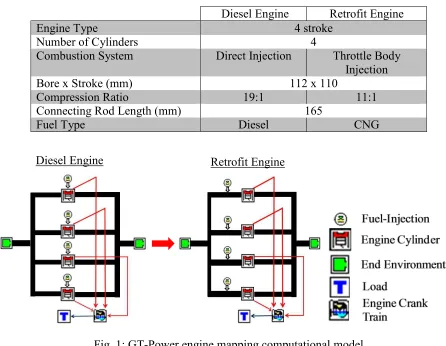
Elementary feature in modeling 1-dimensional GT-Power software are the component from flow and mechanical library. The detail of the basic engine system that was used in the engine crank train is based on Table 1. Fig. 1 shows how the components are linked based on GT-Power engine mapping computational model. In order to convert the DE to a RE, modifications of the design in engine system are required. Since RE used a throttle body injection, the DE fuel injection system was replaced from Injprofile connection to InjAF-RatioConn which inflict air-fuel ratio. Stochiometric air-fuel ratio used in this analysis is 14.3 and 17.3 for DE and RE respectively [9]. Different fuel type used in this study necessitates a different combustion process. EngCylCombDI-Wiebe (compression ignition) and EngCylCombSI-EngCylCombDI-Wiebe (spark ignition) combustion was used in Engcylinder to couple with Injprofile connection and InjAF-RatioConn respectively. Table 2 shows the case setup to study the effects on various engine performance and emission at different engine load. The case was setup; low, medium and high load; at different engine speed [10].
Table 1: Engine parameters
Diesel Engine Retrofit Engine
Engine Type 4 stroke
Number of Cylinders 4
Combustion System Direct Injection Throttle Body Injection
Bore x Stroke (mm) 112 x 110
Compression Ratio 19:1 11:1
Connecting Rod Length (mm) 165
Fuel Type Diesel CNG
[image:3.595.69.515.90.436.2]
Fig. 1: GT-Power engine mapping computational model
Table 2: GT-Power case setup
Engine mode 1 2 3 4 5 6 7 8 9 10
Engine Condition Low load Medium load High load
Engine speed (RPM) 1000 2000 3200 1300 2400 1500 2100 2100 2600 3000 Load (Nm) 16.3 17.6 17.6 58.3 36.6 96.3 70.5 122 135.6 175
Result and discussion
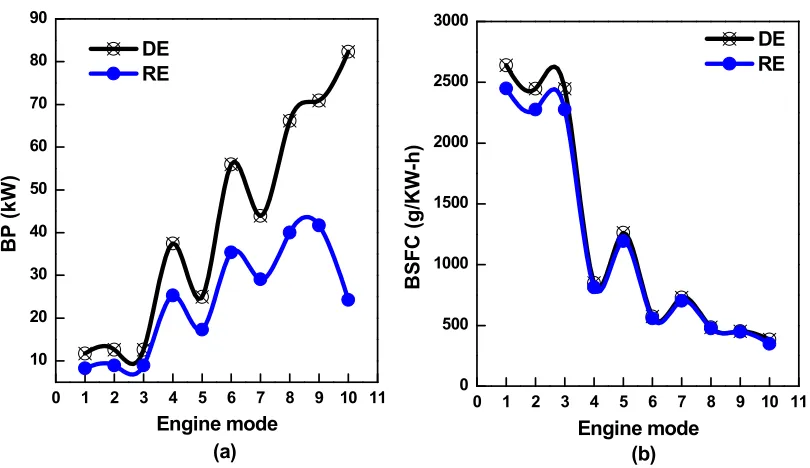
Fig. 2(a) presents the BP at all engine modes condition. The graph show that BP is low at all operating modes. The main reason of the reduction of BP for RE is longer ignition delay and lower CNG flame speed. The highest BP achieved by RE is 41.7kW at high load with engine speed 2600 RPM at 135.6 Nm meanwhile DE shows maximum value of 82.3 kW with engine speed 3000 RPM at 175 Nm. A close gap occurs at low load condtion, however as the engine load raise the percentage difference increases with average at all operating condition 37.3% compared to DE.
Fig. 2(b) shows the variation of BSFC at engine mode condition. In all operating condition RE had always been lower than DE throughout all the engine modes. This was mainly due to the higher heating value of CNG (48 MJ/kg) compared to diesel fuel (45 MJ/kg). Average of BSFC recorded at all engine modes is 4.9% less than DE which shows that RE is very effective at low engine load with percentage of difference below 7.04%.
Diesel Engine Retrofit Engine
Fig. 2: BP and BSFC at engine mode condition
Fig. 3(a) indicates the NOx concentration at engine mode condition. Based on the result RE
shows the maximum NOx emission at high load with 2117.7 PPM followed by DE 1909.8 PPM at
engine mode 10. Interestingly, engine mode 1-9 RE able to reduce NOx emission on average of
48.1% as compared to DE. Generally the reason for this phenomena is the cool gaseous flowing into engine cylinder thus the combustion accomplished at low engine temperature [5].
Fig. 3(b) denotes the HC concentration at engine mode condition. From the result RE shows a high HC emission with an average percentage of differences by 90.3% compared to DE at all engine mode condition. RE produces superior HC due to the imperfect combustion of the hydrocarbon fuel. Emissions from HC generated from CNG fuel mostly methane (CH4) does not
[image:4.595.87.507.497.735.2]bring too much harmful compared to liquid fuels [11].
Fig. 3: NOx and HC emissions at engine mode condition
0 1 2 3 4 5 6 7 8 9 10 11
10 20 30 40 50 60 70 80 90 DE RE B P ( k W ) Engine mode (a)
0 1 2 3 4 5 6 7 8 9 10 11
0 500 1000 1500 2000 2500 3000 DE RE (b) B S F C ( g /K W -h ) Engine mode
0 1 2 3 4 5 6 7 8 9 10 11 200 400 600 800 1000 1200 1400 1600 1800 2000 2200 DE RE N Ox ( P P M ) Engine mode (a)
0 1 2 3 4 5 6 7 8 9 10 11
0.96 0.98 1.00 1.02 1.04 1.06 9.5 10.0 10.5 11.0 11.5 12.0 DE Engine mode (b) RE H C ( P P M )
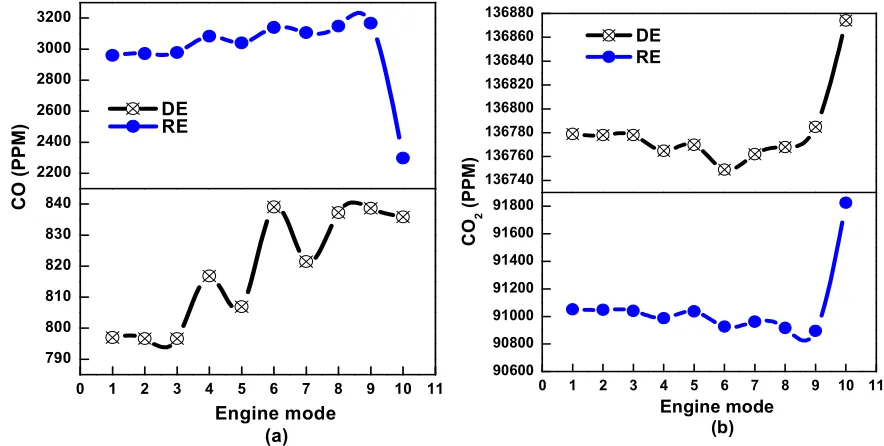
Fig. 4(a) shows the result for CO emissions at engine mode condition. Based on the following graph the lowest concentration of CO was produced from DE by an average of 818.6 PPM followed by RE with 2989.6 PPM. Between engine mode 9 and 10 show that CO concentration decrease by 27.4% suggesting that combustion efficiency increase at high load condtition. RE emit higher CO concentration due to the limited oxygen to convert to CO2.
Fig. 4(b) demonstrates CO2 emissions at engine mode condition. Maximum CO2 recorded at
engine mode 10 which is 136874 and 91825.6 PPM for DE and RE respectively. Throughout the graph, RE experienced a lower CO2 emissions compared to DE with percentage of reduction below
33.4%. Theoretically the reason of lower CO2 emissions was due to the lower hydrogen to carbon
[image:5.595.74.516.225.448.2]ratio of CNG compared to diesel fuel [11].
Fig. 4: CO and CO2 emissions at engine mode condition
Conclusion
In this study the effect of conversion from DE to RE involving compression ratio, fuel injection system and fuel type has been predicted by using 1-dimensional simulation software GT-Power. The developed model is tested at various engine performance and emissions. Based on the investigation RE show that CNG is a better fuel choice economically and environmentally. The result can be summarized below:
(i) RE produces lower BP at all engine modes with an average reduction of 37.3% as compared to DE.
(ii) A reduction of 4.9% for BSFC achieved by RE compared to DE.
(iii) Decreased of NOx exhaust emissions with percentage of difference 48.1% from engine
mode 1 – 9 compared to DE.
(iv) High HC emissions contributed by RE at all engine modes condition with an average of 90.3%. compared to DE
(v) RE leads the highest CO emissions by percentage of difference at all engine modes condition with 72.4% compared to DE.
(vi) DE shows superior CO2 emissions with 33.4% at all engine modes compared to RE.
0 1 2 3 4 5 6 7 8 9 10 11
790 800 810 820 830 840 2200 2400 2600 2800 3000 3200
Engine mode DE
C
O
(
P
P
M
)
(a) RE
136740 136760 136780 136800 136820 136840 136860 136880
0 1 2 3 4 5 6 7 8 9 10 11
90600 90800 91000 91200 91400 91600 91800
DE
C
O 2
(
P
P
M
)
(b) RE
Engine mode
Acknowledgement
Appreciation and acknowledgement to Ministry of Science, Technology and Innovation (MOSTI) for providing financial fund under VOT 1055. The author also would like to express highest gratitude to anyone who contributed to the research work.
References
[1] “Carbon Dioxide Emission From Fuel Combustion,” Climate Change Convention (COP 15), 2009.
[2] F. Cascetta, G. Rotondo, and M. Musto, Measuring of compressed natural gas in automotive application: A comparative analysis of mass versus volumetric metering methods. 19(6) (2008) 338–341.
[3] O. S. Abianeh, M. Mirsalim, and F. Ommi, Combustion Development of a Bi-Fuel Engine. 10 (1) 17 - 25
[4] M. I. Jahirul, H. H. Masjuki, R. Saidur, M. a. Kalam, M. H. Jayed, and M. a. Wazed, Comparative engine performance and emission analysis of CNG and gasoline in a retrofitted car engine, Applied Thermal Engineering. 30 9 (14-15) (2010) 2219 - 2226.
[5] M. A. Kalam and H. H. Masjuki, An experimental investigation of high performance natural gas engine with direct injection, Energy. 36(5) (2011) 3563 - 3571.
[6] C. Poompipatpong and K. Cheenkachorn, A modified diesel engine for natural gas operation: Performance and emission tests, Energy. 36(12) (2011) 6862 - 6866.
[7] J.-J. Zheng, J.-H. Wang, B. Wang, and Z.-H. Huang, Effect of the compression ratio on the performance and combustion of a natural-gas direct-injection engine, Proceedings of the Institution of Mechanical Engineers, Part D: Journal of Automobile Engineering. 223(1) (2009) 85-98.
[8] M. M. Abdelaal and a. H. Hegab, “Combustion and emission characteristics of a natural gas-fueled diesel engine with EGR,” Energy Conversion and Management. 64 (2012) 301- 312.
[9] J. B. Heywood, Internal Combustion Engine Fundamentals, International Ed., McGraw-Hill, 1988.
[10] I. Gamma Technologies, Engine Performance Application Manual Version 7.0. Westmont.IL, USA, 2009.
[11] M. I. Jahirul, R. Saidur, M. Hasanuzzaman, H. H. Masjuki, and M. A. Kalam, A Comparison of the Air Pollution of Gasoline and CNG Driven Car for Malaysia. 2(2) (2007)130 - 138.
[12] S.A. Osman, A.J. Alimin, and V.S. Liong, Optimum combustion chamber geometry for a compression ignition engine retrofitted to run using compressed natural gas (CNG), Applied Mechanics and Materials. 315 ( 2013) 52–556.