Journal of Chemical and Pharmaceutical Research, 2014, 6(7):611-620
Research Article
CODEN(USA) : JCPRC5
ISSN : 0975-7384
Verifiable multi-authority attribute based encryption scheme with
different permissions
Xueyan Liu
1,2, Zhanming Li
1, Zhanjun Hao
3and Qiang Zhang
31
College of Telecom Engineering and Information Engineering, Lanzhou University of Technology, Lanzhou; China
2College of Mathematics and Statistics, Northwest Normal University, Lanzhou, China
3College of Computer Science and Engineering, Northwest Normal University, Lanzhou, China
_____________________________________________________________________________________________
ABSTRACT
In this paper, we study the traffic information granular computing theory and build traffic information fusion model, framework and implementation program based on granular computing. We raise uncertainty reduction algorithms for traffic flow prediction and congestion recognition algorithms based on granular computing theory, which will provide new ideas and methods in the complex decision making under uncertainty problems of the transportation systems. In an attribute based encryption scheme, each user is identified by a set of attributes, which are used to determined ecryption ability for each ciphertext. On the base of attribute based encryption and symmetric encryption algorithm, it proposes a verifiable multi-authority attribute based encryption scheme. In our scheme, access control permission is divided into two kinds: Read and Write for the first time. An encryptor can easily deal with this problem by using two different secret keys. When a user wants to get Read permission, he just needs to go to some authorities, yet not all. We also provide a verification scheme that ensures the integrity of data and realness of data sources. The encryptor generates a signature while encryption, the user carries out verification with given signature and the decrypted message. The scheme not only enhances the confidentiality of data, but also supports more flexible and more fine-grained access control strategy.
Key words: Multiple authorities, Attribute based encryption, Identity based encryption, Permission , Pseudorandom
function(PRF)
_____________________________________________________________________________________________
INTRODUCTION
In 2005, Sahai and Waters introduced Fuzzy Identity-basedEncryption(Fuzzy-IBE) firstly[1].In the scheme, theidentity of user was described as a set of attribute, while thematching relation of identity was transited from the original“match” into“similarity matching”. 2006, Fuzzy-IBE is extended tothe attribute based encryption(ABE) by Goyal, Sahai and Waters etal.[2], they also expounded the concept and significance ofattribute based encryption. In attribute based encryptionmechanism, the user identity information was generalized asrelated attributes, and they divided ABE scheme into twotypes:Ciphertext-Policy ABE(CP-ABE) andKey-PolicyABE (KP-ABE) based on differentapplication.
handshakes scheme, which opened the research ofattribute based security protocol.Chase et al. [12,13] solved a single authority corrupted problem by employing multipleauthorities, and prevent the collusion between users by adopting aglobal identity GID for each user. Lewko et al. [14] present another multi-authority scheme, in which any party
canbecome an authority and does not require any“central authority”.
Attribute based encryption has been rapid developed since it wasborn,and it is a hot direction in cryptograph recently, whichrealizes non interactive fine-grained access control mechanism,expands one-to-one model to one to many model on encryption anddecryption, greatly enriches the flexibility of encryption policyand description of user permissions. Hence, it has a goodapplication prospects in distributed file management, third partydata storage, pay TV system and other fields[15,16].
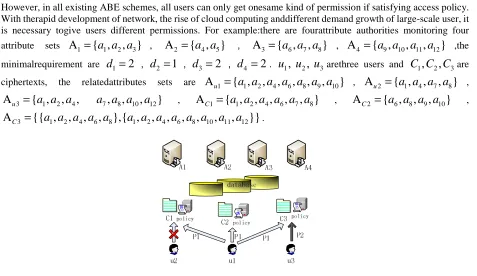
However, in all existing ABE schemes, all users can only get onesame kind of permission if satisfying access policy. With therapid development of network, the rise of cloud computing anddifferent demand growth of large-scale user, it is necessary togive users different permissions. For example:there are fourattribute authorities monitoring four
attribute sets
Α =
1{ ,
a a a
1 2,
3}
,Α =
2{ ,
a a
4 5}
,Α =
3{ ,
a a a
6 7,
8}
,Α =
4{ ,
a a
9 10,
a
11,
a
12}
,the minimalrequirement ared
1=
2
,d
2=
1
,d
3=
2
,d
4=
2
.u
1,
u
2,
u
3arethree users andC C C
1,
2,
3are ciphertexts, the relatedattributes sets areΑ =
u1{ ,
a a a a a a a
1 2,
4,
6,
8,
9,
10}
,Α =
u2{ ,
a a a a
1 4,
7,
8}
,3
{ ,
1 2,
4,
u
a a a
Α =
a a a
7,
8,
10,
a
12}
,Α =
C1{ ,
a a a a a a
1 2,
4,
6,
7,
8}
,Α =
C2{ ,
a a a a
6 8,
9,
10}
,3
{{ ,
1 2,
4,
6,
8},{ ,
1 2,
4,
6,
8,
10,
11,
12}}
C
a a a a a
a a a a a a
a
a
[image:2.595.71.548.203.479.2]Α =
.Fig. 1:More Fine-grained Access control From ABE
In Fig 1, 1)
u
1 can decryptC
1,whileu
2 can't.Andu
1only goes to attribute authorityA
1,A
2 andA
3,not toA
4;2)1
u
can decryptC
1 andC
2,but referring differentauthorities set{
Α Α Α
1,
2,
3}
and{
Α Α
3,
4}
, the numberofauthorities is different,too;3)
u
1 getsP
1 permission bygoing to{
Α Α Α
1,
2,
3}
, butu
3 getsP
2 permission bygoing to all authorities.From the example,we can see that:1)in differentapplications,there are many permissions,such asRead, Copy,
Reference andWrite. Therefore, permission problem should be consideredwhile designing access control policy. The
basic operation of userisRead or Write. Of course, one also hasRead permission if he hasWrite permission; 2) auser can get one permission while only going to some authorities.We also provide a verification scheme by a signature. Hence, inthis paper,in order to present Read Permission andWritePermission, we select two different key to controlthe two permissions,and the access policy is generated byencryptor.
The remainder of this paper is organized as follows: We discussthe novelty and contributions of this paper in Section II. InSection III, definitions and preliminaries are presented. In Section IV, the proposed verifiable multi-authority attribute basedencryption scheme with different permission is presented, and thesecurity analysis of the proposed scheme is discussed. In Section V, performance discussion is presented. Finally, conclusions andpossible future research directions are presented in Section VI.
OUR CONTRIBUTIONS
______________________________________________________________________________
• Many scholars have applied ABE to access control, but theissue of different permissions in one system has been ignored.Forexample,some users can read,others can copy.
• In the previous multi-authority schemes,the user mustsatisfy the attributes requirement of each authority to getdecryption ability. It is to say that the user must go to allauthorities.The author of [12] referred the problem inextensions,but there was some limit,which will be discusseddetailed in section V.B.
• In existing attribute based encryption scheme,the attention is focused on decryptor,while the honesty of encryptorand the integrity of data are ignored. For example,a user meetingthe attribute requirement got a message while the message has beencorrupted before encrypted.
To overcome these problems,we propose a verifiable multi-authorityattribute based encryption scheme with different permissions. Thescheme works as follows:First,the central authority setup thesystem parameters, and all authorities generate public keys andsecret keys for user
u
. Second,a sender encrypts a messageM
with a symmetric keyread
K
,which only provides Read permission.ThenK
read and WritepermissionK
write are encrypted respectively. Inthe process theencryptor generates access control policy for users and generatesa signature on
M
. Third, the user gets ReadpermissionandM
, just meeting some authorities requirement,or even one.After, the user can verify the integrity ofM
and authenticityof the encryptor by offered signature. Moreover,if the user wantsto obtainWrite permission, he should meet all attributerequirements of all authorities including the central authority.The contributions of this paper are as follows:
• In the scheme, we realize the permission distinguishthat let user get Read Permission or WritePermission based on having attributes. The access control policyis generated by the encryptor, so the encryptor has more choicerights, which is more friendly to users. On the premise of theprotection of data confidentiality, the scheme provides differentpermissions for users having different attributes.
• To obtain Read permission, just some authority are involved,even only one. This scheme avoids the shortcomings that onemust go to all attribute authorities.
• There generates a BLS short signature[17] formessage
M
while encryption to present verification, whichensures the confidentiality, integrity of data and non-repudiationof encryptor.PREMINARY
In our ABE scheme,we assume that:1) there are
K
attributeauthorities and a trusted central authority.2) the universe ofattributes can be partitioned intoK
attribute sets. Eachattribute authority will monitor one attribute set while thecentral authority will not monitor any attributes.The notations referred in the paper will be shown in Table I.Table.1 Notation
Item Description
u
Α the attribute set of user u
C
Α the attribute set of a ciphertext
k u
Α attributes of u handled by authorityk k
C
Α attributes of ciphertext handled by authorityk
GID the global identity of each
u
k
d the required minimum number of| k k |
u C
Α ∩ Α
A. BILINEAR MAPS AND COMPLEXITY ASSUMPTION
Let
G
1andG
2be two cyclicmultiplicative groups of the same large prime orderp
.Definition 1 (Bilinear Maps) A bilinear pairing is a computable bilinear map between two groups
e
:
1
×
1→
2G
G
G
.It is the modified Weil pairing or Tatepairing which has the following properties:1).Bilinear: For any a
,
b 1g
g
∈
G
,e g
(
a,
g
b)
=
e g g
( , )
ab;2).Non-degenerate: There exists
P Q
,
∈
G
1, such thate P Q
( , ) 1
≠
;3).Efficient: There exists an efficient algorithm to compute the map.
Definition 2 (Decisional Bilinear Diffie-Hellman (BDH) Assumption )Suppose a challenge chooses
a b c R
, , ,
from*
tuple
<
g g
,
a,
g
b,
g e g g
c, ( , )
abc>
from the tuple<
g g
,
a,
g g e g g
b,
c, ( , )
R>
with more than a negligible advantage.Definition 3 (Decisional Modified Bilinear Diffie-Hellman (MBDH) Assumption )Suppose a challenger chooses
, , ,
a b c R
fromZ
*p randomly. The decisional MBDH Assumption is that no polynomial-timeadversary is to be ableto distinguish the tuple
<
g g
,
a,
g g e g g
b,
c, ( , )
abc>
from the tuple<
g g
,
a,
g
b,
g e g g
c, ( , )
R>
with more than a negligible advantage.B.VERIFIABLE MULTI-AUTHORITY ABE SCHEME WITH DIFFERENT PERMISSIONS(VMA-ABE-DP)
The proposed scheme of verifiable multi-authority ABE scheme withdifferent permissions consisting of four phases:
Setup,KeyGen, EncSig andDecVer, are shown as follows.
• Setup: Given a security parameter, thetrusted central authority runs a randomized algorithm whichoutputs a public
key, secret key pair for each of the attributeauthorities, and also outputs a system public key and mastersecret key for himself.
• KeyGen:In this phase,there are two types of key:Attribute Key Generation and Central key Generation.
-Attribute Key Generation:A randomized algorithm run byan attribute authority.Takes as input the authority's
secretkey,the authority's value
d
k, a user's GID,and a set of attributes in the authority's domain.Outputs secretkey for the user.-Central Key Generation:A randomized algorithm run by the central authority.Input the master secret key and a user'sGID,then output secret key for the user.
• EncSig: The sender carries out two work:Encrypt and Signature
-Encryption:A randomized algorithm run by aencryptor. Input a set of attributes for some or all authorities,a message,and the system public key.Outputciphertext.
-Signature:A randomized algorithm run bya encryptor. Input a message and the signature key.Output signature.
• DecVer: The user carries out two work:Decrypt and Verification
-Decryption:A deterministic algorithm run by a user. Takes as input a ciphertext, which is encrypted under attribute
set
Α
C and decryption keys for an attribute setΑ
u.Outputs a messageM
if|
Α ∩ Α ≥
Ck ku|
d
k for a certainnumber of authorities or all authorities
k
.-Verification:A verification algorithm run by a user.Takes as input a signature, the system public key and the decrypted
M
.Outputs Yes or No.C. SECURITY MODEL
To prove confidentiality of the proposed scheme,consider theselective identity(sid) attack model,the prototype scheme isselective identity security model in[1,12]. The game is followed.
• Setup
-The adversary sends a list of attribute sets
Α = Α
C 1CL
Α
lC,l
≤
K
, onefor each authority.He also sends a list of corrupted authoritieswhich cannot include the central authority.-The challenger generates parameters for the system and sends to the adversary.This means the system public key,public keys for all honest authorities, and secret keys for all corrupted authorities.
• Queries: The adversary can make as many secret key queries as he wants to the attribute authorities or to the
central authority. The only requirements are same as in [12].
• Challenge: The adversary sends two messages
M
0 andM
1.The challenger chooses a bitb
, computes the encryption ofM
b under symmetric key which is encrypted for attribute setΑ
C, and sends these ciphertexts to the______________________________________________________________________________
• More Queries: The adversary may make more secret key queries subject to the requirements described above.
• Guess: The adversary outputs a guess
b
'
The adversary is said to succeed if
b
=
b
'
.Definition 4 (Selective ID Secure)}The verifiablemulti-authority attribute scheme with different permissions
issid-secure if there exists a negligible function
ν
such that,in above game any adversary will succeed withprobability at most12
+
ν
( )
k
.D. BLS SIGNATURE
The signature scheme comprises three algorithms, KeyGen,Sign, and Verify. It makes use of a full-domainhash function
H
:{0,1}*
→
G
1.KeyGen:Pick
x
∈
RZ
*p, computePK
=
g
x.The public key isPK
, the secret key isx
.Sign:Given the secret key
x
and a messageM
, computeh
=
H M
(
)
andσ
=
h
x. The signature isσ
.Verify:Given a public key
PK
, a messageM
and asignatureσ
, computeh
=
H M
(
)
. Then verify( , )
(
, )
e g
σ
=
e PK h
.VERIFIABLE MULTI-AUTHORITY ATTRIBUTE BASED ENCRYPTION SCHEME WITH DIFFERENT PERMISSIONS(VMA-ABE-DP)
We now present our verifiable multi-authority attribute basedencryption scheme with different permissions. We use
mixedencryption mechanism, where a symmetric key
K
read is used toencrypt a message, thenK
read andK
writeare encryptedwith the public key cryptosystem. In order to preventcollusion,the scheme uses the global identity GID foreach user,and which is tied with his attributes and his publickey.There is also a BLS short signature to monitor the encryptor.
A. CONSTRUCTION
The proposed verifiable multi-authority attribute based encryptionscheme with different permissions vMA-ABE-DP, consisting of fourphases: Setup, KeyGen,EncSigandDecVer, are shown as follows.
• Setup: Let
G
1 ,G
2 be twocyclic group of prime orderp
and generatorg
∈
G
1 ,1 1 2
:
e
G
×
G
→
G
.Select seedss
1,
L
,
s
K for all authorities.Also selecty
0,{
t
k i,}
k=1,L, ; 1,K i= L,nfromZ
q.H
isa hash function,H
:{0,1}*
→
G
1.System Public Keyis 0
0
( , )
y
Y
=
e g g
.• KeyGen:
-Attribute Authority
k
Authority Secret Key
s t
k,
k,1,
L
,
t
k n,Authority Public Key
T
k,1,
L
,
T
k n, where ,,
k i t k i
T
=
g
, ,,
( , )
k u y k u
Y
=
e g g
.Authority Key for User
u
Let ,( )
k k u sy
=
F u
.Select randomd
k−
1
degree polynomialp
with,
(0)
k up
=
y
.Secret key:( ) ,
,
{
}
p i tk i
u
k i i
D
=
g
∈Α .- Central Authority
k
Central Authority Secret Key
y
0Secret Key for User
u
Let ,( )
k k u sy
=
F u
.Secret key : ( 0 0 , )K k u k
y y
CA
• EncSig:The user whose identifier isGID, randomly selects
s
∈
RZ
q,P
u=
g
s,{
, ,}
, u sk i k i i k
E
=
T
∈Α ∀ .M
is amessage with a symmetric key
K
read (such as AES),which control ReadPermission,and WritePermission key:write
K
.-Encryption:
(
)
read
r K
C
=
E
M
,E
=
Y K
0 write.Theuser generates a setLEB
=
{ ||
k
Α ∩ Α ≥
C u|
d
k}
andK
readispartitioned into
|
LEB
|
parts:K
r1,
L
,
K
r LEB| | ,whereK
read=
K
r1||
L
||
K
r LEB| |.Then{
EE
k=
Y K
k us, rk}
k LEB∈ .-Signature:Compute
h
=
H M
(
)
andσ
=
h
s.The signature isσ
.The ciphertextis:
, ,
, ,
,{
}
,{
}
,
u
r u k i i k k k LEB
C
=<
C E P
E
∈Α ∀EE
∈σ
>
.• DecVer:
-Compute
K
read :For each authorityk
∈
LEB
, ford
k attributesi
∈ Α ∩ Α
kC uk ,computee E
(
k i,,
D
k i,)
=
( )
( , )
p i se g g
.Interpolate to find ( ) , (0),
( , )
i S p i s s
k u
Y
=
∏
e g g
∆ (0) ,( , )
p s( , )
yk use g g
e g g
=
=
,then compute,
{
/
s}
rk k k u k LEB
K
=
EE
Y
∈ to getK
read=
K
r1||
L
||
K
r LEB| |, so'
(
)
read
K r
M
=
D
C
(1)-Verification:First,the user computes
h
=
H M
(
)
.Then verifies( , )
(
u, )
e g
σ
=
e P h
(2)
If (2) is established,
M
and the encryptor are not corrupted;else,M
is corrupted or the signer is not the right one.-Compute
K
write:For each authorityk
andd
k attributesi
∈ Α ∩ Α
Ck ku, computee E
(
k i,,
D
k i,)
=
e g g
( , )
p i s( ) .Interpolate to find (0) ,
,
( , )
( , )
k u y s
s p s
k u
Y
=
e g g
=
e g g
for eachk
.ComputeY
CAs=
e E
(
CA,
D
CA)
,combine thesevalues to obtain , 0
1
K
s s s
CA k k u
Y
Y
Y
=
=
∏
,then 0/
s writeK
=
E Y
(3)B. CORRECTNESS
Now gives the correctness verification.
(1)
EE
k/
Y
k us,=
EE
k/ ( , )
e g g
p(0)s ( ) , (0),
/
( , )
i S p i s s
k u rk
Y
K
e g g
∆=
∏
=
K
rk1
||
||
| |read r r LEB
K
=
K
L
K
,(
)
read
K r
M
=
D
C
.(2)
e g
( , )
σ
=
e g h
( ,
x)
=
e g h
(
x, )
=
e P h
(
u, )
(3) 0 ,
1
/
s/ (
CAs K k us)
k
E Y
E
Y
Y
=
=
∏
,
( ) (0) 1
/ ( (
,
)
( , )
i S)
p i s K
CA CA k
write
E
e E
D
e g g
K
∆ ==
=
∏
C.SECURITY______________________________________________________________________________
Theorem 1.This scheme is sid-secure according todefinition 4.
First we give some explain about behind proof. Then we follow witha detail proof.
About confidentiality: In our scheme, there are two kinds of permissions, which have been obtained by two different
decryptionrespectively, the attribute authority number of the user must go to isdifferent,too. Especially,the central authority need not take part in the first kind of decryption. The two processes involve the confidentiality, but the details are different, we will give proofsdistinctly.
About Read Permission: Getting this kind of permission only need some authority,at least one. The adversary is
allowedto request secret key for a given user
u
and attribute setΑ
u as long as there remains one honest authorityk
such that
|
k k|
C u
d
kΑ ∩ Α <
. Thus, in the worst case,forall but one authorityk
, the adversary will be able to compute,
,
( , )
k u y s s
k u
Y
=
e g g
for additive sharey
k u, . We needK
rk=
EE
k/
Y
k us, to be something which the adversary cannotcompute(
e g g
( , )
abc is indistinguishable from random). Thus, we must "embed" this incomputable value in the share,
k u
y
for the authority from which the adversary does nothave sufficient attributes. Since, in the process of decryptionrk
K
, only need to meet the requirements of one authority,so the prove process may look on as a single authority scheme.About Write Permission: The process of encryption anddecryption is same as Chase's, so the detailed proof
seeliterature[12].
Proof:The confidentiality proof of the scheme comprises twostages,one is to get
K
read to decrypt the encryptedmessage,the other is to get
K
write.The first stage): Suppose there exists a polynomial-timeadversary,
A
,that can attack our scheme in theSelective-IDmodel with advantage
ε
. The challengeC
that can play the Decisional MBDH game withadvantage ε2 .The simulation proceeds as follows:The challenger sets the groups
G
1 andG
2with an efficient bilinear map,e
and generatorg
. The challenger flips afair binary coin,
µ
,outside ofC
'
s view. Ifµ
=
0
,the challenger sets( , , , )
A B C Z
=
(
g
a,
g
b,
g e g g
c, ( , ) )
abc ;otherwise it sets
( , , , )
A B C Z
=
(
g
a,
g
b,
g
c,
e g g
( , ) )
R for randoma b c R
, , ,
.SetupThe adversary sends an attribute set
Α
Ck for an honest authority.The challenge generatesthe public keyparameters as follows.Given
Y
k=
e g A
( , )
=
e g g
( , )
a ,chosen randomβ
k i,∈
Z
p , ,,
{
k i}
k C c
k i i
T
=
g
β ∈Α , and,
k i p
ω
∈
Z
, ,,
{
k i}
k k u C
k i i
T
=
g
ω ∈Α −Α .Secret Key Queries The adversary
A
requestsfor private keys where the attribute setΑ
uk satisfied|
Α ∩ Α <
kC uk|
d
k. We firstdefine three setsΓ Γ
, ', S
in the following manner:k k
C u
Γ = Α ∩ Α
'
kuΓ ⊆ Γ ⊆ Α
and| ' |
Γ = −
d
1
' {0}
S
= Γ ∪
If
:
, si k ii
∈Γ
D
=
g
, wheres
i∈
RZ
pIf ,
,
'
:
i k i k i
i
D
g
λ ω
∈Γ − Γ
=
, whereλ
i∈
RZ
pThe intuition behind these assignments is that we are implicitly choosing a random
d
−
1
degree polynomialp x
( )
by choosing itsvalue for the
d
−
1
points randomly in addition to havingp
(0)
=
a
. Fori
∈Γ
we have,
( )
k i ip i
=
c
β
s
andfori
∈ Γ − Γ
'
we letp i
( )
=
λ
i.The challenge
C
can calculate the otherD
k i, values wherei
∉ Γ
'
since the challenger knows the discrete log of,
k i
T
for alli
∈ Α − Α
uk kC. The challenger makes the assignments sa follows:If
i
∉ Γ
'
:( ) ( ) ( ) , , , 0 ,
, ,
,
'
(
)(
)
s i i i
k j j j S j j S S k j k j i k i
j j
D
C
g
Y
β λ
ω ω ω
∆ ∆ ∆
∈Γ ∈Γ −Γ
=
∏
∏
Using interpolation
C
is able to calculate( )
,
p i ti k i
D
=
g
fori
∉ Γ
'
wherep x
( )
was implicitly defined by therandom assignment of the other
d
k−
1
variablesD
k i,∈Γ
'
andY
k u, .Therefore ,thesimulator is able to construct aprivate key for the attribute set
Α
ku.ChallengeThe adversary
A
submits two challenge messagesM
0 andM
1 to the challenger.The challenger flips a fair binary coin,b
, and returns an encryption ofM
b. The ciphertext is output as:,
,
,{
}
,
( , )
si c k i i
read C
rb K k i i k rk
C
=
E
E
=
B
β ∈ΑEE
=
e g A
β⋅
K
If
µ
=
0
, thenZ
=
e g g
( , )
abc .If we let'
bc
r
=
, then we have' '
0
( , )
( , )
ab
c ar ar
rk rk k rk
E
=
e g g
⋅
K
=
e g g
⋅
K
=
Y
⋅
K
and,
, , ' , '
,
(
,)
bc k i
k i b k i c r c k i r
k i k i
E
B
g
g
g
T
β
β β β
=
=
=
=
=
.Therefore,the ciphertext is a random encryption of the messageb
M
underΑ
C.Otherwise, if
µ
=
1
, thenZ
=
e g g
( , )
R. We then haveE
1=
e g g
( , )
R⋅
K
rk, sinceR
is random,E
'
will be arandom element ofG
2 from the adversaries view and themessage contains no information aboutM
b.More Secret Key QueriesThe challenger acts exactly as itdid above.
Guess
A
will submit a guessb
'
ofb
. Ifb
=
b
'
the challenger will outputµ
'
=
0
to indicate that it wasgiven aMBDH-tuple,otherwise it will output
µ
' 1
=
to indicateit was given a random 4-tuple.In the case where
µ
=
1
the adversary gains no information aboutb
. Therefore, we havePr[
ν ν µ
≠
' |
= =
1]
12. Sincethe challenger guessesµ
' 1
=
whenb
≠
b
'
, we havePr[ '
µ µ µ
=
|
= =
1]
21 . Ifµ
=
0
then the adversarysees an encryption ofM
v. The adversary's advantage in thissituation isε
by definition. Therefore, wehave
Pr[
b
=
b
' |
µ
= = +
0]
12ε
. Since the challenger guessesµ
'
=
0
whenb
=
b
'
,we have1 2
______________________________________________________________________________
1 1
2
Pr[ '
µ
=
µ µ
|
= +
0]
2Pr[ '
µ
=
1 1 1 1 1 1 1 2 2 2 2 2 2 2
|
1]
(
)
µ µ
= − =
+ + ⋅ − =
ε
ε
The second stage): The same as in[12].
Theorem 2.The signature scheme in vMA-ABE-DP is secure against existential forgery on adaptive chosen-message
attacks in Random Oracle Modelif BLS signature is secure against existential forgery on adaptivechosen-message attacks.
Proof: The signature of the scheme is BLS shortsignature.Since BLS signature is secure against existentialforgery on
adaptive chosen-message attacks,so ours is.
DISCUSSION
A. DISCUSSION
In the scheme,we encrypt secret keys
K
readinstead ofmessageM
,alleviating the burden of encryption.K
readisdividedinto
LEB
parts and encrypted,which avoiding an adversary obtainsM
withl
<
LEB
parts and enhancing the security of the scheme.We combine thesymmetric and asymmetric key system effectively.The mixedencryption mechanism(To ensure efficient encryption usingsymmetric key encryption of data, the encryption key is encryptedwith the public key cryptosystem ), ensure illegal users not toget encryption key.
Prevent illegal users and malicious users destroying informationof the legitimate and honest users in the system. One side, thesignature can be used to verify the message sources; on the otherside, even if illegal users can crack encrypted
data, they can notwrite data to the legitimate user message for not knowing
K
write, illegally modified data can also be checked out.B. COMPARISON
About the number problem of authorities, which the user must go tobefore he can decrypt a message,was discussed in our scheme andChase's,but there was some limit in Chase's.Now we will give somecomparison followed.
1)We remove this problem by increasing a public key ,
,
( , )
k u y k u
Y
=
e g g
by each attribute authority. Theencryptorinclude
EE
k=
Y
k us,⋅
K
rk in the encryptionbased onLEB
=
{ ||
k
Α ∩ Α ≥
C u|
d
k}
.Todecrypt a message without to go to authorities that not inLEB
.In Chase's scheme,he added one "authority attributek
" foreach authority and acorresponding tNk Nk
T
=
g
to thepublic key,the central authority gave every user a secret key foreach authority:, /
k u Nk y t Nk
D
=
g
.The encryptor wouldincludeT
Nks in the encryption for these authorities withoutrequired anyattributes and a user would combine
T
Nks andD
Nk while decryption. We can make a conclusion that thecentral authority and the encryptorare involved as generating accesspolicy in Chase's while only encryptor did in ours, which reducesthe dependenceon the central authority's, more easilyextended to semi-trusted authority or no trusted authorityscheme.2)Chase et.al. made an extension to let the user to go to at least
D
authorities while decryption,yet in our scheme,it can bearbitrary number authority specified by encryptor. As aresult,ours is more flexible in application.3) In the above process, there is added some information in both schemes. We assume that there is only a user,
K
attribute authorities,
x
attribute authorities without required any attribute in [12],|
LEB
|
attribute authorities involved while decryption in our scheme. The comparison of added information is shown in Table II. In [12], increased one authority attributek
and one public key for each attribute authority, increased every user a secret keyNk
D
foreach attribute authority, increasedT
Nks in the encryption forx
authorities withoutrequired any attributes,the total increased communication is
K k
| | 2
+
K p
|
|
+
x p
|
|
. Yet, in our scheme, increased a public key for eachattribute authority and
|
LEB
|
EE
k, the total increased communication is(
K
+
|
LEB
|) |
p
|
. While decryption,there still needs to compute
K
,( , )
yk usHowever, it only needs to compute
|
LEB
|
,( , )
yk use g g
in our scheme, where1 |
≤
LEB
|
≤
K
, so the amount ofcomputation reduced at least
K
−
|
LEB
|
. Thus, from the analysis of increased communication and computation, our scheme is significantly better.Table.2Additional Information
Item [12]scheme Our scheme
Each attribute authority a authority attribute
k
a public keyT
Nk a public keyCentral authority Ksecret key DNk 0
ciphertext
x
T
Nks |LEB EE| kdecryption 0 computational cost − −(K |LEB|) computational cost
CONCLUSION
We create a novel scheme of verifiable multi-authority attributebased encryption. Our scheme allows users having differentattributes to obtain different access permissions.In the process, thenumber of authority is not fixed. All these are done by encryptoreasily. Our system allows decryptorto verify the integrity of dataand realness of encryptor who provided a signature on message.
Next, it would be interesting to consider much more accesspermission in attributes based encryption scheme. With the rapiddevelopment of cloud compute,we will apply it in cloud storage.
Acknowledgments
The authors wish to thank the anonymous referees for their patiencein reading this manuscript and their invaluable comments andsuggestions.
The work was supported by the National Natural Science Foundationof China under grant ( 61163038, 71263045);The
Ministry ofeducation of Humanities and social science research projects (12YJCZH282);The Ministry of education program for New Century Excellent Talents (ncet-12-0620).
REFERENCES
[1]A.Sahai, B.Waters. Advances in Cryptology, 2005,3494(5),457-473.
[2]V. Goyal, O. Pandey, A. Sahai, et al. Attribute-based encryption for fine-grained access control of encrypted data,
Proceedings of the 13th ACM Conference on Computer and Communications Security,2006,3(10),89-98.
[3]J. Bethencourt, A.Sahai, B. Waters. IEEE Symposium on Security and Privacy, 2007,6571 (3),321-334.
[4]L. Cheung, C. Newport. Provably secure ciphertext-policy ABE, Proceedings of the 14th ACM Conference on
Computer and Communications Security, 2007,5932(8),456-465.
[5]B. Waters. PublicKey Cryptography-PKC 2011, 2011,6571(3),53-70.
[6]K.Emura, A. Miyaji, A. Nomura, et al. Information Security Practice and Experience, 2009,5451(4),13-23. [7]C. Chen, Z. F. Zhang, D. G. Feng. Provable Security, 2011,6980(10),84-101.
[8]N. Attrapadung, B.Libert, E. De Panafieu. Public Key Cryptography-PKC 2011,2011,6571(3), 90-108. [9]S. Agrawal,X.Boyen,V.Vaikuntanathan, et al. Public Key Cryptography-PKC 2012,2012,7293(5),280-297. [10]H. K.Maji, M.Prabhakaran, M .Rosulek. Attribute-based signatures, Topics in Cryptology-CT-RSA 2011,2011, 376-392.
[11]G. Ateniese, J. Kirsch, M. Blanton. Theory of Cryptography, 2007,4392(2),515-534.
[12]M. Chase, S.S. M. Chow. Improving privacy and security inmulti-authority attribute-based encryption,
Proceedings of the 16th ACM Conference on Computer and Communications Security.ACM, 2009,121-130.
[13]A. Lewko, B. Waters. Advances in Cryptology-EUROCRYPT 2011, 2011,6632(5),568-588.
[14]M. Pirretti, P. Traynor, P.Mc Daniel, et al. Secure attribute-based systems, ACM Conference on Computer and
Communications Security-CCS 2006. 2006,18(5),99-112.
[15]Qinlong Huang, Zhaofeng Ma, Jingyi Fu et al. Journal of computers,2013,8(11),2776-2780.