International Journal of Emerging Technology and Advanced Engineering
Website: www.ijetae.com (ISSN 2250-2459, Volume 2, Issue 9, September 2012)328
Steady State Analysis of Vapour Absorption Refrigeration
System using li-br-h2o as a Refrigerant
Piyush Mahendru
1, S.K.Agrawal
2, P.Pachorkar
31M.Tech Student (Thermal System & Design), SRCEM, Banmore
2, 3Assistant Professor, Department of Mechanical Engineering, SRCEM, Banmore
Abstract - In recent years, the global warming and environmental pollutions getting worse and create an awareness to the society to another alternative system which is more environmental friendly such as application of solar energy. In this research paper, the steady state analysis of vars (vapour absorption refrigeration system) has been done. The following equations of state have been used for the steady state analysis.
Keywords - .solar cooling; solar-driven refrigeration system; absorber; absorption refrigeration cycle; steady state analysis;
I. INTRODUCTION
In this study, the application of solar energy for absorption chiller is explored. The system will be modeled by the visual basic programming and at the same time the performance of the system can be evaluated.
The demand for energy for refrigeration and air conditioning to control temperature and humidity and for fresh air has increased continuously throughout the last decades, especially in developing countries like india. This increase is caused amongst other reasons, by increased thermal loads, occupant comfort demands, and architectural trends. This has been responsible for the escalation of electricity demand especially for the high peak loads .energy sources will become important. An alternative solution for this problem is solar energy, which is available plentiful in most areas, which also represents a good source of thermal energy. Of the various solar air conditioning alternatives, the absorption system appears to be one of the most promising methods. The absorption cycle is similar in certain respects to the electrically driven vapor compression machines. Of the various solar absorption air conditioning systems, li br- h2o and h2o–nh3 are the major working pairs available. It is reported that libr-h2o pair has higher cop than any other pair of the working fluids.
The libr-h2o system operates at a generator temperature
in the range of 70–95°c with water used as a coolant in the absorber and condenser [2]. The cop of the system is between 0.6 and 0.8. The major components in the libr-h2o solar absorption cooling systems are chillers and solar collectors.
II. MATHEMATICAL MODELING OF SOLAR ABSORPTION SYSTEM WITH LITHIUM BROMIDE WATER SOLUTION
Solar collector
For this study, solar flat collector has been selected. Under steady conditions, the useful heat delivered by a solar collector is equal to the energy absorbed in the heat transfer fluid minus the direct and indirect heat losses from the surface to the surroundings. This principle can be stated in the following relationship:
With the exception of average plate temperature p t , these terms can be readily determined. For convenience, equation (6) can be modified by substituting inlet fluid temperature for the average plate temperature, if a suitable correction factor is included. The resulting equation is
III. PROPERTIES OF WATER-LITHIUM BROMIDE
SOLUTIONS
The composition of water-lithium bromide solutions can be expressed either in mass fraction (ξ ) or mole fraction ( x ). For water-lithium bromide solutions, the mass fraction ξ is defined as the ratio of mass of anhydrous lithium bromide to the total mass of solution, i.e.
International Journal of Emerging Technology and Advanced Engineering
Website: www.ijetae.com (ISSN 2250-2459, Volume 2, Issue 9, September 2012)329
The number moles of lithium bromide and water can easily be obtained from their respective masses in solution and molecular weights, thus;IV. STEADY FLOW ANALYSIS OF WATER-LITHIUM
BROMIDE SYSTEMS
A steady flow analysis of the system is carried out with the following assumptions:
I. Steady state and steady flow
II. Changes in potential and kinetic energies across each component are negligible
III. No pressure drops due to friction
IV. Only pure refrigerant boils in the generator.
The circulation ratio (λ ) is defined as the ratio of strong solution flow rate to refrigerant flow rate and it is given by:
This implies that the strong solution flow rate is given by:
The analysis is carried out by applying mass and energy balance across each component
.
Condenser
Expansion valve (refrigerant)
Evaporator
Absorber
From total mass balance
From mass balance of water
Solution pump
However, if we assume the solution to be incompressible, then
International Journal of Emerging Technology and Advanced Engineering
Website: www.ijetae.com (ISSN 2250-2459, Volume 2, Issue 9, September 2012)330
Heat transfer rate in the solution of heat exchanger, hx q is given byGenerator
Heat input to the generator is given by:
Solution expansion valve
The cop of the system is given by:
The second law (exergetic) efficiency of the system ii η is given by:
In order to find the steady-state performance of the system from the above set of equations, we needs to know the operating temperatures, weak and strong solution concentrations, effectiveness of solution heat exchanger and the refrigeration capacity. It is generally assumed that the solution at the exit of absorber and generator is at equilibrium so that the equilibrium p-t-ξ and h-t-ξ charts can be used for evaluating solution property data.
The effectiveness of solution heat exchanger, hx ε is given by
:
The enthalpy at exit of condenser is given as:
The enthalpy at the exit of the evaporator is given as:
The enthalpy at the exit of the generator is given as:
International Journal of Emerging Technology and Advanced Engineering
Website: www.ijetae.com (ISSN 2250-2459, Volume 2, Issue 9, September 2012)331
V. RELATION OF COP OVER THE GENERATORTEMPERATURE
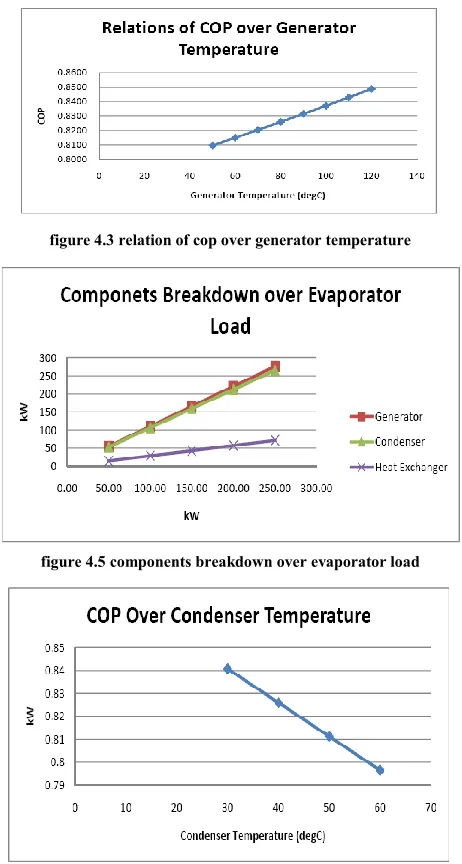
[image:4.612.335.551.258.426.2]Based on the relation of cop and generator temperature below, its shows that the cop values increase as the generator temperature increases. In this water lithium bromide vapor absorption system, we need to increase as much as possible generator input to increase the cop but since we are using solar energy as a heat generator thus we have the limitation. From the research by v. Mittal and ks kasana (2006), the cop becomes constant after generator inlet temperature reaching 95°c.
figure 4.3 relation of cop over generator temperature
figure 4.5 components breakdown over evaporator load
figure 4.6: relation of cop ove condenser temperature
VI. MINIMUM HEAT SOURCE TEMPERATURE FOR LIBR -WATER SYSTEM
The minimum heat source temperature (8) for the single stage water lithium bromide vapor absorption system with an output chilled water temperature of 6.7°c (for air conditioning application) is shown in table below:-
Table 1
minimum heat source temperature for water lithium bromide vapor Absorption system
[image:4.612.53.284.271.703.2]International Journal of Emerging Technology and Advanced Engineering
Website: www.ijetae.com (ISSN 2250-2459, Volume 2, Issue 9, September 2012)332
VII. CONCLUSIONThe application of renewable energy in air conditioning system required continuous improvement and study to make it available and practical for the daily use. The economic factor has becomes the main constraint for this application since the conventional energy is far cheaper compared to the renewable energy. The simulation of solar absorption system in this study provides good tools to identifying the parameter or components of water lithium bromide solution. Besides that, the maximum cop and generator temperature and be evaluated.
REFERENCES
[1 ] P. J. Wilbur, and c. E. Mitchell, solar absorption air-conditioning alternatives, solar energy, 17, 193–199 (1975).
[2 ] V. Mittal, k. S. Kasana, and n. S. Thakur, harnessing solar energy for absorption air-conditioning system, proc. Int. Congress on renewable energy resources, allied publishers, pune, pp. 115–127 (2005). [3 ] M. A. Hammad, and m. S audi, performance of a solar libr–water
absorption refrigeration system, renew. Energy 2, 275–282 (1992). [4 ] Haim, g. Grossman, and a. Shavit, simulation and analysis of open
cycle absorption systems for solarcooling, solar energy, 49, 515– 534 (1992).