Journal of Chemical and Pharmaceutical Research, 2014, 6(4):780-785
Research Article
CODEN(USA) : JCPRC5
ISSN : 0975-7384
A novel series of Jumonji domain-containing protein 2 (JMJD2C)
inhibitors: Quantitative structure-activity relationship analysis,
toxicity prediction and docking studies
Sophi Damayanti
1*Lila Iasha Panggabean
1, Khairrurijal
2and Daryono Hadi Tjahjono
11Pharmacochemistry Research Group, School of Pharmacy, Bandung Institute of Technology, Jalan Ganesa No.10
Bandung
2
Physics of Electronic Materials, Faculty of Mathematics and Natural Sciences, Bandung Institute of Technology , Jalan Ganesa No.10 Bandung
____________________________________________________________________________________________
ABSTRACT
Jumonji domain-containing protein 2 (JMJD2C) plays a role in increasing the production of Mdm2 oncogene in overproduction condition. Further, it will inhibit the cell cycle of p53 to suppress tumor growth. The purpose of this research was to study Quantitative Structure Activity Relationship (QSAR), design new compounds, predict their toxicity, and interaction of new compounds with the receptor. Optimization of three-dimensional structure was performed using HyperChem 8.0.3 with Semi-empirical AM1 method with iteration limit of 50 and convergence limit of 0.01. Leave One Out Cross Validation (LOO-CV) was done for predictor value calculation and determination of outlier compounds using MOE 2007.09. Multilinear regression analysis was conducted by SPSS Statistics 17.0. The best QSAR equation was used to find new compounds with better activity than the parent compound. Study of toxicity of new compounds to humans was performed with Toxtree 2.1.0 and that to aquatic organisms was obtained with Ecosar 1.00a. The interaction of new compounds with receptors was observed using Argus Lab 4.0.1 and AutoDock Vina. The best QSAR equation was: IC50 = -3914.398(±369.478) - 277.686(±29.759) AM1_HOMO -
176.811(±18.602) logS + 2.820(±0.206)ASA_H - 368.008(±20.701) logP(o/w). Three new compounds were
obtained with better activity than that of the parent compound. Compound 1 and 3 were potential candidates for better interaction with receptors JMJD2C.
Key words: cancer, JMJD2C, QSAR equation, docking, toxicity, activity, interaction.
____________________________________________________________________________________________
INTRODUCTION
People are reported suffering from diseases so called cancer. Boyle (2008) stated an estimation that over 12 million cases was found and diagnosed. The mortality data showed 7 million deaths and 25 million persons live in the world together with cancer. World population is growing bigger and will increase the incident of cancer. Future prediction in 2030, 27 million incident cases of cancer, 17 million cancer deaths per year and 75 million cancer patients are exist [1]. In United States, about 63,300 cases of breast carcinoma in situ and 55,560 cases of melanoma in situ are expected to be newly diagnosed in 2012 [2].
anticancer drug discovery and its target[3]. JMJD2C are reported to be associated with cancer. Overproduction of JMJD2C will demethylate histones and increase expression of Mdm2 oncogene resulting in decreasing production of tumor suppressor gene p53 in cells [4,5,6,7]. Furthermore, JMJD2C has been involved in oesophageal cancers by amplification [8, 9].
Hamada et al. have synthesized a series of inhibitor Jumonji Domain-Containing Protein 2 (JMJD2C) [4]. Quantitative study of the structure and activity relationship series of that JMJD2C inhibitor has not been found to date. Therefore, the purpose of this study was to determine the equation which describes the model of predictors that influence the activity of inhibitor, designing new compounds with better activity than the parent compound, prediction of toxicity and docking study with proteins JMJD2C.
EXPERIMENTAL SECTION
The research method included the preparation of a three-dimensional model of the structure of the compound using the software HyperChemTM 8.0.3. Then, the model was used to measure the value of the predictor using the software Molecular Operating Environment (MOE 2007.09) and performed statistical analysis using SPSS Statistics 17.0 software to obtain QSAR equation that best meet the criteria.
Preparation of three-dimensional model of the structure of compounds was done by drawing the structure of molecules in two-dimensional plane and the addition of hydrogen. Three-dimensional structure of molecules was further optimized by semi-empirical AM1 method with convergence iteration limit and limit 00:01 50.
The predictor models were selected with criteria of r ≥ 0.8 and the Ftable/ Fcalculated ≥ 1 with a significance level of 95%. q2 value of each predictor models that have met the criteria was calculated and that with largest q2 was selected. LOO-CV was done by eliminating outliers compounds in order to obtain the best QSAR equation.
Design of new compounds was done by selecting 14 compounds of the series JMJD2C protein inhibitor based on research by Hamada et al as the parent compound (Figure 1) [4]. Parent compound was substituted with variation of substituents on the aromatic ring structure by Topliss scheme [10,11]
Figure 1 Structure of Parent Compund [4]
Best QSAR equation was used to obtain the IC50 of new compounds. Toxicity of parent and new compound were
predicted using Toxtree 2.1.0 software and Ecosar 1.00. Lastly, docking study of their interaction with receptors JMJD2C using software Arguslab 4.0.1 and AutoDock Vina was examined.
RESULTS AND CONCLUSION
Fifteen compounds were structure geometrily optimized and further their predictors were calculated. The value of each compound was statistically analyzed to obtain the best QSAR equation that describes the influence of certain predictors of the JMJD2C inhibitor activity. Statistical analysis of the first step was through multilinear regression analysis with IC50 of each compound trial as the dependent variable (Y) and the value of each predictor as the
independent variable (X). Multilinear regression was done by combining IC50 with 2, 3, and 4 predictors. In general,
the regression equation can be accepted on QSAR study if the correlation coefficient (r) to be around or better than 0.8, and if the value of F indicates a significance level better than 95% [12]. 167 combinations that meets these criteria were obtained.
Table 1 Predictors combination that meet the criteria and has positive q2 value
Model q2 r Fcalculated/Ftable
AM1_Eele, log S, log P(o/w), AM1_E 0.071 0.977 15.410
AM1_HOMO, log S, ASA, log P(o/w) 0.24 0.977 14.784
glob, log S, ASA, log P(o/w) 0.218 0.97 11.576
glob, log S, AM1_E, log P(o/w) 0.095 0.948 9.623
AM1_dipole, log S, ASA, log P(o/w) 0.0004 0.965 6.329
glob, log S, AM1_HF, log P(o/w) 0.034 0.941 5.577
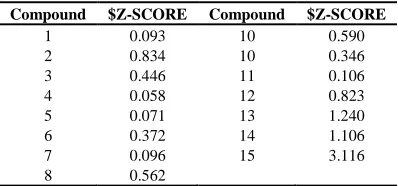
The combination of the six models showed no q2 values ≥ 0.5 (Table 1). Based on the result on Table 1, 2 models have the highest value of q2. Further, the value of $ Z-SCORE was calculated using MOE 2007.09. $ Z-SCORE value of each compound is shown by Table 2.
Table 2 $Z-SCORE value of each compound
Compound $Z-SCORE Compound $Z-SCORE
1 0.093 10 0.590
2 0.834 10 0.346
3 0.446 11 0.106
4 0.058 12 0.823
5 0.071 13 1.240
6 0.372 14 1.106
7 0.096 15 3.116
8 0.562
According to the Table 2, it was found that compound 15 acted as outlier. Therefore, it was eliminated from multilinear regression since the Z-score was out of requirement (≥ 2.5). Then, the newly calculated value of q2 and R2 value equation model was reexamined. Having obtained the value of q2≥ 0.5, the model that fit QSAR equation was a model equation which has an acceptable value of R2≥ 0.8 [14].
The best QSAR equation in this study was IC50 = -3914.398(±369.478) -277.686(±29.759)
*AM1_HOMO-176.811(±18.602)*logS+2.820(±0.206)*ASA_H-368.008(±20.701)*logP(o/w) with R2 = 0.987.
Best QSAR equation can be used to calculate the closeness between IC50 calculation and IC50 experimental results.
[image:3.595.180.430.90.159.2]This can be done by plotting both values in graph (Figure 2).
Figure 2 The plot of experimental IC50 and calculated IC50
Tabel 3 Relationship between predictors and IC50
AM1_HOMO log S ASA_H log P(o/w) IC50 AM1_HOMO 1 -0.488 0.883 0.703 -0.673
log S 1 -0.808 -0.944 0.338
ASA_H 1 0.931 -0.546
log P(o/w) 1 -0.572
[image:3.595.207.406.233.326.2] [image:3.595.191.421.463.607.2]Table 3 stated that the most influence predictor were AM1_HOMO (correlation coefficient = -0673) and AM1_HOMO interdependence with ASA_H (correlation coefficient = 0833) [15]. Therefore, addition of groups in designing new compounds was done base on the value of AM1_HOMO and ASA_H in order to obtain a better IC50
values. Furthermore, the value of Log S and Log P (o/w) were examined to other parameter as important descriptor for QSAR antimicrobial and anticancer agents [16,17].
Design of new compounds can be done by first selecting a compound of the series JMJD2C inhibitor. Compound 14 (IC50 = 1.3) was chosen as the parent compound. The purpose of the design of new compounds was to discover new
compounds with better activity than the parent compound and the whole series JMJD2C inhibitor. Topliss scheme for aromatic subtituen was used for design of new compounds.
The aromatic ring substituents on the parent compound was replaced at different substitution positions (X) ie,-Cl,-OMe,-CH3,-But (tertiary butyl),-CF3,-NMe2 ,-NH2, and-F. Substitution was done also by combining 2 substituents (X and Y) on the Topliss scheme at different positions. Substituent replacement was done by combining 2 identical and different substituents in sequence. The used substituents were -Cl, -OMe, -CH3, -But (tertiary butyl), -CF3, -NMe2, -NH2, and -F [18,19].
Design of the new compound resulted 486 compounds. All the compounds were then optimized with HyperChem 8.0.3, semi-empirical AM1 method to limit repetition (iteration) 50 and centering limit (convergence) 0.01. The values of each predictor newly designed compounds were used in the best QSAR equation to find prediction of IC50
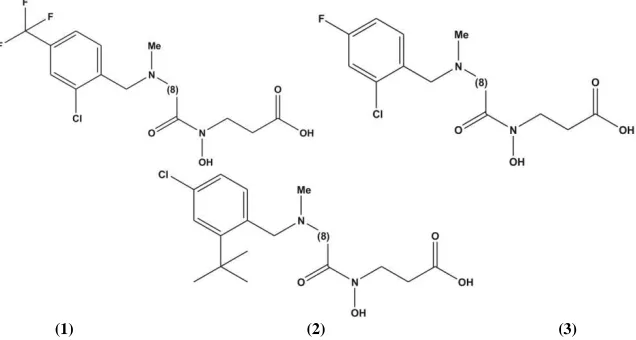
values. The three compounds with lower IC50 values in comparison to parent compound are shown in Figure 3.
[image:4.595.148.466.327.497.2](1) (2) (3)
Figure 3 Three new compounds with higher activity (IC50 of compound 1: 0.296214; compound 2: 1.213421; compound 3: 0.702227)
Toxicity and interaction with the receptor protein JMJD2C of 3 new compounds were further examined. Toxicity estimation on human was conducted especially in the mutagenicity and carcinogenicity studies using 2.1.0 Toxtree Benigni/Bossa whereas on marine organisms using Ecosar 1.00 [20, 21]. Results of toxicity using Toxtree 2.1.0 shows that the compound 1 and compound 3 were more toxic than the parent compound and the compound 2. Toxicity studies using Ecosar 1.00 was done by comparing the predicted number of compounds/L of water to their solubility in water. The least toxic to most toxic compound was the compound 3, compound 1, parent compound and compound 2.
After estimating the toxicity of new compounds, the docking study of the new compounds with its receptor was estimated using Argus Lab 4.0.1 and AutoDock Vina. Result of ∆G value, Total Hydrogen Bonding and Bond Distance by Argus Lab 4.0.1 are shown in Table 4.
Table 4 Result of ∆G value, Total Hydrogen Bonding and Bond Distance by Argus Lab 4.0.1
Compound ∆G (kcal/mol) Total hydrogen bonding Bond distance (Å)
Parent -8.158 3 2.997
2.468 2.969
1 -6.94 2 2.359
2.093
2 -7.69 2 2.9998
2.592
3 -7.93 1 2.9997
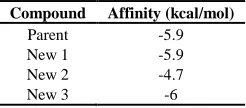
The affinity conformation was given by AutoDock Vina. The affinity values (kcal / mol) of new compounds and the parent compound are shown in Table 5.
Table 5 Affinity value of parent and new compounds with their receptor using AutoDock Vina
Compound Affinity (kcal/mol)
Parent -5.9
New 1 -5.9
New 2 -4.7
New 3 -6
By combining the results of docking from the Argus Lab 4.0.1 and AutoDock Vina, compound 1 and 3 showed the closest free energy to the parent compound. It had a close affinity to the conformation of parent compound.
In conclusion, QSAR model equation stated IC50 = -3914.398(±369.478) - 277.686(±29.759) AM1_HOMO -
176.811(±18.602) logS + 2.820(±0.206)ASA_H - 368.008(±20.701) logP(o/w) with R2 = 0.987, Fcalculated/Ftable = 47.69358067, q2 = 0.644794. Three new designed compounds were obtained with better activity prediction than that of the parent compound. Compound 1 and 3 were potential candidates as new JMJD2C inhibitor.
Acknowledgement
Thankful are adressed to Kusnandar Anggadiredja and Andhika Bintang Mahardhika during manuscript preparation.
REFERENCES
[1]P Boyle and B Levin, World Cancer Report, IARC Press, Lyon, 2008, 9-42. [2]S Rebecca; D Naishadham; A. Jemal, Cancer J. Clin, 2012, 62, 10–29
[3]SP Dholakia; BN Suhagia; AK Patel; PP Kapupara; DK Sureja, J. Chem. Pharm. Res., 2011, 3(4), 315-332. [4]S Hamada; T Suzuki; K Mino; K Koseki; F Oehme; I Flamme; H Ozasa; Y Itoh; D Ogasawara; H Komaarashi; A Kato; H Tsumoto; H Nakagawa; M Hasegawa; R Sasaki; T Mizukami; N Miyata, J. Med. Chem., 2010, 53(15), 5629 – 5634.
[5]A Ishimura; M Terashima; H Kimura; K Akagi; Y Suzuki; S Sugano; T Suzuki, Biochem. Biophys. Res.
Commun., 2009, 389, 366 - 368.
[6]A Akihiko; M Terashima; H Kimura; K Akagi; Y Suzuki; S Sugano, Biochem. and Biophys. Res. Comm., 2009, 389, 366–371
[7]F Lan; AC Nottke; Y Shi, Curr. Opin. Cell Biol., 2008, 20, 316-325.
[8]ZQ Yang; I Imoto; Y Fukuda; A Pimkhaokham; Y Shimada; M Imamura; S Sugano; Y Nakamura; J Inazawa,
Cancer Res., 2000, 60, 4735–4739.
[9]RJ Klose; EM Kallin; Y Zhang, Nat Rev Genet, 2006, 7(9), 715-727.
[10] JE Brady, FA Senese, ND Jespersen. Chemistry, 5th. ed., John Wiley & Sons Inc., New York, 2009, 236 - 241, 290, 312-313.
[11] YC Martin. Quantitative Drug Design: A Critical Introduction, 2nd ed., CRC Press, Boca Raton, 2010, 73-74. [12] H Kubinyi. Drug Discovery Technologies, Volume 3 of Comprehensive Medicinal, Chemistry II, JB Taylor and DJ Triggle, Eds., Elsevier, Oxford, 2007.
[13] T Puzyn, J Leszczynski, MT Cronin. Recent Advances in QSAR Studies, Oxford University Press, New York,
2010, 3-11.
[14] JC Chen; L Qian; Y Shen; LM Chen; KC Zheng, Sci China Ser B, 2008, 51(2), 111 - 119.
[image:5.595.245.368.245.299.2][17] Z Bayat; M Zanoozi, J. Chem. Pharm. Res., 2010, 2(6), 416-423
[18] P Bultinck; HD Winter; W Langenaeker; JP Tollenaere, Computational Medicinal Chemistry for Drug Discovery, Marcel Dekker Inc., New York, 2004, 642 – 643.
[19] HJ Smith; H William. Introduction to the Principles of Drug Design and Action, CRC Press, Boca Raton, 2005, 170-190.
[20] RG Clements. Estimating Toxicity of Industrial Chemicals to Aquatic Organisms Using Structure-Activity Relationship, Environmental Effects Branch Health and Environmental Review Division Office of Pollution Prevention and Toxics U.S. Environmental Protection Agency, Washington D. C, 1996, 1-7.