http://dx.doi.org/10.4236/ojn.2015.51005
Quality of Nursing Courses as Perceived by
Students: Relationship with Their Academic
Achievement in Palestine College of Nursing
Yousif Mahmoud AwadFaculty of Intermediate Studies, University of Palestine, Gaza Strip, Gaza, Palestine Email: [email protected]
Received 28 December 2014; accepted 10 January 2015; published 15 January 2015
Copyright © 2015 by author and Scientific Research Publishing Inc.
This work is licensed under the Creative Commons Attribution International License (CC BY). http://creativecommons.org/licenses/by/4.0/
Abstract
recommend for further studies about concerning quality in nursing education.
Keywords
Nursing Education, Quality, Curriculum, Student’s Perceptions, Achievement
1. Introduction
The goals of education are to prepare people to function properly in society according to societal needs. Quality assurance (QA) is one of the mechanisms developed by educational institutions to ensure that graduates attain adequate standards of education and training. The scope of assessment of QA includes curriculum; student guidance, teaching and assessment; teaching and learning environment; available resources; and standards, qual-ity control and procedures [1].
Curriculum design is one of the exciting intellectual challenges that the field of education can offer. Curricu-lum design is about what to teach, why to teach it, and how to teach it. At the same times, curricuCurricu-lum design ul-timately depends on the purpose of the institution which provides the curricula [2].
The objective of the nursing program is to qualify students to function independently as nurses and to partici-pate in cross-disciplinary cooperation. The education shall give the students skills in theoretical and clinical nursing in accordance with social, scientific and technological developments as well as society’s needs for nurs-ing [3].
The quality of nursing and midwifery education could be evaluated by many indicators such as standard cur-riculum, number of qualified teachers, number of students passing the national examination, number of students receiving a nursing license upon graduation, number of students getting jobs upon graduation, number of re-search grants and number of publications in peer review journals [1].
Nursing education concentrates on the transmission of nursing knowledge, and assisting nursing students to acquire the necessary skills and attitudes associated with nursing practice. Nursing education encompasses the three domains of learning, the cognitive, affective, and psychomotor. Development of nursing education can be achieved through the evaluation of the effectiveness of teaching in nursing programs [4].
It’s founded that in the study entitled “nursing students’ perceptions of nursing as a subject and function” [5], the author described students’ perceptions of nursing as a theoretical subject and the contents of the subject of nursing include various fields of knowledge. Regarding the function of nursing, students believed there is con-siderable report writing about which affected their nursing care. The students’ perceptions of the contents of the subjects of nursing related only in part to professional function, both at the beginning and the end of their nurs-ing education.
Students’ perceptions of effective and ineffective clinical instructors are four categories of important qualities: professional competencies, interpersonal relationship, personality characteristics, and teaching abilities. Moreo-ver, effective teachers have significantly high scores in all of these four qualities. Large differences in scores between effective and ineffective teachers were found in the interpersonal relationship category. Therefore, teachers’ attitudes toward students, rather than their professional abilities make crucial difference between effec-tive and ineffeceffec-tive teachers [6].
1.1. Significance of the Study
The study is a unique study about the quality of nursing courses as perceived by students that will help to assess the academic nursing staff members in considering the quality factors of nursing courses as perceived by stu-dents. Limited studies handle likes this topic in Gaza Strip, there for this study will serve as an exploratory at-tempt to assess and describe the current situation of students’ perceptions about nursing courses and its relations with their academic achievement.
future development of the nursing profession in Palestine.
1.2. Aim of the Study
The purpose of this study was to determine BSN nursing student’s perceptions of the quality of the following nursing courses; fundamentals of nursing, adult nursing, pediatric nursing, maternity nursing, community nurs-ing, mental health and psychiatric nursing and nursing management and leadership taught in Palestine College of Nursing and its relationship with their academic achievement both in theory and clinical.
1.3. Research Questions
1) What are the student’s perceptions about the quality of their nursing courses? 2) How does the quality of nursing courses correlate with student’s achievement?
2. Subjects and Methods
2.1. Study DesignA descriptive, correlational design was adopted in the current study. This design used to explore the relationship between the student’s perceptions of the quality of nursing courses, and its relationship with their academic achievement.
2.2. Setting of the Study
The study was conducted in the Palestine College of Nursing at Gaza Strip. The college is a governmental one affiliated to the Ministry of Health.
2.3. Sample and Sampling Technique
A lists of academic numbers for all nursing students whom registered, attended the courses and the final exam according to the study curriculum plan were obtained from the admission and registration department in the Pa-lestine College of Nursing.
Study sample was non probability quota sample from total student number (600) students whom formerly registered in the college. The sample size was (467), nursing students studied previously mentioned nursing courses distributed as the following: first level, 74 students; second level, 70 students; third level, 119 students; fourth level, 171 students; and upgrading students 33 students.
2.4. Inclusion Criteria
Students who studied the above mentioned nursing courses during the first and second semesters both theory and practice were included in the study.
2.5. Tools of the Study
Data was collected using two tools, the first tool was a self-administered questionnaire developed by the re-searcher after review of the literature. The tool included nine domains “Objectives of the course, Contents of the course, Teacher/Instructor competencies, Teacher/Instructors attributes, characteristics”, Teaching Methodology, Students/teacher Interaction & Communication, Courses Evaluation Process “Exams, Grading/Assignment, Courses Evaluation Process” Exams, Grading/Assignment, The Clinical Instructors, and Clinical Setting “do-mains of total 87 questions of five points Likert’s scale measured the quality of nursing courses as perceived by the students. The tool covered three main parts.
The second tool was the achievement sheet, which included student’s academic number, study level, semester, study year and students grades/marks for each nursing course included in this study both in theory and clinical.
2.6. Scoring the Quality of Perceptions
range from (3.5 - 4.25 mean score, = 70% - 85%), and low quality level (<3.5 mean score, ≤70%).
2.7. Content Validity
Content validity was checked before the pilot study and the actual data collection, through distribution of the first tool to nine experts in the field of the study, to ensure appropriateness, relevancy, clarity and completeness of the tool. Most of the tool items had consensus from the group of experts. Modifications and changes were in-troduced as required.
2.8. Reliability
Reliability was measured by using Alpha Chronbach Coefficient of total (87) questions which was equal to (0.972).
2.9. Ethical Consideration
Acceptance of all students to participate in this study were obtained and ensured their participation was volunta-rily. Students were assured that anonymity and confidentiality was maintained and the information they pro-vided would be used only for the purpose of this research. Any students have the right to participate, refuse or withdraw from the study at any time without any conditions or threatening.
A written approval was obtained from the MOH officials in Gaza Strip to conduct the research, because the college is one of the MOH institutions.
2.10. Data Analysis and Statistical Design
Data entry performed by using the Statistical Package for Social Sciences(SPSS) software version 16, and then data cleaning were done. Quantitative data were expressed in measures of central tendency like mean, Standard Deviation (SD); and categorical data were expressed in terms of frequency and percent. t-test was used for comparison between numerical variables, one way analysis of variance (ANOVA), and correlation tests was used for comparison between categorical variables. A significance level was considered when P value 0.05.
3. Results
Results of the current study are presented as the following sequence, demographic characteristics of the students, students perceptions of the quality dimensions of all nursing courses, students perceptions of the quality of all nursing courses, correlation between students achievements, and quality dimensions of nursing courses, and t-test to differentiate between students gender perceptions of the quality dimensions of nursing courses.
3.1. Demographic characteristics of the students
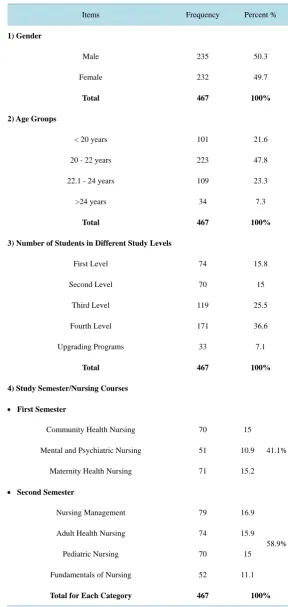
Table 1 shows that 50.3% of the students were males, while 49.7% were females. The age range of 47.8% was 20 - 22 years. The highest percentage 36.6% of the students were enrolled in the fourth level, while the lowest percentage 7.1% were the students in the upgrading program. The students enrolled in the first semester represented 41.1%, while the enrolled in the second semester were 58.9%.
3.2. Student’s Perceptions of the of the Quality Dimensions of All Nursing Courses
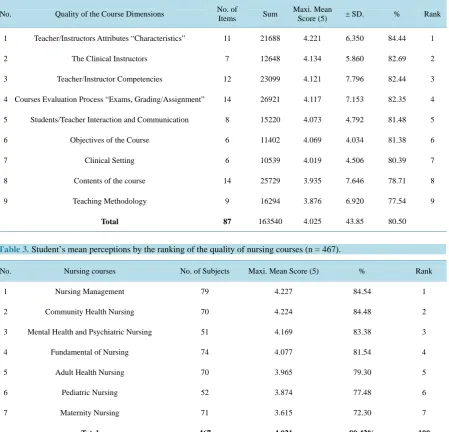
Table 2 shows that the total students perceptions of the quality dimensions for all nurses courses was with av-erage level (mean = 4.025), students perceived the dimensions, teacher/instructors attributes/characteristics, the clinical Instructors and teacher/instructor competencies, of this course were with average quality level and of the first ranks with (mean = 4.221, 4.134, and 4.121, respectively). Where they perceived the dimensions, teaching methodology and contents of the course, of the least ranks of the quality level (mean = 3.876 and 3.935, respec-tively).
3.3. Total Students Perceptions of the Quality of All Nursing Course
Table 1. Demographic characteristics of the students by gender, age groups, study levels and nursing courses (n = 467).
Items Frequency Percent %
1) Gender
Male 235 50.3
Female 232 49.7
Total 467 100%
2) Age Groups
< 20 years 101 21.6
20 - 22 years 223 47.8
22.1 - 24 years 109 23.3
>24 years 34 7.3
Total 467 100%
3) Number of Students in Different Study Levels
First Level 74 15.8
Second Level 70 15
Third Level 119 25.5
Fourth Level 171 36.6
Upgrading Programs 33 7.1
Total 467 100%
4) Study Semester/Nursing Courses
• First Semester
Community Health Nursing 70 15
41.1%
Mental and Psychiatric Nursing 51 10.9
Maternity Health Nursing 71 15.2
• Second Semester
Nursing Management 79 16.9
58.9%
Adult Health Nursing 74 15.9
Pediatric Nursing 70 15
Fundamentals of Nursing 52 11.1
Table 2. Total student’s mean perceptions by the quality dimensions of all nursing courses (n = 467).
No. Quality of the Course Dimensions No. of Items Sum Maxi. Mean Score (5) ± SD. % Rank
1 Teacher/Instructors Attributes “Characteristics” 11 21688 4.221 6.350 84.44 1
2 The Clinical Instructors 7 12648 4.134 5.860 82.69 2
3 Teacher/Instructor Competencies 12 23099 4.121 7.796 82.44 3
4 Courses Evaluation Process “Exams, Grading/Assignment” 14 26921 4.117 7.153 82.35 4
5 Students/Teacher Interaction and Communication 8 15220 4.073 4.792 81.48 5
6 Objectives of the Course 6 11402 4.069 4.034 81.38 6
7 Clinical Setting 6 10539 4.019 4.506 80.39 7
8 Contents of the course 14 25729 3.935 7.646 78.71 8
9 Teaching Methodology 9 16294 3.876 6.920 77.54 9
[image:6.595.91.541.102.534.2]Total 87 163540 4.025 43.85 80.50
Table 3. Student’s mean perceptions by the ranking of the quality of nursing courses (n = 467).
No. Nursing courses No. of Subjects Maxi. Mean Score (5) % Rank
1 Nursing Management 79 4.227 84.54 1
2 Community Health Nursing 70 4.224 84.48 2
3 Mental Health and Psychiatric Nursing 51 4.169 83.38 3
4 Fundamental of Nursing 74 4.077 81.54 4
5 Adult Health Nursing 70 3.965 79.30 5
6 Pediatric Nursing 52 3.874 77.48 6
7 Maternity Nursing 71 3.615 72.30 7
Total 467 4.021 80.42% 100
quality level (mean = 4.021). Students perceived the nursing management course, and community health nursing with high quality level (mean = 4.227, and 4.224, respectively) and of the first ranks. They perceived the pedia-tric nursing course and maternity nursing course with average quality level (mean = 3.874, and 3.615, respec-tively), and of the least ranks of the nursing courses.
[image:6.595.87.538.360.545.2]3.4. Students Achievements
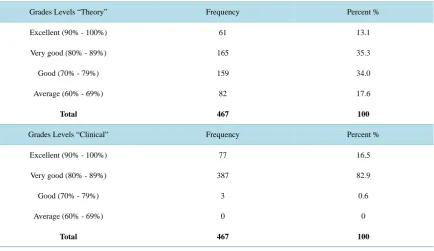
Table 4 shows that the students’ grades levels were excellent level, for 13.1%, very good level, for 35.3%, good level for 34%, and the average, for 17.6%. The highest clinical grade level 82.9%, were very good level, excel-lent level 16.5%, while only 0.6% of the students have got good grade level.
Table 4. Distribution of students according their academic achievement in theory and practice (n = 467).
Grades Levels “Theory” Frequency Percent %
Excellent (90% - 100%) 61 13.1
Very good (80% - 89%) 165 35.3
Good (70% - 79%) 159 34.0
Average (60% - 69%) 82 17.6
Total 467 100
Grades Levels “Clinical” Frequency Percent %
Excellent (90% - 100%) 77 16.5
Very good (80% - 89%) 387 82.9
Good (70% - 79%) 3 0.6
Average (60% - 69%) 0 0
[image:7.595.99.537.382.616.2]Total 467 100
Table 5. Correlation level between the quality dimensions of nursing courses and students’ academic achievements (n = 467).
No. Quality of the Course Dimensions Correlation Level (r value) Sig. Level
1 Objectives of the Course **0.208 (0.01)
2 Contents of the Course **0.149 (0.01)
3 Teacher/Instructor Competencies *0.094 (0.05)
4 Teacher/Instructors Attributes “Characteristics” **0.143 (0.01)
5 Teaching Methodology *0.092 (0.05)
6 Students/Teacher Interaction and Communication **0.166 (0.01)
7 Courses Evaluation Process “Exams, Grading/Assignment” **0.177 (0.01)
8 The Clinical Instructors 0.070 Not Sig.
9 Clinical Setting 0.000 Not Sig.
Total **0.138 Sig. at (0.01)
r value at df (465) and sig. level (0.05) = 0.088 (2-tailed); r value at df (465) and sig. level (0.01) = 0.115 (2-tailed).
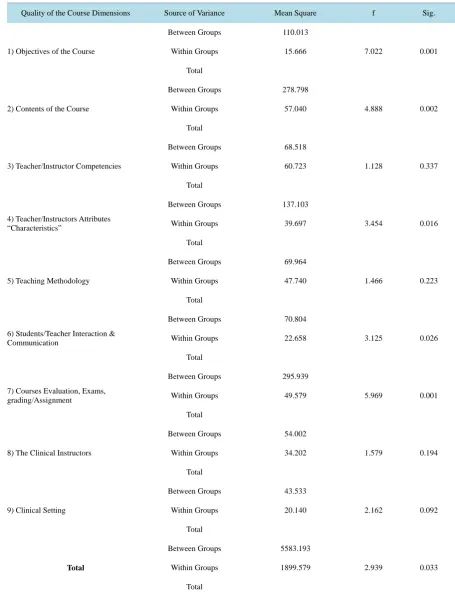
Table 6 shows that there is a statistical, significant different, between students’ achievements levels, and their perceptions of the quality dimensions number (1, 2, 4, 6, 7 and the total scores) at sig. level (0.001, 0.002, 0.016, 0.026, 0.001, and 0.033, respectively). While there is no statistical significant difference of students, achieve-ment levels of their perceptions of the quality dimensions numbers (3, 5, 8 and 9).
Table 6. Analysis of the variance in the mean scores of students achievements levels of perceptions of the quality of the different dimensions of the components of nursing courses, (ANOVA, test), (N = 467).
Quality of the Course Dimensions Source of Variance Mean Square f Sig.
1) Objectives of the Course
Between Groups 110.013
7.022 0.001
Within Groups 15.666
Total
2) Contents of the Course
Between Groups 278.798
4.888 0.002
Within Groups 57.040
Total
3) Teacher/Instructor Competencies
Between Groups 68.518
1.128 0.337
Within Groups 60.723
Total
4) Teacher/Instructors Attributes “Characteristics”
Between Groups 137.103
3.454 0.016
Within Groups 39.697
Total
5) Teaching Methodology
Between Groups 69.964
1.466 0.223
Within Groups 47.740
Total
6) Students/Teacher Interaction & Communication
Between Groups 70.804
3.125 0.026
Within Groups 22.658
Total
7) Courses Evaluation, Exams, grading/Assignment
Between Groups 295.939
5.969 0.001
Within Groups 49.579
Total
8) The Clinical Instructors
Between Groups 54.002
1.579 0.194
Within Groups 34.202
Total
9) Clinical Setting
Between Groups 43.533
2.162 0.092
Within Groups 20.140
Total
Total
Between Groups 5583.193
2.939 0.033
Within Groups 1899.579
Total
Table 7.t. test independent sample results of comparison between gender with all domains of the study.
No. Domains Group N Mean SD t. Sig. Value
1 Objectives of the Course
Male 235 24.272 4.263
0.771 0.441
Female 232 24.560 3.792
2 Contents of the Course
Male 235 54.723 8.063
1.055 0.292
Female 232 55.470 7.198
3 Teacher/Instructor Competencies
Male 235 49.055 8.049
1.136 0.256
Female 232 49.875 7.525
4 Teacher/Instructors Attributes “Characteristics”
Male 235 46.438 6.471
0.010 0.992
Female 232 46.444 6.240
5 Teaching Methodology
Male 235 34.502 6.687
1.222 0.222
Female 232 35.284 7.140
6 Students/Teacher Interaction and Communication
Male 235 32.349 5.061
1.099 0.272
Female 232 32.836 4.502
7 Courses Evaluation Process “Exams, Grading/Assignment”
Male 235 57.277 7.426
1.126 0.261
Female 232 58.022 6.861
8 The Clinical Instructors
Male 205 29.098 5.506
0.519 0.604
Female 232 28.806 6.165
9 Clinical Setting
Male 205 24.224 4.430
0.469 0.639
Female 232 24.022 4.579
Total
Male 235 345.132 46.598
2.524 0.012
Female 232 355.319 40.347
“t” table value at (465) d f. at (0.05) sig. level equal 1.96.
4. Discussion
The present study was conducted to determine BSN, nursing student’s perceptions of the quality of the nursing courses in the Palestine college of nursing this included; fundamentals of nursing, adult nursing, pediatric nurs-ing, maternity nursnurs-ing, community nursnurs-ing, mental and psychiatric health nursing and nursing management and leadership taught in Palestine College of Nursing and its relationship with their academic achievement.
4.1. Demographic Characteristics
According to the study findings the demographic characteristics of the students, revealed that the gender distri-bution approximately had the same percent. The Palestine College of Nursing accepts each year students of both genders, who have general secondary school education. Then they are classified into male and female classes.
reported that increasing the number of male nurses was a community aim as in such a nursing college mostly admit female nursing students were dominating.
Student’s age rang was from <20 years to >24 years. About fifty percent of students age were ranged from 20 - 22 years, this may be the college majority of the students were regular and normally upgrading.
4.2. Students’ Perceptions of the Quality Dimensions of All Nursing Courses
The study revealed that, students at the Palestine College of Nursing perceived the nursing courses as having average quality level (80.50%), with some variation between dimensions where the dimensions “teacher attributes” and “the clinical instructor” having the highest scores, (84.44% 82.69% respectively). This could be because the college appoints teachers according to criteria, which assures their competency and consequently the quality of the teaching-learning process. The students perceived their instructors as having good personal and professional characteristics as dealing with students with respect, giving feedback, motivating them, being available most of the times answering their questions, giving instructions, create a positive and comfortable learning environment, correlating theory with practice in clinical settings and show good role model.
The study findings was supported by many researchers, [8], reported that the most important characteristics of effective teacher/instructor was personality qualities and traits which emerged as the highest ranking as corrects students mistakes without criticizing them, were available, well prepared for teaching, a good role model, and encouraged a climate of mutual respect. [9] added that students perceived effective teacher as the one who teach at the student knowledge level, and provide frequent feedback to them. Also [9] reported that good teachers create positive relationships with students, are professional role models, and provide students with interpersonal support.
Generally, teaching methodology have been perceived by students as having the least quality level score (77.54%), of the dimensions of all nursing courses. This could be because most of teachers using a limited strategies and methods of teaching, as they depended on lectures, and power points presentations only. Other teaching methods like role play, group discussions, problem solving, simulations, self-learning…etc. were not used because of the unavailability of facilities, both manpower and materials.
These results were not congruent with the results of previous researchers. [10] found that undergraduate stu-dents perceived teaching strategies, faculty enthusiasm and knowledge base, faculty support of stustu-dents efforts are faculty strengths points. Also [9] found that teaching methods was chosen by students as the next most fre-quent characteristics of effective teacher/instructor after personality attributes.
The study findings revealed that there is no statistical significant difference between students’ gender and their perceptions of the quality dimensions of all courses, except in the total score there is a statistical significant difference at sig. level (0.012). This could be because the students males and females are from the same culture, background, nursing courses were taught by the same teacher, same contents, they did clinical practice in the same settings, and taken the same exams and assignment.
The study results supported by other researchers, [11], who reported in this study entitled “classroom and clinical learning approach on academic achievement associated degree nursing students” there was no signifi-cant difference between the learning outcomes and the students gender. [12] added that gender is not associated with students’ academic success rate. Other study [13], found that there is no statistical significant difference between male and female students in their perception of effective teacher regarding professional competencies, interpersonal relationship and personal characteristics.
4.3. Students Perceptions of the Overall Quality Level of All Nursing Courses
The study findings revealed that the students perceived the whole nursing courses as having average quality lev-el (80.42%). While there is, some differences of scores. among nursing courses The “nursing management course, and community health nursing course” were of the first two ranks and having high quality level (84.54% and 84.48%, respectively), Mental health and psychiatric nursing course, fundamentals of nursing course, adult health nursing; pediatric nursing, and maternity nursing were of next ranking respectively with scores (83.38%, 81.34%, 97.30%, 77.48%, and 72.30%, respectively).
tors interactions. This result is consistent with [14], who found that students of upper level classes evaluate their instructors with higher ratings scores.
4.4. Students Achievement Levels “Theory and Clinical”
The study results revealed that students’ grades in the theoretical part of the course were ranged from average level, (60% - 69%), to the excellent levels, (90% - 100%), with grades mean score 78.53%. The excellent level was 13.1%, very good level was 35.5%, good level was 34%, and average level was 17.6%, of the study sample.
This could be because the theoretical grades were obtained through year work such as many tests during the semester, as quizzes, midterm, writing assignments, attendance, participation and final exam; through this process many grades may be lost. Another cause may be due to difficult exams, and students stress. What men-tioned may affect the students’ final theoretical achievement levels. This is consistent with [15], who reported that nursing educators can use many assessment strategies for given course like doing tests, assignments, quizzes, projects, presentations and contribution to discussions.
Students’ clinical achievements were ranged from good level (70% - 79%), to excellent level (80% - 89%), with grades mean score, (86.85%). The excellent level was 16.5%, very good level was 82.9%, and good level was 0.06%, of the study sample. This is not congruent with [11], who reported about classroom and clinical learning approach on academic achievement, the sample mean score in clinical performance grade was (78.8%).
This could be because the students in clinical settings deals with many cases with different medical diagnosis, practiced and oriented to different nursing models of care delivery such as, total patient care, case management, functional nursing, methods, and team nursing tried to do their best efforts to integrate theory into practice, also they are facing the real situations in clinical settings and they have to get involved and take the opportunity in the practice and express themselves to acquire skills and knowledge. Another factor is that the instructor and working staff guide the students to practice and acquire more skills during their presence in the clinical settings. In the same context the clinical achievement of very good level was constitutes (82.9%), of study sample which is too high in comparison with theoretical grades where only (35.3%), have very good level with ratio (2.4:1). This may lead to grade inflation, which could be happen because most of clinical instructors are part timers, did not observe the students adequately and consequently over estimate them. This is consistent with [16], who reported that many nursing students are evaluated by seasonal, term, and part-time faculty. This could be a significant contributing factor to grade inflation.
On the same domain, [15], reported that evaluating nursing students in the clinical practice is a complex process and little is known about how educators assess students learning and competencies in clinical settings.
4.5. Relationship between the Quality Dimensions of the Nursing Courses and Students’ Achievements
There is a significant positive relationship between the quality dimensions of the nursing courses and the stu-dents’ achievements. This relationship was found between students' achievements and the following quality di-mensions such as explaining objectives of the course at the beginning of the course, the contents of the course, teacher characteristics, students/teacher interaction, course evaluation, teacher competencies, and teaching me-thodology and students’ achievements.
This could be because the courses objectives, were clear, logic, explained at the beginning of the course and relevant to the course topics, courses contents were interested, covered all topics and subjects of the course and delivered in a way that convenient to students, satisfactory courses evaluation process, fair evaluation, compre-hensive exams and covered most of the course topics, teachers were competencies, efficient and well prepared. Where students’ achievements reflect their understanding and knowledge acquired through course taught. This is in agreement with [17], who reported that grades provide students with information related to how well they understand course material.
0.05) level.
Also the study revealed that there is a statistical significant difference between students’ achievements level of their total perceptions of all nursing courses, and five dimensions from nine. These are the objectives of the course, contents of the course, teacher/instructors characteristics, students/teacher interaction and communica-tion, and courses evaluation
4.6. Study Implication for Nurse Educators
Academic program integrity is meant of control quality in nursing education. Higher education is delivered via program or courses leading to academic or professional awards, with each program having a nursing educators team responsible for its operational management. Curriculum quality criteria should be related to present and anticipated future needs, aims and objectives which are explicit and carefully focused.
The study results could help initiating change in the faculty staff regarding the teaching process, teaching methods, clinical practice, clinical setting and students evaluation .Also could help to establish mutual and well- defined expectations among the students and faculty administrators and academic staff, which could help to create a healthy academic atmosphere conducive to learning.
5. Conclusion and Recommendations
The study concluded that the students’ total perceptions of the quality of nursing courses were of average quality level and there is a significant correlation between most of the courses’ quality dimensions and students’ aca-demic achievement.
The study recommended improving the quality of nursing courses for better level and to improve the quality of some dimensions like using a diversity of teaching strategies, the quality of clinical settings, clinical envi-ronment, and improve the quality of nursing instructors in some clinical areas.
Recommendations
According to the results of the current study, the following recommendations are suggested:
• The Palestine College of Nursing should encourage different teaching strategies such as self-directed learn-ing, problem-solving skills, role play, simulation, group discussions and ensure its application, especially for the pedantic nursing course, adult health nursing course, maternity health nursing course, fundamentals of nursing and mental and psychiatric nursing course.
• Improve the readiness of clinical settings for clinical practice such as enough facilities, supplies and equip-ment to enable nursing students to practice what they have learned in the classroom safely and efficiently, especially for the mental health and psychiatric, and maternity training clinical settings.
• Improve the clinical nursing instructors’ abilities and potentials in supervision, communication and evalua-tion skills, through refreshment courses about clinical learning strategies especially for community health nursing and maternity health nursing courses.
• Contents of the nursing courses to be organized in a logic sequence, containing important issues which are relevant to students’ career practice.
References
[1] WHO (2007) Quality Assurance and Accreditation of Nursing and Midwifery Educational Institutions. Report of Re-gional Workshop, Malé, Maldives, South East Asia, 9-11 July 2007.
[2] Iwasiw, C., Goldenberg, D. and Andrusyszyn, M. (2008) Curriculum Development in Nursing Education. 2nd Edition, Illustrated, Jones and Bartlett Publisher, Sudbury, MA.
[3] Bydam, J. (2004) Bachelor of Nursing Curriculum, Copenhagen County School of Nursing and Radiography. Canadian Association of Schools of Nursing, The CASN Accreditation Program, Ottawa.
[4] Salsali, M. (2005) Evaluating Teaching Effectiveness in Nursing Education. An Iranian Perspective. BMC Medical Education, 5, 29. http://dx.doi.org/10.1186/1472-6920-5-29
[5] Granum, V. (2004) Nursing Students’ Perceptions of Nursing as a Subject and a Function. Journal of Nursing Educa-tion, 43, 297-304.
Jour-nal of Nursing Education, 44, 187-192.
[7] Ozdemir, A., Akansel, N. and Tunk, G.C. (2008) Gender and Career: Female and Male Nursing Students’ Perceptions of Mail Nursing Role in Turkey. Health Science Journal, 2, 153-161.
[8] Sieh, S. and Bell, S. (1994) Perceptions of Effective Clinical Teachers in Associate Degree Programs. Journal of Nursing Education, 33, 389-394.
[9] Berg, C.L. and Lindseth, G., (2004) Students’ Perspectives of Effective and Ineffective Nursing Instructors. Journal of Nursing Education, 43, 565-568.
[10] Wolf, A., Bender, P., Beitz, J., Wieland, D. and Vito, K. (2004) Strengths and Weaknesses of Faculty Teaching Per-formance Reported by Undergraduate and Graduate Nursing Students. Journal of Professional Nursing, 20, 118-128.
http://dx.doi.org/10.1016/j.profnurs.2004.03.003
[11] Carrick, J. (2010) The Effect of Classroom and Clinical Learning Approach on Academic Achievement Associated Degree Nursing Students. Indiana University of Pennsylvania, Indiana.
[12] Dante, A., Valoppi, G., Saiani, L. and Palese, A. (2011) Factors Associated with Nursing Students’ Academic Success or Failure: A Retrospective Italian Multicenter Study. Nurse Education Today, 31, 59-64.
http://dx.doi.org/10.1016/j.nedt.2010.03.016
[13] Nahas, V. and Yam, B. (2001) Hong Kong Nursing Students’ Perceptions of Effective Clinical Teachers. Journal of Nursing Education, 40, 233-237.
[14] Smith, H. and Nortvedt, M. (2008) Evaluation of Evidence-Based Methods Used to Teach Nursing Students to Criti-cally Appraise Evidence. Journal of Nursing Education, 47, 372-375.
http://dx.doi.org/10.3928/01484834-20080801-08
[15] Oermann, M., Saewert, K., Charasika, M. and Yarbrough, S. (2009) Assessment and Grading Practice in School of Nursing: National Survey Finding Part I. Nursing Education Perspective, 30, 274-278.
[16] Scanlan, J. and Care, W. (2004) Grade Inflation: Should We Be Concerned? Journal of Nursing Education, 43, 475- 478.
[17] Marzano, R. (2000) Transforming Classroom Grading. Association for Supervision and Curriculum Development, Alexandria.