
© 2017, IRJET | Impact Factor value: 5.181 | ISO 9001:2008 Certified Journal | Page 405
Review on Performance and Emission characteristics of different types
Fish oil biodiesel as an alternative to the conventional Diesel fuel in C.I.
Engine
Rasal Rushikesh M
1, Ghaysundar Ashwin G
21
Dr. D. Y. Patil School of Engineering Academy, Talegaon-Ambi, Savitribai Phule Pune University, India
2Professor, Mechanical Engineering, Dr. D. Y. Patil School of Engineering Academy, Talegaon, maharashtra,India
---***---Abstract - Every day the need for the conventional fuels is
increasing as the industrialization and transportation is increasing at a faster rate. This causes the rapid decline in conventional hydrocarbon fuel’s reservoir which is forcing researchers all over the globe to go for alternatives for these hydrocarbon fuels. Different fuels like Jatropha, Pongamia, Waste cooking oil, Fish oil, Peanut oil, etc. were tested in C.I. Engines. This paper presents the comparison of Performance and emission characteristics of different types of Fish oil biodiesel extracted from discarded body parts of fish like head, tail, fins, etc. The brake power, brake specific fuel consumption, brake thermal efficiency are the performance parameters and Hydrocarbon, carbon monoxides, carbon dioxides, nitrogen oxides are the emission parameter under consideration. Considerable decrease in all the emission parameters was observed except carbon dioxide emissions. Brake thermal efficiency also increases with marginal increase in brake specific fuel consumption. Overall the fish oil biodiesel has shown promising results on C.I. Engines.
Key Words: C.I. Engine, Alternative fuels, Fish oil
1. INTRODUCTION
Biomass resources are easily available in a bulk all over the world and can be economically, socially and environmentally capable as an alternative for the reduction and gradual substitution to the fossil fuels, promoting sustainable development [21]. Fish oil is produced in large quantity by fish-processing Industry. This by-product from industries has almost equal calorific value to the conventional diesel fuel. The world’s economy depends mainly on the energy economy. Currently fossil fuels, namely coal, petroleum and natural gas, dominate the world energy market occupying 26–27% each of total energy consumption [5]. Particularly, petroleum products take up the major share since they are mainly used in transportation and industrialization sectors. With the growth of both these sectors, the energy consumption also increased. It is estimated that by 2030, the per-capita energy consumption growth will be at a rate of 0.7% per year [5]. The enormous growth of world population, increased technical development, enhancement in the stranded of living and industrialization has led to this intricate situation in the field of energy supply and demand [13]. During the First and Second World Wars, pyrolysis of
vegetable oils played an important role in liquid fuel supply. Since the petroleum crisis at the end of 1970s, several studies on the cracking of vegetable oils and fats have been conducted and the results indicate the technical viability to produce fuels similar to petroleum-based fuels. This energy source has the advantage of being carbon dioxide neutral in contrast to fossil fuels, but it is often challenged since it requires the use of land potentially available for food crops [21]. The above factors create need for (necessitate) developing and commercializing alternatives to fossil fuels from bio-origin. The growing awareness and interest for non conventional bio energy sources and fuels led the authors to work on it. One of such alternative energy sources is biodiesel which can be used as alternative to diesel fuels in C.I. Engine.
2. FUEL PROPERTIES
The fish oil ethyl ester contains very less suspended matter and is of transparent alight yellow colour. The different properties of this biodiesel must be investigated before they are actually being used in the C.I. Engine. The fuel properties such as density, viscosity, flash point, cetane index and calorific value obtained by authors are mentioned in table -1
Table -1: Fuel properties observed by authors
Property Author’s name Rasim [15] Sakthivel [5] Swaminat han [13] Godiganur [18]
Lin and Li [24]
Density
(kg/m3) 881 885 - 880 860
Calorific Value (kJ/kg)
40546 40057 37800 42241 41370
Cetane No. 52.4 52.6 51 52.4 50.9
Viscosity
(mm2/s) 4.451 4.741 4.96 4 7.2
Flash
© 2017, IRJET | Impact Factor value: 5.181 | ISO 9001:2008 Certified Journal | Page 406
3. RESULTS AND DISCUSSION
The performance and emission parameters of fish oil biodiesel used by three different authors are compared in the following.
3.1 Performance characteristics
3.1.1 Brake thermal efficiency
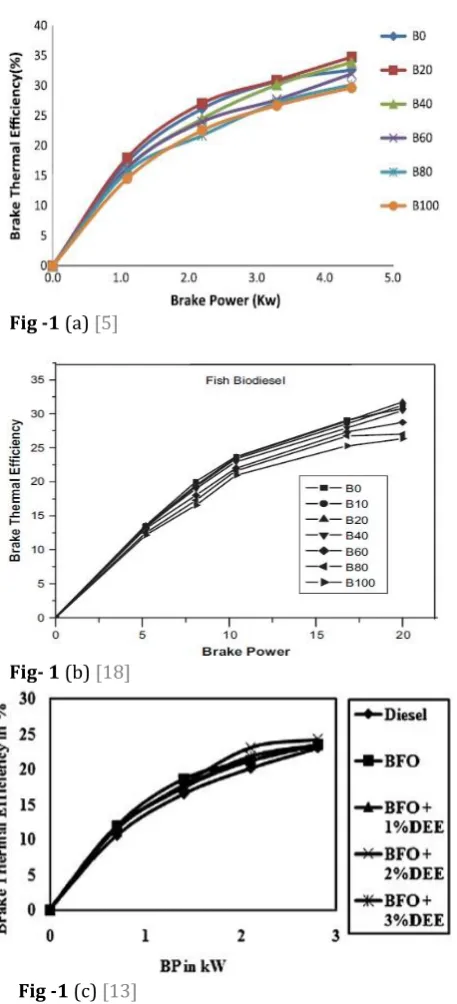
Fig -1 (a) [5]
Fig- 1 (b) [18]
Fig -1 (c) [13]
Fig -1 (a), (b) and (c) Graph of brake power V/s Brake thermal efficiency.
The comparison of variation of brake thermal efficiency with brake power is shown in the figure -1 (a), (b) and (c). It indicates how efficiently the fuel’s energy is converted to mechanical energy. As the brake power increases the brake thermal efficiency goes on increasing for all type of fish oil biodiesel and diesel. The brake thermal efficiency of Blend B20 (as compared to diesel i.e. 21.36%) was found to be higher i.e. 22.15% by G. Sakthivel and 31.74% by S. Godiganur and for BFO with no additive by C. Swaminathan. The other blends shows lesser brake thermal efficiency compared to diesel. This might be because of the reduction in ignition delay which increases the compression work as the power produces before the piston reaches to the top dead centre and loss of energy occurs. Also the calorific value of the biodiesel decreases with increase in percentage of blend.
3.1.2 Brake specific fuel consumption
Fig -2 (a) [18]
Fig2 (b) [13]
[image:2.595.51.280.216.719.2] [image:2.595.320.547.342.730.2]© 2017, IRJET | Impact Factor value: 5.181 | ISO 9001:2008 Certified Journal | Page 407 The comparison of variation of brake specific fuel
consumption with brake power is shown in the figure -2 (a), (b) and (c). Brake specific fuel consumption increases with increase in the percentage of fish oil biodiesel in diesel for all loads. Figure -2 (a) shows that there is decrease in the fuel consumption with increase in load for all fuels. One of the reason for this could be that less heat losses occurs at higher loads hence percent increase in fuel consumption to operate the engine is less than the percent increase in brake power Whereas Fig -2 (a) shows increase in fuel consumption with increase in load for all fuels. With addition of diethyl ether also increase the brake specific fuel consumption at a constant load. This might be because of the higher density of the fish oil. As the same volume of fuel will be consumed at a constant brake power mass consumed will increase.
3.2 Emission characteristics
3.2.1 Hydrocarbon emissions
Fig -3 (a) [5]
Fig -3 (b) [18]
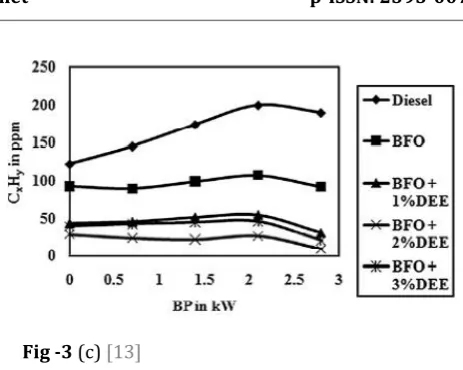
Fig -3 (c) [13]
Fig -3 (a), (b) and (c) Graph of brake power V/s Hydrocarbon emissions
The comparison of variation of Hydrocarbon emissions with brake power is shown in the figure -3 (a), (b) and (c). Figure -3 (a) shows that the hydrocarbon emissions go on decreasing with increase in brake power for all types of fuels whereas Figure -3 (b) shows that the hydrocarbon emissions go on increasing with increase in brake power for all types of fuels which creates confusion between the behaviors of the fuel. But Figure -3 (c) also shows the slight increase in the hydrocarbon emissions with increase in brake power in the initial stage which supports the behavior of fuel shown in Figure -3 (b). In all the three cases conventional diesel fuel shows higher value of hydrocarbon emissions as compared to all fish oil biodiesel-diesel blends. The reduction of 21% of hydrocarbon emissions with the use of biodiesel-diesel blends was observed as compared to diesel [5]. The lowest emission of HC i.e. 17.5 ppm was observed at B20 blend [18]. In the entire cases conventional diesel shows higher values of HC emissions compared to fish oil biodiesel-diesel blends. This could be because of the higher percentage of oxygen in the fish oil biodiesel which helps to improve the combustion process.
3.2.2 Carbon monoxide emissions
[image:3.595.317.549.73.258.2]© 2017, IRJET | Impact Factor value: 5.181 | ISO 9001:2008 Certified Journal | Page 408
Fig -4 (a)
[5]
Fig -4 (b)
[18]
Fig -4 (c)
[13]
Fig -4 (a), (b) and (c) Graph of brake power V/s Carbon monoxide emissions
For all fish oil biodiesel- diesel blends the CO emissions are lesser than conventional diesel fuel. This is because fish oil biodiesel contains more amount of oxygen content which helps for complete combustion of fuel and hence produces lesser amount of CO emissions. Minimum CO emissions of
0.015% were observed at B100 which is obvious reason that 100% fish oil contains maximum amount of oxygen content.
3.2.3 Nitrogen oxide emissions
Fig -5 (a) [5]
Fig -5 (b) [18]
Fig -5 (c) [13]
Fig -5 (a), (b) and (c) Graph of brake power V/s Nitrogen oxide emissions
[image:4.595.50.370.74.669.2] [image:4.595.267.545.134.670.2]© 2017, IRJET | Impact Factor value: 5.181 | ISO 9001:2008 Certified Journal | Page 409 increase in load. The NOx emission for B100 was found to be
the lowest. This may be because of the viscosity of the fish oil biodiesel is high which leads to less mixing of it with air causes less pre-ignition temperature and hence low NOx. But on the other hand Godiganur says there is increase in the NOx emissions with increase in the percentage of fuel blend as well as increase in load both are the contradictory statements. At the same time Swaminathan supports the behavior of the fish oil with the behavior of fish oil taken by Godiganur. One of the reason is fish oil biodiesel contains more amount of oxygen which may lead to formation of NOx.
4. CONCLUSIONS
1. Higher brake thermal efficiency can be achieved with the use of fish oil biodiesel compared to diesel.
2. There is slight increase in brake specific fuel consumption is observed.
3. Considerable amount of decrease in all emissions except CO2 emissions which increases with increase in amount of fish oil biodiesel in diesel.
4. Abundant of raw fish oil is available which is coming from different fishing industries.
5. Fish oil is a better alternative to the conventional diesel fuel.
REFERENCES
[1] Vanessa F. de Almeida, Pedro J. García-Moreno, Antonio Guadix, Emilia M. Guadix, (2015) Biodiesel production from mixtures of waste fish oil, palm oil and waste frying oil: Optimization of fuel properties. Fuel Processing Technology, 133, 152–160.
[2] Gislaine Iastiaque Martins, Deonir Secco, Helton Aparecido Rosa, Reinaldo Aparecido Bariccatti, Bruna Dresch Dolci, Samuel Nelson Melegari de Souza, Reginaldo Ferreira Santos, Tiago Roque Benetoli da Silva, Flavio Gurgacz., (2015), Physical and chemical properties of fish oil biodiesel produced in Brazil. Renewable and Sustainable Energy Reviews, 42, 154-157.
[3] Mohammed Takase, Ting Zhao, Min Zhang, Yao Chen, Hongyang Liu, Liuqing Yang, Xiangyang Wu., ( 2015), An expatiate review of neem, jatropha, rubber and karanja as multipurpose non-edible biodiesel resources and comparison of their fuel,engine and emission properties. Renewable and Sustainable Energy Reviews, 43, 495-520.
[4] Alpaslan Atmanlı, Bedri Yüksel, Erol _Ileri, A. Deniz Karaoglan., (2015), Response surface methodology based optimization of diesel–n-butanol –cotton oil ternary blend ratios to improve engine performance and exhaust emission characteristics. Energy Conversion and Management, 383-394.
[5] G. Sakthivel, G. Nagarajan, M. Ilangkumaran, Aditya Bajirao Gaikwad, (2014), Comparative analysis of performance, emission and combustion parameters of diesel engine fuelled with ethyl ester of fish oil and its diesel blends. Fuel, 132, 116–124.
[6] Luka Lešnik, Jurij Iljaz, Aleš Hribernik, Breda Kegl, (2014), Numerical and experimental study of combustion, performance and emission characteristics of a heavy-duty DI diesel engine running on diesel, biodiesel and their blends. Energy Conversion and Management, 81, 534-546.
[7] Pedro J. García-Moreno, Mohriam Khanum, Antonio Guadix, Emilia M. Guadix, (2014), Optimization of biodiesel production from waste fish oil. Renewable Energy, 68, 618-624.
[8] Kwon Hong, Jung Woo Park, Seung Bum Lee, (2013), Optimization of fish-oil-based biodiesel synthesis. Journal of Industrial and Engineering Chemistry, 19, 764-768.
[9] D.C. Rakopoulos, (2013), Combustion and emissions of cottonseed oil and its bio-diesel in blends with either n-butanol or diethyl ether in HSDI diesel engine. Fuel, 105, 603-613.
[10] R. Yahyaee, B.Ghobadian, G.Najafi, (2013), Waste fish oil biodiesel as a source of renewable fuel in Iran. Renewable and Sustainable Energy Reviews 17, 312-319.
[11] Probir Kumar Bose, Madhujit Deb*, Rahul Banerjee, Arindam Majumder, (2013), Multi objective optimization of performance parameters of a single cylinder diesel engine running with hydrogen using a Taguchi-fuzzy based approach. Energy,375-386. [12] Horng-Wen Wu, Zhan-Yi Wu, (2013), Using Taguchi
method on combustion performance of a diesel engine with diesel/biodiesel blend and port-inducting H2. Applied Energy, 362-370.
[13] C. Swaminathan , J. Sarangan, (2012), Performance and exhaust emission characteristics of a CI engine fueled with biodiesel (fish oil) with DEE as additive. Biomass and bioenergy, 39, 168-174.
[14] Horng-Wen Wu, Zhan-Yi Wu, (2012), Combustion characteristics and optimal factors determination with Taguchi method for diesel engines port-injecting hydrogen. Energy, 411-420.
[15] Rasim Behçet, (2011), Performance and emission study of waste anchovy fish biodiesel in a diesel engine. Fuel Processing Technology, 92, 1187-1194.
[16] Kian Fei Yee, Keat Teong Lee, Riccardo Ceccato, Ahmad Zuhairi Abdullah, (2011), Production of biodiesel from Jatropha curcas L. oil catalyzed by SO24 /ZrO2 catalyst: Effect of interaction between process variables. Bioresource Technology, 102, 4285-4289.
[17] M. Pandian, S.P. Sivapirakasam, M. Udayakumar, (2011), Investigation on the effect of injection system parameters on performance and emission characteristics of a twin cylinder compression ignition direct injection engine fuelled with pongamia biodiesel– diesel blend usingresponse surface methodology. Applied Energy, 2663-2676.
[18] Sharanappa Godiganur, Ch. Suryanarayana Murthy, Rana Prathap Reddy, (2010), Performance and emission characteristics of a Kirloskar HA394 diesel engine operated on fish oil methyl esters. Renewable Energy, 35, 355-359.
© 2017, IRJET | Impact Factor value: 5.181 | ISO 9001:2008 Certified Journal | Page 410 [20] Jibrail Kansedo, Keat Teong Lee, Subhash Bhatia, (2009),
Cerbera odollam (sea mango) oil as a promising non-edible feedstock for biodiesel production. Fuel, 88, 1148-1150
[21] V.R. Wiggers, A. Wisniewski Jr., L.A.S. Madureira, A.A. Chivanga Barros, H.F. Meier, (2009), Biofuels from waste fish oil pyrolysis: Continuous production in a pilot plant. Fuel, 88, 2135-2141.
[22] Cherng-Yuan Lin, Rong-Ji Li, (2009), Engine performance and emission characteristics of marine fish-oil biodiesel produced from the discarded parts of marine fish. Fuel Processing Technology, 90, 883-888. [23] T. Ganapathy, K. Murugesan, R.P. Gakkhar, (2009),
Performance optimization of Jatropha biodiesel engine model using Taguchi approach. Applied Energy, 2476-2486.
[24] Cherng-Yuan Lin, Rong-Ji Li, (2009), Fuel properties of biodiesel produced from the crude fish oil from the soapstock of marine fish
[25] Fernando Preto, Frank Zhang, Jinsheng Wang, (2008), A study on using fish oil as an alternative fuel for conventional combustors. Fuel, 87, 2258-2268.
![Fig -5 (a) [5]](https://thumb-us.123doks.com/thumbv2/123dok_us/8162775.806268/4.595.267.545.134.670/fig-a.webp)
