© 2017, IRJET | Impact Factor value: 5.181 | ISO 9001:2008 Certified Journal | Page 1678
Identification of Bottleneck and Reducing Cycle Time of an Industrial
Oven by Using Project Management Techniques
Vikas S. Jadhav
[1], V. Vivekanand
[2]1
P G Student, Industrial Engineering Department, Ramaiah Institute of Technology, Bangaluru.
2Assistant Professor Industrial Engineering Department, Ramaiah Institute of Technology, Bangaluru.
---***---Abstract -The present work was carried in a oven industry. In order to reduce the manufacturing time of Industrial Oven. a process oriented crashing approach to project management is proposed which gives information about total project data and about individual activities as a function of contractual. The decision to reduce the project duration must be based on the analysis of trade off between time and cost. In current method the assembly of industrial oven is done in 2041minutes i.e. 34.01hours and within 4.3 working days critical path method is the proposed method to carry out the assembly operation in parallel way so that the assembly of the complete oven can be completed in 1694minutes i.e. 28.23hours therefore saving 5.78hours i.e. (347 minutes) reduced cycle time by 17% of initial cycle time.
Keywords: industrial oven machine, Product Breakdown Structure, Network Techniques, Critical Path Method and crashing technique, Project management.
1. INTRODUCTION
The aim of the paper is to reduce the cycle time of Industrial Oven machines by Identifying the bottleneck and reducing cycle time of activities. This is done by using the industrial engineering techniques such as,
Critical Path Method (CPM)
CPM and PERT are network based methods to assist in the planning, scheduling and control of projects. A project is defined as a collection of interrelated activities with each activity consuming time and resources. Both the methods are basically time oriented methods in the sense that they both lead to the determination of a time schedule for a project.
1.1 PROBLEM STATEMENT
After studying the problem Earlier the oven industry used to take 2041 minutes i.e. 34.01hours and within 4.3 working days this is because of using the same resources to carry out the other subassemblies
1.2 OBJECTIVES
The objective of the project is to identify the location of Bottleneck in the existing process, determine the project critical path duration, reduce the cycle time of project and
decrease the production cost by applying the project management techniques.
2 LITERATURE REVIEW
Komesh Sahu and Meenu Sahu[1]. “Minimizing Cost and Time of Project using Crashing” this paper tells about the crashing in project management. Crashing is reducing project time by expending additional resources. Crashing the network is nothing but contracting or compressing the network that means to reduce the project duration at minimum cost with minimum project duration. Naveen Kumar and Dalgobind Mahto[2] “Assembly Line Balancing”, here the authors said that Assembly line balancing is to know how tasks are to be assigned to individual work stations, so that the predetermined goal is achieved. Minimization of number of work stations and maximization of the production rate are the most common goals. Peter Shelth Professor Guy Le Roy[3] “Project Analysis Through CPM Critical path method” here he said that CPM is a technique for analyzing projects by determining the longest sequence of tasks (or the sequence of task with the least slack) through a project network. The CPM and the CCPM (Critical chain project management) are both valuable tools that any organization can use successfully to manage their projects. “Scope management, cost management, and time management” are important variables for projects. Concepts like network diagram (PERT and CPM),learnt how to draw the CPM network, precedence diagram and management engineering were more useful in this project.
3 METHODOLOGY
© 2017, IRJET | Impact Factor value: 5.181 | ISO 9001:2008 Certified Journal | Page 1679
3.1 WORK BREAKDOWN STRUCTURE
The product breakdown structure in project management and systems engineering is a deliverable oriented decomposition of a project into smaller components. A work breakdown structure element may be a product, a service, or any combination. A work breakdown structure. The product breakdown structure of an industrial oven manufacturing.
[image:2.595.311.536.96.393.2]Work Breakdown Structure
Figure- 2 Work Breakdown Structure
It can be seen in above figure that the industrial oven is divided in main two component i.e. 1)Blower and burning assembly 2) Turn table ,ramp assembly than further again divided in to their subassemblies such as heat exchanger, blower housing, motor coupling assembly and control panel. The another main assembly separated by their subassemblies like Baking chamber door, bottom base assembly, inner ramp, air flow sheet. The manufacturing time and operations of subassemblies are given tables at different work stations. The subassemblies like heat exchanger, blower housing. Baking chamber door and bottom base all are manufactured parallel at different workstations.
3.2 ACTIVITY RELATIONSHIP TABLE
[image:2.595.38.288.227.440.2]In the process of manufacturing industrial oven there are number of activities which needs to perform and the sequence of operation, operation time and the total number of activities are tabulated in table 1.
Table – 1 Activity Relationship Table
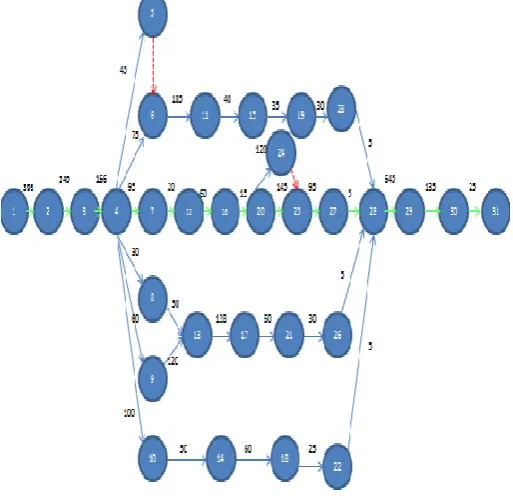
3.3 DEVELOPMENT OF PROJECT NETWORK
[image:2.595.308.565.463.712.2]© 2017, IRJET | Impact Factor value: 5.181 | ISO 9001:2008 Certified Journal | Page 1680
3.4 IDENTIFICATION OF CRITICAL PATH
The path which has highest duration
The critical Path Is
1-2-3-4-7-12-16-20-25-27-28-29-30-31
And critical path duration is = 2041 minutes (34.01 hours) The total Indirect cost 4800/shift = 600/hour
3.5 CRASHING
Crashing the project refers to reduce crashing a number of activities to reduce the duration of project below normal value.
The special measures might include using overtime, hiring additional temporary help, using special time saving materials, obtaining special equipment.
Critical path method of Time Cost Trade Offs is concerned with how much (if any) to crash each of the activities to anticipated duration of the project down to a desired value. The data required for determining how much to crash a particular activity is calculated by the time cost trade for the activities.
Cost Scheduling Computations:
Let
NT= Normal time: - completion of an activity with allocation of resources
NC= Normal cost: - cost associated with normal time CT=Crash time: - shortest completion time of an activity with extra resources
CC= Crash cost: - cost associated with crash time Cost Slope = change in cost/change in time
= (Normal cost - crash cost) / (crash time - normal time)
© 2017, IRJET | Impact Factor value: 5.181 | ISO 9001:2008 Certified Journal | Page 1681
Table 2
Total direct cost (TDC) – it is the one in which we can allocate the cost of the job directly
Example: Raw material cost, labor cost
Total indirect cost (TIC) – in which not possible to allocate the cost of job directly
TIC = 600/hour
Slope of each activity can be calculated as Slope = CC-NC /ND-CD
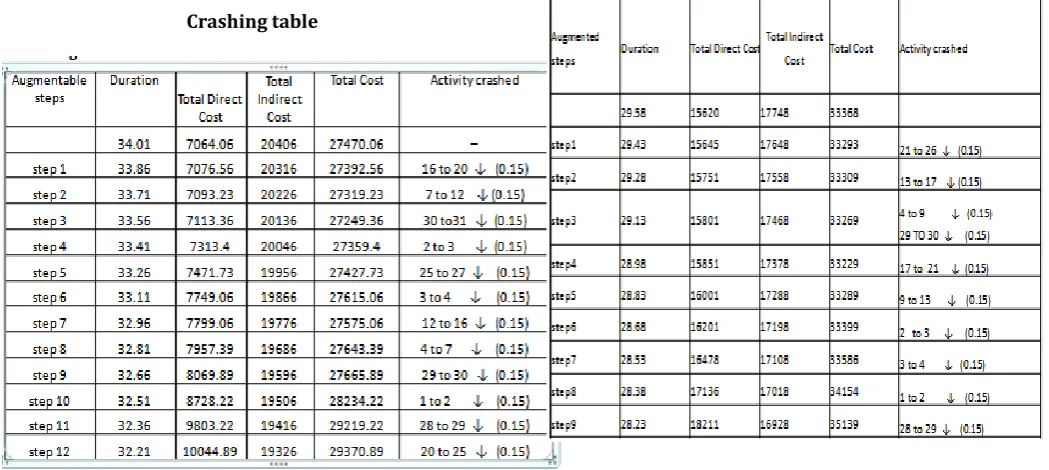
Crashing along this critical path and looking into their minimum slope the crashing can be start on activity which has lower slope and its ascending order along the critical path and ∆t value which is found (0.15). The activity “16 to 20” has lower ∆t value can be crashed by 0.15hours (9minutes)
Crashing table
Table 3 Crashing Critical Path 1
[image:4.595.38.568.52.387.2]After crashing along the critical path the duration of project is reduced from 34.01hours to 32.21hours Similarly further crashing can done to another critical Path and so on.
Figure – 4 Final Precedence Network
Critical path 2 is
[image:4.595.35.560.430.665.2]1-2-3-4-9-13-16-20-25-27-28-29-30-31 =1775minutes (29.58 hours)
Table- 4 Crashing Critical Path 4
© 2017, IRJET | Impact Factor value: 5.181 | ISO 9001:2008 Certified Journal | Page 1682
4 OPTIMUM SCHEDULE COST
Determining Time estimation for all activities
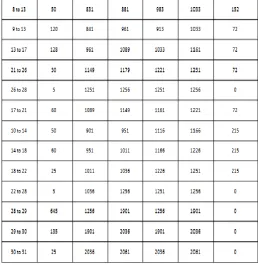
– EST- Earliest start time: the earliest time at which the activity can start given that its precedent activities must be completed first.
– EFT-Earliest finish time: equals to the earliest start time for the activity plus the time required to complete the activity.
– LFT- Latest finish time: the latest time in which the activity can be completed without delaying the project.
– LST- Latest start time: equal to the latest finish time minus the time required to complete the activity.
[image:5.595.309.568.106.372.2]– TF- total float = LFT – EFT
Table -5 Optimum Scheduling Time Estimation
It is seen in above table the total float along the critical path is zero, the activity which are not comes in the critical path having total float.
4 RESULTS
Because crashing a non critical activity does not affect the overall project duration, only critical activities can be crashed are crashed are considered. The activities to be crashed are chosen in order of increasing expanses. Thus the activity with the smaller crash cost in table is chosen to be crashed first. Initial cycle time for 1 complete oven was 34.01hours after crashing the cycle time reduces up to 28.23hours The total time saved is 5.78hours (347minutes). The normal duration of the project is 34.01hours and the corresponding cost was 27470, the minimum duration of project is 28.23hours and its cost is 35139 The number of hours saved = 5.78 hours (17%) The common activity duration reduced by 189minutes (54.46%) The parallel activity duration reduced by 158minutes (45.53%) Further crashing will results in change in critical path so after that crashing is stopped.
6 CONCLUSION
© 2017, IRJET | Impact Factor value: 5.181 | ISO 9001:2008 Certified Journal | Page 1683 the complete oven can be completed in 1694mins
i.e.28.23hours. by allocating extra resources to crashed activity Therefore saving 5.78hours i.e. (347minutes). In order to validate the Critical path method results and it also showed the same result i.e. complete machine assembly can be done in 3.4 working days the minimum duration of project is 28.23hours and its cost is 35139 and the number of hours saved = 5.78 hours (17%).
REFERENCES
[1] Hadi Gokcen, Kursad Aggak “Balancing Of Parallel
Assembly Line”
[2] S.Shanmugasundaram, V.Mathan Kumar “Application of
project scheduling and Cost analysis Using PERT and CPM” Vol. 4, No. 2, April 2015 (ISSN 2278 – 5973)
[3] Michael A. Chilton “Resource Allocation in IT Projects” [4] Tung Yang and Photios G. Ioannou “Scheduling Systems
With Focus On Practical Concerns In Repetitive Projects”
[5] Ali Goksu, Selma Catovic.”Implementation of CPM and
PERT In Assembly Line”
[6] Komesh Sahu and Meenu “Minimizing Cost and Time of
Project using Crashing”
[7] Hamdy A. Taha”Operations Research: An Introduction
Book”
[8] Frederick S Hillier and Gerald J. Lieberman