© 2017, IRJET | Impact Factor value: 5.181 | ISO 9001:2008 Certified Journal
| Page 167
ENHANCING PERFORMANCE FOR ORTHOGONAL FREQUENCY DIVISION
MULTIPLEXING IN WIRELESS SYSTEM
*1
Mrs. Saranya R,
*
2Ms. Lavanya S
*1
M.Phil Research Scholar, PG & Research Department of Computer Science & Information Technology Auxilium
College , Vellore, Tamil Nadu, India
*2
Head of the Department, PG & Research Department of Computer Science & Information Technology Auxilium
College, Vellore, Tamil Nadu, India
---***---Abstract:
Orthogonal Frequency Division Multiplexing(OFDM) is used to reduce guard space without interferences. It supports both single carrier and multi carrier and is used by multiple users for transmitting and receiving data at the same time. It reduces fading and eliminates ISI (Inter Symbol Interferences).In the existing system, they have used Two-Step Resource Allocation Algorithm and Efficient Resource Allocation Algorithm which is based on two step approach. Step1 is carrier selection and Step2 is power and sub carrier allocation. These two algorithms are implemented for throughput used by per user and per CC (Component Carrier) load. But these algorithms are used to reduce the complexity but it is not efficient in power balancing of CC load. The proposed system implements new techniques of PAPR Reduction. One major drawback of OFDM systems is high peak-to-average power ratio (PAPR), which degrades the efficiency of power amplifier. Therefore, PAPR reduction is very important for OFDM systems. The Selective Level Mapping is a technique which needs to transmit the information to receiver, with the selected signal, as side information. The SLM scheme is a low complexity, called Class-III SLM scheme. It is proposed that only one inverse fast Fourier transform (IFFT) is needed to generate alternative OFDM signal sequences. By randomly selecting the cyclic shift and rotation values, Class-IIISLM scheme can generate up to N3 alternative OFDM signal sequences, where N is the IFFT size. However, all N3 alternative OFDM signal sequences do not achieve good PAPR reduction performances. Therefore, an efficient selection method of good rotation and cyclic shift values is needed, which results in good PAPR reduction performance. The selection method of proper rotation values, when U >N/8 is proposed, in order to overcome the drawback of power efficiency on balance of CC load. Simulation results show that the proposed method achieves the optimal PAPR reduction performance. In addition, the proposed scheme requires less memory and side information than random scheme.
Keywords: orthogonal frequency division multiplexing (OFDM), peak to average power ratio (PAPR), IFFT, SLM scheme.
I. INTRODUCTION
Nowadays, in wireless communication systems, the ability of OFDM to efficiently exploit the wideband properties of the radio channel lies at the heart of its popularity plays a very important role to combat the doubly dispersive channels. This feature has helped to establish OFDM as the physical layer of choice for broadband wireless communications systems (European Telecommunications Standards Institute, 2002; National Institute of Informatics, 2002; IEEE, 2003). Therefore, it is expected that OFDM will be still a fundamental element in future wireless communications[3].
Orthogonal Frequency Division Multiplexing is a Frequency Division Multiplexing (FDM) scheme used as a digital multi-carrier modulation method. A large number of closely spaced orthogonal sub-carrier signals are used to carry data on several parallel data streams or channels. Each sub-carrier is modulated with a conventional modulation scheme (such as quadrature amplitude modulation or phase-shift keying) at a low symbol rate, maintaining total data rates similar to conventional single-carrier modulation schemes in the same bandwidth[2]. Orthogonal Frequency Division Multiplexing is a form of signal modulation that divides a high data rate modulating stream placing them onto many slowly modulated narrowband close-spaced subcarriers, and in this way, is less sensitive to frequency selective fading[4].
© 2017, IRJET | Impact Factor value: 5.181 | ISO 9001:2008 Certified Journal
| Page 168
OFDM is a form of multicarrier modulation. An OFDM signal consists of a number of closely spaced modulated carriers. When modulation of any form - voice, data, etc. is applied to a carrier, then sidebands spread out either side. It is necessary for a receiver to be able to receive the whole signal to be able to successfully demodulate the data. As a result, when signals are transmitted close to one another they must be spaced so that the receiver can separate them using a filter and there must be a guard band between them. Although the sidebands from each carrier overlap, they can still be receivedwithout the interference that might be expected because they are orthogonal to each another. This is achieved by having the carrier spacing equal to the reciprocal of the symbol period[4].
Fig .1.2 Receiving Signal Carrying Modulation
The demodulators, translating each carrier down to DC. The resulting signal is integrated over the symbol period to regenerate the data from that carrier. The same demodulator also demodulates the other carriers. As the carrier spacing, equal to the reciprocal of the symbol period means that they will have a whole number of cycles in the symbol period and their contribution will sum to zero - in other words there is no interference contribution. OFDM is based on the concept of frequency-division multiplexing (FDM), the method of transmitting multiple data streams over a common broadband medium. That medium could be radio spectrum, coax cable, twisted pair, or fiber-optic cable. Each data stream is modulated onto multiple adjacent carriers within the bandwidth of the medium, and all are transmitted simultaneously. It is a modulation format that is being used for many of the latest wireless and telecommunications standards.
II. RELATIVE WORK
2.1 Aggregation-based Spectrum Assignment in Cognitive Radio Networks
A novel genetic algorithm based spectrum aggregation scheme is proposed by taking into
consideration the realistic constraints of co-channel interference and maximum aggregation span to use. The use Genetic algorithm (GA) to solve Spectrum Aggregation problem because of faster convergence speed and better searching capability. We compare the performance of our algorithm with Maximum Satisfaction Algorithm (MSA) and Random Channel Assignment (RCA). They are assumed realistic constraints of Co-Channel Interference (CCI) and Maximum Aggregation Span (MAS) for the optimization problem[1]. Performance of the proposed algorithm is validated by running a number of computer simulations and showed the efficiency of the approach by comparing with the RCA and MSA algorithms, available in State-Of-The-Art (SOTA). The paper proposes an aggregation-based spectrum assignment method using GA. We maximized rewarded sum of bandwidth as an optimization criterion to realize efficient assignment of available whitespaces. The simulation results show that our method decreases the number of rejected users and improves the spectrum efficiency of Cognitive Radio Networks (CRN)[1].
2.2 Power Control and Resource Allocation for Multi-cell OFDM Networks
The optimization algorithm is to each resources is allocated to at most one user in a period of time. So, this algorithm develops one low-complexity distributed power control and resource allocation algorithm. This algorithm is strictly proved to converge. The distributed power minimization problem is convex. It is proved that this convex problem can be solved by solving one convex problem with fewer variables and one linearprogram. For the search method of resource allocation problem in multiuser OFDM systems with proportional rate constraints, is the complexity of obtaining the optimal solution.This algorithm provides a low-complexity distributed algorithm to solve the total power minimization problem, and prove the convergence to this distributed algorithm. Moreover, the implementation and complexity analysis of the proposed algorithm is also presented [2].
2.3 Energy-Efficient Resource Allocation in OFDM Relay Networks under Proportional Rate Constraints
© 2017, IRJET | Impact Factor value: 5.181 | ISO 9001:2008 Certified Journal
| Page 169
Besides, the effects of the relay selection, subcarrier assignment and power allocation on the system performance were also discussed via simulation, which provides some useful insights for EE OFDM relay system design. In the end, the algorithm analyzes the total achievable rate 𝑅, the proportional rate constraints and total consumed power 𝑃tot of the system at first and then formulate an optimal problem to find the optimal energy efficient resource allocation[3]
.
2.4 OFDM Spectrum
One requirement of the OFDM transmitting and receiving systems is that they must be linear. Any non-linearity will cause interference between the carriers as a result of inter-modulation distortion. This will introduce unwanted signals that would cause interference and impair the orthogonality of the transmission.The equipment to be used the high peak to average ratio of multi-carrier systems such as OFDM requires the RF final amplifier on the output of the transmitter to be able to handle the peaks whilst the average power is much lower and this leads to inefficiency [5]. In some systems the peaks are limited. Although this introduces distortion that results in a higher level of data errors,. The primary advantage of OFDM over single-carrier schemes is its ability to cope with severe channel conditions without complex equalization filters. Channel equalization is simplified because OFDM may be viewed as using many slowly modulated narrowband signals rather than one rapidly modulated wideband signal. The low symbol rate makes the use of a guard interval between symbols affordable, making it possible to eliminate intersymbol interference (ISI) and utilize echoes and time-spreading to
achieve a diversity gain, i.e. a signal-to-noise
ratio improvement.
Fig.2.1 OFDM Spectrum
2.5 Signal Processing of OFDM
Transmitter
An OFDM carrier signal is the sum of a number of orthogonal carriers, with baseband data on each sub-carrier being independently modulated commonly using some type of quadrature amplitude modulation (QAM)
or phase-shift keying (PSK)[5][2]. This composite
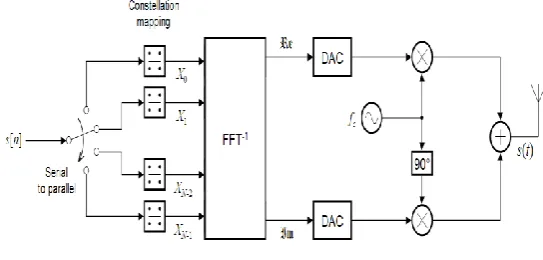
baseband signal is typically used to modulate a main RF carrier.In s[n] is a serial stream of binary digits. By inverse multiplexing, these are first De-multiplexed into N parallel streams, and each one mapped to a (possibly complex) symbol stream using some modulation constellation (QAM, PSK, etc.). Note that the constellations may be different, so some streams may carry a higher bit-rate than others.An inverse FFT is computed on each set of symbols, giving a set of complex time-domain samples. These samples are then quadrature-mixed to pass band in the standard way. The real and imaginary components are first converted to the analogue domain using digital-to-analogue converters (DACs) [8]. The digital-to-analogue signals are
then used to modulate cosine and sine waves at
[image:3.595.309.581.407.537.2]the carrier frequency, fc, respectively. These signals are then summed to give the transmission signal, s(t).
Fig 2.2 Signal Transmitter
Receiver
© 2017, IRJET | Impact Factor value: 5.181 | ISO 9001:2008 Certified Journal
| Page 170
Fig 2.3 Signal Receiver
III. TWO STEP RESOURCES ALLOCATION
ALGORITHM
AND
EFFICIENT
RESOURCES
ALLOCATION ALGORITHM
In existing system, state-of-the-art solutions, this paper’s major contributions can be summarized as follows:
Resource Allocation (RA) with Carrier
Aggregation (CA) functionality is formulated as an optimization problem under the practical constraints of transmits power and limited number of Component Carrier’s (CC) available for each user.
A sub-optimal low-complexity solution (TSRAA) is proposed to solve the optimization problem.
An efficient solution (ERAA) is proposed to approximate TSRAA.
Simulation based study is provided to evaluate the performance of the proposed methods and compare them with the optimum solution.The optimization problem formulated is a complex mixed integer programming problem and is computationally expensive. The proposed system provides a novel approach to convert given problem into a two-step optimization problem and obtain a sub-optimal solution. The first step is for the carrier selection and second step is for assigning power and SCs.
They are two-step RA algorithm is
Power selection
Sub carrier allocation
3.1 Single User OFDM
In a single-user OFDM system, we consider an iterative algorithm that solves for the Eigen values (row of matrix) of the optimum transmit co-variance matrix that maximizes the rate. It is based on enforcing the optimality
conditions of the optimization problem at each iteration. It is proves that converges to the unique global optimum power allocation when initiated at an arbitrary point.
3.2 Multi User OFDM
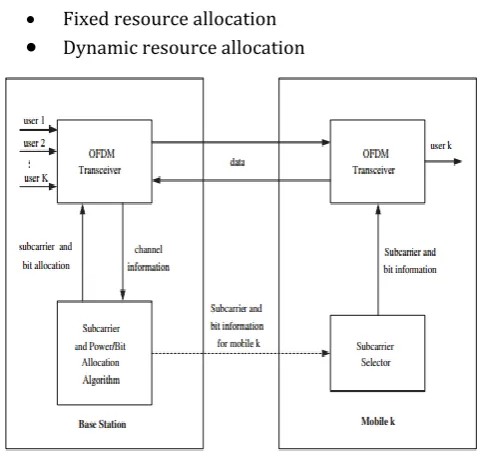
Multiuser OFDM adds multiple accesses to OFDM by allowing a number of users to share an OFDM symbol. Two classes of resource allocation schemes exist:
Fixed resource allocation
[image:4.595.313.553.214.440.2]
Dynamic resource allocationFig .3.1 Multiuser OFDM System Block Diagram
3.3 Water Filling Algorithm
Water filling algorithm is a general name given to the ideas in communication systems design and practice for equalization strategies on communications channels. As the name suggests, just as water finds its level even when filled in one part of a vessel with multiple openings, as a consequence of Pascal's law, the amplifier systems in communications network repeaters or receivers amplify each channel up to the required power level compensating for the channel impairments. For example, channel power allocation in MIMO systems.
It is defined by the sum over all achievable user rates, is maximized under a transmit power constraint. We maximize the sum rate of the system. It is an individual minimum rate requirement for each user has to be fulfilled. Such a scheme may be needed in systems where delay critical as well as non-delay critical data should be sent to each user.
© 2017, IRJET | Impact Factor value: 5.181 | ISO 9001:2008 Certified Journal
| Page 171
the heuristic sum rate maximization algorithm using eigen value updates. Then the optimal power allocation is retrieved by perform water-filling over the adapted Eigen values.
Efficient Resource Allocation Algorithm
Inputs: Let R= (R1, R2, ..., Rj, ..., Rm) be the set of m available resources which should process n independent tasks denoted by the set T= (T1, T2, ..., Ti, ..., Tn), i= 1, 2, ..., n, j= 1, 2, ..., m. All the resources are unrelated and parallel, and each task Ti can be executed on any subset Rj ∈ R of available resources.
Outputs: The output is an effective and efficient resource allocation scheme, including scheduling tasks to appropriate resources and makes span.
Constraints: The execution time of each task on a resource depends on the actual situation, and the value cannot be fixed in advance. Each task must be completed without interruption once started, and resources cannot perform more than one subtask at a time.
Objectives: The main objective is to improve energy efficiency of the data center and minimize make span so as to achieve an energy-efficient schedule.
Definition 1
Assume that si represents the voltage supply class of resource ri, and si has K DVS level; then the supply voltage and frequency relationship matrix of si can be described as follows:
Vi= [(v1(i), f1(i); v2(i), v2(i);.. vk(i), fk(i))] T
where vk(i) is the voltage supply for resource ri at level k, k is the number of levels in the class si, and fk(i) denotes the working frequency at the same level k, 0 ≤ fk(i) ≤1.
IV. PEAK AND AVERAGE POWER RATIO
REDUCTION USE SLM CLASS III TECHNIQUES
The PAPR is the relation between the maximum powers of a sample in a given OFDM transmit symbol divided by the average power of that OFDM symbol. PAPR occurs when in a multicarrier system the different sub-carriers are out of phase with each other. At each instant they are different with respect to each other at different phase values. When all the points achieve the maximum value simultaneously; this will cause the output envelope to suddenly shoot up which causes a 'peak' in the output envelope. Due to presence of large number of independently modulated subcarriers in an OFDM system, the peak value of the system can be very high as compared to the average of the whole system. This ratio of the peak
to average power value is termed as Peak-to-Average Power Ratio.
4.1 Effect of PAPR
There are some obstacles in using OFDM in transmission system in contrast to its advantages: A major obstacle is that the OFDM signal exhibits a very high Peak to Average Power Ratio (PAPR).
Therefore, RF power amplifiers should be
operated in a very large linear region. Otherwise, the signal peaks get into non-linear region of the power amplifier causing signal distortion. This signal distortion introduces intermediation among the subcarriers and out of band radiation. Thus, the power amplifiers should be operated with large power back-offs. On the other hand, this leads to very inefficient amplification and expensive transmitters. Thus, it is highly desirable to reduce the PAPR.
These large peaks cause saturation in power amplifiers, leading to intermediation products among the subcarriers and disturbing out of band energy. Therefore, it is desirable to reduce the PAPR.
To reduce the PAPR, several techniques have been proposed such as clipping, coding, peak windowing, Tone Reservation and Tone Injection. But, most of these methods are unable to achieve simultaneously a large reduction in PAPR with low complexity, with low coding overhead, without performance degradation and without transmitter receiver symbol handshake.
Complexity is increased in the analog to digital and digital to analog converter.
PAPR Reduction Techniques
Clipping: Clipping is the simplest technique that is used to reduce PAPR in OFDM system. The basic idea of this technique is to clip the parts of the signals that have high peak outside of the allowed region.
Coding Schemes: When N signals that have the same phase added together results in the high peak power which is N times the average power. The main idea of coding schemes is to select code word that will produce good PAPR. The good PAPR can be obtained by reducing occurrence probability of the same phase of the N signals.
© 2017, IRJET | Impact Factor value: 5.181 | ISO 9001:2008 Certified Journal
| Page 172
smallest PAPR for transmission. There is another way which can also be used to express PTS method by multiplying the original OFDM signal with a number of phase sequences.
Selective Level Mapping (SLM): The Selective Level Mapping (SLM) techniques are a promising PAPR reduction technique of OFDM system[7]. The SLM is a distortion less technique that can reduce PAPR efficiently without increase in power requirement and incurring data rate loss.
Tone Injection (TI): Tone Injection technique uses additive correction method for reducing PAPR. TI is based on mapping of original data that causes large peaks to several new positions which will not generate large peaks and thus reducing PAPR. The receiver must know how to map the redundant positions on the original one. TI is distortion less technique and does not exhibit data rate loss. However, transmitter is more complex as it requires additional IFFT operation.
Tone Reservation (TR): Tone Reservation technique is based on reserving small set of tones which are called as peak reduction carriers to reduce PAPR. These tones are orthogonal to each other and they are added to a data block or information signal to minimize the high peak. The amount of PAPR reduction depends on number of reserved tones and their position [9].
Selective Level Mapping (SLM) Technique
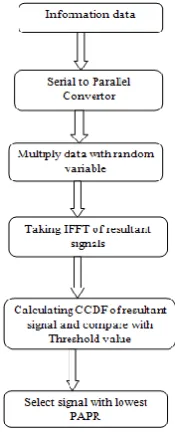
SLM PAPR reduction technique has been first proposed by Bamul.et.al. Selective mapping is a simple PAPR suppression method for OFDM signals. The SLM technique is basically implemented from the idea of symbol scrambling. In this scheme, a set of candidate signals are generated to represent the same information, then the signal with lowest PAPR is selected for transmission. The information about the selection of these candidate signals need to be explicitly transmitted along with the selected signal as side information.
Class-III Selected Mapping
[image:6.595.322.550.108.225.2]Class-III SLM scheme proposes a selection method of optimal cyclic shift values by analyzing the correlation between alternative OFDM signal sequences. The proposed analytic method can also be applied to Class-I and Class-II SLM schemes.
Fig .4.1 Block Diagram of Selective mapping technique class III
Selected mapping technique needs to transmit the information to receiver, with the selected signal, as side information. If there is any error in the received information, then it is difficult for the receiver to recover the information from the transmitted selected signal. Due to this problem a strong protection is needed regarding side information. If the receiver has this side information then the process of decoding becomes very simple.
Fig.4.2 Flow chart for SLM technique
SLM Algorithm:
In our SLM Algorithm symbol sequence copies U times. The u phase sequence is
P
(u)= [p
0(u), p
1(u),….p
(u)N-1]
TwhereP
N(u)= [p
N(u), p
1(u)k(n),….p
(u)N-1]
T, K
(u)= {0.1},
N= 0,1, ….N-1u= 1,2,….N, when K(u)nequals to 0, rotation
vector is 1. While K(u)n equal to 1, the phase sequence can
[image:6.595.393.481.383.600.2]© 2017, IRJET | Impact Factor value: 5.181 | ISO 9001:2008 Certified Journal
| Page 173
modulated. The computational complexity greatly reduced.
Step1: Divide the input data in to number of sub blocks and converted into parallel form by using convertor.
Step2: Then the input data sequences are multiplied by phase sequence to generate input symbol sequence.
Step3.IFFT operation is made on each of input resultant symbol sequence.
Step4.Calculate CCDF of resultant signal and compare it with threshold value.
Step5: Data with lowest PAPR is selected for transmission
.
V. EVALUATION RESULT
This experiment was done using the MATLAB simulation software and the properties configured.
Table: 5.1 Simulation Parameter
The simulation results discuss about some graphical representation of the system performance. Peak to Average Power Ratio are various processes compared to other techniques and rotation selection.
[image:7.595.320.547.368.574.2]1. Basic data bit send to the SLM techniques. This u=4 data bits can be the longest distance travelled by PAPR reduction
.
Fig .5.1 Data Bit send to SLM Techniques
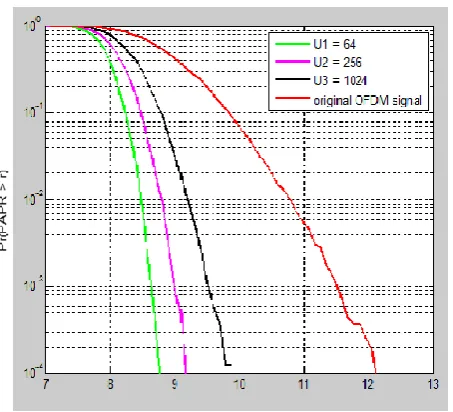
2. Data bit are compared with OFDM signals. It is reverse process. Then u=64 data bit is a PAPR reduced to other signals.
Fig .5.2 Original signals are compared with data bits
© 2017, IRJET | Impact Factor value: 5.181 | ISO 9001:2008 Certified Journal
| Page 174
Fig5.3 SLM Class III techniquesConclusion
The Selection method of optimal cyclic shift values for Class-III SLM scheme is proposed. Also, a selection method of good additional alternative OFDM signal sequences by using proper rotation values is proposed. And this algorithm provides efficient power on balance of CC load. Although the analysis to derive the optimal condition is complicated, we do not need to compute the optimal condition for each OFDM symbol when we apply the proposed scheme to real systems. Therefore, the computational complexity of the proposed scheme is basically as same as random scheme. There are some advantages of the proposed scheme. First, random scheme requires memory for 3 complex numbers (rotation values), whereas the proposed scheme does not need the memory for rotation values. Second, random scheme requires log2 (N/4)bits of side information for cyclic shift values and log2bits of side information for rotation values. Whereas, the proposed scheme requires only log2 bits of side information if the cyclic shift values are shared by the transmitter and receiver. Third, random scheme has a risk to select the cases of bad PAPR reduction performance, whereas the proposed scheme always guarantees the optimal PAPR reduction performance.
Future Work
In future, this algorithm can be proposed with PTS schemes and adaptive techniques, which is used for better PAPR reduction and reduced complexity rate for OFDM system.
REFERENCES
1. DVB, “Frame Structure Channel Coding and Modulation for a Second Generation Digital Terrestrial Television Broadcasting System (DVB-T2)”, ETSI EN 302755 V1.1.1 September 2009.
2. Kyeongcheol Yang and Seok-II Chang, ”Peak-To-Average Power Control in OFDM Using Standard Arrays of Linear Block Code”, IEEE communication letters, Vol.7, No.4, pp. 174-176, April 2003
3. R. Van Nee and R. Prasad, “OFDM for Wireless Multimedia Communications”, Artech House, Boston, Mass, USA, 2000.
4. J. Daugman, “How iris recognition works,” IEEE Transactions on Circuits and Systems for Video Technology, vol. 14, no. 1, pp. 21–30,2004. 5. S. Venugopalan and M. Savvides, “How to
generate spoofed irises from an iris code template,” IEEE Transactions on Information Forensics and Security, vol. 6, no. 2, pp. 385– 395, 2011.
6. J. Galbally, A. Ross, M. Gomez-Barrero, J. Fierrez, and J. Ortega-Garcia, “Iris image reconstruction from binary templates: An efficient probabilistic approach based on genetic algorithms,” Computer Vision and Image Understanding, vol. 117, no. 10, pp. 1512–1525, 2013.
7. K. Park, D. Jeong, B. Kang and E. Lee, “A Study on Iris Feature Watermarking on Face Data” Springer Berlin Heidelberg, 2007, vol.4432, book section 47,pp. 415–423.
8. A. Hassanien, A. Abraham, and C. Grosan, “Spiking neural network and wavelets for hiding iris data in digital images,” Soft Computing, vol. 13,no. 4, pp. 401–416, 2009. 9. S. Majumder, K. J. Devi, and S. K. Sarkar,
“Singular value decomposition and wavelet-based iris biometric watermarking,” IET Biometrics,vol. 2, no. 1, pp. 21–27, 2013.
10. M. Paunwala and S. Patnaik, “Biometric
template protection with DCT based
watermarking,” Machine Vision and