© 2017, IRJET | Impact Factor value: 6.171 | ISO 9001:2008 Certified Journal
| Page 271
BEHAVIOUR BASED SAFETY APPROACH IN SHIPYARD
Suman Mohan M
1, Leo A Gerald
21
P.G Scholar, Dept. of Industrial Safety Engineering, Bannari Amman Institute of Technology, Tamilnadu, India
2Professor, Dept. of Industrial Safety Engineering, Bannari Amman Institute of Technology, Tamilnadu, India
---***---Abstract -
Enforcement of law and implementation ofdifferent methods and practices by organization to reduce accidents at workplace is a continuum which has resulted in new ways. Behaviour Based Safety (BBS) study is a process that creates a safety partnership between management and employees that continually focuses people's attentions and actions on theirs, and others, daily safety behaviours. BBS study in Shipyards are limited. In shipyards complicated tasks are carried out at same time and chance for accidents due to different activities are very high. As per Heinrich’s Theory, 88 percent of all workplace accidents and injuries/illnesses are caused by unsafe behaviours. Hence Behaviour Based intervention is the best method to be adopted to control the accidents in the workplace. The objective of this research is to provide a decision support system, which will assist shipyards in implementing BBS. This research is carried out by a pilot study in a shipyard located in South India. A group of 15 workers were selected for the study. It is done by peer observation and feedback method to identify the critical behaviours and analyzing the stimulus leading to the behaviours and hence providing the feedback individually and publically. Safety performance was also evaluated at regular intervals to calculate the improvement in the group. The result showed that an adequate improvement in safety performance is possible with this approach. The group participated in the study has shown improvement of at least two times the safety based behaviour.
Key Words: Behaviour Based Safety (BBS), Safety Index (SI), Shipyard, Unsafe behaviour
1. INTRODUCTION
Shipbuilding is an extremely complex business, which means quite complicated tasks are performed in parallel. In addition, sufficient space must be provided for the storage of massive amounts of material and equipment. The handling and processing of steel through the production processes requires a great amount of facilities and space in a shipyard. After the steel plates are received, inspected and stored, they must also be blasted, primed, cut to shape, formed to the proper design, and welded to make assemblies. The assembly procedure is made up of panel fabrication, block assembly, pre -outfitting, grand assembly, pipe routing, air conditioning, electrical cable fitting, surface preparation and coatings. Besides, the time between order and delivery must be strict and in time, so the above-mentioned tasks should be performed in a smooth manner. Here the chance for
accidents are high which can be caused mostly by human acts.
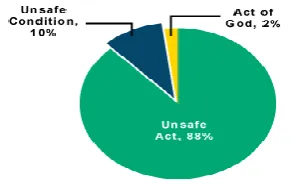
Fig -1: Reasons for accidents
According to Heinrich on the foundation of 75,000 of industrial accidents that 88% of accidents were caused by human unsafe behaviour, 10% accidents were caused by unsafe psychical environment and only 2% accidents were
attributed to unresisting factors [1]. Heinrich research results
indicated that 98% accidents could be prevented and controlled within human ability. In nowadays a great deal of
industrial accidents were also caused by human factors [2].
Therefore, it has become an important subject to prevent and control human behaviour on accident prevention. To human unsafe behaviour, the most effective method is Behaviour Based Safety (BBS). BBS is one effective method on accident prevention widely applied by Europe and American countries since1980s, which it can realize the target that safety performance index, such as accident rate and injury rate, change from dragging indicator to leading
indicator [3].Meantime BBS can provide one structural and
quantitative approach for safety management and safety production long term mechanism .BBS principle can be induced that human safety conscience and safety habit is not
innate but could be improved by training [4]. Through
observing and rectifying others behaviour while observed and rectified by others, human safety behaviour and safety conscience could be enhanced. The BBS advocators believe that unsafe behaviour is mainly accident cause and accident could be decreased by correct behaviour. Praising and encouraging the employee’s safety behaviour is better than punishing the employee’s unsafe behaviour. Behaviour could be measured and improved by some methods such as observation, analysis and feedback. The best person selected defining unsafe behaviour is the employee itself and the employee’s participation and communication can improve
[image:1.595.366.515.234.326.2]© 2017, IRJET | Impact Factor value: 6.171 | ISO 9001:2008 Certified Journal
| Page 272
Behavioural change is not brought about by changing the person, but by changing their perception of accidents of accidents and thus changing the environment in which they work. It involves observing behaviour “at risk” or unsafe activities, followed by directing or modifying behaviour to achieve safe operation. Primary technique in BBS include peer observation and feedback, training and education sessions, behaviour based incentives, prompts and goal setting. Behaviour modifications gives quicker impact, especially with specific, observable problems. The overall goal of this movement is to lower safety incidents and workplace injuries. BBS system educate employees for the root causes of their accident prone behaviour. It teaches them to realise trends of behaviour that cause them to succumb to hazards. It transfers the control of the incident into the hands of the employee. The employee themselves becomes proactive towards his own safety and less of a victim of the circumstances of his surroundings. The effectiveness of BBS study depends on effective evaluation and implementation. The steps for implementation are discussed below.
2. AIM AND OBJECTIVES
2.1 Aim
Assessing the effectiveness of Behaviour Based Safety (BBS) intervention in shipyard and to provide a decision support system which will assists shipyards in implementing BBS.
2.2 Objectives
To identify the critical behaviours or “at risk”
behaviours leading to accidents.
To evaluate the stimulus leading critical behaviours.
To provide feedback to workers individually and
publically.
To measure step by step improvement in workers
during the study.
3. RESEARCH METHODOLOGY
3.1 Formation of design team and participants
A design team is usually composed of workers, supervisors, managers and safety personnel. This study is conducted by 1 student with supervision from project guide and HSE engineers in the shipyard and with the help of 3 safety trainees in the shipyard.
Participants were 15 workers from day shift. 10 of them are grinding workers and remaining 5 are forklift operators. Participants are selected on looking at incident trends to determine which processes carry the greatest risk for incidents .For this, past 2 years HSE violations and injury data
are evaluated. Job wise injury statistics for the year 2016 and 2017 are given below.
Table -1: Injury statistics in the year 2016
No. of injuries Operations
4 Welding
5 Cutting
8 Material handling (Fork lift)
3 Material handling (Crane)
7 Grinding
4 Blasting
1 Painting
5 Fitting
2 Pipe pickling
Table -2: Injury statistics in the year 2017-till Aug 2017
No. of injuries Operations
2 Welding
2 Cutting
6 Material handling (Fork lift)
4 Material handling (Crane)
6 Grinding
4 Blasting
1 Painting
3 Fitting
1 Pipe pickling
Above statistics shows that most injuries were occurring in material handling using forklift and grinding operations. Hence those operations were taken for the study.
3.2 Identification of critical or “at risk” behaviours
Critical behaviours are those that put workers at risk for injuries and other losses. A small number of unsafe behaviours are generally responsible for the large share of accidents or incidents.
Following steps are followed to identify the critical behaviours:
Looking at incident reports to determine the causes
of incidents.
Conducting hazard evaluation of the facility to
determine the areas that have the greatest risk for an incident.
Interviewing workers.
Discussions and brainstorming sessions with HSE
professionals on the site.
© 2017, IRJET | Impact Factor value: 6.171 | ISO 9001:2008 Certified Journal
| Page 273
that independent observers evaluating the same employee will get the same results. For example, one of the items on the checklist is personal protective equipment (PPE). Be specific about what PPE is required. Don’t leave it up to the observer to decide.
a) PPE – Determine what personal protective equipment is required to perform the task. Be specific so that the person conducting the observation knows exactly what to look for.
b) Housekeeping – The observer will evaluate the work area and document its condition.
c) Using Tools and Equipment – The observer needs to know the appropriate tools and equipment that are to be used while performing this task. They should also understand how the tools are to be used safely.
d) Body Positioning/Protection – The observer will determine if the employee is performing the task in a manner that will protect him from strains, falling objects, exposure to a sudden release of chemicals, etc.
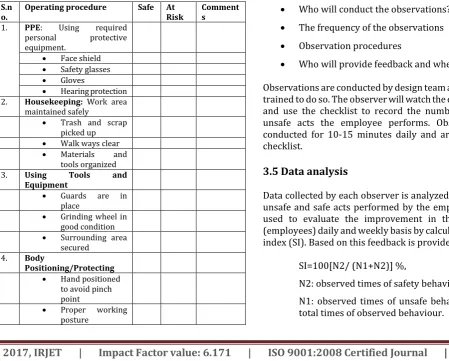
3.3 Developing Behaviour Observation Checklist
[image:3.595.308.566.102.332.2]Based on the critical behaviours, checklists are formed.
Table -3: Safety Behaviour Checklist for grinding operation
S.n
o. Operating procedure Safe At Risk Comments 1. PPE: Using required
personal protective equipment.
Face shield Safety glasses Gloves
Hearing protection 2. Housekeeping: Work area
maintained safely
Trash and scrap picked up Walk ways clear Materials and
tools organized 3. Using Tools and
Equipment
Guards are in place
Grinding wheel in good condition Surrounding area
secured 4. Body
Positioning/Protecting Hand positioned
to avoid pinch point
[image:3.595.45.495.434.795.2] Proper working posture
Table -4: Safety Behaviour Checklist for forklift operators
3.4 Developing observation procedure
Observation and feedback are the most important components of the BBS process. Observation provides the data that makes this process uniquely effective.
Following steps are followed after forming the checklist:
Who will conduct the observations?
The frequency of the observations
Observation procedures
Who will provide feedback and when
Observations are conducted by design team and supervisors trained to do so. The observer will watch the employee work, and use the checklist to record the number of safe and unsafe acts the employee performs. Observations are conducted for 10-15 minutes daily and are noted in the checklist.
3.5 Data analysis
Data collected by each observer is analyzed for finding the unsafe and safe acts performed by the employees. This is used to evaluate the improvement in the participants (employees) daily and weekly basis by calculating the safety index (SI). Based on this feedback is provided.
SI=100[N2/ (N1+N2)] %,
N2: observed times of safety behaviour;
N1: observed times of unsafe behaviour; N1+N2: total times of observed behaviour.
S.no
. Critical behaviours Safe At Risk Comments
1. Operator’s driver’s license
displayed above the waist
2. Forks 6” or less from
ground when traveling
3. Seat belts worn during
forklift operation
4. Sets parking brake, puts
forks to floor, puts gear in neutral, and shuts off when leaving forklift unattended
5. Wears authorized PPE
during operation
6. Removes freight from side
of forks
7. Forklift compartment kept
clean
8. Carrying passengers while
© 2017, IRJET | Impact Factor value: 6.171 | ISO 9001:2008 Certified Journal
| Page 274
3.6 Developing feedback procedure
Frequent feedback is essential in maintaining any safe behaviour. Provide positive feedback for safe behaviours and non-threatening, instructive feedback on how to correct unsafe behaviours.
Following steps are considered before giving feedback:
Who will provide feedback?
How often feedback be given?
How feedback is given?
Feedback is provided on daily basis and weekly basis. Daily feedbacks are provided verbally to each participants individually mentioning the safe and unsafe behaviours they performed. Feedbacks are also displayed publically in notice boards on weekly basis showing the change in safety index of the entire group (Participants), which shows change in behaviour among the group. Daily feedbacks are provided by the observer itself after the work. Stimulus leading to unsafe behaviours are identified and training sessions are provided to the group in every week to correct the unsafe behaviours they performed.
3.7 Measuring success
Success of the study is measured by calculating the Safety Index on weekly basis for the group .A baseline of 70% is set which is used to evaluate the improvement. Participants performing tasks with higher percentage of safe behaviour or Safety Index than the baseline shows the improvement in the group. Change in the Safety Index during the 8 week study time shows the effectiveness of the BBS among the workers.
4. RESULTS
After 8 week study in the shipyard, following results were obtained.
Graph -1: Change in safety behaviour among grinding workers during study
Graph -2: Change in Safety Index among grinding workers
Safety index was calculated by using formula,
SI=100[N2/ (N1+N2)] %,
N2: observed times of safety behaviour;
N1: observed times of unsafe behaviour; N1+N2: total times of observed behaviour.
For every week, the total number of safe behaviours and safe behaviours are calculated by adding the safe behaviour and unsafe behaviour of individual participants. This is later used to find the safety index of the group in each week.
Graph -2 shows the chart of change in safety index during the 8 week of study. At the beginning of the BBS study, safety index was 42.74% that is 43% safe behaviour and 57% unsafe behaviours are performed by the grinding workers. Later at the end of study, by proper training and feedback process, the safety index was raised to 88.2% (88% safe behaviour and 12% unsafe behaviour).
© 2017, IRJET | Impact Factor value: 6.171 | ISO 9001:2008 Certified Journal
| Page 275
Graph -4: Change in Safety Index among forklift operatorsGraph -4 shows change in safety index of forklift operators during the time period of 8 weeks. Initially at the beginning of study, safety index was 48.86 that is 49% safe behaviour and 51% unsafe behaviour is showed by the forklift operators. At the end of the study, safety index is improved to 89% (89% safe behaviour and 11% unsafe behaviour).
5. CONCLUSION
Behaviour Based Safety (BBS) study has shown a great improvement in the safe behaviour of the participants. At beginning of study the participant group (Grinding workers-10) showed 57% “at risk” or unsafe behaviours and the safety Index was 43%. After the BBS approach, in the time period of 8 weeks the Safety Index increased to 88% and the unsafe behaviours are reduced to 12%. Likewise for the forklift operators, initially the participants showed 51% unsafe behaviour and Safety Index was 49%. Later at the end, safety index improved to 89% with 11% unsafe behaviour. The result showed that the group participated in this study has shown improvement of at least two times the safety based behaviour. The study mainly targeted the stimulus leading the unsafe behaviour in the participants. Based on it, effective training sessions are provided by the safety engineers in the shipyard which made the BBS approach success.
REFERENCES
[1] Heinrich H,1941. Industrial Accident Prevention, 2nd
edition, New York: McGraw-Hill.M.
[2] Eeik H 1998, Cognitive Reliability and Error Analysis
Method, Printed by the Alden Group, Oxford,p.132-136.
[3] Fu gui,2005. The Accident Common Cause and
Prevention Strategy Based on Behavior, Journal of Safety and Environment 5(1),p. 80-83.
[4] Cooper, MD,1993. Goal-Setting for Safety, The Safety &
Health Practitioner 11,p.32-37.
[5] E. Scott Geller,2001. The Psychology of Safety Handbook,
2nd ed. Florida: CRC Press LLC.M.
[6] Malgorzata Jasiulewicz-Kaczmarek, Katarzyna
Szwedzka, Marek Szczuka, Behaviour Based Intervention for Occupational Safety – Case Study, In Procedia Manufacturing, Volume 3, 2015, Pages 4876-4883, ISSN 2351-9789.
[7] Dawei Chen, Hanzhi Tian, Behavior Based Safety for
Accidents Prevention and Positive Study in China Construction Project, In Procedia Engineering, Volume 43, 2012, Pages 528-534, ISSN 1877-7058.
[8] Joshua H Williams, E.Scott Geller, Behavior-Based
Intervention for Occupational Safety: Critical Impact of Social Comparison Feedback, In Journal of Safety Research, Volume 31, Issue 3, 2000, Pages 135-142, ISSN 0022-4375.
[9] B.Sekara, Dr. Nehal Anwar Siddiquib, A Study On
Behavior Based Safety In Refinery, In Journal of Int J OHSFE-Allied Sci./Vol. 6/Issue 1/Oct-Dec,2015/007-013.
[10] Oostakhan M, Mofidi A, Davudian Talab A.